
Short answer: an architect needs a bag that carries rigid A3, A2 or A1 drawings without creasing them, plus a laptop, a scale rule and site kit — and almost no retail bag is built for that constraint. The practical solution is a tall rigid portfolio tote sized to the sheet format the practice actually uses, paired with a hard-shell drawing tube for rolled sets. For architecture firms ordering branded bags, that means a custom OEM programme rather than an off-the-shelf purchase: minimum order 200 pieces, sampling in 6–10 days, bulk production in 35–50 days, and pre-shipment inspection to AQL 2.5.
This guide covers the bag types architects actually use, the sheet-format dimensions that drive every other decision, the materials that survive a construction site, drawing-tube specifications most buyers get wrong, realistic cost bands, and the five checks that separate a real factory from a reseller. It is written for practice managers, marketing leads and procurement teams sourcing branded bags for an architecture firm, and for brands building an architect-focused product line.
What bags do architects and architecture firms actually need?
Architects do not buy “a bag”. They buy a way to move a set of drawings, a laptop and site equipment between studio, client meeting and construction site without damaging any of it. Five formats cover almost every real use case, and each one has a different structural requirement.
| Bag format | Primary use | What makes or breaks it | Typical internal size |
|---|---|---|---|
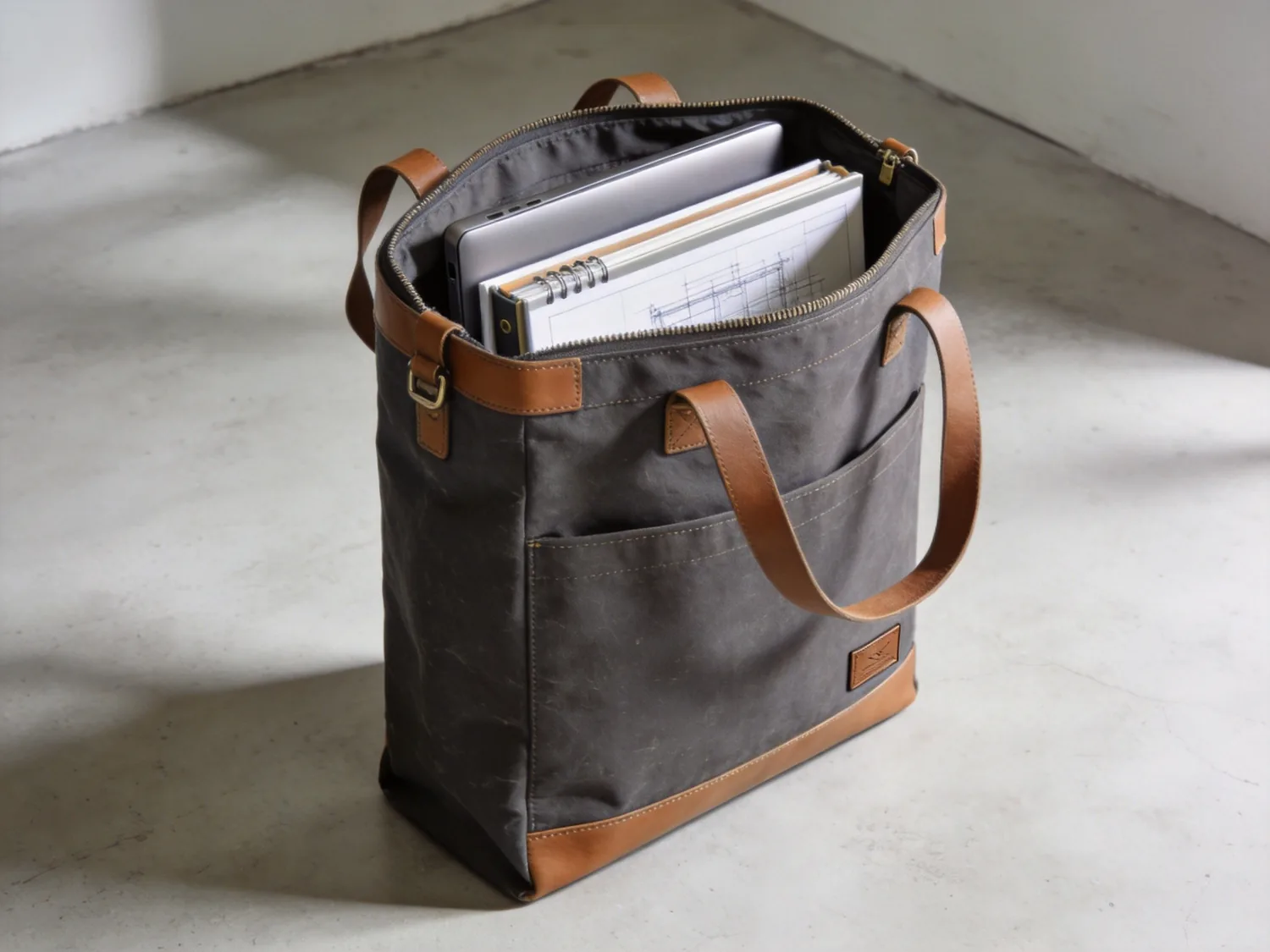
| Tall portfolio tote | Daily studio-to-meeting carry, A3 binders, laptop | Rigid base and a full-height gusset so A3 sheets stay flat; opening must clear the sheet width | 40–46 cm H × 32–36 cm W × 10–13 cm D |
| Hard-shell drawing tube | Rolled A3/A2/A1 sets, site visits, transport | Wall thickness and cap seal; a thin tube ovalises and creases the roll | Inner ø 7.5–9 cm (A3/A2), 9–11 cm (A1) |
| Slim laptop briefcase | Client presentations, boardroom, travel | Suspended laptop sleeve plus a flat document pocket that takes A4 without folding | 38–42 cm × 28–30 cm × 6–8 cm |
| Drafting-board carrier | Portable drawing boards, 60–80 cm formats | Rigid flat panel and corner reinforcement; the board must not flex | Sized to board, typically 65–82 cm long |
| Site / equipment backpack | Construction site, model transport, tools | Abrasion resistance, weather sealing and load stability, not styling | 25–35 L with padded device sleeve |
Table 1 — The five bag formats that cover real architecture practice use cases.
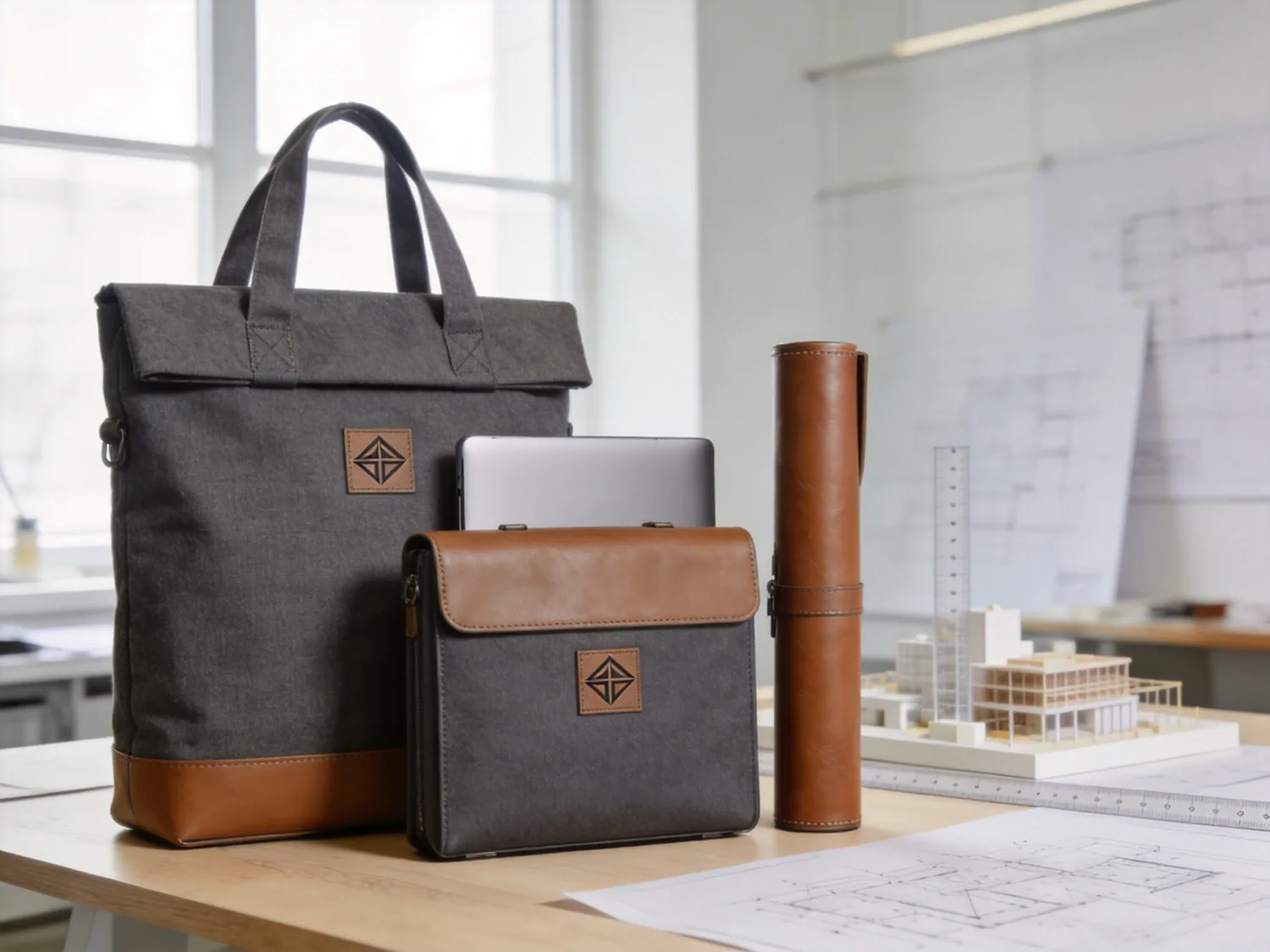
The most common sourcing mistake is ordering one bag to do all five jobs. A portfolio tote cannot protect a rolled A1 set, and a drawing tube cannot carry a laptop safely. Firms that standardise usually order a two-piece set — a portfolio tote for daily use plus a drawing tube for transport — which is also the combination that reads best as a branded gift.
A3, A2 or A1? Match the bag to the drawing format first
Every dimension in an architect bag descends from one number: the sheet format the practice prints at. A-series sizes are defined by ISO 216, and each size halves the previous one, so a bag that fits A2 will fit A3 but not the reverse. Confirm the working format before sampling — this single answer decides the pattern, the material consumption and the freight volume.
| Sheet format | Sheet size (mm) | Minimum internal bag dimension | Rolled tube inner diameter | Who typically uses it |
|---|---|---|---|---|
| A4 | 297 × 210 | 30 × 22 cm flat pocket | ø 5–6 cm | Site documents, specifications, meeting notes |
| A3 | 420 × 297 | 44 × 32 cm | ø 7.5–8.5 cm | Most practices — the default presentation and drawing size |
| A2 | 594 × 420 | 62 × 45 cm | ø 9–10 cm | Design development sets, competition boards |
| A1 | 841 × 594 | 87 × 63 cm | ø 10–11 cm | Competition entries, large-format presentation |
| A0 | 1189 × 841 | Not practical as a carry bag | ø 12–14 cm (transport only) | Plotter output, shipped flat or rolled in rigid cases |
Table 2 — Sheet format drives bag dimension. Add 2–3 cm clearance to every internal measurement.
Two field-tested details matter more than the table. First, a rigid A3 binder measures roughly 45 × 33 cm externally once the spine is included — sizing a bag at exactly 44 × 32 cm produces a bag that will not close. Second, the gusset must be at least 10 cm; below that, a loaded A3 binder tilts and the corners take all the wear. If a practice works across two formats, specify the larger one: an A2-capable tote with an internal divider handles A3 cleanly, while the reverse is impossible.
Which materials survive a construction site?
An architect bag lives a harder life than a commuter bag. It gets set down on concrete, dragged through scaffold access, rained on between the car and the site hut, and loaded with sharp-edged boards and metal scale rules. Material selection is therefore the single biggest driver of whether a programme produces a bag that lasts three years or three months.
| Material | Abrasion resistance | Water resistance | Weight | Relative cost | Best for |
|---|---|---|---|---|---|
| 1680D ballistic nylon | Excellent | Good (PU backer) | Medium | $$ | Site bags, high-wear daily totes |
| 600D–1000D Cordura nylon | Very good | Good, better with DWR | Medium–low | $–$$ | Volume programmes, backpacks, tube sleeves |
| Waxed canvas 18–20 oz | Good | Fair — re-waxable | High | $$ | Heritage-look totes, brand-led gifting |
| Full-grain leather 1.4–1.8 mm | Good | Fair without treatment | High | $$$$ | Executive briefcases, drawing tubes, premium gifts |
| Recycled PET 600D (rPET) | Good | Good with coating | Medium–low | $–$$ | Firms with published sustainability targets |
| PU-coated polyester 300D | Fair | Good | Low | $ | Budget internal pouches, linings |
Table 3 — Material trade-offs for architect bags. Fabric weights follow standard Cordura denier classifications.
For a working site bag, 1680D ballistic nylon with a PU backer and bar-tacked stress points is the default recommendation: it resists abrasion from concrete and scaffold far better than canvas, and it does not need re-waxing. For a client-facing gift, waxed canvas or full-grain leather reads more considered and photographs better in a firm’s own marketing. Many practices order both — a durable working bag and a smaller leather piece for client handover.
Two specification details are routinely skipped and both cause early failure. Specify bar-tacking at every handle and strap junction, not single stitching; and specify a reinforced base panel with a separate abrasion layer. On a bag that is set down on site surfaces several times a day, the base is the first component to fail, and a base patch costs a fraction of a replacement programme.
Drawing tubes: the specification most buyers get wrong
Drawing tubes look simple, which is exactly why they go wrong. A tube that is 0.6 mm too thin in the wall will ovalise under a loaded bag in transit and crease every sheet inside. Five parameters decide whether a tube actually protects drawings.
- Wall thickness. Below 1.2 mm the tube deforms under load. For A2 and A1 formats, specify 1.5–2.0 mm rigid wall or a reinforced core.
- Inner diameter. Match the rolled set, not the sheet format alone: a 20-sheet A1 roll needs roughly ø 90–100 mm, while a 5-sheet A3 roll needs ø 75 mm.
- Cap mechanism. Screw-lock is the most secure and the most expensive; magnetic is the fastest for daily use; snap-fit is cheapest but loosens with repeated cycles. For firm-branded gifts, screw-lock with a debossed logo cap is the standard choice.
- End reinforcement. Both ends need a rigid ring. Unreinforced tube mouths crack within a season of site use.
- Carry method. A fixed shoulder strap is fine for A3; for A1 specify a detachable adjustable strap plus a handle, because a loaded A1 tube is too long to carry on one shoulder comfortably.
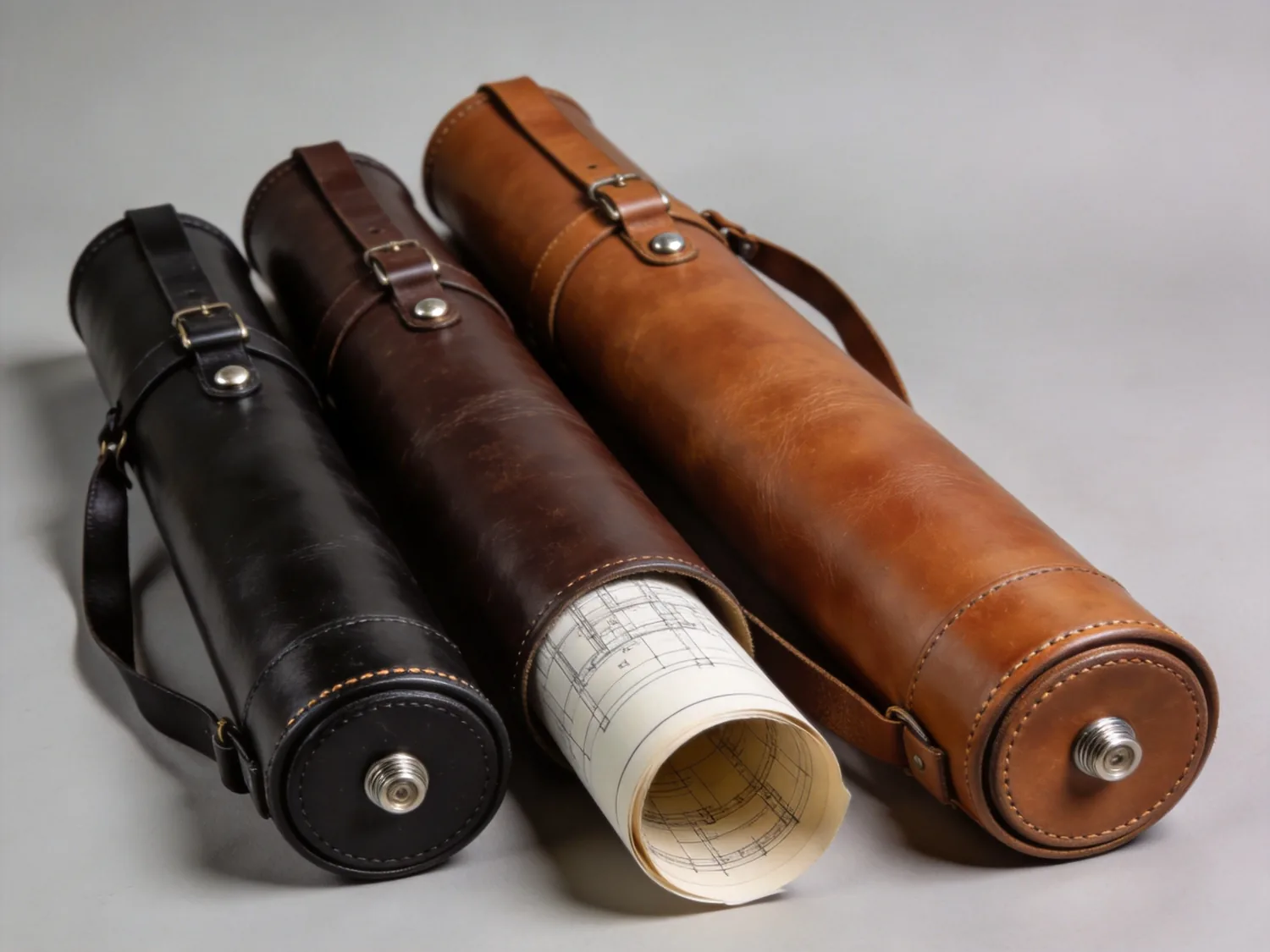
A drawing tube is also the single most giftable item in the category. It has a clear purpose, it carries a logo well on a flat cap surface, it is easy to ship, and it survives years of use — which means a firm’s branding stays in clients’ hands far longer than on a tote. Practices ordering graduation gifts, competition-entry kits or client handover sets consistently find the tube converts better than a second bag.
How much does a custom architect bag programme cost?
Cost in this category is driven by material grade and hardware count far more than by order volume. The bands below reflect typical OEM quotations for a 200–1,000 piece programme with custom branding; they are indicative ranges for planning, not a quotation for any specific design.
| Item | Typical range (USD, FOB) | What moves it |
|---|---|---|
| Sampling fee, portfolio tote | 60–150 per style | Pattern complexity, hardware count; normally refunded against the first bulk order |
| Sampling fee, drawing tube | 80–180 per style | Tube diameter, cap mechanism, leather vs. coated shell |
| Portfolio tote, 600D–1680D nylon | 9–22 per piece | Fabric denier, zip grade, number of internal pockets |
| Portfolio tote, waxed canvas | 14–28 per piece | Canvas weight, leather trim area, lining |
| Drawing tube, coated shell | 7–16 per piece | Diameter, wall thickness, cap type |
| Drawing tube, full-grain leather | 24–55 per piece | Leather grade, cap hardware, strap |
| Custom branding (deboss, print, woven label) | 0.20–1.50 per piece | Method and number of logo positions |
| Custom packaging (printed box, dust bag) | 0.80–3.50 per piece | Board grade, print colours, inserts |
Table 4 — Indicative OEM cost bands for architect bag programmes. Freight, duties and local taxes excluded.
Three levers reduce landed cost without cheapening the product. Consolidating the logo to one position instead of three typically saves more than switching fabric. Standardising a shared lining and zip across the whole set lowers per-unit cost because components are bought in one volume. And planning a single production run across the full set — tote, briefcase and tube together — usually beats splitting the order across quarters. For a deeper breakdown of where money actually goes, see our bag manufacturing cost structure guide and how to negotiate pricing with a custom bag supplier.
How to choose an architect bag manufacturer: five checks
Most suppliers who claim architect-bag capability are trading companies reselling generic totes. Five checks separate a real manufacturing partner from a reseller, and all five can be completed before you place an order.
- Ask for the pattern, not a photo. A factory will send a dimensioned pattern or tech pack for your format. A reseller sends catalogue images and asks you to pick a colour.
- Test the A3 clearance claim. Request a sample loaded with a real 45 × 33 cm binder and confirm the bag closes, stands upright and does not tip. This one test eliminates most unsuitable suppliers.
- Confirm who inspects, and to what standard. Pre-shipment inspection to AQL 2.5 under ISO 2859-1 is the working norm for bag export. A supplier who cannot name an inspection standard is not inspecting.
- Ask what happens after delivery. A stated warranty period and a documented defect process matter more than a lower unit price; on a 500-piece programme, a 2% defect rate without recourse costs more than the price difference.
- Verify the export documentation trail. Confirm the entity that issues the invoice, the HS code used and the port of loading. This is where resellers and undisclosed intermediaries surface.
If you are still deciding between manufacturing models, our OEM vs ODM vs private label comparison sets out which model fits which stage of brand development, and the custom leather bag manufacturing guide covers material and construction decisions in more depth.
How JUNYUAN BAGS manufactures architect bags
JUNYUAN BAGS is an OEM/ODM bag manufacturer established in 2014 in Quanzhou, Fujian, China, producing custom golf bags, backpacks, duffels, tool bags and professional carry pieces for brands and corporate buyers. Architect bags — portfolio totes, drawing tubes and slim briefcases — sit within our professional carry line, using the same pattern room, sampling team and inspection process as our core categories.
What a programme looks like in practice:
| Stage | What happens | Typical duration |
|---|---|---|
| Brief and specification | You share the sheet format, target capacity, material preference, logo method and quantity. We confirm feasibility and quote. | 1–3 days |
| Pattern and sampling | Pattern drafted to your format, one physical sample produced for fit, material and hardware validation. | 6–10 days |
| Sample revision | Adjustments to dimension, pocket layout or hardware; one revision round is standard. | 5–7 days |
| Bulk production | Cutting, sewing, hardware setting, logo application and assembly. | 35–50 days |
| Pre-shipment inspection | AQL 2.5 inspection covering dimension, stitching, hardware function, logo position and packing. | 2–3 days |
| Export and documentation | Packing, carton marking and export documentation; FOB or CIF terms. | Per schedule |
Table 5 — Standard OEM programme timeline for a custom architect bag order.
Minimum order quantity is 200 pieces per style. Sampling is charged and refunded against the first bulk order. Every bulk order ships with a 12-month warranty covering stitching, hardware and material defects, and inspection is carried out to AQL 2.5 before packing. We do not publish factory floor area or headcount figures; what we do publish is the process, the timeline and the inspection standard, because those are the parts a buyer can actually hold us to.
Frequently asked questions about custom architect bags
Q1. What is the best bag for architects?
The best bag for an architect is a tall rigid portfolio tote sized to the drawing format the practice works in — typically A3, requiring roughly 44 × 32 cm internal and a gusset of at least 10 cm — paired with a hard-shell drawing tube for rolled sets. Retail bags fail this brief because they are designed around a laptop, not around a rigid 45 × 33 cm binder. For firms ordering in volume, the practical answer is a custom OEM programme at a 200-piece minimum, with 6–10 day sampling and 35–50 day production.
Q2. What size bag do architects need for A3 drawings?
An A3 sheet measures 420 × 297 mm, but the bag must be larger than the sheet. A rigid A3 binder measures about 450 × 330 mm externally once the spine is included, so a usable A3 bag needs at least 44 × 32 cm internal plus 2–3 cm clearance on each dimension. Specify a minimum internal height of 45 cm and a gusset of 10–13 cm. A bag built to exactly 44 × 32 cm will not close over a loaded binder.
Q3. Can I order custom architect bags with my firm’s logo?
Yes. Logo application methods for architect bags include debossing on leather trim, screen print or heat transfer on canvas and nylon, woven labels, rubber or silicone patches, and metal hardware plates. Debossing on a leather patch or a leather cap on a drawing tube gives the most considered result for client-facing gifts, while screen print suits volume programmes on canvas totes. Custom branding typically adds USD 0.20–1.50 per piece depending on method and the number of logo positions.
Q4. What is the minimum order quantity for custom architect bags?
The minimum order quantity for custom architect bags is 200 pieces per style. This applies to portfolio totes, drawing tubes, slim briefcases and drafting-board carriers alike. A programme covering a two-piece set — tote plus tube — is normally quoted as two styles at 200 pieces each, though combined-run pricing is available when both styles are produced in a single production window.
Q5. How long does sampling and production take?
Sampling takes 6–10 days for a first physical sample, plus 5–7 days if a revision round is required. Bulk production runs 35–50 days after sample approval and deposit, depending on quantity, material availability and hardware complexity. Pre-shipment inspection to AQL 2.5 adds 2–3 days. A straightforward single-style order therefore typically moves from brief to shipment in roughly 8–10 weeks.
Q6. What materials are best for architect bags?
For working site bags, 1680D ballistic nylon with a PU backer and bar-tacked stress points offers the best abrasion resistance against concrete and scaffold. For volume programmes, 600D–1000D Cordura nylon balances durability and cost. For client-facing gifts, waxed canvas 18–20 oz or full-grain leather 1.4–1.8 mm reads more considered and photographs better. Recycled PET 600D suits firms with published sustainability targets. Whichever shell you choose, specify a reinforced base panel and bar-tacking at every handle junction.
Q7. What is a drawing tube and which size do I need?
A drawing tube is a rigid cylindrical case for transporting rolled drawings, blueprints and presentation sets without creasing them. Size it to the roll, not just the sheet format: a 5-sheet A3 roll needs roughly ø 75 mm inner diameter, a 20-sheet A1 roll needs ø 90–100 mm. Wall thickness should be at least 1.2 mm, and 1.5–2.0 mm for A2 and A1 formats, otherwise the tube ovalises under load and creases the sheets inside.
Q8. Can you make A2 or A1 drawing tubes?
Yes. Drawing tubes are produced for A3, A2 and A1 formats and for custom dimensions. A2 requires an inner diameter of roughly 90–100 mm and A1 roughly 100–110 mm, both with wall thickness of 1.5–2.0 mm. A1 tubes should be specified with a detachable adjustable shoulder strap plus a handle, because a loaded A1 tube is too long for comfortable single-shoulder carry. A0 is generally shipped flat or in rigid transport cases rather than as a carry tube.
Q9. Are custom architect bags suitable for construction site use?
Yes, if the specification is built for it. Site use demands abrasion-resistant shell fabric such as 1680D ballistic nylon, bar-tacked stress points, a reinforced base panel, weather-resistant zips and a load-stable carry system. A portfolio tote built to these specifications handles concrete surfaces, scaffold access and rain between the car and the site hut. A waxed canvas or leather bag is better reserved for client-facing use, since those materials show site wear quickly.
Q10. What do architecture firms typically order as branded gifts?
Architecture firms most commonly order a matched two-piece set: a portfolio tote or slim briefcase for daily studio use plus a leather drawing tube for client handover and competition kits. The drawing tube converts particularly well as a gift because it has an unambiguous purpose, carries a logo on a flat cap surface, ships cheaply and stays in a client’s hands for years. Firms also order drawing tubes as graduation gifts for architecture schools and as competition-entry presentation kits.
Q11. How much does a custom architect bag programme cost?
For a 200–1,000 piece programme, indicative FOB ranges are USD 9–22 per portfolio tote in 600D–1680D nylon, USD 14–28 in waxed canvas, USD 7–16 per coated-shell drawing tube and USD 24–55 per full-grain leather tube. Custom branding adds USD 0.20–1.50 per piece and custom packaging USD 0.80–3.50. Sampling is USD 60–180 per style and is normally refunded against the first bulk order. Freight, duties and local taxes are excluded.
Q12. Do you provide AQL inspection and quality reports?
Yes. Every bulk order is inspected to AQL 2.5 under the ISO 2859-1 sampling standard before packing, covering dimensions, stitching integrity, hardware function, logo position and packing accuracy. Inspection reports are available with shipment documentation. Third-party inspection by a nominated agency can also be arranged at the buyer’s request, and buyers are welcome to attend inspection or nominate an inspector.
Q13. Can bags be shipped to multiple office locations?
Yes. Multi-destination shipment is standard for architecture firms with several studios. Orders can be split at packing stage with separate carton marking and addresses per location, and shipped either as one consolidated consignment to a single port with onward distribution, or as separate shipments per destination. Splitting affects freight cost and lead time, so the destination plan should be confirmed before production starts rather than after inspection.
Q14. How do I start an OEM order for architect bags?
Send five things: the sheet format you work in (A3, A2 or A1), the bag formats you need, your preferred material or a reference image, your logo artwork and application preference, and your target quantity and delivery date. We reply within roughly 24 hours with a feasibility assessment, sampling cost, MOQ options and a lead-time quotation. Sampling then begins on approval, with a physical sample in 6–10 days.
Related reading
Request a custom architect bag quotation
Send your sheet format, bag types, logo artwork and target quantity. We reply within about 24 hours with sampling cost, MOQ options and lead time. MOQ 500 pcs · sampling 6–10 days · bulk production 35–50 days · AQL 2.5 inspection · 12-month warranty.