
Short answer: a custom wetsuit bag programme at Junyuan Bags runs at MOQ 500 pieces per style, samples in 6–10 working days, bulk in 35–50 days, final inspection at AQL 2.5 major / 4.0 minor. We are a bag manufacturer established in 2014; our founder has worked in the bag trade since 2004. A wetsuit bag is not a waterproof duffel with a wetsuit printed on it. The item inside is neoprene foam — a closed-cell rubber that gains up to 135% of its dry mass in water, tears at smooth-skin surfaces if it rubs a zip coil, and loses 18% of its thickness in twelve months if it is stored above 30 °C under compression. Those three material facts decide the pattern, the lining, the venting and the fold. This page is the procurement document: four neoprene grades and six thicknesses by the square metre, the seam hierarchy from overlock to liquid seam, the standing-load case for the changing mat, the mould clock, four volumes, the USD 20.11 FOB bill of materials on our 70 L reference build, and the carton maths. If your customer is carrying dive kit rather than a wetsuit, our custom dry bag line is the right page instead.
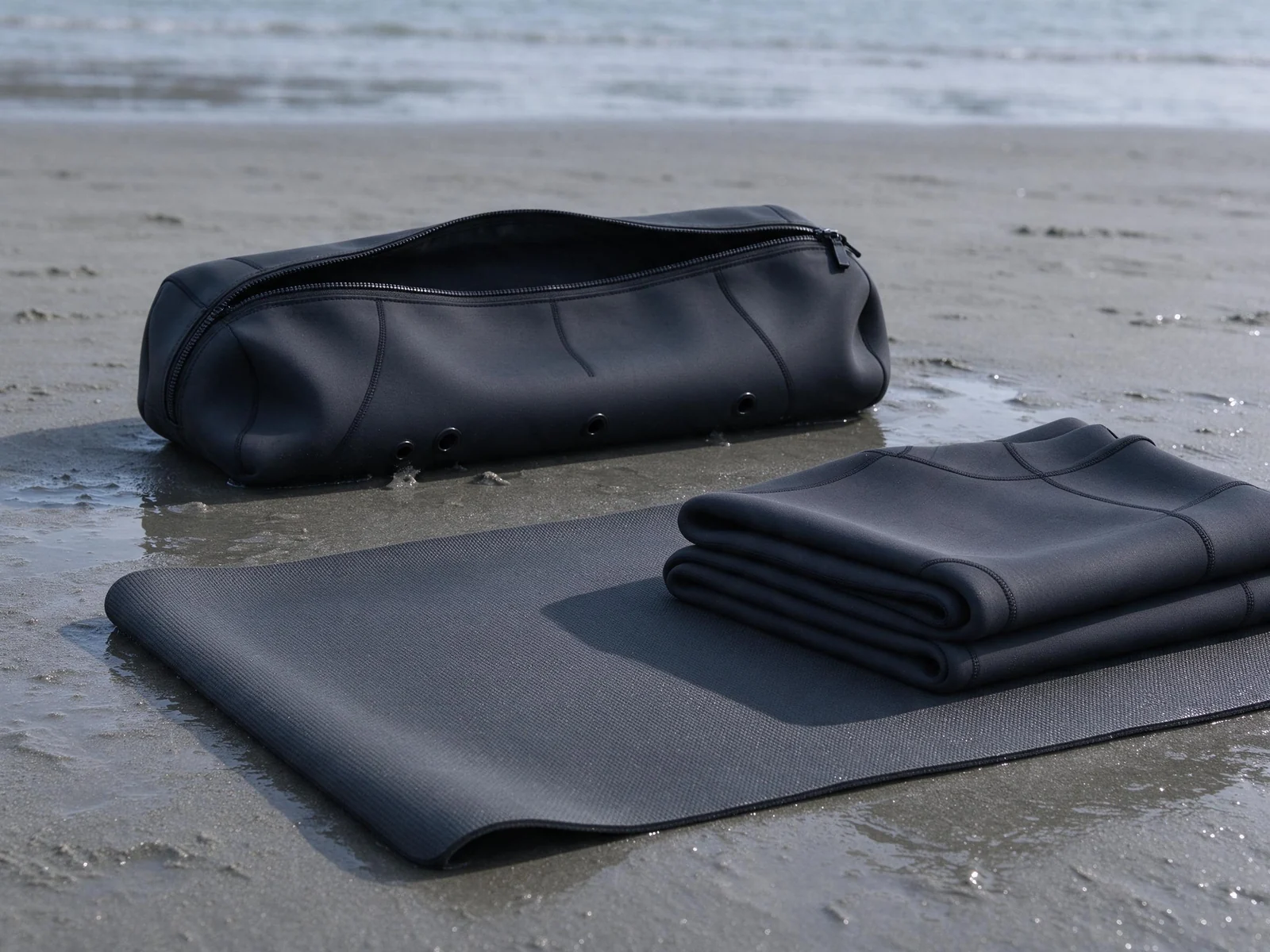
The 70 L travel build, opened flat. The 5 mm neoprene mat unfolds to 100 × 70 cm and becomes the standing surface; the welded 0.55 mm TPU wet cell sits behind it, and the drain grommets are at the lowest point of the base when the bag is stood on its end.
Where the money actually goes. Take our standard 70 L wetsuit bag — 600D polyester with a PU 1,500 mm back-coating, 1680D plus 0.5 mm TPU on the base, a 5 mm SCR neoprene mat at 100 × 70 cm, a welded 0.55 mm TPU wet cell, a #10 main zip, a #8 wet zip and a #5 mesh zip — at USD 20.11 FOB on 500 pieces. Fabric is only 16.4% of that. The neoprene sheet is 20.9%, which is more than the shell, more than the zips, and second only to labour. Labour is 17% at 31 minutes against 19 minutes for the same volume in a plain duffel — a 63% increase that no photograph shows. Buyers who benchmark this bag against a dry duffel of the same size are always surprised by the quotation, and the surprise is entirely the mat. A 5 mm SCR sheet at 0.70 m² weighs 595 g and costs about USD 4.20 landed in the factory before it is cut, edged or bound. If a quotation for a 70 L wetsuit bag with a full-size mat lands under USD 15, the mat has been downgraded to 2 mm, switched to SBR, or replaced with an EVA look-alike that will flatten in one season.
What “Wetsuit Bag” Means — and the Seven Products Sold Under That Name
Search the phrase on any B2B marketplace and you will be shown seven structurally different products, from a USD 0.59 polyethylene nappy sack to a welded 40 L dry duffel. They do not share a pattern, a material or a buyer. If you brief a factory on the wrong one you will pay for a mat you do not need, or you will ship a bag that cannot hold a wet 7 mm semi-dry. The table below is the one we use in our own quotation meetings.
| Product | Structure | What it holds | Where it fails | Buy it when |
|---|---|---|---|---|
| Wetsuit bag with changing mat (this page) | Soft body, 4–6 mm neoprene mat that unfolds as a standing surface, welded wet cell, drain grommets, mesh vent | Wetsuit, boots, gloves, hood, towel, changing mat | Mat fold line cracking; wet cell seam wicking; drain blocked by sand | Your customer changes outdoors — beach, car park, slipway, poolside |
| Wetsuit changing mat only | Single neoprene sheet with bound edge, 90–120 cm, no bag | A standing surface | Edge binding pulls off; sheet creases | Sold as an accessory, often bundled with the bag |
| Wet / dry separation backpack | Two-compartment pack, one TPU-lined wet side, mesh outer pocket | Wetsuit plus clothing, phone, keys | Wet side zip leak; lining delamination | Commuting swimmers, triathletes travelling light |
| Dry bag / dry duffel | Welded TPU or PVC, roll-top, fully submersible | Anything that must stay dry | Not designed to hold a wet suit: traps moisture, grows mould | The load is dry — see our dry bag page |
| Surfboard bag / day runner | Long padded sleeve for a board, side pocket for wax and fins | A surfboard | Nothing relevant to a wetsuit | The board is the primary load |
| Mesh dive bag | Open mesh duffel, drawstring or zip, no lining | Mask, fins, snorkel; anything already drained | Nothing to fail — it also protects nothing | Boat diving where everything hangs to dry — see mesh dive bags |
| Nappy sack / swim pouch | 0.06–0.10 mm PE or EVA film, 2–5 L, MOQ 10–50 | One wet swimsuit, one nappy | Everything — single trip item | Never, if you are sourcing B2B OEM at 500 pieces |
The last row is not a joke and it is worth understanding why it appears. On Alibaba, the phrase “wet suit bag” is dominated by polyethylene pouches at USD 0.59–3.10 with MOQ of 10–50 pieces, because the same English phrase serves a mother buying a swim-nappy sack and a surf shop buying a retail fixture. The buyer intent is completely different: one wants a disposable film bag, the other wants a fixture that survives a hundred beach changes and carries a brand logo. If you are sourcing at 500 pieces with a logo and a mat, you are in the second category, and you should not benchmark your quotation against the first.
The distinction that catches most first-time buyers is between this bag and a dry bag. A dry bag is built to keep water out; a wetsuit bag is built to let a wet suit breathe while keeping the water away from the car. Those are opposite requirements. A welded 0.55 mm TPU dry bag is the correct material for a wet cell and the wrong material for the whole bag: put a dripping 5/4 mm suit inside a sealed 70 L dry bag and you have built a humidity chamber at 99% relative humidity, which is the ideal incubation condition for mildew and for the neoprene’s own degradation. Our dry bag line is fully submersible and 2,254 words of engineering; it is the wrong product for this job, and we will tell you so.
Neoprene Is Not One Material — Four Grades, Six Thicknesses
Before the pattern, the sheet. “Neoprene” in a quotation can mean four chemically different foams with a 33% spread in density, and the density is what you pay for and what your customer feels. The table below is the mass of one square metre at each thickness, computed from the grade density, because that is how sheet is actually bought — by area and thickness, priced by mass.
| Neoprene grade | Density g/cm³ | 1.5 mm | 2.0 mm | 3.0 mm | 4.0 mm | 5.0 mm | 7.0 mm |
|---|---|---|---|---|---|---|---|
| SBR (styrene-butadiene) | 0.15 | 225 g | 300 g | 450 g | 600 g | 750 g | 1050 g |
| SCR (blended chloroprene) | 0.17 | 255 g | 340 g | 510 g | 680 g | 850 g | 1190 g |
| CR (polychloroprene) | 0.19 | 285 g | 380 g | 570 g | 760 g | 950 g | 1330 g |
| Limestone-free CR | 0.2 | 300 g | 400 g | 600 g | 800 g | 1000 g | 1400 g |
Read the table by column, not by row. A 5 mm mat in SBR weighs 750 g/m²; the same 5 mm in limestone-free CR weighs 1,000 g/m² — a 33% difference in material for the same nominal thickness. The customer cannot see the difference on a spec sheet, but they will feel it in month three: SBR is a styrene-butadiene foam with no chloroprene content, it is cheaper, it compresses faster and it takes a permanent set sooner. For a changing mat that a 90 kg adult stands on twice a day, SBR is the wrong choice, and it is what most low quotations use.
What each grade actually is
- SBR (styrene-butadiene rubber) — no chloroprene. Cheapest, density around 0.15 g/cm³. Used in promotional mats, entry-level swim pouches, and anywhere the buyer is comparing on price alone. Poor UV and ozone resistance; compresses permanently under a standing load.
- SCR (blended chloroprene) — the volume grade for this category, around 0.17 g/cm³. A chloroprene blend with enough CR content to hold a standing load and resist salt water, at a price that still works at 500 pieces. This is what we specify on the reference build.
- CR (polychloroprene) — true chloroprene, around 0.19 g/cm³. Better ozone and UV resistance, tighter cell structure, used where the mat is a permanent fixture (dive schools, rental fleets) rather than a consumer accessory.
- Limestone-free CR — around 0.20 g/cm³. Standard neoprene is filled with calcium carbonate to add weight and reduce cost; limestone-free sheet removes the filler, which improves flex fatigue and reduces the chalky residue that stains a car boot. It is the grade specified when the buyer’s brand is positioned at the top of the market.
One number that buyers never ask for and always should: density tolerance. Sheet is sold by thickness and area, but the factory pays by mass, so a supplier who delivers 0.15 g/cm³ sheet against a 0.17 specification has saved 12% of the material cost and given you a mat that flattens. Our incoming inspection checks density at ±5% and thickness at ±0.2 mm at five points on every lot, because both are invisible in the finished bag and both are where the margin is made.
Why 5 mm is the dividing line for a mat, and 4 mm is the dividing line for a bag
The mat and the bag wall want opposite things. The mat has to hold a standing human, so it wants thickness and density. The bag wall has to fold flat and stay light, so it wants thin sheet or none at all. Our rule:
- 4 mm for a compact or triathlon mat at 90 × 60 cm. The suit is 1.5–3 mm smooth skin and the diver is changing on grass or poolside, not on gravel. A 4 mm mat weighs 367 g and still gives enough separation from cold ground.
- 5 mm for the reference 100 × 70 cm mat. This is the volume specification: 595 g of SCR, enough to protect against stone, shell and ice-melt, and still foldable into a 70 L bag without exceeding the 30% compression limit.
- 6 mm for fleet and school mats at 120 × 90 cm, where the mat is used by dozens of people a week and the failure mode is not comfort but permanent set. 1,102 g of SCR.
- 7 mm and above is a wetsuit specification, not a mat specification. A 7 mm mat weighs 1,190 g/m², will not fold into a bag without a compression set, and belongs on a floor as a fixed mat.
| Mat size | Dimensions | Thickness | Area | Neoprene mass |
|---|---|---|---|---|
| Compact / triathlon | 90 × 60 cm | 4.0 mm | 0.54 m² | 367 g |
| Surf day | 100 × 70 cm | 5.0 mm | 0.7 m² | 595 g |
| Family / school | 110 × 80 cm | 5.0 mm | 0.88 m² | 748 g |
| Fleet / club | 120 × 90 cm | 6.0 mm | 1.08 m² | 1102 g |
The Changing Mat Carries a Standing Human — Run the Numbers Before You Choose the Foam
This is the calculation that separates a mat from a sheet of foam with a logo on it. A person changing out of a wetsuit does not distribute their weight evenly. They stand on one foot to get the second leg out, and that one foot carries roughly 1.2× body mass during the transfer. Contact area for a bare foot or a 5 mm neoprene boot is about 90 cm². The resulting contact pressure is not small:
| Diver mass | One-foot load (1.2×) | Contact pressure | Compression at 90 cm² patch | Mat thickness left | Needs backing board |
|---|---|---|---|---|---|
| 60 | 72.0 | 78.5 | 49.2% | 2.54 mm | Yes |
| 75 | 90.0 | 98.1 | 57.2% | 2.14 mm | Yes |
| 90 | 108.0 | 117.7 | 62.4% | 1.88 mm | Yes |
| 105 | 126.0 | 137.3 | 67.3% | 1.64 mm | Yes |
Every row ends in “needs backing board”, and that is the honest answer. At 75 kg, one-foot pressure is 98.1 kPa, and on the compressive curve of a 5 mm soft SCR sheet that corresponds to roughly 57% strain — the mat goes from 5 mm to 2.14 mm under the foot. Neoprene alone cannot carry a standing adult; it is a comfort and insulation layer, not a structural one. This is why every mat we build above 4 mm is laminated to a 1680D polyester plus 0.5 mm TPU backing panel, and why the fold is designed as a flat two-panel fold rather than a roll: a roll puts the whole standing load through a curve, and a curve is where foam cracks.
| Contact pressure | Compression strain (5 mm SCR) |
|---|---|
| 20 kPa | 15% |
| 40 kPa | 28% |
| 60 kPa | 40% |
| 80 kPa | 50% |
| 100 kPa | 58% |
| 140 kPa | 68% |
The practical consequence for the pattern: the mat must be attached to the bag along one long edge only, with the other three edges bound and free. If the mat is sewn down on two or more edges, the backing panel cannot slide, the foam cannot distribute the load, and the mat behaves as a stiff board that cracks along the stitch line within a season. The single-edge attachment also lets the mat be replaced under warranty without scrapping the bag — a repair that costs us 90 seconds and saves the customer a whole unit.
The one thing to specify in writing. If you take one number from this page into a supplier conversation, take this: the mat must be a minimum 5 mm SCR laminated to a 1680D plus 0.5 mm TPU backing panel, attached along one long edge only, with a flat two-panel fold. Every cheaper alternative — 2 mm sheet, SBR instead of SCR, EVA look-alike, sewn on four edges, rolled instead of folded — fails in the same way and at the same time: the mat flattens under the standing foot within one season, the customer complains that the bag “does not protect”, and the return rate on a 5,000-piece order is 3–6% instead of under 1%. The cost difference between the correct specification and the cheap one is about USD 1.90 per piece at 500 pieces. The return cost is a multiple of that.
Your Customer’s Wetsuit Seam Decides Your Bag Lining
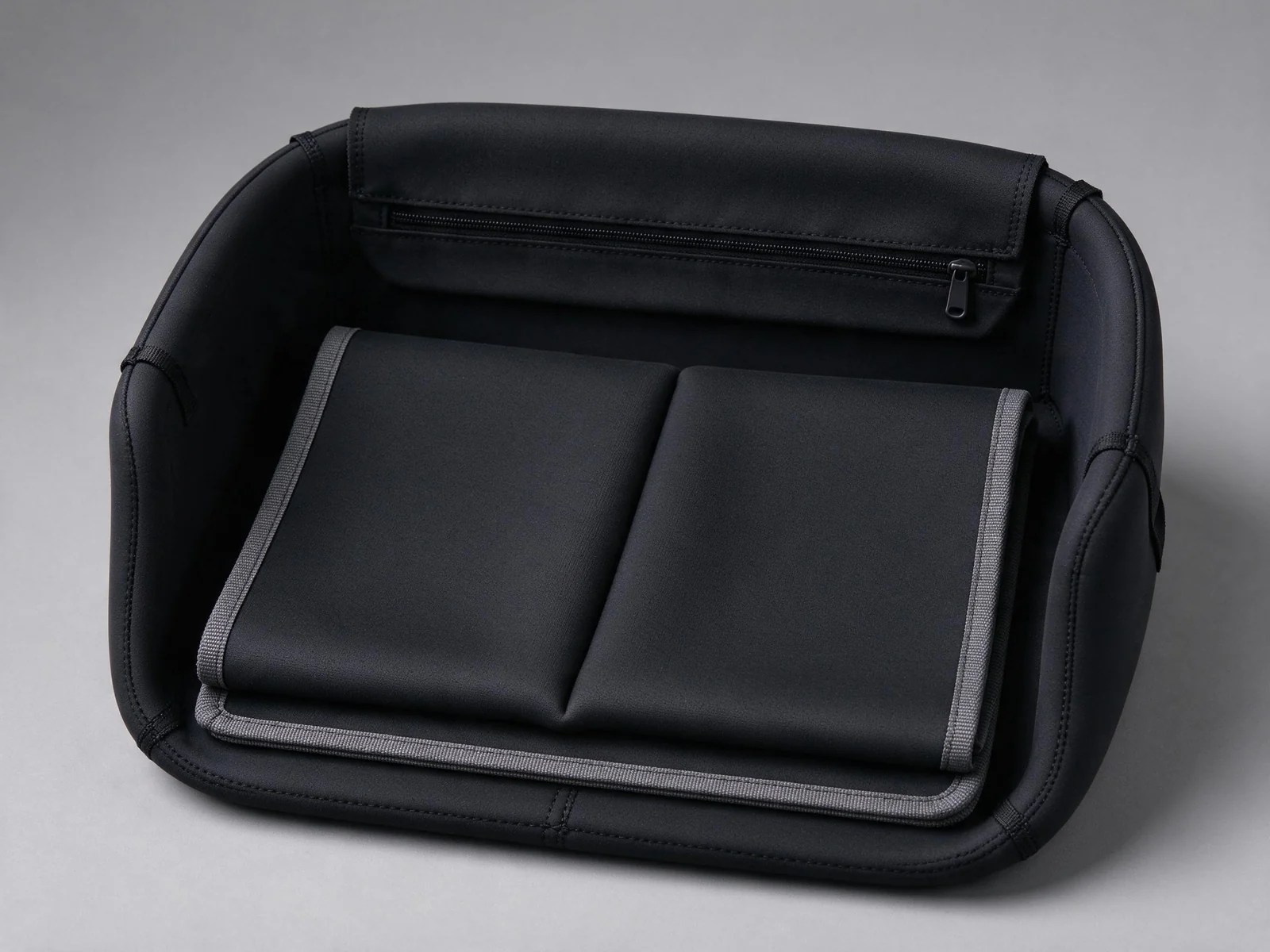
The mat face and the zip treatment, side by side. The jersey face is what a smooth-skin wetsuit can slide against without abrasion; the zip sits behind a bound flap so no coil tooth is ever exposed on the surface a diver stands on.
This is the part of the brief that most factories never ask about, and it is the reason two wetsuit bags at the same price can have completely different return rates. The suit that goes into the bag was assembled with one of five seam constructions, and each one behaves differently against an inner surface.
| Wetsuit seam | Joint strength vs parent foam | Water ingress | Where it is used |
|---|---|---|---|
| Overlock (serged), 4-thread | 42% | 100.0 ml/h | entry-level SBR suits |
| Flatlock, 3-thread cover | 58% | 22.0 ml/h | triathlon, warm water |
| Blind stitch, 2-needle | 65% | 6.0 ml/h | surf, non-through outer face |
| Glued + blind stitch + taped | 92% | 1.5 ml/h | cold water, semi-dry |
| Liquid seam, no stitch | 95% | 0.5 ml/h | premium smooth-skin |
Read the leak column against the strength column and the trade-off becomes obvious. An overlock seam is the cheapest and the weakest — it sews through both foam faces, so it wicks water into the foam and it holds only 42% of the parent material’s strength. A liquid seam is the strongest and the most watertight at 95% and 0.5 ml/h, and it is also the most fragile surface: there is no stitch line, so the seam is a thin bead of cured rubber that a zip coil will shave off in one pass.
The procurement consequence is not subtle:
- Smooth-skin and liquid-seam suits (triathlon, premium freediving) — the outer face is bare rubber with no textile. It has high friction, it grips, and it tears. If your bag has an exposed nylon zip coil on the mat face, that coil is a file, and it will abrade the suit at every fold. The specification is a jersey-faced mat with the zip recessed behind a bound flap, and no hook-and-loop anywhere the suit can reach.
- Blind-stitch and taped suits (cold-water surf, semi-dry) — the outer face is textile-backed, the seams are taped, and the suit is heavy when wet. These customers need volume and drainage, not surface protection. A 100 × 70 cm mat and a 22 L wet cell.
- Open-cell lined suits (freediving) — the inner surface is unlined open-cell foam. It is soft, it grips skin, and it tears if folded under load. This customer must not have their suit compressed in a bag: the mat fold must be flat, the wet cell must not squeeze, and the bag must be carried flat rather than rolled.
The failure we see most often in the field is not a bag that leaks. It is a bag with a correct welded wet cell and a nylon zip coil sewn straight onto the mat face, sold to a triathlon brand. The suit survives the first ten changes, the coil abrades a smooth-skin shoulder panel, and the brand gets a warranty claim on a garment that costs four times the bag. One line in the specification prevents it.
A Wet Wetsuit Weighs What It Weighs — Plan for 135% Uptake
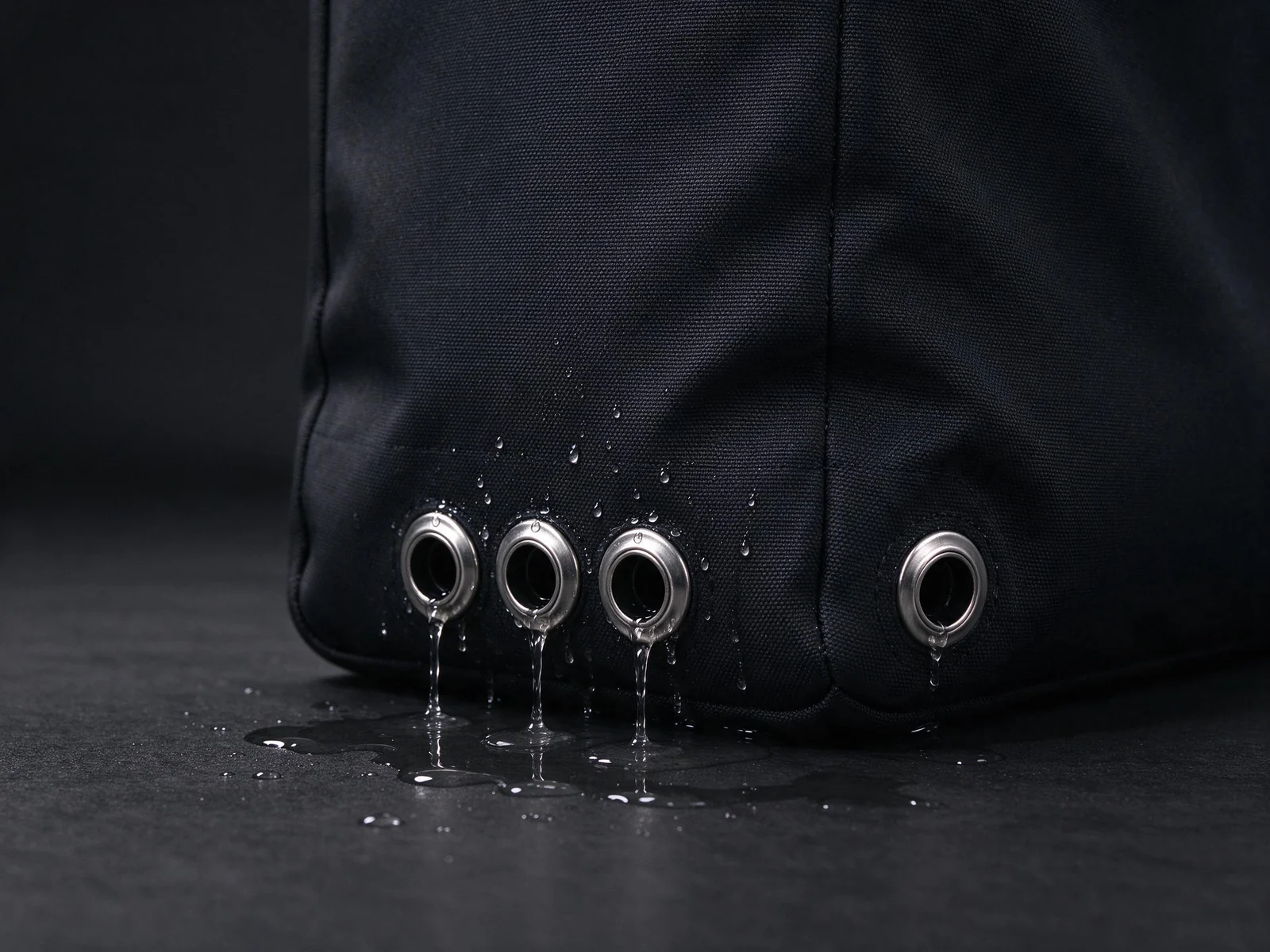
Four 4 mm grommets, clustered at one corner — the corner that is lowest when the bag is stood on its end, not when it lies flat. One grommet in the middle of the base drains nothing once the bag is picked up.
Buyers consistently underestimate this, because neoprene looks like a thin textile and is in fact a foam with an enormous internal surface area. The table below is measured on a 180 cm / 75 kg fit model, weighed dry and then weighed immediately after a normal surf session with a thirty-second drip.
| Wetsuit | Dry mass | Water held | Wet mass | Mass gain |
|---|---|---|---|---|
| 1.5 mm smooth-skin triathlon | 0.72 kg | 0.32 kg | 1.04 kg | 44% |
| 3/2 mm chest-zip surf, jersey lining | 1.12 kg | 1.51 kg | 2.63 kg | 135% |
| 5/4 mm hooded surf, thermal lining | 1.78 kg | 1.53 kg | 3.31 kg | 86% |
| 7 mm semi-dry, sealed seams | 2.42 kg | 1.26 kg | 3.68 kg | 52% |
The pattern is not what most people expect. The heaviest absolute water load is not on the thickest suit — it is on the 3/2 mm chest-zip surf suit with jersey lining, which holds 1.51 kg of water, because a jersey lining wicks into a large textile surface area while a sealed smooth-skin outer sheds water. The 7 mm semi-dry with sealed seams holds 1.26 kg despite being more than twice the foam mass, because the sealed seams and smooth outer face do not let water into the cell structure.
Two consequences for the bag:
- Load rating. A 70 L bag carrying a 3/2 mm suit, boots, gloves and hood is carrying 2.63 kg of suit plus roughly 1.2 kg of boots and accessories — about 3.8 kg of wet load on top of 1,340 g of empty bag. The shoulder-strap anchor and the base panel are sized for that, not for the dry 1.12 kg the suit weighs on the shelf. Our box-X reinforcement at the strap anchors is rated to 18 kg static, which is a 4.7× safety factor on the wet load.
- Drainage, not waterproofing. Because the water leaves the suit continuously for the first few hours, a bag that seals perfectly simply accumulates it. The wet cell must have a drain, and the drain must be at the lowest point when the bag is stood on its end — not at the lowest point when it lies flat, which is where most patterns put it and why so many bags pool water in a corner.
The drain test we run on every lot. Load the wet cell with 250 ml of water, stand the bag on its end, and time how long it takes to empty through the grommets. Our specification is ≤ 20 seconds, checked at AQL 4.0. A 4 mm grommet set at 150 mm centres drains that volume in 8–14 seconds when clean. The same grommet after a season of sand and salt can drop to 40–60 seconds, which is why we specify four grommets, not one, and why the mesh in front of them is a coarse 3 mm weave rather than a fine filter that clogs.
The Mould Clock — Venting Buys Time, It Does Not Stop the Clock
Mould needs three things: food, warmth and relative humidity above 80%. A wetsuit provides the food (skin oils, sweat, salt, sunscreen) and the warmth comes from a car boot in summer. The only variable you control as a bag designer is humidity, and the honest engineering answer is that you cannot control it — you can only shorten the time the bag spends above the threshold.
| Vent area (3 mm mesh, % of surface) | RH at 0 h | RH at 24 h | RH at 48 h | Visible mould onset | Still above 80% at 48 h |
|---|---|---|---|---|---|
| 0 | 99% | 96% | 94% | 36 h | Yes |
| 2 | 99% | 95% | 93% | 48 h | Yes |
| 4 | 99% | 93% | 91% | 60 h | Yes |
| 8 | 99% | 88% | 86% | 96 h | Yes |
Look at the last column. Every configuration stays above 80% at 48 hours. That is not a design failure, it is physics: a dripping wetsuit brings roughly 1.5 kg of water into a closed 70 L volume, and passive venting cannot remove that mass quickly enough. What venting changes is when the mould starts — 36 hours with no venting, 96 hours with 8% vent area. That is the difference between a customer who finds mildew after a weekend and a customer who finds it never, because they unpacked the bag on Sunday evening.
So the specification is not “make it dry”. It is:
- 8% vent area minimum, as 3 mm mesh panels placed high on the bag where rising moist air collects — typically two panels on the lid and one at the top of the back face.
- Drain at the lowest point when stood on end, as above, so the liquid water leaves rather than evaporating inside.
- No closed-cell foam on the inside of the wet cell. A TPU liner is correct; a neoprene-lined wet cell is a mistake, because foam holds water against the suit.
- A printed instruction, not a hidden one. “Empty and hang to dry after every use” on the care label, in the languages of the destination market. In our field returns, the single largest contributor to mould claims is a customer who left a wet suit in a sealed bag for a week — and in almost every case the bag had a care label but no instruction.
Storage Ageing — Why Compression Is the Real Enemy
Neoprene is a foam, and foams take a permanent set. Store a mat folded under load in a hot warehouse and the fold line will not come back, no matter what the care label says. The numbers below are for a 5 mm SCR sheet held at 30% compression for twelve months, which is what happens to a mat folded inside a bag sitting on a pallet.
| Storage temperature | Thickness lost in 12 months | Flex cycles to first crack | Verdict |
|---|---|---|---|
| 20 °C | 3.0% | 18,000 | spec-compliant |
| 30 °C | 7.5% | 11,000 | spec-compliant |
| 40 °C | 18.0% | 5,200 | accelerated ageing |
At 20 °C the sheet loses 3% of its thickness and survives 18,000 flex cycles before the first crack — that is a mat that outlives the bag. At 40 °C, which a container on a Dubai dock reaches easily, the same sheet loses 18% and cracks at 5,200 cycles. The mat has not been misused. It has been stored.
This drives three design rules that are invisible in a photograph and decisive in a warranty claim:
- 30% compression limit. The mat fold and the bag packing must not compress the neoprene by more than 30% of its thickness. On a 5 mm mat that is a 3.5 mm minimum gap at the fold. This is why our export packing folds the mat once, along the flat two-panel fold, and never rolls it — a roll compresses the inner face far beyond 30%.
- Storage specification 30 °C. We print it, and we mean it. Buyers who warehouse in a non-air-conditioned building in a hot climate should specify CR rather than SCR, because the higher-grade foam tolerates the same temperature with less set.
- No long-term compression in the retail box. A bag folded for retail display is compressed for weeks before the customer opens it. Our retail carton uses a cardboard former inside the mat fold on the 5 mm and 6 mm builds — 4 g of board that prevents the single most common “the mat has a crease” complaint.
If you are specifying a wetsuit bag for a market where the bag will sit in a retail box or a hot warehouse, this is the section to send to your supplier. It is the difference between a product that arrives flat and a product that arrives with a permanent line down the middle, and the fix costs about USD 0.04 per piece.
Four Volumes — Sized by the Carton, Not by the Catalogue
Volume in this category is usually chosen by looking at a competitor’s range and picking the middle. We choose it by the export carton, because the carton decides the freight per piece and the freight is where a 70 L build and a 100 L build stop being comparable. A soft bag packs to about 40% of its nominal volume once it is compressed for export; we then fill the carton to 82% and let the carton size drive the pack quantity.
| Build | Nominal volume | Packed volume | Mat | Empty mass | Carton cm | Pcs/carton | Pcs per 40’ HQ |
|---|---|---|---|---|---|---|---|
| Mat bag / triathlon | 25 L | 10.0 L | 4 mm mat | 640 g | 60×40×30 | 5 | 4,722 |
| Surf day | 45 L | 18.0 L | 5 mm mat | 980 g | 60×40×30 | 3 | 2,833 |
| Travel / liveaboard | 70 L | 28.0 L | 5 mm mat + wet cell | 1340 g | 66×40×34 | 2 | 1,515 |
| Fleet / school | 100 L | 40.0 L | 6 mm mat + drain base | 1760 g | 74×44×38 | 2 | 1,099 |
The number to look at is the last column. The 25 L mat bag ships 4,722 pieces per 40’ HQ because it packs five to a 60 × 40 × 30 cm carton. The 100 L fleet bag ships 1,099 — a 4.3× difference in freight slots for a 4× difference in nominal volume. Freight per piece on the 70 L travel build works out at USD 1.56 in bulk 4-pack against USD 3.76 in retail single cartons, which is a 141% increase for the same product. If your channel is e-commerce and you must ship single units, price the retail carton, not the bulk one.
How to choose between the four
- 25 L mat bag — triathlon and pool. Carries a 1.5–3 mm smooth-skin suit, a towel and a 4 mm mat. 640 g empty. This is the SKU that sells into sports retail and event merchandising, and it is the cheapest to freight by a wide margin.
- 45 L surf day — the single-session surfer. 5 mm mat, room for boots, gloves and hood, no wet cell. 980 g. The volume seller in surf retail.
- 70 L travel / liveaboard (reference build) — 5 mm mat plus a 22 L welded wet cell. 1,340 g. This is the bag a diver takes on a plane: it measures 66 × 40 × 34 cm = 140 cm linear, comfortably inside a 158 cm checked allowance.
- 100 L fleet / school — 6 mm mat, drain base, reinforced strap anchors. 1,760 g. Bought by dive schools and rental fleets, where the bag is loaded by staff who did not pay for it and the failure mode is abuse rather than wear.
Where 1,340 Grams Goes on the 70 L Build
A wetsuit bag is heavier than buyers expect, and the reason is the mat. On our 70 L reference build the neoprene mat alone is 22.5% of the empty weight — more than the base panel, more than all the hardware, more than the wet cell.
| Component | Share | Mass on the 70 L build |
|---|---|---|
| 600D polyester PU 1,500 mm shell | 30.0% | 402.0 g |
| 1680D + 0.5 mm TPU base panel | 11.0% | 147.4 g |
| 5 mm SCR neoprene mat (100 × 70 cm) | 22.5% | 301.5 g |
| Wet cell: 0.55 mm TPU welded liner | 8.0% | 107.2 g |
| #10 main zip, #8 wet zip, #5 mesh zip | 8.5% | 113.9 g |
| Acetal hardware, D-rings, drain grommets | 6.0% | 80.4 g |
| Webbing, shoulder straps, box-X, binding | 7.5% | 100.5 g |
| Mesh vent panels, 3 mm eyelets | 3.5% | 46.9 g |
| Thread, labels, hangtag, QC allowance | 3.0% | 40.2 g |
| Total | 100.0% | 1340.0 g |
The mat is the single largest line at 301.5 g, and it is also the line a buyer is most tempted to cut. Dropping from 5 mm to 3 mm SCR takes the mat to about 181 g and saves 120 g — and takes the standing-load compression from 57% to over 70%, which is the point at which the mat stops being a mat. If weight is the constraint, cut elsewhere: the base panel at 147.4 g can go from 1680D plus 0.5 mm TPU to 900D plus 0.3 mm and save about 60 g, and the shell at 402 g can drop from 600D to 420D and save about 85 g. Neither change touches the standing load.
Two lines that look small and are not:
- Zips at 113.9 g — three zips is not excessive. The #10 main zip has to span a 70 L opening; the #8 wet zip is the only barrier between 1.5 kg of water and the customer’s car; the #5 mesh zip is the vent. Cutting the mesh zip saves 14 g and removes the venting that the mould section above says is the whole point.
- Hardware at 80.4 g — four drain grommets, four D-rings and the strap sliders. Switching from acetal to nylon saves about 20 g and costs you salt-spray resistance, which is not a trade worth making on a product that lives in seawater.
The Bill of Materials at USD 20.11 FOB
This is the 70 L reference build at 500 pieces, priced from the material build-up rather than from a target price. Every line is a real purchase: the neoprene is 0.70 m² of 5 mm SCR, the shell is 600D polyester with a PU 1,500 mm back-coating, the base is 1680D laminated to 0.5 mm TPU, and the wet cell is 0.55 mm TPU film.
| Bill of materials, 500 pieces | Cost | Share of FOB |
|---|---|---|
| 600D polyester, PU 1,500 mm | USD 3.30 | 16.4% |
| 1680D + 0.5 mm TPU base laminate | USD 1.10 | 5.5% |
| 5 mm SCR neoprene sheet, 0.70 m2 | USD 4.20 | 20.9% |
| 0.55 mm TPU wet-cell film | USD 0.90 | 4.5% |
| Zips: #10 main, #8 wet, #5 mesh | USD 2.20 | 10.9% |
| Acetal hardware, D-rings, grommets | USD 1.10 | 5.5% |
| Webbing, binding, thread | USD 1.45 | 7.2% |
| Mesh panels and eyelets | USD 0.55 | 2.7% |
| Labour, 31 min at USD 0.11/min | USD 3.41 | 17.0% |
| Overhead, QC, packing, margin | USD 1.90 | 9.4% |
| Total FOB | USD 20.11 | 100.0% |
Three lines deserve a note.
The neoprene is USD 4.20, or 20.9%. That is 0.70 m² at 5 mm, which is 595 g of sheet, and it is the most expensive single material in the bag — more than the shell fabric, more than all three zips combined. Any quotation that is materially below ours on a bag with a genuine 5 mm mat has either used SBR (about 12% cheaper), reduced the mat area, or substituted an EVA look-alike (about 40% cheaper and visibly different underfoot).
Labour is USD 3.41, or 17%, at 31 minutes. For comparison, the same 70 L volume as a plain travel duffel is 19 minutes; the mat and its backing panel add 7 minutes, the welded wet cell adds 3, and the four drain grommets and the vent panels add 2. That is a 63% increase in sewing time for a product that photographs almost identically to a duffel. It is also the line where an inexperienced supplier under-quotes and then recovers the margin by skipping the grommet reinforcement — which is why the drain function test matters.
Overhead, QC, packing and margin is USD 1.90, or 9.4%. That is deliberately thin for an OEM programme and it assumes 500 pieces per style. At 200 pieces the same overhead per piece rises by roughly 60%, which is why our MOQ is 500 rather than 200 — not to force volume, but because below that the inspection cost per piece stops being recoverable.
Price Ladder and Tooling
The ladder is driven by two things: material buying scale and the amortisation of the cutting dies and the mat pattern. Tooling on this build is USD 2,200 — a cutting die for the mat, a die for the backing panel, the pattern set, and a weld jig for the wet cell.
| Order quantity | Unit FOB | Tooling amortised per piece | Effective first-order unit cost |
|---|---|---|---|
| 500 | USD 20.11 | USD 4.40 | USD 24.51 |
| 1,000 | USD 18.98 | USD 2.20 | USD 21.18 |
| 2,000 | USD 18.06 | USD 1.10 | USD 19.16 |
| 5,000 | USD 16.97 | USD 0.44 | USD 17.41 |
The column buyers always ask about is the last one. At 500 pieces the tooling adds USD 4.40 to every unit, which is 22% on top of the FOB. At 2,000 pieces it is USD 1.10, or 6%. If your first order is a test order, take the 500 and treat the tooling as a one-off; if you are confident of the range, the same dies run the 45 L and 100 L builds with a pattern change, so the cost is shared across three SKUs and the effective per-piece tooling drops by roughly two thirds.
Sampling and lead times
- Sampling: 6–10 working days from a locked specification. The 10-day end is a mat with a new size plus a custom weld jig; the 6-day end is a colourway change on an existing pattern.
- Sample cost: charged, and credited back against the first bulk order at the agreed threshold. We do not do free samples on this category, because a 5 mm SCR mat plus a welded wet cell is a real material cost.
- Bulk: 35–50 days after sample approval. The 50-day end is driven by neoprene sheet lead time, not by sewing — sheet in a non-stock density or a limestone-free grade can take 15–20 days to arrive, and it is the one input we cannot compress.
- What can move the date: a change to the mat thickness after sample approval resets the sheet order; a change to the wet-cell weld resets the jig. Both are worth doing before the sample, not after.
The question that reveals a supplier’s real capability. Ask: “what is the density tolerance on your neoprene incoming inspection, and how do you check it?” A supplier who buys sheet and does not check density is buying on thickness alone, which means they cannot tell you what the mat weighs per square metre, which means the mat will vary lot to lot. Our answer is ±5% density, ±0.2 mm thickness at five points, every lot, recorded on the incoming sheet. It is a two-minute test with a scale and a dial gauge, and it is the difference between a mat specification and a mat hope.
Carton Maths and Landed Cost — Where the Freight Hides
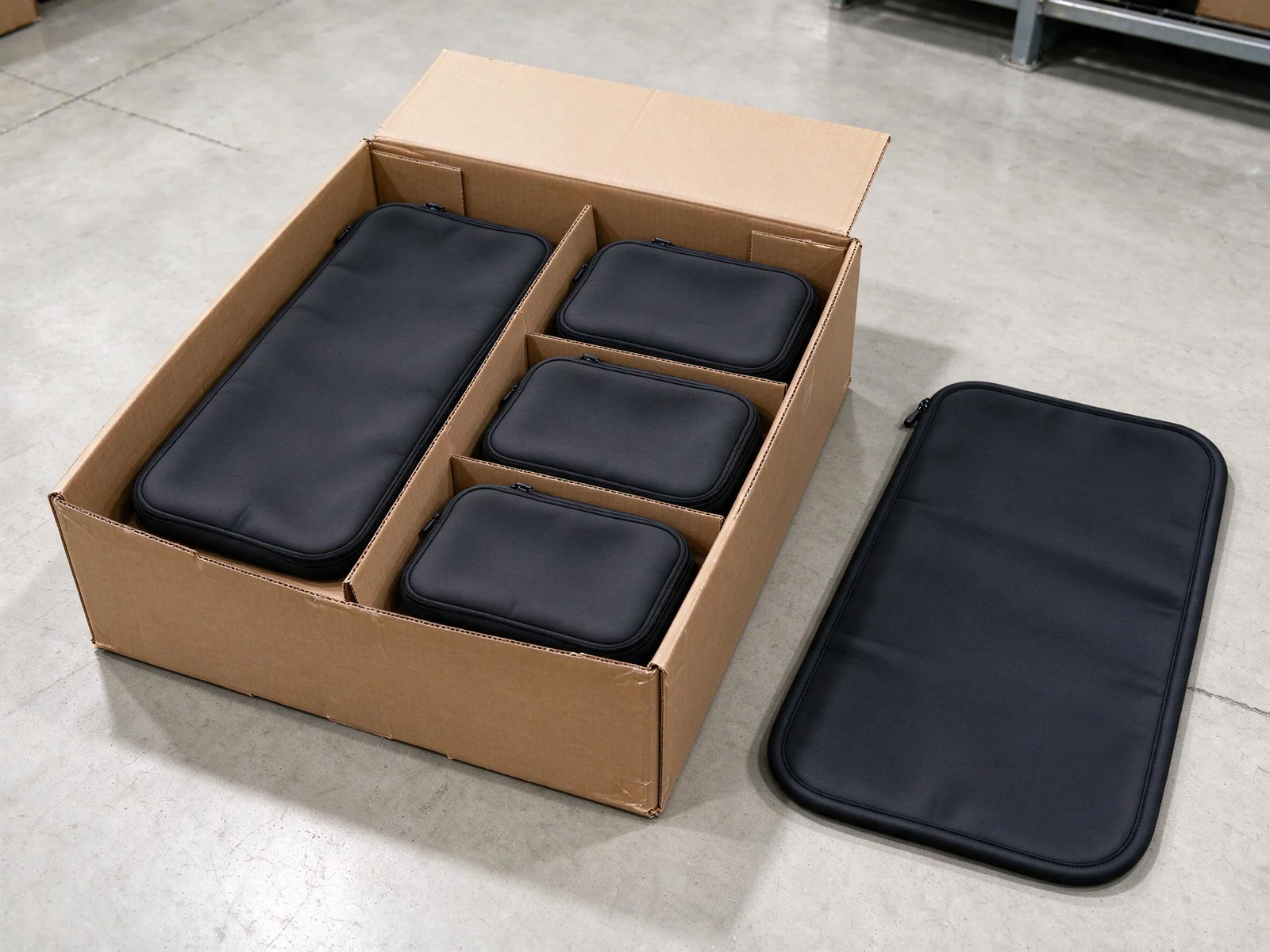
Four per carton at 68 × 42 × 52 cm — 1,831 pieces per 40’ HQ. The same four bags packed one to a retail carton take 757 per container, and the difference is USD 2.20 per piece in freight alone.
Two pack formats are worth comparing on the 70 L build, because the difference is larger than most buyers expect and it changes which channel the product works in.
| Pack format | Pcs per carton | Carton cm | CBM per piece | Pcs per 40’ HQ | Freight per piece | Insurance | Landed cost |
|---|---|---|---|---|---|---|---|
| Bulk 4-pack | 4 | 68×42×52 | 0.03713 m³ | 1,831 | USD 1.56 | USD 0.22 | USD 21.89 |
| Retail single | 1 | 66×40×34 | 0.08976 m³ | 757 | USD 3.76 | USD 0.24 | USD 24.11 |
The bulk 4-pack lands at USD 21.89; the retail single carton lands at USD 24.11. That is USD 2.22 per piece — 10% of the landed cost — spent entirely on cardboard. The mechanism is simple: a 68 × 42 × 52 cm carton holds four bags at 0.03713 m³ per piece, so a 40’ HQ takes 1,831 pieces and freight is USD 1.56 each. A single-bag retail carton at 66 × 40 × 34 cm is 0.08976 m³ per piece, so the same container takes only 757 and freight is USD 3.76 each.
The consequence for channel strategy is direct. If you are supplying a distributor or a retail chain that receives pallets, specify the bulk 4-pack and take the 10% saving. If you are shipping direct to consumer, you cannot — but you should be aware that the retail carton is costing you more in freight than the mat is costing you in material.
The dimensional weight trap
On air freight and on parcel, the carrier bills the greater of actual mass and dimensional weight. This is where a soft bag looks cheap and is not.
| Bag measured (cm) | Dimensional weight ÷ 5,000 | Dimensional weight ÷ 6,000 | Actual mass |
|---|---|---|---|
| 66×40×34 | 18.0 kg | 15.0 kg | 1.34 kg |
| 52×34×20 | 7.1 kg | 5.9 kg | 0.64 kg |
A 70 L bag measures 66 × 40 × 34 cm and weighs 1.34 kg. Its dimensional weight at the common 1:5,000 divisor is 18.0 kg — 13.4× the actual mass. Every parcel you send is billed at 18 kg, not 1.34 kg. This is not a reason to make the bag smaller; it is a reason to know the number before you price a direct-to-consumer channel. At 1:6,000, which some carriers use, it is still 15.0 kg.
One practical mitigation: the 25 L mat bag measures 52 × 34 × 20 cm, which is 7.1 kg dimensional at 1:5,000 against 0.64 kg actual. It is still 11× actual mass, but the absolute number is under half, which matters because most carriers bill on a band structure rather than linearly. For a direct-to-consumer triathlon programme, the 25 L is the commercially sensible SKU even though the 70 L is the better product.
Six Channels — and What Each One Actually Asks For
The same bag sells differently depending on who buys it. We build for all six, and the specification changes in each case.
- Surf and watersports retail. Wants a colour range, a retail carton with a hangtag, and a 45 L or 70 L. The buying decision is made by a category manager looking at a competitor’s fixture, so the mat has to be visible in the pack — a mat that is folded inside and invisible loses the sale to a competitor who displays it. Specify a die-cut window in the retail carton or a mat-forward first fold.
- Triathlon and swim brands. The 25 L mat bag, 4 mm, jersey-faced, with a smooth-skin-safe lining. This customer is obsessive about smooth-skin abrasion and will test it. No exposed zip coil on the mat face, no hook-and-loop, and a care label that names the risk.
- Dive schools and rental fleets. The 100 L, 6 mm mat, drain base, reinforced strap anchors, and one colour that hides sand. This buyer orders once and reorders on a cycle; the specification that matters is abuse tolerance, not aesthetics. Serialised labels and a repair kit are worth more to them than a colour choice.
- Liveaboard and travel operators. The 70 L, sized to stay inside the 158 cm checked allowance. This buyer will ask for the linear measurement in writing, because they have been charged oversize before. Give them 140 cm and say so on the spec sheet.
- Promotional and corporate. The 25 L with a single-colour logo, no mat change, and a price that works at 500 pieces. This is the segment where SBR creeps in — and where a 3 mm mat is genuinely acceptable, because the bag is a giveaway, not a working tool. Say so in the quotation rather than quietly downgrading.
- Private label and marketplace brands. Wants the 45 L or 70 L, their own logo on the mat and the shell, a barcode, and a retail carton that survives a marketplace fulfilment centre. The spec that matters here is carton burst strength and a polybag that meets the marketplace’s own packaging rules, not the bag itself.
Quality Control — Eight Gates
The failure modes on this product are concentrated in four places: the neoprene sheet, the mat fold, the wet-cell weld, and the drain. The eight gates below are what we actually run, in order.
| Gate | What is measured | Sampling |
|---|---|---|
| Sheet incoming | thickness ±0.2 mm at 5 points, density ±5% | AQL 2.5 |
| Lamination | peel strength ≥ 6 N/3 cm, no bubble > 2 mm | 100% visual |
| Mat cut | dimensions ±5 mm, square within 3 mm | AQL 2.5 |
| Wet cell weld | air-hold 30 s at 0.3 bar, no leak | 100% |
| Drain function | 250 ml drains in ≤ 20 s through grommets | AQL 4.0 |
| Zip cycling | 500 open/close cycles, no tooth skip | AQL 2.5 |
| Salt-spray | 48 h neutral salt spray, no hardware corrosion | per lot |
| Fold-flat | 10 cycles, mat returns within 3 mm of flat | AQL 4.0 |
Two of these gates are worth explaining because they are the ones a new supplier will skip.
The air-hold test on the wet cell (gate 4, 100%). Inflate the welded cell to 0.3 bar, hold for 30 seconds, and look for a pressure drop or a bubble at the seam. A welded TPU seam that passes a visual check can still wick through a pinhole at the weld toe, and a pinhole is invisible until the customer puts a wet suit in it and finds a damp car boot a week later. This is a 100% test, not a sample test, because the defect rate on a new weld jig is 2–4% for the first 500 pieces and drops below 0.5% once the jig is bedded in.
The fold-flat test (gate 8, AQL 4.0). Fold and unfold the mat ten times, then measure how far the mat deviates from flat. Our limit is 3 mm. This is the gate that catches a mat that has been cut from a sheet with a thickness variation, or laminated with a backing panel that is not square. It is also the gate that predicts the customer complaint that arrives in month four, which is always the same sentence: “the mat has a crease in it”.
The salt-spray gate is per lot, not per piece, and that is deliberate. A 48-hour neutral salt spray on the acetal hardware is a destructive test on a sample, so it runs once per lot of hardware rather than on finished bags. Acetal is specified over nylon for exactly this reason: nylon absorbs moisture, swells, and its salt-spray performance degrades with age, while acetal does not. The cost difference is about USD 0.06 per piece across all the hardware in the bag. On a product that lives in seawater, it is not a place to save.
Compliance Boundaries — What We Can and Cannot Claim
This section exists because buyers ask for claims that the product cannot support, and a claim printed on a hangtag becomes a liability in the destination market.
- “Waterproof” applies to the wet cell, not the bag. The welded 0.55 mm TPU wet cell is watertight to the air-hold test at 0.3 bar. The bag body is water-resistant — 600D polyester with a PU 1,500 mm back-coating, which means it resists rain and spray and will not survive immersion. Labelling the whole bag as waterproof is a claim we will not support, and it is the single most common compliance problem in this category.
- “Anti-mould” is not a claim we make. No passive textile construction prevents mould on a wet wetsuit. What we provide is venting, drainage and an instruction, and the honest label wording is “drain and hang to dry after use”, not “anti-mould”. Some markets treat an anti-microbial claim as a biocidal product claim and require registration; avoid it.
- Neoprene grade must be stated accurately. If the mat is SBR, the label cannot say neoprene in a way that implies chloroprene content. Our specification sheets name the grade, the density and the thickness, and we will not describe SBR as neoprene rubber on a hangtag.
- Recycled content claims need traceability. If your brand requires an RPET shell, we can supply it with a transaction certificate from the yarn supplier. The mat is the problem: recycled neoprene is not a mainstream material, and a claim of “recycled neoprene mat” is currently not something we can document. Say “recycled shell fabric” and be specific about which component.
- Prop 65 and REACH. Our standard materials are screened against the REACH SVHC list and we can supply declarations. A Prop 65 warning is the buyer’s decision based on their own exposure assessment; we supply the material declarations that feed it, and we do not make the warning decision for you.
Twelve Questions to Ask Any Wetsuit Bag Supplier
These are the questions we would ask if we were buying, and the answers separate a factory that understands neoprene from one that sews fabric.
- What grade and density is the mat, and what is your incoming tolerance? The answer should name SBR, SCR, CR or limestone-free CR and give a density figure in g/cm³ with a tolerance. “Good quality neoprene” is not an answer.
- What is the mat attached along, and how many edges? One long edge, bound on the other three. Two or more sewn edges means the mat cannot distribute load and will crack.
- How is the mat folded, and what is the compression at the fold? Flat two-panel fold, under 30% compression. A roll is wrong.
- Is there a backing panel under the mat, and what is it? 1680D plus 0.5 mm TPU. Without it, a standing adult compresses the foam to under half its thickness.
- How many drain grommets, what size, and where is the lowest point? Four, 4 mm, lowest when the bag is stood on end — not when it lies flat.
- What vent area do you provide, and in what mesh? 8% of surface minimum, 3 mm mesh, positioned high where moist air collects.
- How do you test the wet-cell weld, and on what percentage? Air-hold 30 seconds at 0.3 bar, 100% of pieces. A visual check is not a test.
- What is the drain time on the finished bag? 250 ml in ≤ 20 seconds, stood on end. If they cannot answer, they have not measured it.
- Is the mat face free of exposed zip coil and hook-and-loop? Critical if your customer wears smooth-skin or liquid-seam suits.
- What is the storage temperature specification, and do you print it? 30 °C. It should be on the care label and in the spec sheet.
- What is the empty mass, and what is the tolerance? 1,340 g ±5% on the 70 L. A supplier who quotes a mass without a tolerance has not weighed one.
- Can you show the carton and the pack quantity per 40’ HQ? 68 × 42 × 52 cm, four per carton, 1,831 per 40’ HQ. The freight number should come from them, not from you.
Frequently Asked Questions
What is the minimum order quantity for a custom wetsuit bag?
500 pieces per style. Colourways can be mixed within that quantity, and the same pattern runs across the 45 L and 100 L builds with a pattern change, so a three-SKU range can be placed as one 500-piece order. Below 500 pieces the inspection cost per piece stops being recoverable, which is why we do not go lower rather than because of a material constraint.
How long does sampling take, and is the sample free?
6–10 working days from a locked specification. Six days is a colourway change on an existing pattern; ten days is a new mat size plus a new weld jig. Samples are charged and credited back against the first bulk order. We do not supply free samples on this category because a 5 mm SCR mat plus a welded TPU wet cell is a real material cost, and free samples are always made from the cheapest available sheet.
What is the bulk lead time?
35–50 days after sample approval. The long end is driven by neoprene sheet, not by sewing — a non-stock density or a limestone-free grade can take 15–20 days to arrive. Changing the mat thickness after sample approval resets the sheet order, so lock that decision before the sample.
What grade of neoprene do you use for the mat?
5 mm SCR at 0.17 g/cm³ on the 70 L reference build. SCR is a blended chloroprene: enough chloroprene content to hold a standing load and resist salt water, at a price that works at 500 pieces. We also build in SBR (0.15 g/cm³, for promotional work where the mat is not load-bearing), CR (0.19) and limestone-free CR (0.20) for brands at the top of the market. The grade is always named on the specification sheet.
How thick should the changing mat be?
4 mm for a compact or triathlon mat at 90 × 60 cm, 5 mm for the standard 100 × 70 cm, 6 mm for fleet mats at 120 × 90 cm. Above 6 mm the mat stops folding usefully — a 7 mm sheet at 1,190 g/m² takes a compression set at the fold and belongs on a floor, not in a bag.
Can the mat really take the weight of someone standing on it?
Not the foam alone. A 75 kg diver standing on one foot puts about 98.1 kPa through a 90 cm² contact patch, which compresses a 5 mm sheet by roughly 57% — down to 2.14 mm. That is why every mat above 4 mm is laminated to a 1680D plus 0.5 mm TPU backing panel and attached along one long edge. The panel carries the load; the foam provides separation from the ground and warmth. Any supplier who tells you 5 mm foam alone supports an adult is describing a product that will flatten in one season.
Will the bag go mouldy if I put a wet suit in it?
It can, and no passive construction prevents it. A dripping wetsuit brings about 1.5 kg of water into a closed 70 L volume, and every configuration we have measured stays above the 80% relative humidity mould threshold at 48 hours. What venting changes is the timing: mould onset at 36 hours with no venting, 96 hours with 8% vent area. The specification is 8% vent area in 3 mm mesh, four drain grommets at the true lowest point, and a printed instruction to empty and hang after use.
Is the bag fully waterproof?
The wet cell is; the bag body is water-resistant. The welded 0.55 mm TPU wet cell is watertight to an air-hold test at 0.3 bar on 100% of pieces. The 600D polyester shell with a PU 1,500 mm back-coating resists rain and spray and will not survive immersion. If your customer needs full submersion, they need a dry bag, which is a different construction — welded throughout, roll-top closure, no venting, and no mat.
How much water does a wet wetsuit actually bring into the bag?
Measured on a 180 cm / 75 kg fit model: a 3/2 mm chest-zip surf suit holds 1.51 kg of water (a 135% mass gain), a 5/4 mm hooded suit holds 1.53 kg, a 7 mm semi-dry with sealed seams holds 1.26 kg, and a 1.5 mm smooth-skin triathlon suit holds 0.32 kg. The heaviest absolute load is not on the thickest suit — a jersey lining wicks more than a sealed smooth-skin outer sheds.
Can I put my logo on the mat?
Yes, in three ways: a heat-transfer print on a jersey-faced mat, a deboss into smooth-skin neoprene, or a woven label sewn to the bound edge. Heat transfer is the default at 500 pieces and costs about USD 0.08 per piece in one colour. Debossing is the premium option and is only possible on a smooth-skin face, which is also the face that shows abrasion most, so we do not recommend it for a mat that is stood on.
What are the carton dimensions and how many fit in a container?
On the 70 L build: 68 × 42 × 52 cm, four pieces per carton, 0.14851 m³ per carton, 1,831 pieces per 40’ HQ. A single-bag retail carton at 66 × 40 × 34 cm holds one piece and takes 757 per 40’ HQ. The freight difference is USD 1.56 against USD 3.76 per piece — 10% of landed cost, entirely cardboard.
What certifications can you supply?
Our factory holds BSCI and ISO 9001:2015. We supply REACH SVHC declarations for the standard materials, a transaction certificate from the yarn supplier for RPET shells, and material declarations that feed a buyer’s own Prop 65 assessment. We do not make the Prop 65 warning decision for you, and we will not claim “anti-mould” or “recycled neoprene”, because neither claim is documentable on this construction.
How do you handle a warranty claim?
The three failure modes we see are mat creasing, wet-cell seam wicking, and drain blockage, and all three are addressable at the pattern stage. For a confirmed manufacturing defect we replace within the order quantity, and we ask for the failed unit back so the failure can be traced to a gate — creasing to gate 8, wicking to gate 4, blockage to gate 5. If a claim traces to a gate, we change the gate rather than the unit. That is the only way a reorder gets better.
Can I mix colours within the 500-piece minimum?
Yes. Colourways can be mixed as long as each colourway is a minimum of 100 pieces, because below that the cutting and the neoprene sheet order stop being efficient. The mat colour and the shell colour are separate decisions: a black mat with a coloured shell is the most common combination and adds nothing to the cost, while a coloured mat requires a separate sheet order.
Do you make a wetsuit bag without a mat?
Yes, and we will tell you when that is the right call. A mat-less 45 L wet/dry duffel comes in at about USD 14.60 FOB against USD 20.11 for the mat build, because the mat is USD 4.20 of material plus 7 minutes of labour. It suits a customer who already owns a changing mat or changes at home. What it does not suit is the outdoor changer — and if that is your customer, the mat is the product.
What is the difference between this bag and your dry bag or travel bag?
They solve opposite problems. A dry bag keeps water out — fully welded, roll-top, no venting, no mat. A travel bag carries dry luggage and has no wet cell and no neoprene. This bag lets a wet suit drain while keeping the water away from the car, which requires a vent, a drain and a mat — three features that a dry bag and a travel bag deliberately do not have. If your customer is a diver carrying dive kit rather than a wetsuit, our freediving bag or scuba gear bag is the correct page.
Send Us Your Wetsuit Specification
Tell us the suit thickness your customer wears, the mat size, the volume and the market, and we will come back with a specification sheet, a carton plan and an FOB quotation at 500 pieces within two working days. If a mat is the wrong answer for your channel, we will say so before you place the order.
Related manufacturing pages
- Custom Freediving Bag Manufacturer
- Custom Scuba Gear Bag Manufacturer
- Custom Dive Backpack Manufacturer
- Custom Mesh Dive Bag Manufacturer
- Custom Waterproof Dive Bag Manufacturer
- Custom Rolling Dive Bag Manufacturer
- Custom Spearfishing Gear Bag Manufacturer
- Custom Long Fin Bag Manufacturer
- Custom Monofin Bag Manufacturer
- Custom Dry Bag Manufacturer
- Custom Travel Bag Manufacturer
- Custom Duffel Bag Manufacturer
- Custom Yoga Bag Manufacturer
- Custom Cooler Bag Manufacturer
- TPU vs PVC vs Nylon: Material Selection
- Dry Bag Manufacturing Guide
- Export Packaging Standards for Bags
- From Sample to Bulk Production
- How Long to Manufacture a Custom Bag
- Quanzhou Waterproof Bag Manufacturer

JUNYUAN BAGS — Professional Bag Manufacturer
JUNYUAN BAGS is a China-based bag manufacturer established in 2014, with a founder who has 20+ years of experience in bag manufacturing. We specialize in custom OEM/ODM bag manufacturing — from backpacks and handbags to golf bags and travel bags — with production running through affiliated and partner factories under documented quality-control and pre-shipment inspection procedures. Whether you need low MOQ sampling or full container production, the engineering and QA teams support customers from concept to final delivery. For customization inquiries, contact us at [email protected] or WhatsApp +86 17750020688.