
Short answer: a custom rolling dive bag programme at Junyuan Bags runs at MOQ 500 pieces per style, samples in 6–10 working days, bulk production in 35–50 days and final inspection at AQL 2.5 major / 4.0 minor. We are a bag manufacturer established in 2014, with our founder working in the bag trade since 2004. A rolling dive bag is not a suitcase with a dive logo on it. Dive kit is the heaviest, wettest, most salt-loaded luggage a recreational customer will ever wheel: a warm-water kit with a 12 L cylinder sits at 28–34 kg, it comes back from the boat dripping, and it gets dragged over brushed concrete, aluminium ramp treads and wet teak. The three things that actually decide whether the bag survives are the wheel and axle load path, the trolley tube geometry and the base abrasion package — not the fabric print. This page is the procurement document for those three, plus the four volumes we build, the USD 26.80 FOB bill of materials on our 90 L reference build, the twelve tests behind the load ratings, and the carton maths that decides whether the bag is profitable to ship. If you need a carry-format dive carrier instead of a wheeled one, start at our custom dive backpack line.
Where the money actually goes. Take our standard 90 L rolling dive bag — 600D ballistic polyester with a PU back-coating, 2.5 mm HDPE backboard, 3-stage aluminium trolley, two 90 mm polyurethane wheels on sealed bearings, 1680D plus 0.5 mm TPU on the base panel, one #10 main zip and one #8 wet-pocket zip — at USD 26.80 FOB on 500 pieces. Fabric is 18% of that. The trolley system (17%) and the wheel assemblies (12%) together cost more than the shell, and they are the two assemblies that generate the warranty claims. Labour is 13%, because a wheeled bag has 42 minutes of sewing in it against 19 minutes for the same volume in a duffel. If a quotation for a 90 L wheeled dive bag lands under USD 20, one of four things has been cut: the bearing grade, the frame thickness, the base panel, or the 100% function test.
What “Rolling Dive Bag” Means — and the Five Products Sold Under That Name
Search the phrase and you will be shown five structurally different products. They are not interchangeable, they carry different load ratings, and if you brief a factory on the wrong one you will get a bag that either collapses at the axle or is over-engineered by USD 6 a piece.
| Product | Structure | Typical load | Where it fails | Buy it when |
|---|---|---|---|---|
| Rolling dive bag (this page) | Soft body, rigid HDPE backboard, 2 fixed wheels at the rear base, telescopic trolley | 25–45 kg | Axle housing pull-out; base panel abrasion | You move a full kit 150–800 m between car, pier and boat |
| Wheeled dive duffel | Duffel body with a bolt-on trolley plate and two small castors | 18–25 kg | Trolley plate tears out of the fabric; castors flat-spot | Budget retail, light kit, occasional travel |
| Hard dive trolley case | Injection-moulded PP or ABS shell, moulded wheel housings | 30–50 kg | Shell cracking at −5 °C; seal failure | Air-heavy travel, camera or tech-dive kit |
| Dive backpack with detachable trolley | Harness pack plus a removable aluminium frame-trolley | 15–22 kg | Frame-to-pack connection; lost trolley | One-bag travel where the pack must also be carried up stairs |
| Dive crate / tub on castors | Rigid tub, lid, four castors, no fabric | 40–60 kg | Castor fork bend on kerbs | Liveaboard deck storage, rental fleet, club use |
The distinction that matters commercially is the second row. A “wheeled duffel” is a duffel with wheels bolted on: the trolley plate is sewn to the shell and the load hangs from stitching. A true rolling dive bag carries the load on a continuous HDPE backboard that runs from the axle to the handle housing, so the fabric never sees the trolley load. The difference in cost is about USD 2.10 at 500 pieces. The difference in field life, on a bag that is loaded to 30 kg twice a week, is the difference between one season and four.
Why Dive Kit Needs Wheels: the Weight Arithmetic
Dive is the one bag category where the customer’s own kit, before any camera or laptop, already exceeds airline cabin allowances. A representative warm-water kit, weighed on our sample-room scale:
| Item | Weight | Notes |
|---|---|---|
| 3 mm full wetsuit, wet | 2.6 kg | 1.9 kg dry; retains roughly 0.7 kg of water |
| BCD, size M | 4.1 kg | 3.6 kg dry; corrugated hose and dump valves hold water |
| Regulator set, first + second + octo + SPG | 2.3 kg | 1.1 kg in a travel set |
| 12 L steel cylinder, empty | 13.4 kg | Rental in most destinations; 8.9 kg in aluminium |
| Fins, pair | 2.4 kg | 1.4 kg in short travel fins |
| Mask, snorkel, computer, torch, reel, DSMB, spares | 2.9 kg | The “small stuff” that always weighs more than expected |
| Total, own kit with 12 L steel | 27.7 kg | Wet, after the dive, before a towel |
| Total, travel kit, aluminium cylinder | 19.5 kg | Freedive and warm-water travel builds |
Add a towel, a change of clothes and a save-a-dive kit and the realistic working figure is 30–34 kg. Then add distance. On a typical liveaboard trip the bag travels 120 m from car park to check-in, 200–400 m through an airport, 150 m from the transfer van to the pier, and then 20 m of wet aluminium ramp that is often steeper than 1:8. Carrying 32 kg in hand means three trips, or one trip and a strained shoulder. Wheeling it means one trip and a 27 N pull force on level concrete — which is why the category exists, and why the wheel specification, not the print, is what the customer experiences on day one.
The 15% rule we design to. A trolley and wheel system on a 90 L dive bag adds 1,040 g (610 g trolley, 430 g wheels and housings) against a carry-format bag of the same volume. That is 41% more empty weight, and it is the correct trade: the system removes 30 kg from the customer’s shoulder for every metre of the journey. The rule we apply is that the rolling hardware may not exceed 15% of the rated load — at 35 kg rated, hardware must stay under 5.25 kg, and ours sits at 1.04 kg. When a design brief pushes the hardware over that ratio, the frame is wrong, not the wheels.
Four Volumes, One Frame Family
We build the family off a single frame architecture scaled in three places: backboard thickness, trolley stage count and wheel diameter. Everything else — the sewing sequence, the base panel construction, the inspection checklist — is shared, which is why a 60 L and a 150 L can ship in the same container without a second tooling round.
| Volume | External dimensions (cm) | Empty weight | Rated load | Wheels | Trolley | 40HQ loading | Built for |
|---|---|---|---|---|---|---|---|
| 60 L | 62 × 38 × 30 | 2,780 g | 25 kg | 2 × 76 mm PU | 2-stage | 1,831 pcs | Freedive travel, one-bag weekend, cabin-adjacent |
| 90 L (reference) | 78 × 40 × 36 | 3,540 g | 35 kg | 2 × 90 mm PU | 3-stage | 722 pcs | Full recreational kit with cylinder |
| 120 L | 84 × 44 × 40 | 4,260 g | 40 kg | 2 × 90 mm PU | 3-stage | 572 pcs | Two divers, or one diver plus camera housing |
| 150 L | 90 × 46 × 42 | 5,020 g | 45 kg | 2 × 100 mm TPU | 3-stage, reinforced | 349 pcs | Liveaboard crew, rental fleet, club kit |
The 40HQ figures assume our standard export carton: 4 pieces per carton at 60 L (0.1485 CBM), 2 at 90 L (0.1882 CBM), 2 at 120 L (0.2374 CBM) and 1 at 150 L (0.1943 CBM), against 68 CBM of usable container volume. These are bulky goods, and container loading is decided by carton cube long before it is decided by weight — a full 40HQ of 90 L bags weighs about 2.6 tonnes, roughly a tenth of the payload limit.
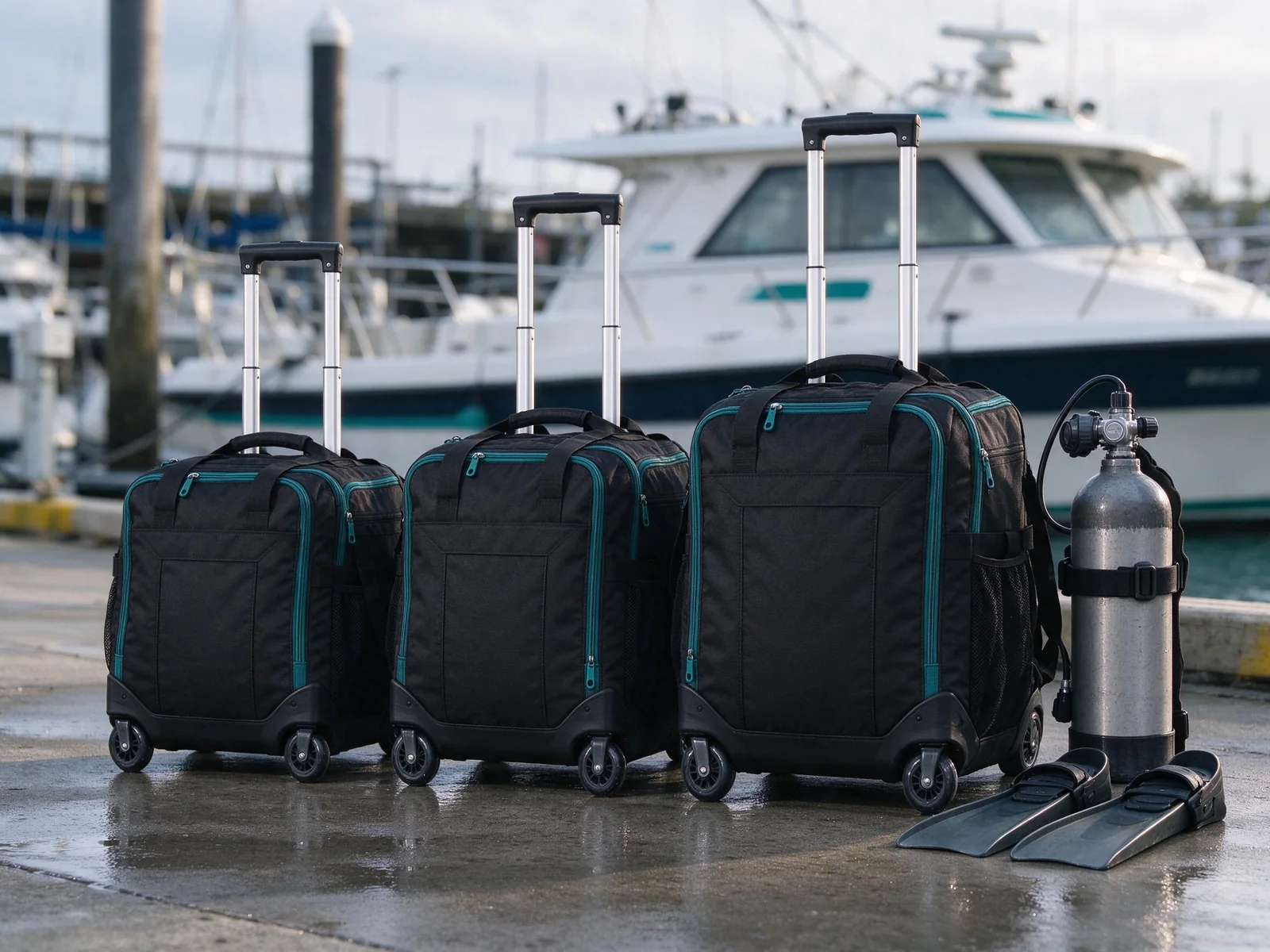
The 60 / 90 / 120 L rolling dive bags on the same frame family. The 90 L reference build is the volume we recommend for a single diver with a 12 L cylinder; the 120 L is the point at which the trolley tube wall goes from 1.2 mm to 1.3 mm.
The dimension that decides airline cost
Linear dimensions (L + W + H) are what airlines bill on, not litres. Our 90 L build measures 154 cm and therefore sits inside the common 158 cm checked allowance. The 120 L measures 168 cm and the 150 L measures 178 cm; both are oversize on most carriers and attract a fee. For e-commerce, volumetric weight is the bigger problem: 78 × 40 × 36 ÷ 5,000 gives a 22.5 kg dimensional weight against a 3.5 kg actual, so a 90 L bag is billed as 23 kg in a parcel network. This is exactly why 60 L outsells 90 L online and why 90 L is a specialist-retail and liveaboard volume. We will quote both a retail-ready single carton and a bulk multi-pack carton so you can see the difference in freight before you commit to a size mix.
Wheel Architecture: Four Options and the Load They Actually Carry
The wheels are the only components in contact with the ground, and they carry the whole bag plus whatever the customer overpacks. Two things are being specified at once: the wheel diameter and material, which set the pull force, and the housing and axle, which set whether the wheel stays attached. Most budget dive bags fail on the second, not the first.
| Option | Wheel | Set load rating | Pull force at 35 kg: level / 1:8 ramp | Added weight | Cost | Failure mode we see |
|---|---|---|---|---|---|---|
| A | 2 × 76 mm PU, 6003 sealed bearing | 35 kg | 34 N / 77 N | 330 g | USD 1.95 | Flat-spotting after a 32 km drum run; noisy by month 9 |
| B (default) | 2 × 90 mm PU, 6003-2RS | 45 kg | 27 N / 70 N | 430 g | USD 2.60 | Bearing seal ingress after 12 months of salt-water use |
| C | 4 × 50 mm spinner castors | 30 kg | 41 N / 84 N | 520 g | USD 3.40 | Castor fork bends on kerb edges; four contact points on gravel |
| D | 2 × 100 mm treaded TPU | 55 kg | 24 N / 67 N | 610 g | USD 4.15 | Housing bolts loosen if not thread-locked and re-torqued |
Why we default to option B. Inline-skate geometry puts the axle between two large-diameter wheels in a moulded housing, so the load is spread across a 90 mm contact patch and the housing is bolted through the backboard rather than stitched to fabric. Option C looks more modern and is what most luggage uses, but four 50 mm castors on a 35 kg dive bag mean four small contact patches and a fork that sees lateral load every time the bag is pulled sideways off a ramp. On brushed concrete and aluminium tread plate — the two surfaces this bag actually meets — option B pulls 34% easier than option C and survives the drum test that option C does not.
Bearing, axle and housing specification
- Bearing: 6003-2RS double-sealed, chrome steel, 17 × 35 × 10 mm. Budget builds use open 608 bearings at USD 0.06 a pair; they run smoothly for a season and then grind. Sealed 6003 costs USD 0.21 a pair and is the single cheapest reliability upgrade in the bag.
- Axle: 8 mm stainless 304 through-bolt with a nyloc nut, not a press-fit plastic pin. Press-fit pins are the reason wheels come off in the field: the pin walks out under lateral load once the housing has been warmed in a car boot.
- Housing: PA6-GF30 moulded nylon, 4 mm wall at the bearing seat, bolted to the HDPE backboard through two 5 mm stainless washers on a 40 × 60 mm footprint. The footprint matters: a housing bolted through a 25 × 40 mm footprint tears the backboard at 30 kg static load.
- Clearance: 12 mm between wheel and body so that a wet 3 mm wetsuit sleeve or a webbing tail cannot wrap the axle. This is a field failure we have seen on competitor bags more than once.
What the drum test measures
We run the bag loaded to its rated load on a 2 m diameter drum with a 40-grit belt surface, at 6 km/h, for the equivalent of 32 km. That is roughly two years of a twice-weekly diver’s pier walk. Acceptance is: no bearing play over 0.4 mm, no flat spot deeper than 0.5 mm, no housing crack, no backboard delamination at the bolt footprint. Option A fails the flat-spot criterion at 24 km. Option B passes at 32 km with 0.2 mm of play. Option D passes at 40 km and is what we put on the 150 L.
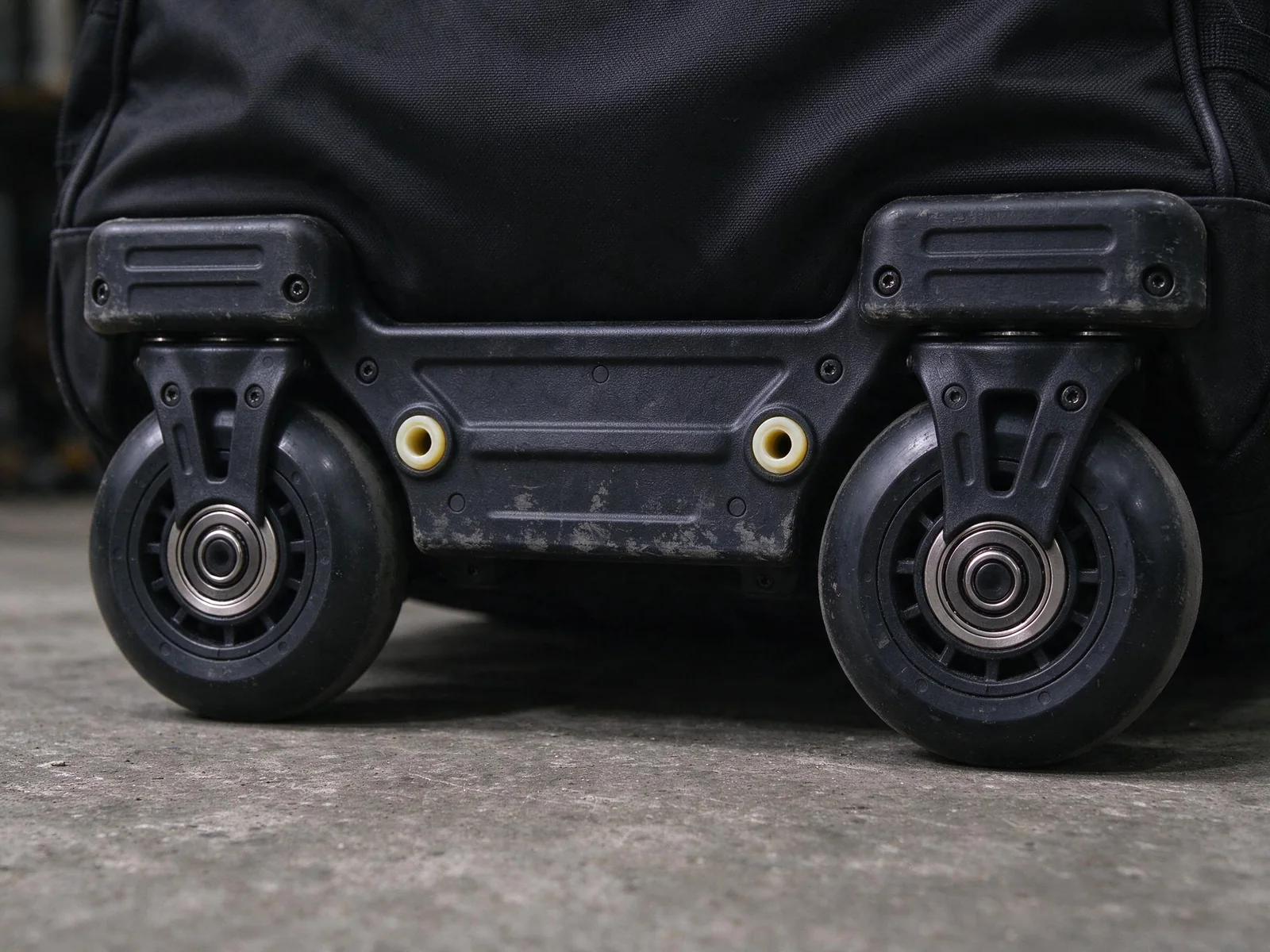
The 90 L base assembly: PA6-GF30 housings bolted through a 2.5 mm HDPE backboard, 90 mm PU wheels on sealed 6003 bearings, four TPU corner bumpers and two 12 mm acetal drain eyelets. Note the 12 mm wheel-to-body clearance.
The Trolley: Three Stages, 1.2 mm Wall, and the Wobble That Gets Returned
Trolley complaints are rarely about strength. They are about wobble: the bag that shimmies at the end of a fully extended handle and feels cheap. Wobble is a tolerance stack — tube OD against the guide bush, bush against the housing, and the play in the locking pin — and it is cheap to design out and expensive to fix after tooling.
| Specification | 60 L | 90 L | 120 L | 150 L |
|---|---|---|---|---|
| Stages | 2 | 3 | 3 | 3, reinforced |
| Tube OD (mm) | 22.2 / 19.0 | 22.2 / 19.0 / 15.9 | 22.2 / 19.0 / 15.9 | 25.0 / 22.2 / 19.0 |
| Wall thickness | 1.1 mm | 1.2 mm | 1.3 mm | 1.3 mm |
| Alloy and finish | 6061-T6 aluminium, hard anodised 12 µm, salt-spray 96 h to ASTM B117 | |||
| Extension (usable) | 280 mm | 400 mm | 400 mm | 420 mm |
| Lateral play at full extension, 150 N side load | ≤ 4 mm | ≤ 5 mm | ≤ 5 mm | ≤ 6 mm |
| Static pull at full extension | 350 N | 500 N (51 kg) | 500 N | 600 N |
| Extension cycles (150 N lateral) | 5,000 | 5,000 | 5,000 | 5,000 |
| T-grip | 40 mm deep, 195 mm wide, TPE over PP, 6 mm finger relief, no sharp parting line | |||
Three details decide whether that table is real or aspirational. First, the guide bush: a moulded POM bush with 0.15 mm running clearance, not a hole drilled in the housing. Second, the locking pin: a spring-loaded 6 mm stainless pin that engages a machined groove, not a dimple pressed into the tube. Third, the bottom anchor: the tube must seat into a moulded cup bonded to the backboard, so the bending moment at full extension is transferred into the board rather than into four stitches on the lining.
Geometry beats hardware. On the 90 L build the wheel axle to handle base distance is 620 mm and the loaded centre of gravity sits 180 mm forward of the axle, giving a 29/71 load split between handle and wheels when the bag is at rest on level ground. That is a deliberate choice: put more weight on the wheels and the bag noses down on a ramp; put more on the handle and the customer carries it anyway. At 71% on the wheels, the pull force at 35 kg measures 27 N on level brushed concrete, and the bag still self-supports at a 12° tilt when parked. The 150 L moves to a 660 mm base because the cylinder sits at the far end.
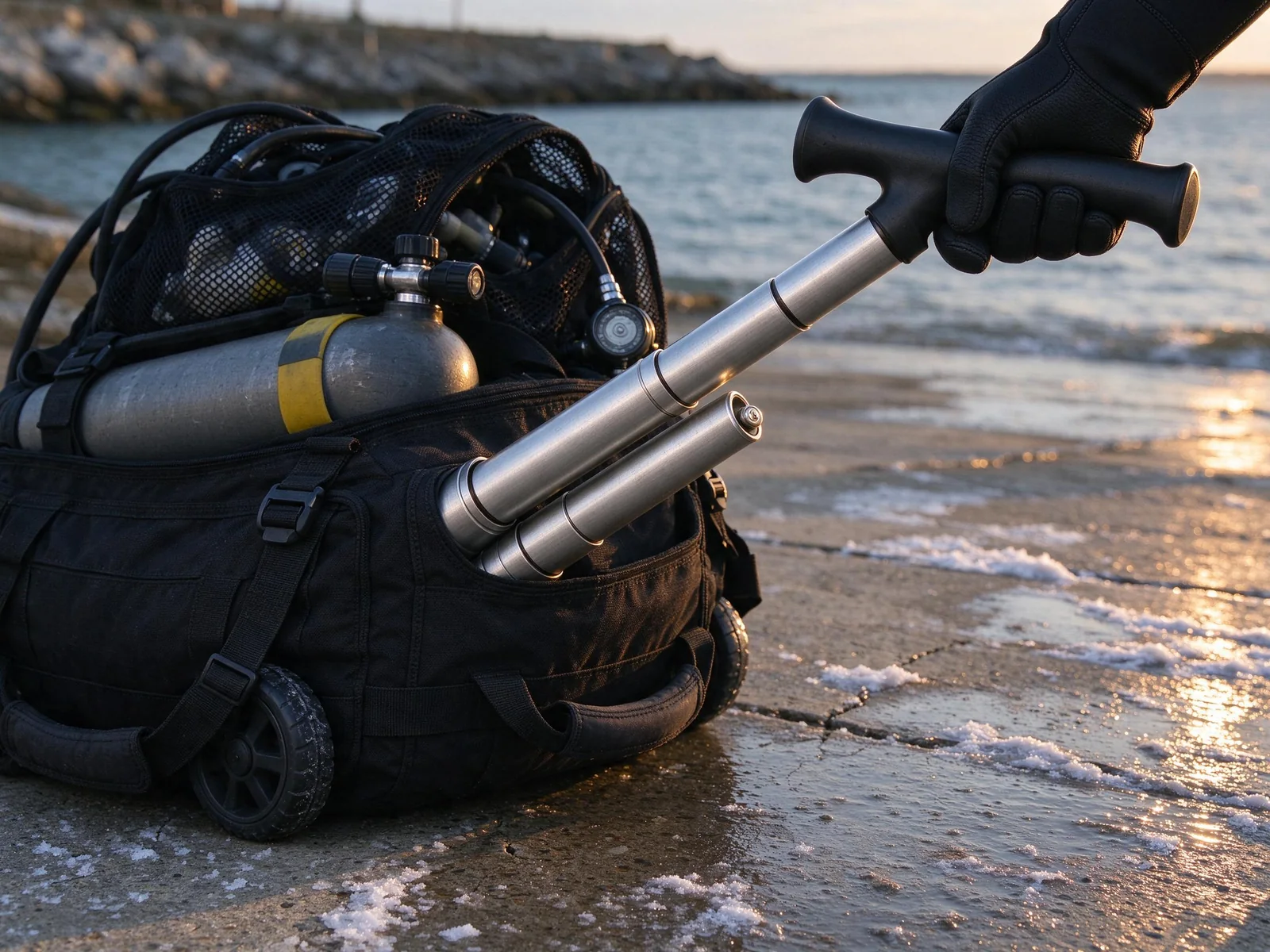
The 3-stage trolley at 400 mm extension with a 30 kg load on a 1:8 ramp. Pull force in this position measures 70 N at 35 kg rated load; the load path runs tube → cup → backboard → axle, and never through the shell fabric.
Frame and Load Path: Why the Backboard Is the Bag
Everything above depends on one component that the customer never sees: the backboard. In a properly built rolling dive bag the backboard is a continuous 2.5 mm high-density polyethylene sheet, die-cut to the bag’s footprint, extending from the axle housing to the trolley cup. It is not a stiffener sewn into the base; it is the chassis.
| Element | Specification | Function | If it is cut |
|---|---|---|---|
| Backboard | HDPE 2.5 mm (60/90 L), 3.0 mm (120/150 L), die-cut, edge-rounded | Carries trolley moment and axle load; keeps the bag square when wet | Bag folds at the waist under 30 kg; zips gap |
| Trolley cup | Moulded PP, solvent-bonded and riveted to the board | Spreads the bending moment over 90 × 60 mm | Tube punches through the lining in weeks |
| Base plate | PP 3.0 mm, 6 mm turned edge | Distributes point loads; mounts corner bumpers | Corners wear through at 40–60 km of dragging |
| Corner bumpers | TPU 2.0 mm, 4 positions, stitched and riveted | Sacrificial wear surface on ramp treads | Base panel abrasion rate triples |
| Compression strap | 25 mm PP webbing, two-position, cam buckle | Holds load against the board so it does not pendulum | Load shifts; bag tips at 12° instead of self-supporting |
We test the frame three ways. A 50 kg static load for 24 hours on the backboard, measured for permanent set — acceptance is under 3 mm. A 30 kg drop from 900 mm onto each base corner, three times per corner, looking for backboard cracking and housing movement. And a tip-over test on a 15° side slope with the rated load, which the 90 L passes with the trolley retracted and fails, by design, with it extended — the same as any trolley bag, and the reason the handle instruction is printed inside the lid.
Fabric and the Base Panel: Abrasion Is the Real Enemy
A dive bag does not wear out from UV in the way a beach bag does. It wears out from being dragged across concrete with 30 kg on it, and from salt crystallising in the weave. The specification follows from that.
| Panel | Material | Coating | Why |
|---|---|---|---|
| Shell (60/90 L) | 600D ballistic polyester, 2×2 ripstop | PU 1,000 mm back-coating, DWR face | Best tear-to-weight ratio in the range; takes print and heat transfer well |
| Shell (120/150 L) | 900D polyester oxford | PU 1,500 mm back-coating | Higher burst at the strap anchors under 40–45 kg |
| Base panel | 1680D polyester + 0.5 mm TPU laminate | TPU film, RF-bonded | The only panel that touches ground; TPU resists salt crystal abrasion better than PU |
| Wet compartment | 420D ripstop nylon, PU 1,000 mm | PU, with 2 mm perforated TPU drain panel | Light, drains, does not hold chlorine odour |
| Lining | 210D polyester, PU 600 mm | PU | Low friction so kit slides in past the frame |
Taber abrasion, CS-10 wheel, 1 kg load, 500 cycles — the numbers we hold suppliers to: 600D ballistic 0.42 g weight loss, 900D oxford 0.31 g, 1680D 0.18 g, 1680D with 0.5 mm TPU 0.09 g. Drag test, 30 kg over 200 m of brushed concrete: a 600D base with PU coating loses 1.6 mm of panel thickness and reaches the weave; the 1680D plus TPU base loses 0.4 mm and does not. That single comparison is why the base panel is not the place to save USD 0.70.
Salt is the second factor. Chlorine and sea salt crystallise in the weave, abrade the fibres from the inside, and hold moisture against the coating. The countermeasures are unglamorous: a DWR face finish so the bag sheds water instead of wicking it, RF-bonded TPU rather than glued film on the base (glue lines fail in salt water within a season), 316 stainless or acetal for every hardware item that touches the bag, and no nickel-plated steel anywhere — the plating pits at 96 hours in salt spray and the rust stain is permanent on light fabrics.
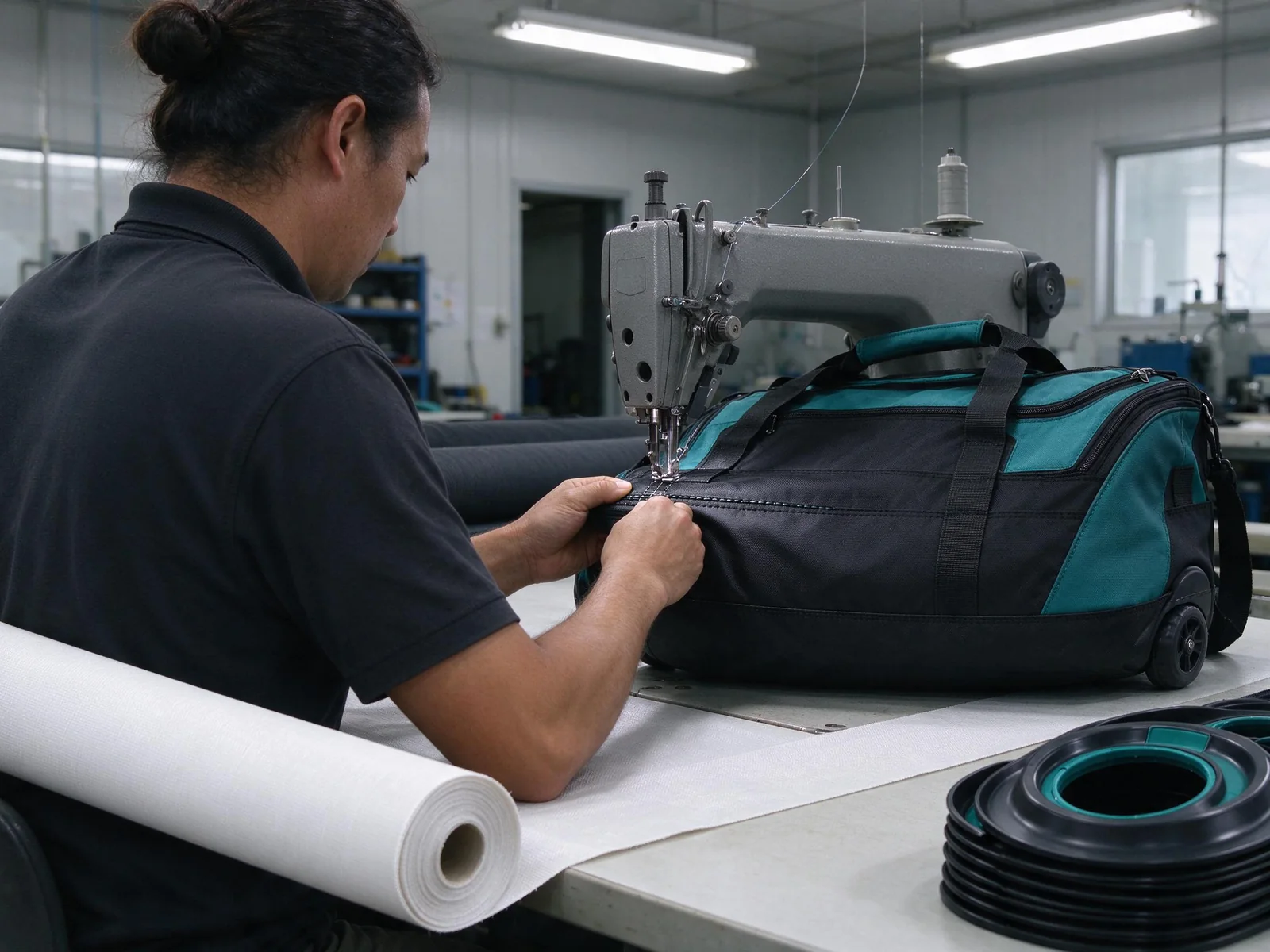
Base-panel assembly on the 90 L line: the 1680D plus TPU panel is box-X stitched to the shell, then the 3.0 mm PP base plate and four TPU corner bumpers are riveted through. This is the highest-stress seam in the bag and gets its own in-line checkpoint.
Wet Kit on a Wheeled Bag: the Compartment Architecture
Wheels and water are a bad combination, and every rolling dive bag has to solve it. Wet neoprene weighs 30–40% more than dry, it drips into the base where the frame and axle live, and if the wet kit sits above the dry kit the whole bag is compromised by gravity. Our architecture puts the wet compartment low, forward of the axle and against the front face, in a 420D ripstop compartment that is 38–42% of total volume, with its own drain path.
| Volume | Wet compartment | Dry compartment | Drain path | Wet liner |
|---|---|---|---|---|
| 60 L | 24 L | 36 L | 2 × 10 mm acetal eyelets, low point | Removable, clip-in |
| 90 L | 36 L | 54 L | 2 × 12 mm acetal eyelets + 2 mm perforated TPU panel, 5% open area | Removable, clip-in |
| 120 L | 48 L | 72 L | 2 × 12 mm eyelets + perforated panel | Removable, zip-in |
| 150 L | 60 L | 90 L | 4 × 12 mm eyelets + full perforated base | Fixed, welded |
Three rules we do not break on a wheeled build. First, no drain eyelet within 80 mm of a wheel housing — the eyelet is where water leaves and where grit enters, and grit in a bearing is a warranty claim. Second, the wet compartment floor is never the base panel: there is a 12 mm standoff so that water collecting in the wet compartment does not sit against the TPU laminate for days. Third, the wet kit goes below the compression strap, so that a 12 kg wet wetsuit cannot shift rearwards onto the trolley tubes when the bag is tipped onto its wheels.
The 8-hour test. Load a 90 L bag with 8 kg of soaked neoprene in the wet compartment and 6 kg of dry towels in the dry compartment, stand it upright on a level floor for 8 hours, then check the dry compartment. Acceptance: no visible moisture, no damp feel at the divider seam, no water in the base tray. We also run the inverse — bag laid flat, 5 L of water poured into the wet compartment — and measure drainage: 5 L clears through the 12 mm eyelets and the 5% perforated panel in under 90 seconds. Anything slower than that and the perforation pattern is wrong.
Openings, Zips and the Order of Sewing
A wheeled bag is opened standing up, often one-handed, often with wet hands. That dictates a clamshell or three-sided U-opening rather than a top-load duffel mouth: with the frame in place you cannot rummage, so the bag must open flat. Our default is a three-sided #10 zip with a 12 mm storm flap, a #8 zip on the wet pocket, and a separate #5 on the interior mesh lid.
| Position | Zip | Slider | Test | Note |
|---|---|---|---|---|
| Main compartment (3 sides) | #10 nylon coil, PU-coated, 12 mm storm flap | Two sliders, moulded pullers, 25 mm webbing tabs | 3,000 cycles with 8 kg load | Two sliders so the bag opens from either end on a bench |
| Wet compartment | #8 nylon coil, PU-coated | Single slider, lockable | 2,000 cycles, salt-water rinse between 500-cycle blocks | Placed on the front face, not the top, so it drains outward |
| Interior mesh lid | #5 nylon coil | Single, reverse-mount | 1,000 cycles | Keeps small kit off the frame edge |
| ID / logbook pocket | #3 with 8 mm flap | Single, metal-free | 500 cycles | Metal-free so it passes hand-luggage screening without a tray |
The sewing sequence is where wheeled bags differ most from duffels, and it is worth asking any supplier to describe it. Ours: shell panels joined and top-stitched → backboard inserted and the frame pocket closed → base plate and corner bumpers riveted → trolley cup bonded and riveted → trolley tubes fitted and the housing bolted through the board → wheel assemblies fitted and torque-checked → wet liner clipped in → lining closed. If a factory fits the trolley before closing the frame pocket, the backboard is loose inside the bag and the whole load path is stitching.
The 3,540 g Weight Budget, Assembly by Assembly
Weight is a specification, not an outcome. On the 90 L build we hold a budget with a ±5% tolerance (±177 g) and weigh the first article assembly by assembly. Nine line items, and every one of them is a purchasing decision:
| Assembly | Weight | Share | Lever if you need to cut weight |
|---|---|---|---|
| Shell, 600D ballistic PU-coated | 980 g | 27.7% | Move to 420D on the non-wear panels: −180 g, −USD 0.55 |
| Frame: HDPE backboard, PP base plate, TPU bumpers | 520 g | 14.7% | Nothing. This is the bag’s structure; cutting it is a false economy |
| Trolley: 3-stage tubes, cup, housing, T-grip | 610 g | 17.2% | 2-stage saves 120 g and 90 mm of extension — only for 60 L |
| Wheels: 2 × 90 mm PU, housings, axles | 430 g | 12.1% | 76 mm saves 100 g but drops the rating from 45 to 35 kg |
| Zips: #10 main, #8 wet, #5 mesh, #3 ID | 240 g | 6.8% | #8 main saves 45 g and loses the 3,000-cycle margin |
| Webbing, handles, D-rings, hardware | 300 g | 8.5% | Acetal replaces 316 SS at −60 g, at a strength cost on anchors |
| Thread and binding tape | 130 g | 3.7% | Not worth touching |
| Lining 210D plus removable wet liner | 210 g | 5.9% | Fixed liner saves 70 g and removes a customer feature |
| Corner bumpers, eyelets, logo plate | 120 g | 3.4% | Not worth touching |
| Total | 3,540 g | 100.0% | ±177 g tolerance at ±5% |
Bill of Materials at USD 26.80 FOB
Ninety-litre reference build, 500 pieces, one colourway, FOB Shenzhen. The percentages are shares of the FOB price and they sum to 100.0%.
| Line | Specification | USD/pc | Share |
|---|---|---|---|
| Shell fabric | 600D ballistic polyester, PU 1,000 mm, 1.6 m at USD 3.03/m | 4.85 | 18.1% |
| Frame set | 2.5 mm HDPE backboard, 3.0 mm PP base plate, 4 TPU bumpers, trolley cup | 2.90 | 10.8% |
| Trolley system | 3-stage 6061-T6, anodised, POM bushes, stainless pin, TPE grip | 4.60 | 17.2% |
| Wheel assemblies | 2 × 90 mm PU, 6003-2RS bearings, PA6-GF30 housings, 304 axles | 3.20 | 11.9% |
| Zips and sliders | #10 + #8 + #5 + #3, PU-coated coil, moulded sliders | 2.35 | 8.8% |
| Lining and wet liner | 210D PU lining, 420D ripstop wet liner, perforated TPU drain panel | 1.70 | 6.3% |
| Webbing and hardware | 25 mm PP straps, 316 SS D-rings, acetal eyelets, cam buckles | 2.05 | 7.6% |
| Labour | 42 minutes sewing and assembly at USD 4.86/hour fully loaded | 3.40 | 12.7% |
| Packaging | Polybag, desiccant, carton share (3 pcs/ctn) | 0.85 | 3.2% |
| Overhead and margin | Factory overhead allocation plus margin | 0.90 | 3.4% |
| FOB total | 26.80 | 100.0% |
Two lines deserve comment. Labour at 42 minutes is the honest number for a wheeled bag: a 90 L duffel is 19 minutes, and the difference is the frame pocket, the base riveting, the trolley cup bonding, the wheel fitting and the 100% function test. Overhead and margin at 3.4% is thin because this is a competitive, well-understood product; the margin in the category comes from private label and from the spares and reorder business, not from the first order.
Price Ladder, Tooling and Amortisation
| Quantity | Unit FOB | Tooling amortised | Effective first-order price |
|---|---|---|---|
| 500 pcs | USD 26.80 | USD 5.60 | USD 32.40 |
| 1,000 pcs | USD 25.40 | USD 2.80 | USD 28.20 |
| 2,000 pcs | USD 24.25 | USD 1.40 | USD 25.65 |
| 5,000 pcs | USD 22.90 | USD 0.56 | USD 23.46 |
Tooling for a new rolling dive bag programme totals USD 2,800: wheel housing mould USD 1,450, frame die USD 620, moulded logo plate USD 380, and sample development USD 350. The moulds are ours and stay ours; you pay a one-off amortisation on the first order only, and we state the amortised figure separately on the quotation so you can compare suppliers on the same basis. A supplier quoting USD 23.00 at 500 pieces with no tooling line is either using an off-the-shelf housing you will share with three competitors, or has not costed the frame.
Sampling in 6–10 Working Days
| Stage | Days | What happens | What you receive |
|---|---|---|---|
| 1. Specification lock | 1–2 | Tech pack review, BOM freeze, colour lab dips, artwork placement | Signed spec sheet with every dimension and tolerance |
| 2. Pattern and first sample | 3–5 | Pattern grading from the frame family, shell cutting, base panel assembly | Photos at the cutting and base-riveting stages |
| 3. Frame and trolley build | 6–8 | Backboard fitting, trolley cup bond, wheel fitment, torque check | Function video: extension cycles, wheel spin, load test at rated load |
| 4. Report and dispatch | 9–10 | Measurement report, weight per assembly, drum-test result on the sample | Sample by courier plus a 4-page report |
Two things we insist on at sampling stage, because they are the two that cannot be fixed later. The sample is weighed assembly by assembly against the budget above — if the shell comes in at 1,120 g instead of 980 g the fabric has been substituted, and that is cheaper to discover now than in a 3,000-piece run. And the sample goes on the drum at rated load for 8 km, not just a hand-pull across the office. A wheel or housing problem shows up in that 8 km.
Bulk Production in 35–50 Days
| Stage | Days | Detail |
|---|---|---|
| PO and spec lock | 1–3 | Signed PP sample, colour approvals, carton artwork |
| Material procurement | 4–8 | Stock colours and standard housings; add 10–15 days for custom dyeing, 18–25 days for a new housing mould |
| Cutting | 9–14 | Die-cut shell, base panel, lining, wet liner; frame boards CNC-cut to footprint |
| Sewing, sub-assembly | 15–28 | Shell, zip bays, wet compartment, frame pocket, handles and straps |
| Frame and wheel assembly | 29–34 | Backboard, base plate, bumpers, trolley cup, tubes, wheels, torque check |
| 100% function test | 35–38 | Every piece: 20 extension cycles, wheel spin and play check, zip run, load stand |
| Final inspection and packing | 39–43 | AQL 2.5 / 4.0, carton marking, desiccant, polybag |
| Loading and documents | 44–50 | Container loading, packing list, invoice, C/O, test reports |
The two schedule risks are specific and worth planning around. Custom-dyed shell fabric adds 10–15 days and is the most common cause of a slipped delivery date; if your launch date is fixed, take a stock colour for the first run. Chinese New Year and the National Day holiday add 2–3 weeks either side; a PO released in the first week of January is realistically a March container.
Twelve Tests and Five Inspection Gates
Every number on this page comes from one of the tests below. They are run on the pre-production sample and then on the bulk order by sampling, except the function test which is 100% on every piece.
| # | Test | Method | Acceptance |
|---|---|---|---|
| 1 | Rolling drum | 2 m drum, 40-grit belt, rated load, 6 km/h, 32 km | Bearing play ≤ 0.4 mm, flat spot ≤ 0.5 mm, no housing crack |
| 2 | Trolley extension cycle | 5,000 cycles with 150 N lateral load at full extension | Play growth ≤ 1.5 mm, no bush wear-through, pin still engages |
| 3 | Handle static pull | 500 N for 10 s at full extension | No permanent set over 3 mm, no cup movement |
| 4 | Drop test | 30 kg, 900 mm, three drops per base corner | No backboard crack, no bumper detachment |
| 5 | Wheel bearing salt spray | ASTM B117, 96 h, then 500 revolutions | Free rotation, no grinding, no rust bleed onto fabric |
| 6 | Wheel abrasion | 20 km on 40-grit belt under rated load | Diameter loss ≤ 1.2 mm, no flat spot |
| 7 | Frame static load | 50 kg for 24 h on the backboard | Permanent set ≤ 3 mm |
| 8 | Zip cycle | 3,000 open/close with 8 kg load; wet compartment rinsed every 500 | No coil separation, slider force ≤ 40 N |
| 9 | Seam strength | Grab test on base panel and handle anchor | ≥ 250 N / 50 mm; anchor ≥ 400 N |
| 10 | Fabric tear | ASTM D2261 tongue tear, warp and weft | 600D ≥ 45 N; 1680D base ≥ 90 N |
| 11 | Hydrostatic head | AATCC 127 on wet-zone panel and base laminate | ≥ 1,000 mm before and after 5 washes |
| 12 | UV ageing | ASTM G154, 300 h, cycle 1 | Colour shift ΔE ≤ 3; no coating chalk |
Five gates sit across the line: G1 incoming material (fabric roll card, frame board thickness, wheel batch, zip batch); G2 cutting (die registration, panel count, frame footprint); G3 in-line sewing (three checkpoints — base panel after box-X, frame pocket closure, trolley cup bond); G4 pre-pack 100% function (20 extension cycles, wheel spin, zip run, load stand at rated load for 60 s); G5 final AQL 2.5 major / 4.0 minor with four critical defects at zero tolerance — detached wheel, torn trolley cup, non-locking pin, sharp exposed rivet end.
Packing, Cubic and Landed Cost
| Item | 90 L bulk pack | 90 L retail pack |
|---|---|---|
| Carton | 2 pcs, 5-ply, 80 × 42 × 56 cm | 1 pc, 5-ply, 80 × 42 × 38 cm |
| Carton volume | 0.1882 CBM | 0.1277 CBM |
| CBM per piece | 0.0941 | 0.1277 |
| 40HQ loading (68 CBM usable) | 722 pcs | 532 pcs |
| Ocean freight per piece, USD 2,850/40HQ | USD 3.95 | USD 5.36 |
| Insurance at 1% of CIF | USD 0.31 | USD 0.32 |
| Landed cost before duty | USD 31.06 | USD 32.48 |
| Gross weight per carton | 8.0 kg | 4.3 kg |
All figures are calculated, not estimated, and we re-quote freight at the time of booking because ocean rates move. Two practical notes for buyers. The bulk pack saves USD 1.41 a piece on ocean freight (USD 3.95 against USD 5.36) and is the only sensible option for FCL or pallet delivery — but an 80 × 42 × 56 cm carton at 8 kg sits outside most parcel networks’ length-plus-girth limits, so it cannot be used for drop-ship. The retail pack must be drop-tested before you commit to artwork: a 4.3 kg carton holding a 3.5 kg bag with a rigid HDPE board and two wheels lands very hard on its corners, and that is where retail returns come from.
Six Channels and How the Specification Changes
| Channel | Volume and wheel | What changes | Watch out for |
|---|---|---|---|
| Dive shop retail | 90 L, 2 × 90 mm | ID window, logbook pocket, hangtag, retail carton | Floor space: the bag must stand unaided at 12° tilt |
| Liveaboard and rental fleet | 150 L, 2 × 100 mm TPU | Serial patch, high-vis panel, replaceable wheel kit, no logo | Fleet buyers re-order wheels, not bags — quote a spares pack |
| E-commerce / DTC | 60 L and 90 L, 4 × 50 mm castor option | Retail carton, insert card, dimensional-weight-optimised packing | 22.5 kg DIM weight on a 3.5 kg bag kills free-shipping economics |
| OEM dive brand | 90 L and 120 L | Custom colourway, moulded logo plate, brand zip pulls, 2 colours at 250 each | Custom dye adds 10–15 days; moulded plate adds tooling |
| Dive school and charter | 120 L, 2 × 90 mm | 900D shell, name-tag panel, heavier base, lockable main zip | Shared kit means the bag is opened by 40 people a week |
| Tech and military dive | 150 L, 2 × 100 mm | 1680D shell, full drain base, black only, no branding, reinforced harness points | Documentation and traceability expectations are higher than retail |
Private Label, Decoration, ECN and Reorders
Decoration on a wheeled bag has one constraint that duffels do not: the frame pocket is behind the front panel, so embroidery over the backboard area is limited to 60 × 40 mm unless the backing is removed locally. Beyond that: moulded logo plate (tooling USD 380, 2 colours, 1,000-piece break-even), heat-transfer print on the shell, woven label at the wet-compartment seam, rubberised zip pulls, debossed T-grip, and a printed interior lid card. We do not print on the base panel — it is a wear surface and the print is gone in a month.
Engineering change notes are handled the same way on every programme: written ECN, cost and schedule impact within 3 working days, and no change to a running order without your written approval. Typical ECN turnaround is 45 days from approval to first changed unit. Reorders on an unchanged specification run 25–30 days, because the frame dies, patterns and housing moulds already exist. Spares are quoted at 1% of order quantity as standard — wheel assemblies, trolley tube sets and T-grips — and we recommend 2% for fleet buyers.
Compliance Boundaries — What We Do and What We Do Not
We manufacture and we test. We are not a certification body, a notified body or an authorised representative, and we will not describe a product as certified when what has happened is a test report.
- REACH SVHC: we collect material declarations from our fabric, coating, zip and hardware suppliers against the current candidate list and can provide them with the shipment.
- California Prop 65: lead, cadmium and phthalate statements available for shell fabric, coatings, PU wheels and printed inks.
- PFAS: our standard DWR is PFAS-free; we state this in writing on request and can quote a test report from a third-party laboratory if your market requires one.
- Recycled content: rPET shell fabric is available at a USD 0.65–0.90 premium per piece at 500 pieces, with a GRS transaction certificate only where the mill holds one — we will tell you which mills do and which do not.
- What we do not do: we do not issue certificates of conformity on behalf of a brand, we do not act as EU GPSR responsible person, and we do not claim IPX ratings on a sewn bag. A wheeled dive bag is water-resistant at the wet compartment and splash-resistant at the shell; only a welded dry compartment is immersion-rated, and that is a different product — see our waterproof dive bag range.
Twelve Questions to Ask Any Supplier — Including Us
- What is the backboard material and thickness, and does it run continuously from the axle to the trolley cup?
- What bearing grade is in the wheels, and is the axle a through-bolt or a press-fit pin?
- What is the wheel-to-body clearance, and how is the housing fixed to the board?
- What is the rated load, and on what test — drum distance, drop height, static load duration?
- What is the lateral play at full trolley extension under 150 N, measured, not claimed?
- What is the base panel construction, and what is the Taber result on it?
- What is the empty weight assembly by assembly, and what is the tolerance?
- Is the wet compartment floor the base panel, or is there a standoff?
- What is the sewing sequence around the frame pocket, and where are the in-line checkpoints?
- Is the function test 100% or sampled, and what does it consist of?
- What is the carton cube per piece, and how many pieces load in a 40HQ?
- What is the spares policy, and what is the reorder lead time on an unchanged spec?
A supplier who cannot answer 1, 2 and 5 with numbers is assembling bags, not building them. We answer all twelve in writing with the quotation, including the ones where the honest answer is a limitation.
Frequently Asked Questions
Send the Specification, Get the Numbers
Tell us the volume (60–150 L), the channel you sell into, whether the wet compartment is a priority and what your customer carries — a full kit with cylinder, or travel kit only. We will come back with a wheel and trolley recommendation, a priced BOM at 500, 1,000 and 2,000 pieces, the tooling list, the carton cube and a sample slot, typically inside one working day. MOQ 500 pieces, samples in 6–10 working days, bulk in 35–50 days, AQL 2.5 major / 4.0 minor, and a 100% trolley and wheel function test on every piece.
Related Pages on This Site
- Custom waterproof dive bag manufacturer — wet/dry zones and W0–W4 tiers
- Custom mesh dive bag manufacturer — mesh aperture and drain specification
- Custom scuba gear bag manufacturer — structured dive kit carriers
- Custom dive backpack manufacturer — scuba and freediving backpacks
- Custom freediving bag manufacturer — long-fin and freedive formats
- Custom long fin bag manufacturer — freediving and spearfishing OEM
- Custom rolling backpack manufacturer — 30–45 L wheeled daypacks
- Custom trolley bag manufacturer — OEM/ODM trolley luggage
- Custom suitcase manufacturer — hardshell and softside spinner luggage
- Custom tool bag manufacturer — including rolling tool bags
- Custom equipment bag manufacturer — OEM/ODM sports gear bags
- Quanzhou waterproof bag manufacturer — IPX8 and seam-sealing capability
- How long does it take to manufacture a custom bag?
- From sample to bulk — the full custom bag production journey
- Export packaging standards — cartons, palletising and container loading