
Short answer: a custom mesh dive bag programme at Junyuan Bags runs at MOQ 500 pieces per style, samples in 6–10 working days, bulk production in 35–50 days, and final inspection at AQL 2.5 major / 4.0 minor. We are a bag manufacturer established in 2014, with our founder in the bag trade since 2004. A mesh dive bag looks like the simplest product in a dive line and is the one that fails fastest, because it works in the three conditions that destroy sewn goods at once: salt water, UV and chlorine. The specification is therefore not the mesh itself — it is the aperture (we build 4, 6 and 8 mm as standard), the open area that decides how fast 80 L of water leaves the bag, the double-fold binding with bar-tacks at 100 mm that stops the mesh tearing out of the seam, and the acetal and 316 stainless hardware that still opens after a season of salt. This page is the procurement document for the dive brand, liveaboard operator or rental fleet placing that order. For the full kit carrier in the same range, start with our custom scuba gear bag page; for the long-fin format, see custom long fin bag.
Where the money actually goes. Take our standard 80 L mesh dive bag — 420D hexagonal polyester mesh body, 600D PVC-backed base panel, 25 mm webbing, acetal hardware — at USD 12.80 FOB per piece on 500 pieces. The mesh fabric itself is only 21% of that, USD 2.69. Binding tape and webbing are another 11%, straps and padding 8%, hardware 7%, thread and bar-tacks 4%, decoration 3%. Labour is 22% — USD 2.82 — and that number is high on purpose, because a mesh bag is almost entirely seam work: 12.4 m of binding, 96 bar-tacks and two strap anchors per bag. Overheads and packing 9%, factory margin 6%, base fabric 9%. The commercial consequence is simple: a mesh bag is not a fabric product, it is a stitching product, so the way to take cost out is a cleaner seam design, not a cheaper mesh. Freight behaves the other way round. Flat-packed at 12 pieces per 0.072 CBM carton, a 40HQ takes 11,328 bags and ocean freight is USD 0.23 per piece at USD 2,600 per 40HQ — 1.8% of FOB, the lowest freight ratio of any dive bag we build. That is why a mesh bag can be sold profitably at USD 29.90 retail while a rolling gear bag at the same FOB cannot.
What a Mesh Dive Bag Is — and the Five Products It Gets Confused With
A mesh dive bag is a drain-through carrier for wet gear. It is two or three panels of open-weave fabric sewn to a solid, coated base, closed with a drawstring, a zip or a fold-over top, and carried by a pair of shoulder straps or a single haul handle. Its job is not to protect the equipment from the outside world. Its job is to let the sea water, the rinse water and the sand leave the bag while the gear stays inside, so the kit can travel from the rinse tank to the drying rack without sitting in a puddle of its own salt water for three days.
That is a narrow function, and it explains every design decision on this page. A mesh bag carries 12–18 kg of wet load with no rigid structure, so the load path runs entirely through webbing and stitching. It is stored wet, folded and often in a hot vehicle, so the materials must survive mould, chlorine and 60 °C rather than rain. It is bought in multiples by dive centres that need to see inside it, so visibility is a feature, not an accident. And it is sold at a retail price where a USD 0.40 seam upgrade is a 3% cost increase, which is exactly why the cheap versions tear at the binding within one season and the good ones last five.
Five different products are called “mesh dive bag” on a purchase order. Each has a different pattern, a different BOM and a different price. Settle the name before the PO:
- Mesh dive bag (this page). 30–110 L, mesh body, solid coated base, drawstring or zip, shoulder straps. 480–880 g empty. Carries a full kit wet and drains it. This is the volume product and the one most private-label dive programmes start with.
- Dry bag. A sealed, waterproof roll-top sack with welded or taped seams and no mesh at all. It keeps water out; a mesh bag lets water out. They are opposites sold into the same customer, which is why dive brands usually carry both — see our custom dry bag line for that side of the range.
- Scuba gear bag. The structured carrier: 80–120 L, padded or moulded shell, wheels or a load-bearing harness, BCD and regulator compartments. It protects gear in an aircraft hold; a mesh bag does not. If your reference sample has a rigid base and a padded lid, you are buying from our scuba gear bag range, not this one.
- Laundry mesh bag. The same hexagonal mesh in a 210D fine weave with a zip and no load-bearing anchors, designed for a washing machine at 2–4 kg. Put 15 kg of wet scuba kit in one and the binding fails on the first lift. If your project is travel laundry, that is our laundry bag page.
- Beach mesh tote. A 40 L fashion item with rope handles and a printed panel, sold on appearance rather than load. It shares the fabric and none of the engineering. Our beach bag line covers it.
One further distinction worth writing into your own spec sheet: a mesh dive bag is not a fin bag. Long fins are 80–105 cm and a fin bag is a length-driven pattern with a reinforced nose and a drain panel at the tip. If your assortment includes freediving or spearfishing fins, specify a separate long fin bag rather than stretching the dive bag pattern, because a 105 cm fin in a 70 cm bag bends the blade and generates the return.
Mesh Specification: Aperture, Open Area and the Drain Equation
Buyers specify mesh by “small, medium or large”. That is not a specification. Three numbers decide how a mesh bag behaves, and all three are cheap to put on a drawing:
- Aperture — the clear opening between strands, in millimetres. It decides what falls out: sand (0.5–2 mm grains), shell grit, and how easily a mask strap or a fin buckle catches.
- Strand and yarn — the thickness of the filament and the yarn count behind it. It decides burst strength and how the mesh behaves when a wet 15 kg load pulls on a 200 mm span.
- Open area — the percentage of the panel that is hole rather than material. It is not a catalogue value; it is arithmetic: for a square weave, open area is the aperture divided by the pitch (aperture plus strand), squared. A 6 mm aperture on a 1.2 mm strand gives a 7.2 mm pitch and about 69% open area. That single number sets the drain time.
| Aperture | Yarn / strand | Open area | Sand release | Drain of an 80 L bag | Where it belongs |
|---|---|---|---|---|---|
| 2 mm | 210D nylon, 0.6 mm | ~55% | Retains coarse sand | 90–120 s | Snorkel accessories, mask and computer pouches |
| 4 mm | 420D polyester, 0.9 mm | ~63% | Releases most sand | 45–60 s | Retail 30–50 L bags, travel-friendly |
| 6 mm | 420D polyester, 1.2 mm | ~69% | Clean release | 30–35 s | Our default for 50–110 L |
| 8 mm | 500D polyester, 1.4 mm | ~72% | Full release, including shell grit | 25–30 s | Rental fleets, boat decks, heavy abuse |
| 10 mm | 500D PVC-coated, 1.8 mm | ~71% | Full release | 20–25 s | Commercial / liveaboard rental only |
Two practical rules come out of that table, and both cost nothing to apply. First, 6 mm is the right default for a retail dive bag: it drains an 80 L bag in about half a minute, it releases sand without holding grit in the weave, and it is coarse enough that a fin buckle does not snag on every lift. Second, going finer never improves the product. A 2 mm mesh looks tidier in a photograph and turns the bag into a sand trap that weighs an extra kilogram after a shore dive, which is the single most common complaint in one-star reviews of mesh bags.
The drain equation is worth stating explicitly because it is what the customer actually experiences. A solid 80 L gear bag holds 3–5 L of water in its base and seams after a rinse; that water is what smells on day three. A 6 mm mesh bag holds under 0.4 L — what clings to the weave and sits in the base seam — and drains to that figure within 35 seconds of being lifted clear. The difference between those two numbers is the entire product category, and it is delivered by the aperture and the base drain grommet, not by marketing copy.
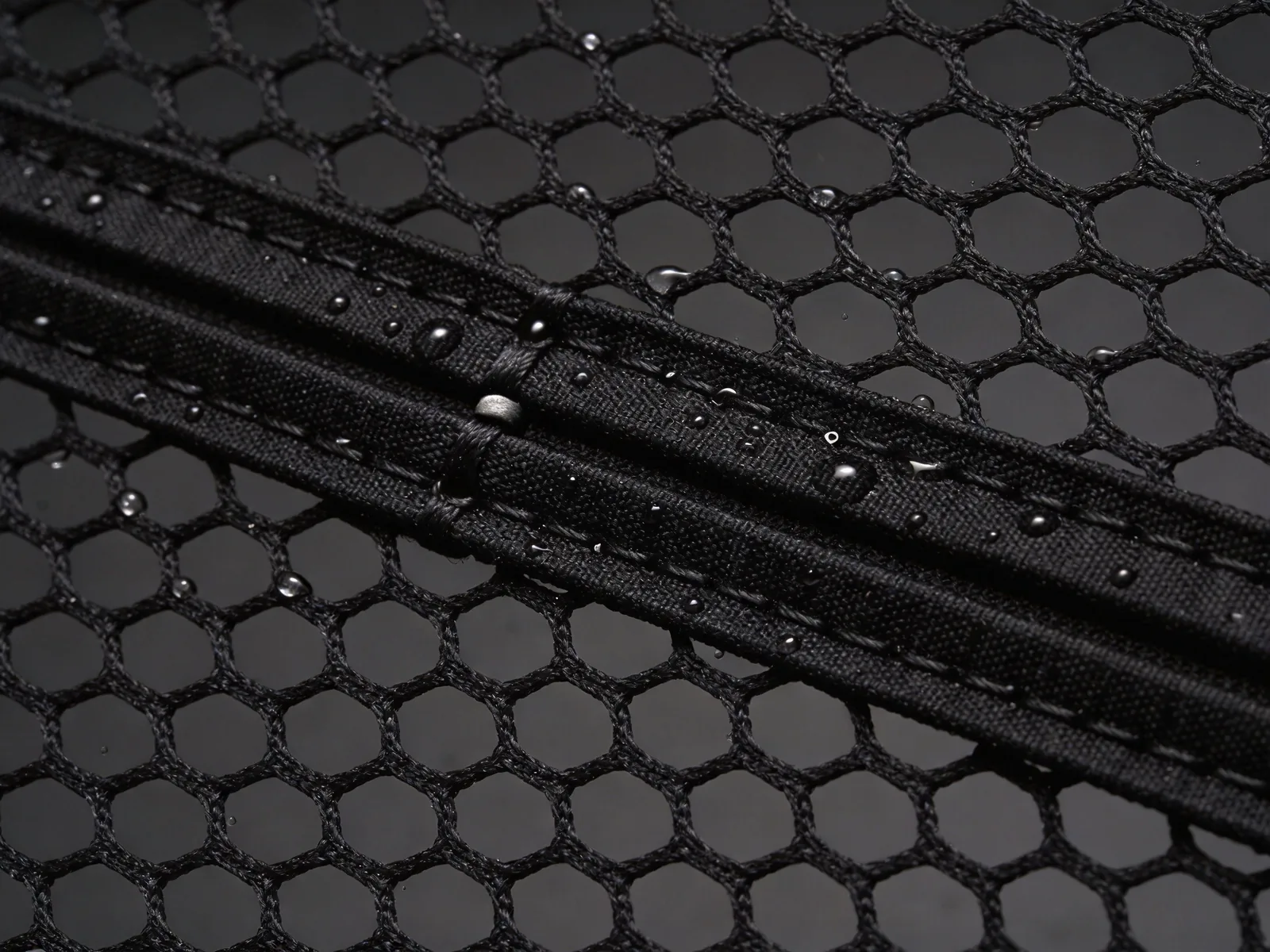
6 mm hexagonal polyester mesh, 1.2 mm strand, roughly 69% open area, finished with a double-fold binding and a bar-tack where the panel meets the base. The binding is where a mesh bag lives or dies.
Four Volumes, One Pattern Family
We build the mesh dive bag as a single pattern family in four volumes. That matters commercially: the binding width, the strap anchors, the base construction and the bar-tack spacing are identical across the four, so a brand can launch a 30 L and an 80 L in the same order without paying twice for patterns, and a rental fleet can standardise on one repair kit.
| Volume | Packed dimensions (cm) | Empty weight | What it carries | Carton / loading | Typical buyer |
|---|---|---|---|---|---|
| 30 L | 58 × 30 × 26 | 480 g | Mask, snorkel, computer, rash vest, small fins | 24 pcs per 0.060 CBM carton | Snorkel tours, resort shops, travel retail |
| 50 L | 68 × 34 × 30 | 610 g | Wetsuit, mask, fins, regulator bag, towel | 18 pcs per 0.066 CBM carton | Day-boat operators, DTC brands |
| 80 L | 75 × 38 × 34 | 740 g | Full kit: BCD, regulator, wetsuit, fins, weights, mask | 12 pcs per 0.072 CBM carton | Dive retail, private label, liveaboard |
| 110 L | 85 × 42 × 38 | 880 g | Two kits, or one kit plus rental stock | 8 pcs per 0.080 CBM carton | Rental fleets, dive schools, club programmes |
The 80 L is the volume product and the one we recommend for a first order, because it is the smallest volume that genuinely takes a complete single-tank kit: a BCD at 3–4 kg packed, a regulator set in its own pouch, a 5 mm wetsuit, a pair of open-heel fins, 4–6 kg of lead and a mask. The 110 L exists for the rental counter, where the bag is loaded by staff rather than by the diver and the load is a two-kit rotation. The 30 L is not a scaled-down toy — it is the snorkel-tour format, and it is the fastest-moving SKU in resort retail because it fits a luggage allowance and sells at an impulse price.
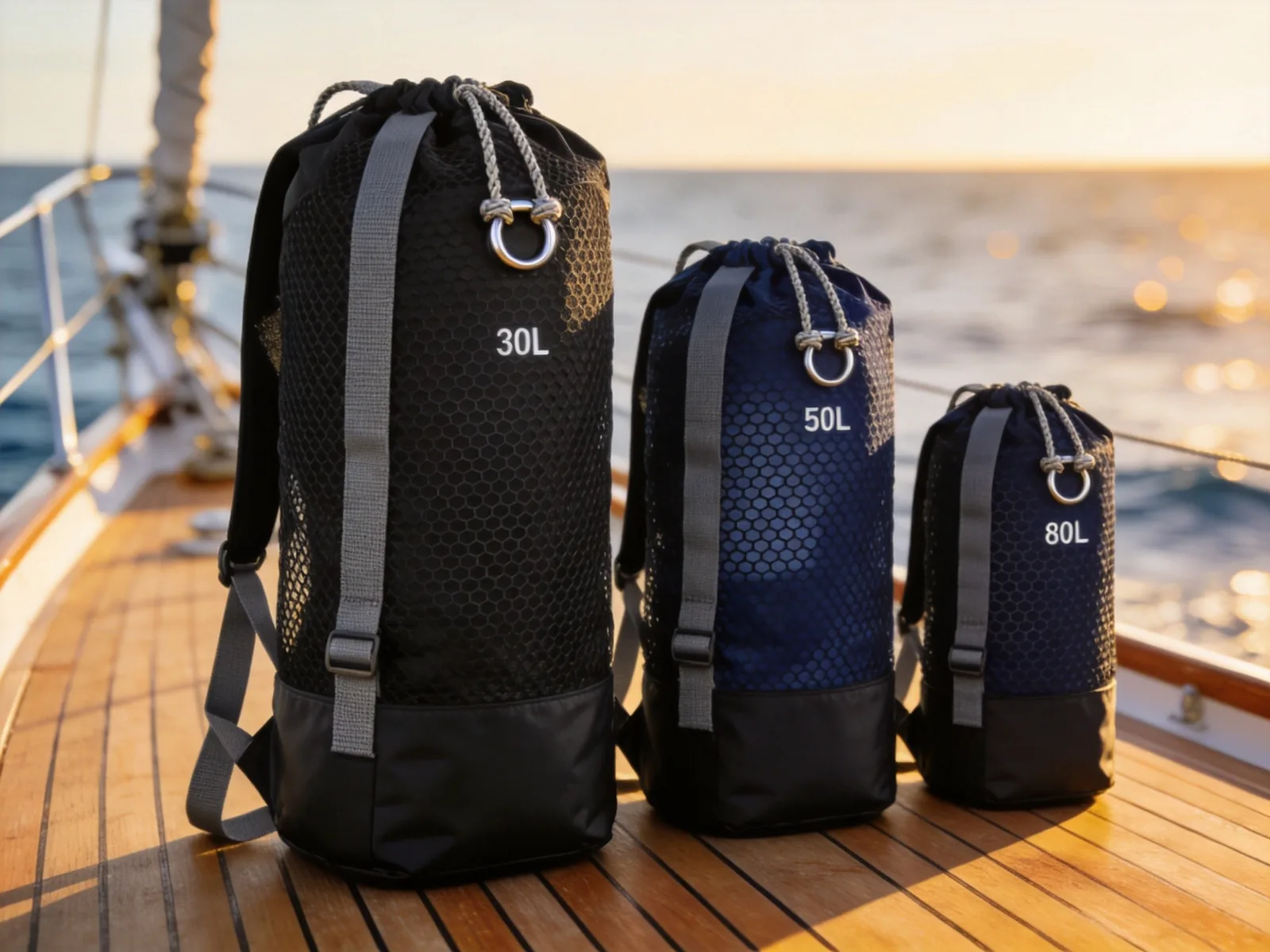
One pattern family in three volumes — 30 L, 50 L and 80 L. Same 25 mm binding, same box-X strap anchors, same base construction, so a range launches on one pattern bill and one repair kit.
One sizing note that prevents returns: measure the longest item, not the biggest volume. A pair of open-heel fins in a size XL is 68–72 cm, which is why the 50 L is 68 cm and the 80 L is 75 cm. If your range includes long-blade freediving fins at 90–105 cm, no dive bag volume solves it; that is the long fin bag pattern.
Construction: the Eight Places a Mesh Bag Fails
A mesh bag has no frame, no padding and no rigid panel to spread a load. Every kilogram in it hangs on stitching, and stitching fails in a predictable order. The table below is the specification we build to, written as the failure it prevents — which is also the most useful format for a QC checklist, because each row can be inspected in seconds on the line.
| # | Failure point | What happens in service | Our specification |
|---|---|---|---|
| 1 | Mesh tearing out of the binding | Wet 15 kg load pulls the mesh through single-fold tape; the bag opens along the side seam | Double-fold 25 mm polyester binding, two rows of stitching at 3.5 stitches/cm, 8 mm bite into the mesh |
| 2 | Seam creep between bar-tacks | Mesh stretches 6–9% when wet; unsupported spans open up | Bar-tack every 100 mm on all mesh-to-binding seams, 96 bar-tacks per 80 L bag |
| 3 | Base seam failure | The base carries the entire wet load and is the first seam to go | Three-row stitch, 25 mm binding, plus a 20 mm webbing band around the base perimeter |
| 4 | Base panel delamination | PVC coating separates from the weave after chlorine and heat cycles | 600D PVC-backed panel, 0.35 mm coating, RF-weldable, tested at 60 °C for 72 h |
| 5 | Strap anchor pull-out | The shoulder strap tears out of the bag with a full load on a boat ladder | Box-X anchor on a bonded 60 × 40 mm patch, 500 N static pull, 51 kg |
| 6 | Hardware seizure | Nickel-plated steel buckles corrode solid in salt within weeks | Acetal (POM) buckles and cord locks; 316 stainless D-rings only; no plated steel anywhere |
| 7 | Cord wear at the top | Drawstring frays at the eyelet, then the bag will not close | 5 mm braided polyester cord, brass-free acetal eyelet, 8 mm binding channel |
| 8 | Mildew and odour | Water sits in the base corner and the bag smells permanently | 10 mm acetal drain grommet in the lowest corner, mesh gusset to floor level, no closed lining |
Two of these eight rows carry most of the cost and all of the reputation. The binding is where a cheap mesh bag announces itself: single-fold tape, one row of stitching, 6 mm bite, and the mesh pulls out at the first lift with a full load. The upgrade to double-fold tape with a second row costs about USD 0.34 per bag at 500 pieces and roughly doubles the service life. The bar-tack programme costs USD 0.11 per bag and is the difference between a bag that holds its shape for five seasons and one that sags into a sack by the end of the first.
The third row — the base — deserves a note of its own. On a mesh bag, the base is the only closed panel, so it takes 100% of the wet load and 100% of the abrasion from being set down on concrete, boat decks and car park tarmac. We build it as a separate panel, not as a continuation of the mesh, because a mesh base either tears at the fold or holds water. The base is 600D polyester with a 0.35 mm PVC back, bound with 25 mm tape, stitched three rows, and wrapped in a 20 mm webbing band that takes the abrasion instead of the seam. If your target market is rental or liveaboard, the base goes to 1680D and the webbing band to 25 mm for USD 0.62 more.
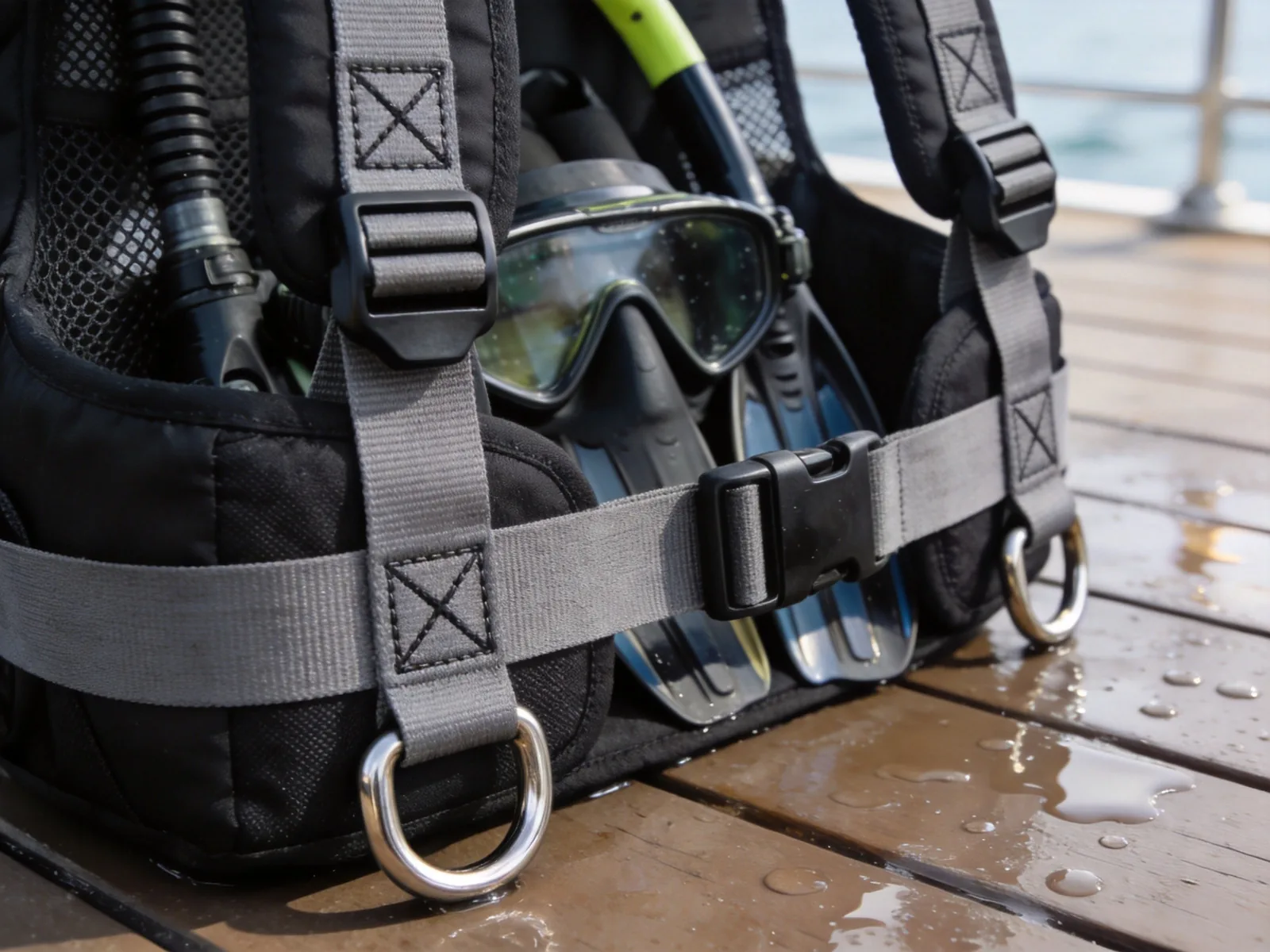
Base assembly and load path: 600D PVC-backed base panel with a 20 mm webbing band, box-X strap anchors on bonded patches, acetal side-release buckles and a 316 stainless D-ring. Everything that touches salt is either plastic or 316.
The 740 g Weight Budget, Assembly by Assembly
Weight is the second number a buyer checks after price, and on a mesh bag it is almost entirely fabric and webbing rather than hardware. The budget below is our standard 80 L build at 740 g, tolerance ±5%, which is 37 g. We weigh five pieces per carton on the line, because a mesh bag that drifts 60 g heavy is usually a binding width that has been quietly increased and will show up as a cost variance on the next PO.
| Assembly | Weight | Share | What moves it |
|---|---|---|---|
| 420D polyester hex mesh body (2 panels + gusset) | 270 g | 36.5% | Aperture and yarn count; 500D adds 40 g |
| 600D PVC-backed base panel | 142 g | 19.2% | 1680D base adds 55 g; HDPE stiffener adds 38 g |
| 25 mm polyester binding tape (12.4 m) | 58 g | 7.8% | Double-fold vs single-fold: +14 g |
| 25 mm webbing straps and haul handle | 86 g | 11.6% | 38 mm webbing adds 26 g |
| Shoulder strap with 8 mm EVA pad, 2 anchors | 64 g | 8.6% | Detachable strap and clips add 45 g |
| 5 mm braided polyester drawstring and cord lock | 22 g | 3.0% | A #10 zip instead adds 48 g |
| Acetal buckles, two 316 SS D-rings, drain grommet | 48 g | 6.5% | Steel hardware adds 60 g and rusts |
| Thread, bar-tacks, seam tape | 32 g | 4.3% | Bar-tack density |
| Labels, hangtag, print | 18 g | 2.4% | Woven label vs printed |
| Total | 740 g | 100.0% | ±37 g at ±5% |
Percentages are rounded to one decimal, so the column may differ from 100.0% by 0.1. The useful reading is the top two rows: 56% of the bag is two fabrics, which means weight is a purchasing decision before it is an engineering one. Dropping the base from 600D to 420D saves 46 g and USD 0.31, and costs you the only abrasion-resistant panel on the product — a trade we refuse for retail but accept for promotional 30 L bags that never touch concrete.
Base, Straps and the Load Path: 30 kg Static, 500 N Anchors
The load path on a mesh dive bag runs from the shoulder strap, through two box-X anchors, into the base webbing band, and nowhere else. There is no frame to redistribute force, so every component in that chain has to be sized against the wet load, not the dry one. A full 80 L kit is 14–16 kg dry and 18–20 kg after a dive, because a 5 mm wetsuit holds 2–3 kg of water and the mesh holds another 0.4 kg. We specify against 20 kg service load and test to 30 kg static for 24 hours.
- Strap anchors: box-X on a bonded 60 × 40 mm patch, four bar-tacks per anchor, tested to 500 N (51 kg) static pull — two and a half times the service load. The bonded patch spreads the force over 24 cm² so the mesh is never asked to carry a point load.
- Haul handle: 25 mm webbing, bar-tacked at both ends, tested to 250 N (25.5 kg) because one hand lifts the bag off a deck while the other hand holds a ladder.
- Shoulder strap: 38 mm webbing over an 8 mm EVA pad, 55–65 cm adjustable, anchored at the base band rather than the mid-panel. A strap anchored above the mid-line tips the bag forward and the base corner digs into the wearer’s back, which is the second most common ergonomic complaint after sand weight.
- Base band: a continuous 20 mm webbing loop around the base perimeter, stitched through the base binding. This is the component that converts a strap pull into a distributed load, and it is the first thing we remove when a buyer asks for a USD 0.40 cost reduction — and the first thing we add back after the first claim.
Two design details cost nothing and prevent most field failures. First, put the drain grommet at the lowest point of the base when the bag is standing, not in the centre — a centred grommet leaves a 10 mm puddle in a corner that never dries. Second, carry the mesh gusset to floor level so the base is a shallow tray rather than a bucket; a 40 mm tray drains in seconds, a 120 mm bucket holds a litre.
Salt, UV and Chlorine: the Three Degraders
A mesh dive bag lives in the worst environment a sewn product can be sold into. It is stored wet, dried in direct sun, rinsed in chlorinated pool water, and packed into a hot vehicle between dives. Each of those three exposures attacks a different component, and each has a cheap countermeasure that belongs on the spec sheet rather than in a brochure.
| Degrader | What it attacks | Field symptom | Specification response | Bench test |
|---|---|---|---|---|
| Salt water | Hardware, thread, base coating | Buckles seize; stitching wicks salt and stiffens; coating blisters | Acetal + 316 SS only; bonded polyester thread; 0.35 mm PVC back | 48 h neutral salt spray (ASTM B117); 20 rinse cycles |
| UV | Mesh yarn, webbing, cord | Mesh goes chalky and loses 30–50% strength in one summer; webbing fades | UV-stabilised polyester with 0.3–0.5% HALS; dope-dyed black as default | 300 h QUV (ASTM G154), ≤20% strength loss |
| Chlorine | Elastane, coating, print | Print flakes; coating yellows; elastic in the cord lock weakens | No elastane in load paths; silicone-free print; acetal springs | 50 pool-water soak cycles at 30 °C; colourfastness ISO 105-E03 |
| Heat + wet storage | PVC coating, mould | Mildew smell that never leaves; coating tacky | Open mesh, drain grommet, no closed lining, anti-mildew finish optional | 72 h at 60 °C and 90% RH; 7-day wet-bag odour panel |
The UV row is the one buyers underestimate. A mesh bag used by a dive centre is in the sun perhaps 1,500 hours a year, and unstabilised polyester mesh at 420D loses roughly half its tear strength over one season in Florida or Queensland conditions. The fix is not exotic: UV-stabilised yarn with a HALS package, dope-dyed rather than piece-dyed, adds about USD 0.18 per bag at 500 pieces. We specify it as standard on all mesh, and we will not quote an unstabilised mesh for a product sold into a sunbelt market, because the failure arrives inside the warranty window.
Hardware: Acetal, 316 Stainless, and Why No Nickel-Plated Steel
The fastest way to ruin a good mesh bag is to fit it with the hardware that looks best in a sample photograph. Nickel-plated steel is bright, cheap and available in every buckle shape a designer wants; it also corrodes in salt water within two to four weeks of regular use, and once a side-release buckle seizes, the bag is functionally dead even though the fabric is fine.
| Component | Material we specify | Why | Cost vs plated steel |
|---|---|---|---|
| Side-release buckles | Acetal (POM) copolymer | No metal spring to seize; survives −20 to 80 °C; 60 kg rated | +USD 0.09 per set |
| Cord locks | Acetal body, stainless-free spring | Operates with wet or sandy hands; no corrosion path | +USD 0.03 |
| D-rings | 316 stainless, 3 mm wire | Load-bearing accessory point that must not pit | +USD 0.11 each |
| Drain grommet | Acetal, 10 mm | No brass to dezincify; press-fit, no rattle | +USD 0.04 |
| Zipper (if specified) | #10 plastic coil, corrosion-resistant slider | Coil zips tolerate sand better than metal; no teeth to seize | +USD 0.42 vs #8 metal |
| Webbing adjusters | Acetal ladder locks | Grip on wet 25 mm webbing without teeth | +USD 0.05 |
Total hardware difference against a plated-steel build is about USD 0.38 per bag at 500 pieces, or 3% of FOB. It is the single highest-return 3% in the product, because hardware corrosion is what generates the one-star review, and a review about a rusted buckle is not answered by a fabric upgrade.
Closure Systems: Drawstring, Zip, Roll-Top or Fold-Over
The top of a mesh bag is the interface the customer touches every dive, and it decides both the price and the failure mode. Four options are standard in our pattern library; all four fit the same body.
| Closure | Opening speed | Sand tolerance | Water shedding | Added cost | Best for |
|---|---|---|---|---|---|
| Drawstring with cord lock | Fast, one hand | Excellent | None (by design) | Base | Retail 30–80 L, the default |
| #10 plastic coil zip | Medium, two hands | Good if taped | Partial | +USD 0.42 | Travel bags where gear must not spill |
| Roll-top with side buckle | Slow | Good | Good | +USD 0.58 | Boat decks, wet-deck transport, hybrid mesh/dry |
| Fold-over with hook-and-loop | Fastest | Poor — grit clogs the hook | None | +USD 0.12 | Rental and school fleets only |
Our default recommendation is the drawstring with a 5 mm braided cord and an acetal cord lock: it opens with one hand while the other holds a mask, it does not care about sand, and it has no mechanism to fail. A zip is worth specifying only if the bag will be checked as airline luggage, where a spill matters more than a fast opening — and if you do, insist on a plastic coil rather than a metal zip, for the same reason the buckles are acetal.
Bill of Materials at USD 12.80 FOB
The BOM below is the 80 L standard build at 500 pieces, ex-works to FOB. It is the document we hand to a buyer who asks where the money is, and it is deliberately itemised to the point where a sourcing manager can argue with a line rather than with a total.
| Line | Component | USD / pc | Share of FOB | Lever |
|---|---|---|---|---|
| 1 | 420D UV-stabilised hex mesh fabric | 2.69 | 21.0% | Yarn count; 500D adds USD 0.44 |
| 2 | 600D PVC-backed base fabric | 1.15 | 9.0% | 1680D adds USD 0.62 |
| 3 | 25 mm binding tape and webbing | 1.41 | 11.0% | Single-fold saves USD 0.34, halves life |
| 4 | Shoulder strap, EVA pad, anchors | 1.02 | 8.0% | Detachable strap adds USD 0.71 |
| 5 | Hardware: acetal, 316 SS, grommet | 0.90 | 7.0% | Plated steel saves USD 0.38, rusts |
| 6 | Thread, bar-tacks, seam finishing | 0.51 | 4.0% | Bar-tack density |
| 7 | Decoration (print or woven label) | 0.38 | 3.0% | Colour count |
| 8 | Labour (cut, sew, bind, bar-tack, trim) | 2.82 | 22.0% | Seam design, not wage |
| 9 | Overheads and packing | 1.15 | 9.0% | Polybag vs retail carton |
| 10 | Factory margin | 0.77 | 6.0% | — |
| Total FOB | 12.80 | 100.0% |
Two lines are worth arguing about and eight are not. Line 8, labour at 22%, is the highest in the dive range and it is structural: 12.4 m of binding, 96 bar-tacks and two strap anchors cannot be automated at our volumes, and the only way to reduce it is to simplify the seam — for example by replacing the bound gusset with a single folded panel, which saves USD 0.29 and costs 12% of the strength margin. Line 5, hardware at 7%, is where a buyer is most often tempted, and it is the one line we push back on hardest. The other eight are market-priced inputs and moving them simply moves quality.
Price Ladder, Tooling and Amortisation
A mesh dive bag prices on a shallow curve, because so much of the cost is labour and labour does not scale with quantity the way fabric buying does. The ladder below is our standard 80 L build; the same percentages apply across the four volumes.
| Quantity | FOB / pc | vs 500 | What drives the reduction |
|---|---|---|---|
| 500 pcs | USD 12.80 | — | Base price; pattern and screens amortised in the run |
| 1,000 pcs | USD 12.03 | −6.0% | Fabric bought in full rolls; cutting made economical in 100-piece lays |
| 2,000 pcs | USD 11.52 | −10.0% | Binding and webbing in mill lots; line stays set up between runs |
| 5,000 pcs | USD 10.88 | −15.0% | Yarn-dyed mesh commitment; dedicated bar-tack station |
Tooling is small on this product, which is one of its commercial advantages over a moulded or wheeled bag:
- Pattern and sample set: USD 350–600 one-off. At 500 pieces that is USD 0.70–1.20 per bag; at 2,000 pieces, USD 0.18–0.30.
- Screen print frame: USD 45–90 per colour. A one-colour logo on the base panel is therefore USD 0.09–0.18 per bag at 500.
- Woven label die: USD 60–120, reusable across every future order and every volume.
- Embroidery disk: USD 60–120 if the logo is stitched rather than printed.
- Heat-transfer plate: USD 120–260 for a multi-colour panel.
Total realistic tooling for a first order is USD 400–800, or USD 0.80–1.60 per bag at 500 pieces. That is why we recommend launching a mesh programme before a structured gear bag programme: the tooling exposure is a tenth of the cost of a hood mould or a clamshell, and the money is better spent on the second colourway than on a mould.
Sampling in 6–10 Working Days
Sampling runs in four stages, and the clock starts when the specification is locked in writing — aperture, volume, base fabric, closure, hardware, colourway, artwork and target price. A sample built against a verbal brief is a sample that gets remade, and the remake is what turns a 10-day sampling promise into three weeks.
| Stage | Days | What happens | What you receive |
|---|---|---|---|
| 1. Spec lock and pattern check | 1–2 | Aperture and open area confirmed, volume checked against the longest item in the kit, base and closure fixed | Dimensioned drawing, mesh data sheet, BOM at your quantity |
| 2. Cut and pre-assembly | 3–5 | Mesh and base cut, binding prepared, bar-tack positions marked, hardware pulled from stock | Cut-panel photo set, hardware confirmation |
| 3. Sew and assemble | 5–8 | Panels bound and joined, base three-row stitched, straps box-X anchored, closure fitted | In-process photos at three checkpoints |
| 4. Load, drain and function review | 8–10 | 30 kg static load, 500 N anchor pull, drain timing with an 80 L fill, hardware cycle test, artwork check | Physical sample, test sheet with numbers, freight weight and cube |
Two revision rounds are included. A third round is normally a design change rather than a correction and is charged at USD 45–90 per sample. Samples are charged at cost and refunded on the bulk order, and we courier with the carton cube and the actual piece weight on the paperwork, because a mesh bag’s freight is decided by cube and most buyers are surprised by how small it is.
Bulk Production in 35–50 Days
Bulk runs 35–50 days after sample approval and deposit, across eight stages. The spread is not padding: it reflects where the queue actually forms, which on a mesh bag is the binding and bar-tack stations rather than fabric.
| Stage | Day | Output |
|---|---|---|
| 1. Material in and inspection | 1–7 | Mesh rolls, base fabric, webbing, hardware received and checked against the approved sample |
| 2. Cutting | 5–9 | Mesh panels, gussets, bases cut in 100-piece lays |
| 3. Binding and panel assembly | 8–18 | Double-fold binding, two-row stitching, panel joins |
| 4. Base and strap assembly | 16–26 | Three-row base stitch, webbing band, box-X anchors |
| 5. Top closure and hardware | 24–32 | Drawstring channel or zip, cord lock, D-rings, drain grommet |
| 6. Trimming and bar-tack QC | 30–36 | Thread trim, bar-tack count audit, hardware function check |
| 7. Final inspection | 36–42 | AQL 2.5 major / 4.0 minor, plus the 12 bench tests on a sample set |
| 8. Packing and carton handover | 40–50 | Polybag or retail carton, carton marking, loading plan |
Three things move the date and should be settled at sampling, not after the deposit. Custom-dyed mesh adds 10–15 days, because mesh is dyed in beam lots and a colour match on an open weave is harder than on a solid fabric. Yarn-dyed black is faster and more UV-stable than piece-dyed, and it is what we recommend unless the colour is the product. The March to May pre-season window adds 7–10 days across the board, so a programme aimed at a June retail set needs a deposit in February. And if the closure is a zip, the slider and tape are the longest-lead hardware at 12–18 days; we confirm them at sampling so they are on site before cutting finishes.
Twelve Tests and Five Inspection Gates
Every mesh bag specification on this page is backed by a bench test, because the failure modes are cheap to reproduce and expensive to discover in a customer’s hands. These are our own protocols, not third-party certification, and we will prepare samples if you want a lab report commissioned in your own name.
| # | Test | Method | Acceptance |
|---|---|---|---|
| 1 | Static load | 30 kg in the bag, suspended by the shoulder strap, 24 h | No seam failure, no anchor movement >2 mm |
| 2 | Strap anchor pull | 500 N static on each anchor, 60 s | No pull-out, no mesh distortion |
| 3 | Haul handle pull | 250 N static, 60 s | No bar-tack failure |
| 4 | Mesh burst | Tongue tear on 6 mm mesh, 5 specimens | ≥400 N average |
| 5 | Drawstring cycle | 5,000 open/close cycles with a 10 kg load | No cord fray, cord lock still grips |
| 6 | Zip cycle (if specified) | 3,000 cycles under 5 kg load, sand-contaminated | No slider jump, no tooth separation |
| 7 | Salt spray | 48 h neutral salt spray on hardware and stitching | No red rust; buckles operate by hand |
| 8 | UV ageing | 300 h QUV, mesh and webbing | ≤20% tensile loss, no chalking |
| 9 | Chlorine soak | 50 cycles in pool water at 30 °C | No coating blister, no print flake |
| 10 | Abrasion | Taber, 1,000 cycles on the base panel | No coating breakthrough |
| 11 | Loaded drop | 1.2 m onto six faces and three edges, 18 kg load | No seam opening, hardware intact |
| 12 | Hot wet storage | 72 h at 60 °C / 90% RH, then 7-day odour panel | No mildew, no tacky coating |
Five inspection gates run alongside the tests, and each one exists because a specific defect class gets past a single end-of-line check: gate 1 incoming fabric (aperture measured, open area calculated, UV certificate checked); gate 2 cut panels (count and dimensions against the pattern); gate 3 in-line seam audit (first 20 pieces, then every 50th, measuring stitch density and bar-tack spacing); gate 4 pre-final (hardware function, drain timing, weight against the 740 g budget); gate 5 final AQL 2.5 major / 4.0 minor. Four defects are treated as critical with zero acceptance: a missed bar-tack on a strap anchor, a single-row base stitch, plated steel hardware anywhere, and a drain grommet that is not at the low point.
Packing, Cubic and Landed Cost
Freight is where a mesh bag wins against every other product in a dive range. It is light, it folds flat, and it nests, so a container carries an enormous number of pieces relative to value.
| Packing | Carton | Pcs / carton | CBM / pc | 40HQ loading | Ocean freight / pc at USD 2,600 per 40HQ |
|---|---|---|---|---|---|
| Polybag, export carton (standard) | 60 × 40 × 30 cm | 12 | 0.0060 | 11,328 pcs | USD 0.23 |
| Individual retail carton | 42 × 32 × 6 cm | 1 | 0.0081 | 8,432 pcs | USD 0.31 |
| 20GP reference, polybag | 60 × 40 × 30 cm | 12 | 0.0060 | 5,496 pcs | USD 0.47 |
Landed cost at the destination port gate, before duty, on the standard build:
- FOB: USD 12.80
- Ocean freight, 40HQ at 11,328 pcs: USD 0.23
- Marine insurance at 0.4%: USD 0.05
- Destination THC and documentation, allocated: USD 0.35
- Landed before duty: USD 13.43 per piece
Duty is your own classification decision and we do not quote rates; we supply an HS code proposal and a packing list, and your broker confirms the entry. The point of the table is different: on a USD 12.80 bag, freight is 1.7% of landed cost, so the way to improve landed cost is the FOB line, not the container plan. That is the opposite of a rolling gear bag, where cube dominates, and it is why we will argue with a buyer about binding tape for an hour and about packing for two minutes.
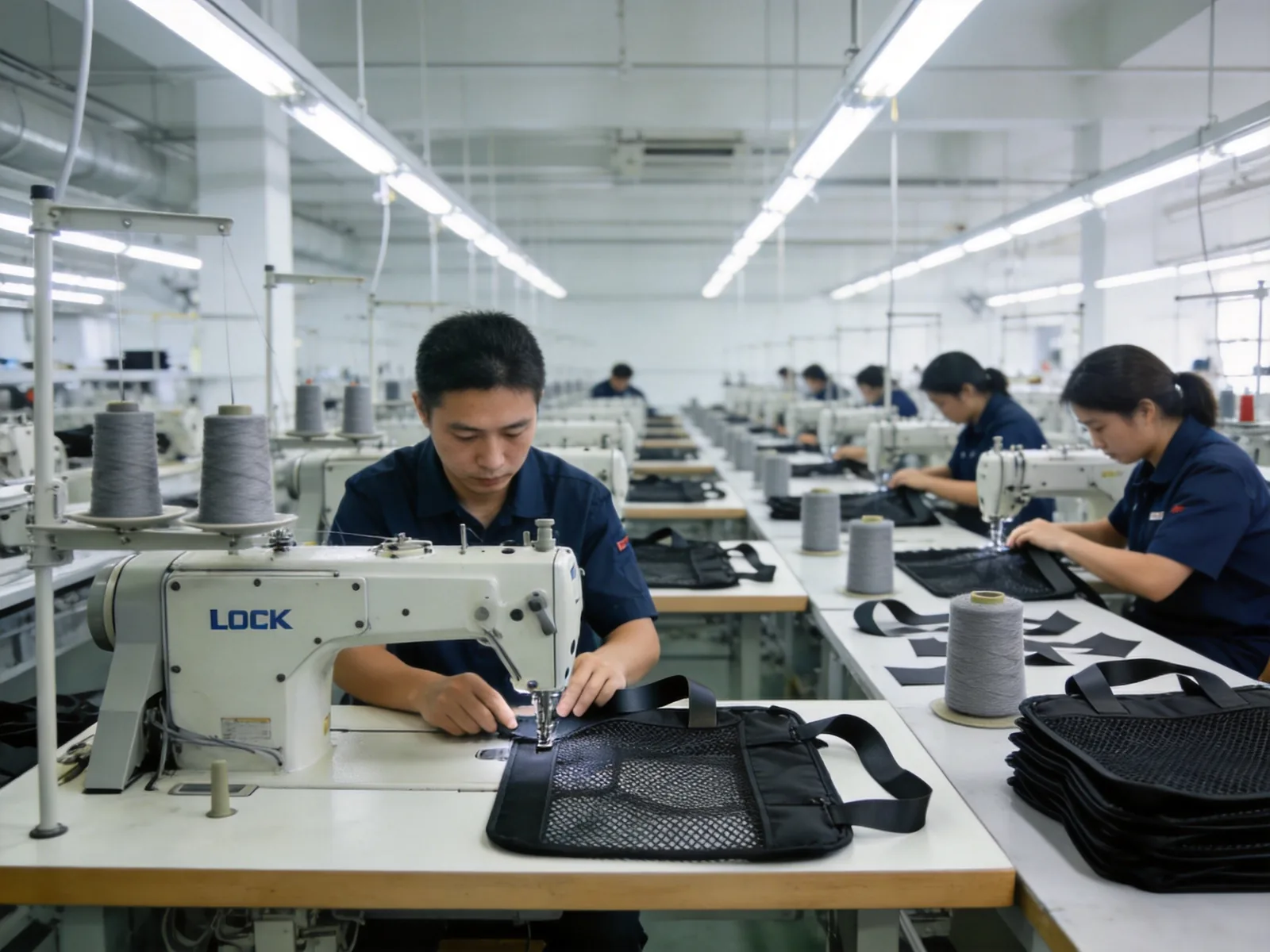
Binding and bar-tack stations on the mesh line. A mesh bag is a stitching product: 12.4 m of binding and 96 bar-tacks per 80 L piece, which is why 22% of FOB sits in labour.
Six Channels and How the Specification Changes
The same 80 L pattern sells into six channels, and each one moves three or four specification lines. Getting the channel right before the sample saves a remake.
| Channel | What they buy | Specification shift | Typical quantity |
|---|---|---|---|
| Dive retail / local dive shop | Branded 50–80 L, drawstring, visible logo | 6 mm mesh, 420D, print on base panel, retail carton | 300–800 per colour |
| Liveaboard and boat operators | 80–110 L, heavy use, fleet marking | 8 mm mesh, 1680D base, roll-top or zip, name panel | 100–400 |
| Rental fleets and dive schools | 110 L, numbered, repairable | 8–10 mm PVC-coated mesh, steel-free hardware, 1% spares, no decoration | 200–1,000 |
| Snorkel and resort tours | 30 L, light, cheap, colourful | 4 mm mesh, 420D base, fold-over closure, multi-colour print | 500–2,000 |
| Private-label DTC brands | 50–80 L, premium finish, packaging | 6 mm UV-stabilised, 600D base, detachable strap, woven label, retail carton | 500–1,500 |
| Marketplace (Amazon and EU equivalents) | 80 L, one SKU, tight landed cost | 6 mm, 600D base, polybag, FBA carton and label programme | 1,000–3,000 |
Two shifts are worth flagging because they are routinely missed. A rental fleet needs the bag to be repairable, not pretty: it wants a solid base, steel-free hardware, a numbered name panel and a 1% spares shipment of buckles and cord, because a rental bag is retired by a broken buckle, never by worn mesh. A marketplace seller needs the opposite discipline: one SKU, one colour, a carton that survives a parcel network, and a landed cost that leaves room for a 15% referral fee — which is why the polybag build at USD 0.23 freight is the right choice there and the retail carton is not.
Private Label, Decoration, ECN and Reorders
Decoration on a mesh bag is constrained by the substrate: you cannot print fine detail across an open weave and expect it to survive a season. The base panel and the solid webbing are the printable surfaces, and the mesh itself is best left for a woven label or a stitched patch.
- Screen print on the base panel: the cheapest durable option, USD 45–90 per colour for the frame and USD 0.09–0.18 per bag at 500. Maximum three colours before registration becomes visible on a 600D surface.
- Woven label: the premium option for a mesh body, USD 60–120 for the die and USD 0.06–0.11 per label. Sewn to the binding so it does not float on the open weave.
- Embroidery: works on the base and the strap pad, not on mesh. A 60 × 25 mm logo is USD 0.14–0.26 per bag at 500.
- Heat transfer: best for multi-colour artwork, USD 120–260 for the plate, USD 0.12–0.22 per bag. Avoid on PVC-coated surfaces unless the film is specified for it.
Engineering change notices are handled as a written ECN against the approved sample, with a photograph of the affected component and a cost and lead-time delta. Anything that touches the mesh aperture, the base fabric or the hardware is treated as a new sample, because those three change the load path. Reorders with no change run in 25–30 days rather than 35–50, since the pattern, screens and labels already exist and the line is set up from the same drawings. We ship spares at 1% of order quantity — buckles, cord locks, grommets and cord — packed and marked separately, at roughly USD 0.19 per bag, which removes most of the first-year after-sales friction for a fleet buyer.
Compliance Boundaries — What We Do and What We Do Not
We are a manufacturer, not a certification body, and the distinction matters when a buyer’s compliance team asks for paperwork.
- We provide: material declarations from our mills; a REACH SVHC statement at material level; a California Proposition 65 statement on the components we buy; UV-stabilisation confirmation for the mesh; packing lists with an HS code proposal; and samples for any test you commission in your own name.
- We do not provide: CE, UKCA or CPSIA certificates; we are not an EU authorised representative, a GPSR responsible person or a testing laboratory, and we will not sign a declaration in those capacities.
- What we will do: build to a specification that makes your own compliance route straightforward — documented materials, no undeclared coatings, no plated steel in a salt-water product, and a bill of materials that matches what ships.
One practical note for the EU and UK: mesh dive bags are usually outside the PPE and diving-equipment directives because they carry gear rather than protect a person, but they are still in scope for general product safety, chemical restrictions and, from 2025 onward in the EU, GPSR traceability. You appoint the responsible entity; we support it with documents, samples and a stable BOM.
Twelve Questions to Ask Any Supplier — Including Us
These are the questions we would ask if we were buying, and every one of them has a numeric answer. A supplier who replies with adjectives is a trading company, which is not automatically wrong, but it changes who owns the claim when the first binding tears out.
- What is the mesh aperture, the strand diameter and the calculated open area, and what is the measured drain time on an 80 L fill?
- Is the mesh UV-stabilised, at what HALS loading, and can you show a 300-hour QUV result?
- How many rows of stitching hold the binding, what is the stitch density, and how deep is the bite into the mesh?
- What is the bar-tack spacing on mesh-to-binding seams, and how many bar-tacks are on an 80 L bag?
- How is the base panel constructed, how many rows hold it, and is there a webbing band around the perimeter?
- What is the strap anchor construction, and what static pull does one anchor take?
- Which hardware materials are used, and is there any plated steel anywhere in the product?
- What is the empty weight and its tolerance, and how many pieces per carton are weighed on the line?
- What are the exact FOB prices at 500, 1,000, 2,000 and 5,000, and which line of the BOM changes between them?
- What is the sampling calendar in stages, how many revisions are included, and what does a third round cost?
- What is the bulk calendar in stages, and what adds days — dyeing, hardware lead time, or season?
- Who issues the compliance documents, and who is the responsible person in my market?
Frequently Asked Questions
Send the Specification, Get the Numbers
Tell us the volume, mesh aperture, base fabric, closure, hardware, colourway and quantity. We will come back with a dimensioned drawing, a mesh data sheet with calculated open area and drain time, a BOM at your quantity, the tooling list with amortisation, and a sampling slot in 6–10 working days. MOQ 500 pieces, bulk 35–50 days, AQL 2.5 major / 4.0 minor — from a bag manufacturer established in 2014, with a founder in the trade since 2004.
Related Pages on This Site
- Custom Scuba Gear Bag Manufacturer — Dive Equipment Bag OEM/ODM
- Custom Dive Backpack Manufacturer — Scuba & Freediving Backpacks
- Custom Freediving Bag Manufacturer — OEM/ODM
- Custom Long Fin Bag Manufacturer — Freediving & Spearfishing
- Custom Dry Bag Manufacturer — Waterproof Dry Sacks
- Custom Waterproof Bag Manufacturer — Roll-Top & Dry Bags
- Quanzhou Waterproof Bag Manufacturer — IPX8 and Seam Sealing
- Custom Equipment Bag Manufacturer — Sports Gear Bags
- Custom Laundry Bag Manufacturer — Nylon Mesh Bags
- Mesh vs Nylon — Ventilation in Sports Bags
- TPU vs PVC vs Nylon — Material Selection Guide
- Bag Zippers and Seams — Engineering Guide
- Waterproof Manufacturing and IPX Guide 2026
- Custom Beach Bag Manufacturer — Mesh Beach Totes
- FOB vs EXW vs DDP — Incoterms for Bag Imports
- How to Source Bags from China — Buyer’s Guide