The LED mirror cosmetic bag is the first EVA category since the molded beach tote to break out of seasonal demand. It also happens to combine three manufacturing disciplines that rarely sit inside the same product: a molded EVA shell, a sealed LED lighting module with a rechargeable battery, and a mirror surface that has to arrive intact after ocean freight and a retail DC. Brands that treat this as “a cosmetic bag with a light glued in” get return rates they did not budget for. Brands that engineer it as a small appliance that happens to be a bag get repeat orders. The difference is decided in about six specification decisions — shell wall thickness, mirror mounting method, battery placement, switch type, sealing class, and how the light module is tested before packing. JUNYUAN BAGS has manufactured molded EVA bags and cosmetic bags since 2014, from Quanzhou in Fujian. This page covers what we actually produce, the specifications that decide whether your unit survives retail handling, and how to brief a project so the first sample is close to what you can sell.
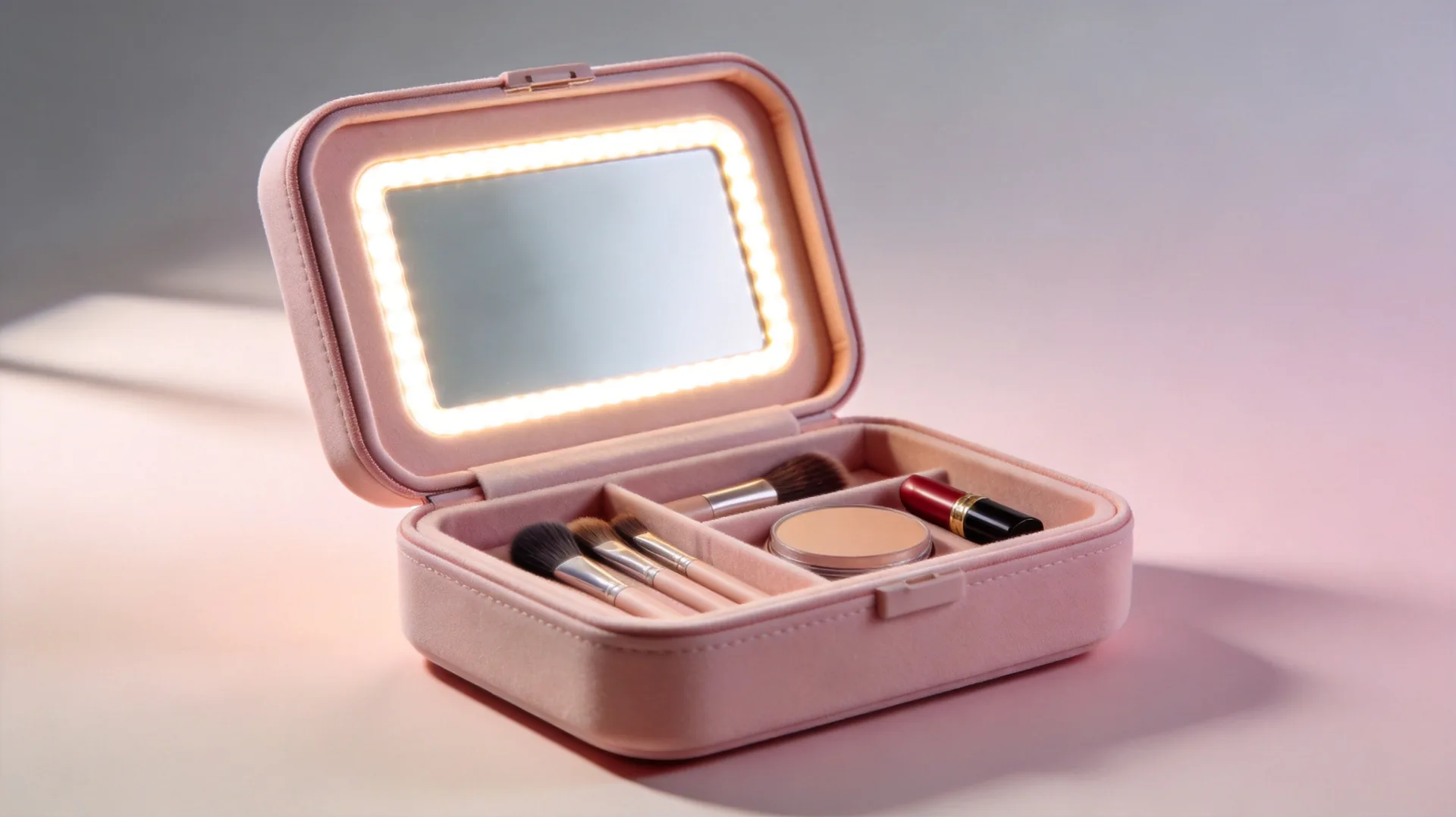
EVA LED mirror makeup bag hero — open lighted vanity case with warm-white LED ring lit, cosmetics inside, clean studio background
1. Why the LED Mirror Cosmetic Bag Became the Second EVA Breakout
Molded EVA beach totes proved that consumers will pay a premium for a bag that is waterproof, washable, and structurally rigid. The LED mirror cosmetic bag applies the same material logic to a different use case, and it does something the beach tote cannot: it creates a reason to buy a second unit.
Three demand drivers are visible in the category data our brand clients bring to us:
The mirror replaces a hotel amenity. Travelers no longer assume good lighting at the destination. A lighted case means consistent makeup application in a rental bathroom, a hostel, a cruise cabin, or an airport lounge. The purchase is triggered by a specific upcoming trip, which makes it a high-intent, low-consideration buy.
The EVA shell solves a problem fabric cases cannot. Powder spills. Liquid foundations leak. A molded EVA shell wipes clean and does not absorb pigment, which matters more in a case that opens flat on a counter than in a pouch that stays zipped.
Content drives discovery, not search. This category moves on short-form video. A ring light turning on inside a case is a visual event that photographs well and demonstrates instantly. That changes the design brief: the light has to look good on camera at 4000K, not just function in a bathroom.
What this means for a private-label buyer is that the product must satisfy two audiences at once — the end consumer who wants a clean, bright mirror, and the creator or retailer who needs it to look premium in a 12-second clip. Most failed samples we see chose one and ignored the other.
2. What We Manufacture: LED Mirror Bag Formats
We do not sell a single catalog shape. The shell format is chosen around the mirror size, the battery volume, and the way the case is meant to open. The five formats below cover the majority of private-label programs we run.
| Format | Shell size (approx.) | Mirror | Typical use case | Best-fit buyer |
|---|---|---|---|---|
| Clamshell vanity case | 24 × 17 × 9 cm | Full-lid 20 × 13 cm | Flat-open counter use, full kit | Beauty brands, gift sets |
| Zip-around travel case | 22 × 14 × 8 cm | 15 × 10 cm hinged | Luggage, carry-on | Travel accessory brands |
| Hanging toiletry organizer | 26 × 20 × 10 cm (open) | 12 × 8 cm detachable | Hotel bathrooms, dorms | DTC travel brands |
| Train case with tray | 28 × 18 × 12 cm | 18 × 12 cm lid-mounted | Pro artists, multi-layer storage | Pro beauty, salon supply |
| Compact palm case | 16 × 11 × 6 cm | 10 × 7 cm | Handbag, on-the-go touch-ups | Mass retail, subscription boxes |
Two structural choices run through all five formats.
Rigid shell versus soft-shell hybrid. A fully molded EVA shell holds its shape when open and protects the mirror, but it does not compress. A hybrid uses molded EVA panels for the lid and base with a softer EVA or laminated body, which saves freight cube and packs flatter. We recommend the rigid shell for anything above a 15 cm mirror — the lid stiffness is what prevents mirror cracking in transit.
Lid-mounted versus detachable mirror. Lid-mounted is cheaper and simpler, but the mirror angle is fixed by the hinge. Detachable mirrors with a folding stand cost more and add a failure point, but they photograph better and support the “pro artist” positioning. We quote both and let the retail price decide.
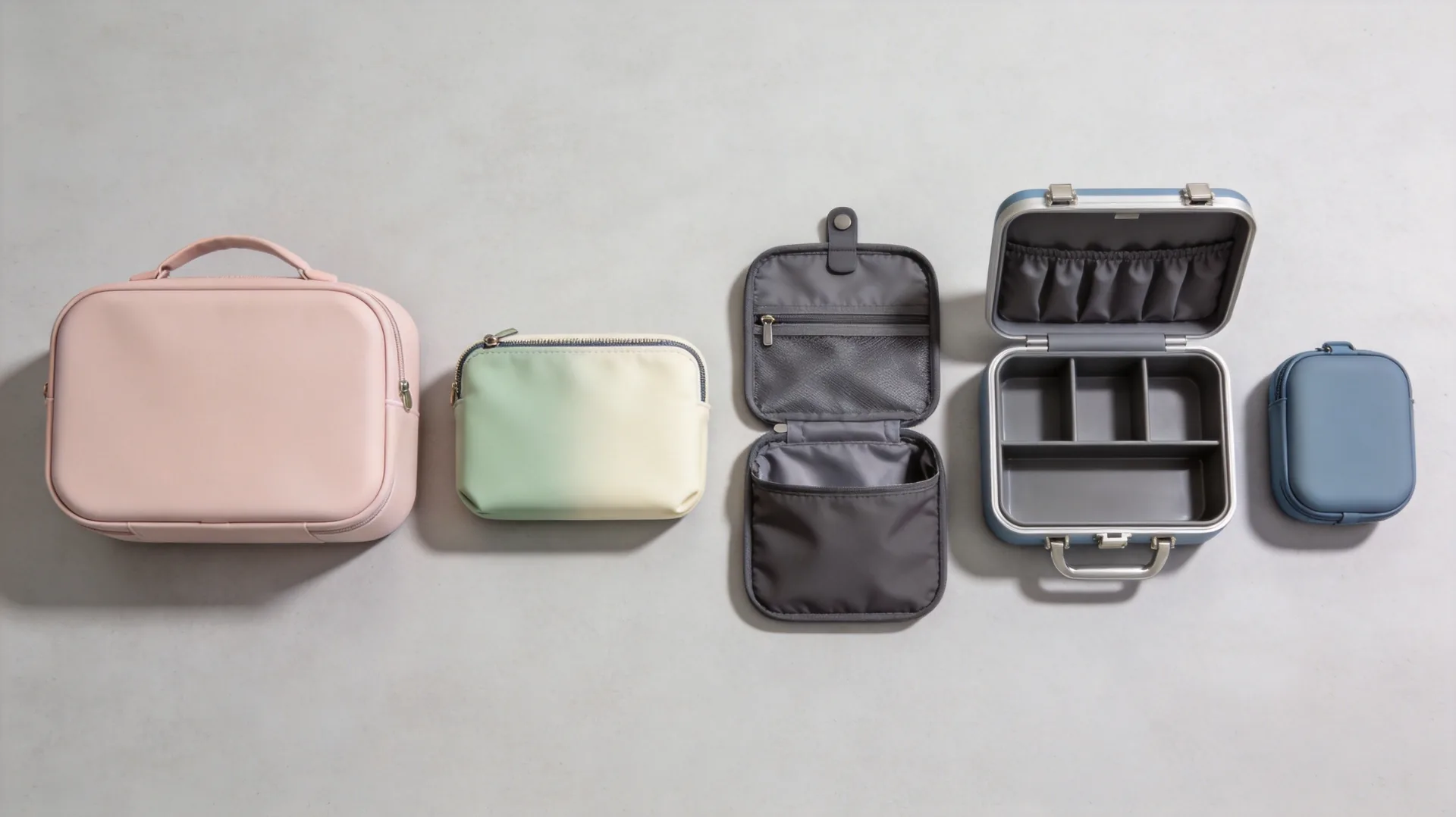
Five LED mirror bag formats laid out side by side — clamshell, zip-around, hanging organizer, train case, compact — top-down flat lay
3. EVA Shell Engineering: Wall Thickness, Density, Waterproof Rating
The shell is where most cost and most durability are decided. EVA sheet is not a commodity — density and wall thickness change the hand feel, the drop performance, and the freight weight all at once.
| Parameter | Standard range | What changes when you move it | Our default recommendation |
|---|---|---|---|
| EVA sheet thickness | 4 mm – 8 mm | Thicker resists denting and holds the lid open; adds weight and cost | 5 mm body, 6 mm lid for mirrors ≥15 cm |
| EVA density | 60 – 90 kg/m³ | Higher density feels more premium and resists compression set; lower density is lighter and cheaper | 75 kg/m³ for retail above $29 |
| Surface finish | Matte, embossed, laminated | Lamination hides mold marks and adds color depth; embossing adds grip | Matte for solid colors, laminated for prints |
| Water resistance | Splash-resistant to IPX4 | IPX4 covers counter spills and bathroom humidity; submersible ratings require a different closure | IPX4 minimum for any unit sold as “waterproof” |
| Closure type | Nylon zip, sealed zip, magnetic | Sealed zip supports higher water resistance but stiffens the opening | #5 nylon coil zip with storm flap |
| Hardware | Molded EVA handle, webbing, metal D-ring | Metal adds perceived value but must be nickel-tested for EU/US | Molded EVA handle, nickel-free metal where specified |
Two engineering notes worth stating plainly, because they come up in almost every project review.
“Waterproof” is a claim with a test behind it. A molded EVA shell is inherently water-resistant because it is closed-cell. The failure point is always the zip line and the seam where the light module is routed. If you intend to advertise waterproofing, specify IPX4 and test the zip with the light module installed — not on a bare shell. We run that test on pre-production samples and report the result rather than assuming it.
Wall thickness drives the mirror, not the other way around. Buyers usually pick a mirror size first and then ask for a shell. The correct order is reversed: the lid must be stiff enough that opening the case does not flex the mirror plane. On a 20 cm mirror, a 4 mm lid will show a visible bow at the hinge line within a few hundred open-close cycles. We specify 6 mm and a reinforced hinge plate.
4. The LED Mirror Module: What Actually Matters
This is the part of the product that generates warranty claims. A cosmetic bag has no electrical component; a lighted cosmetic bag does. The module has to survive vibration, humidity, and the way consumers charge things — which is to say, badly and with whatever cable is nearby.
| Module spec | Options | Practical guidance |
|---|---|---|
| Light temperature | Single white, or 3-color (3000K warm / 4000K natural / 6000K cool) | 3-color is the current standard for anything above $25 retail. 4000K is the default and the one that photographs best |
| Dimming | None, or stepless touch dimming | Touch dimming adds roughly a 3–5% unit cost and is the most-requested feature in reviews |
| LED count and layout | Perimeter strip, or halo ring | Perimeter strip gives even light on a rectangular mirror; halo ring is the signature look for compact cases |
| Battery | 1200 mAh – 4000 mAh Li-polymer | 2000 mAh covers roughly 2.5–3 hours at full brightness; size the battery to the mirror, not to the marketing copy |
| Charging | Micro-USB, USB-C, USB-C with PD | Specify USB-C. Micro-USB now reads as an outdated product in reviews and returns |
| Charging port sealing | Rubber plug, or sealed membrane | A rubber plug is acceptable at IPX4; a sealed membrane is required if you claim anything higher |
| Switch | Mechanical button, touch sensor, magnetic reed | Touch sensor is the expected interaction; mechanical buttons get flagged as “cheap” in review text |
| Mirror mounting | Adhesive pad, mechanical clip, molded frame | Adhesive fails in heat; a molded frame with a mechanical clip is the durable answer for ocean freight |
| CRI | 80+, 90+ | Specify CRI 90+ if the product is positioned for makeup application rather than ambient light. This is the single spec most likely to be omitted and most likely to be noticed |
Three failure modes we design against, because they account for most after-sales complaints in this category:
Mirror separation in heat. Adhesive-mounted mirrors lift when a container sits on a dock in summer. We specify a molded EVA frame with a mechanical retention clip and a secondary adhesive, and we heat-cycle pre-production units before approval.
Battery swelling under a rigid lid. A Li-polymer cell that is packed tight against a non-yielding shell has nowhere to expand. We leave a defined expansion gap and place the cell away from the mirror plane, so a swollen cell does not crack the glass.
Charge port water ingress. The port is the lowest point of the shell when the case stands open on a wet counter. A downward-facing port with a sealed membrane is the fix; an upward-facing port with a rubber plug is the common mistake.
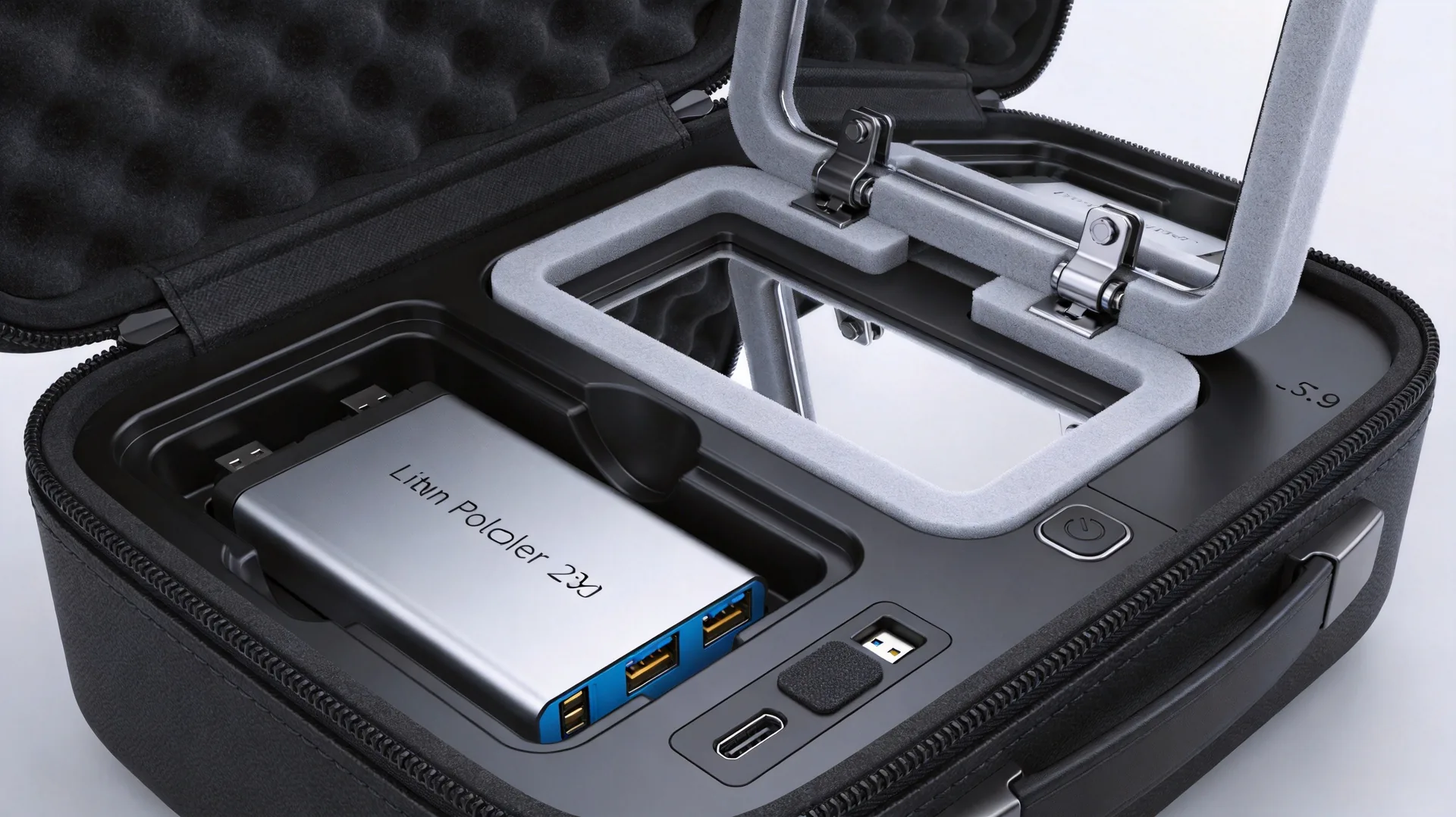
LED mirror module cutaway — showing battery placement, sealed USB-C port, molded mirror frame and touch sensor on an EVA shell
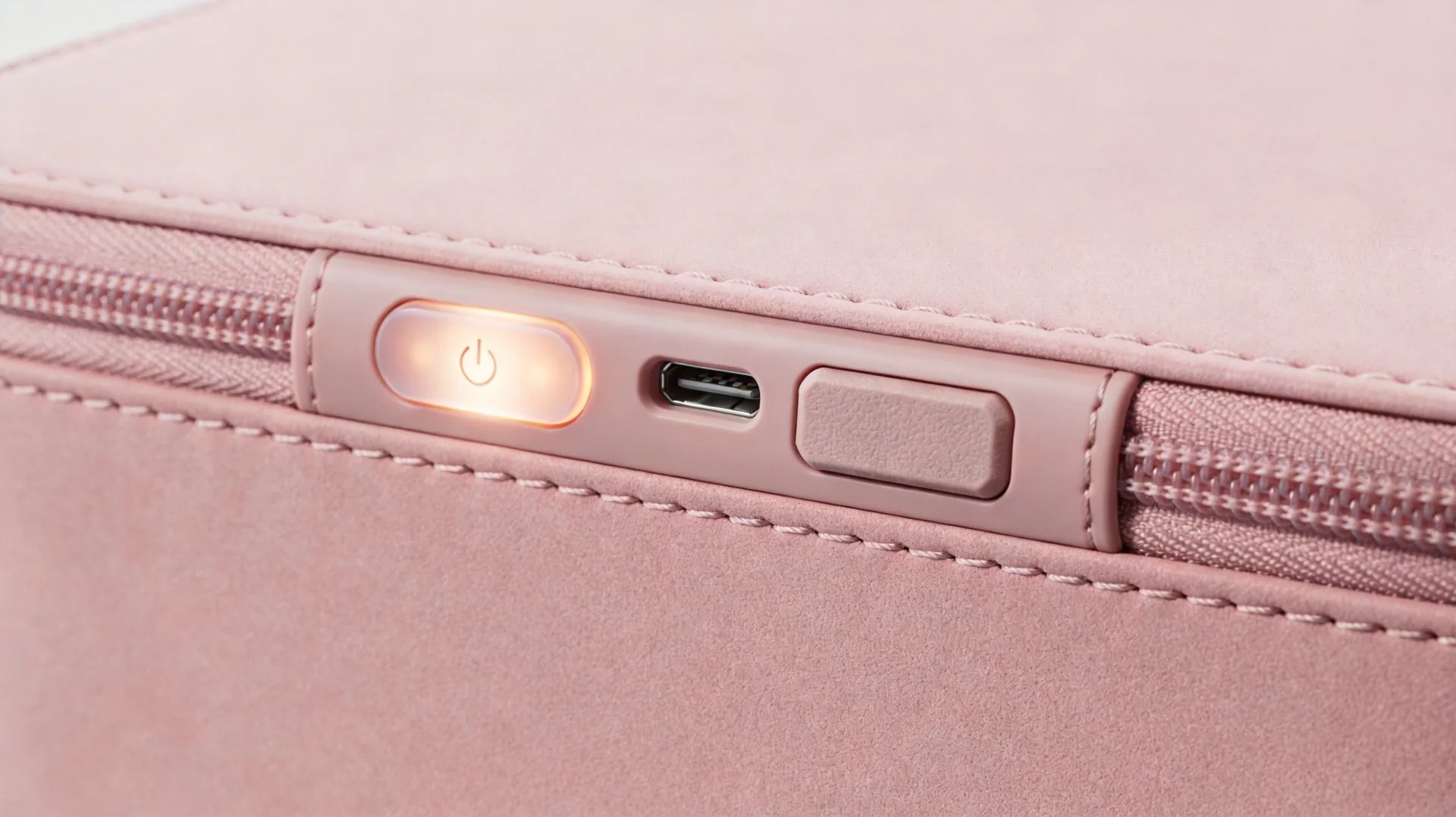
USB-C charge port and touch dimming switch detail — macro view of the sealed port cover, touch sensor and zip stitch line on a molded EVA shell
5. Customization: Color, Logo, Interior, Packaging
Customization in this category splits into what changes the mold and what does not. Knowing the difference is what keeps tooling cost from surprising you.
No tooling required (color and finish): EVA sheet is available in a wide color range including Pantone matching on volume orders. Matte, embossed, and laminated finishes are all surface treatments applied to standard sheet. Interior lining color and material — microfiber, 210D polyester, wipe-clean TPU — are independent of the shell mold.
Logo application, no tooling: Silkscreen, heat transfer, woven label, and rubberized patch. On a molded EVA surface, heat transfer and rubberized patches hold best; silkscreen on a textured surface needs a flat land area designed into the mold, so specify it early.
Tooling required: Any change to shell geometry, mirror aperture, interior tray layout, or molded handle. A new compression or injection mold is a one-time cost that is quoted separately and amortized against the order. Interior tray inserts usually need their own tooling, which is why we quote tray variants as a separate line.
Packaging: Retail-ready options include a printed EVA-matched sleeve, a molded pulp insert, a fabric drawstring pouch, and a gift box. For Amazon-bound programs we also produce FNSKU-labeled polybag and ISTA-3A-tested carton configurations. Packaging is the cheapest place to add perceived value and the most common place buyers under-specify.
6. Quality Control and Test Protocol
Inspection follows AQL 2.5 major / 4.0 minor on finished goods, which is the standard most US and EU retail buyers specify. On top of the AQL inspection, a lighted cosmetic bag needs functional tests that a general bag inspection does not cover.
Incoming material: EVA sheet density and thickness verification per lot; LED module incoming functional test with a sample charge-discharge cycle; mirror flatness check against a straight edge.
In-process: Light module installation torque and seating check; sealing integrity at the port and switch; hinge cycle test on the lid.
Pre-production and pilot: Drop test from 76 cm on all six faces with the case closed and the light module installed; heat cycle at 45 °C and cold cycle at −10 °C to check mirror retention and battery behavior; IPX4 splash test on the zip line and charge port.
Final inspection: 100% light-on function check before packing, plus AQL 2.5/4.0 sampling on appearance, stitching, zip function, hardware, logo placement, and packing accuracy.
We report test results on the pre-production sample rather than asserting compliance in a brochure. If a unit fails a drop or heat cycle, that finding goes into the sample report and drives a design change before the bulk order — which is the entire point of sampling.
7. MOQ, Sampling and Lead Times
| Stage | Standard | Notes |
|---|---|---|
| MOQ | 500 pcs per style | Mixed colors and interior configurations accepted within a run; mixed formats require separate MOQs |
| Sampling | 6–10 days | Includes LED module sourcing, shell build, and mirror fitting |
| Sample fee | Charged, refunded against first bulk order | Covers materials, module, and courier |
| Bulk production | 35–50 days after sample approval | Tooling lead time is additional if a new mold is required |
| Tooling | Quoted per project | Amortized or one-time depending on program size |
| Repeat order | Shorter than first run | No new sampling required if specifications are unchanged |
The 500-piece MOQ applies per style, not per colorway. A program with three colors of the same shell runs as one 500-piece minimum. What does reset the MOQ is a change in shell geometry or mirror size, because that is a different mold.
8. Compliance and Documentation for US/EU Import
A lighted cosmetic bag sits at the intersection of a bag, a small electrical device, and a mirror. That means documentation beyond a standard bag shipment.
Materials: REACH SVHC screening on EVA sheet, lining, and hardware; California Prop 65 review on shell, lining, and any printed surface; phthalate and lead testing on soft components.
Electrical: Battery UN 38.3 transport documentation for lithium cells; IEC 62133 cell-level safety report where the buyer’s compliance team requires it; charging circuit overcharge and short-circuit protection verification.
Children’s product consideration: If the case is marketed to or could reasonably be used by children under 12, CPSIA lead and phthalate limits apply, and the product may need a Children’s Product Certificate. This is a positioning decision as much as a compliance one, and it is much cheaper to decide before artwork than after.
Other: ISTA-3A transit testing for carton configuration on e-commerce programs; FSC documentation where paper packaging is used; labeling review for country-of-origin and battery disposal markings.
We prepare the documentation package for the shipment and coordinate third-party laboratory testing through accredited facilities at the buyer’s direction. We do not issue the certificates ourselves — testing is performed by independent labs and the report belongs to your file.
9. Cost Drivers: What Moves Your Unit Price
Buyers often ask for a target price before specifications are set. In this category, five variables account for most of the spread between a $6 unit and a $14 unit at the same MOQ.
Mirror size and mounting method. Glass area and the mounting system together are usually the largest single cost driver after the shell. A mechanical frame with clips costs more than adhesive but eliminates a warranty category.
LED module specification. Three-color with stepless dimming and CRI 90+ roughly doubles module cost versus a single-white non-dimmable strip. Battery capacity scales cost nearly linearly above 2000 mAh.
Shell thickness and density. Moving from 4 mm at 60 kg/m³ to 6 mm at 75 kg/m³ increases material cost meaningfully and also increases freight weight — both effects compound.
Interior complexity. A single-compartment lining is cheap. A molded tray with brush slots, a brush roll, and a removable divider can add more cost than the LED module itself, because it needs its own tooling.
Packaging. A printed sleeve and a molded pulp insert are modest. A rigid gift box with magnetic closure and EVA-matched foam can add a meaningful per-unit cost at low volumes, though it amortizes well at scale.
The practical advice: decide the retail price and the return-rate tolerance first, then let those two numbers set the mirror mounting method and the LED specification. Those are the two decisions that determine whether the program is profitable after returns.
10. OEM vs ODM: Which Path Fits Your Brand
OEM means you bring the design and we build to your specification. You own the mold or the design files, the shell geometry is yours, and the product is not available to other buyers. This path fits brands with an established identity and a clear point of difference, and it carries tooling cost and a longer development timeline.
ODM means you select from our existing shell platforms and apply your color, logo, interior, and packaging. Tooling cost is eliminated or heavily reduced, sampling is faster, and the trade-off is that the shell geometry is not exclusive to you. This path fits brands entering the category, testing a new price tier, or running a fast promotional program.
Most programs we run are a hybrid: the buyer starts on an ODM platform for the first season to validate sell-through, then commissions a proprietary shell once the category proves out. That sequence keeps the first order’s risk low without giving up the ability to differentiate later.
11. How to Brief Us: RFQ Checklist
The fastest way to get an accurate quote is to answer these eight questions. Missing any one of them usually produces a quote with a range wide enough to be useless.
- Format — which of the five shell formats, or a reference image
- Mirror size and mounting — lid-mounted or detachable, approximate dimensions
- LED specification — single white or 3-color, dimmable or not, target CRI
- Battery target — desired runtime at full brightness
- Shell — color or Pantone reference, finish, target thickness if you have a preference
- Interior — lining material, compartment or tray layout
- Branding — logo method and placement, and whether artwork is final
- Program — target quantity per style, target retail price, destination market, and required certification
- Molded EVA beach totes — the category that established our EVA molding capability, with the same shell engineering described above
- Custom cosmetic and makeup bags — soft-shell, quilted, PVC, and brush-roll formats for buyers who need the full cosmetic range
- Custom beach bags — mesh, canvas, and laminated totes for resort and promotional programs
- EVA charm accessories — decorative charm programs designed to pair with molded totes as a combined order
Send those eight items with any reference images and we return a specification-matched quotation with material options, tooling cost, logo cost, and lead time, typically within one to two business days.
12. Frequently Asked Questions
Explore Our Other Custom Bag Lines
Our molded EVA and cosmetic bag programs share tooling, materials, and inspection teams, which means a buyer running several categories can consolidate production. Related lines:
Start Your LED Mirror Cosmetic Bag Project
Send the eight-item brief above with reference images and we will return a specification-matched quotation with material options, tooling cost, and lead time. If you are still deciding between formats, tell us your target retail price and destination market and we will recommend the configuration that holds margin after returns.
Contact: [email protected] | WhatsApp / Phone: +86 17750020688
JUNYUAN BAGS — Custom bag manufacturing since 2014, Quanzhou, Fujian, China.