
When choosing a sports bag, durability is key. Abrasion-resistant fabrics ensure your bag withstands daily wear and tear, from rough surfaces to heavy loads. Here’s a quick rundown of the top materials:
- Nylon Cordura: Tough, lightweight, and versatile; great for rugged use.
- Ballistic Nylon (1680D): Extremely durable; ideal for high-stress areas like bag bottoms.
- Ripstop Nylon: Lightweight and tear-resistant; perfect for travel and daypacks.
- Polyester Oxford (600D–900D): Affordable with good UV resistance; suitable for gym and promotional bags.
- TPU-Coated Fabrics: Waterproof and flexible in extreme conditions; great for wet-gear pockets.
- Heavy-Duty Canvas: Sturdy and breathable; fits casual or heritage-style bags.
- HDPE/Dyneema®: Ultra-strong and lightweight; used strategically in high-performance bags.
Each fabric offers unique strengths, from abrasion resistance to UV stability, ensuring your bag lasts longer while looking great. Below is a comparison to help you pick the right one for your needs.
| Fabric | Best Use | Key Strength | Drawback |
|---|---|---|---|
| Nylon Cordura | Rugged outdoor bags | High durability, versatile | Higher cost |
| Ballistic Nylon (1680D) | Heavy-duty equipment bags | Extreme abrasion resistance | Heavy and stiff texture |
| Ripstop Nylon | Lightweight travel bags | Tear-resistant, lightweight | Slight crinkling sound |
| Polyester Oxford | Gym and promotional bags | Affordable, UV-resistant | Less durable than nylon |
| TPU-Coated Fabrics | Wet compartments, swim bags | Waterproof, cold-resistant | Higher cost |
| Heavy-Duty Canvas | Casual or heritage-style bags | Sturdy and breathable | Heavier, needs maintenance |
| HDPE/Dyneema® | Ultralight performance gear | Strongest weight-to-strength ratio | Very expensive |
Choose based on your bag’s purpose and the wear it will endure. For heavy-duty needs, go with ballistic nylon or Cordura. For lightweight options, ripstop nylon or TPU-coated fabrics excel. Casual users may prefer canvas for its classic look and breathability.
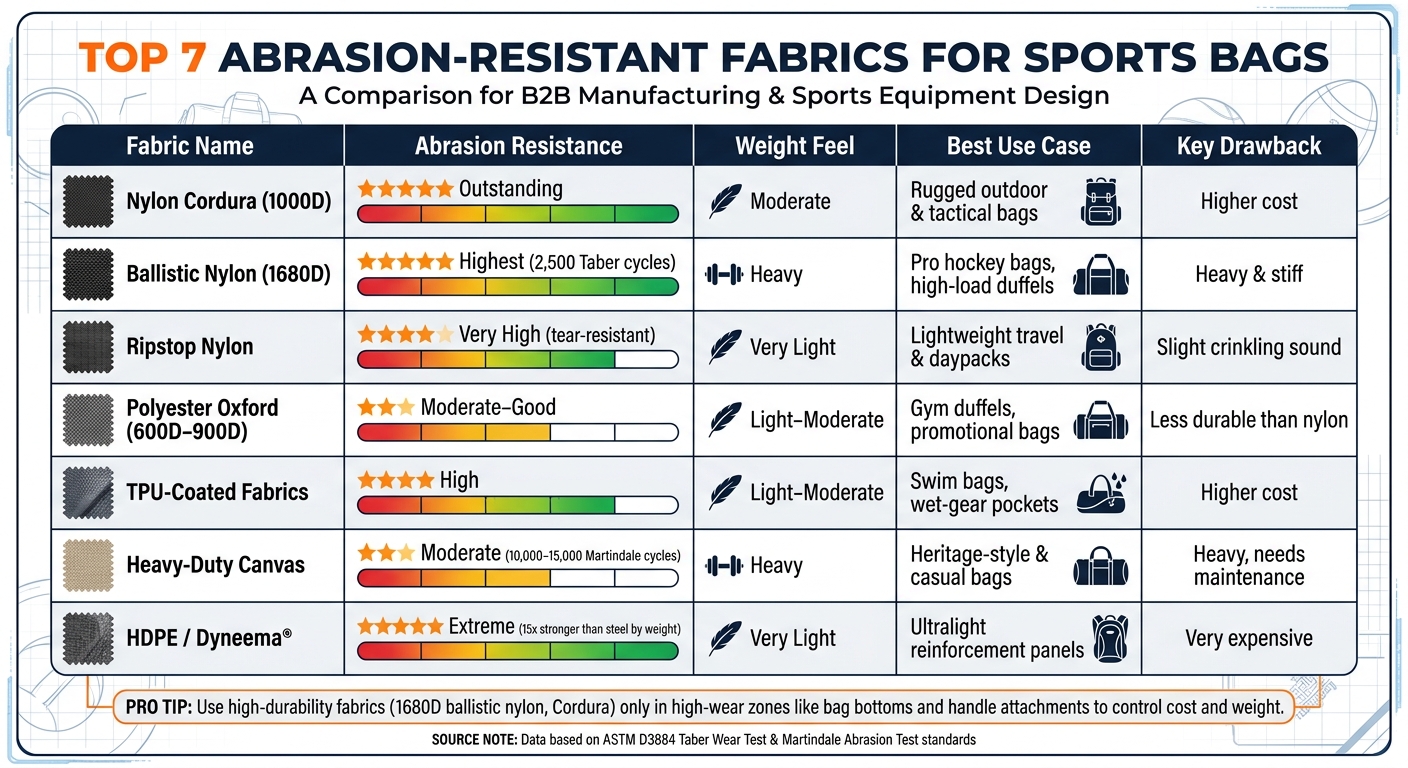
Top 7 Abrasion-Resistant Fabrics for Sports Bags: Side-by-Side Comparison
The Ultimate Strong and Abrasion Resistant Nylon Fabric!
sbb-itb-1e6451b
Key Performance Factors in Abrasion-Resistant Sports Bag Fabrics
When it comes to sports bag durability, understanding fabric performance is crucial.
Denier (D) is a measure of thread thickness. A higher denier means thicker, stronger fibers. For instance, 420D works well for lightweight bags, whereas 600D, 900D, and 1680D fabrics are better suited for gym, outdoor, and professional-grade bags, respectively.
Abrasion resistance is tested in labs to evaluate how well fabrics hold up under wear and tear. Two common methods are the Taber Wear Test (ASTM D3884), which uses an abrasive wheel to measure cycles until damage, and the Martindale Abrasion Test, which applies a figure-eight rubbing motion. While general clothing fabrics endure about 20,000 cycles, sports bag materials often surpass 50,000 cycles.
Tensile strength is another critical factor, measuring the maximum force a fabric can handle before breaking. For instance, in ASTM D5034 testing, 600D high-tenacity nylon could withstand up to 185 lbs of force. This is especially important for bags designed to carry heavy items like dumbbells, bats, or multiple racquets.
"Clients want lightweight bags, but thin fabric causes major seam slippage. It ruins long-term structural integrity." – Manager Lin, Lead Material Engineer
Tear strength evaluates how well a fabric resists the spread of rips, with ASTM D2261 being the standard test. Fabrics with ripstop weaves, which feature a reinforced grid pattern, excel in this area. Lastly, fabric weight (GSM) indicates material density. Heavier GSM fabrics are better at withstanding repeated stretching, making them ideal for high-stress areas like bag bottoms and handle attachment points.
These fabric properties are summarized in the table below, showcasing their relevance to various bag types:
| Fabric Property | Testing Standard | Most Relevant For |
|---|---|---|
| Abrasion Resistance | Taber (ASTM D3884) / Martindale | Bag bottoms, side panels on ball and racquet sports bags |
| Tensile Strength | ASTM D5034 / ISO 13934 | Heavy-load travel bags, team gear bags |
| Tear Strength | ASTM D2261 | Outdoor and hiking bags, ripstop shells |
| Water Resistance | Hydrostatic Head Test | Swim gear pockets, wet/dry compartments |
| Colorfastness | AATCC Standards | Branded team bags, promotional duffels |
1. Nylon Cordura
First developed by DuPont and now manufactured by Invista, Cordura has become synonymous with durability in performance textiles. Made from air-textured, high-tenacity nylon 6,6 fibers, it boasts abrasion resistance three times greater than standard nylon. This means a Cordura bottom panel can handle years of wear on rough surfaces like gym floors, locker room tiles, or even turf, without losing its strength or integrity. This impressive toughness makes it a go-to material for a wide variety of bag designs.
What makes Cordura even more appealing is its excellent balance between weight and durability, making it perfect for sports bags. It’s available in different weights – ranging from 330D for lighter needs to 1000D for heavy-duty applications – allowing manufacturers to tailor it to specific uses. For example, a 420D Cordura shell is ideal for tennis racquet bags, which are often stored in car trunks, while the more rugged 1000D version can withstand the constant abrasion of a hockey gear bag.
"Cordura® fabric offers outstanding durability, abrasion resistance, and long-lasting performance, even under heavy use." – sporbag.com
Cordura also resists mildew and fading, thanks to its thoughtful design. It features a durable water-repellent (DWR) finish on the outer surface and a polyurethane (PU) coating on the back, enhancing moisture resistance while maintaining flexibility. The PU coating is kept under 0.15mm thick to ensure the fabric remains pliable.
For manufacturers looking to manage costs without compromising on performance, Cordura can be strategically used in high-wear areas like the bottom panel, handle attachments, and side panels. This targeted approach maximizes durability while keeping material expenses in check. It’s a strategy commonly seen in professional hockey bags, premium golf stand bags, and rugged outdoor backpacks.
2. Ballistic Nylon
Ballistic nylon, first created by DuPont during World War II as material for military body armor, has become a go-to choice for high-performance sports bags. Its standout characteristic is a thick, two-ply basket weave made from high-denier synthetic yarns, typically 1680D, resulting in an incredibly dense and durable surface. This toughness has been confirmed through rigorous lab testing.
In abrasion tests, 1680D ballistic nylon endured 2,500 cycles on a Taber wear tester before showing signs of wear. For comparison, standard 600D nylon failed after just 800 cycles. That’s more than three times the abrasion resistance, which makes a big difference for bags that face rough treatment – whether dragged across concrete, tossed onto locker room floors, or stuffed into tight overhead bins.
"We use this heavy fabric for pro hockey teams. Hockey players drag their gear across rough concrete. The thick nylon stops holes. Standard fabrics fail in two weeks." – Sally Peng, Senior Director of Production & Textile Engineering, Leeline Bags
Despite its durability, ballistic nylon does come with trade-offs. It’s heavier than mid-weight fabrics and has a stiff, industrial texture. Plus, it’s not naturally waterproof, so manufacturers often add PU or TPU coatings to protect bags in wet conditions. Its thickness can also make production challenging, as standard sewing needles may snap, requiring specialized hardware and slower stitching speeds.
Given its cost and weight, the smart approach is targeted use. Instead of covering an entire bag, ballistic nylon is often used in high-wear areas like the bottom, handle attachment points, and other stress zones. This method keeps the bag lighter while reinforcing the parts that take the most abuse. It’s a common strategy for pro hockey bags, rugged field equipment bags, and premium travel duffels designed to handle tough conditions.
3. Ripstop Nylon
Ripstop nylon takes the spotlight when transitioning from heavier fabrics, offering a lightweight yet durable alternative. Its defining feature is a reinforced grid pattern woven into the material, designed to stop tears from spreading without adding unnecessary weight. Essentially, if a small tear or puncture occurs, the grid prevents it from growing larger.
Sally Peng, Senior Director of Production & Textile Engineering, explains it best:
"Its woven grid pattern stops tears instantly. You sacrifice some softness for ultimate water resistance."
Weighing in at just 2–3 oz/yd², ripstop nylon provides an excellent balance of weight and durability. While it’s not as abrasion-resistant as some heavier fabrics, its lightweight nature makes it perfect for designs where every ounce matters, such as travel and daypacks.
For sports bags, ripstop nylon is a smart choice for the main body of lightweight bags and internal compartments. When laminated with TPU (thermoplastic polyurethane), it offers flexibility even in freezing temperatures down to -22°F (-30°C). However, to maintain water resistance, seam tape must be applied to internal joints. As Alice Liu, a Backpack & Sports Bag Product Specialist, emphasizes:
"The sewing needle punches thousands of holes through the TPU. Mandate seam tape on all internal joints. The best waterproof fabric fails if you leave stitch lines exposed."
A denier range of 40D to 70D is often considered ideal, striking the right balance between strength and packability. Zoey Lee, Sales Director, highlights its popularity:
"Ripstop nylon is the standard requirement for our outdoor clients’ lightweight daypacks, packable bags, and custom raincovers due to its high tear resistance."
One minor drawback of ripstop nylon is the slight crinkling sound it can produce due to its coating, which some users may notice. Despite this, its tear resistance, lightweight profile, and versatility make it a top choice for crafting durable, functional sports bags.
4. Polyester Oxford Weaves
Polyester Oxford stands out as a practical, everyday fabric that balances durability, color retention, and affordability. With a 600D to 900D range, it offers reliable strength and vibrant colorfastness, making it ideal for everything from small custom orders to large-scale promotional projects.
What makes this fabric particularly appealing is its dimensional stability. This feature helps gym duffels and similar bags maintain their structured, upright shape. For commuters and students, this translates to a more polished and organized appearance, even with daily use. The combination of stability and durability ensures that these bags hold their form under constant wear and tear.
Polyester also edges out nylon in UV resistance and color accuracy. For example, 600D polyester retains 95% of its color after 200 hours of UV exposure, which is a significant advantage over nylon. Sally Peng, Senior Director of Production & Textile Engineering, explains:
"Polyester wins on price and colorfastness. It easily passes AATCC colorfastness standards because it holds dye perfectly."
This makes Polyester Oxford a top choice for branded gear like team bags or corporate promotional items, especially when precise Pantone color matching is required.
On the downside, polyester doesn’t match nylon’s abrasion resistance. For areas like the bottom panel of a bag – where wear and tear are highest – reinforcement is key. A smart solution is pairing 600D–900D polyester for the main body with a tougher material, such as 1680D ballistic nylon, for the base. To maintain flexibility, keep PU coatings under 0.15mm thickness, and prioritize high-quality binding agents to prevent flaking during heavy use.
| Feature | Polyester Oxford (600D–900D) | Nylon Oxford (420D–600D) |
|---|---|---|
| Abrasion Resistance | Good to Very Good | Strong / High |
| UV Resistance | Excellent (95% retention) | Moderate (15% fading) |
| Color Stability | High (holds dye well) | Lower (prone to fading) |
| Cost | Lower / Budget-friendly | Higher / Premium |
| Best Use Case | Gym duffels, student gear, promotional bags | Technical/high-load gear |
5. TPU-Coated Fabrics
TPU (Thermoplastic Polyurethane) coated fabrics bring a different approach to durability and performance compared to traditional liquid-applied coatings. Instead of applying a liquid layer to the surface, TPU is melted directly into the base material – usually ripstop nylon or polyester. This process creates a laminate bond that holds up better over time, resisting peeling and delamination.
One key advantage of TPU-coated fabrics is their lighter weight compared to PVC-coated options. They also perform better under harsh conditions, offering greater puncture and abrasion resistance. For instance, TPU-coated ripstop nylon remains flexible in extreme cold, withstanding temperatures as low as -22°F (-30°C), while PVC-coated nylon begins to crack at 14°F (-10°C).
Sally Peng, Senior Director of Production & Textile Engineering, highlights this benefit:
"TPU stays flexible in freezing conditions and weighs less… We gladly pay the 20% premium to eliminate cold-weather returns."
Manufacturers often use TPU coatings strategically, applying them to areas like shoe compartments, wet-gear sections, and bag bottoms – places that endure the most moisture and abrasion. However, there’s a critical consideration when sewing TPU-coated fabrics: sewing needles can puncture the waterproof barrier. As Sewing Floor Manager Chen points out:
"The sewing needle punches thousands of holes through the TPU… The best waterproof fabric fails if you leave stitch lines exposed."
To maintain the fabric’s waterproof integrity, seam taping all internal joints is a must. Additionally, TPU-coated fabrics are more likely to comply with California Proposition 65 and REACH standards, as they avoid the chlorine-based chemicals often found in PVC. This makes TPU a more environmentally conscious choice for high-performance sports bags.
| Feature | TPU-Coated Fabric | PVC-Coated Fabric | Standard PU Coating |
|---|---|---|---|
| Cold Resistance | Flexible down to -22°F (-30°C) | Cracks at 14°F (-10°C) | Moderate |
| Weight | Lightweight | Heavy | Very Lightweight |
| Abrasion Resistance | High | High | Moderate |
| Environmental Compliance | REACH/Prop 65 Safe | Often Non-Compliant | Generally Safe |
| Cost | Premium (+20%) | Moderate | Low |
6. Heavy-Duty Canvas and Cotton Blends
Heavy-duty canvas stands out for its durability, thanks to its plain weave construction. This weave – where threads cross in an over-and-under pattern – creates a dense and sturdy surface. Unlike synthetic fabrics measured in denier, canvas is measured by weight in ounces per square yard. For example, 18 oz. duck canvas is a go-to choice for heavy-duty bags, offering excellent structural integrity and resistance to wear.
In terms of abrasion resistance, heavy-duty canvas delivers 10,000–15,000 Martindale cycles, which is lower compared to Cordura® nylon’s 20,000–50,000+ cycles. Its tensile strength ranges from 6–9 MPa, falling short of nylon’s 10–14 MPa. While it doesn’t match the performance of synthetic materials, canvas is more than capable of handling the needs of everyday gym bags. Plus, its natural cotton fibers provide better breathability than synthetic laminates – an important feature for carrying sweaty gear.
"Nylon generally has a higher tensile strength and tear resistance for its weight compared to canvas. However, a very heavy-duty canvas can be more resistant to abrasion than a lightweight nylon." – SELVANE
Cotton-polyester blends take this a step further, offering 15,000–20,000 Martindale cycles for abrasion resistance, along with improved UV resistance and color retention, thanks to the polyester component. These blends are a budget-friendly alternative to materials like Cordura® or ballistic nylon.
Waxing canvas with paraffin or beeswax can increase abrasion resistance by up to 25% and add water repellency while maintaining breathability. However, this comes with a tradeoff: waxed canvas requires special care. It should never be machine washed, as that would strip the coating. Instead, spot cleaning with cold water and a soft brush is recommended, with re-waxing needed annually or after heavy use.
Canvas is ideal for urban gym bags, heritage-style rucksacks, and casual sports totes where its natural look and breathability are more important than weight-saving or extreme durability. However, it’s not the best option for technical gear requiring waterproofing or maximum tear resistance.
Next, we’ll explore HDPE and polypropylene fabrics, which offer a different balance of strength and lightweight durability.
7. HDPE and Polypropylene Fabrics
HDPE and polypropylene are often lumped together because they both belong to the polyolefin family. But in reality, these materials cater to completely different ends of the sports bag spectrum. Each has unique characteristics that make it suitable for specific design and performance needs.
Polypropylene is a lightweight and affordable material, making it a go-to choice for promotional bags that don’t require heavy-duty durability. It works well for items like trade show totes where basic structure is sufficient. However, it’s not designed to handle rough treatment, so it’s not ideal for gym bags that face daily wear and tear. For products requiring more durability, materials like 600D polyester or high-tenacity nylon are better options.
HDPE, particularly in its Ultra-High-Molecular-Weight form (commercially known as Dyneema®), is in an entirely different category. Dyneema® is renowned for its exceptional strength-to-weight ratio – it’s 15 times stronger than steel by weight. This makes it perfect for reinforcing critical parts of high-performance sports bags. Not only is it incredibly strong, but it also resists extreme temperatures and tearing, all while being lighter than nylon or polyester.
Due to its premium cost, Dyneema® isn’t used across entire bags. Instead, manufacturers apply it strategically in high-stress areas, such as base panels or shoulder strap reinforcements, especially in ultralight performance bags. This approach maximizes durability without driving up production costs unnecessarily. Additionally, bio-based and recycled versions of Dyneema® are gaining popularity. These sustainable options boast a carbon footprint that’s 90% lower than standard high-molecular-weight polyethylene fibers, and 75% of Dyneema® production facilities now operate on renewable energy.
| Fabric | Best For | Key Strength | Key Drawback |
|---|---|---|---|
| HDPE (Dyneema®) | Ultralight high-performance gear | 15x stronger than steel by weight | Very high cost |
| Polypropylene | Promotional/giveaway bags | Low cost, lightweight | Low durability under heavy use |
From cost-effective solutions to cutting-edge performance materials, HDPE and polypropylene cover a broad range of needs in sports bag manufacturing.
Fabric Comparison Table
The table below offers a clear breakdown of abrasion resistance, weight, and the best uses for various fabrics in sports bags. It’s worth noting that fabric performance isn’t just about denier count – 600D fabrics can outperform some lower-quality 1680D versions. As Floor Manager Chen points out:
"High denier is ineffective without proper weaving density."
| Fabric | Abrasion Resistance | Weight Feel | Best Sports Bag Applications |
|---|---|---|---|
| Nylon Cordura (1000D) | Outstanding | Moderate | High-end sports bags, tactical gear, rugged outdoor backpacks |
| Ballistic Nylon (1680D) | Highest (2,500 Taber cycles) | Heavy | Pro hockey bags, bag bottoms, high-load equipment duffels |
| Ripstop Nylon | Very High (tear-resistant) | Very Light | Lightweight performance bags, waterproof pockets, internal dividers |
| Polyester Oxford (600D–900D) | Moderate to Good | Light to Moderate | Everyday gym duffels, promotional bags, student bags |
| TPU-Coated Fabrics | High | Light to Moderate | Swim bags, wet-gear pockets, shoe compartments |
| Heavy-Duty Canvas | Moderate | Heavy | Heritage-style weekenders, dry-climate lifestyle bags |
| HDPE (Dyneema®) / Polypropylene | Low–Moderate (PP) / Extreme (Dyneema®) | Very Light | Promotional totes (PP); ultralight reinforcement panels (Dyneema®) |
This table highlights how different fabrics cater to specific needs. For example, 600D–900D polyester Oxford is a go-to choice for everyday sports bags. It balances affordability and durability, retains color well (maintaining 95% of its color after 200 hours of UV exposure), and is lightweight enough for regular gym use. On the other hand, heavier fabrics like ballistic nylon are better suited for gear-heavy applications, where durability outweighs concerns about added bulk.
Conclusion
Choosing the right fabric for the right purpose is key. Ballistic nylon (1680D) is ideal for heavy-duty gear and high-load duffels, offering top-notch abrasion resistance. Cordura® (1000D) is perfect for hiking and tactical applications. For everyday gym bags, 600D–900D polyester Oxford provides solid durability and excellent color retention. Meanwhile, TPU-laminated ripstop nylon shines in wet or damp conditions.
A smart approach is to reserve high-durability fabrics for areas where they’re truly needed. As Jacky Yao, Product Development Manager, explains:
"Only upgrade to 1680D nylon for bag bottoms or high-wear zones to control unit costs while maximizing durability."
This method of fabric zoning – using tougher materials in high-stress areas and lighter fabrics elsewhere – balances weight, cost, and durability. It’s a strategy that enhances the bag’s performance without unnecessary expense or bulk.
JUNYUAN BAGS supplies all these options, from eco-friendly GRS-certified rPET to 1680D ballistic nylon, for custom sports bags. They provide OEM and ODM manufacturing services, offering custom logos, sizes, and materials for both small orders and large-scale production.
FAQs
What denier should I choose for my sports bag?
The right denier for your bag depends on how you plan to use it and the trade-off between weight and durability. For gym bags or everyday use, 420D to 600D nylon or polyester is a solid choice. For more rugged or heavy-duty purposes, consider 1680D ballistic nylon or 1000D Cordura for added toughness. If you’re looking for a balance between cost and durability, fabrics in the 600D to 900D range are a practical option. At JUNYUAN BAGS, you’ll find guidance in choosing the material that fits your needs perfectly.
How do Taber and Martindale abrasion tests differ?
The Martindale test uses a figure-eight rubbing motion to mimic wear and tear by rubbing fabric against an abrasive surface until the fibers break. This method is commonly applied to evaluate textiles used in bags and apparel.
In contrast, the Taber test employs a rotary motion. Here, the fabric is placed on a rotating platform and subjected to wear using specialized abrading wheels. The test measures damage through controlled rotations, offering a different perspective on fabric durability.
How can a bag be waterproof if it has stitched seams?
Even with materials like TPU-laminated nylon or polyester that are designed to resist water, stitching can create small needle holes that allow moisture to seep through. To address this, manufacturers use seam tape to cover the internal stitch lines. This tape seals the tiny holes, effectively blocking leaks and ensuring the bag stays protected from water.