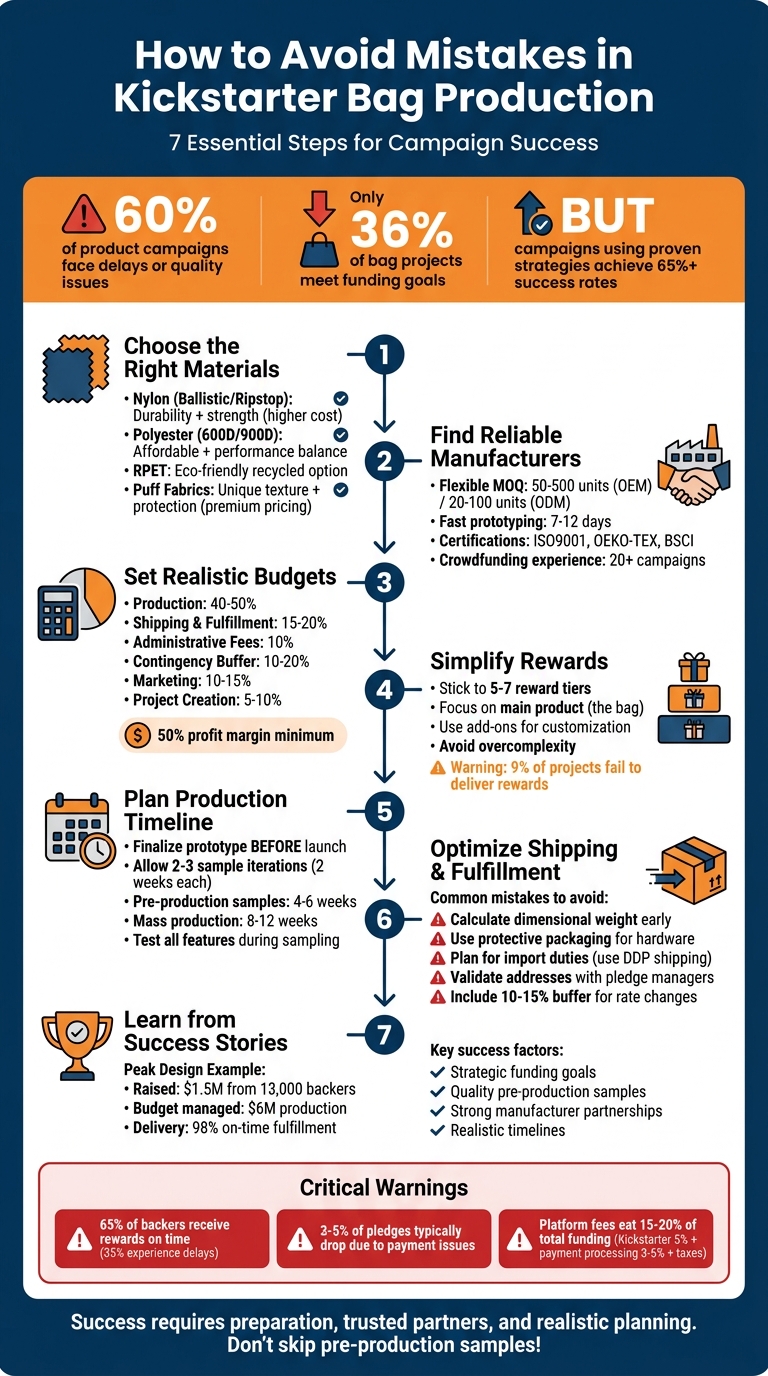
Launching a Kickstarter bag campaign can be rewarding but comes with challenges.Over 60% of product campaigns face delays or quality issues, often caused by manufacturing mistakes or budget mismanagement.Bag campaigns, in particular, frequently encounter unexpected costs like tariffs, shipping miscalculations, and tooling fees, leading to delays or failure.
Straight Answer
MOQ 500 pieces ·Sampling 6-10 days ·Production 35-50 days ·AQL 2.5 inspection ·Sample fee refunded on volume order.JUNYUAN BAGS (QUANZHOU JUNYUAN COMMERCIAL AND TRADING CO., LTD.), an SGS-verified OEM/ODM bag factory (about 200,000 pieces/month, 7 lines, 149 machines, 137 workers) serving 200+ brands in 100+ countries, supports Kickstarter bag projects end to end.
To succeed, focus on these key areas:
- Choose the right materials: Balance durability, cost, and backer preferences (e.g., nylon for strength, RPET for eco-conscious backers).
- Work with reliable manufacturers: Look for flexible MOQs (50–500 units), fast prototyping (7–12 days), and certifications like ISO9001 or OEKO-TEX.
- Set realistic budgets: Account for production, shipping, fees, and a contingency buffer to avoid overruns.
- Simplify rewards: Stick to 5–7 tiers to reduce complexity and errors.
- Plan production timelines: Finalize prototypes before launch and allocate time for pre-production samples.
Examples of success (like Peak Design) highlight the importance of preparation, while failures (like OMS Backpack) show the risks of skipping steps like sampling.By planning carefully, working with experienced partners, and managing costs, you can deliver on promises and keep backers satisfied.
7 Essential Steps to Avoid Kickstarter Bag Production Mistakes
Choosing the Right Materials for Your Custom Bags
Material Options and Their Trade-offs
The materials you choose for your custom bags can make or break your campaign.For example, nylon (Ballistic and Ripstop) is a top-tier option for athletic backpacks.It’s known for its durability, offering outstanding abrasion resistance and an excellent strength-to-weight ratio.However, this durability often comes with a higher price tag compared to alternatives like polyester.
Polyester (600D/900D), on the other hand, has become the go-to material for many.It strikes a balance between affordability and performance, resisting both stretching and shrinking to help bags maintain their shape over time.Additionally, RPET (recycled polyester) is gaining traction, particularly among backers who value eco-friendly choices, making it a smart option for campaigns with sustainability in mind.
For something more eye-catching, specialized fabrics like "Puff"(quilted or padded materials) can give your product a unique edge.These textured materials not only add visual appeal but also provide extra protection.Just keep in mind, they can bump up your production costs.
Balancing Quality and Cost for Kickstarter Campaigns
Picking the right material is only part of the equation;you’ll also need to carefully manage the balance between quality and cost.Consider this: 9% of Kickstarter projects fail to deliver rewards as promised.One common culprit?Underestimating production costs, which can lead to compromises on material quality.
"Entrepreneurs must also recognize that even successfully funded projects may have unforeseen production challenges or other roadblocks that can delay completion or lead to unexpected costs."- Double Jump Media
To avoid these pitfalls, set funding goals that include a buffer for unexpected expenses.Before committing to mass production, test your material choices by sharing realistic visuals and gathering feedback from backers.This helps ensure that the final product aligns with what you’ve promised.After all, if the quality doesn’t meet expectations, backers may see the project as a failure.Careful planning and budgeting are key to keeping your campaign on track and your backers happy.
sbb-itb-1e6451b
Finding and Evaluating Reliable Manufacturers Like JUNYUAN BAGS
Manufacturer Evaluation Criteria
Choosing the right manufacturer can make or break your Kickstarter campaign.It’s not just about production;it’s about finding a partner who understands the unique demands of crowdfunding.From tight deadlines to evolving designs and the need to deliver exactly what you promised, your manufacturer plays a pivotal role in your success.
Start by assessing their Minimum Order Quantity (MOQ) flexibility.Many traditional manufacturers require massive orders – often over 1,000 units – which isn’t feasible for most Kickstarter creators.Instead, look for manufacturers offering MOQs in the range of 50–500 units for OEM projects and 20–100 units for ODM projects.This flexibility allows you to fulfill early-bird rewards without overcommitting your budget or ending up with excess inventory.
Another critical factor is prototyping speed.Aim for a manufacturer that can deliver prototypes within 7–12 days.This not only helps with visual marketing but also allows you to validate your design before launch.Slow prototyping can derail your entire timeline, so be sure to ask about their turnaround time and request 3D drawings to refine your design before moving to physical samples.
Don’t overlook material certifications.If your campaign promotes eco-friendly products, ensure the manufacturer uses certified materials like OEKO-TEX fabrics, rPET, or recycled nylon.This helps you maintain credibility and avoid accusations of greenwashing.Quality management certifications like ISO9001 or ethical standards such as BSCI are also essential for ensuring high production standards.
Here’s a quick breakdown of how these criteria help you avoid common production pitfalls:
| Evaluation Criterion | Importance for Kickstarter Success | Common Mistake Avoided |
|---|---|---|
| Flexible MOQ (50-500 units) | Helps manage tiered rewards | Overproduction and excess inventory |
| Fast Sampling (7-12 days) | Supports campaign visuals and testing | Delayed launches due to slow prototyping |
| OEM/ODM Customization | Enables unique product features | Generic designs that fail to attract backers |
| DDP Shipping Support | Simplifies global delivery | Hidden fees and logistics complications |
| Material Certifications | Ensures quality and eco-claims | Greenwashing or subpar materials |
Finally, prioritize manufacturers with crowdfunding experience.A partner who has supported 20+ successful Kickstarter campaigns understands the challenges you face, from backer expectations to meeting deadlines.Their expertise can help you avoid rookie mistakes and keep your campaign on track.
Why Partner with JUNYUAN BAGS
Once you’ve outlined your criteria, the next step is finding a manufacturer that meets those standards.That’s where JUNYUAN BAGS comes in.With over 20 successful Kickstarter campaigns under their belt, they’ve helped creators raise up to $380,000 and exceed funding goals by 450%.Their experience means they understand the stakes and know how to deliver on promises.
Their 4-step process simplifies production for Kickstarter creators: Idea Consultation, 3D Drawing, Sample Confirmation, and Mass Production/Delivery.The 3D drawing phase is particularly valuable, allowing you to refine your design and address potential issues before investing in physical samples, saving both time and money.
JUNYUAN BAGS also offers extensive OEM/ODM customization options, from selecting specialized materials like waterproof or lightweight fabrics to custom hardware and structural design tweaks.Whether you’re designing a tech-savvy laptop bag, an eco-conscious messenger bag, or a sports-specific golf bag, their team can bring your vision to life.Certifications like BSCI, CE, RoHS, and ISO9001 ensure both quality and ethical manufacturing practices.
One of their standout features is their DDP (Delivered Duty Paid) shipping service, which takes the hassle out of global fulfillment.Instead of juggling multiple logistics partners and customs issues, JUNYUAN BAGS handles end-to-end delivery, making it easier to calculate costs and avoid delays that could upset backers.
Plan for 2–3 sample iterations to perfect your design before launch.Use the 7–12 day prototyping window to test every detail – zippers, straps, waterproofing – so you know your product is up to standard.Only move to mass production after approving a final "golden sample."This ensures your backers get exactly what you promised, turning your campaign into a success story.
Setting Realistic Funding Goals and Budget Breakdowns
Nailing your funding goal can make or break your campaign.As Russell Nohelty, a USA Today–bestselling author and publisher, explains:
"A successful campaign [is] one that ends up in the black at the end of the day, meaning that it raised more than it cost to fulfill."
Every dollar you raise needs to cover production, shipping, fees, and still leave room for profit.That’s why it’s critical to base your budget on real numbers.Don’t guess – get actual quotes from manufacturers like JUNYUAN BAGS for materials, labor, hardware, and branding costs before setting your funding goal.
Aiming for at least a 50% profit margin is a smart move.For example, if it costs $30 to produce and ship your custom bag, you should charge backers at least $60.Anything less could leave you scrambling to cover unexpected costs.Breaking your budget into clear categories will also help you stay on top of your finances.
How to Allocate Production Costs
Here’s a sample budget breakdown to guide your planning:
| Budget Category | Recommended Allocation | What It Covers |
|---|---|---|
| Production | 40–50% | Materials, labor, hardware (zippers, buckles), branding (embroidery, labels) |
| Shipping &Fulfillment | 15–20% | Postage, boxes, packing materials, warehousing |
| Administrative Fees | 10% | Kickstarter’s 5% fee and 3–5% payment processing |
| Contingency Buffer | 10–20% | Unexpected shipping hikes, production overruns, material price increases |
| Marketing | 10–15% | Digital ads, public relations, email campaigns, giveaways |
| Project Creation | 5–10% | Tech packs, prototyping, sample revisions |
Keep production costs within 40–50% of your total budget to ensure you can cover fees and unexpected expenses.
Administrative fees are another key area to plan for.Kickstarter takes a flat 5%, and payment processors like Stripe add around 3–4%, depending on your backers’ locations.Budgeting a full 10% for these fees is a safe bet.Be cautious with small pledges – processing fees can climb to 5% plus $0.05 per transaction for pledges under $10.To avoid this, consider setting a minimum pledge amount above $10 or bundling smaller items.
A contingency buffer is non-negotiable.While 10% is standard, many creators go for 15–20% to protect against surprises like rising international shipping rates or material price increases.These costs can shift every 6–12 months, so planning ahead is essential.
Avoiding Hidden Costs and Budget Overruns
Even with careful planning, hidden expenses can throw off your budget.For instance, 3–5% of pledges typically drop off due to issues like expired cards or insufficient funds.If you raise $50,000, that’s $1,500–$2,500 gone before production starts.Build this into your calculations from the beginning.
"It’s typical to see 3 to 5% of pledges drop, so you want to budget that in.If you’re counting on every dollar to hit your production targets, these dropped pledges can mess with your plans if not accounted for."– LaunchBoom
Shipping is another area where costs can sneak up on you.Don’t just calculate postage – factor in the cost of sturdy boxes, packing filler, and printed labels.Spending a bit more on durable packaging can save you money in the long run by reducing damage and replacements.
International shipping requires special attention.Instead of rolling these costs into your base price, charge backers the actual shipping rate for their region.For example, domestic shipping might cost $8 per bag, but shipping to Europe or Australia could be as high as $35.If you don’t plan for this, you risk wiping out your profit margins.
Stretch goals can also complicate your budget.Adding features like extra pockets or upgraded materials increases costs, weight, and complexity.Keep these costs to about 10% of the extra funds raised.For instance, if a new color option brings in $5,000, it shouldn’t cost more than $500 to implement.
Finally, don’t forget about taxes.Kickstarter funds are generally considered taxable income, and you might also owe sales tax or VAT depending on your backers’ locations.Talk to a tax advisor early to understand your obligations and avoid surprises later.
Between platform fees, processing fees, dropped pledges, taxes, and shipping fluctuations, you could lose 15–20% of your total funding.If you don’t account for these deductions upfront, you might find yourself in trouble before production even starts.The key is to do the math, get accurate quotes, and build in enough buffer to handle the unexpected.Solid financial planning will keep your campaign running smoothly and ensure you’re prepared for every step of the process.
Simplifying Rewards and Avoiding Overcomplexity
Material and manufacturing challenges can create production hiccups, but an overly complicated reward system can also jeopardize your campaign.When reward structures become too intricate, they can confuse backers and disrupt your entire process.To avoid this, aim for 5–7 reward tiers centered on your main product – the bag.This not only keeps things straightforward but also prevents "choice paralysis", making it easier for backers to decide and for you to fulfill orders.
Instead of piling on unrelated extras, consider offering add-ons to let backers personalize their orders.For example, you could have a base tier for the bag and then let supporters add items like a matching wallet or a replacement strap through a post-campaign manager.This method keeps reward levels clean and simple while still giving backers flexibility.A streamlined system improves clarity for supporters and makes production and fulfillment much easier.
Custom or co-branded tiers can be tempting but come with risks if not carefully planned.A cautionary tale is the "Code School Guide"Kickstarter campaign from April 2021.A late addition of a "Branded Book"package extended the sales process beyond the campaign period, ultimately contributing to its failure.This highlights the importance of finalizing reward tiers well before launching, much like the need for pre-production testing discussed earlier.
Offering too many reward variations also increases the chances of packing mistakes and delays.Statistics show that 9% of projects fail to deliver rewards, and only 65% of backers receive their rewards on time.Just as pre-production samples help prevent manufacturing setbacks, a simplified reward system reduces fulfillment errors.Standardizing your packaging and testing with sample orders can further lower these risks.
"Kickstarter is incorrectly named.It should be called Kickfinisher"
Ultimately, your campaign should focus on delivering a clear and simple promise, rather than getting bogged down in elaborate or overly complex reward schemes.
Managing Production Timelines and Pre-Production Samples
Creating a Realistic Production Timeline
Before you hit the launch button, ensure your prototype is finalized.That means nailing down your bag’s structure, materials, and logo application methods well in advance.This kind of preparation helps you avoid costly mid-production changes that have derailed many campaigns in the past.
Set aside time for 2–3 sample iterations, each lasting about two weeks, to perfect your design.Take the Nomad Sling Pack campaign as an example: they raised $380,000 from over 1,200 backers by teaming up with JUNYUAN BAGS.Their approach included a 50-unit minimum order quantity and rapid prototyping.Multiple sampling rounds allowed them to incorporate custom waterproof zippers and hit their delivery goals.
Creating a detailed spec sheet early on is another must.This document – complete with dimensions, materials, hardware details, pocket placements, and branding methods – not only speeds up the quoting process but also minimizes errors during the shift from sampling to mass production.
Think ahead to shipping and fulfillment as well.Flexible production runs can help you align with your reward tiers.For example, the Urban Flex Backpack campaign used an ODM (Original Design Manufacturer) approach with pre-existing modular designs.This strategy helped them achieve 428% funding with over 1,000 backers while maintaining a smooth production line and meeting delivery timelines.
The Role of Pre-Production Samples
Once your production timeline is in place, pre-production samples become your go-to tool for verifying every detail.These samples take your concept off the page and turn it into a real, tangible product you can assess.Use them to confirm that all design elements – like waterproof zippers, modular sleeves, or specialized hardware – function as intended.
Samples are also essential for creating authentic visuals for your campaign.High-quality photos and videos of the actual pre-production sample build trust with potential backers far more effectively than generic 3D renderings.Make sure your sample is ready in time to feature in your marketing materials.
Beyond aesthetics, the sampling process uncovers potential manufacturing challenges.For instance, recycled nylon might not hold the shape you envisioned, or organic cotton might require a different stitching technique.Identifying these issues during sampling allows for adjustments before mass production begins, saving you from producing defective products in bulk.
Allocate about two weeks for each sample iteration to allow for testing, feedback, and any necessary tweaks.Rushing through this phase can lead to subpar results.Treat the sampling process as the standard that your mass production must meet, ensuring a high-quality final product.
Optimizing Shipping and Fulfillment Logistics
Common Shipping Mistakes and Solutions
Shipping mistakes can eat into your profits and damage your reputation with backers.Just as you carefully plan production, you need to pay close attention to shipping details to ensure rewards arrive as promised.One common issue is dimensional weight.For example, bags might be lightweight but take up a lot of space, and carriers often charge based on the volume rather than actual weight.To avoid surprise costs that cut into your margins, calculate dimensional weight early in the process.
Another area to focus on is protective packaging.For bags with metal hardware or zippers, using foam padding or cardboard inserts can prevent damage during transit.This extra step ensures your product arrives in perfect condition.
Import duties and unexpected fees can also create challenges.Ignoring landed costs may result in backers facing surprise charges, or worse, packages stuck in customs.To prevent this, consider using "Delivered Duty Paid"(DDP) shipping methods or setting up regional fulfillment hubs to handle these fees in advance.Additionally, use pledge management tools like BackerKit or PledgeManager to validate addresses early.These tools can help catch errors and adjust shipping fees to reflect any rate changes closer to delivery.
| Common Shipping Mistake | Solution |
|---|---|
| Excess Packaging Volume | Use vacuum-sealing for soft bags or custom-sized mailers to save space. |
| Unexpected Customs Fees | Opt for "Delivered Duty Paid"(DDP) methods or regional fulfillment hubs. |
| Damaged Hardware/Zippers | Add foam padding or cardboard inserts for metal and delicate components. |
| High Fulfillment Labor Costs | Work with manufacturers to include SKU labels and barcodes to streamline handling. |
By addressing these issues upfront, you’ll be better prepared to select a fulfillment partner who can execute your logistics plan seamlessly.
Choosing Reliable Fulfillment Partners
Once your shipping practices are fine-tuned, the next step is selecting a fulfillment partner that aligns with your campaign’s quality expectations.After verifying production samples and locking in your supply chain, focus on finding a partner who can ensure smooth delivery.
Seek out partners offering shipping-ready production services.For example, JUNYUAN BAGS provides OEM/ODM services that include specialized packaging, allowing products to move directly from the factory to global distribution.Tasks like individual bagging, barcoding, and inserting items into final mailers are handled at the production level, cutting down on labor costs and reducing the number of touchpoints before the product reaches backers.Be sure to request firm quotes and include a 10–15% buffer to account for potential rate changes.
Communication is equally important when working with fulfillment partners.Even if problems arise, keeping backers informed can make a big difference.In 15–20% of reported failures, backers noted that creators who kept them updated about shipping or production issues handled the situation well.Look for partners who provide integrated tracking and real-time inventory updates so you can maintain transparency with your backers throughout the process.
Lessons from Successful and Failed Kickstarter Bag Campaigns
When it comes to Kickstarter campaigns for bags, success often hinges on more than just quality production and material choices.A well-thought-out market strategy can make or break a project.
What Successful Campaigns Did Right
One standout strategy for successful campaigns is setting strategic funding goals.Instead of aiming for the full production cost upfront, creators often set lower public goals to create a sense of momentum.This approach works because backers are more likely to support a campaign that already appears to be thriving.A great example is Ink+Volt’s laptop bag campaign in January 2018.Although they needed $100,000 to cover production costs, they set their public goal at $45,000 to encourage early pledges.
"People are much more likely to pledge on a campaign that has far exceeded its fundraising goal"
Another winning tactic is aligning with the right audience.Before launching a campaign, testing interest in a higher-priced product by offering a similar third-party item can provide early validation.Additionally, building an email list months in advance using prototype photos allows creators to gather insights on pricing and features that resonate with potential backers.
High-quality campaign videos also play a pivotal role.These videos, especially when optimized for mobile viewing, help showcase the bag’s features and build trust with potential backers.While these strategies can drive success, failing to target the right audience or misjudging pricing can lead to failure.
Common Mistakes from Failed Campaigns
On the flip side, several common pitfalls have derailed campaigns.One major issue is misaligning with the target audience.For instance, Ink+Volt struggled when they introduced two luxury laptop bags priced under $300 (Dream+Discover and Above+Beyond models).Despite their previous success with $40 planners, their existing audience didn’t convert for this higher-priced product.Their first campaign barely missed its $45,000 goal by $300 but had to be canceled since $100,000 was the actual production cost due to the factory’s 800-unit minimum order.A second attempt in March 2018, even with lower pricing and support from a marketing firm, only raised $40,000, resulting in a $20,000 loss.This included $8,000 spent on video production and $10,000 on digital ads.
As Ink+Volt founder Kate Matsudaira explained:
"If your customers aren’t willing to pay $300, it doesn’t matter whether it’s a good deal or not"
Reflecting on the experience, the company noted:
"Kickstarter is a great way to test ideas…if we had not done a Kickstarter and had instead just plowed ahead trying to sell the bag on our website, we would be out $160,000"
Another frequent misstep is relying too heavily on price adjustments.Simply lowering prices between campaigns rarely addresses deeper issues like market fit.Ink+Volt discovered this firsthand:
"Lowering the price between campaigns didn’t impact conversions for us.We probably had the right price point to begin with"
These examples highlight the importance of thorough pre-launch preparation.From understanding your audience to validating pricing, careful planning is crucial before diving into production.
Conclusion: Key Takeaways for a Successful Kickstarter Bag Campaign
Creating a thriving Kickstarter bag campaign requires careful planning, from selecting materials to ensuring smooth delivery.While only 36% of bag projects typically meet their funding goals, campaigns that adopt proven strategies can boost their success rate to 65% or more.The key lies in avoiding common missteps that derail many projects.
Work with trusted manufacturers like JUNYUAN BAGS to sidestep quality issues and production delays.With 22% of failed campaigns blaming unreliable factories, choosing a manufacturer with OEM/ODM expertise, fast prototyping, and experience in your bag category can significantly lower risks.Clear and consistent communication throughout the production process is essential to keep everything on track.
Plan your budget wisely to avoid overruns. For example, Peak Design’s 2019 Travel Backpack campaign raised $1.5 million from 13,000 backers by managing a $6 million production budget effectively.They delivered on time to 98% of backers without major quality complaints, showcasing how strong financial planning can lead to success.
Simplify your rewards and stick to realistic production timelines.Limit reward tiers to 3–5 options and allocate enough time for pre-production sampling and manufacturing. Aim for 4–6 weeks to produce pre-production samples and 8–12 weeks for full manufacturing.WaterField Designs exemplified this in Q1 2022 with their Air Porter Backpack campaign, which raised $312,000 from 1,200 backers.By setting a modest $50,000 goal, including a 15% shipping buffer, and managing an 8-week production timeline, they achieved 100% fulfillment just 45 days after funding.
Every detail matters.Test your materials, validate pricing with your audience, and never skip pre-production samples.When materials, manufacturing, budgeting, and timelines come together, you can navigate common Kickstarter challenges effectively.These examples show that with realistic expectations and strong manufacturing partnerships, Kickstarter can be a powerful platform to bring your bag project to life.
FAQs
How do I pick materials that match my price point and backer expectations?
When selecting materials, aim for a balance between cost, durability, and appearance to match the goals of your campaign.Here are a few examples:
- Nylon: Lightweight and resistant to weather, it’s a practical choice for many products, with costs ranging from $2 to $8 per yard.
- PU Leather: Offers a sleek, water-resistant finish, ideal for a stylish look, priced at $8 to $30 per yard.
- Canvas: Known for its strength and rugged charm, it comes at a cost of $4 to $40 per yard.
Make sure the material you choose not only fits your budget but also aligns with your product’s vision and meets the quality expectations of your backers.
What should I ask a bag manufacturer before committing to mass production?
When evaluating a potential partner, it’s essential to address a few key areas to ensure they can handle your project needs effectively.Start by asking about their ability to manage scalable production, maintain consistent quality, and achieve on-time delivery rates of 95% or higher.These factors are critical for keeping your campaign on track.
Next, explore their customization options.Can they accommodate your preferences for materials, branding, and hardware?Do they have the flexibility to meet unique requirements?Don’t forget to check if they hold relevant certifications like ISO 9001 or BSCI, which can be a good indicator of their reliability and standards.
Another important aspect is their prototyping speed.Ideally, they should be able to deliver prototypes within 7–14 days, giving you enough time to review and make adjustments.Additionally, verify their low Minimum Order Quantities (MOQs) – anywhere between 50 to 500 units – to ensure they can cater to smaller-scale campaigns if needed.
Lastly, confirm that they can meet your material and finish requirements and discuss practical details like timelines, costs, and communication processes.Aligning on these points early can save you headaches later and ensure everything runs smoothly with your campaign schedule.
How do I estimate total landed cost (shipping, duties, packaging) per bag?
To figure out the total landed cost per bag, you’ll need to account for all related expenses.This includes shipping charges from the manufacturer, any import duties or customs fees, and packaging costs like boxes and labels.Be as detailed as possible, and don’t forget to leave room for unexpected expenses by including a margin.Adding up these costs will give you a clear picture of your funding needs, helping you avoid budget issues during your Kickstarter campaign.
Frequently Asked Questions
How do I avoid timeline slips?
Tell the factory your drop-dead shipping date, confirm production slots, and order long-lead materials in parallel with sampling.
What pricing mistakes should I avoid?
Under-pricing landed cost leaves no margin after shipping and platform fees.Price off the itemized BOM and MOQ 500 rather than guessing.
How do I recover if production slips?
Communicate early, share updated timelines with photos, and work with the factory to hold a fixed shipping date.Transparency preserves backer trust.
What mistakes raise costs?
Late material changes, extra sample rounds, hardware spec churn and back-to-back revisions.Training the team to lock specs early protects your margin.
How do I avoid confusing backers?
Publish honest timelines, clear shipping tiers and one manufacturing FAQ.Vague or overstated promises cause fulfillment risk.
How do I avoid quality surprises?
Agree an AQL 2.5 inspection plan before production and approve a production sample.Pre-shipment checks catch stitching and hardware issues early.
Should I avoid too many tiers?
Yes.Each tier adds tooling and sampling;2-3 focused configurations at a 500-piece MOQ each protect timeline and quality.
How do I avoid sample production errors?
Finalize an itemized tech pack and physical material swatches before sampling, then approve a physical sample before the 35-50 day production run.
What are the biggest mistakes in Kickstarter bag production?
Common failures: skipping material approval, unresolved tech packs, over-engineering, and under-budgeting shipping and fees.Locking decisions early avoids each.
What legal mistakes should I watch?
Protect your design with an NDA and avoid copying existing branded bags;keep proprietary specs confidential.
Related Blog Posts