Quick answer: The industry standard minimum order quantity (MOQ) for custom golf bags is 200 pieces per style and colour. That number covers a fully custom build — your own shell fabric, lining, trim colours, logo application, hardware and packaging — and it is the volume floor at which most Chinese OEM golf bag factories will open a dedicated production line. Orders below 200 pieces are normally accepted only as paid samples or as an add-on to an existing bulk run. Sampling takes 6–10 business days, bulk production takes 35–50 days after sample approval, and final inspection is carried out to AQL 2.5 for major defects and AQL 4.0 for minor defects under the ISO 2859-1 sampling standard.
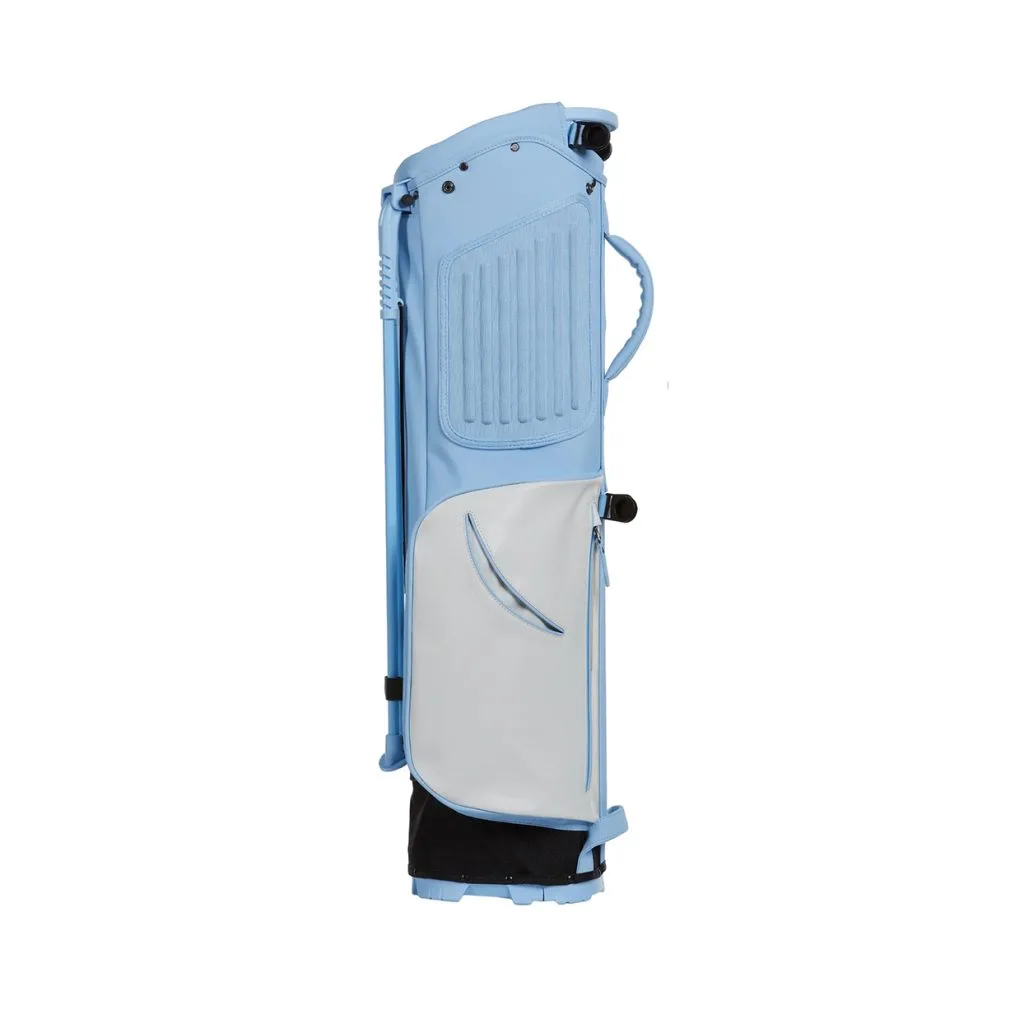
The Short Answer: What Is the Standard Golf Bag MOQ?
200 pieces per style and colour is not an arbitrary round number chosen to sound approachable. It is the point where three separate cost curves intersect: the minimum quantity a mill will run for a custom fabric, the fixed setup cost of your chosen branding method, and the changeover time on the assembly line. Below that volume, all three of those costs have to be absorbed by too few units, and the per-unit price rises faster than the extra flexibility is worth.
| Order scenario | Typical MOQ | What it actually covers |
|---|---|---|
| Paid sample or prototype | 1–3 pcs | Single build; sample fee is refunded against the first bulk order |
| Standard trial run | 200 pcs per style and colour | One style, one colourway, full custom branding |
| Two colourways, one style | 200 pcs each (400 total) | Separate cutting, print and embroidery setup per colourway |
| Two styles, one colourway | 200 pcs each (400 total) | Separate pattern set and line changeover per style |
| Repeat order, unchanged spec | 200 pcs | Existing patterns, screens and embroidery programmes reused |
For a brand launching a first golf bag line, that usually means one style in one or two colourways rather than four styles in six colours. Consolidating the range is almost always cheaper than splitting it, because the second colourway of the same style reuses the pattern, the cutting die and the line setup — only the material roll and the branding programme change.
Why 200 Pieces Is the Floor, Not a Marketing Number
Buyers often assume MOQ is a negotiating tactic. In practice it is a cost recovery threshold, and it breaks down into three measurable inputs.
Material Minimums Come From the Mill
Golf bag shells are built from coated polyester, nylon, ripstop or PU-backed twill, and mills sell those by the roll. A single roll of a custom-dyed 600D polyester typically yields enough yardage for 180–250 golf bags once cutting waste is accounted for. If you specify a custom Pantone dye lot rather than a stock colour, the mill has to run a full dye bath regardless of how much you order, so the fabric cost per bag is fixed across the entire roll. Ordering 80 bags means paying for the roll and carrying 100 bags worth of unused fabric — which no factory will do without a surcharge that usually exceeds the savings from ordering less.
The same logic applies to linings, webbing, piping and mesh. Stock colours carry no minimum beyond the roll; custom-dyed trims push you into the same dye-bath economics. Our golf bag material selection guide covers which components are worth custom-dyeing and which are better left stock.
Branding Setup Costs Are Fixed, Not Per Unit
Embroidery requires a digitised programme per logo, and a multi-colour crest can take two to four hours of digitising before a single stitch is sewn. Screen printing requires a screen per colour. Heat transfer requires a plate per design. Silicone and moulded rubber badges require a steel mould, which is the most expensive setup of all and typically carries its own 500–1,000 piece minimum because the tooling is amortised across the run.
None of these costs scale with quantity. A 12,000-stitch crest programme costs the same to digitise whether you produce 200 bags or 2,000. Spread across 200 units it adds a few cents per bag; spread across 50 units it adds several dollars. The full comparison of embroidery, printing, transfer and moulded badges is in our golf bag logo and branding methods guide.
Line Changeover Costs the Same for 200 or 2,000
A golf bag runs across seven or more stations: cutting, shell assembly, piping, zipper setting, pocket attachment, hardware riveting and final trim. Changing a line from one style to another involves re-hanging patterns, resetting stitch guides, recalibrating the piping folder and re-briefing operators. On a seven-line floor running dedicated equipment, that changeover is measured in hours, not minutes.
Because changeover cost is fixed per style, the factory’s cost per bag falls steeply from 200 to 500 units and then flattens. That is why a 200-piece order is accepted but a 50-piece order usually is not: at 50 units the changeover alone can exceed the entire labour content of the order.
What Actually Moves Your MOQ Up or Down
200 pieces is the baseline for a standard custom build. Five variables push it higher, and in narrow circumstances one of them can pull it lower.
Design Complexity and Panel Count
A cart bag with 14 dividers, six external pockets and a moulded base uses far more pattern pieces than a simple Sunday bag. Each additional panel adds a cutting operation, a seam and a quality checkpoint. Multi-panel designs with curved seams and contrast piping typically carry a higher MOQ because cutting yield drops and operator time per unit rises. Designs with more than 40 pattern pieces commonly move from 200 to 300 pieces per colour.
Material Selection and Availability
Stock 600D polyester, standard nylon and stock PU leather keep you at the 200-piece floor. Three categories push MOQ upward:
- Custom-dyed fabric in a specific Pantone: adds a dye-bath minimum on top of the bag MOQ.
- Genuine leather panels: hides are graded and cut individually, and a single hide yields only a limited number of panels. Leather golf bags typically start at 200–300 pieces depending on panel size. See our custom leather golf bag range for how panel layout affects yield.
- Certified recycled or solution-dyed fabrics: supply is narrower and traceability documentation is issued per batch, so mills prefer larger runs. Our sustainability and eco-material guide explains which certifications require batch-level traceability.
Hardware, Zippers and Custom Moulds
Stock YKK zippers, standard D-rings and catalogue buckles have no meaningful minimum. Anything requiring a new tool — a branded metal badge, a custom buckle, a moulded rubber foot, an embossed logo plate — carries its own tooling minimum that usually sits between 500 and 1,000 pieces, because the mould cost has to be recovered. If your design depends on a proprietary hardware piece, expect the MOQ for that style to be set by the tooling rather than by the bag.
Colour Count and Mixed Styles
This is the single most common source of MOQ misunderstanding. The minimum applies per style and colour, not to the total order. Four colourways of one cart bag is 800 pieces, not 200. Buyers who expect to mix four colours inside a 200-piece order are usually quoted a surcharge, because each colourway needs its own cutting lay and its own trim set.
There is one exception worth asking about: colourways that share the same shell fabric and differ only in trim, piping and embroidery thread. Some factories will treat these as a single run with a lower combined minimum, since only the trim changes. It is worth asking explicitly rather than assuming.
Season Timing and Factory Capacity
MOQ is not only a cost question; it is a scheduling question. Golf is seasonal in most markets, and capacity tightens sharply from March to July as brands build inventory for the Northern Hemisphere spring. In peak season a factory with seven lines and high-volume monthly capacity can afford to be selective, and small orders get pushed to the back of the queue or priced up to make them worth interrupting a larger run. Placing a 200-piece trial order in the off-season (August to February) usually gets both better pricing and better attention than the same order in April.
MOQ Benchmarks by Golf Bag Type
Different golf bag constructions carry different baseline minimums because pattern complexity, hardware count and material yield differ. The figures below reflect the standard floor for a fully custom build with your own branding.
| Bag type | Typical MOQ | Why it sits there |
|---|---|---|
| Stand bag / Sunday bag | 200 pcs per style and colour | Moderate panel count, standard hardware, high material yield |
| Cart bag | 200 pcs per style and colour | More pockets and dividers, but standard components throughout |
| Staff bag | 200–300 pcs per style and colour | Heavy panel count, reinforced structure, moulded base |
| Leather golf bag | 200–300 pcs per style and colour | Hide grading and individual panel cutting reduce yield |
| Golf travel cover | 200 pcs per style and colour | Large cut area per unit, but simple construction |
| Golf shoe bag / accessory bag | 200 pcs per style and colour | Small format, but separate pattern and setup from the main bag |
| Custom hardware or moulded badge | 500–1,000 pcs | Tooling cost must be recovered across the run |
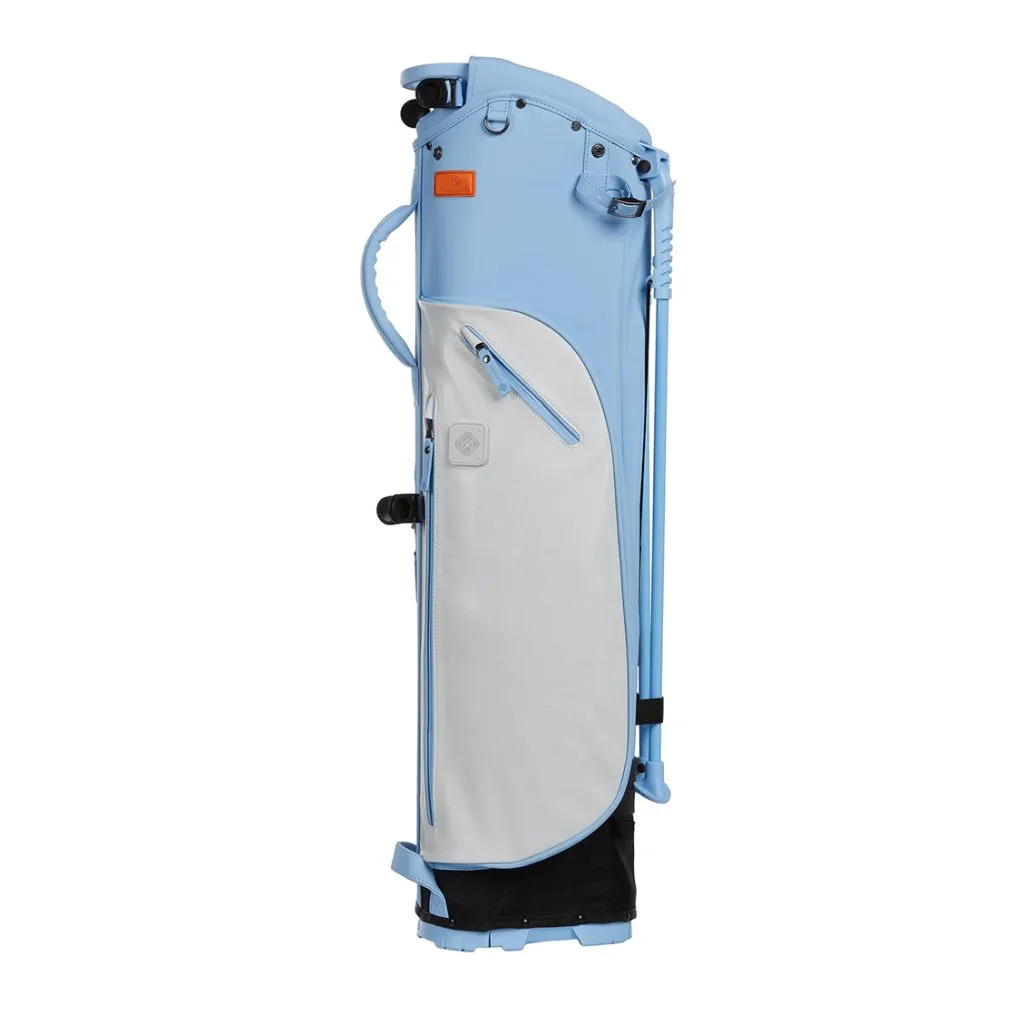
Product-specific detail is on each range page: custom stand and Sunday golf bags, custom staff bags, and custom golf den caddies.
MOQ and Total Landed Cost: The Real Trade-Off
Buyers frequently try to negotiate the MOQ down and treat the resulting unit price as a win. It usually is not. The correct comparison is not price per bag at 200 units versus price per bag at 500 units — it is total landed cost per bag sold, which includes freight, duty, inventory carrying cost and the cost of unsold stock.
| Volume | Typical effect on unit cost | What it means for a first order |
|---|---|---|
| 50 pcs (below minimum) | +35–60% vs. 200 pcs | Only viable as a paid sample run, not as sellable inventory |
| 200 pcs | Baseline | Setup fully absorbed; the practical entry point |
| 500 pcs | −8–14% vs. 200 pcs | Better material purchasing, less changeover per unit |
| 1,000 pcs | −14–22% vs. 200 pcs | Diminishing returns begin here for a single colourway |
| 2,000+ pcs | −20–28% vs. 200 pcs | Only justified against confirmed sell-through |
Those ranges assume the same specification throughout. The trap is ordering 1,000 units of a colourway that sells 300 and leaves 700 in a warehouse, which turns a 20% unit saving into a 70% inventory loss. For a first season, 200 pieces per colourway is usually the right balance between unit economics and inventory risk. The full cost build-up — material, labour, hardware, packaging, freight and duty — is broken down in our custom golf bag cost and pricing guide.
How to Negotiate a Workable MOQ
The productive conversation is not “can you lower the MOQ” but “how do we reach your minimum without carrying inventory we cannot sell”. Five approaches work in practice:
- Consolidate colourways. One style in two colourways at 200 each is usually cheaper per unit than two styles in one colourway each, because the pattern and line setup are shared.
- Keep the shell stock and customise the trim. Stock fabric with a custom-dyed piping and embroidery thread keeps you at the 200 floor while still producing a differentiated product.
- Move tooling-dependent features to a later run. A moulded metal badge can be added in season two once volume justifies the 500–1,000 piece tooling minimum.
- Order off-season. August to February capacity is looser, and a 200-piece order placed then is treated as a full run rather than a gap-filler.
- Split delivery, not volume. A single 400-piece order released in two shipments keeps the unit price of the full run while spreading cash flow across two quarters.
What does not work is asking a factory to produce 120 pieces at the 200-piece price. No factory absorbs that difference; it either declines or quietly reduces material grade. If a quote for 120 pieces comes back at the same unit price as 200, that is a signal to check the specification, not a win. Our guide to choosing a golf bag manufacturer sets out the questions that surface this early.
How to Verify a Supplier’s Real MOQ
A stated MOQ is a claim until it is tested. Four checks separate a real 200-piece floor from a number written to win the enquiry:
- Ask which components drive their minimum. A supplier with a genuine cost model can name the mill minimum, the branding setup and the changeover cost. A supplier quoting a number without a reason is quoting a sales figure.
- Ask for the specification behind the quote. Confirm the shell fabric weight, lining, zipper brand, hardware finish and packaging are identical across the 200-piece and 500-piece quotes. A falling price with a falling specification is not a discount.
- Ask what happens at 199 pieces. The answer reveals whether 200 is a cost threshold or a policy. A factory that can explain the surcharge at 199 is a factory that understands its own floor.
- Verify capacity claims independently. Ask for the inspection report, the number of lines, the machine count and the monthly output, then check them against a third-party audit. Our quality control and inspection guide explains what an AQL 2.5 / 4.0 inspection actually covers.
For reference, JUNYUAN BAGS has exported custom bags since 2014. The founding team entered the bag trade in 2004, and the company itself was established in 2014. Production runs through an affiliated factory in Quanzhou third-party verified on site, covering our production team, dedicated production lines and dedicated equipment including dedicated sewing stations, with high-volume monthly capacity. Sampling takes 6–10 business days, bulk production 35–50 days after sample approval, payment is 30% deposit with the balance against the bill of lading copy, and terms are FOB Xiamen or Shenzhen. Broader market context sits in our review of golf bag manufacturers in China.
Frequently Asked Questions
What is the industry standard MOQ for custom golf bags?
The industry standard is 200 pieces per style and colour for a fully custom golf bag. That volume covers a custom shell fabric, your own trim and colourway, logo application by embroidery or print, custom hardware and branded packaging. The minimum applies to each style and colour combination separately, not to the combined order value.
Why is the minimum order quantity 200 pieces rather than 50 or 100?
Because 200 pieces is the point at which three fixed costs can be absorbed: the mill’s minimum dye lot for a custom fabric, the one-off setup for embroidery digitising or screen printing, and the line changeover between styles. At 50 pieces those costs are spread across too few units, so the per-unit price typically rises 35–60% above the 200-piece price.
Can I order fewer than 200 pieces for a sample run?
Yes. Paid samples are produced at 1–3 pieces and take 6–10 business days. The sample fee is refunded against the first bulk order. Samples are for approval of construction, materials, colour matching and branding placement; they are not sellable inventory, and most factories will not release a sub-200 production run as finished goods.
How long does sampling take before a bulk order?
Sampling takes 6–10 business days from receipt of a confirmed tech pack and approved materials. Complex builds with custom moulded hardware add time for tooling, which is quoted separately. Sample approval should cover shell fabric hand-feel, colour under daylight, embroidery placement, zipper function and pocket geometry before the bulk order is released.
How long is bulk production after sample approval?
Bulk production runs 35–50 days after sample approval, depending on material lead times and whether the order falls in peak season. Peak season for golf runs from March to July as Northern Hemisphere brands build spring inventory; orders placed in that window sit at the upper end of the range. August to February typically runs closer to 35 days.
Which golf bag types have the highest minimum order quantity?
Staff bags and leather golf bags carry the highest baseline at 200–300 pieces per style and colour. Staff bags use heavy panel counts and a moulded base; leather bags are limited by hide grading and individual panel cutting, which reduces material yield per unit. Stand bags, cart bags and travel covers sit at the 200-piece floor.
Does adding more colours increase the MOQ?
Yes, if the additional colour is a separate colourway. The minimum applies per style and colour, so two colourways of one cart bag means 400 pieces, not 200. The exception is colourways that share the same shell fabric and differ only in trim, piping and embroidery thread — some factories will treat those as one run with a lower combined minimum.
Does custom embroidery or printing change the MOQ?
Not the bag MOQ, but it adds a setup cost that is charged once per order. Embroidery requires a digitised programme per logo, typically two to four hours for a multi-colour crest; screen printing requires a screen per colour; heat transfer requires a plate per design. These setup charges do not scale with quantity, so they are proportionally cheaper on larger runs.
Can I mix different styles to reach the 200-piece minimum?
Generally no. The minimum is per style because each style needs its own pattern set, cutting lay and line changeover. Mixing four styles at 50 pieces each does not reach the threshold; it produces four changeovers and four setups. Some factories will accept mixed styles at a surcharge, but the resulting unit price is usually close to the sub-minimum price.
What payment terms are standard for a 200-piece order?
Standard terms are 30% deposit on order confirmation with the remaining 70% against the bill of lading copy, so payment of the balance is triggered by documented shipment rather than by production completion. Terms are FOB Xiamen or Shenzhen. Longer terms are occasionally available for established accounts with repeat order history, but not for first orders.
What quality standard should I specify in the purchase order?
Specify AQL 2.5 for major defects and AQL 4.0 for minor defects, applied under ISO 2859-1, the international acceptance sampling standard maintained by the International Organization for Standardization. Major defects cover structural failures such as broken zippers, failed stitching or separated seams; minor defects cover cosmetic issues that do not affect function. Specify the sampling level and the inspection stage — during production, pre-shipment or both.
What Incoterms are typical for golf bag orders from China?
FOB is the most common term for custom golf bag orders, with Xiamen and Shenzhen the usual ports for Fujian-based production. FOB keeps control of freight and insurance with the buyer and gives a clean cost baseline for comparison between suppliers. CIF and DDP are available but make unit-cost comparison harder, because freight and duty are folded into a single number.
How much does a 200-piece custom golf bag order cost per unit?
Unit cost depends on bag type, material grade, hardware count and branding method rather than on volume alone, so a single figure would be misleading. What can be stated precisely is the volume effect: 200 pieces is the baseline, 500 pieces typically lands 8–14% below it, and 1,000 pieces 14–22% below, assuming an unchanged specification. A quotation should itemise material, labour, hardware, branding setup, packaging and freight separately.
What is the lead time for a repeat order of the same style?
A repeat order with an unchanged specification runs at the lower end of the 35–50 day range, because patterns, embroidery programmes and trim specifications are already approved and on file. The order still requires a pre-production sample check if the fabric dye lot has changed, since a new dye lot can shift colour slightly even against an approved standard.
Where can I find a full walkthrough of the custom golf bag process?
Our complete B2B guide to custom golf bag manufacturing covers design, materials, sampling, production, inspection and shipping end to end. For sourcing specifically from China, including factory verification and Incoterms, see the China manufacturing guide.