
What NOCSAE Actually Covers, and What It Does Not
NOCSAE — the National Operating Committee on Standards for Athletic Equipment — is an independent, non-profit standards development body formed in 1970. It writes performance and test standards for protective equipment and funds the research behind them. It does not certify products, it does not approve products, and it does not police compliance; in its own words, NOCSAE publishes standards but does not conduct surveillance to assure compliance, and it does not approve, disapprove, certify or recertify athletic equipment of any kind. Certification is carried out by the Safety Equipment Institute (SEI), an ANSI/ISO 17065 accredited certifying body, which manages testing through accredited independent laboratories and audits manufacturers for continued compliance.
This distinction matters for anyone sourcing bags. NOCSAE standards cover helmets, faceguards, gloves, shin guards, chest protectors and balls. They do not cover the bag an athlete carries that equipment in. There is no NOCSAE bag standard, and no supplier can legitimately claim a bag is “NOCSAE certified.” What a bag can do is preserve or compromise the condition of equipment that is certified. That is the real specification question, and it is the one this guide answers.
The Standards That Matter to an Equipment Program
Procurement teams do not need to memorise the full standards library, but they do need to recognise the document numbers that appear on equipment documentation and understand what each one governs. The following are the ones that come up most often in school, club and league purchasing.
| Document | Scope | Why It Matters to a Bag Specification |
|---|---|---|
| ND001 | Standard test method and equipment for evaluating headgear and equipment performance | Defines the test conditions all other standards reference; establishes what “as certified” configuration means |
| ND002 | Newly manufactured football helmets | The baseline configuration a helmet must be returned to |
| ND004 | Recertified football helmets | Sets the shell, component and date-marking conditions that bag handling can violate |
| ND006 | Newly manufactured youth football helmets (effective 1 March 2027) | Specifies high-temperature conditioning at 100 °F ± 3 °F for 4 to 24 hours |
| ND011 | Manufacturer’s procedural guide for quality control and sample selection | Explains the sampling discipline behind the certification mark |
| ND015 | Corrosion characteristics of metallic hardware | Directly relevant to buckles, snaps and clips stored in a damp bag |
| ND081 | Pneumatic ram test method for protective headgear and faceguards | Governs rotational acceleration criteria for newer standards |
| ND087 / ND089 | Football faceguards, new and recertified | Faceguards are the most exposed component in transport |
| ND090 | Soccer shin guards | Relevant to team bag compartment design for football programs |
How a Bag Can Compromise Certified Equipment
There are five mechanisms by which an unsuitable bag degrades certified equipment. Each maps to a specific requirement in the standards, which is what makes the risk arguable rather than theoretical.
Shell Damage Through Stacking and Compression
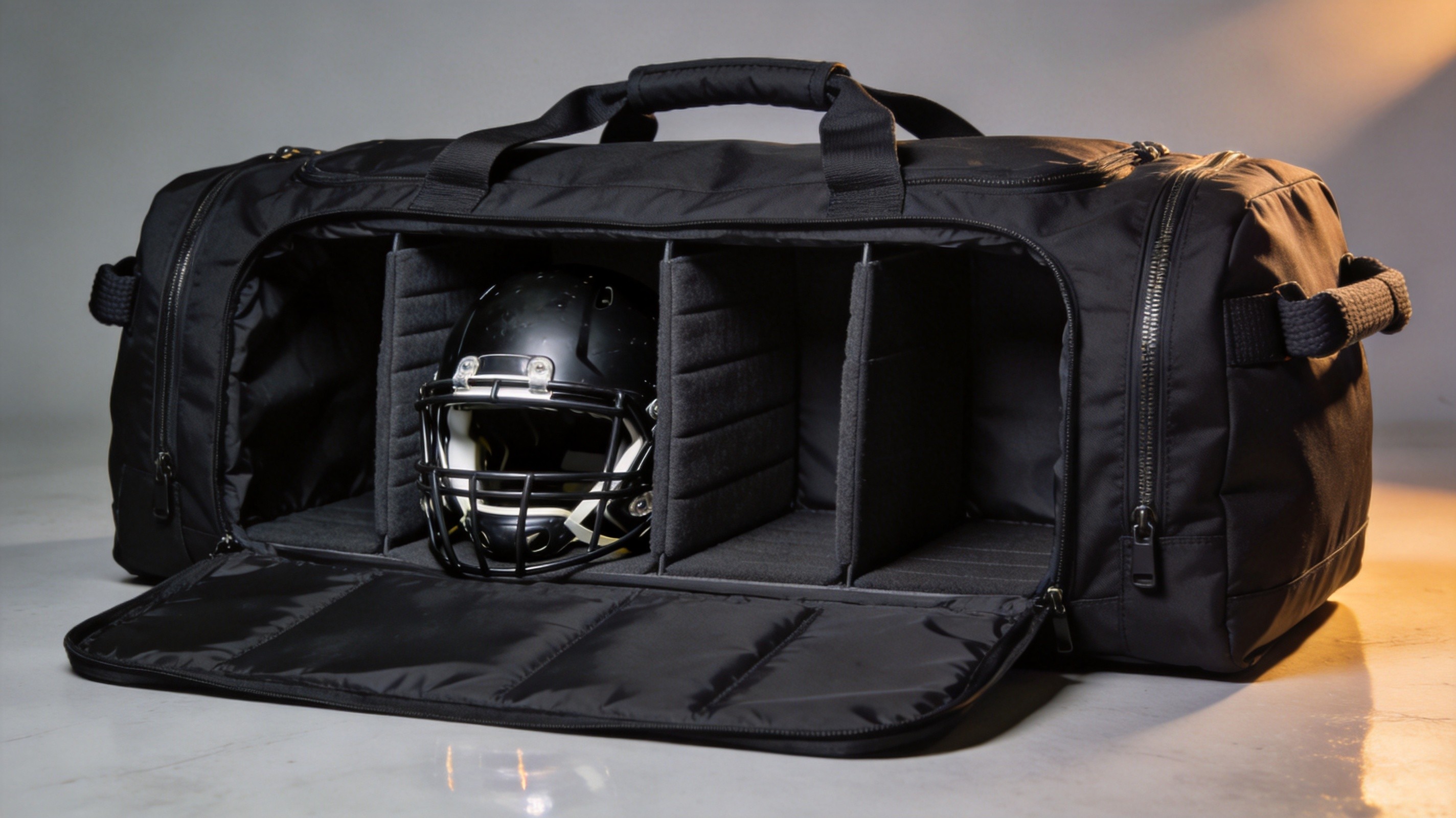
ND004 requires that recertified helmet shells be free from cracks, and that all components function as originally certified. A bag without a dedicated, semi-rigid helmet compartment allows helmets to be stacked against each other, pressed by shoulder pads, or compressed under a bus-load of kit. Cracks and stress marks that develop in transit are grounds for the helmet to fail recertification, which converts a transport problem into a capital replacement cost. A rigid or semi-rigid helmet shell compartment is the single most important bag feature in a program that transports helmets in bulk.
High-Temperature Exposure
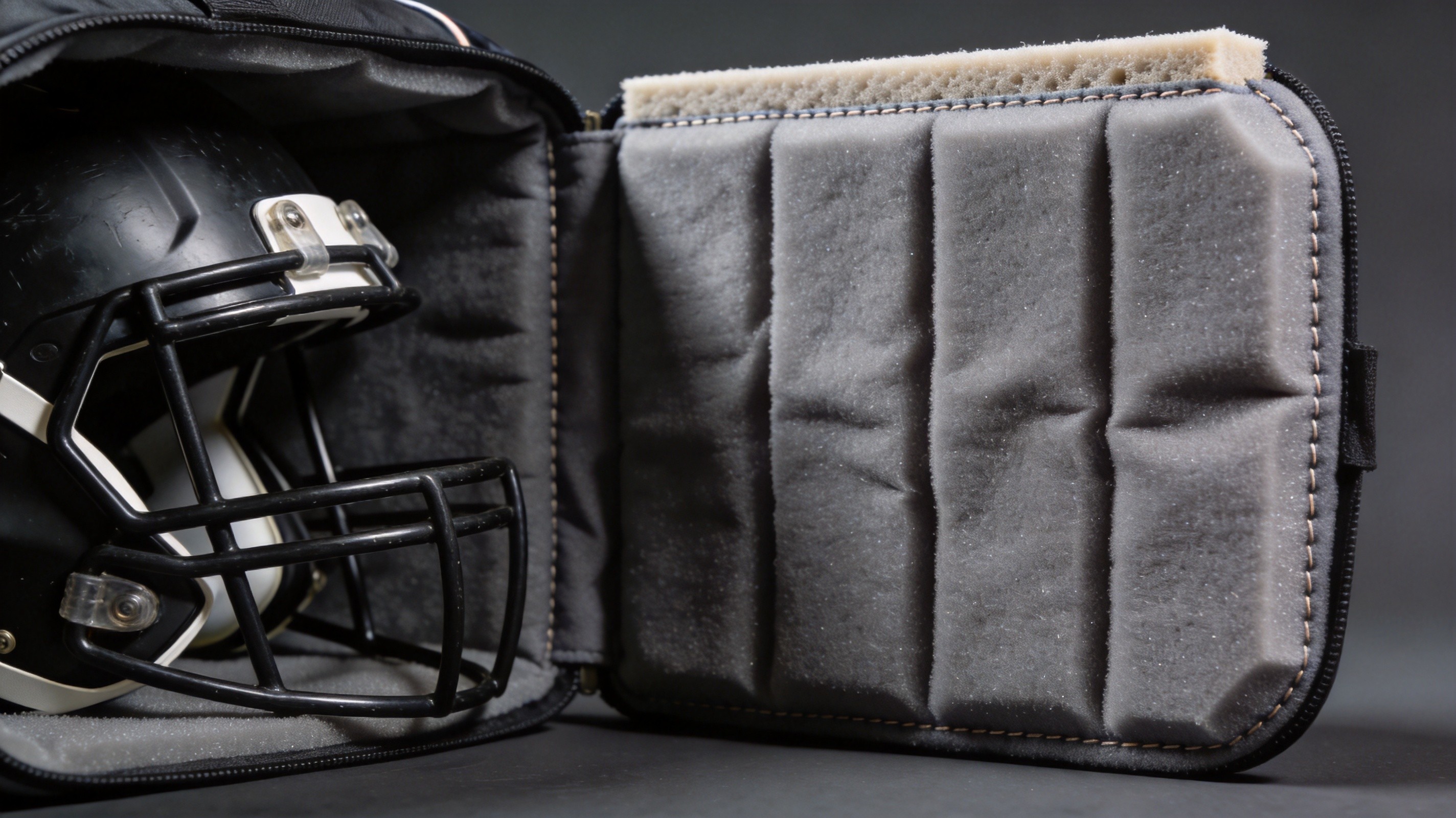
NOCSAE standards condition helmets at elevated temperature as part of the test protocol; the youth football standard, for example, specifies exposure to 100 °F ± 3 °F (39 °C ± 1 °C) for at least four and no more than twenty-four hours. A bag left in a vehicle or an equipment shed in summer can exceed that envelope substantially, and the exposure is cumulative across a season. Padding foams, adhesives and shell resins are all affected by repeated thermal cycling, and the degradation is invisible until a recertification test fails. Insulated or reflective helmet compartments, and storage guidance that keeps bags out of direct sun, address this directly.
Loss of the Manufacture Date Marking
ND004 permits recertification only where the date of manufacture is legible, and requires that the date remain legible through the reconditioning process so the user can read it on return. A bag with an abrasive interior, or one where helmets slide against each other, wears exactly the label the recertifier needs. Protecting the interior surface, and specifying a lining with known abrasion resistance, is a small design decision with a large downstream effect. Our article on abrasion-resistant fabrics for sports bags covers the material options.
Moisture and Hardware Corrosion
ND015 addresses the corrosion characteristics of metallic hardware. Helmets, faceguards, snaps and buckles stored in a bag that traps moisture sit in a condensing environment for hours at a time, repeatedly, across a season. The corrosion that follows attacks the very hardware the standard tests. Ventilation is the mitigation, and it has to be designed rather than assumed; our guide to ventilation systems in sports bags sets out the architectures that actually move air.
Configuration Change and Certification Void
NOCSAE warns explicitly that add-on accessories can modify mass, change the centre of gravity, and interfere with the shell’s ability to disperse impact energy. Where an add-on product has not been tested with a specific helmet model, the manufacturer and SEI have the right under the standards to declare certification void if the product is altered in any way. A bag that requires equipment to be clipped, strapped or permanently fitted into a carrier is close to that line. The safe design rule is that a bag holds equipment; it does not modify it.
Design Requirements for Equipment Bags in a Certified Program
The following specification points are what we recommend for programs that transport NOCSAE-certified equipment. They are written so they can be copied into a purchase specification.
- Dedicated helmet capacity. One compartment per helmet, or a rigid divider system, with a semi-rigid shell that resists compression when the bag is stacked.
- No equipment-on-equipment contact. Faceguards must not bear load, and helmets must not rest against each other or against hard hardware.
- Thermal buffering. Insulated or reflective lining on helmet compartments where bags are stored in vehicles or unconditioned buildings.
- Ventilation with an intake and an exhaust. Moisture removal matters for hardware corrosion and for padding life, not only for odour.
- Abrasion-controlled interior. Lining specified with a stated abrasion performance, so date and certification markings survive the season.
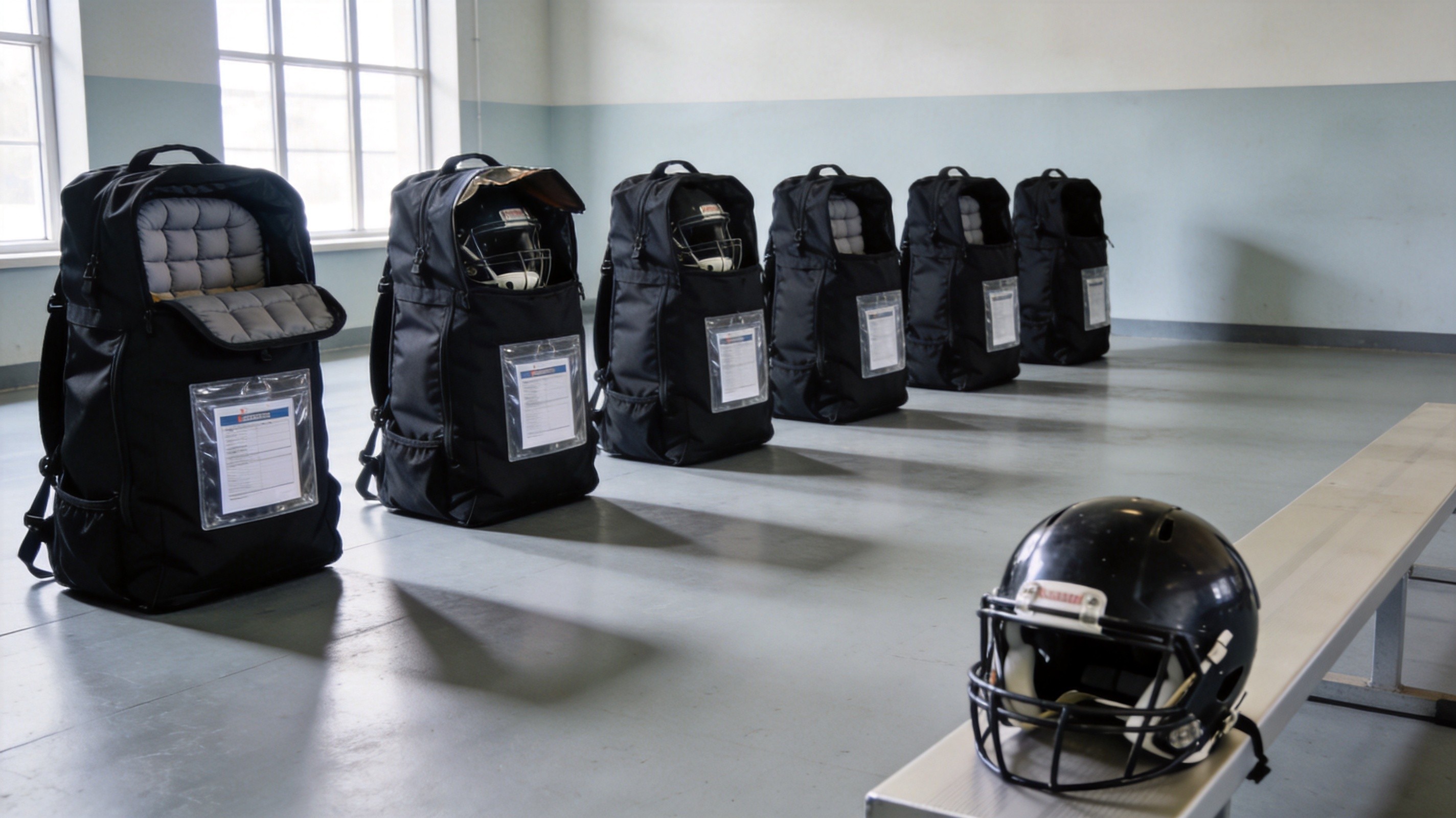
- Visible identification. An external ID window or a clear pocket so equipment can be tracked without opening the bag.
- RFID transparency where relevant. NOCSAE has been funding and validating a passive RFID label system for individual helmet identification and inventory tracking; a bag that shields the label defeats the purpose, so a non-metallic window over the label area is worth specifying.
- No permanent attachment points. Nothing that requires equipment to be modified to fit the bag.
Padding selection interacts with several of these points. Our guide to padding materials for custom sports bags compares EVA, PE, PU, gel and neoprene on the properties that matter here, and the broader guide to sports bag safety features covers the wider set of protection questions buyers raise.
Procurement Checklist for Schools, Clubs and Leagues
Before awarding an equipment bag contract, the following questions should have documented answers. Each one corresponds to a risk that has produced a real cost in a program somewhere.
- Does the bag provide one protected position per helmet, or does it rely on padding between stacked helmets?
- What is the compression resistance of the helmet compartment shell, and has it been tested with the bag loaded?
- Is the interior lining specified by abrasion performance, or only by hand feel?
- Does every equipment compartment have both an intake and an exhaust vent?
- Is there any metal hardware in contact with helmet shells or faceguards?
- Can equipment be identified and inventoried without opening the bag?
- Does the design require any modification to the equipment to fit?
- Is storage guidance supplied with the bag, covering temperature and ventilation?
What an OEM/ODM Program Looks Like
Equipment bag programs for certified equipment are not catalogue purchases. They start from the equipment list: how many helmets, which models, which sizes, how many faceguards, whether shoulder pads or chest protectors travel in the same bag. From that we derive compartment geometry, shell rigidity, lining specification and ventilation layout, then produce a sample for physical fit testing with the actual equipment. Fit testing is not optional here, because a compartment that is ten millimetres too tight creates the compression the whole design exists to prevent.
JUNYUAN BAGS was established as a company in 2014, working from our facility in Quanzhou, Fujian, and our manufacturing team has been in the bag industry since 2004. Our standard terms for custom programs are a minimum order of 500 pieces, sampling in 6 to 10 days, bulk production in 35 to 50 days from sample approval, FOB Xiamen, inspected to AQL 2.5. Programs that add moulded shells or insulated compartments should plan a longer sample window, because those components require tooling and a first-article check before sewing begins. The guide to custom sports bag manufacturing in China sets out the full sequence, and the sports bag category shows the programs we currently produce.
Frequently Asked Questions
Does NOCSAE certify equipment bags?
No. NOCSAE writes performance and test standards for protective equipment such as helmets, faceguards, gloves, shin guards and chest protectors. It does not cover bags, and it does not certify any product itself; certification is issued by the Safety Equipment Institute, an ANSI/ISO 17065 accredited body. A supplier claiming a bag is NOCSAE certified is misstating the standard. What a bag can legitimately claim is that it is designed to preserve the condition of certified equipment, and that claim should be supported by compartment design, compression resistance and ventilation specification.
Can a bag void a helmet’s NOCSAE certification?
A bag alone will not void certification, but a bag that requires the helmet to be altered, fitted with non-original hardware or permanently modified can. NOCSAE states that add-on accessories may change mass and centre of gravity and interfere with shell performance, and that where an add-on has not been tested with a specific helmet model the manufacturer and SEI may declare certification void if the product is altered. The design rule is straightforward: a bag should hold equipment without changing it. Any carrier that needs clips, straps or fittings attached to the helmet should be reviewed before it is adopted program-wide.
What temperature should a helmet storage bag withstand?
NOCSAE standards condition helmets at elevated temperature during testing; the youth football helmet standard specifies 100 °F ± 3 °F (39 °C ± 1 °C) for between four and twenty-four hours. A bag cannot be said to “withstand” a temperature in the standards sense, because the standards test helmets rather than bags. What a buyer should specify is thermal buffering: insulation or a reflective lining on helmet compartments, plus written storage guidance that keeps bags out of direct sun and out of parked vehicles. The objective is to keep the equipment’s cumulative heat exposure inside the envelope its certification was based on.
How often must NOCSAE-certified helmets be recertified?
NOCSAE guidance states that a helmet older than two years should be reconditioned and recertified to the NOCSAE standard. Recertification is carried out by licensed reconditioners; NOCSAE currently licenses 22 reconditioners nationally in the United States. A recertified helmet carries a recertification label inside indicating the recertifying firm and the date, and may carry an exterior label showing the year. Two bag-related conditions bear on this: the manufacture date must remain legible for recertification to be permitted, and the shell must be free from cracks. Both are transport-protection issues.
What documentation should a bag supplier provide?
For an equipment bag program we provide a technical drawing showing compartment geometry and ventilation layout, a material specification listing shell, lining and hardware with the abrasion and air permeability data where relevant, a physical fit sample tested with the buyer’s actual equipment, and inspection records against the agreed AQL. Where the buyer’s tender requires third-party test reports for materials, we arrange testing to the standard the buyer nominates and supply the report with the conditioning atmosphere and test conditions stated. What we do not do is issue any document implying the bag itself carries a protective equipment certification, because no such certification exists.
Is a rigid or a soft bag better for certified equipment?
Neither is universally better; the requirement follows the transport pattern. A soft bag with internal semi-rigid dividers suits programs where bags are carried individually by athletes and loaded once. A rigid or framed bag suits bulk transport where bags are stacked in a trailer or stored in a container, because stacking load is the dominant risk and only a rigid structure resists it. The failure mode to avoid in both cases is the same: helmets in contact with each other with nothing but padding between them. Our article on designing bags for team sports covers how transport patterns change the specification.