
The global golf bag market is projected to reach $2.1 billion by 2030, driven by rising golf participation and growing demand for personalized equipment. For entrepreneurs and existing bag manufacturers, launching a custom golf bag brand represents one of the most exciting opportunities in the sporting goods sector today.
? Related: Looking for a comprehensive guide to custom golf bag manufacturing? Check out our Custom Golf Bag Manufacturing Complete Guide — covering materials, design, QC, and sourcing strategies.
This comprehensive guide walks you through every critical step — from market analysis and brand positioning to design, manufacturing, pricing, and distribution. Whether you are a startup founder exploring the golf industry or an established bag company expanding your product portfolio, this roadmap provides the actionable framework you need to build a profitable custom golf bag brand.
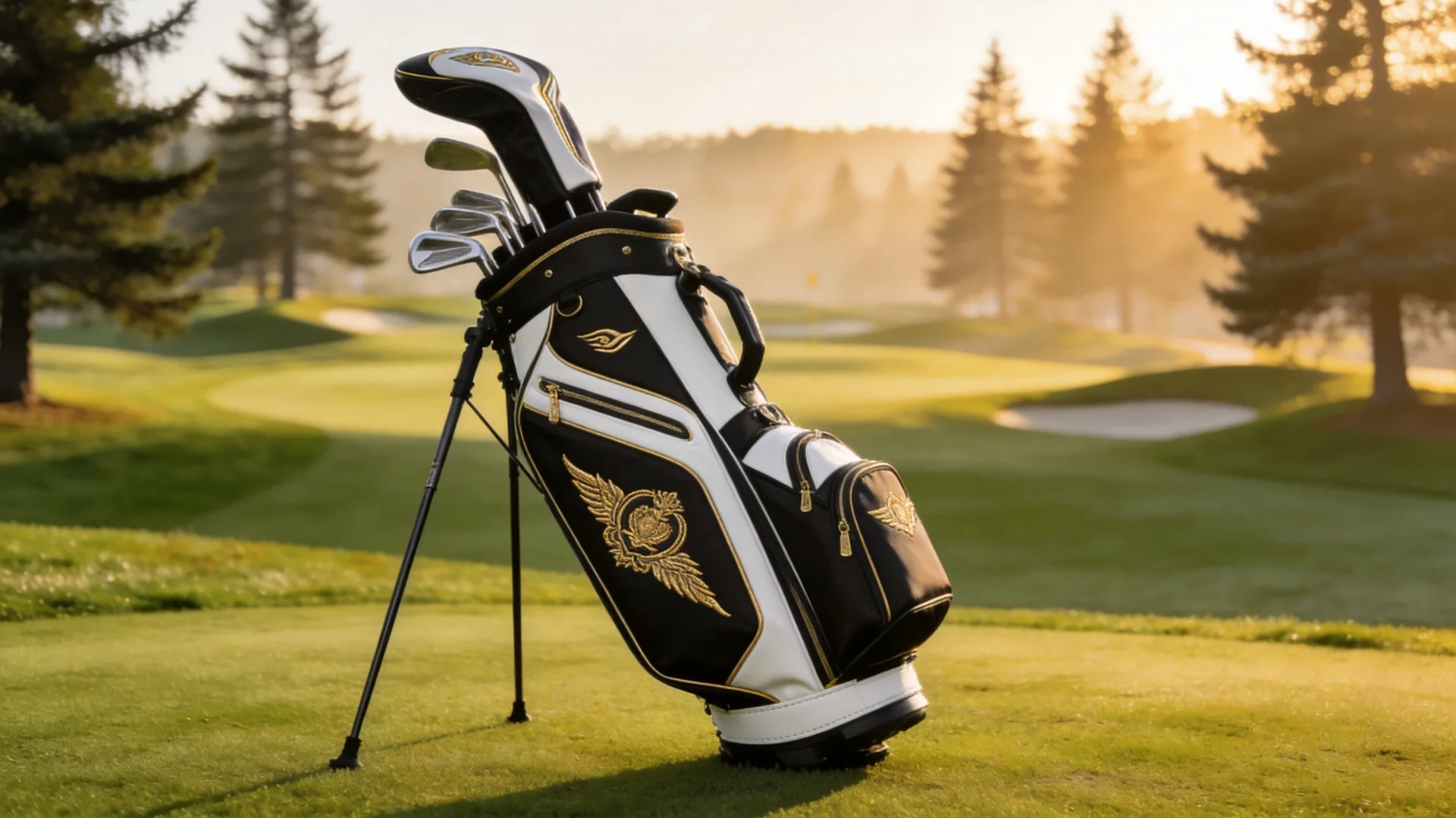
Market Opportunity: Why Start a Golf Bag Brand Now?
The golf industry has experienced a remarkable renaissance over the past five years. According to the National Golf Foundation, there are over 28 million golfers in the United States alone, with the number of rounds played reaching all-time highs. The global golf equipment market, valued at approximately $1.5 billion for golf bags in 2024, is expected to grow at a CAGR of 5.8% through 2030.
Several macro trends make this an ideal entry point:
- The DTC revolution: Direct-to-consumer brands like Vessel and Sun Mountain have proven that new golf bag brands can compete with legacy players by selling online and controlling the full customer experience. DTC margins typically run 40-60% compared to 20-30% in traditional wholesale.
- Customization demand: Modern golfers increasingly want equipment that reflects their personal style. Custom colorways, monogramming, and bespoke features command 30-50% premium over standard products.
- Niche segment growth: Premium staff bags, lightweight carry bags, and specialized travel bags are outpacing the overall market growth rate. Brands that own a specific niche can achieve faster customer acquisition and stronger loyalty.
- Corporate and team market: Golf tournaments, corporate outings, and college team programs create consistent B2B demand for custom-branded bags with reliable reorder cycles.
The window is open, but success depends on strategic execution. The brands thriving today identified a specific gap in the market and built their entire operation around serving that customer better than anyone else.
Step 1: Define Your Brand Identity & Target Customer
Before designing a single bag, you must establish a clear brand foundation. The golf bag market serves distinct customer segments, each with different expectations and price sensitivities.
Brand Positioning Framework
Start by answering three fundamental questions:
- Who is your ideal customer? Define demographics (age, income, location), psychographics (values, lifestyle, aspirational identity), and behavioral patterns (how often they play, where they shop, what they currently use).
- What problem do you solve? Perhaps existing bags lack sufficient organization for tournament play. Maybe travel bags fail to protect expensive clubs during flights. Or perhaps the market lacks affordable bags with premium aesthetics.
- Why should customers choose you? Your unique value proposition must be specific enough to guide every design, marketing, and pricing decision.
Customer Persona Examples
The Country Club Enthusiast: Plays 3-4 rounds per week, values premium materials and aesthetics, brand-conscious, willing to invest $600-$1,200 in a staff bag that matches their personal style.
The Weekend Warrior: Plays 1-2 rounds monthly, prioritizes functionality and value, researches extensively before purchasing, budget range $200-$400.
The Travel Golfer: Plays destination rounds 4-6 times per year, needs durable bags with superior club protection and organizational features for airline travel, budget $300-$700.
The Young Golf Enthusiast: Age 25-35, new to the sport, influenced by social media and peer trends, seeks modern designs at accessible price points ($150-$300).
Price Point Strategy
Your price point determines everything from material selection to manufacturing complexity and minimum order quantities. Premium positioning requires higher-quality materials (full-grain leather, 1680D ballistic nylon, custom metal hardware) and commands higher margins but requires larger initial investment. Value positioning demands smart material sourcing and efficient manufacturing processes to maintain healthy margins at competitive prices.
A practical approach: map your target price against competitors at the same level, identify 2-3 features where you can genuinely outperform them, and build your brand story around those differentiators.
Step 2: Design Your Golf Bag Collection
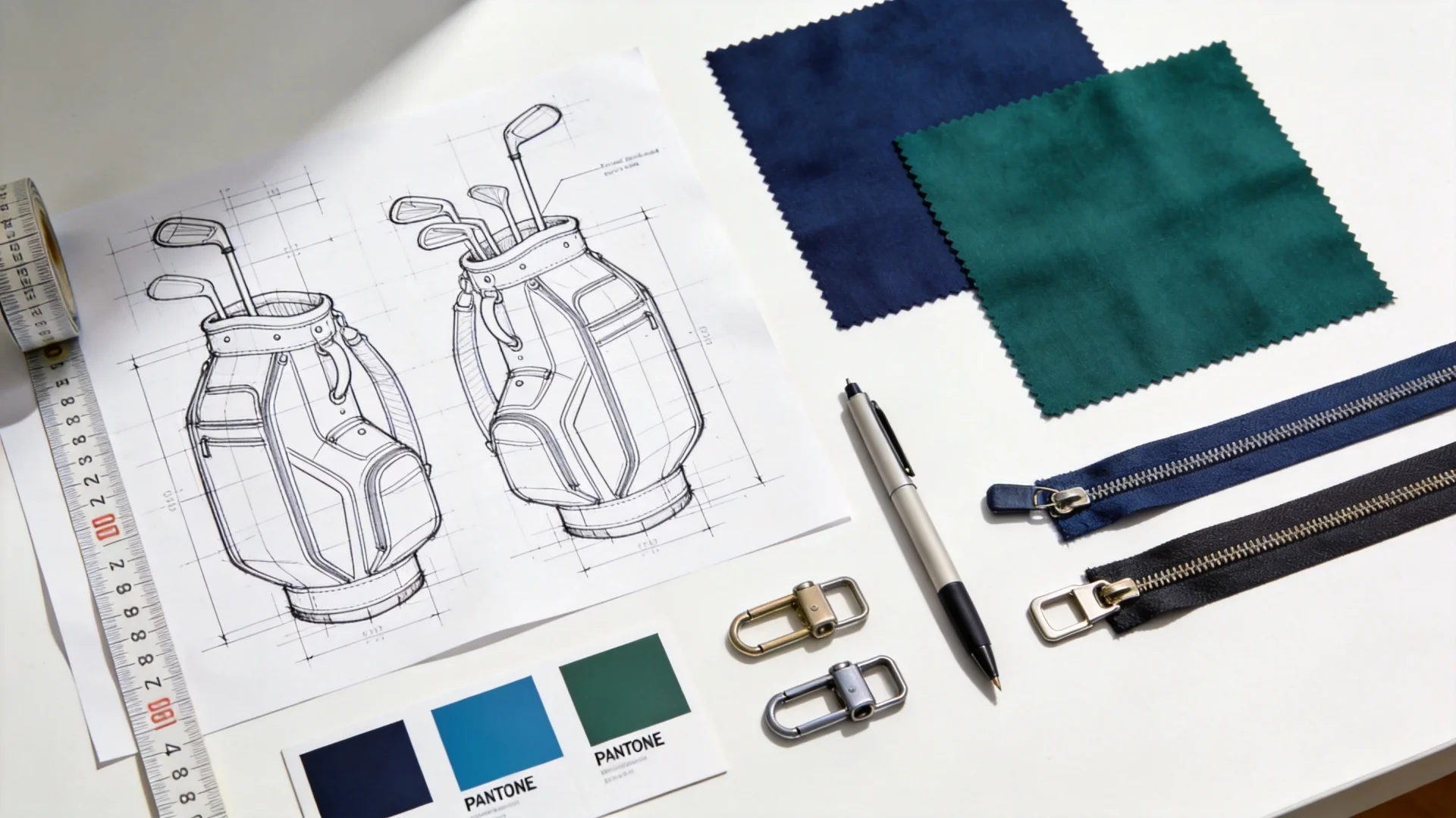
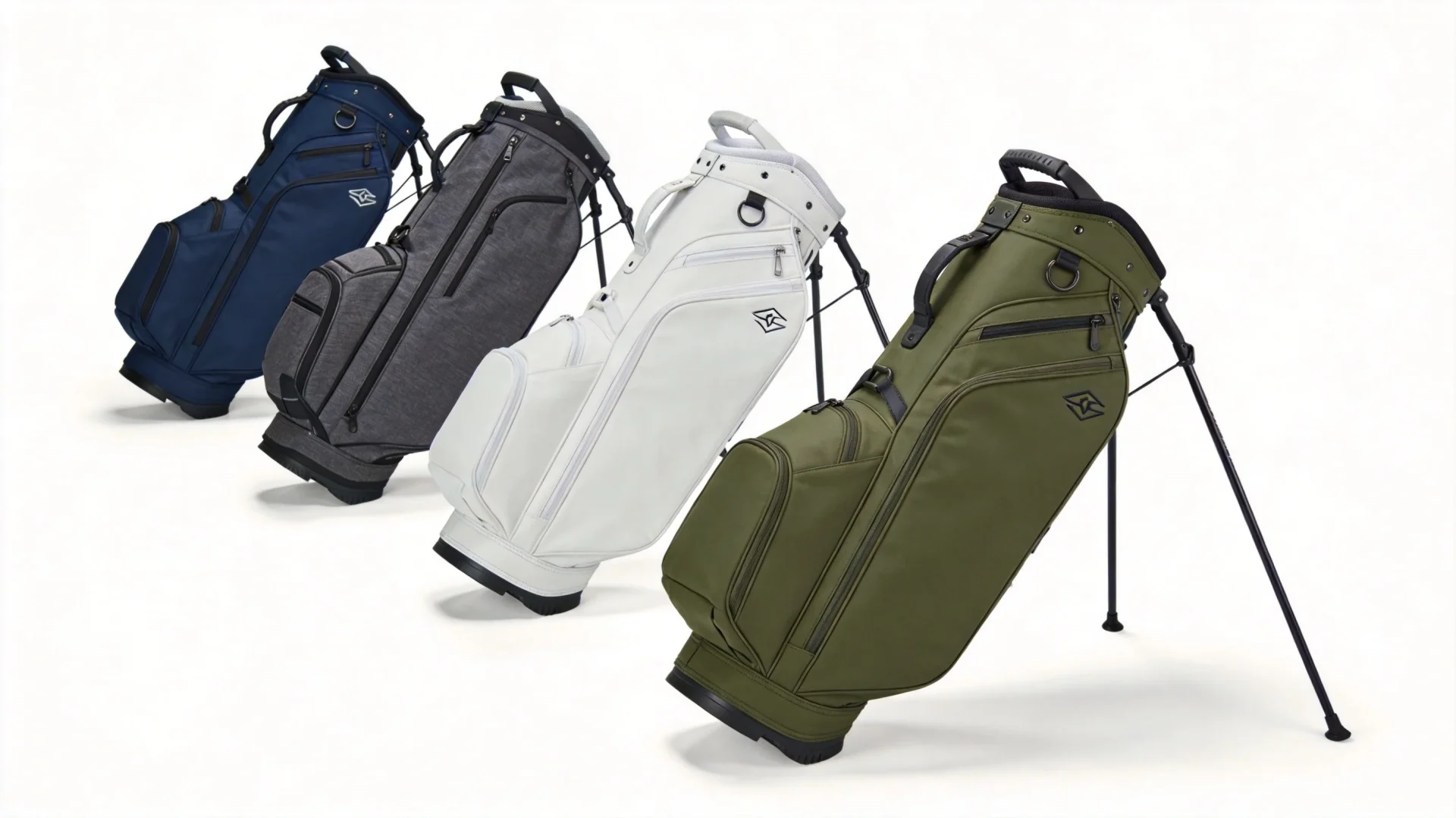
Your product line should serve your target customer’s primary use cases while offering clear differentiation from competitors.
Product Line Planning
A well-structured golf bag collection typically includes:
- Staff/Tour bags: Large-capacity bags (35+ inches) used by professionals and serious enthusiasts. Premium materials, maximum branding surface, highest price point ($400-$1,200 retail).
- Cart bags: Designed for riding, featuring optimized pocket layouts for cart-mounted use, typically 14-way divider systems ($200-$500 retail).
- Carry/Stand bags: Lightweight designs (under 5 lbs) with integrated stand mechanisms and comfortable dual straps for walking golfers ($150-$400 retail).
- Travel bags: Heavy-duty protection with padded club heads, reinforced bottoms, and wheels for airline travel ($200-$600 retail).
- Sunday/Utility bags: Minimalist designs for casual rounds or as lifestyle accessories ($100-$250 retail).
For a new brand launch, start with 2-3 core products that serve your primary customer segment. You can expand the line once you validate product-market fit and build manufacturing relationships.
Design Essentials
Every successful golf bag design must address these critical elements:
- Divider system: Full-length dividers (14-way being industry standard) prevent club tangling and protect shafts. Individual divider tubes with soft lining prevent rattling during transport.
- Material selection: Common options include nylon (210D to 1680D), polyester, PU leather, genuine leather, and hybrid constructions. Each offers different trade-offs in durability, weight, water resistance, and cost.
- Pocket configuration: Consider purpose-built pockets: insulated cooler pocket, waterproof valuables pocket, full-length apparel pocket, dedicated rangefinder pocket, and accessory organizers.
- Strap system: For carry bags, invest in ergonomic dual-strap systems with breathable mesh padding. For cart bags, focus on a sturdy handle and cart pass-through design.
- Weight optimization: Strategic material selection and construction methods can reduce weight by 15-20% without sacrificing durability.
- Waterproofing: Consider water-resistant zippers, sealed seams, and waterproof base materials to protect contents in wet conditions.
Tech Packs and Specifications
Before approaching manufacturers, prepare detailed tech packs for each bag design. A complete tech pack includes technical flat drawings with precise dimensions, bill of materials specifying every component, color specifications using Pantone codes, branding placement maps, construction details, and packaging specifications.
Professional tech packs reduce sampling iterations, minimize miscommunication with manufacturers, and serve as the contractual baseline for quality control inspections.
Step 3: Find the Right Manufacturing Partner
Your manufacturing partner directly impacts product quality, profit margins, and scalability. This decision deserves careful research and due diligence.
OEM vs. ODM Decision
OEM (Original Equipment Manufacturing): You provide complete designs and specifications; the factory produces exactly to your requirements. Maximum control but requires significant upfront investment in design development.
ODM (Original Design Manufacturing): The factory provides existing designs that you customize with your branding and selected modifications. Reduces development time and cost but limits differentiation. Many successful brands start with ODM and transition to OEM as they scale.
How to Vet Manufacturers
- Industry experience: Prioritize manufacturers with proven golf bag production experience. Request references and examine stitching consistency, zipper quality, reinforcement at stress points, and finishing details.
- Production capacity: Ensure the factory can handle your initial order volume and scale as your brand grows. Ask about peak season constraints and lead time variability.
- Certifications: Verify ISO 9001, BSCI, SEDEX, or other relevant certifications depending on your target markets.
- Communication responsiveness: Test responsiveness during the inquiry process — this predicts the entire partnership experience.
Sample Development Process
- Initial prototype (2-4 weeks): First physical sample based on your tech pack. Evaluates overall proportions, pocket placement, structural integrity.
- Fit and function sample (2-3 weeks): Incorporates feedback from the first sample. Tests with actual golf clubs to verify divider fit and weight distribution.
- Pre-production sample (2-3 weeks): Made with final production materials and all branding elements. This is the approval benchmark for all production units.
- Production sample: Pulled from the first production run for final verification before shipment.
? Related: Need a deeper dive into sample development? Our Bag Sample Development & Prototyping Complete Guide covers everything from tech packs to approval workflows.
Step 4: Branding, Logo & Custom Features
Branding transforms a generic golf bag into a recognizable product that commands premium pricing and builds customer loyalty.
Logo Application Methods
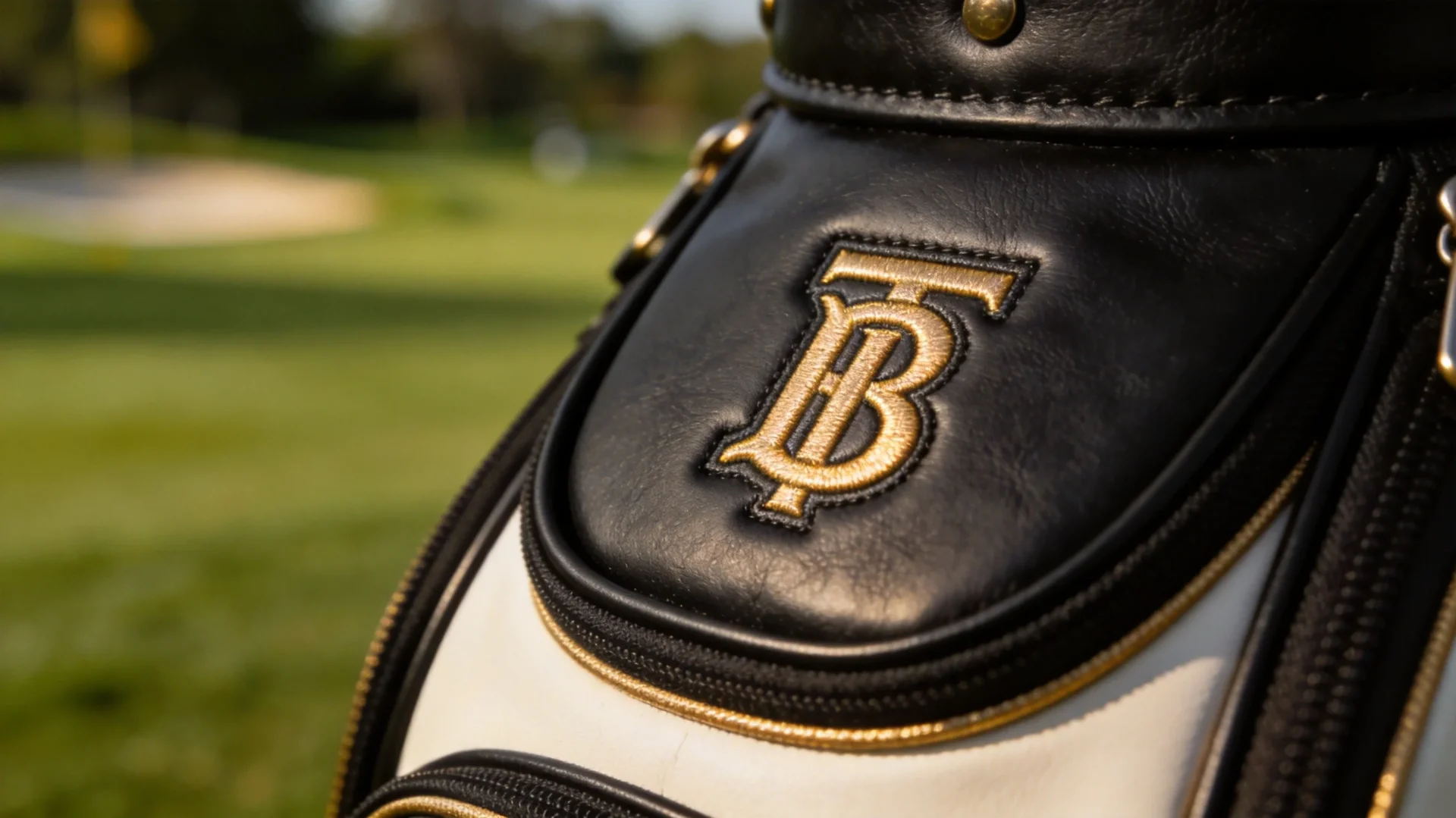
- Embroidery: The gold standard for premium golf bags. Creates a textured, professional appearance with excellent durability. Ideal for logos with simple geometry and limited colors.
- Screen printing: Cost-effective for larger logos or full-color designs. Works well on flat fabric surfaces.
- Heat transfer/debossing: Creates a sophisticated embedded look, particularly effective on leather and synthetic leather surfaces. Offers excellent durability and premium hand feel.
- Rubber/silicone patches: Sewn or adhered patches that create dimensional branding elements. Popular for modern, sporty brand aesthetics.
- Metal badges: CNC-machined or cast metal logos that provide ultimate premium positioning on staff bags and luxury cart bags.
Custom Hardware and Features
Beyond logos, custom features create genuine differentiation: custom zipper pulls with your brand logo, branded buckle hardware in your signature finish (matte black, brushed gold, antique silver), custom-printed interior lining, proprietary strap systems with branded detailing, and custom-molded base plates with integrated brand identity.
? Related: Dive deeper into branding techniques in our Custom Golf Bag Logo & Branding Methods Guide — comparing embroidery, screen printing, heat transfer, and more.
Step 5: Pricing, MOQ & Budget Planning
Understanding the full cost structure is essential for setting profitable retail prices and planning your initial investment.
Cost Breakdown
| Cost Component | % of Total | Example (Cart Bag) |
|---|---|---|
| Materials (fabric, leather, hardware) | 35-45% | $15-$22 |
| Labor (cutting, sewing, assembly) | 25-35% | $10-$16 |
| Branding (logos, custom hardware) | 10-15% | $4-$7 |
| Packaging and accessories | 5-8% | $2-$4 |
| Shipping and logistics | 8-12% | $4-$6 |
| Total FOB Cost | 100% | $35-$55 |
? Related: Get detailed cost breakdowns and pricing strategies in our Custom Golf Bag Cost & Pricing Guide.
Minimum Order Quantities
MOQs vary by manufacturer and product complexity:
- Standard designs with custom branding: 100-300 pieces per color/style
- Full custom designs (new molds/tooling): 300-500 pieces per style
- ODM with logo customization: 50-100 pieces per style
Negotiate better MOQs by offering multi-style orders that share materials, committing to reorder schedules, or accepting slightly higher per-unit costs for smaller initial runs.
Startup Budget Planning
| Item | Budget Range |
|---|---|
| Sample development (3-5 rounds) | $2,000 – $5,000 |
| First production run (200-500 units) | $8,000 – $27,500 |
| Branding and packaging | $1,500 – $4,000 |
| Design and tech pack development | $2,000 – $6,000 |
| Quality control inspections | $500 – $1,500 |
| Shipping and import duties | $2,000 – $5,000 |
| Estimated Total | $16,000 – $49,000 |
Step 6: Quality Control & Production Timeline
Consistent quality is non-negotiable for building a reputable golf bag brand. Implement a structured QC program covering incoming material inspection, in-line production inspection (DUPRO at 20% completion), and final random inspection based on AQL standards (typically AQL 2.5 for major defects and AQL 4.0 for minor defects).
Common QC checkpoints specific to golf bags include: divider system fit with actual golf clubs, stand mechanism deployment and retraction (for carry bags), weight verification, zipper smoothness under load, strap padding comfort, waterproofing effectiveness, and branding placement accuracy.
Production Timeline
- Sample approval: 6-10 weeks
- Material sourcing and procurement: 2-4 weeks
- Production (cutting, sewing, assembly): 3-5 weeks
- Quality control inspection: 1-2 weeks
- Shipping and customs: 3-5 weeks (sea freight) or 1-2 weeks (air freight)
Total timeline from design approval to delivery: 70-110 days. Plan additional buffer time for seasonal peak periods (typically Q1 and Q3 when golf retailers prepare for spring and fall seasons).
Step 7: Launch Strategy: DTC, Wholesale & Distribution
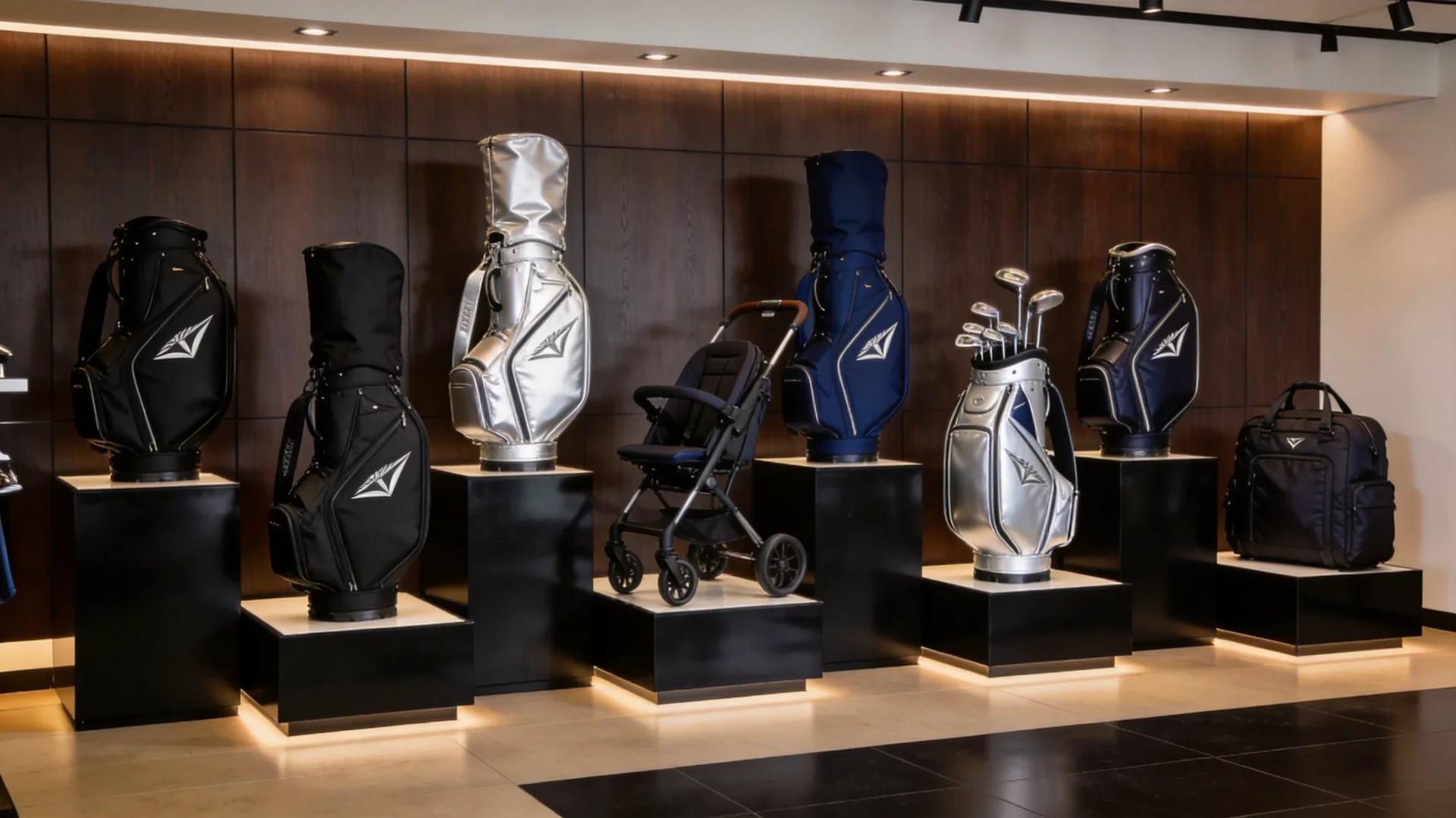
Your distribution strategy determines how customers discover and purchase your brand. Each channel offers distinct advantages.
Channel Comparison
Amazon: Immediate access to millions of golf-buying customers with FBA logistics handling fulfillment. However, Amazon fees (15% referral plus FBA costs) compress margins, and price competition is intense. Best for brands with strong SEO capability and competitive pricing.
Shopify DTC Website: Maximum brand control, customer data ownership, and profit margins. Requires investment in driving traffic through paid advertising, content marketing, and social media. Ideal as your brand’s primary home and storytelling platform.
Retail Wholesale: Getting your bags into golf pro shops and specialty stores provides credibility and physical product exposure. Expect 40-50% wholesale margins for retailers with net-30 to net-60 payment terms. Start with independent pro shops before approaching larger chains.
Hybrid Approach: Most successful new brands launch simultaneously on their own website (for margin and brand building) and select retail partners (for credibility and discovery). Add Amazon once you have product reviews and optimized listings.
Marketing Channels
- SEO and content marketing: Build organic traffic with golf-related content, buying guides, and product comparison pages. Highest long-term ROI with 3-6 month ramp-up period.
- Golf influencer partnerships: Collaborate with golf instructors, YouTube personalities, and social media golfers. Micro-influencers (5,000-50,000 followers) offer the best engagement rates for new brands.
- Paid social media: Instagram and Facebook ads targeting golf enthusiasts with lookalike audiences based on your initial customer base.
- Trade shows: Attend PGA Merchandise Show, Golf Festival, and regional golf expos to connect with retail buyers and generate press coverage.
- Email marketing: Build your list from day one with early-bird pricing and exclusive content. Delivers the highest ROI of any channel for established brands.
Frequently Asked Questions
What is the minimum order quantity for starting a custom golf bag brand?
Most golf bag manufacturers require a minimum of 100-500 pieces per style and color. For OEM projects with fully custom designs, MOQs typically start at 300 pieces. ODM programs with existing molds can start as low as 50-100 pieces with custom branding. Negotiate better MOQs by ordering multiple styles that share common materials, or by committing to quarterly reorders.
How long does it take to launch a golf bag brand from concept to market?
A realistic timeline from initial concept to first customer delivery is 4-6 months for simple branding projects and 6-10 months for fully custom designs. This includes design development (4-8 weeks), sampling (6-10 weeks), production (4-6 weeks), quality control (1-2 weeks), and shipping (3-5 weeks). Allow additional time for website development and marketing preparation.
What is the typical profit margin for a custom golf bag brand?
DTC brands typically achieve 50-65% gross margins (selling at 2.5-4x the landed cost). Wholesale margins are typically 30-45% (selling at 1.8-2.2x the landed cost). For example, a cart bag with a landed cost of $45 could retail for $112-$180 DTC, or wholesale for $81-$99. Brands with strong positioning and premium materials can command even higher multiples.
Should I choose OEM or ODM manufacturing for my first golf bag collection?
If you have a clear design vision, sufficient budget for sampling ($3,000-$8,000), and a 6+ month timeline, OEM gives you complete differentiation. If you need faster market entry with lower upfront investment, ODM with custom branding offers a practical starting point. Many successful brands begin with ODM, validate their market positioning, and transition to OEM for subsequent collections when they have customer feedback to inform design decisions.
How do I ensure consistent quality across production runs?
Implement a three-tier quality control system: incoming material inspection, in-line production inspection (DUPRO at 20% completion), and final random inspection (AQL 2.5 standard). Always approve a pre-production sample that serves as the quality benchmark. Hire a third-party inspection service for independent verification and maintain detailed quality documentation and photographic records for consistency reference.
Ready to Launch Your Custom Golf Bag Brand?
Partner with JUNYUAN — your experienced manufacturing team with over a decade of expertise in custom golf bag production. From concept design to final delivery, we guide you through every step of building your brand.
? Related: For a complete overview of custom golf bag manufacturing, check out our Custom Golf Bag Manufacturing Complete Guide.