Why Sample Development Is the Most Critical Phase in Bag Manufacturing
Every successful bag product begins with one non-negotiable step: bag sample development. Whether you are launching a private-label backpack brand, developing a custom tactical bag for a government contract, or preparing a carry-on collection for a major retailer, the sampling phase is where concepts become tangible products — and where costly mistakes are either caught or compounded.
Consider this: a single material specification error discovered during mass production can halt an entire order, wasting weeks of work and thousands of dollars in raw materials. A zipper placement that looks perfect on a 2D sketch might create an uncomfortable bulge when the bag is loaded to capacity. A dye lot mismatch between the main fabric and the lining may go unnoticed until the first 500 units arrive at the warehouse.
These are not hypothetical scenarios. They are common failures that brands experience when sampling is rushed, undervalued, or treated as a formality rather than a strategic process. According to industry data, reworking a production run due to sampling errors costs 10 to 20 times more than investing in thorough prototype iterations upfront.
Beyond cost, sampling directly impacts your time-to-market window. In the competitive bag industry, being 4 to 6 weeks late to a seasonal launch can mean missing back-to-school, holiday, or trade show opportunities entirely. Brands that invest in rigorous sample development — testing materials, validating construction methods, and securing stakeholder approvals — consistently reach production faster than those who skip or shortcut the process.
At Junyuan, with over two decades of bag industry experience dating from 2004, we have refined our sampling process to minimize iterations while maximizing quality. This guide shares everything B2B buyers need to know about bag sample development and prototyping — from choosing the right sample type to managing the handoff to mass production.
Types of Samples: Prototype, Pre-Production, Production, Golden Sample — Differences & When to Use Each
Understanding the different types of samples in bag manufacturing is essential for effective communication with your factory and for planning your development timeline. Each sample type serves a distinct purpose in the product development lifecycle.
Prototype Sample (Proto Sample)
The prototype sample is the first physical manifestation of your bag design. Created during the early design phase, it focuses on validating the overall concept — proportions, compartment layout, strap configuration, and general aesthetic. Prototype samples are typically made with available or similar materials rather than exact production fabrics, since the goal is to test form and function rather than final specifications. Most brands create 1 to 3 prototype rounds before locking the design direction.
Pre-Production Sample (PP Sample)
Once the prototype is approved, the pre-production sample is manufactured using the exact production materials — the correct fabric, hardware, lining, thread, and padding. This sample must be constructed using the same methods planned for mass production. The PP sample serves as the final quality benchmark before full-scale manufacturing begins. Retail buyers and brand managers use this sample for final sign-off, photography, and marketing material creation.
Production Sample
A production sample is pulled directly from the first batch of mass production. It confirms that the factory has correctly implemented the approved pre-production specifications at scale. This sample is used for internal quality verification and is often sent to the buyer for comparison against the golden sample. Any deviation found at this stage triggers immediate corrective action.
Golden Sample
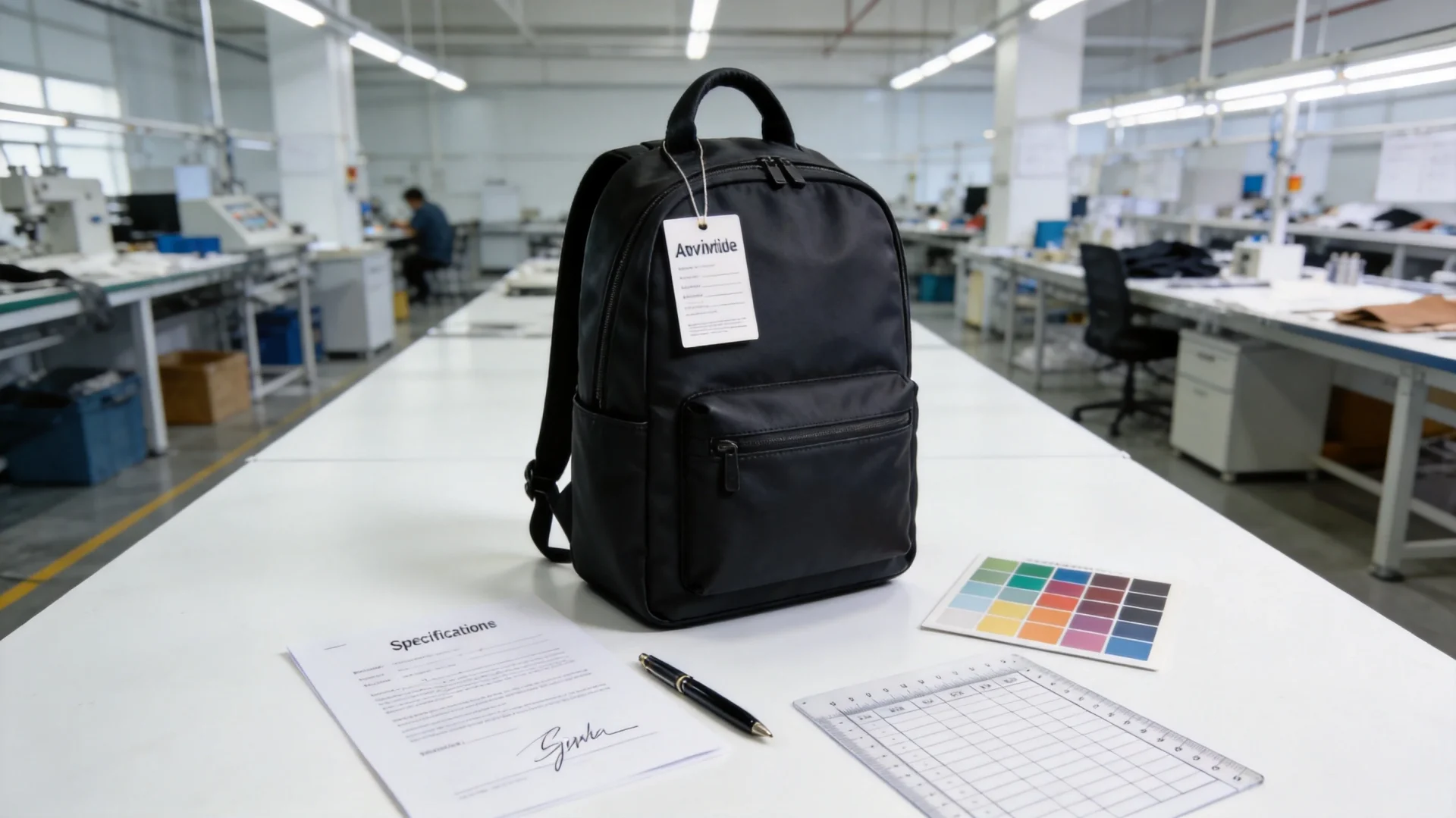
The golden sample — sometimes called the “approved reference sample” or “sealed sample” — is the ultimate quality standard for the entire production run. Two identical copies are typically signed, dated, and sealed: one stays with the factory’s production line, and one is held by the buyer. Every unit produced must match the golden sample in materials, construction, color, dimensions, stitching quality, and finishing details.
Prototyping vs Sampling: Key Differences for Bag Manufacturing
While often used interchangeably, prototyping and sampling serve different functions in bag development. Understanding the distinction helps you allocate resources more effectively and communicate precisely with your manufacturing partner.
Prototyping is the creative exploration phase. It is iterative, experimental, and focused on solving design challenges. During prototyping, you test different silhouettes, experiment with compartment configurations, evaluate ergonomic features, and validate that your design concept translates from a flat sketch into a three-dimensional object. Prototypes are often made quickly with whatever materials are on hand, and perfection is not the goal — learning is.
Sampling, in contrast, is the specification verification phase. Once the design is locked through prototyping, sampling produces units that precisely match the final technical specifications. Sampling uses exact production materials, exact tooling, and exact construction methods. The purpose is to confirm that the factory can consistently reproduce the approved design at the required quality level.
In practice, the transition from prototyping to sampling is not always a clean handoff. Many manufacturers like Junyuan operate with an integrated approach where prototype insights directly inform the sampling process. Our custom bag design guide provides a detailed look at how the design-to-sample workflow operates in a professional OEM environment.
For brands working with tight deadlines — such as Kickstarter bag projects — understanding this distinction is particularly important. Rushing through prototyping to “save time” almost always leads to more sampling iterations, which ultimately costs more time and money.
The Complete Bag Sample Development Process
A professional bag sample development process follows a structured workflow with clearly defined stages. While timelines and complexity vary by project, the core steps remain consistent across product categories — from custom backpacks to cooler bags and sports equipment.
Step 1: Design Brief & Requirements Gathering
The process begins with a comprehensive design brief that captures your target market, intended use case, price point, quantity requirements, and aesthetic preferences. This document is the foundation for all subsequent development work and should include reference images, competitor analysis, and specific functional requirements (water resistance, laptop compartments, modular attachment systems, etc.).
Step 2: Design Concept & Sketch Development
Based on the brief, the factory’s design team creates initial concept sketches — both hand-drawn and digital. These sketches explore multiple directions and are presented to the client for feedback. This stage may involve 2 to 5 concept variations before selecting the direction to prototype.
Step 3: CAD Drawings & Technical Specifications
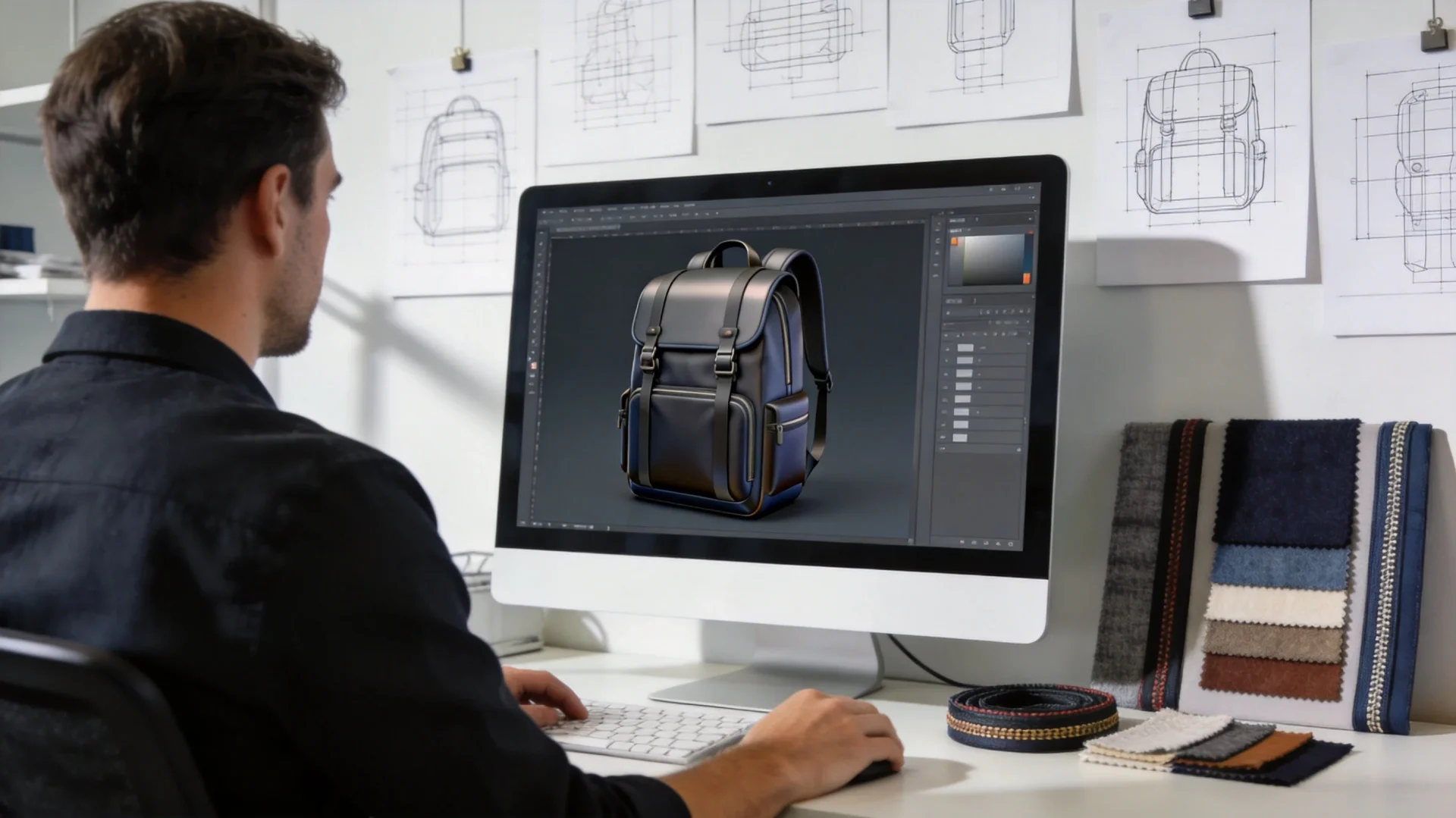
Once the concept direction is approved, detailed CAD (Computer-Aided Design) drawings are created. These include front, side, back, and top views with precise dimensions, seam placements, pocket locations, zipper lengths, and hardware positions. CAD files serve as the blueprint for pattern makers and are essential for ensuring dimensional accuracy.
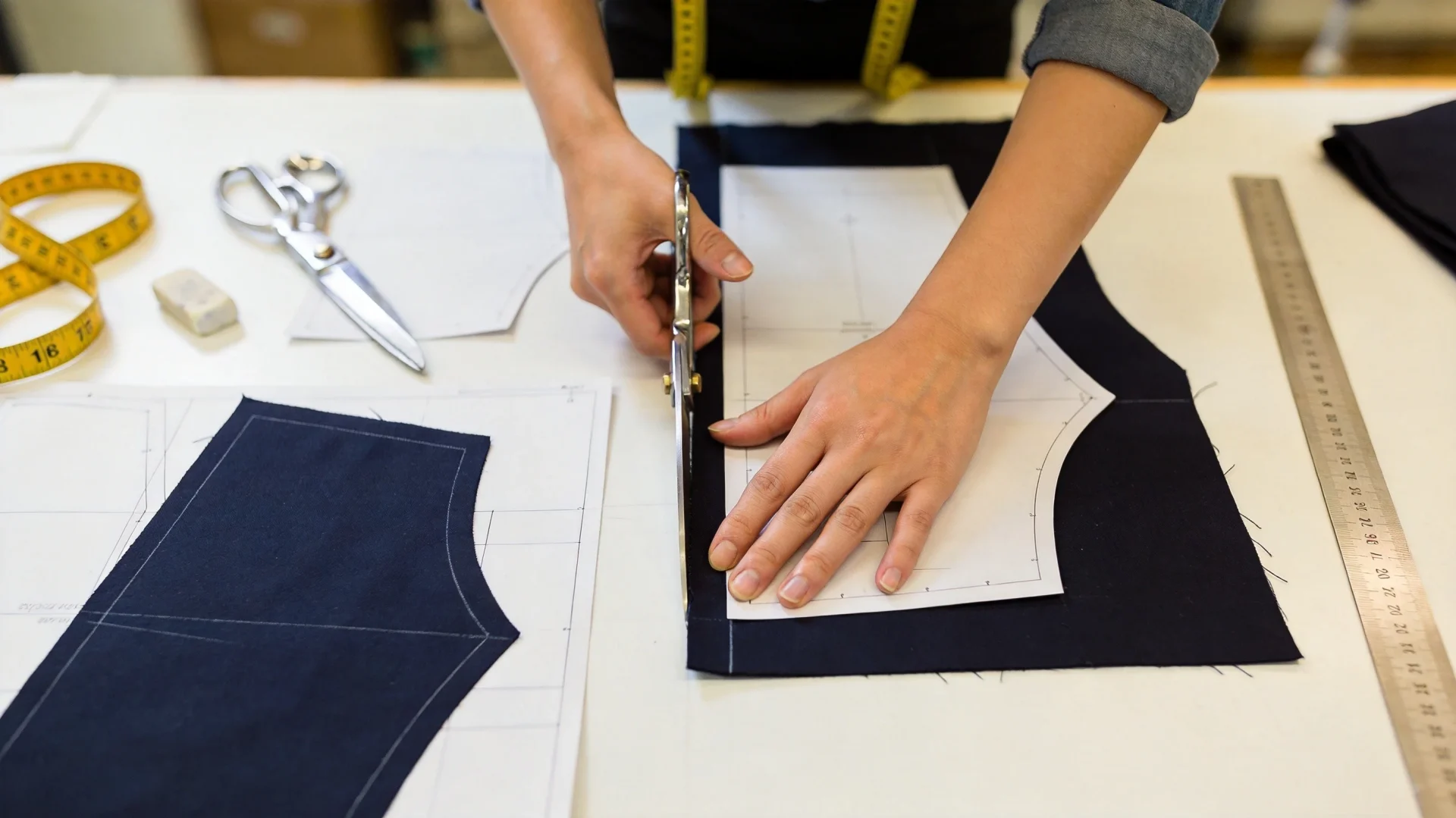
Step 4: Pattern Making
Expert pattern makers translate the CAD drawings into physical paper or digital patterns — the templates used to cut fabric pieces. Pattern making is a specialized skill that directly impacts the bag’s final fit, structure, and visual proportions. A well-made pattern accounts for seam allowances, fabric stretch, padding thickness, and the three-dimensional form of the finished product.
Step 5: First Prototype Assembly
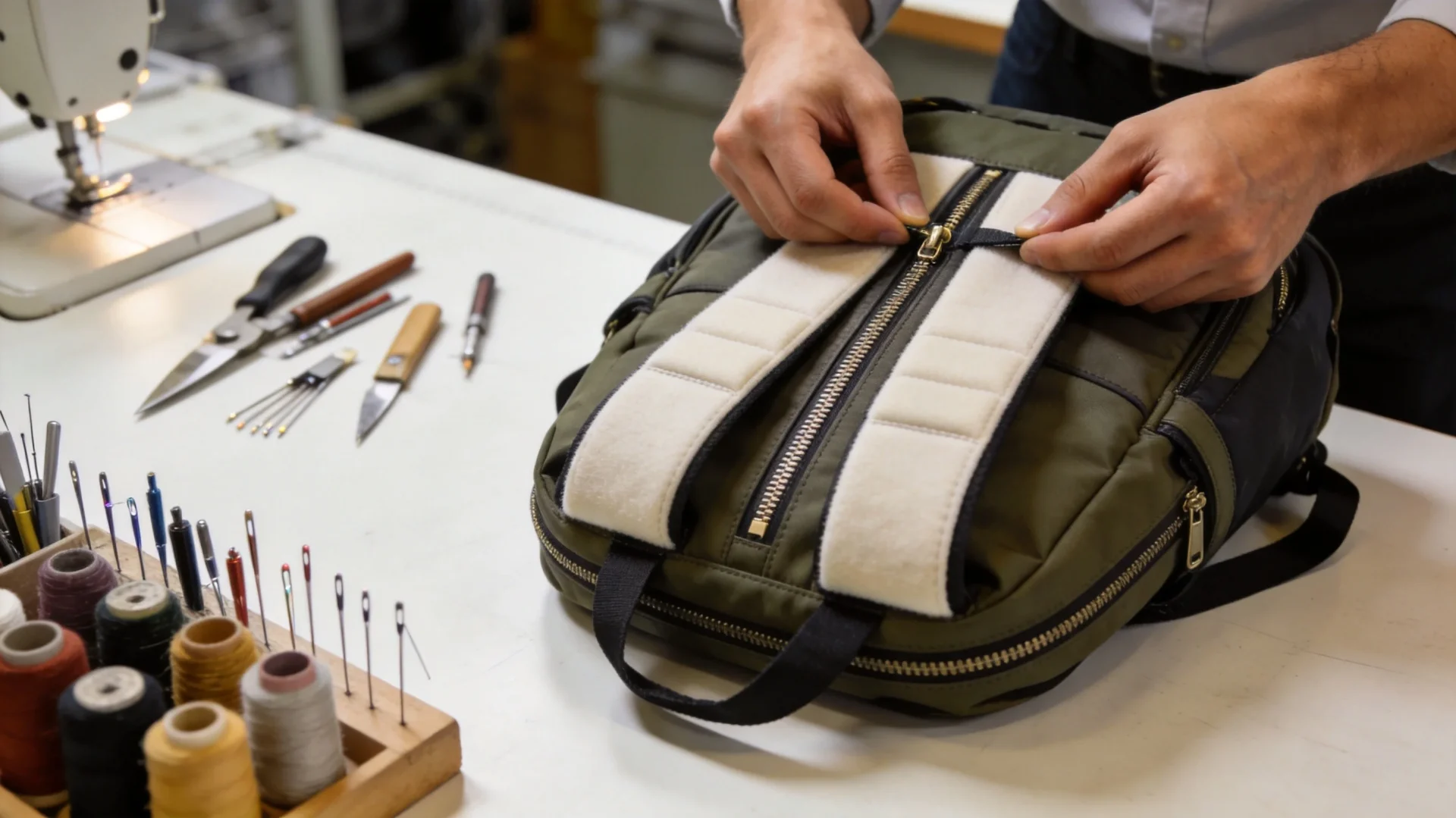
The pattern pieces are cut from the selected materials and assembled into the first physical prototype. This is where the design truly comes to life. The prototype is evaluated for overall aesthetics, structural integrity, comfort (for wearable bags), functionality (pocket accessibility, zipper operation), and visual balance.
Step 6: Internal Review & Client Feedback
The prototype undergoes internal quality review by the factory’s technical team before being sent to the client. Photos, videos, and detailed measurement reports accompany the physical sample (or are sent digitally for remote clients). The client evaluates the prototype against their original requirements and provides structured feedback.
Step 7: Revision Rounds
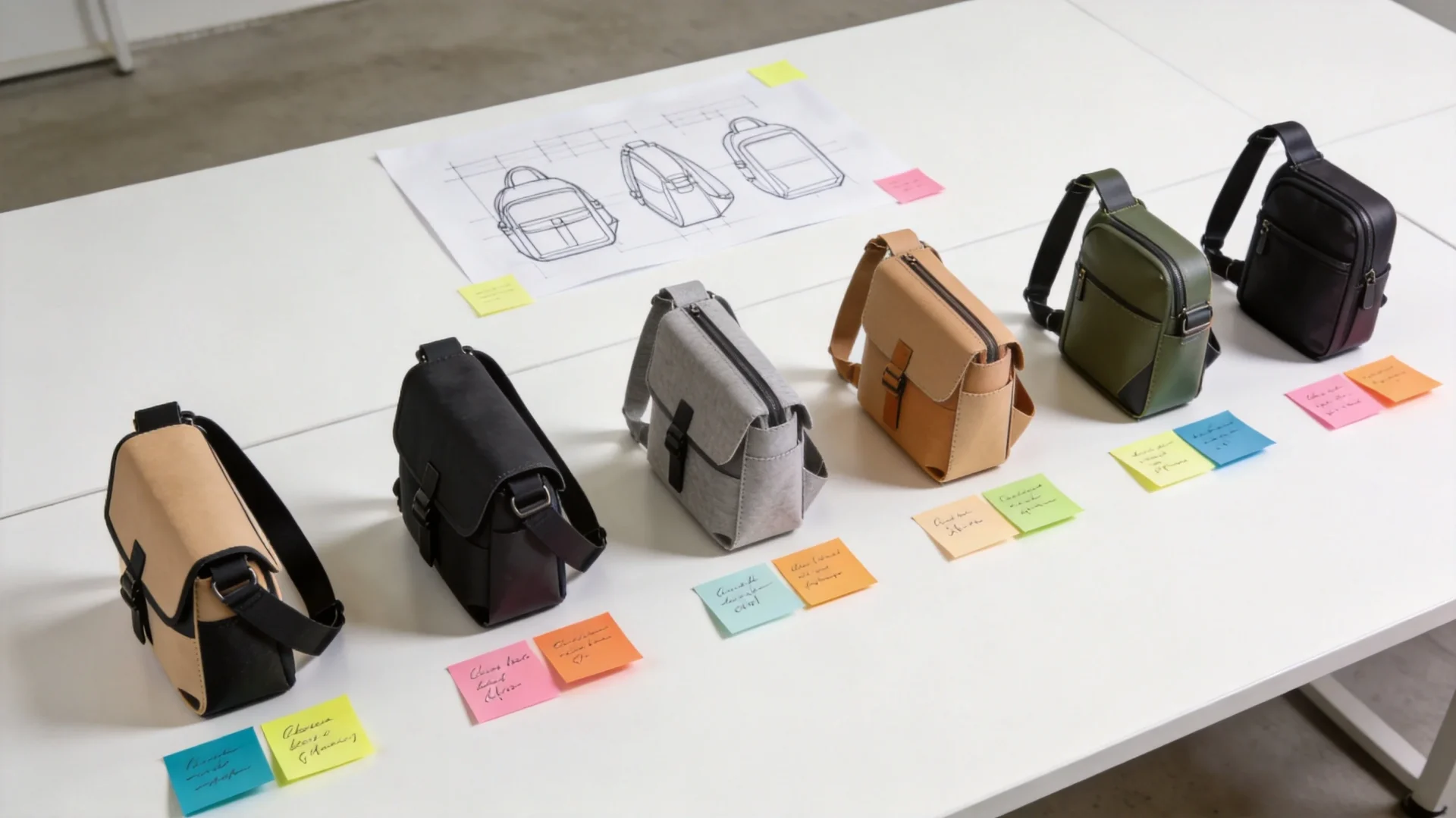
Based on feedback, revisions are made to the pattern, materials, or construction methods, and a revised sample is produced. Most projects require 2 to 3 revision rounds. Clear, specific communication during this phase is critical — vague feedback like “make it better” leads to costly misinterpretations.
Step 8: Final Approval & Golden Sample
Once all revisions are complete, the final approved sample becomes the golden sample. Both parties sign and seal copies. This sample now governs all quality standards for the production run.
Materials Selection for Samples
Material selection during the sampling phase is one of the most impactful decisions in bag development. The right materials determine the bag’s durability, weight, water resistance, texture, and ultimately its perceived value in the market.
Fabric Options
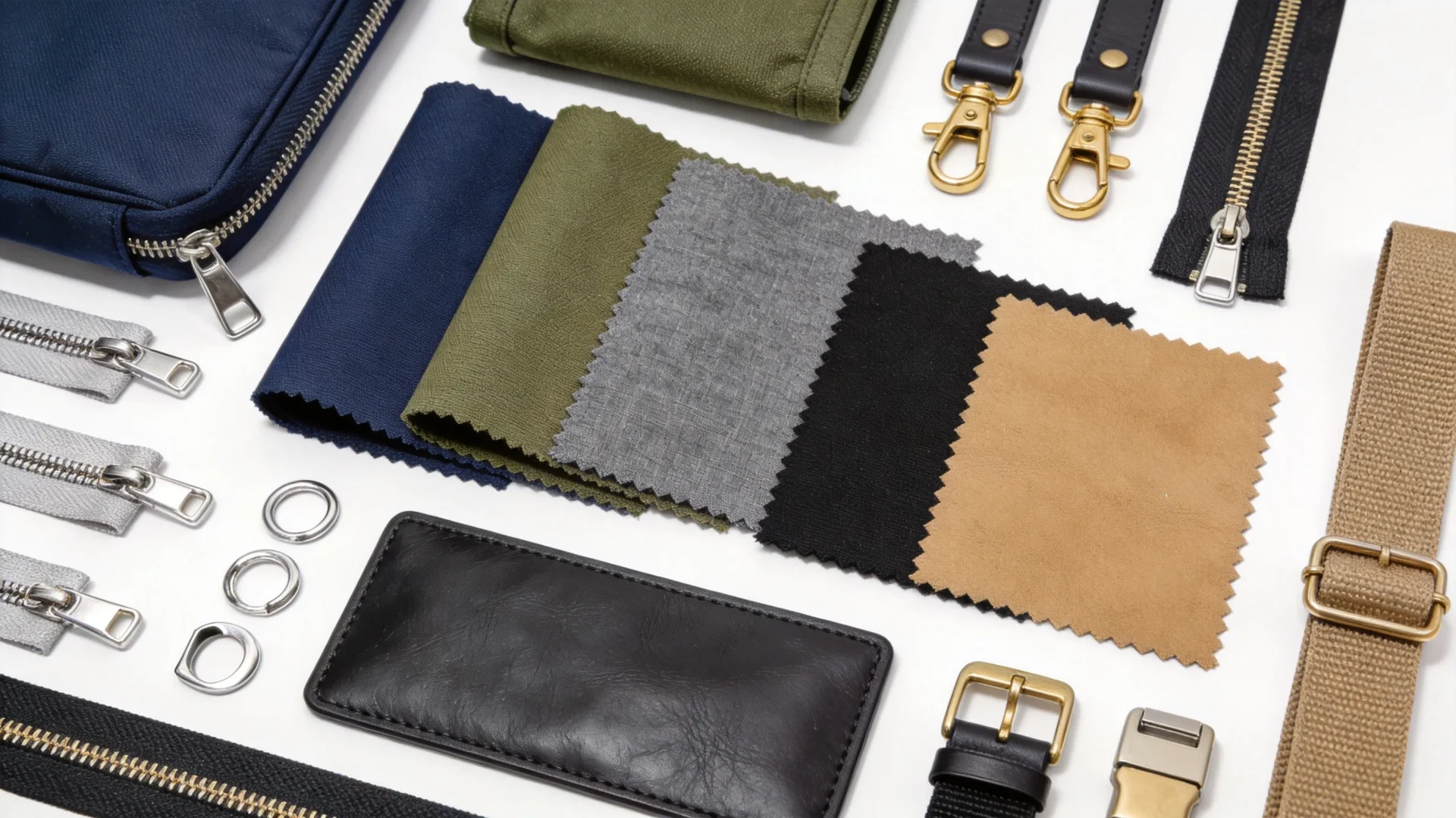
Common bag fabrics include nylon (lightweight, strong, excellent for backpacks), polyester (cost-effective, UV resistant, good for outdoor bags), canvas (durable, classic aesthetic, ideal for lifestyle bags), Cordura (military-grade abrasion resistance), and TPU-coated fabrics (waterproof, suitable for dry bags and cooler bags). During sampling, factories typically provide fabric swatch books with 20 to 50 options, allowing buyers to evaluate hand-feel, weight, and color before committing to production quantities.
Hardware & Trims
Zippers, buckles, D-rings, snaps, and logo plates are critical both functionally and aesthetically. Leading hardware brands include YKK (the industry standard for reliability), SBS, and various custom options for branded hardware. During sampling, test multiple zipper pull styles, buckle release mechanisms, and metal finishes (matte black, antique brass, gunmetal, polished nickel) to determine the best combination for your target market.
Lining, Padding & Interior Components
Interior materials are just as important as exterior fabrics. Common lining options include polyester taffeta, nylon ripstop, and cotton blends. For laptop bags and camera bags, EVA foam, EPE foam, and memory foam padding are selected based on the required shock absorption level. Sample development should always test the interaction between padding thickness and the bag’s external dimensions — adding 5mm of padding can change a “carry-on compliant” bag into an oversized one.
Design & Technical Specifications
Comprehensive technical specifications are the bridge between design intent and manufacturing reality. Without precise specs, even the most talented factory cannot produce a bag that matches your vision.
Tech Packs
A tech pack (technical package) is the complete specification document for your bag. It includes detailed flat sketches (front, back, side, interior views), a bill of materials (BOM) listing every fabric, thread, zipper, buckle, label, and packaging component, construction notes for every seam and assembly step, Pantone color references, and measurement charts with tolerances. A well-prepared tech pack reduces sampling iterations by ensuring the factory understands every detail before cutting the first piece of fabric.
Bill of Materials (BOM)
The BOM itemizes every component with specific supplier references, material codes, colorways, and quantities per unit. For a typical backpack, the BOM may include 30 to 60 individual components — from the main body fabric and zipper pulls to the interior label and polybag packaging. Accuracy in the BOM prevents material substitution errors that are among the most common sampling mistakes.
CAD Drawings & 3D Renderings
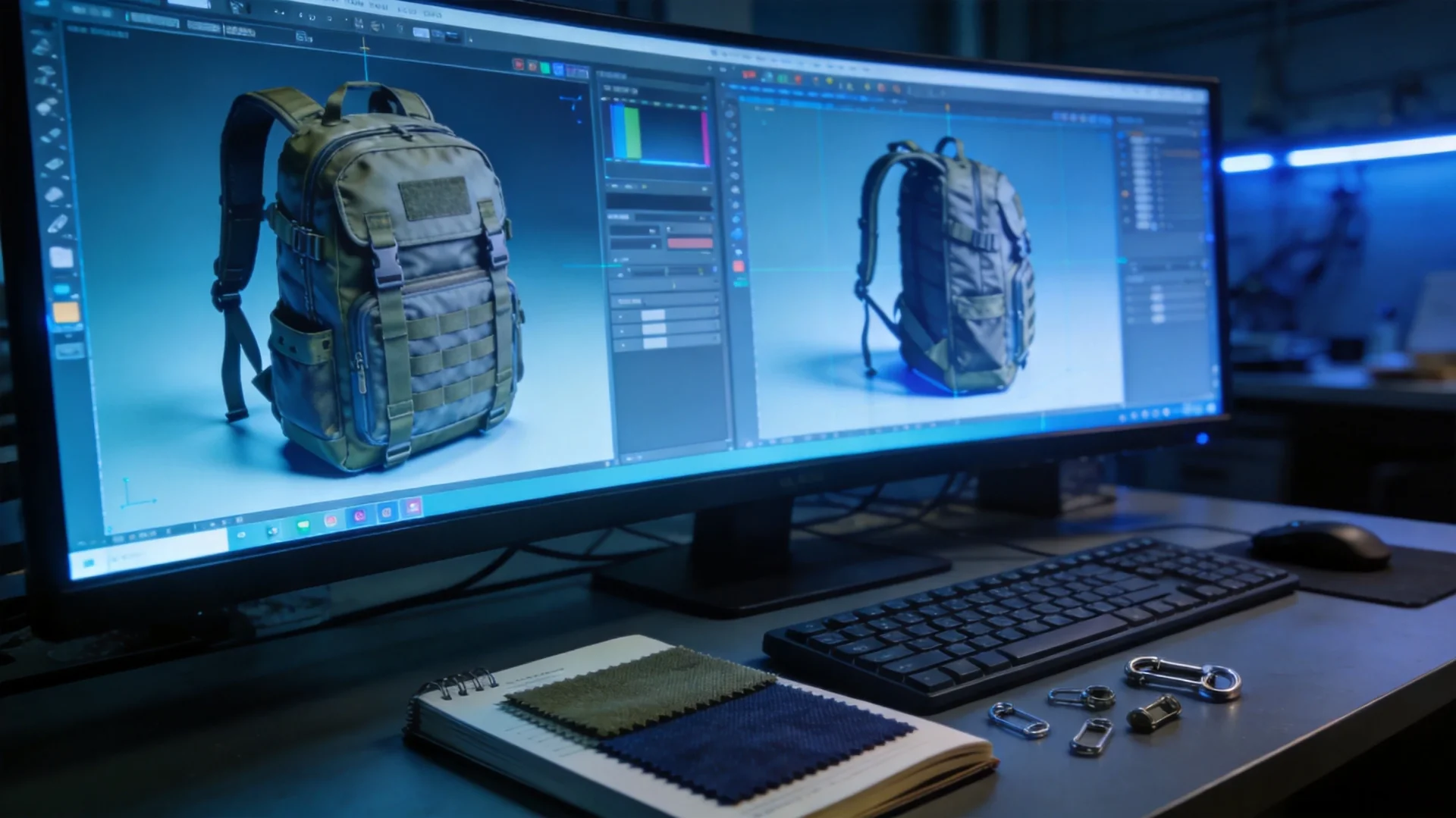
Modern bag development leverages CAD software for precise technical drawings and 3D rendering for photorealistic visualization. CAD drawings provide exact measurements and seam positions, while 3D renderings allow stakeholders to evaluate the design’s visual appeal before any physical sample is made. This combination significantly reduces early-stage prototyping costs and accelerates the approval process.
Sampling Timeline & Turnaround
Understanding realistic sampling timelines is crucial for production planning. Here is a typical breakdown for a standard bag sampling project:
| Phase | Duration | Notes |
|---|---|---|
| Design Brief Review | 2–3 days | Factory evaluates feasibility and requests clarification |
| Concept Sketches | 3–5 days | 2–5 concept directions presented |
| First Prototype | 7–14 days | Depends on design complexity and material availability |
| Revision Round 1 | 5–10 days | Minor adjustments to pattern or materials |
| Revision Round 2 | 5–7 days | Fine-tuning details and construction |
| Pre-Production Sample | 7–10 days | Uses exact production materials |
| Final Approval | 2–3 days | Client review and sign-off |
Total typical timeline: 4 to 7 weeks from initial brief to approved golden sample. For simpler designs with fewer compartments and standard materials, the process may compress to 3 weeks. Complex designs — multi-compartment tactical bags, bags with integrated electronics, or bags requiring custom-molded hardware — may require 8 to 12 weeks.
Rush sampling options are available at most established factories, typically reducing standard timelines by 30–40% with a surcharge of 20–50%. For time-sensitive projects like crowdfunding campaigns, Junyuan offers dedicated expedited sampling services to meet tight launch deadlines without sacrificing quality.
Quality Testing During Sampling
Quality testing during the sampling phase is not optional — it is essential. Testing validates that the bag will perform as expected throughout its intended product lifecycle. The following tests should be conducted on pre-production samples at minimum:
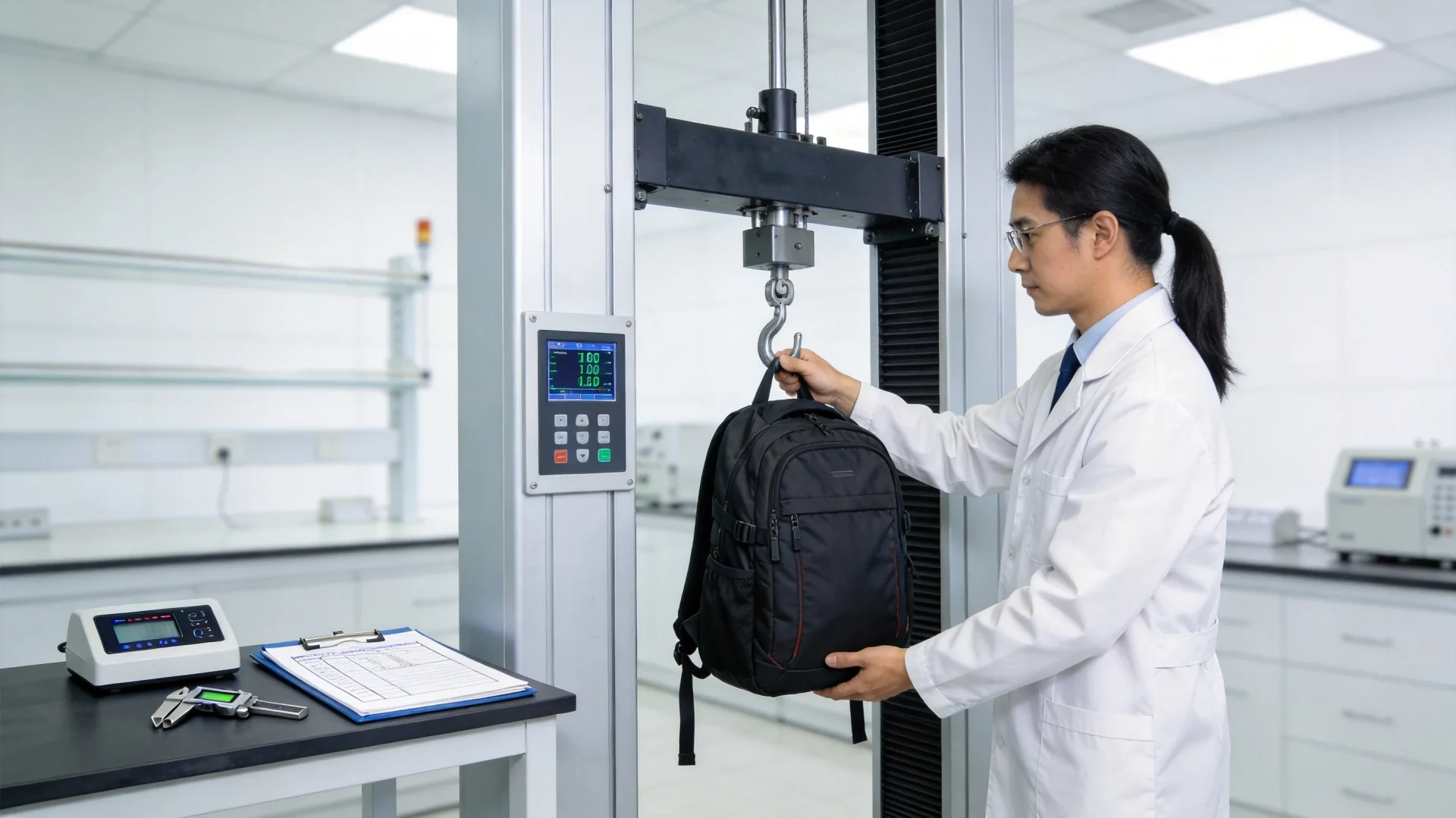
Load Testing
The bag is loaded to 125–150% of its rated capacity and subjected to dynamic movement testing. Straps, handles, and attachment points are checked for stress fractures, seam separation, and deformation. For backpacks, a standard test involves loading 25 kg and performing 500 lift cycles.
Zipper Endurance Testing
Zippers are tested through repeated open-close cycles (typically 1,000 to 5,000 cycles depending on the zipper type and bag application). The test checks for tooth separation, slider wear, and fabric catch issues. YKK zippers typically exceed 10,000 cycles in standardized testing.
Colorfastness Testing
Fabric samples are tested for color resistance to light (UV exposure), water, rubbing (crocking), and washing. This is particularly important for bags used outdoors or in high-sunlight environments. A colorfastness rating of 4 or above (on a 1–5 grey scale) is typically required for premium products.
Dimensional Accuracy Verification
Every critical dimension on the sample is measured against the tech pack specifications. Tolerances are typically ±3mm for bags under 30cm and ±5mm for larger bags. Deviations beyond tolerance require pattern adjustments before sampling proceeds.
Additional Tests
Depending on the bag type and target market, additional tests may include water resistance testing (spray test or hydrostatic pressure), abrasion resistance (Martindale or Taber testing), seam strength testing, buckle and snap pull testing, and chemical compliance testing (REACH, Prop 65, CPSIA). For brands targeting specific retail channels, check the retailer’s compliance requirements early in the sampling process to avoid costly re-testing later.
Common Sampling Mistakes & How to Avoid Them
Even experienced brands can fall into sampling pitfalls. Based on over two decades of OEM manufacturing, here are the most common mistakes we see — and how to prevent them:
1. Vague or Incomplete Design Briefs
Mistake: Starting sampling with an unclear brief leads to prototypes that miss the mark, requiring additional rounds. Phrases like “make it look premium” or “similar to [competitor brand]” are not specifications.
Solution: Invest time in a detailed brief with reference images, exact dimensions, material preferences, target price point, and functional requirements. Include a competitor teardown if available.
2. Material Substitution Without Communication
Mistake: The factory uses a different fabric or hardware than specified because the exact material was out of stock, without informing the client. The sample looks and feels wrong, but the issue isn’t identified until weeks later.
Solution: Require written approval for any material substitution. Build a material alternatives list into your tech pack with pre-approved substitutes.
3. Skipping the Pre-Production Sample
Mistake: Approving a prototype made with substitute materials and going directly to mass production. The production units reveal unexpected issues with drape, stiffness, color, or weight that were masked by the substitute materials.
Solution: Always produce and approve a pre-production sample using exact production materials before authorizing mass production. No exceptions.
4. Poor Communication During Revisions
Mistake: Sending unstructured feedback via multiple channels (email, WhatsApp, voice notes) with contradictory instructions. The factory’s sample team receives conflicting priorities.
Solution: Use a standardized feedback template with photos, annotations, and a clear priority ranking for each issue. Consolidate all feedback into a single communication per revision round.
5. Ignoring Tolerances and Testing Standards
Mistake: Approving a sample that “looks right” without verifying measurements or conducting performance tests. The production run reveals systemic dimensional or quality issues.
Solution: Always require a measurement report with every sample submission. Conduct performance tests on pre-production samples, not just visual inspection.
Cost of Bag Sampling
Understanding sampling costs helps you budget effectively and evaluate manufacturer proposals. Here is a general cost framework for bag sampling at a professional OEM factory:
| Cost Component | Typical Range (USD) | Notes |
|---|---|---|
| Prototype Sample | $150 – $500 | Depends on complexity; simpler bags at lower end |
| Pre-Production Sample | $200 – $800 | Uses exact production materials; higher due to setup |
| Revision Round | $80 – $300 per round | Minor adjustments; major redesigns cost more |
| Custom Tooling/Molds | $200 – $2,000 | For custom buckles, logo plates, or molded components |
| Express Shipping (sample) | $40 – $120 | International DHL/FedEx for sample delivery |
| 3D Rendering | $100 – $400 | Photorealistic digital prototype (optional) |
Sample cost refund policy: Most reputable factories, including Junyuan, refund the sampling cost (partially or fully) when the buyer places a bulk production order above a certain minimum quantity. This policy aligns the factory’s incentive with the buyer’s goal of finding the right product-market fit before committing to volume.
It is important to view sampling costs as investment in risk reduction, not as an expense to minimize. A $500 pre-production sample that catches a $50,000 production error delivers extraordinary ROI.
Digital Prototyping & 3D Visualization in Bag Development
The bag manufacturing industry is rapidly adopting digital prototyping technologies that complement — and in some cases reduce the need for — physical sampling.
3D Rendering & Visualization
Modern 3D software (CLO 3D, Browzwear, Blender) can generate photorealistic renderings of bag designs, complete with accurate fabric drape, texture, lighting, and shadow effects. These renderings allow stakeholders to evaluate aesthetics, proportions, and color combinations before any physical sample is produced. For brands presenting to retail buyers or crowdfunding backers, high-quality 3D renderings can accelerate pre-selling and marketing campaigns by weeks or even months.
Virtual Fit Testing
Advanced 3D tools can simulate how a bag conforms to the human body — testing strap pressure distribution, back panel ventilation, and load-bearing behavior. This virtual testing identifies ergonomic issues early, reducing the number of physical prototype iterations needed for wearable bags like backpacks and messenger bags.
Digital Color Matching
Spectrophotometer-based digital color matching allows factories to precisely match Pantone references without shipping physical color swatches back and forth. This technology reduces sampling lead time by 3 to 5 days per color approval cycle.
Limitations of Digital Prototyping
While digital tools are powerful, they cannot yet fully replace physical sampling. Hand-feel, material stiffness, zipper operation, and real-world load testing still require physical samples. The most effective approach combines digital prototyping for early-stage design validation with targeted physical sampling for final specification verification.
From Sample to Mass Production: The Handoff Process
The transition from approved sample to mass production is a critical handoff point where miscommunication can introduce errors at scale. A professional manufacturer follows a structured process to ensure a seamless transition:
1. Golden Sample Sealing
Two copies of the approved sample are signed, dated, and sealed with official stamps. One copy remains on the production floor as the reference standard; the other is shipped to the buyer. Any dispute about quality during production is resolved by comparing against these sealed samples.
2. Production Briefing & Line Setup
The technical team conducts a pre-production meeting with the factory floor supervisors, reviewing every construction detail, quality checkpoint, and potential risk area identified during sampling. Pattern files, material orders, and work instructions are finalized and distributed.
3. First Article Inspection (FAI)
The first 5 to 10 units off the production line undergo full inspection against the golden sample. This catches any issues introduced during scale-up — such as tension differences between sample sewing and production-line sewing, or slight variations in fabric cutting when using automated cutting machines versus manual sample cutting.
4. In-Line & Final Inspection
Throughout mass production, in-line inspections verify that quality standards are maintained. Final random inspection (typically AQL 2.5 standard) is conducted before packaging and shipment. Brands that participated actively in the sampling process and built strong communication channels with the factory consistently experience smoother production runs.
For brands planning multi-product or seasonal collections, understanding how sampling integrates with broader seasonal production planning is essential for hitting launch windows.
How to Evaluate a Manufacturer’s Sampling Capability
Not all bag manufacturers offer equal sampling capabilities. When evaluating potential OEM partners, assess the following criteria:
- Sample room capacity: Does the factory have a dedicated sample team separate from the production line? A dedicated sample room with skilled technicians ensures that sample quality reflects production capability without production schedule conflicts.
- Iteration speed: How quickly can the factory turn around a prototype? Can they provide a first sample within 7–10 days? Ask for specific case studies or references.
- Technical documentation: Does the factory provide professional tech packs, measurement reports, and photo documentation with every sample? This indicates process maturity and attention to detail.
- Material library: A well-stocked material library with hundreds of fabric, hardware, and trim options allows faster sampling without waiting for material procurement.
- Testing capabilities: Can the factory conduct in-house quality tests (load, zipper, colorfastness)? Or do they need to outsource testing, adding time and cost?
- Communication quality: How does the factory handle sample feedback? Do they have a dedicated project manager, or will you be communicating through generic sales channels?
- Sample cost policy: Does the factory offer sample cost refunds on bulk orders? What is the policy for revision rounds?
- Digital capabilities: Does the factory offer 3D rendering, CAD services, or digital pattern making? These capabilities can significantly accelerate the development process.
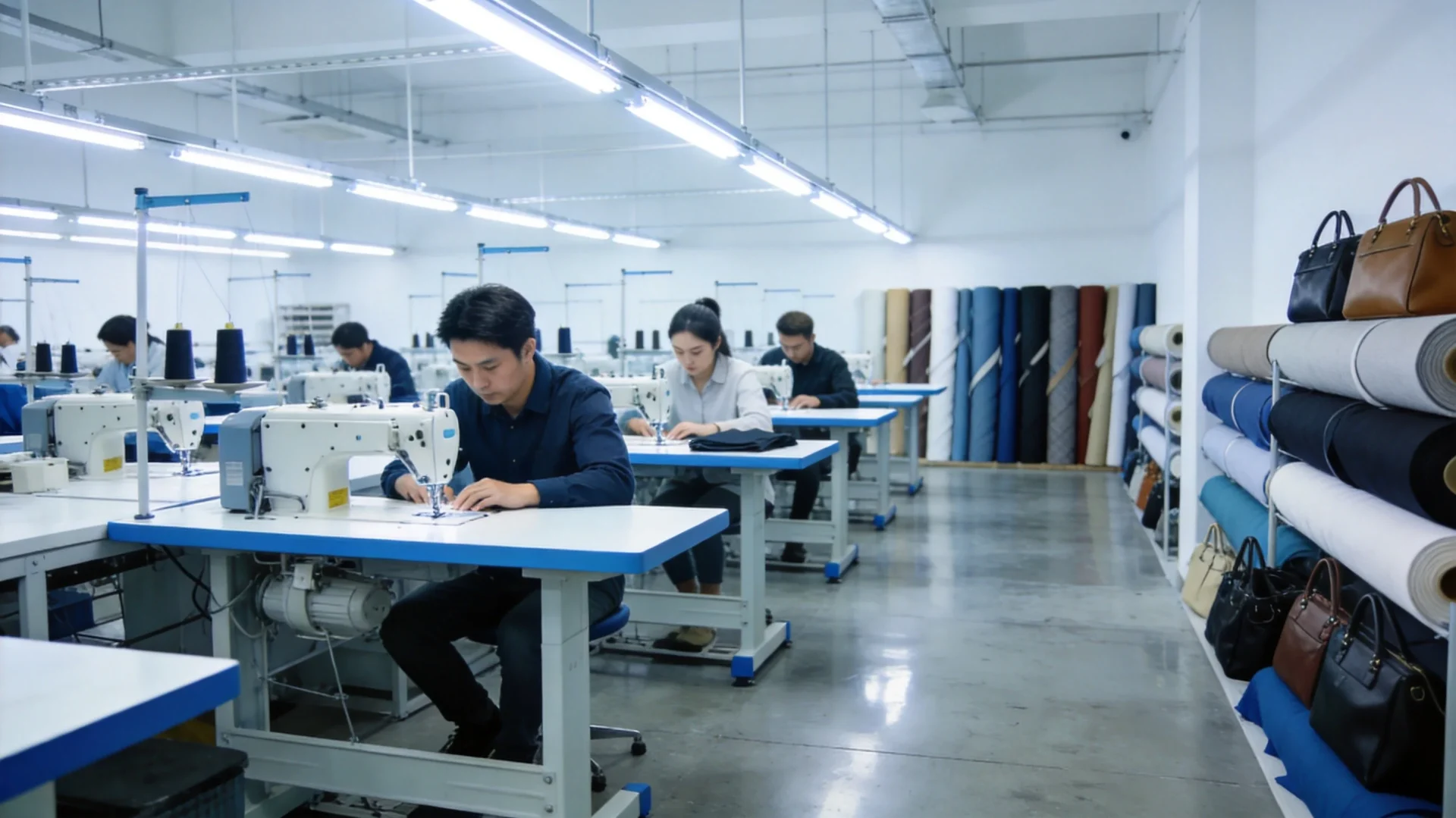
At Junyuan, we maintain a dedicated sample development center with a team of 15+ specialized technicians, a material library of 500+ options, and in-house testing equipment. Our average prototype turnaround is 10 days, with pre-production samples completed in 7 days. We have supported over 1,000 bag development projects across 40+ countries.
Frequently Asked Questions
1. How long does bag sample development typically take?
A standard bag sampling project takes 4 to 7 weeks from initial brief to approved golden sample. Simple designs may complete in 3 weeks; complex multi-compartment bags may require 8 to 12 weeks.
2. How much does a bag prototype cost?
Prototype samples typically cost between $150 and $500 depending on design complexity. Pre-production samples using exact materials range from $200 to $800. Most factories refund sampling costs on qualifying bulk orders.
3. What is the difference between a prototype and a pre-production sample?
A prototype validates the design concept using available materials and focuses on form and function. A pre-production sample is made with exact production materials and methods and serves as the final quality benchmark before mass production.
4. How many sampling rounds are typically needed?
Most bag projects require 2 to 4 sampling rounds, including the initial prototype and 1 to 3 revision rounds. Complex designs or first-time bag brands may need 4 to 6 rounds.
5. Can I request a sample without a full tech pack?
Yes. Many factories, including Junyuan, offer design-assistance services. If you provide reference images, sketches, or a concept description, the factory’s design team can help develop the tech pack and specifications as part of the sampling process.
6. What is a golden sample?
A golden sample is the final approved reference sample that serves as the quality standard for the entire production run. Two sealed copies are kept — one by the factory and one by the buyer — to ensure consistent quality throughout manufacturing.
7. Do you offer 3D rendering before physical sampling?
Yes. We provide photorealistic 3D renderings as part of our design service. This allows you to evaluate aesthetics and make design decisions before investing in physical prototyping, reducing costs and lead time.
8. What happens if the sample doesn’t match my expectations?
Our revision process is designed for exactly this scenario. We include 2 to 3 revision rounds in our standard sampling service at no additional charge (beyond the initial sample cost). Each revision addresses specific feedback with a new sample for your review.
9. Can I visit the factory during the sampling process?
Absolutely. We encourage client visits during the sampling phase. Seeing the sample workshop, meeting the technicians, and reviewing samples in person leads to faster approvals and stronger collaboration. Virtual factory tours are also available for remote clients.
10. Is the sampling cost refundable?
Yes. Junyuan refunds the sampling cost when the client places a production order that meets the minimum order quantity (typically 300–500 pieces depending on the bag type). The refund is applied as a credit against the production order.
11. Can you match a competitor’s bag sample?
Yes. Reverse engineering from an existing sample is a common service. Send us the competitor bag (or detailed photos), and our team will analyze the materials, construction methods, and dimensions to develop a matching or improved version. See our prototype development guide for more details.
12. What file formats do you accept for bag designs?
We accept AI, PSD, PDF, DWG, DXF, and standard image formats (JPG, PNG). For tech packs, PDF or Excel formats work best. If you only have hand-drawn sketches or concept images, our design team can develop them into production-ready specifications.
Start Your Bag Sample Development with Junyuan
With over two decades of bag industry experience dating from 2004, 1,000+ successful bag development projects, and a dedicated sample development center, Junyuan is your trusted partner for bag sample development and prototyping. From initial concept sketch to approved golden sample, our team of designers, pattern makers, and quality specialists will guide you through every step of the process.
Whether you are launching a new backpack brand, developing a seasonal collection, or creating custom bags for a crowdfunding campaign, we offer fast turnaround, transparent pricing, and the technical expertise to bring your vision to life — right the first time.
Ready to start? Contact our sample development team today for a free consultation and quote. Send us your design brief, reference images, or even just an idea — and we will show you how professional bag sampling should work.