
Cold Weather Backpack System OEM: Insulation, Attachment & Gear Integration (2026)
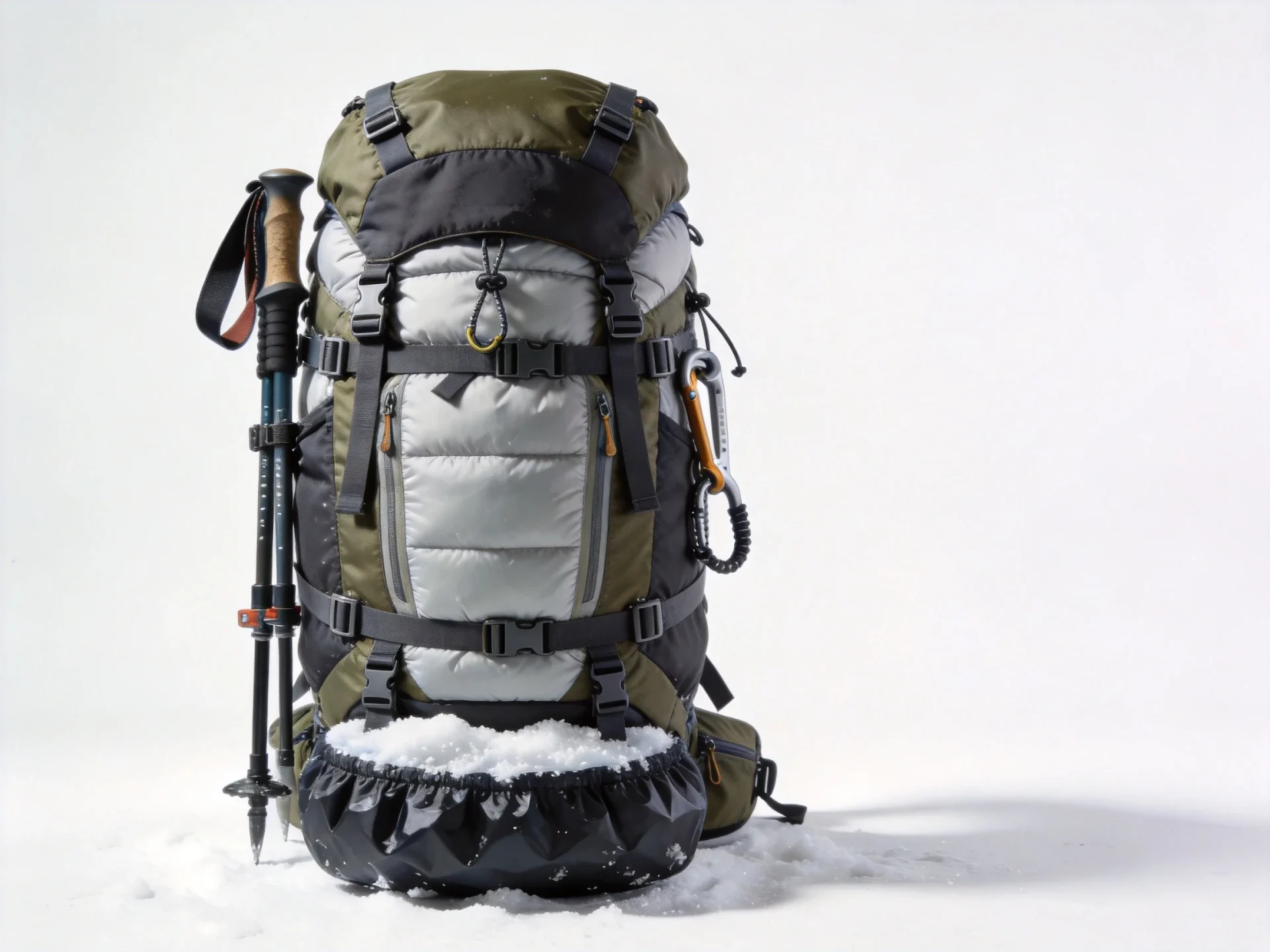
The cold weather outdoor gear market has experienced remarkable growth, with global demand for technical backpacks engineered for extreme conditions reaching new heights. From Arctic expeditions to winter mountaineering, ski touring to cold-weather hunting, brands require manufacturing partners who understand the unique engineering challenges of sub-zero environments. As a certified OEM/ODM backpack manufacturer led by a founder with bag industry experience dating from 2004 in Quanzhou, Fujian, China, JUNYUAN BAGS delivers cold weather backpack systems that meet the most demanding performance standards in the industry.
This comprehensive technical guide covers every critical aspect of cold weather backpack system OEM manufacturing: insulation material science, waterproof-breathable fabric selection, external attachment engineering, layered loading architecture, and cold temperature testing protocols. Whether you are launching an alpine backpack line or expanding your winter collection, this pillar page provides the manufacturing intelligence to make informed sourcing decisions.
Understanding Cold Weather Backpack System Architecture
A cold weather backpack system is fundamentally different from a standard outdoor pack. It must perform reliably in temperatures ranging from -20°C to -40°C while managing moisture, protecting sensitive gear, and providing secure attachment points for specialized equipment. The engineering challenge lies in balancing three competing requirements: thermal protection, weight management, and functional accessibility — all while maintaining the structural integrity needed for extreme conditions.
At JUNYUAN BAGS, our engineering team approaches cold weather backpack design as an integrated system rather than a collection of features. Every component — from the insulation type and thickness to the zipper selection and buckle material — must function cohesively in sub-zero environments. This systems-thinking approach is what separates our technical backpack manufacturing from standard bag production. The same engineering rigor applies to our athletic backpack lines and eco-friendly recycled backpack collections.
The Three-Zone Design Philosophy
Our cold weather backpack systems follow a three-zone design philosophy:
- Zone 1 — Core Insulation Layer: The main body insulation that protects contents from external cold and prevents internal moisture from freezing
- Zone 2 — Weather Shell: The exterior waterproof-breathable membrane that shields against snow, ice, and wind while allowing vapor escape
- Zone 3 — Attachment & Load System: The external integration platform for gear, tools, and accessories specific to cold weather activities
Each zone requires specialized materials, construction techniques, and testing protocols. Our factory in Quanzhou, Fujian has dedicated production lines for each zone, with specialized machinery for insulation bonding, seam sealing, and hardware installation.
Insulation Material Selection: Thinsulate vs. PrimaLoft & Beyond
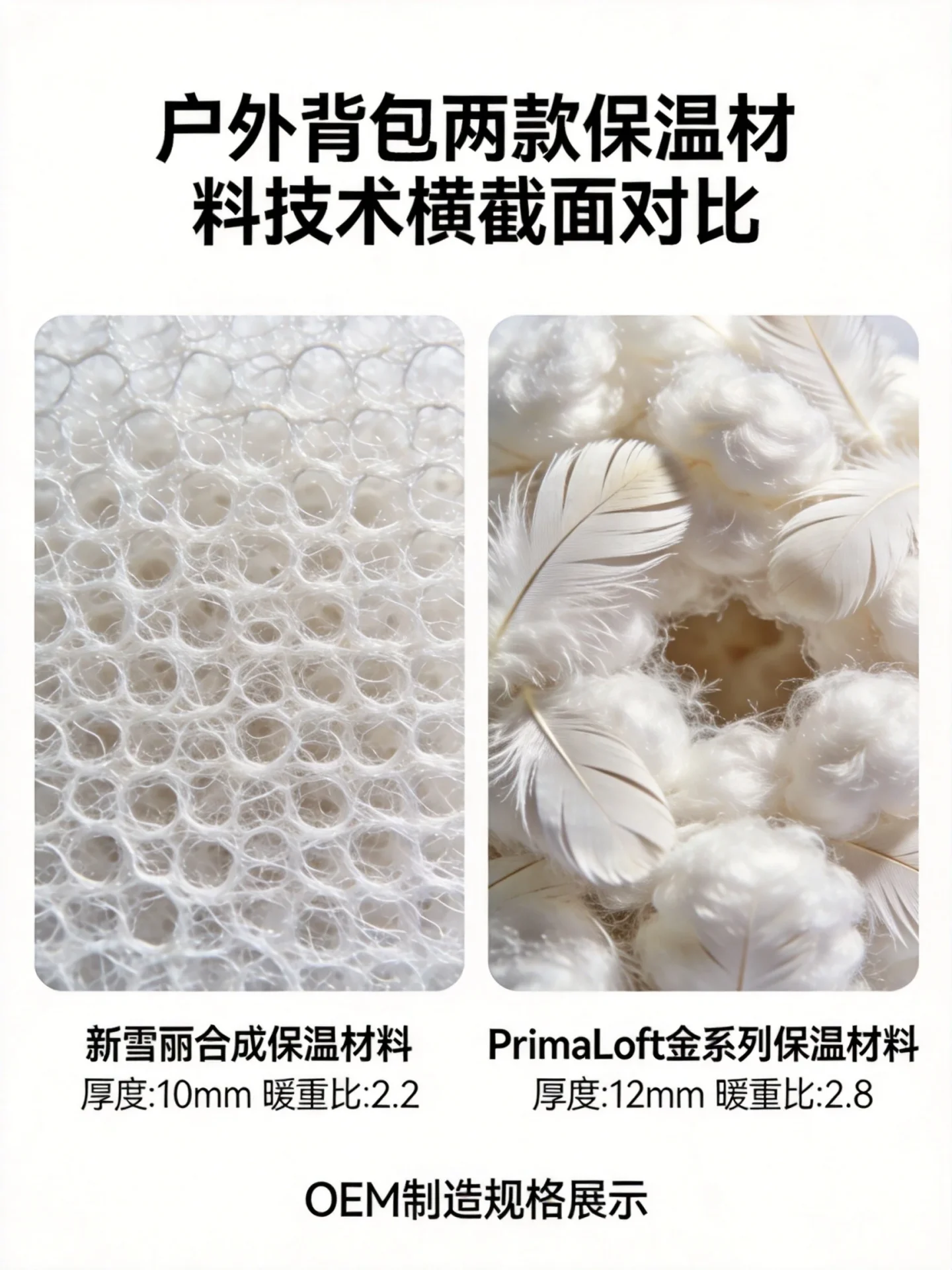
Insulation is the heart of any cold weather backpack system. The choice of insulation material directly determines the pack’s thermal performance, weight, compressibility, and price point. As a leading outdoor backpack ODM factory, we work with all major insulation technologies and can guide brands toward the optimal solution for their target market and performance requirements.
3M Thinsulate Insulation
3M Thinsulate remains the industry benchmark for cold weather backpack insulation. This synthetic insulation uses microfiber technology — fibers approximately 2–5 micrometers in diameter — that trap body heat while maintaining a thin profile. Thinsulate is available in multiple grades optimized for different applications.
Thinsulate Grades for Backpack Manufacturing
| Grade | Weight (g/m²) | Temperature Range | Best Application | FOB Cost Impact |
|---|---|---|---|---|
| Thinsulate Type B | 100–150 | 0°C to -15°C | Winter commuter packs | $1.50–$2.50/unit |
| Thinsulate Type C | 150–200 | -10°C to -25°C | Alpine daypacks | $2.50–$4.00/unit |
| Thinsulate Platinum | 100–200 | -15°C to -30°C | Expedition backpacks | $4.00–$6.50/unit |
| Thinsulate Pro | 200–300 | -20°C to -40°C | Arctic expedition packs | $6.00–$9.00/unit |
Thinsulate Manufacturing Integration
In our backpack manufacturing facility, Thinsulate is integrated using a bonded quilt construction that prevents insulation migration and cold spots. The insulation is ultrasonically bonded between the shell fabric and the lining, creating a smooth, uniform thermal layer without traditional stitch-through quilting that creates thermal weak points.
PrimaLoft Insulation
PrimaLoft represents the premium tier of synthetic insulation for cold weather backpacks. Originally developed for the U.S. Army, PrimaLoft mimics the structure of natural goose down with plume-like fiber clusters that create loft and trap air for superior warmth. PrimaLoft maintains its insulating properties even when wet — a critical advantage in cold, humid conditions where moisture management is essential.
PrimaLoft Grades for Backpack Manufacturing
| Grade | Weight (g/m²) | CLO Value | Temperature Range | Best Application |
|---|---|---|---|---|
| PrimaLoft Silver | 100–170 | 0.5–0.7 | 0°C to -20°C | Winter hiking backpacks |
| PrimaLoft Gold | 130–200 | 0.7–0.92 | -15°C to -30°C | Alpine mountaineering packs |
| PrimaLoft Gold Active | 100–160 | 0.55–0.75 | -10°C to -25°C | High-exertion winter packs |
| PrimaLoft Cross Core | 60–100 | 0.6–0.85 | -15°C to -30°C | Ultralight cold weather packs |
PrimaLoft vs. Thinsulate Comparison
When advising OEM clients on insulation selection, we typically compare key performance metrics:
- Warmth-to-weight ratio: PrimaLoft Gold leads with a CLO value of 0.92 at 200 g/m², approximately 15% warmer per gram than Thinsulate Pro
- Compressibility: PrimaLoft compresses more efficiently, allowing smaller pack profiles
- Wet performance: PrimaLoft retains 96% of its insulating value when wet; Thinsulate retains approximately 80%
- Cost: Thinsulate offers 20–35% cost savings over equivalent PrimaLoft grades
- Brand recognition: PrimaLoft carries stronger consumer brand equity in premium outdoor markets
Hybrid Insulation Systems
For our most advanced cold weather backpack OEM projects, we develop hybrid insulation systems that zone different insulation types based on body mapping data. High-moisture areas (where the pack contacts the wearer’s back) use PrimaLoft for its superior wet performance, while low-moisture areas (sides and front) use Thinsulate for cost efficiency. This approach optimizes both performance and cost, delivering premium results without the full PrimaLoft price premium.
Fleece & Soft Shell Linings
Beyond primary insulation, the interior lining material plays a significant role in thermal performance. We offer several lining options for cold weather packs:
- Polar fleece (200–300 g/m²): Soft interior lining that adds warmth and protects gear from scratches
- Ripstop nylon with DWR: Lightweight, durable interior that resists moisture buildup
- Gore-Tex Infinium membrane: Windproof, water-resistant liner for maximum protection
Waterproof-Breathable Fabric Systems
In cold weather environments, fabric selection is critical. The exterior shell must simultaneously repel snow and ice, resist abrasion from rock and equipment, and allow internal moisture vapor to escape. If moisture cannot escape the pack, it will condense and freeze, compromising both insulation performance and the structural integrity of the pack.
Fabric Options for Cold Weather Backpacks
| Fabric System | Denier | Membrane | Water Column | Breathability (g/m²/24h) | Best Use |
|---|---|---|---|---|---|
| Ripstop Nylon + TPU | 210D–420D | TPU membrane | 10,000mm | 5,000–8,000 | Budget winter packs |
| Ballistic Nylon + DWR | 1050D | PU coating | 5,000mm | 3,000–5,000 | Durable expedition packs |
| Ripstop + Gore-Tex Pro | 200D–300D | Gore-Tex Pro 3L | 28,000mm | 25,000+ | Premium alpine packs |
| X-Pac VX21 | 210D ripstop | X-Pac laminate | 15,000mm | 10,000 | Technical ultralight packs |
| Dyneema Composite (DCF) | N/A | Non-woven laminate | 20,000mm | N/A | Expedition ultralight packs |
Seam Sealing for Extreme Weather Protection
In cold weather backpack manufacturing, seam sealing is a critical differentiator. Every stitch hole in the shell fabric represents a potential entry point for moisture. Our factory offers two levels of seam sealing:
Taped Seams (Standard)
Thermoplastic polyurethane (TPU) tape applied to the inside of all critical seams using a hot-air welding machine. This covers stitch holes and creates a continuous waterproof barrier. Standard on all mid-range and premium cold weather packs.
Fully Welded Seams (Premium)
High-frequency welding that bonds fabric panels without stitching, eliminating needle holes entirely. Combined with waterproof zipper integration, this approach creates a fully sealed system rated to 20,000mm+ water column. Recommended for Arctic and high-altitude expedition packs.
Our expertise in waterproof construction extends across our entire product range. Our laptop backpack manufacturing capabilities include the same waterproof construction techniques, ensuring cross-category quality and consistency. Our waterproof expertise extends to tactical bags, laptop backpacks, and sports backpacks.
External Attachment Systems: Ice Axe, Trekking Poles & Gear Integration
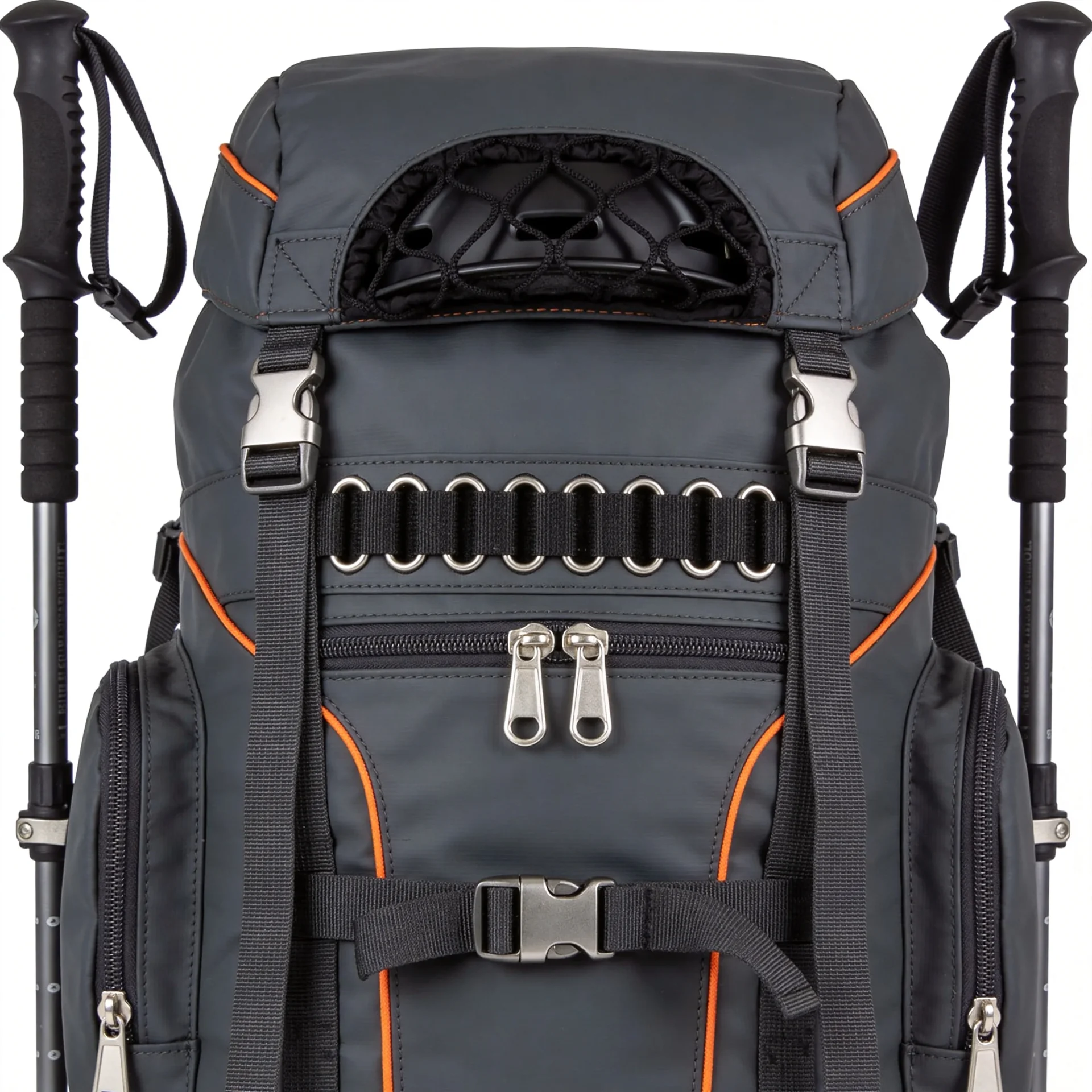
The external attachment system is what transforms a cold weather backpack from a simple container into a true gear platform. In alpine, mountaineering, and winter expedition scenarios, users need to carry ice axes, trekking poles, snow shovels, avalanche probes, crampons, helmets, and other specialized equipment — all while maintaining balanced weight distribution and quick access.
Ice Axe Attachment Systems
Ice axe attachment is a fundamental requirement for any technical mountaineering backpack. Our OEM manufacturing includes several ice axe attachment options:
Standard Ice Axe Loop
- Hypalon-reinforced loop at the base of the pack (bottom panel)
- Elastic shaft holder with toggle at the top of the pack
- Positioned at 45° angle for balanced weight distribution
- Supports axe shafts from 18mm to 28mm diameter
- Reinforced with bartack stitching at all stress points
Dual Ice Axe Attachment
- Two parallel attachment points for simultaneous dual-tool carry
- Reinforced Hypalon base loops with drainage holes
- Adjustable bungee shaft retainers with reflective cord
- Compatible with ice axes from 45cm to 75cm length
- Positioned for center-of-gravity optimization when loaded
Trekking Pole Attachment Integration
Trekking pole attachment is one of the most frequently requested features in our outdoor backpack lines. We offer multiple attachment configurations:
- Side compression strap system: Integrated loops on compression straps for pole storage along the pack’s side
- Front shock-cord attachment: Elastic bungee system on the front panel for quick stow-and-go
- Dedicated pole pocket: Bottom-mounted reinforced pocket with drawstring closure
- MOLLE-compatible attachment: Modular webbing that accepts aftermarket pole attachments
Snow Shovel & Avalanche Probe Integration
Shovel Integration Design
- Dedicated rear panel sleeve with reinforced bottom grommet for drainage
- Vertical or horizontal orientation options based on pack volume
- Quick-release buckle or magnetic closure for sub-30-second access
- Accommodates shovel blade lengths from 20cm to 35cm
- Internal divider separates shovel from other gear
Avalanche Probe Integration
- Dedicated tubular pocket on shoulder strap or hip belt
- Quick-pull cord for emergency deployment
- Compatible with probe lengths from 220cm to 320cm (collapsed: 20cm–35cm)
- Reinforced exit grommet with metal eyelet
Helmet Attachment & Daisy Chain Systems
For climbing-oriented cold weather packs, we integrate helmet attachment systems using reinforced mesh nets or bungee cord configurations at the top or bottom of the pack. Combined with our daisy chain MOLLE webbing systems, these attachment points provide versatile gear-carrying options.
Our daisy chain webbing is manufactured from 25mm nylon with a breaking strength of 500+ kg per loop. We can customize loop spacing (standard: 50mm), width (20mm or 25mm), and number of attachment rows based on your design requirements.
Crampon Pocket & Harness Attachment
Technical alpine packs benefit from reinforced crampon patches on the back panel (where crampon points contact the pack) and dedicated harness attachment loops on the hip belt. These features are manufactured using 1000D Cordura or Hypalon for maximum abrasion resistance.
Layered Loading Design: Compartment Architecture for Cold Weather
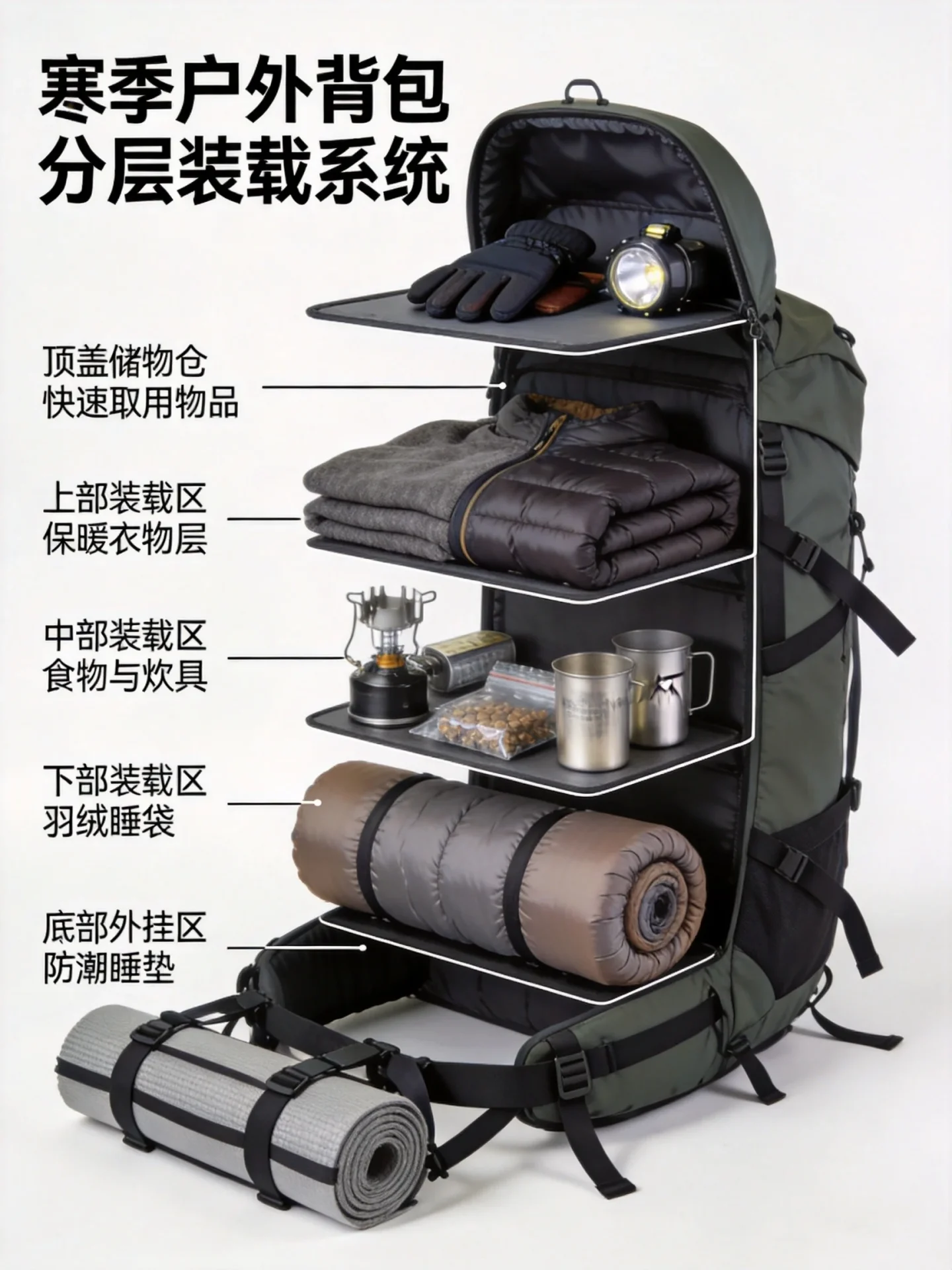
Cold weather backpack systems require fundamentally different compartment architecture compared to standard hiking packs. The layering system must account for bulky insulation layers, hard-shelled equipment, and the need for quick access to safety-critical items — all while maintaining thermal protection for sensitive gear like batteries, electronics, and water reservoirs.
The Four-Zone Loading System
Zone A: Top Lid / Brain (Quick-Access Zone)
- Removable top lid with zippered compartments
- Fleece-lined goggle pocket with ventilation to prevent fogging
- Map pocket with clear TPU window for waterproof map viewing
- Emergency whistle integrated into sternum strap buckle
- Key clip and small-item organization slots
Zone B: Upper Main Compartment (Clothing & Insulation)
- Primary storage for insulation layers, jackets, and soft goods
- Drawstring closure or roll-top for flexible capacity
- Internal hydration sleeve with insulated tube routing to prevent freezing
- Fleece-lined electronics pocket (placed closest to the body for warmth)
- Compression strap system to consolidate load
Zone C: Middle Section (Food, Cooking & Safety Gear)
- Accessed via front panel zipper or panel-loader design
- Dedicated avalanche safety gear pocket (shovel/probe)
- Insulated food pocket to prevent freezing of snacks and water
- First-aid kit compartment with quick-access pull tab
- Internal mesh organizer for small items
Zone D: Bottom Compartment (Sleeping Bag & Pad)
- Separate bottom zippered compartment for sleeping bag
- Internal divider that can be removed for single-compartment use
- External bottom straps for sleeping pad or foam mattress attachment
- Reinforced bottom panel with abrasion-resistant Hypalon
- Drainage grommets for moisture management
Volume Specifications by Application
| Application | Recommended Volume | Key Compartments | Target Market |
|---|---|---|---|
| Day Tour (winter hiking) | 25–35L | 3 zones, no sleeping bag compartment | Recreational winter hikers |
| Alpine Touring | 30–45L | 4 zones, ski carry, safety pocket | Ski mountaineers |
| Mountaineering | 40–55L | 4 zones, rope attachment, ice axe dual | Technical climbers |
| Expedition | 55–80L | Full 4-zone, extended frame, heavy load | Expedition teams |
| Winter Hunting | 45–65L | 4 zones, game carry, rifle attachment | Backcountry hunters |
Frame & Suspension System for Heavy Cold-Weather Loads
Cold weather backpacks carry significantly more weight than summer equivalents due to heavier insulation, additional safety gear, and multi-day provisions. Our frame and suspension systems are engineered for loads of 15–30 kg with comfort and stability.
Frame options include:
- Internal aluminum frame (6061-T6): Lightweight, adjustable, and integrated into the pack structure
- HDPE framesheet: Semi-rigid load distribution for medium-weight applications
- Removable framesheet + stay: Versatile system allowing weight savings on lighter trips
Our athletic backpack manufacturing expertise in ergonomic design directly informs our cold weather suspension systems, incorporating breathable air-mesh back panels, contoured hip belts, and load-lifter straps for optimal weight transfer. This ergonomic expertise also benefits our laptop backpack range and sustainable backpack lines.
Cold Temperature Testing Standards & Quality Protocols
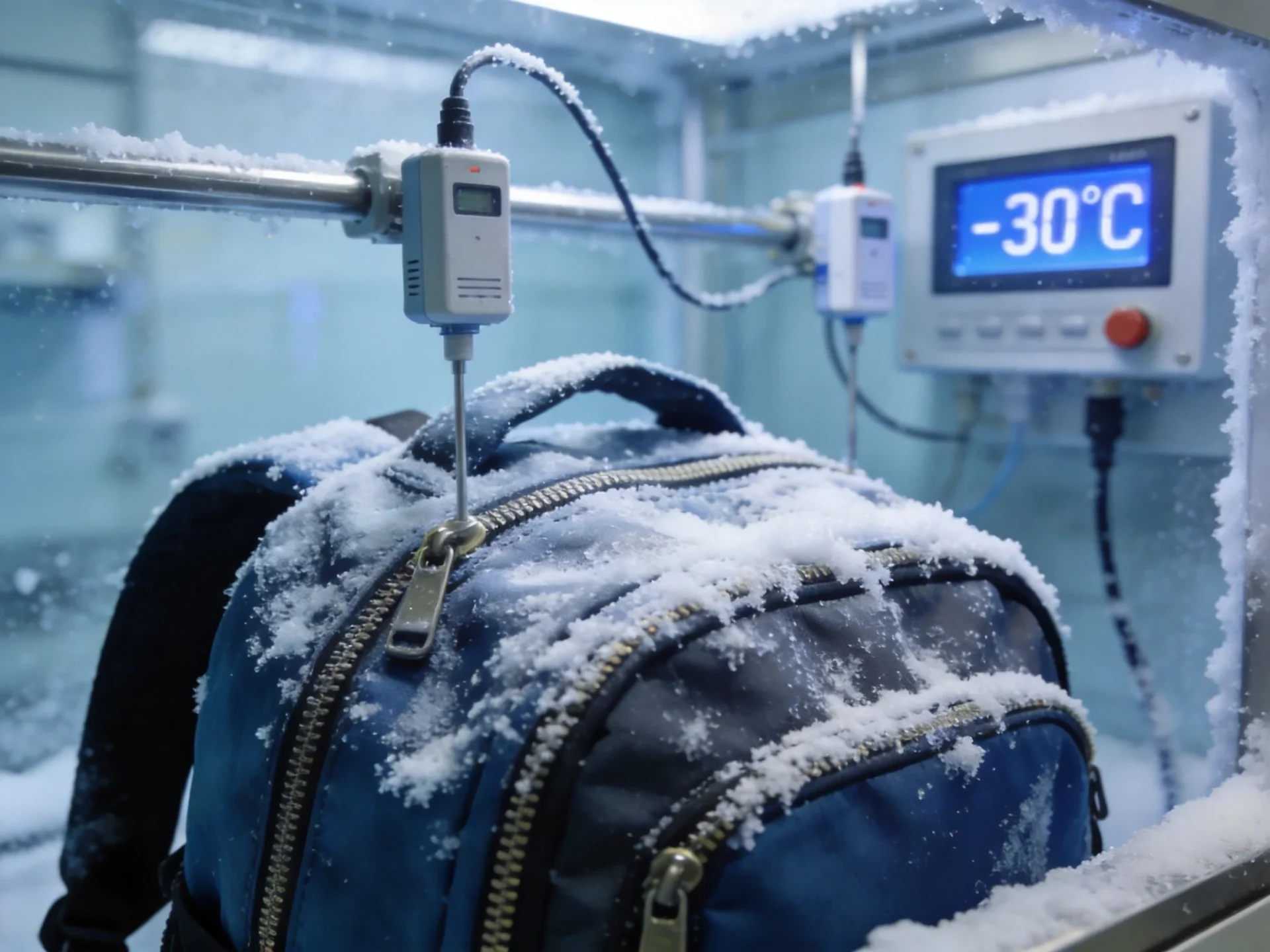
Quality testing in cold weather backpack manufacturing is not optional — it is a critical safety requirement. A zipper failure at -30°C in an alpine environment is not an inconvenience; it is a potentially life-threatening equipment failure. Our factory in Quanzhou, Fujian maintains a dedicated environmental testing chamber and follows rigorous cold-weather testing protocols for every backpack design before production approval.
Cold Temperature Testing Parameters
Environmental Chamber Testing Protocol
| Test | Temperature | Duration | Pass Criteria |
|---|---|---|---|
| Cold Flex Test (Fabric) | -30°C | 4 hours | No cracking or delamination after 1,000 flex cycles |
| Zipper Cold Operation | -25°C | 2 hours | Full operation force < 50N after thermal equalization |
| Buckle Impact Test | -30°C | 4 hours | No fracture when dropped from 200,000 per month (SGS-verified) onto steel plate |
| Seam Tape Adhesion | -20°C to +40°C (thermal cycling) | 10 cycles | No delamination or edge lifting |
| Insulation Compression | -25°C under 5kg load | 72 hours | Loft recovery > 90% after decompression |
| Thread Tensile Strength | -30°C | 2 hours | Retains > 85% of room-temperature tensile strength |
| Webbing Stiffness | -30°C | 4 hours | Bend radius < 25mm without cracking |
| Velcro Cold Bond | -25°C | 2 hours | Shear strength > 40 N/cm² |
Component-Level Cold Weather Specifications
Zipper Selection for Extreme Cold
Standard nylon zippers become stiff and unreliable below -15°C. For cold weather backpacks, we specify:
- YKK Vislon waterproof zippers: Molded polyurethane teeth that remain flexible to -30°C
- YKK Aquaguard zippers: Polyurethane-coated coil zippers with cold-weather lubrication
- Oversized pull tabs: Glove-compatible pull tabs (minimum 25mm × 15mm) with reflective elements
- Double-slider design: Allows top and bottom access to the same compartment
Buckle & Hardware Material Selection
Standard ABS plastic buckles become brittle and fracture in extreme cold. Our cold weather specifications require:
- POM (Polyoxymethylene/Delrin) buckles: Maintain impact strength to -40°C
- Reinforced nylon buckles (glass-filled): Higher temperature threshold and structural rigidity
- Aluminum hardware: For load-bearing D-rings and attachment points — no cold-temperature embrittlement
- Stainless steel components: For critical safety attachment points
Thread & Stitching Specifications
We use bonded nylon 6.6 thread (minimum 210D/3) for all structural seams in cold weather backpacks. This thread type maintains flexibility and tensile strength at temperatures below -30°C. All stress points receive bartack reinforcement (minimum 42 stitches per bartack). Stitch density is maintained at 8–10 stitches per inch for optimal seam strength.
Field Testing Protocol
Beyond laboratory testing, we recommend that OEM clients conduct field testing in actual cold weather conditions before final production approval. Our sample development process includes:
- Lab Testing Phase: Environmental chamber testing of all materials and components
- Prototype Sample: First physical sample for dimensional and construction verification
- Field Test Sample: Production-identical sample for real-world cold weather testing
- Pre-Production Sample: Final sample incorporating any field-test modifications
- Production Approval: Gold-seal sample for mass production reference
This comprehensive testing approach ensures that every cold weather backpack system we manufacture meets the performance expectations of the most demanding outdoor brands and their customers.
Manufacturing Capabilities at JUNYUAN BAGS
Our Quanzhou, Fujian factory combines led by a founder with bag industry experience dating from 2004 with modern production technology. Key capabilities for cold weather backpack OEM include:
Production Capabilities
- Monthly capacity: 200,000+ units
- Automated fabric cutting with laser alignment
- Ultrasonic bonding for insulation attachment
- Hot-air seam sealing stations
- High-frequency welding for waterproof construction
- Computerized bartack machines for stress points
- Environmental testing chamber (-40°C capability)
Certifications & Compliance
- BSCI certified factory
- ISO 9001 quality management
- SEDEX social compliance
- OEKO-TEX for sustainable materials
- REACH compliant materials
- CPSIA compliant for US market
- California Proposition 65 compliant
OEM & ODM Process Overview
- Consultation: Share your cold weather backpack requirements, target market, and volume
- Design & Development: Our team creates 3D tech packs and material specifications within 48 hours
- Prototype Sampling: Physical prototype delivered in 10–15 business days
- Testing & Iteration: Lab testing and field testing with design modifications
- Production Approval: Pre-production sample sign-off
- Mass Production: 25–40 days depending on quantity and complexity
- Quality Inspection: AQL 2.5 standard with comprehensive cold-weather testing
- Shipping: FOB Xiamen, CIF, or DDP delivery to your destination
Our expertise extends beyond cold weather packs. Our laptop backpack manufacturing division and recycled polyester backpack capabilities allow brands to develop comprehensive product portfolios from a single OEM partner. We also support tactical bag manufacturing with similar cold-weather and technical specifications. Explore our full range of OEM/ODM bag manufacturing services to build your complete product portfolio from a single factory.
Why Choose JUNYUAN BAGS for Cold Weather Backpack OEM
- expertise dating from 2004 Technical Expertise: Established in 2014, we have manufactured cold weather backpack systems for leading outdoor brands worldwide
- Comprehensive Insulation Integration: Certified partnerships with 3M Thinsulate and PrimaLoft for genuine insulation materials
- Advanced Weatherproofing: Hot-air seam sealing, high-frequency welding, and waterproof zipper integration
- Environmental Testing: In-house testing chamber capable of -40°C simulation for comprehensive cold-weather validation
- Full Attachment System Customization: Ice axe loops, trekking pole attachments, avalanche safety pockets, and modular MOLLE platforms
- Global Shipping from FOB Xiamen: Efficient access to Xiamen Port for worldwide delivery
- Flexible MOQ: Starting at 300 pieces per design with scalable production to 50,000+ units
- Dedicated Project Management: Single point of contact from initial inquiry through final delivery
Frequently Asked Questions
What insulation materials do you offer for cold weather backpacks?
We work with 3M Thinsulate (Types B, C, Platinum, and Pro), PrimaLoft (Silver, Gold, Gold Active, and Cross Core), and hybrid insulation systems that zone different materials for optimized performance and cost. We can advise on the best insulation choice based on your target temperature range, activity level, and price positioning.
What is the minimum order quantity for cold weather backpack systems?
Our standard MOQ is 300 pieces per design per color. For existing platform modifications (e.g., adding insulation to an existing design), MOQs can be as low as 200 pieces. Volume discounts apply for orders over 1,000 pieces.
Can you manufacture backpacks rated for extreme cold (-30°C to -40°C)?
Yes. Our factory has a dedicated environmental testing chamber capable of simulating temperatures to -40°C. We have manufactured Arctic expedition packs tested and proven in temperatures below -35°C. All materials, zippers, buckles, and thread are selected and tested specifically for extreme cold performance.
What external attachment features can you integrate?
We integrate ice axe loops (single and dual), trekking pole attachments, snow shovel pockets, avalanche probe holders, helmet nets, crampon patches, harness attachment loops, daisy chain MOLLE webbing, ski carry systems, and custom attachment solutions. All attachment points are reinforced with bartack stitching and Hypalon or Cordura reinforcement.
What waterproof-breathable fabrics do you recommend?
For premium alpine packs, we recommend Gore-Tex Pro 3L or X-Pac VX21. For mid-range winter hiking packs, 420D ripstop nylon with TPU membrane offers excellent performance at a competitive cost. For durable expedition packs, 1050D ballistic nylon with DWR provides maximum abrasion resistance. All options can be seam-sealed (taped or welded).
How long does sampling take for cold weather backpacks?
Prototype samples: 10–15 business days. Pre-production samples with full testing: 15–20 business days. We recommend an additional 5–7 days for environmental chamber testing of the prototype sample before final design approval.
What certifications does your factory hold?
Our factory holds BSCI, ISO 9001, SEDEX, and OEKO-TEX certifications. All materials comply with REACH, CPSIA, and California Proposition 65 requirements. We can provide third-party testing reports from SGS, Bureau Veritas, or Intertek upon request.
What is your production lead time?
Mass production takes 25–40 days depending on order quantity and design complexity. Cold weather backpacks with insulation bonding, seam sealing, and multiple attachment systems typically require 30–35 days. We provide detailed production timelines with milestone dates before order confirmation.
Can you support both OEM and ODM for cold weather backpacks?
Absolutely. For OEM projects, we manufacture to your exact specifications. For ODM projects, our design team develops complete backpack systems based on your target market, price point, and performance requirements. Our ODM service includes 3D tech pack creation within 48 hours and physical samples within 15 days.
Where is your factory located and what are your shipping options?
Our factory is located in Quanzhou, Fujian, China. We ship FOB Xiamen with efficient access to one of China’s major container ports. We also support CIF, DDP, and door-to-door shipping to destinations worldwide. Contact us at [email protected] for shipping quotes.
Start Your Cold Weather Backpack OEM Project
Get a detailed quote within 24 hours. MOQ from 300 pieces. FOB Xiamen, China. Explore our capabilities: OEM/ODM services | Laptop backpacks | Athletic backpacks | RPET backpacks | Contact us | Request quote