
What is a skate backpack, and how is it different from a normal backpack? A skate backpack is an ordinary daypack with three systems added and one surface changed: an external board-carry system that holds a 7.5–8.5 inch deck against the pack body, an abrasion panel on every surface the grip tape can touch, and a strap-and-buckle rig rated for a 2.5–3.5 kg board that moves on every step. The laptop sleeve, the bottle pocket and the zipper chain are standard backpack construction.
What does it cost to make one? A skate backpack that retails under $100 typically leaves the factory at $12–22 FOB, and roughly 60–70% of that factory cost sits in fabric, webbing and hardware rather than in labour. Bulk OEM production runs at MOQ 500 pcs per style and colour, with 6–10 business days for sampling and 35–50 days for bulk delivery, inspected to AQL 2.5 major / 4.0 minor and shipped FOB Xiamen.
What Makes a Skate Backpack Different from a Standard Daypack
A skate backpack is not a separate category of bag. It is a standard daypack with four modifications, and every one of those modifications adds cost, weight and a quality-control checkpoint that a commuter pack does not need. Buyers who put a skate pack next to a commuter pack of the same litreage will find the same laptop compartment, the same side bottle pocket and the same nylon coil zipper. The difference is concentrated in four places.
1. External board-carry system. Two straps and two buckles, mounted on the front panel or the side panel, positioned to hold a deck 7.5–8.5 inches wide and 29–33 inches long. The system has to hold the board without the trucks pressing into the fabric, and without the deck shifting when the wearer runs for a bus.
2. Abrasion panel. Grip tape is silicon carbide grit bonded to a paper or mesh backing, typically 36-grit to 80-grit. Against fabric it behaves exactly like sandpaper. A skate pack therefore needs a higher-abrasion face fabric, or a laminated panel, on every surface the deck can contact — and that includes the inside of the board straps, not only the outer shell.
3. Reinforced attachment points. Bar-tacks, box-X stitches and rivets at every strap junction. The board swings on each step, so the attachment points are loaded in shear and in fatigue rather than in steady tension. A single row of stitching that survives a 15 kg static pull test can still fail after 20,000 walking cycles.
4. Hardware rated for a moving load. Buckles on a commuter pack hold a static load. Buckles on a skate pack hold 2.5–3.5 kg that moves. A side-release buckle that passes a 15 kg static pull can still pop open under repeated dynamic loading if the strap geometry puts the load on the release tab instead of on the buckle body.
The table below sets the two constructions side by side at the specification level, which is the level a buyer or a product developer actually works at.
| Specification | Standard commuter daypack | Skate backpack |
|---|---|---|
| Primary load | Laptop and documents, static | Laptop plus board, dynamic |
| Board attachment | None | 2 straps and 2 buckles, front or side mounted |
| Face fabric, typical | 600D polyester, PU back-coating | 900D–1680D polyester, or 600D with laminated abrasion panel |
| Deck contact surface | Not treated | Reinforced panel or high-abrasion laminate |
| Stitch at strap junction | Single row plus bar-tack | Box-X plus bar-tack plus rivet |
| Buckle rating | 12–15 kg static pull | 15–20 kg, verified under cyclic load |
| Typical finished weight | 0.7–1.0 kg | 1.0–1.6 kg |
| Typical retail price | $45–90 | $60–140 |
| Dominant failure mode | Zipper or lining wear | Board strap anchor tear-out, face fabric abrasion |
The weight penalty is the trade a buyer notices first, and retail listings show the spread clearly. The Oakley Freshman is quoted at 1.3 lbs (0.59 kg) with a 20.5 × 12.5 × 7.0 inch body. The WOLT is quoted at 1.7 lbs (0.77 kg) with a 15.6-inch laptop sleeve and a packable mesh helmet holder. The GoHimal runs 34 L at 0.86 kg. Light packs exist, but they reach those numbers with thinner face fabric and a shorter service life, and that is a deliberate engineering choice rather than a defect.
The clearest statement of the design problem comes from a retail buyer’s guide rather than from a factory: skate-first packs often sacrifice organization and padding, while school-first packs sometimes bolt on a flimsy board strap as an afterthought. That single sentence is the entire product brief. A skate pack that sells has to solve both halves of it, and the second half — organization and padding — is where most low-cost OEM programmes fail. A factory that only knows how to sew two straps onto a generic daypack will produce a bag that photographs well and tears out in month three.
For buyers sourcing a laptop-first skate pack, the laptop compartment specification is worth handling as a separate brief, because the sleeve, the foam density and the false bottom are all standard components that can be pulled from an existing custom laptop backpack manufacturing platform rather than designed from zero.
Board Carry Systems: Vertical, Horizontal and Diagonal Compared
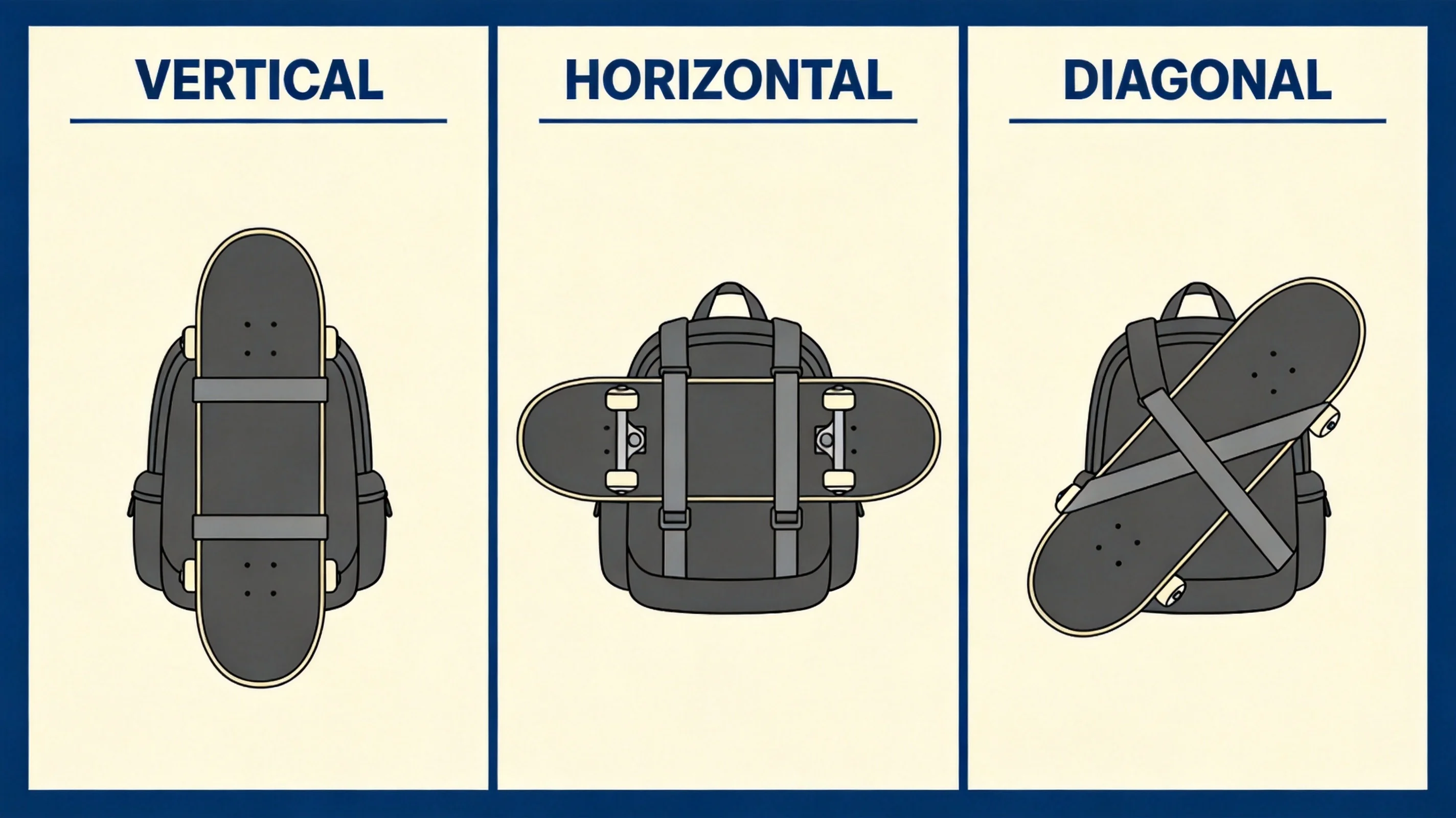
Board carry is the one feature that defines the category, and there are only three geometries in commercial production. Every retail skate pack on the market uses one of them, or a variant that combines two. The choice drives the pattern, the strap length, the anchor positions and the wearer’s centre of gravity, so it has to be settled before the first pattern is cut.
Vertical carry: the default for narrow decks
Two straps run down the front panel, the deck stands upright with its long axis parallel to the wearer’s spine, and the trucks face outward or inward depending on the anchor layout. Vertical carry is the most common system in production because it needs the least pattern change from a standard daypack: two webbing runs, four anchor stitches and two buckles. It also keeps the load close to the spine, which is why it remains the standard for packs under 25 L.
The engineering constraint is deck width. A vertical system built for a 7.75-inch deck will not accept an 8.5-inch deck without the straps splaying, and a splayed strap puts the load on the buckle’s release tab. The practical fix is to specify the strap span for the widest deck in the target range and add a second, shorter strap position for narrow decks, which costs roughly $0.25–0.40 per unit in extra webbing and one additional bar-tack operation.
Horizontal carry: the choice for wide decks and longboards
The deck lies across the front panel, long axis perpendicular to the spine. Horizontal carry accepts a 9-inch to 10-inch deck without splaying, and it is the standard choice for longboard and cruiser packs. The trade-off is balance: a deck mounted horizontally puts 2.5–3.5 kg of mass across the shoulders instead of along the spine, and the pack tends to rotate on the wearer’s back during a ride. Packs that use horizontal carry almost always add a sternum strap and a compression strap to control that rotation.
Horizontal carry also loads the anchor stitches differently. The board’s weight acts as a lever across the width of the front panel, so the two outermost anchors see a peeling load rather than a shear load. That is the specific failure that box-X stitching is designed to resist, and it is why a horizontal system should never be built with single-row stitching even when the buckle rating looks adequate.
Diagonal carry: the compromise that costs the most
The deck sits at roughly 30–45 degrees, one truck high on the shoulder side and one low on the hip side. Diagonal carry balances better than horizontal and accepts wider decks than vertical, which is why it appears on crossover packs aimed at both skaters and commuters. It is also the most expensive geometry to produce: the strap runs are longer, the anchor positions are asymmetric so the pattern cannot be mirrored, and the two straps must be length-adjustable independently or the deck sits crooked.
In production terms, diagonal carry typically adds $0.60–1.10 per unit over vertical carry, mostly in webbing length and in the extra cutting operation created by the asymmetric pattern. For a programme under 3,000 units that cost is real money, so diagonal carry is usually specified only when the retail positioning demands it.
| Attribute | Vertical carry | Horizontal carry | Diagonal carry |
|---|---|---|---|
| Deck width accepted | 7.5–8.0 in typical, 8.5 in with splay | 8.5–10.0 in | 7.75–9.0 in |
| Load path | Along the spine | Across the shoulders | Shoulder to hip, diagonal |
| Balance in motion | Best | Poorest, needs sternum strap | Good |
| Anchor load type | Shear | Peel plus shear | Mixed, asymmetric |
| Pattern change from daypack | Minimal | Moderate | Extensive, non-mirrored |
| Added unit cost vs vertical | Baseline | +$0.30–0.55 | +$0.60–1.10 |
| Best fit | Packs under 25 L, school and commuter crossover | Longboard and cruiser packs, 28 L and up | Crossover packs, 25–32 L |
One production note that buyers rarely specify and always notice: the deck must be held off the fabric. A board strapped flat against the shell transfers every vibration from the pavement straight into the face fabric, and grip tape grinds the panel on every step. Standoff is created by the truck hangers, which are 2–3 inches tall, so a correctly designed system lets the trucks carry the deck and keeps the grip-tape surface away from the shell. Systems that clamp the deck flat — usually the cheapest ones — destroy the pack in a season.
The same geometry rules apply to powered boards, which are heavier and put a bigger static load on the same anchors. A production brief for an electric skateboard backpack should raise the buckle rating by one step and add a third anchor point on the centre line, because a 9–12 kg e-board will tear out a two-anchor vertical system that is perfectly adequate for a 3 kg deck.
Fabric and Abrasion Specs That Survive Grip Tape
Why grip tape destroys standard backpack fabric
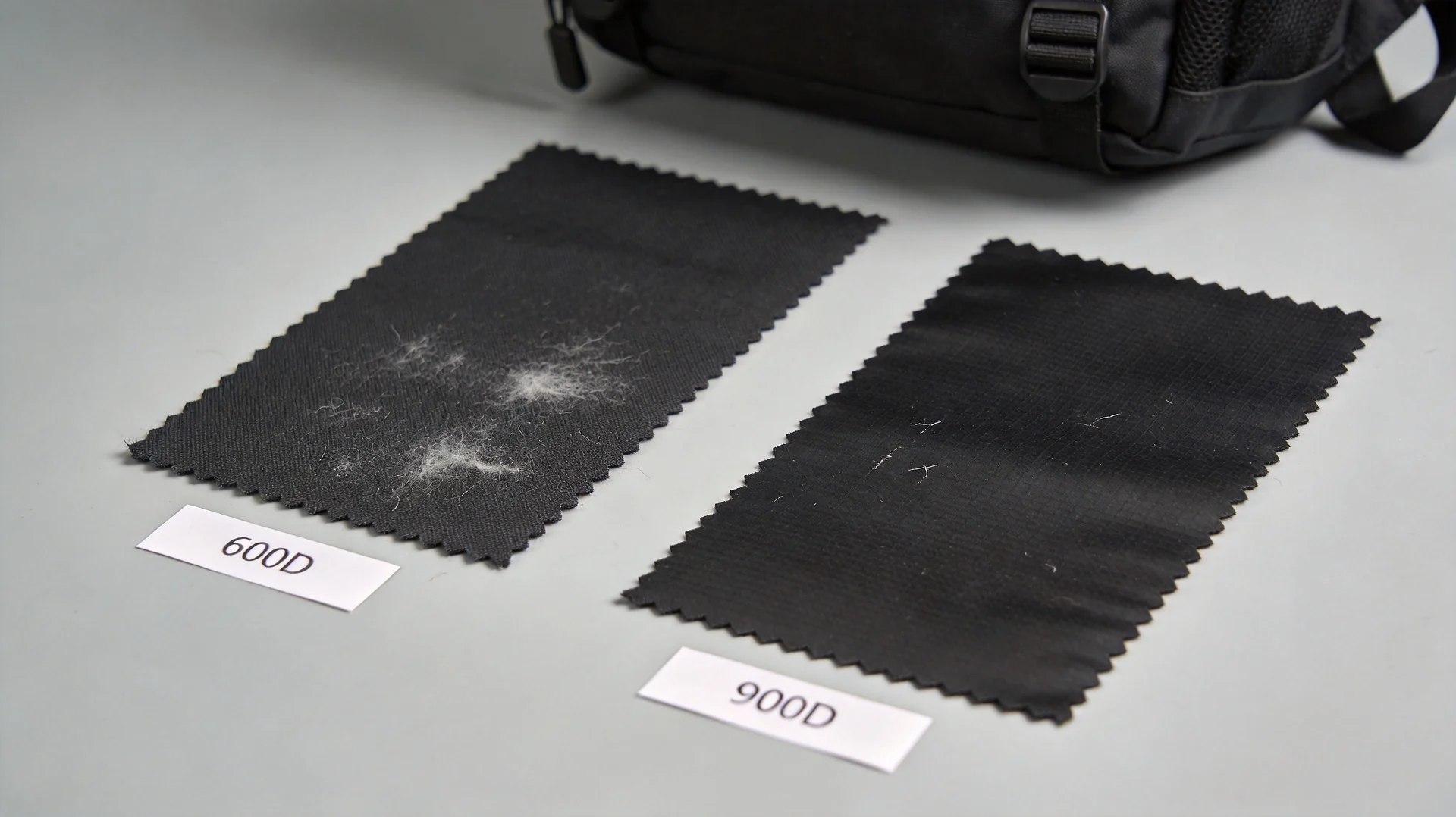
Grip tape is an abrasive, and it is an abrasive that is pressed into the fabric under load rather than merely rubbed against it. A 60-grit sheet of silicon carbide, held against 600D polyester by a 3 kg deck and cycled 2,000 times as the wearer walks, will abrade through the face yarn and expose the PU back-coating. Once the coating is exposed, water ingress begins, the yarn loses bulk, and the panel fails by tearing along the weave.
The industry measures this with three standards, and a buyer should name the standard in the purchase order rather than accept a verbal claim of durability. ASTM D3884 is the Taber abrasion method, using a rotating abrasive wheel under a specified load; results are reported as cycles to a defined end-point. ASTM D4157 is the Wyzenbeek method, using an oscillating drum covered in abrasive fabric; it is the method most often used for automotive and upholstery textiles and is the better predictor of flat-surface abrasion. ISO 12947 is the Martindale method, which uses a circular rubbing motion and is the European standard most frequently cited on fabric datasheets.
None of the three methods simulates grip tape exactly, so a factory specification should combine a lab number with a physical test. The practical approach is to require a Taber result on the face fabric and then run an in-house grip-tape cycle test on the finished panel: clamp a scrap deck with used grip tape against the panel, apply a 3 kg load, and cycle 500 times. A panel that shows no yarn breakthrough at 500 cycles will survive a normal retail service life.
Fabric options ranked by abrasion resistance
Five fabrics cover almost all skate pack production. The table below gives the working specification for each, with the trade-offs that matter in a costing sheet.
| Fabric | Weight (gsm) | Abrasion behaviour | Relative cost | Best use in a skate pack |
|---|---|---|---|---|
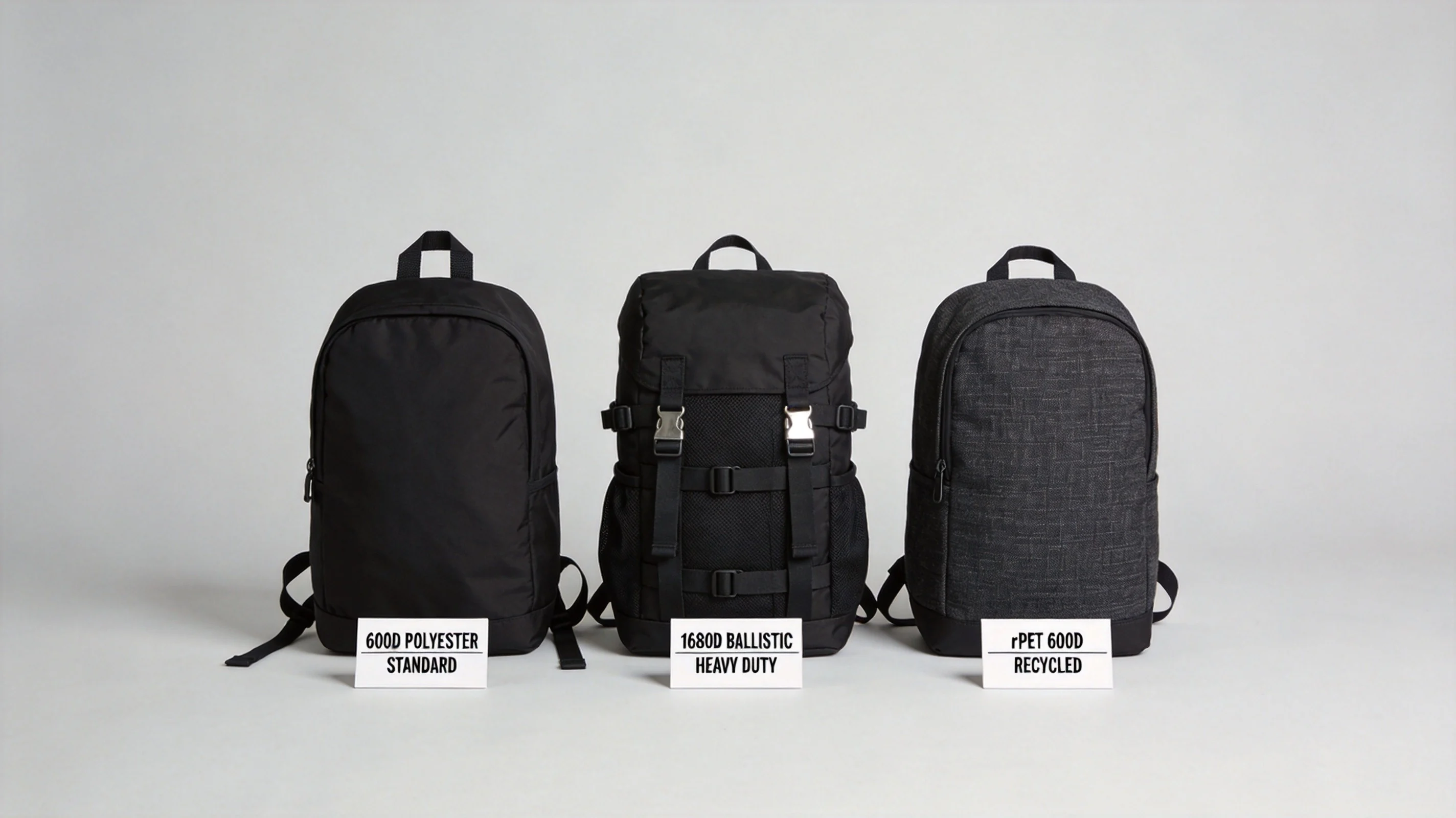
| 600D polyester, PU coated | 220–260 | Adequate on the body, fails at deck contact | Baseline | Side panels, back panel, lining-facing areas |
| 900D polyester, PU coated | 330–380 | Good, roughly 1.5–2× the abrasion life of 600D | +8–14% | Full shell on mid-tier packs |
| 1680D ballistic polyester | 500–600 | Excellent, resists yarn breakthrough under grit | +25–40% | Deck contact panel, high-wear programmes |
| 600D recycled polyester (RPET), PU coated | 230–270 | Comparable to virgin 600D when tested to the same standard | +5–12% | Whole shell on sustainability-led programmes |
| Tarpaulin laminate, 500D base | 450–550 | Highest abrasion resistance, fully waterproof body | +30–50% | Deck panel plus base on premium packs |
The most common cost error in a skate pack programme is to specify 1680D across the whole shell. That roughly doubles the fabric cost of the bag for a benefit the buyer only needs on one panel. The correct specification is a hybrid: 600D or RPET on the body, 1680D ballistic or a tarpaulin laminate on the deck contact zone and on the base. That construction reaches the same service life at 40–55% of the fabric premium of a full 1680D shell, and it is what most competent factories will propose if the buyer asks the question directly.
Where the brief calls for abrasion resistance as a headline claim rather than an internal spec, the cut-resistant construction family is the adjacent reference point, since it uses the same high-tenacity yarns and the same panel logic. The custom cut-resistant backpack manufacturing platform is built around that panel-and-laminate approach.
Coating, lining and seam construction
Abrasion resistance is a face-fabric property. Water resistance and seam integrity are separate specifications, and they are where skate packs most often fail in the field even when the face fabric is correct.
Coating. PU coating at 1,000–1,500 mm hydrostatic head is the normal specification for a skate pack body; it handles rain and splash without the stiffness of PVC. PVC coating at 2,000–3,000 mm gives better water resistance and a lower unit cost, but it hardens at low temperature, which matters for a product sold in northern markets. A common and cost-effective compromise is PU on the deck panel and PVC on the base.
Lining. 210D polyester is standard. On the deck contact zone the lining should be a coated 210D rather than a plain weave, because grit that passes the face fabric will otherwise abrade the lining from the inside and contaminate the main compartment.
Seams. The deck contact panel should be joined with a lap seam and bound, not with a simple butt seam, because a butt seam exposes the stitch line to the abrasive. Critical seams on the board-carry anchors should be taped or bound, and every anchor should be bar-tacked after assembly rather than before, so the tack penetrates all layers including the reinforcement patch.
For programmes where the pack has to hold up in sustained rain, the waterproof construction route is worth costing separately rather than specifying a heavier coating on a standard shell. The custom waterproof bag manufacturing platform covers welded and seam-sealed construction, which reaches a different performance class entirely.
What $100 Buys at Retail vs What It Costs to Make
The under-$100 retail band is the volume segment for skate packs, and it is worth understanding where the money actually goes, because that breakdown determines what a factory can and cannot deliver at a given FOB price. A skate backpack that retails at $99 in the United States typically carries a landed cost of $18–28 and an FOB price of $12–22. The gap between FOB and landed covers freight, duty, and the importer’s inspection and warehousing.
| Cost element | Share of FOB at $15 | What drives it |
|---|---|---|
| Face fabric and lining | 28–34% | Denier, coating type, RPET premium, panel hybridisation |
| Webbing, zippers, buckles, hardware | 22–28% | Buckle rating, zipper brand, number of anchor points |
| Foam and padding | 10–14% | Back panel density, laptop sleeve foam, shoulder strap EVA |
| Cutting and sewing labour | 18–24% | Panel count, number of stitch operations, box-X and bar-tack count |
| Finishing, QC, packing | 6–9% | AQL level, trimming, hangtag and polybag |
| Factory margin and overhead | 8–12% | Order quantity, payment terms, seasonality |
Two conclusions follow from that table. First, fabric and hardware together are 50–62% of the factory cost, so the levers that move price fastest are specification levers, not labour levers. Second, labour is under a quarter of the cost, which means a buyer who tries to negotiate the price down by squeezing labour is attacking the smallest number on the sheet while risking the largest quality risk — the stitch operations at the board-carry anchors.
It is also worth being precise about what the retail price actually includes on the shelf. Retail listings in this segment show a consistent specification band: 25 L capacity, 1.3–1.7 lbs, a 15.6-inch laptop sleeve, a side-access or top-access laptop opening, exterior cargo straps and reflective detailing. The Dakine Mission Street is quoted at 25 L, 1.5 lbs and 20.1 inches long with side-access laptop entry. The Cosmos Skateboard Travel pack is quoted with 33 inches of internal length, 600D nylon and a 1.5-inch strap width. The One and Only pack is quoted at 900D polyester with a PU coating, five pockets across five compartments and a 15.6-inch laptop sleeve.
Those numbers are a useful benchmark for a buyer building a private-label programme, because they define what a consumer already expects at this price. A pack that hits 25 L, 1.5 lbs, a 900D-equivalent face fabric and a 15.6-inch laptop sleeve at a $15–18 FOB is competitive. A pack that reaches the same spec sheet at $12 FOB has almost certainly removed one of the board-carry anchors, thinned the face fabric, or substituted a lower-rated buckle — and that is exactly the substitution a buyer should refuse.
Buyers comparing retail options before writing an OEM brief will find the current market reviewed in our skateboard backpack buying guide, which covers the C-end landscape in detail. The purpose of this article is the other side of the transaction: what has to happen in a factory to hit those numbers reliably at volume.
Where the target is a premium retail position above $100, the construction route changes rather than merely improving. Premium programmes typically move to 1680D ballistic or tarpaulin, add a moulded back panel, and specify YKK zippers and metal hardware, which is a different platform from the volume build. The custom premium backpack manufacturing route covers that specification class.
School-channel skate packs are a distinct sub-segment with their own constraints: they need a reinforced base, a name-tag window, and a lighter empty weight because the pack is carried all day. The custom school backpack manufacturing platform is built for that brief, and the board-carry system can be added to it without changing the base pattern.
Skate Pack OEM Spec Sheet: MOQ, Sampling and Lead Times
This is the section buyers copy into a purchase order. Every number below is the working specification for a skate pack programme, and each one should appear explicitly in the quotation request rather than being left to the factory’s default.
| Parameter | Standard specification | Notes |
|---|---|---|
| MOQ | 500 pcs per style and colour | Colour is counted separately; a 3-colour programme is 1,500 pcs minimum |
| Sampling time | 6–10 business days | From confirmed spec sheet and artwork; excludes shipping |
| Sample cost | Charged per unit | Rebated against the first bulk order once the volume threshold is met |
| Bulk production | 35–50 days | From sample approval and deposit receipt |
| Inspection standard | AQL 2.5 major / 4.0 minor | Applied at final random inspection before packing |
| Incoterm | FOB Xiamen | Other terms quoted on request |
| Warranty | 12 months | Covers workmanship and hardware, not wear from grip tape abrasion |
| Board-carry anchors | 4 anchors minimum, box-X plus bar-tack plus rivet | 6 anchors for decks above 8.5 in or e-boards |
| Buckle static pull rating | 15 kg minimum | 20 kg for e-board programmes |
| Face fabric | 600D–1680D polyester or RPET, PU coated | Deck contact panel at 1680D or tarpaulin laminate |
| Coating | PU 1,000–1,500 mm hydrostatic head | PVC 2,000–3,000 mm on base panels if cost-driven |
| Lining | 210D polyester, coated on deck contact zones | Plain 210D acceptable elsewhere |
| Zippers | Nylon coil, No. 8 main, No. 5 secondary | Branded zippers available at a cost premium |
| Laptop sleeve | Up to 15.6 in, 8–10 mm foam, false bottom | 17 in sleeve adds $0.80–1.40 per unit |
| Capacity range | 22–32 L | Above 32 L the pack moves into the longboard category |
| Finished weight target | 1.0–1.6 kg | Below 1.0 kg requires thinner face fabric and a service-life trade |
| Carton configuration | 20–30 pcs per carton, polybag per unit | Hangtag and retail packaging quoted separately |
Three of those rows deserve emphasis because they are where quotations most often diverge. The first is MOQ. A quotation that says “500 pcs” without stating “per style and colour” will, in practice, be read as 500 pcs across the whole order, and the price will not hold once the colour split is confirmed. The second is sampling time. Six to ten business days is the honest figure for a pack with a board-carry system, because the sample has to be sewn with the reinforcement patches and then load-tested; a factory quoting three days is either reusing an existing pattern or skipping the load test. The third is the warranty. A 12-month workmanship warranty should not be read as covering grip-tape abrasion, because abrasion is a wear mechanism rather than a defect, and a factory that agrees to cover it is pricing a risk it cannot control.
For programmes that sit alongside a broader bag sourcing plan, the anchor reference point is the general custom backpack manufacturer platform, which carries the same MOQ, sampling and inspection terms and can absorb a skate pack brief as a variant.
Quality Control Points Specific to Skate Packs
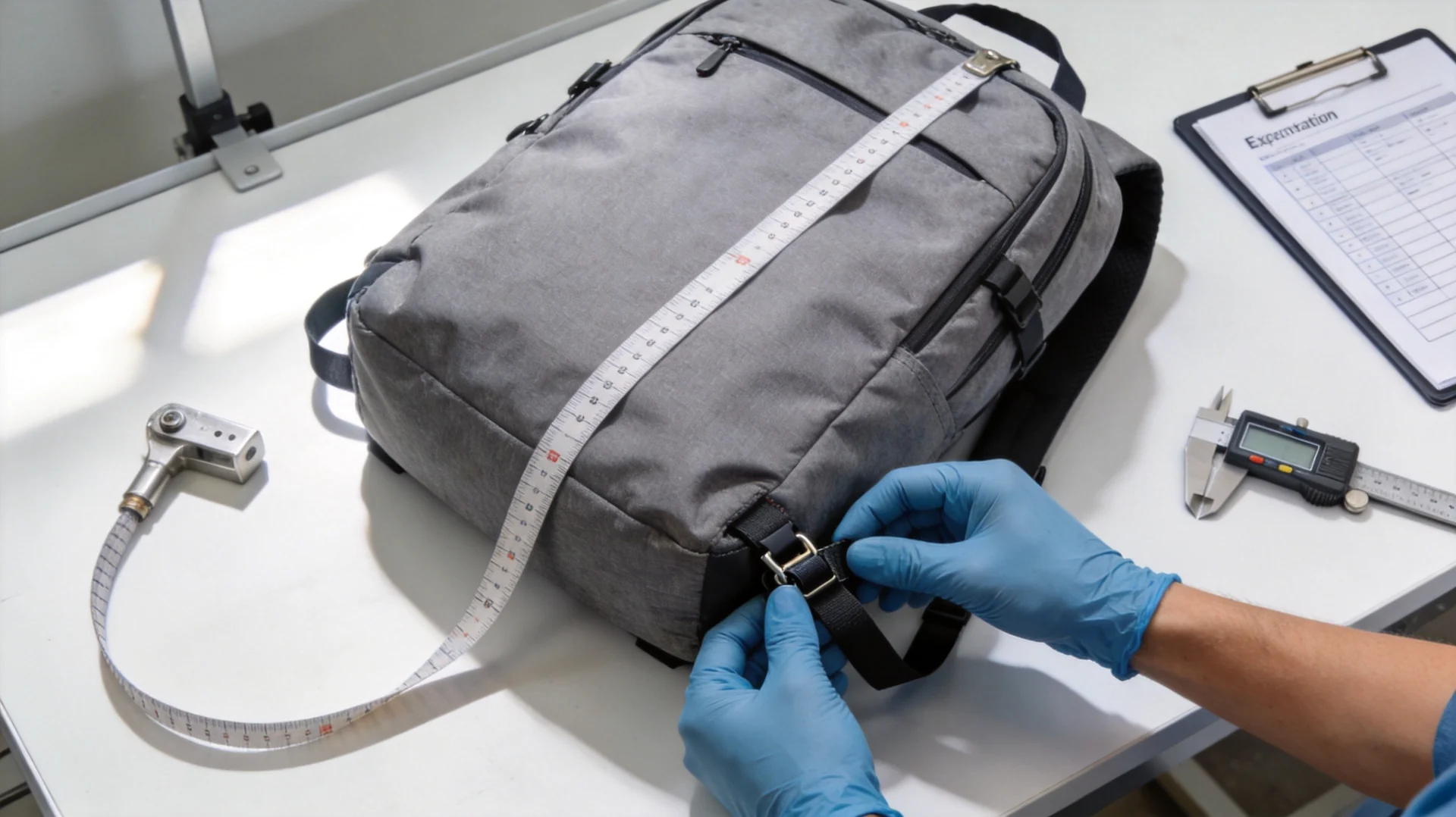
Standard backpack QC checks the whole bag: stitch density, seam strength, zipper function, hardware attachment, measurement against spec, cleanliness and packing. A skate pack needs all of that plus four checks that do not exist on a commuter programme. Those four checks are what separates a programme that survives a season from one that generates returns in month four.
Incoming material inspection
Grip tape destroys the wrong fabric quickly, so the fabric check has to happen before cutting rather than after assembly. Incoming inspection on a skate pack programme should confirm denier by weight per square metre, confirm the coating type and thickness, and run an abrasion check on a swatch from every roll lot. A lot that measures 20% below the specified gsm will fail at the deck contact zone even though it passes a visual inspection.
The same applies to webbing. Board-carry straps should be 25 mm woven polypropylene or polyester at a minimum of 1.2 mm thickness; a 1.0 mm webbing that looks identical on the roll will stretch under a swinging deck and let the board rotate. Buckle inspection should confirm the moulded rating mark and should include a sample pull test from every incoming carton, because buckle quality is the single most variable hardware item in a low-cost programme.
In-line checks during assembly
Three in-line checkpoints catch the defects that cannot be fixed after the bag is closed. After the anchor patches are sewn, check that the reinforcement patch is fully captured by the box-X stitch and that the bar-tack penetrates all layers. After the board straps are attached, mount a production deck and confirm the strap span accepts the widest deck in the range without splaying. Before the bag is turned, verify that no stitch line on the deck contact panel is exposed on the outside face, because an exposed stitch line is the first thing grip tape cuts.
In-line inspection on a skate pack line typically runs at one check per 20–30 pieces rather than the one-per-50 that is adequate on a commuter programme, because the anchor operations are hand-guided and vary between operators. That is a real cost, and it is one of the reasons a skate pack carries a higher unit price than a plain daypack of the same size.
Final AQL inspection and the load test
Final random inspection to AQL 2.5 major / 4.0 minor covers the standard defect list. On a skate pack, three additional tests should be written into the inspection plan and reported with the inspection record.
Anchor pull test. Apply 25 kg to each board-carry anchor for 60 seconds. No stitch elongation beyond 2 mm, no tear-out, no visible yarn break at the patch edge.
Buckle cycle test. Open and close each board-carry buckle 200 times with a 3 kg load applied. The buckle must not self-release and the release tab must return to its seated position.
Deck mount test. Mount the widest deck in the programme’s range, lift the pack by the shoulder straps and shake for 30 seconds. The deck must not shift more than 20 mm in any direction.
Those three tests take under two minutes per unit on a sample basis and they are the difference between a programme with a return rate under 2% and one with a return rate above 8%. A buyer who does not write them into the inspection plan should assume they are not being performed.
How to Brief a Factory: A 12-Point Skate Pack Spec
Most sourcing problems on skate packs originate in the brief rather than in the factory. A brief that says “skate backpack, 25 L, custom logo, need good quality” will produce a bag that matches none of the buyer’s expectations, and the resulting sample round consumes three weeks and two air-freight cycles. The twelve points below are the minimum a brief needs to be actionable.
- Deck range. State the minimum and maximum deck width and length the pack must carry, not a single nominal size.
- Carry geometry. Vertical, horizontal or diagonal, with the anchor count and anchor positions marked on a sketch.
- Capacity and dimensions. Litres plus the external height, width and depth, because litres alone do not define a pattern.
- Face fabric by zone. Body fabric, deck contact panel fabric and base fabric specified separately, with denier and coating.
- Coating and hydrostatic head. A number, not “water resistant”.
- Lining specification. Denier and coating, with the deck contact zone called out separately.
- Hardware list. Buckle type and pull rating, zipper size and brand, D-rings, hook-and-loop areas.
- Stitch specification at anchors. Box-X plus bar-tack plus rivet, with the stitch density.
- Laptop sleeve. Maximum device size, foam thickness, false bottom yes or no.
- Target finished weight. A number in grams, with a tolerance, because weight drives fabric choice.
- Test requirements. Abrasion standard, anchor pull test, buckle cycle test, deck mount test.
- Commercial terms. MOQ by colour, target FOB, sampling timeline, inspection standard, Incoterm.
A brief built on those twelve points produces a sample that is close to final on the first round, which typically saves two to three weeks against a loosely written brief. It also makes quotations comparable, because every factory is pricing the same specification rather than its own interpretation of it.
Where the skate pack sits inside a wider equipment programme — for example a brand that also sells pads, helmets and travel gear — the brief can be consolidated with the equipment range so that fabric, hardware and colour are shared across SKUs. That consolidation is what the custom equipment bag manufacturing route is designed for, and it usually reduces per-unit cost by 6–12% through combined material purchasing.
Compliance and Testing for Skate Packs
Compliance requirements for a skate pack depend on the destination market, and they attach to the materials and to the components rather than to the bag as a whole. Four regimes cover most of the volume.
REACH. For the European Union, the restriction list and the SVHC candidate list apply to every article placed on the market. In practice this means a restricted-substances test on the face fabric, lining, webbing, coating and any printed or dyed component, plus a declaration on the SVHC content above 0.1% by weight. Azo dyes, phthalates in coatings, and certain flame retardants are the recurring failure points.
California Proposition 65. For the United States, Prop 65 requires a warning unless exposure to listed chemicals is below the applicable threshold. For soft goods the practical concern is lead in zipper pulls and metal hardware, and DEHP in PVC components. Testing to the Prop 65 list on hardware and coated fabric is the normal route.
CPSIA. Where a skate pack is marketed to or could reasonably be used by children under 12 — which is common in the school channel — CPSIA applies. That brings total lead content limits on substrates and paint, phthalate limits on plasticised components, and small-parts requirements for any detachable component. A buckle that can be removed by hand is a CPSIA small-parts failure.
Performance standards. Abrasion performance should be specified against ASTM D3884 (Taber), ASTM D4157 (Wyzenbeek) or ISO 12947 (Martindale), with a stated cycle count and end-point. Seam strength is normally specified against ASTM D1683. Zipper function is covered by the zipper supplier’s own test data, which should be requested as part of the material file rather than assumed.
Two compliance points are frequently overlooked on skate packs specifically. The first is that the board-carry webbing is an accessible component that a child can chew, so it falls inside CPSIA substrate testing even though it is not a decorative part. The second is that any printed logo on the deck contact panel must be tested as part of the finished panel, because printing changes the abrasion performance of the surface and a print that sits proud of the weave will wear through before the fabric does.
Sourcing Models: Wholesale, Private Label and Full OEM Skate Pack Programmes
Three sourcing models cover the skate backpack category, and they differ far more in development effort than in unit price. A buyer who picks the wrong model for the stage of the brand will either overpay for flexibility it does not need or underpay for control it cannot do without. The table below sets the three models against the numbers that decide between them.
| Attribute | Wholesale stock | Private label | Full OEM custom |
|---|---|---|---|
| What changes | Nothing; buy an existing pack | Logo, hangtag, colour, packaging | Pattern, fabric, hardware, construction |
| Typical MOQ | 50–200 pcs mixed | 300–500 pcs per colour | 500 pcs per style and colour |
| Development time | 0 days | 3–5 days for artwork | 6–10 business days for a sample, plus a revision round |
| Unit cost | Highest per unit | Mid | Lowest per unit at volume |
| Board-carry control | None; whatever the stock pack has | Limited to strap colour and buckle choice | Full control of geometry, anchors and fabric by zone |
| Exclusivity | None | Logo only | Pattern can be exclusive to the buyer |
| Best fit | Testing demand before committing capital | Established brand adding a skate SKU | Brand with a defined product and retail position |
Wholesale stock is the right starting point when the goal is to test whether a skate pack sells at all in a given channel. The limitation is structural rather than commercial: a stock pack was designed for someone else’s deck range, so the board-carry system may not accept an 8.5-inch deck, and there is no way to change the deck contact fabric. A wholesale programme that succeeds should be treated as market research, not as a supply chain.
Private label is the middle path, and it is where most first-time skate pack programmes land. The pack already exists, so the development risk is low, but logo placement, colour, hangtag and retail packaging are buyer-controlled. Two cautions apply. First, private label does not change construction, so if the stock pack uses two anchors and single-row stitching, that is what ships under the buyer’s logo. Second, colour changes still carry a per-colour minimum, so a three-colour private label programme usually reaches the same MOQ as a simple OEM programme while delivering less differentiation.
Full OEM custom is the only model that gives control over the four specifications that define a skate pack: the board-carry geometry, the anchor construction, the fabric by zone and the hardware rating. It is also the only model where a buyer can specify the four performance tests described earlier and receive an inspection record against them. For a brand with a defined retail position and a deck range to serve, this is the model that pays for itself, because the specification decisions that reduce returns are only available here.
On the supplier side, four questions separate a factory that can run a skate pack programme from one that can only run a generic daypack line. First, can it show the anchor construction drawing with box-X, bar-tack and rivet called out, rather than describing it verbally. Second, can it produce abrasion test data for the specific fabric it proposes. Third, does it run the anchor pull, buckle cycle and deck mount tests in-house, and can it supply a sample inspection record. Fourth, does it quote MOQ per style and colour and state sampling at 6–10 business days. A skate pack supplier that answers all four is a production partner; one that answers two is a trading company relaying specifications.
For buyers consolidating a skate pack with related SKUs, the economics change again. Sharing fabric, webbing and hardware across a skate pack, a commuter pack and a school pack typically reduces the per-unit material cost by 6–12% and cuts the number of incoming material lots by half, which reduces incoming inspection workload proportionally. That consolidation is the main argument for placing a skate pack inside a wider backpack programme rather than running it as a standalone order.
One final point on bulk orders: the quantity that matters is not the total across the programme but the quantity per colour. A 1,500-piece order split across four colourways is four lots of 375 pieces, and a factory quoting at the 1,500-piece price will reprice once the split is confirmed. Confirming the colour split before requesting a quotation is the single simplest way to avoid a late price adjustment.
Frequently Asked Questions About Skate Backpack Manufacturing
What is the difference between a skate backpack and a skateboard bag?
A skate backpack is worn on the back and combines a daypack with a board-carry system, so it carries a laptop and a deck at the same time. A skateboard bag is a purpose-built carry bag, usually a shoulder or duffel format, that carries one or more decks with little or no general storage. The backpack is the higher-volume product because it serves a daily commute; the bag is a specialist item.
How much does it cost to manufacture a skate backpack?
At a 500-piece MOQ, a 25 L skate pack with a vertical board-carry system, 600D/1680D hybrid shell and a 15.6-inch laptop sleeve runs approximately $12–22 FOB Xiamen. Fabric and hardware account for 50–62% of that figure, labour 18–24%, and factory margin 8–12%. Moving to a full 1680D shell, metal hardware and a moulded back panel adds $4–7 per unit.
What is the MOQ for a custom skate backpack?
The standard MOQ is 500 pcs per style and colour. Because colour is counted separately, a programme in three colourways requires 1,500 pcs in total. Stock fabric colours can sometimes be combined to reduce the effective minimum, but a custom-dyed fabric always carries the full 500-piece minimum per colour.
How long does sampling and bulk production take?
Sampling runs 6–10 business days from a confirmed specification sheet and artwork, and excludes shipping time. Bulk production runs 35–50 days from sample approval and deposit receipt. A programme with custom-dyed fabric adds 7–12 days to the bulk timeline for dyeing and lab-dip approval.
What fabric is best for a skate backpack?
A hybrid shell works best: 600D polyester or 600D RPET on the body, and 1680D ballistic polyester or a tarpaulin laminate on the deck contact panel and the base. That combination reaches the same abrasion service life as a full 1680D shell at 40–55% of the fabric premium. A full 1680D shell is only justified when the retail positioning requires it as a claim.
How do you attach a skateboard to a backpack?
Two webbing straps with side-release buckles hold the deck against the pack body, and the truck hangers create the standoff that keeps grip tape away from the fabric. The straps must be positioned so the deck’s long axis either runs vertically along the spine or horizontally across the front panel, and the anchors must be reinforced with box-X stitching, bar-tacks and rivets. A correctly mounted deck does not contact the shell surface.
What is the best board carry system for an 8.5 inch deck?
Horizontal carry handles an 8.5-inch deck most reliably, because the strap span runs across the front panel and does not need to splay. Vertical carry can accept an 8.5-inch deck if the strap span is specified for the widest deck in the range and a second shorter strap position is added for narrower decks, which costs roughly $0.25–0.40 per unit.
How do you stop grip tape from destroying the backpack fabric?
Three measures together: specify 1680D ballistic or a tarpaulin laminate on the deck contact panel, create standoff with the truck hangers so the grip-tape surface never presses flat against the shell, and keep stitch lines off the external face of that panel. A lab abrasion result alone is not sufficient; a 500-cycle in-house grip-tape test on the finished panel is the practical verification.
What hardware should a skate pack use?
Board-carry buckles rated at 15 kg static pull minimum, rising to 20 kg for electric boards. No. 8 nylon coil zippers on the main opening and No. 5 on secondary pockets. 25 mm webbing at 1.2 mm minimum thickness. Every anchor point needs a rivet in addition to box-X stitching and a bar-tack, because the load on a moving deck is a fatigue load rather than a steady pull.
What tests should a skate backpack pass?
Four tests should be written into the inspection plan: an anchor pull test at 25 kg for 60 seconds per anchor, a buckle cycle test of 200 open-close cycles under a 3 kg load, a deck mount test with the widest deck in the range held and shaken for 30 seconds, and a face fabric abrasion test to ASTM D3884, ASTM D4157 or ISO 12947. Seam strength is normally specified to ASTM D1683.
What is the AQL for skate backpack inspection?
Final random inspection runs to AQL 2.5 for major defects and 4.0 for minor defects. Major defects include anchor stitch failure, buckle self-release, exposed stitch lines on the deck contact panel and measurement outside tolerance. Minor defects include cosmetic surface marks, uneven topstitching and hangtag errors.
Can you put a skate backpack in the washing machine?
No. Machine washing degrades PU coating, breaks down foam padding and can deform the board-carry webbing. The correct care method is spot cleaning with a damp cloth and mild detergent, air drying away from direct heat, and brushing grit out of the deck contact panel after each use. Care labelling should state hand wash only and should be specified in the brief, because a care label that permits machine washing creates a warranty exposure.
What retail price does a skate backpack support?
A pack at $15–18 FOB supports a $79–99 retail price at normal specialty-channel margins. A premium build at $22–28 FOB supports $110–140 retail. Below $60 retail the construction has to drop to 600D throughout, two anchors instead of four, and a lower-rated buckle, at which point the product no longer performs as a skate pack and should be positioned as a commuter pack with a board strap.
How do you choose a skate backpack manufacturer?
Four checks. First, ask for the abrasion test data on the specific fabric they propose, not on a generic datasheet. Second, ask for the anchor construction drawing and confirm it includes box-X, bar-tack and rivet. Third, ask which of the four tests in this article they perform and request a sample inspection record. Fourth, confirm the MOQ is quoted per style and colour and that sampling is 6–10 business days rather than a three-day promise that implies a reused pattern.
Final Verdict
A skate backpack is a straightforward product with four non-standard requirements, and almost every quality failure in the category traces back to one of them being skipped. The board-carry system needs four anchors built with box-X stitching, bar-tacks and rivets, because the load is a fatigue load. The deck contact panel needs 1680D ballistic or a tarpaulin laminate, because grip tape is an abrasive. The truck hangers need to create standoff, because a deck clamped flat against the shell destroys the fabric in a season. The hardware needs a 15 kg minimum buckle rating verified under cyclic load, because a static pull test does not predict self-release.
On the commercial side, the numbers that govern a programme are equally simple. MOQ 500 pcs per style and colour. Sampling 6–10 business days. Bulk 35–50 days. AQL 2.5 major / 4.0 minor. FOB Xiamen. A 25 L pack at $15–18 FOB supports a $79–99 retail price, and 50–62% of that FOB sits in fabric and hardware, which is where specification decisions actually move the price.
For a brand building a skate pack programme, the highest-value action is not negotiating the unit price. It is writing a twelve-point brief that specifies the deck range, the carry geometry, the fabric by zone, the anchor construction and the four performance tests. A brief at that level produces a first sample that is close to final and a quotation that is comparable across factories — and it is the single largest lever available on both cost and quality.
JUNYUAN BAGS has been in the bag trade since 2004 and has operated as Quanzhou Junyuan Bags Co., Ltd. since 2014-08-22, producing through affiliated and partner factories. Skate pack programmes run on the same terms as the wider OEM and ODM bag manufacturing platform: MOQ 500 pcs per style and colour, sampling 6–10 business days, bulk 35–50 days, AQL 2.5 major / 4.0 minor, and a 12-month workmanship warranty, FOB Xiamen.
Sources and Further Reading
The specification figures in this article are drawn from published retail product listings and from the standards below. Retail weight, capacity and fabric figures are quoted as listed by the sellers and are not independently measured by us.
- ASTM D3884 — Standard Guide for Abrasion Resistance of Textile Fabrics (Rotary Platform, Double-Head Method), used for Taber abrasion results.
- ASTM D4157 — Standard Test Method for Abrasion Resistance of Textile Fabrics (Oscillatory Cylinder Method), used for Wyzenbeek results.
- ISO 12947 — Textiles, determination of the abrasion resistance of fabrics by the Martindale method.
- ASTM D1683 — Standard Test Method for Failure in Sewn Seams of Woven Fabrics.
- European Chemicals Agency, REACH candidate list of substances of very high concern, and Annex XVII restriction list.
- California Office of Environmental Health Hazard Assessment, Proposition 65 chemical list.
- U.S. Consumer Product Safety Commission, CPSIA total lead content and phthalate requirements for children’s products.
- Retail specification listings reviewed for the benchmark figures: Dakine Mission Street (25 L, 1.5 lbs, 20.1 in, side-access laptop), Cosmos Skateboard Travel (33 in internal length, 600D nylon, 1.5 in strap width), Oakley Freshman (1.3 lbs, 20.5 × 12.5 × 7.0 in), WOLT (1.7 lbs, 15.6 in laptop, packable helmet holder), GoHimal (34 L, 0.86 kg), One and Only (900D polyester with PU coating, five pockets, 15.6 in laptop).