
Short answer: yes, if your laptop ever leaves a desk. A laptop carried without a dedicated bag faces a materially higher risk of cosmetic and functional damage, and one screen replacement on a business ultrabook typically costs more than a mid-range padded backpack at retail. This is not a style question — it is a straight comparison between the price of a bag and the expected repair bill over three years of use. Below we break down the actual cost of damage, the three-layer construction that prevents it, how the three main carry formats compare, and the specific cases where you genuinely do not need a bag.
Quick answer matrix: do you need a laptop bag?
| How your laptop travels | Bag needed? | Minimum specification |
|---|---|---|
| Fixed on a desk, never moves | No | — |
| Carried 1–2 times per week, car to office | Recommended | 5 mm foam + water-repellent shell |
| Daily commute on foot, bus or metro | Yes | 8 mm EVA + water-repellent shell + reinforced base |
| Frequent flights and multi-day travel | Yes | 8–10 mm EVA + trolley strap + anti-theft closure |
| Outdoor, site, workshop or dusty environment | Yes | 10 mm+ padding + IPX4 or better + dust-sealed zips |
The single decision rule: if the laptop spends more than two hours a week outside a controlled indoor surface, the expected damage cost exceeds the bag cost. Everything below explains why that number holds.
What actually protects a laptop: the three-layer structure
Most buyers compare laptop bags on looks and pocket count. In manufacturing terms, protection comes from three distinct layers, each solving a different failure mode. Understanding them makes the price differences between a USD 12 bag and a USD 45 bag immediately legible.
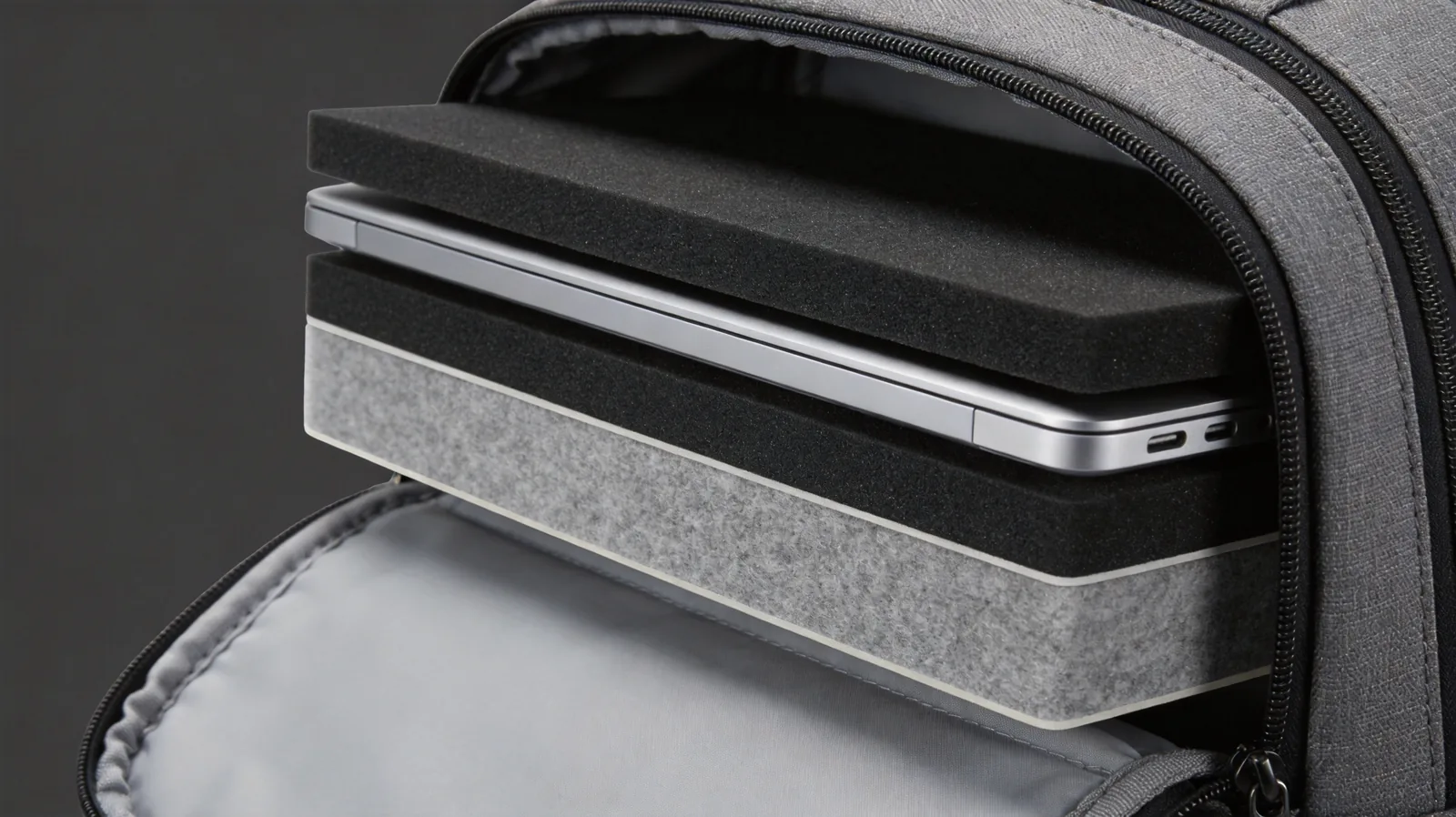
Layer 1 — Outer shell: abrasion and water resistance
The outer shell takes the abrasion. Standard constructions in this category are 600D polyester, 900D polyester, 1680D ballistic nylon, and RPET equivalents. Denier measures yarn thickness, not durability on its own — a 600D polyester with a polyurethane (PU) back coating at 0.15 mm outperforms an uncoated 1680D nylon against rain. What matters at the buying stage is the coating weight and whether the seams are taped or bound. A shell without coated seams will wick water through the stitch line within minutes regardless of fabric rating.
Typical cost contribution: 18–24% of total bag cost at 600D with PU backing.
Layer 2 — Foam core: impact absorption
This is the layer that determines whether a drop becomes a scratch or a cracked panel. Three materials dominate:
| Material | Typical thickness | Behaviour | Relative cost |
|---|---|---|---|
| PE foam | 3–5 mm | Cheapest, compresses permanently after repeated impact | Lowest |
| EVA foam | 6–10 mm | Recovers shape, best impact-to-weight ratio | Mid |
| Molded EPE / air mesh composite | 10–15 mm | Highest absorption, bulkier, used in rugged lines | Highest |
8 mm EVA is the practical floor for a commuter bag. Below 6 mm, the foam bottoms out on a 1 m drop and transfers the load straight into the chassis. Above 12 mm, the compartment becomes bulky without meaningful additional protection.
Layer 3 — Lining: scratch and static control
The lining touches the device. Brushed polyester and velvet-touch tricot prevent micro-scratches on anodised aluminium and piano-black plastics. A cheap unbrushed taffeta lining will visibly mark a MacBook lid within weeks. This layer is inexpensive — often under 6% of bag cost — and is one of the clearest tells of whether a factory cut corners.
The three carry formats compared
Buyers usually frame this as backpack versus briefcase versus sleeve. In protection terms the difference is how much of the device is enclosed and how the load is distributed.
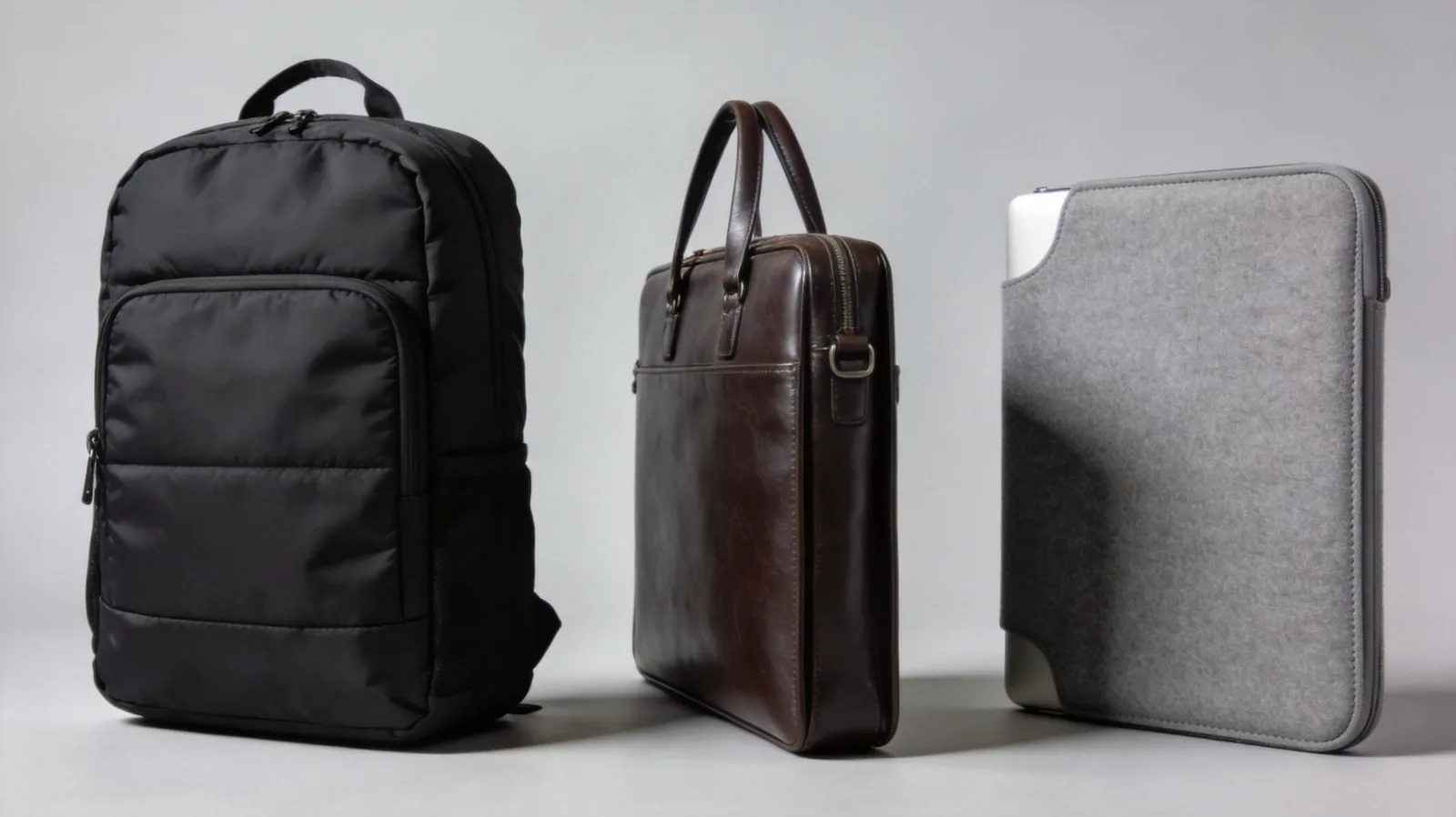
| Format | Protection level | Capacity beyond laptop | Best for |
|---|---|---|---|
| Padded backpack | Highest — full enclosure, load on both shoulders | High (charger, documents, clothing) | Daily commute, travel, mixed loads |
| Structured briefcase | High — rigid walls, single-hand carry | Medium (documents, accessories) | Client meetings, formal environments |
| Neoprene or felt sleeve | Low — scratch protection only | None | Transit inside another bag |
A sleeve is not a substitute for a bag. It solves abrasion and nothing else — no impact absorption, no water resistance, no load distribution. If the laptop goes into a tote or a paper-stuffed work bag, a sleeve is a reasonable minimum. If it is carried on a shoulder strap in the rain, it is not.
For a deeper comparison of format trade-offs, see our breakdown of six laptop bag types and their advantages, and if you are already decided on a backpack, the five most popular laptop backpack styles with cost and channel fit is the natural next read.
The actual cost of not using a bag
This is the part most buying guides skip. Below are realistic repair ranges for business and consumer laptops, based on common service-centre pricing, paired with how the failure typically happens in transit.
| Damage type | Typical repair cost | How it happens in transit |
|---|---|---|
| Shell scratches and dents | USD 80–250 (cosmetic, often unrepaired) | Contact with keys, zips, desk edges in a soft bag |
| Cracked screen or LCD panel | USD 200–600 | Pressure from other items, corner impact on a drop |
| Hinge or chassis deformation | USD 150–400 | Torsion when the bag is overfilled or crushed |
| Liquid ingress to mainboard | USD 400–900, sometimes total loss | Rain through uncoated seams, bottle leakage inside the bag |
| Loose or damaged I/O ports | USD 120–300 | Cable plugs left inserted while the device is in the bag |
| Total loss (severe liquid or crush) | Full replacement value | Bag crushed under luggage, full submersion |
Even at the conservative end, one screen replacement equals the retail price of two to four decent padded backpacks. Over a three-year device lifecycle, the expected value calculation favours the bag decisively — unless the laptop never moves.
The pressure problem is bigger than the drop problem
Buyers over-index on drops and under-index on sustained pressure. A laptop in a soft tote with a hard water bottle, a charger brick and a notebook experiences continuous point loading on the lid. Over months this produces the classic keyboard-imprint pattern on the panel and, in thin ultrabooks, progressive hinge fatigue. A compartment with an 8 mm foam wall and a suspended sleeve — where the device does not touch the bag floor — eliminates this class of damage entirely. That suspended-sleeve detail costs very little to add and is one of the highest-value specifications in the whole bag.
What each price tier actually buys
Retail price in this category maps almost linearly to a small number of material decisions. Understanding the mapping stops buyers from paying for features that do not affect protection, and from accepting a tier that will not survive the intended use.
| Retail band | Typical construction | Protection level | Expected service life |
|---|---|---|---|
| Under USD 20 | 300–600D polyester, 3–5 mm PE foam, unbranded coil zip, single-layer base | Scratch and light scuff only | 9–18 months of daily use |
| USD 20–40 | 600D polyester with PU backing, 6–8 mm EVA, branded coil zip, reinforced base | Drop and rain protection for commuting | 2–3 years |
| USD 40–70 | 900D or 1680D with coated seams, 8–10 mm EVA, water-resistant double-slider zip, laminated base | Full protection, travel-grade | 3–5 years |
| USD 70+ | Ballistic nylon or solution-dyed RPET, 10 mm molded EPE composite, AquaGuard-class zip, PVD hardware | Rugged and weather-sealed | 5 years and beyond |
The jump that matters most is the first one. Moving from the sub-USD 20 band to the USD 20–40 band changes the foam from PE to EVA and adds a reinforced base — the two changes that decide whether the bag protects the device at all. Above USD 40, you are buying longevity and weather sealing rather than additional impact protection.
For manufacturers, the same logic runs in reverse. The cost difference between 6 mm EVA and 8 mm EVA is measured in cents per bag. The cost difference in return rates between them is measured in percentage points. It is one of the clearest value-for-money upgrades available in a laptop programme.
How factories verify protection: QC and drop testing
If you are sourcing rather than buying retail, protection claims need to be verifiable. Reputable factories run a defined inspection protocol rather than relying on sample feel.
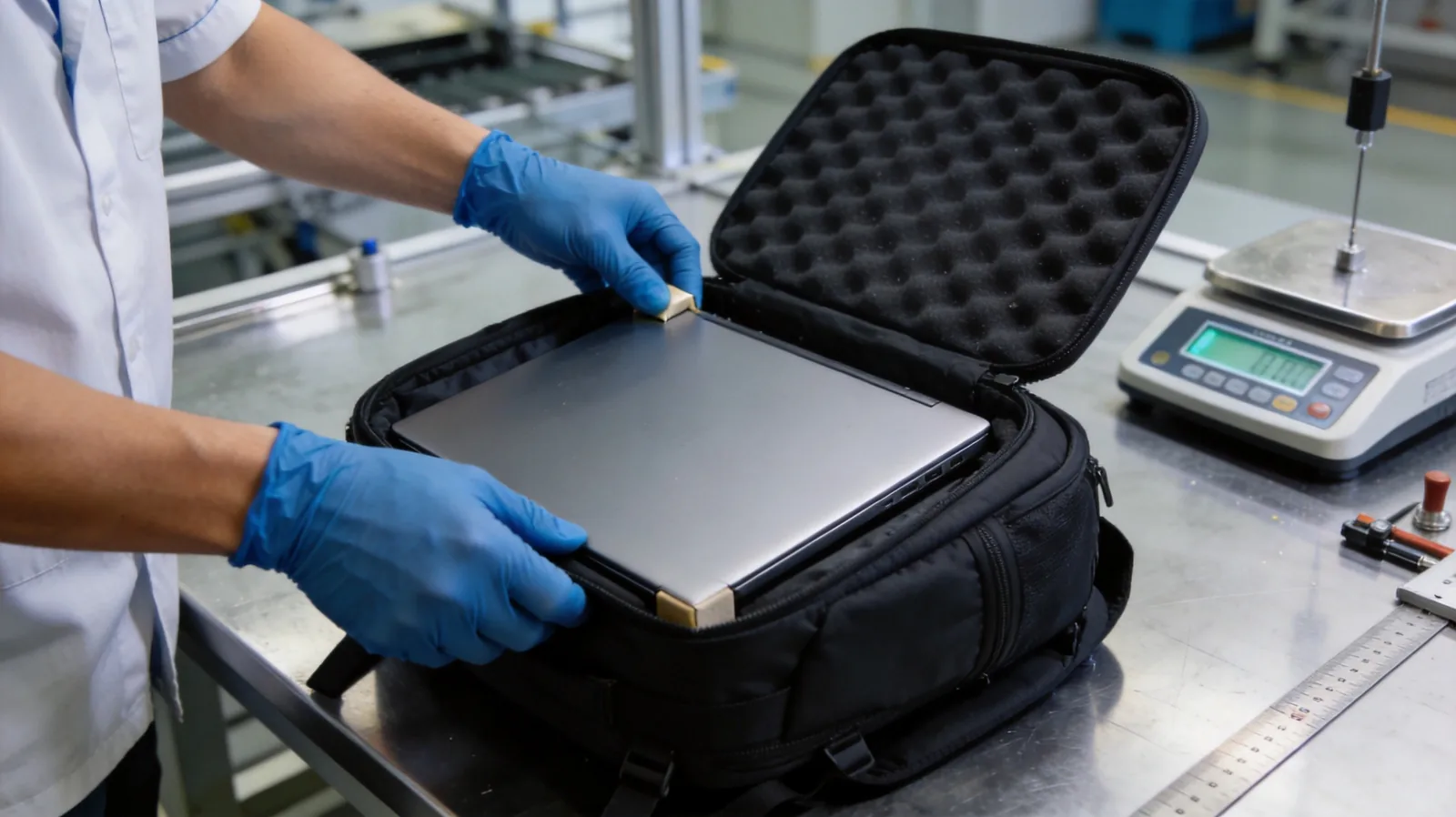
A standard protocol in this category covers:
- Drop test — loaded bag dropped from 76 cm onto corner, edge and flat face, three orientations, device surrogate inside; inspected for compartment breach and surrogate displacement.
- Zipper cycle test — 500 open/close cycles on the main compartment, checked for slider wear and tape separation.
- Seam tensile test — pull test on shoulder-strap and handle attachment points, minimum 200 N for a laptop-carry bag.
- Water repellency — spray rating per AATCC 22, minimum 3 on the shell, plus a 10-minute simulated rain test on the closed bag.
- Hardware corrosion — 24-hour neutral salt spray on buckles and sliders, no red rust.
- Foam thickness verification — caliper measurement at three points per compartment wall against the approved tech pack.
Inspection is normally run at AQL 2.5 for major defects and AQL 4.0 for minor defects. Major defects in this category include compartment foam below specification, broken stitching at strap anchors, and non-functional zips. Minor defects include surface blemishes and loose thread ends. We publish our own inspection and verification process in more detail on the factory audit and supplier verification page.
Three-year cost of ownership
The decision becomes obvious once the comparison is put on a three-year basis instead of a one-off purchase basis. The figures below use conservative assumptions: daily carry, a mid-range business ultrabook, and standard service-centre pricing.
| Scenario | Bag spend | Expected damage events over 3 years | Expected repair cost | Downtime cost | 3-year total |
|---|---|---|---|---|---|
| No bag — laptop carried loose in an existing tote | USD 0 | 0.40 (roughly one incident in two and a half years) | USD 140 expected value | 3–5 working days per incident | USD 140 + downtime |
| Padded sleeve only | USD 12 | 0.25 | USD 88 | 2–4 days per incident | USD 100 + downtime |
| Padded backpack, 8 mm EVA | USD 35 | 0.10 | USD 35 | 1–2 days per incident | USD 70 + minimal downtime |
| Travel-grade backpack, 8–10 mm EVA | USD 60 | 0.06 | USD 21 | 1 day per incident | USD 81 + minimal downtime |
Two conclusions follow. First, the mid-tier padded backpack is the lowest three-year cost, not the cheapest option — the sub-USD 20 tier sits between the sleeve and the padded backpack on protection while costing almost as much as the latter. Second, the downtime column is usually larger than the repair column. For anyone whose income depends on the device, a single lost working week exceeds the entire bag budget several times over.
The calculation only breaks down in one direction: if the laptop genuinely never leaves a controlled indoor surface, the expected damage event rate drops toward zero and any bag spend is pure cost. That is the only scenario in which the cheapest option is also the correct one.
When you genuinely do not need a laptop bag
An honest answer has to include the cases where the bag adds nothing:
- The laptop never leaves a desk. A desktop-replacement machine that stays docked is better served by a dust cover than a bag.
- The device is a company-issued, insured, replaceable unit. Where the employer absorbs damage cost, the personal economic case collapses — though the downtime cost usually does not.
- You already carry a hard case. A rigid-shell case with internal foam delivers the same protection as a padded bag; buying both is redundant.
- Carry distance is under a few minutes and controlled. Desk to meeting room inside one building does not justify a full bag.
Everything outside that list — commuting, travel, site visits, co-working, school — sits on the side of the ledger where the bag pays for itself.
Specification checklist if you are sourcing laptop bags
For brand owners and sourcing teams, the specification decisions that determine perceived quality are concentrated in a small number of line items. This is the checklist we work through on every development brief.
| Specification | Entry level | Recommended | Premium |
|---|---|---|---|
| Shell fabric | 600D polyester, PU backed | 900D polyester or 1680D ballistic nylon | Recycled 600D RPET with solution-dyed yarn |
| Compartment foam | 5 mm PE | 8 mm EVA | 10 mm molded EPE composite |
| Lining | 210D polyester | Brushed tricot | Velvet-touch microfibre |
| Zips | Standard nylon coil | YKK nylon coil, reverse coated | YKK AquaGuard or equivalent water-resistant |
| Base | Single-layer shell | Reinforced 1680D base panel | TPU laminated base with drainage eyelet |
| Trolley strap | Not included | Horizontal sleeve, 200 mm wide | Horizontal sleeve + concealed pass-through |
| Hardware | Painted alloy | Anodised alloy | Matte-black stainless or PVD coated |
Standard programme terms in this category are MOQ 500 pieces per style and colour, sampling in 6–10 business days, and bulk production in 35–50 days after sample approval and deposit. Payment is normally 30% deposit with 70% against B/L copy. Every bag carries a 12-month warranty against manufacturing defects.
If you are building a laptop range, the custom laptop backpack manufacturing page covers construction options in more depth, and the OEM padding standards and compartment design guide goes deeper on foam specification.
Five specification mistakes that generate returns
- Specifying padding by thickness only. A 10 mm PE foam performs worse than 8 mm EVA. Density matters as much as thickness — specify material grade, not just millimetres.
- Ignoring the compartment floor. If the device rests directly on the bag base, every ground impact transfers straight through. Specify a suspended sleeve with at least 15 mm clearance from the base seam.
- Undersizing the compartment by nominal laptop size. A “15.6 inch” compartment built to the panel diagonal will not fit a device with a protective shell. Specify internal dimensions in millimetres and add 15 mm tolerance on each axis.
- Skipping seam coating. Water resistance is lost at the stitch line first. Either tape the seams or specify a bound-and-coated construction; fabric rating alone is not sufficient.
- Not testing the loaded bag. Drop and carry tests performed on an empty bag miss the real failure modes. All impact testing must use a loaded bag with a device surrogate of realistic mass.
Why JUNYUAN BAGS
JUNYUAN BAGS has manufactured custom bags since 2014, working with an affiliated and partner factory network in Quanzhou, Fujian that brings more than two decades of combined bag-production experience across laptop, travel, sports and technical bag categories. Every programme is built to a signed tech pack, sampled in 6–10 business days, and inspected at AQL 2.5 major / 4.0 minor before shipment.
For laptop programmes we handle the full specification cycle — foam grade and thickness, compartment geometry, zip grade, shell coating, branding and packaging — and we will flag specification choices that look good on a costing sheet but generate returns in the field. Start with the custom backpack manufacturing capability overview or review the OEM and ODM service scope. Brand partners who need EU market compliance should also read the GPSR compliance guide for custom bags, and sustainability-led ranges can start from the RPET backpack manufacturing page.
Frequently asked questions
Do I really need a laptop bag if I only commute by car?
For short car commutes a padded sleeve inside an existing bag is usually sufficient. The protection you need scales with the number of uncontrolled impacts, not with distance — a device that goes from desk to seat and back sees very few.
Is a sleeve enough protection for a laptop?
No, not on its own. A sleeve prevents scratches and light scuffs but provides no impact absorption against a drop and no water resistance. It is appropriate only as an inner layer inside a structured bag.
What foam thickness should a laptop compartment have?
8 mm EVA is the practical standard for commuter and travel bags. 5–6 mm is acceptable for light use, and 10 mm or more is appropriate for rugged, outdoor or site-use programmes. Material grade matters as much as thickness.
How much does it cost to replace a cracked laptop screen?
Typically USD 200–600 depending on panel size, resolution and touch capability. On premium ultrabooks the panel alone can exceed USD 400 before labour, which is why a padded bag pays for itself after a single avoided incident.
Does a laptop bag protect against rain?
A water-repellent shell with coated seams handles normal rain for short exposures. Sustained heavy rain requires a water-resistant zip, a roll-top or flap closure, and a laminated base. No fabric bag is waterproof under full submersion.
What is a suspended laptop sleeve?
A compartment designed so the device hangs above the bag base rather than resting on it. This detail, usually adding 15–20 mm of clearance, removes the most common cause of impact damage from ground drops.
What is the difference between PE and EVA foam in a laptop bag?
PE foam is cheaper and compresses permanently after repeated impact. EVA foam recovers its shape and delivers better absorption per millimetre. For any bag expected to survive years of daily use, EVA is the correct specification.
How do I know if a laptop bag’s zips are good quality?
Look for a branded slider, a reverse-coated or water-resistant tape, and a double-slider configuration on the main compartment. Unbranded coil zips with thin tape are the first component to fail on budget bags.
What MOQ applies to custom laptop backpacks?
MOQ is 500 pieces per style and colour. Sampling runs 6–10 business days, and bulk production runs 35–50 days after sample approval and deposit.
Can I customise the interior compartment layout?
Yes. Compartment geometry, sleeve position, divider count, padding thickness and accessory pocket layout are all defined in the tech pack. Interior changes usually require one additional sample round.
Do laptop bags fit all laptop sizes?
No. Compartments are built to internal dimensions in millimetres, not to nominal screen size. A device with a protective shell or a larger chassis in the same size class may not fit — always specify internal dimensions with tolerance.
What is AQL 2.5 and why does it matter?
AQL 2.5 is the acceptable quality limit for major defects in a pre-shipment inspection. In laptop bags, major defects include underspecified foam, broken strap stitching and non-functional zips. AQL 4.0 typically applies to minor cosmetic defects.
Are recycled-material laptop bags as durable as virgin polyester?
RPET from post-consumer bottle feedstock performs equivalently to virgin polyester at the same denier and coating weight. Durability differences come from construction and coating, not from the recycled origin of the yarn.
How long should a laptop bag last?
With 600D or higher shell fabric, EVA foam padding and branded zips, a daily-use bag should deliver three to five years of service. The first components to fail are usually the zip and the strap anchor stitching.
Can you produce laptop bags under our own brand?
Yes. Private label and full OEM/ODM programmes are both available, including custom branding, logo hardware, woven labels, hangtags and retail packaging. Review the OEM and ODM service scope for the full process, or browse the laptop backpack product category for reference constructions.