
Short answer: a custom spearfishing gear bag programme at Junyuan Bags runs at MOQ 500 pieces per style, samples in 6–10 working days, bulk production in 35–50 days and final inspection at AQL 2.5 major / 4.0 minor. We are a bag manufacturer established in 2014, and our founder has worked in the bag trade since 2004. A spearfishing gear bag is not a dive bag with a fish printed on it. The sport carries one rigid item that is longer than any fin — a 75–150 cm speargun with a reel and an exposed muzzle — plus a 12 kg weight belt that behaves like a brick dropped into the bottom of the bag, plus a kill bag full of fish and blood that has to stay out of the wetsuit. Those three facts decide the pattern, the base construction and the internal layout, and none of them are addressed by a generic scuba duffel. This page is the procurement document: five gun-sleeve lengths from 79 to 154 cm internal, the weight-belt load path, the welded kill-bag liner, four volumes, the USD 21.60 FOB bill of materials on our 95 L reference build, twelve tests, and the carton maths. If your customer only carries fins, our custom long fin bag line is the right page instead.
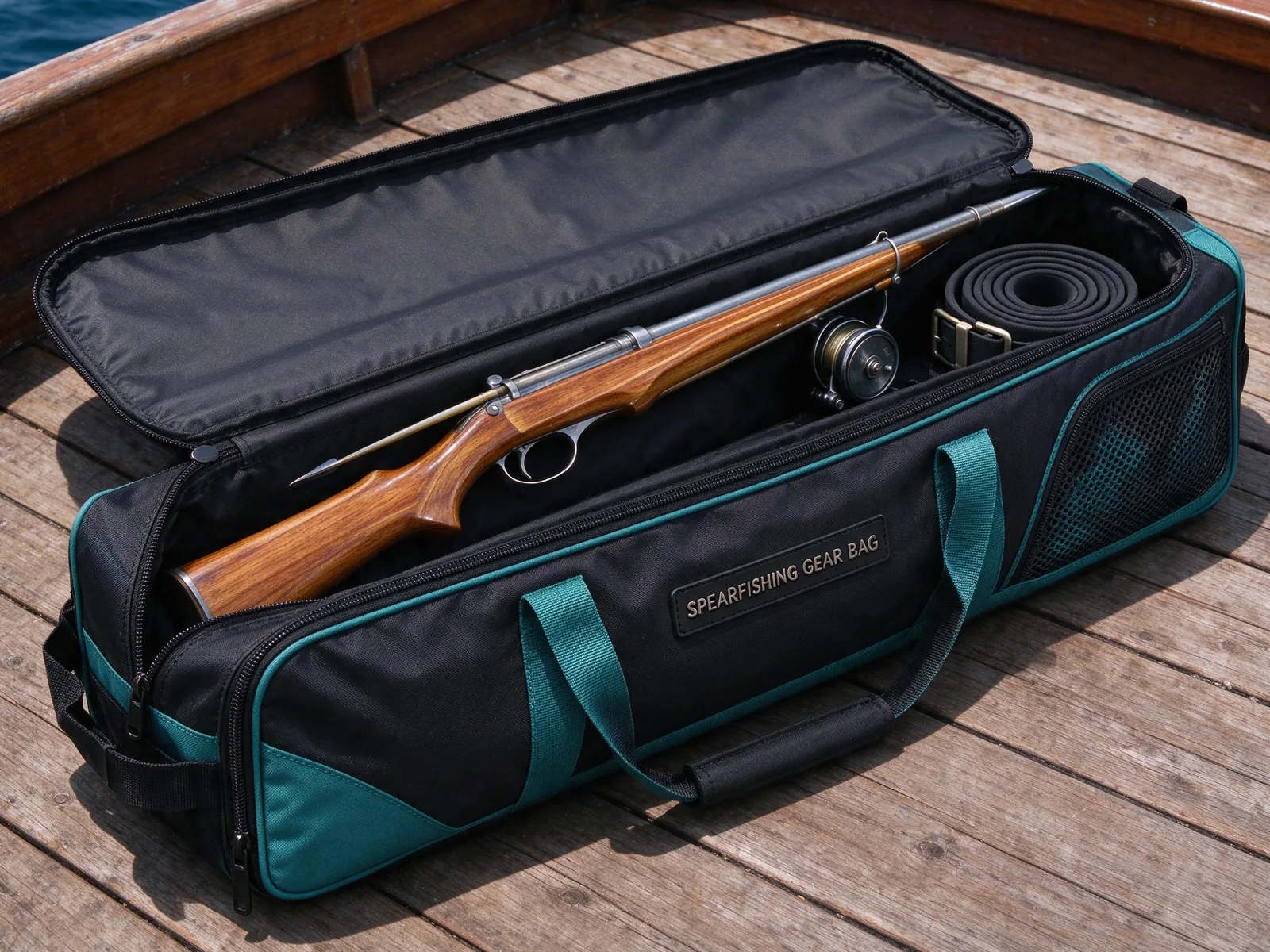
The 95 L travel build, open. The gun deck runs the full length of the front panel with the muzzle pocket at the far end and a 15 mm wider cut at the reel position; the weight belt rides in the base pocket behind the board.
Where the money actually goes. Take our standard 95 L spearfishing gear bag — 600D polyester with a PU 1,500 mm back-coating, 1680D plus 0.5 mm TPU on the base and gun butt, 3 mm and 5 mm EVA padding, a #10 main zip, a #8 wet zip, a welded 0.55 mm TPU kill-bag liner and a 2.5 mm HDPE base board — at USD 21.60 FOB on 500 pieces. Fabric is only 19% of that. Labour is 20% and zips are 14%, because a spearfishing bag has 34 minutes of sewing in it against 19 minutes for the same volume in a plain duffel — a 79% increase that buyers never see in a photograph. Two of those extra minutes are the box-X reinforcement at the four weight-belt anchor points; six are the gun-deck padding and the muzzle pocket; four are the welded liner and its binding. If a quotation for a 95 L spearfishing bag lands under USD 17, one of four things has been cut: the EVA thickness, the base board, the welded liner, or the 100% function test.
What “Spearfishing Gear Bag” Means — and the Six Products Sold Under That Name
Search the phrase and you will be shown six structurally different products. They carry different load cases, they fail in different places, and if you brief a factory on the wrong one you will pay for padding you do not need and still lose the gun. The table below is the one we use in our own quotation meetings.
| Product | Structure | What it holds | Where it fails | Buy it when |
|---|---|---|---|---|
| Spearfishing gear bag (this page) | Soft body, rigid base board, full-length padded gun deck, separate welded kill-bag compartment, mesh fin zone | Gun + reel, weight belt, wetsuit, fins, mask, float, line, kill bag | Base-corner seam at the weight-belt anchor; muzzle pocket wear | Your customer carries the whole kit in one bag, shore or boat |
| Gun sleeve / gun case only | Slim padded sleeve or semi-rigid case, one zip, no base structure | One gun, occasionally two | Zip coil cut by the muzzle; no protection for the butt | The gun travels separately from the soft kit |
| Fin bag / long fin sleeve | 90–110 cm sleeve, blade-tip pad, mesh vent | Fins only | Nothing structural; it is a sleeve | Freedivers who bag fins separately — see our long fin bag page |
| Kill bag / fish bag | Welded TPU or PVC liner, roll-top or heavy zip, drain | Fish, ice, blood | Seam wicking; zip corrosion | Boat hunting where the catch leaves with the diver |
| Float and line bag | Small 10–20 L stuff sack, mesh panels, line hooks | Float, 30 m line, stringer | Line tangles; hook tears the fabric | Separate rigging bag, clipped to the main bag |
| Angling tackle backpack | Multi-pocket pack, rod tubes, lure boxes, no gun deck | Rods, reels, lures, bait | Rod-tube crush; box weight | Hook-and-line fishing, a different sport entirely |
The row that matters commercially is the last one. Spearfishing is not angling, and a tackle backpack is not a substitute: an angler carries 2–4 rods in tubes and 4–8 kg of boxes, while a spearfisher carries one 3.4 kg gun that is 110 cm long, a 12 kg belt, and a catch that bleeds. The tackle pack has no gun deck because there is nothing in it long enough to need one, and it has no welded liner because nothing in it is wet with blood. If you are sourcing both ranges, keep them on separate patterns — a hybrid satisfies neither customer.
The distinction that catches most first-time buyers is between this bag and a freediving bag. Our freediving line is built around 90–110 cm fin sleeves and a wetsuit, with no rigid gun deck and no kill-bag liner, and it runs 24 minutes of labour against our 34. A freediving bag used as a spearfishing bag will hold the gun at an angle, put the muzzle against the zip coil, and put 12 kg of lead on a seam designed for 4 kg of neoprene. That is a warranty claim in month two, not a design preference.
The Speargun Sets the Geometry — Five Sleeve Lengths
Every dimension in a spearfishing bag cascades from the gun. The gun is the longest rigid object in the kit, it cannot be folded, and the two ends are the parts that break: the muzzle (bands, wishbone, muzzle slot) and the butt (loading pad, handle, reel foot). A sleeve that is 20 cm short does not simply look tight — it puts the muzzle in the zip coil and transfers every impact into the trigger mechanism.
We build five sleeve lengths. The rule is internal length = gun length + 40 mm of clearance, and external length = internal + 30 mm of padding and shell. The 40 mm is not arbitrary: 20 mm goes to the muzzle pocket depth so the bands are not compressed against the end wall, and 20 mm goes to the butt pocket so a loading pad does not sit on the seam.
| Gun length | Sleeve internal | Sleeve external | Sleeve mass | Typical gun |
|---|---|---|---|---|
| 75 cm | 79 cm | 82 cm | 236 g | Short reef gun, 60–75 cm barrel, single band |
| 90 cm | 94 cm | 97 cm | 260 g | Standard reef and hole gun, aluminium or carbon |
| 110 cm | 114 cm | 117 cm | 290 g | The volume seller: 100–110 cm wood gun with reel |
| 130 cm (reference) | 134 cm | 137 cm | 322 g | Bluewater and big-fish gun, twin band, reel or breakaway |
| 150 cm | 154 cm | 157 cm | 352 g | Long bluewater gun, 140–150 cm, three bands |
Sleeve mass scales at roughly 1.55 g per centimetre of gun plus 120 g of fixed components (padding, binding, zip, muzzle pocket), which is why a 150 cm sleeve costs about USD 1.10 more than a 75 cm one at 500 pieces. It is the cheapest upgrade in the bag and the one buyers most often skip.
The 157 cm sleeve and the 158 cm airline limit
Linear dimensions (L + W + H) are what carriers bill on. Our 95 L bag measures 72 × 40 × 44 cm = 156 cm, which sits one centimetre inside the common 158 cm checked allowance even with the 130 cm sleeve inside. This is deliberate, and it is the reason the 95 L is the travel volume rather than the 120 L. Put a 150 cm sleeve in a 120 L bag and the bag measures 170 cm linear, which is oversize on most carriers and a USD 75–150 fee each way.
Why we do not offer “one size, 110 cm, fits all”. A 110 cm sleeve in a 95 L bag saves about USD 0.60 a piece and lets you hold one SKU. It also means a 130 cm gun sits with its muzzle jammed in the end wall, the bands permanently compressed, and the reel foot pressed into the trigger guard. In our returns data from OEM customers, gun damage in transit is the single largest claim category on spearfishing bags, and almost all of it traces to a sleeve 10–25 cm too short. Offer two lengths — 114 cm and 134 cm internal — and you cover 90% of the market with 2 SKUs.
The Weight Belt Is the Load Point Nobody Designs For
Here is the arithmetic that a generic dive bag ignores. A working warm-water spearfishing kit, weighed in our sample room:
| Item | Weight | Note |
|---|---|---|
| Speargun, 110 cm wood, with reel and loaded line | 3.4 kg | Rigid, 114 cm long, two vulnerable ends |
| Weight belt, 12 kg of lead | 12.4 kg | Occupies about 0.4 L. This is the point load. |
| 3 mm wetsuit, wet | 2.6 kg | 1.9 kg dry; holds roughly 0.7 kg of water |
| Mask, snorkel, dive computer | 0.9 kg | The small hard items that crack |
| Fins, pair | 2.4 kg | Long blades, 1.4 kg in travel fins |
| Float, 11 L, with 30 m line | 1.9 kg | Clipped externally on most builds |
| Stringer, knife, torch, spares | 1.2 kg | Sharp edges against the shell |
| Kill bag, 8 L, with catch and ice | 5.4 kg | Wet, bleeding, must not touch the wetsuit |
| Total working kit | 30.2 kg | 41% of it is the weight belt |
Twelve kilograms of lead is 41% of the total kit weight and less than 2% of its volume. That ratio is the entire engineering problem: the load is concentrated in a 60 × 12 × 3 cm strip that the customer drops into the bag from waist height, on a boat, with wet hands. A single-line seam at the base corner sees that impact once per trip.
| Belt mass | Static force on the base | What the base must do |
|---|---|---|
| 5 kg | 49 N | Any 600D base with a bound seam holds |
| 8 kg | 78 N | Bound seam plus one row of box-X at the corners |
| 12 kg | 118 N | Rigid base board, box-X at four points, 50 mm webbing loop |
| 16 kg | 157 N | Rigid base board plus a separate stitched belt pocket |
Our construction for 12 kg and above is four layers, and we do not deviate from it: a 2.5 mm HDPE base board cut 8 mm oversize so it cannot migrate; a 1680D plus 0.5 mm TPU bottom panel that is the abrasion surface; a box-X with three rows of stitching at each of the four anchor points in bonded polyester thread; and a continuous 50 mm webbing loop that runs from the hip pad, around the base board and back, so the belt load never hangs from a single seam. The belt rides in a dedicated base pocket rather than loose, because loose lead swings and a swinging 12 kg mass will destroy any bag in a season.
Two acceptance numbers matter and both are on our test sheet: 16 kg static for 24 hours with permanent set ≤ 2 mm, and 900 mm drop at 16 kg on each base corner with no seam failure and no board crack. Ask any supplier for those two results before you place a 500-piece order. A factory that cannot produce them has not built this product before.
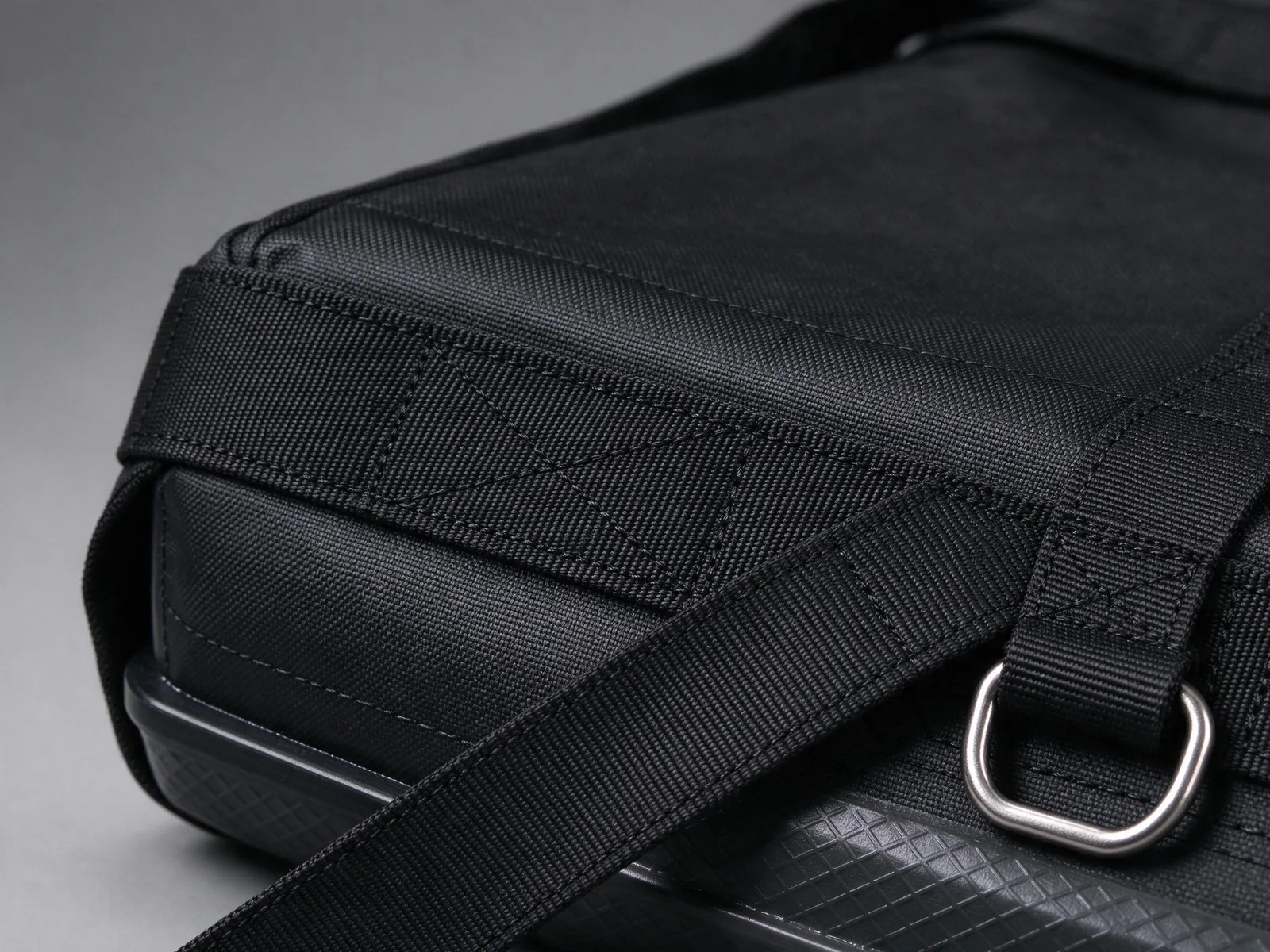
The four weight-belt anchor points on the 95 L build. Box-X with three rows, a continuous 50 mm webbing loop and the 2.5 mm HDPE board edge visible under the lining. This is the area that fails first on a bag that was designed for neoprene, not lead.
The Kill Bag Compartment — Hygiene, Not Just Waterproofing
The kill bag is where a spearfishing bag stops being a luggage item and becomes a hygiene product. A fish comes out of the water bleeding, it goes into the bag with ice or seawater, and by the time the diver is back at the car that bag contains roughly 200–500 ml of blood and slime. If that liquid can reach the wetsuit, the whole bag smells permanently and the customer blames the bag, not the fish.
The compartment therefore has three jobs: contain liquid, drain it, and be cleanable. We build it as a welded 0.55 mm TPU liner — radio-frequency welded, not sewn — because a sewn seam wicks by capillary action and no amount of seam tape fixes a stitch hole that is under 300 mm of liquid head when the bag is laid on its side in a car boot.
| Liner volume | Fish capacity | Liner mass | Closure | Drain |
|---|---|---|---|---|
| 4 L | 2.5 kg, one or two reef fish | 210 g | Roll-top, 3 folds | One 12 mm acetal grommet |
| 8 L (default) | 5.0 kg, a good day on the reef | 320 g | Roll-top, 3 folds, side-release buckle | One 12 mm grommet plus a 40 mm drain channel |
| 12 L | 8.0 kg, boat or bluewater | 430 g | #10 zip with a welded garage, or roll-top | Two 12 mm grommets at the low points |
Three details separate a liner that works from one that leaks. First, the liner is a closed bag inside the main compartment, suspended from four welded tabs, so if it does leak the liquid is still inside the outer shell rather than on the wetsuit. Second, there is no zip penetration between the liner and the main compartment — the access is from the outside face only, which is why the liner sits on the front panel rather than at the bottom. Third, the drain grommet is at the lowest point when the bag is standing, not when it is lying down, because that is the position it occupies on a boat deck.
Our cleaning test is deliberately crude and it is the one buyers should copy: fill the liner with 500 ml of water and a protein solution, close it, lay the bag on its side for 30 minutes, then open the main compartment and check for moisture with a paper towel. Then rinse three times and smell the main compartment after 24 hours at 30 °C. If either check fails, the liner is wrong.
One boundary we state plainly: we do not claim food-contact certification for the kill bag. We supply the TPU film grade and the migration test report from the film mill, and we will state the grade. We are not a food-contact certifier, we do not issue EU 10/2011 declarations of conformity in our own name, and a buyer who needs one must commission it. This is the same position we take on every compliance claim on this site, and it is why our declarations are shorter than some competitors’ and more defensible.
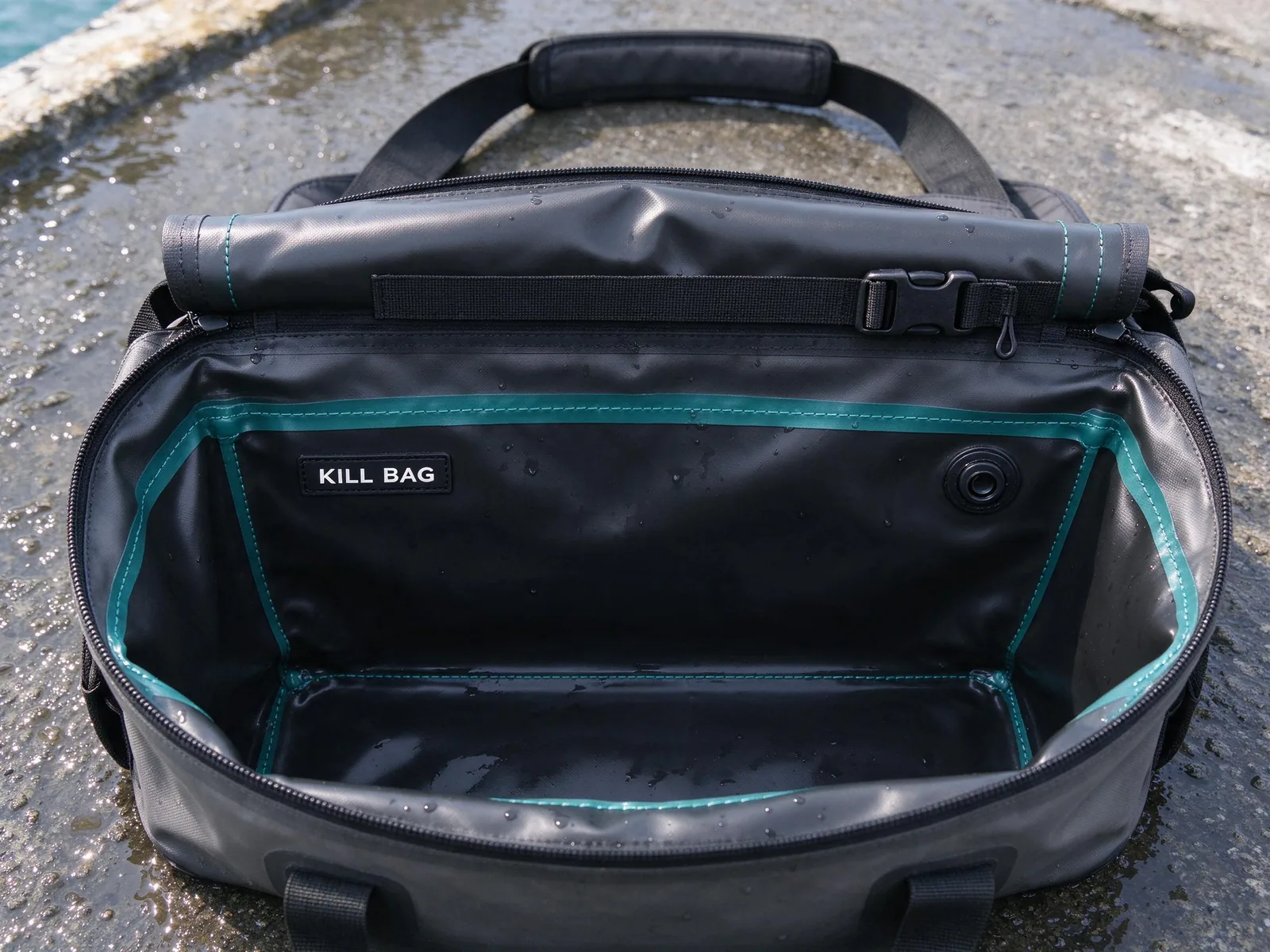
The 8 L welded kill-bag liner, accessed from the front panel only. The teal tape marks the RF weld line; there is no stitch penetration between the liner and the main compartment, which is the detail that keeps the wetsuit out of the blood.
Float Line, Reel and Rigging Management
Rigging is the part of spearfishing that generates the most after-sales complaints and the least design attention. A float line is 20–40 m of 3–5 mm braid; a reel holds 50–100 m of 2 mm line; both come back wet, both tangle, and a tangled line at the start of a dive is a safety issue rather than an annoyance.
| Item | Typical spec | Where it goes in our bag | Failure mode if unsupported |
|---|---|---|---|
| Float line, 30 m | 3–5 mm braid, 250–400 kg break | Two elastic line hooks on the front panel, outside the main zip | Tangles with the gun reel; knot chafe on the zip coil |
| Reel, 50–100 m | Mounted on the gun, 90–120 mm spool | Stays on the gun inside the gun deck; deck is cut 15 mm wider at the reel position | Reel foot bent by the sleeve wall |
| Float, 11 L | Inflatable, 2 attachment eyes | External D-rings, two at 118 N each | D-ring pull-out; float lost on the surface |
| Stringer and knife | Stainless, 300–450 mm | Sheathed pocket on the inner lid, sharp edge down | Blade cuts the shell from the inside |
| Breakaway and bungee | 25 mm quick release | Clipped to the front D-ring, outside the bag | Corrosion weld; release jams |
The gun deck is cut 15 mm wider at the reel position than at the barrel, which is a 2-minute pattern change and the difference between a reel that survives the season and one with a bent foot. The two external D-rings are rated at 118 N each and are box-X anchored into the base board, not sewn to the shell alone; a float that pulls off at the surface is a lost float and a lost dive.
Four Configurations, One Pattern Family
We build four volumes off one pattern family. Backboard, gun deck, liner and kill bag scale with the pattern; the sewing sequence, the inspection checklist and the test sheet are shared. That is why a 45 L shore bag and a 120 L charter bag can ship in the same container without a second tooling round.
| Configuration | Volume | Empty weight | Gun sleeve | Carton | CBM / pc | 40HQ |
|---|---|---|---|---|---|---|
| Shore / reef day | 45 L | 1,180 g | 79 or 94 cm | 4 pcs, 58×36×34 cm | 0.01775 | 3,830 pcs |
| Boat / liveaboard day | 70 L | 1,460 g | 94 or 114 cm | 3 pcs, 66×38×38 cm | 0.03177 | 2,140 pcs |
| Travel / fly-away (reference) | 95 L | 1,980 g | 114 or 134 cm | 2 pcs, 72×40×44 cm | 0.06336 | 1,073 pcs |
| Charter fleet | 120 L | 2,420 g | 134 or 154 cm | 2 pcs, 78×44×46 cm | 0.07894 | 861 pcs |
Container loading is decided by carton cube long before it is decided by weight. A full 40HQ of 95 L bags weighs about 5.5 tonnes, roughly a fifth of the payload limit, so the volume mix you choose is really a freight decision. Note the shape of the curve: moving from 45 L to 95 L cuts pieces per container by 72%, and moving from 95 L to 120 L cuts it by another 20% for only 22% more volume. The 120 L is the least efficient bag we build to ship and the most profitable per piece to sell, which is why fleet buyers and DTC brands end up at opposite ends of the range.
The dimension that decides e-commerce economics
Volumetric weight, not litres, decides whether a bag can be sold online with free shipping. A 95 L bag in its retail carton measures 72 × 40 × 44 cm, which at the standard divisor of 5,000 gives a dimensional weight of 25.3 kg against an actual 4.4 kg. A parcel network bills the 25.3. The 45 L in its 58 × 36 × 34 cm carton comes to 14.2 kg against the same 4.4 kg actual. This is the single reason the 45 L outsells the 95 L online by a wide margin and the 95 L is a specialist-retail and travel volume. We will quote both carton formats so you can see the freight difference before you commit to a size mix.
Materials and Construction
Spearfishing is a salt, sun and abrasion environment, and the bag spends most of its life wet, on a deck, in the sun. Four fabric specifications cover the range; we do not offer a fifth because the price gaps are not worth the SKU count.
| Fabric | Hydrostatic head | Taber abrasion, CS-10, 500 cycles | Where we use it |
|---|---|---|---|
| 420D nylon, PU 800 mm | 800 mm | 0.62 g loss | 45 L shore day bag, ultralight builds |
| 600D polyester, PU 1,500 mm | 1,500 mm | 0.41 g loss | Default shell, all volumes |
| 900D polyester, PU 1,800 mm | 1,800 mm | 0.28 g loss | 120 L charter fleet, high-cycle use |
| 1680D + 0.5 mm TPU base | 8,000 mm | 0.09 g loss | Base panel, gun butt, kill-bag surround |
All four are PVC-free and finished with a PFAS-free DWR. That is a commercial decision as much as an environmental one: several EU retail chains now require a PFAS declaration at the buying stage, and a PVC-coated bag triggers questions in France and Germany that a PU bag does not. The cost difference at 500 pieces is about USD 0.55 on the shell, and we would rather quote it than have a buyer discover it after artwork approval.
Seams, zips and hardware
The shell is sewn with double-row lockstitch in bonded polyester thread (TEX 70 for shell, TEX 90 for load paths), all cut edges are bound, and every load-bearing seam gets a box-X or a bar tack. The kill-bag liner is RF welded at 0.55 mm TPU; we do not stitch it and we do not tape a stitched seam on a liquid-retention compartment. Main closure is a #10 nylon coil zip with a moulded acetal slider and a garage at the top, rated 3,000 cycles at 8 kg load; the wet compartment uses a #8, and the inner pocket a #5.
Hardware is acetal and 316 stainless only. Nickel-plated steel and zinc alloy are the two things we refuse on a salt-water product: the plating pits at the first scratch, the pit turns into a rust bloom that stains the shell, and the buyer sees it as a fabric defect. Our D-rings, sliders, grommets and buckle bodies are acetal; the spring elements and any through-fastener are 316. Every metal part is salt-spray tested to ASTM B117, 96 hours, and a part that shows red rust is rejected at incoming inspection.
Padding is EVA, closed cell, at 3 mm on the deck walls and 5 mm at the muzzle, butt and hip. We do not use open-cell foam or neoprene on the deck because both absorb water: a 5 mm open-cell pad on a 114 cm deck takes on about 90 g of water and never gives it back, which is 90 g of the empty weight permanently converted into a wet sponge against the gun. Closed-cell EVA absorbs nothing and weighs the same wet as dry, which is why it is the only padding we specify on a bag that lives in salt water.
Weight Budget — 1,980 g at 95 L
Empty weight is a design output, not a side effect. We budget it line by line before we cut a pattern, and we weigh every component of the first sample against the budget. The 95 L travel build is budgeted at 1,980 g ±5% (99 g) and it lands on the number, which is why we can publish it.
| Component | Share | Mass |
|---|---|---|
| 600D PU shell, panels cut and bound | 34.0% | 673.2 g |
| 1680D + 0.5 mm TPU base panel | 12.5% | 247.5 g |
| 3 mm and 5 mm EVA (gun deck, butt, hip pad) | 15.0% | 297.0 g |
| #10 main zip, #8 wet zip, #5 inner zip | 9.0% | 178.2 g |
| Acetal hardware, D-rings, sliders, buckles | 6.5% | 128.7 g |
| Webbing, straps, box-X reinforcement, binding | 7.5% | 148.5 g |
| Welded kill-bag liner, 0.55 mm TPU | 6.0% | 118.8 g |
| Mesh vent panels and grommets | 4.5% | 89.1 g |
| Thread, labels, hangtag, QC allowance | 5.0% | 99.0 g |
| Total | 100.0% | 1,980.0 g |
The two lines buyers try to cut are EVA (15%) and the welded liner (6%). Cutting EVA to 2 mm saves about 120 g and USD 0.42, and it is the change that most reliably produces a gun-damage claim, because a 3.4 kg gun with an exposed muzzle needs 5 mm at the ends and no less than 3 mm along the deck. Cutting the liner saves 119 g and USD 1.08 and converts the bag into a wet duffel with a hygiene problem. Neither is a saving; both are a transfer of cost to the customer’s claim file.
For reference, the same 95 L volume as a plain duffel budgets at about 1,140 g. The 840 g difference is the gun deck, the base board, the liner and the belt reinforcement — and it is the difference between a product that fits this sport and one that does not.
Bill of Materials — USD 21.60 FOB at 500 Pieces
This is the priced BOM on the 95 L reference build at 500 pieces, ex-works Quanzhou, FOB Shenzhen. Every line is a purchase order we actually place, and the percentages sum to 100.0%.
| Line | Share | USD / pc |
|---|---|---|
| 600D polyester, PU 1,500 mm back-coating | 19.0% | 4.10 |
| 1680D + 0.5 mm TPU base laminate | 7.0% | 1.51 |
| EVA foam, 3 mm and 5 mm | 8.0% | 1.73 |
| Zips: #10 main, #8 wet, #5 inner | 14.0% | 3.02 |
| Acetal hardware and D-rings | 7.0% | 1.51 |
| Webbing, binding, thread | 9.0% | 1.94 |
| TPU kill-bag liner film, 0.55 mm | 5.0% | 1.08 |
| Mesh and grommets | 3.0% | 0.65 |
| Labour, 34 min at USD 0.13/min | 20.0% | 4.32 |
| Overhead, QC, packing, margin | 8.0% | 1.74 |
| Total FOB | 100.0% | 21.60 |
Labour is the line that surprises every buyer, and it is the honest one. A 95 L plain duffel takes 19 minutes; our freediving bag of the same volume takes 24; this bag takes 34. The extra ten minutes over a freediving bag are: gun-deck padding and muzzle pocket (6), box-X at the four belt anchors (2), and liner fitting and binding (2). At USD 0.13 a minute that is USD 1.30 a piece, and it is not negotiable at any quantity — if a supplier quotes you 24 minutes on this specification, they have not costed the deck.
Price Ladder and Tooling
| Order quantity | FOB / pc | Tooling amortisation / pc | First-order effective / pc |
|---|---|---|---|
| 500 pcs | USD 21.60 | USD 4.80 | USD 26.40 |
| 1,000 pcs | USD 20.46 | USD 2.40 | USD 22.86 |
| 2,000 pcs | USD 19.50 | USD 1.20 | USD 20.70 |
| 5,000 pcs | USD 18.38 | USD 0.48 | USD 18.86 |
The tooling package is USD 2,400 and covers six items: gun-deck die and muzzle-pocket pattern (USD 720), kill-bag liner weld tool (USD 640), base-board die (USD 380), logo plate or deboss plate (USD 340), carton and insert die (USD 180), and the sealing and setting jigs (USD 140). It is charged once and it is yours — we do not reuse your tooling for another customer, and if you move the programme the tooling ships with it or we scrap it on your instruction. Buyers who order 500 pieces and reorder at 2,000 are effectively paying the tooling twice if they take it as a per-piece charge on the first order; ask for it as a separate line and it does not repeat.
Sizes mix freely within one style because they share patterns and the deck die. Colours split at 250 pieces per colourway. A custom-dyed shell adds 10–15 days to the schedule; stock colours do not.
Sampling in 6–10 Working Days
Sampling is four stages and the clock starts when the specification is locked, not when you send an enquiry. We do not start a sample on a verbal brief; we start it when the gun length, belt mass, volume, fabric and liner volume are written down.
| Stage | Days | What you get |
|---|---|---|
| 1. Specification lock and pattern | 2–3 | Dimensioned drawing, pattern set, deck die selection, fabric and trim card |
| 2. Proto sew | 3–4 | First sample, unprinted, in the specified fabric and trim |
| 3. Fit and load check | 1–2 | Gun and belt load test, liner fill test, photographs, weight against budget |
| 4. Test and dispatch | 1–3 | Twelve-test results on the sample, DHL dispatch with tracking |
| Total | 6–10 | Sample in your hands, with its test sheet |
The sample is charged, typically USD 120–180 for a 95 L build depending on the fabric and whether a printed logo is included, plus freight. The charge is refunded in full against the first bulk order at 500 pieces or more. We do not send free samples, because a free sample is a sample nobody specified carefully, and the two changes it usually produces — a shorter deck and thinner EVA — are exactly the changes that break the product.
What comes with the sample matters as much as the sample: the dimensioned drawing with the pattern revision, the component weights against the 1,980 g budget, the twelve-test results, the fabric and trim card with mill references, and the carton drawing. If a supplier sends a bag and a photograph, you have bought a bag, not a specification.
Bulk Production in 35–50 Days
Bulk runs 35–50 calendar days after sample approval and deposit. The eight stages below sum to 30–43 working days of actual build; the remaining 5–7 days are order queue, consolidation and inland handover to the port.
| Stage | Days | Cumulative | Gate |
|---|---|---|---|
| 1. Material booking and incoming inspection | 3–5 | 3–5 | G1: roll card, board thickness, zip batch, film grade |
| 2. Cutting | 3–4 | 6–9 | G2: die registration, panel count, board footprint |
| 3. Shell and gun-deck sewing | 10–14 | 16–23 | G3: deck padding, muzzle pocket, box-X at four anchors |
| 4. Kill-bag liner welding | 3–4 | 19–27 | Weld bead continuity, 100% fill test on first 50 |
| 5. Assembly and hardware | 5–7 | 24–34 | D-ring pull 118 N, zip run, liner tab weld |
| 6. Final QC and function test | 3–4 | 27–38 | G4: 100% function, G5: AQL 2.5 / 4.0 |
| 7. Packing | 2–3 | 29–41 | Carton drop, piece count, polybag and desiccant |
| 8. Documentation and handover | 1–2 | 30–43 | Packing list, test summary, photos, booking |
Three things move the date and only three: custom dye (+10–15 days), a new weld tool for a non-standard liner (+12–18 days), and Chinese New Year or National Day (2–3 weeks either side). Everything else is inside the window. We quote the date in writing with the PI and we tell you at day 10 if it has moved, not at day 30.
Reorder on an unchanged specification is 25–30 days, because patterns, deck dies and the weld tool exist and the fabric is on a repeat colour. That is the number that matters for a brand’s second season, and it is the reason to keep the specification stable through the first reorder rather than redesigning after 500 pieces.
Twelve Tests and Five Inspection Gates
Every number on this page comes from one of the twelve tests below. They run on the pre-production sample and then by sampling on the bulk order, except the function test, which is 100% on every piece.
| # | Test | Method | Acceptance |
|---|---|---|---|
| 1 | Weight-belt static load | 16 kg in the base pocket, 24 h | Permanent set ≤ 2 mm; no stitch pull |
| 2 | Base-corner drop | 16 kg, 900 mm, three drops per corner | No seam failure, no base-board crack |
| 3 | Box-X anchor pull | Tensile on each of four belt anchors | ≥ 400 N per anchor |
| 4 | D-ring static pull | 118 N for 60 s on each external D-ring | No movement > 2 mm, no shell tear |
| 5 | Kill-bag liquid retention | 500 ml water plus protein, 30 min on its side | Dry paper towel in main compartment |
| 6 | Kill-bag odour | Three rinses, 24 h at 30 °C | No detectable odour in main compartment |
| 7 | Zip cycle | 3,000 open/close at 8 kg load | No coil separation; slider force ≤ 40 N |
| 8 | Seam strength | Grab test, shell and base | ≥ 250 N / 50 mm; base ≥ 400 N |
| 9 | Fabric tear | ASTM D2261 tongue tear, warp and weft | 600D ≥ 45 N; 1680D base ≥ 90 N |
| 10 | Hydrostatic head | AATCC 127 on shell and base laminate | ≥ 1,500 mm before and after 5 washes |
| 11 | Salt spray | ASTM B117, 96 h on all metal and plated parts | No red rust; no plating blister |
| 12 | UV ageing | ASTM G154, 300 h, cycle 1 | Colour shift ΔE ≤ 3; no coating chalk |
Five gates sit across the line. G1 incoming material: fabric roll card, base-board thickness, zip batch, TPU film grade. G2 cutting: die registration, panel count, board footprint within 2 mm. G3 in-line sewing at three checkpoints — gun-deck padding and muzzle pocket, the four box-X belt anchors, and the liner tab positions. G4 pre-pack 100% function: load the belt pocket to 12 kg, stand the bag 60 seconds, run the main zip twice, check both D-rings, fill the liner and invert it. G5 final inspection at AQL 2.5 major / 4.0 minor with four critical defects at zero tolerance: a separated weld bead, a torn belt anchor, an exposed sharp fastener, and a gun-deck seam open by more than 3 mm.
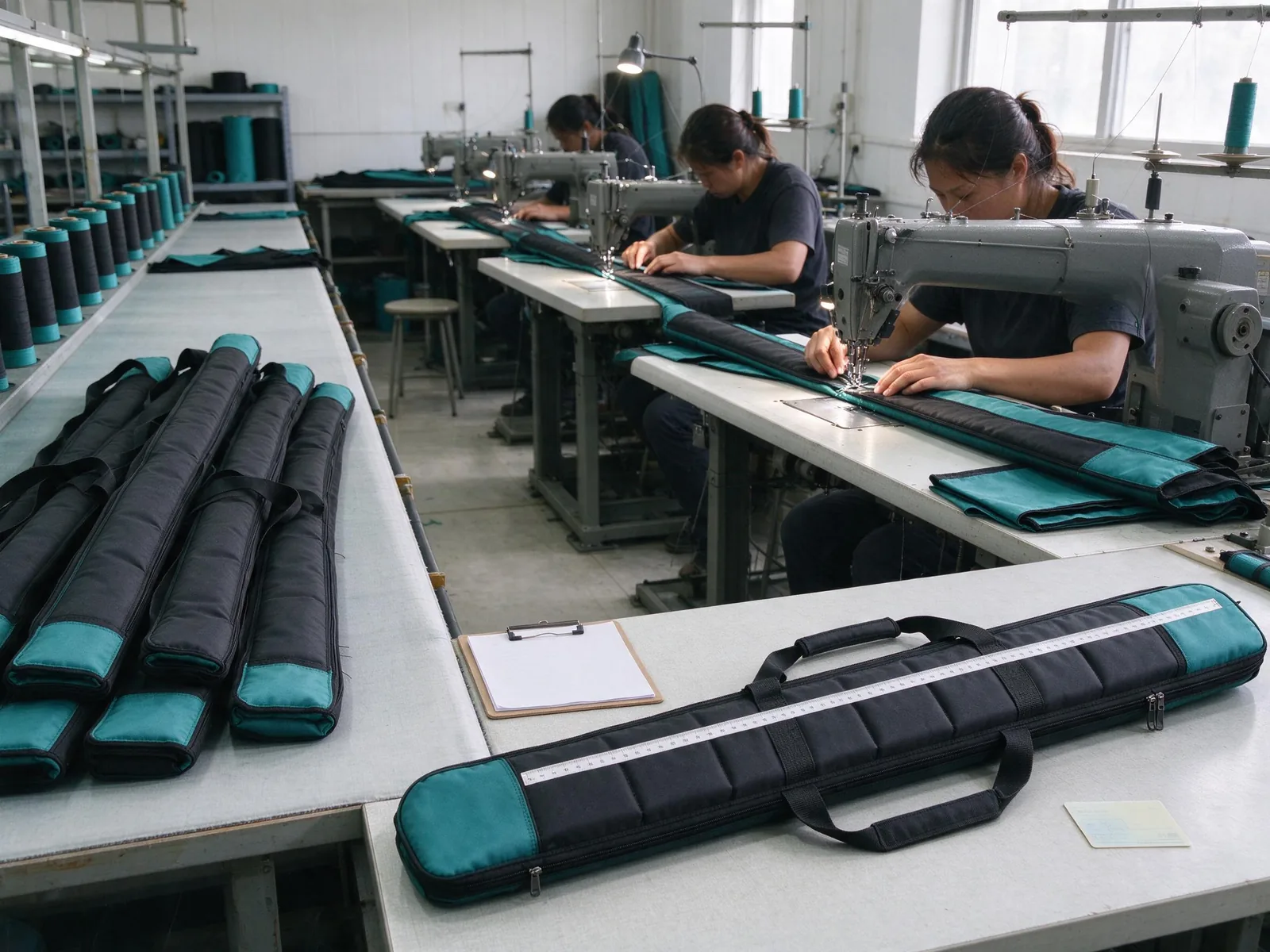
Gun-deck assembly at our Quanzhou line. The long padded sleeves are cut on a dedicated die, so the muzzle pocket and the 15 mm reel relief are identical on piece 1 and piece 5,000 — which is what makes the fit claim on this page repeatable.
Packing, Cubic and Landed Cost
| Item | 95 L bulk 4-pack | 95 L retail single |
|---|---|---|
| Carton | 4 pcs, 5-ply, 74 × 42 × 68 cm | 1 pc, 5-ply, 72 × 40 × 44 cm |
| Carton volume | 0.21134 CBM | 0.12672 CBM |
| CBM per piece | 0.05284 | 0.12672 |
| 40HQ loading (68 CBM usable) | 1,286 pcs | 536 pcs |
| Ocean freight per piece at USD 2,850 / 40HQ | USD 2.22 | USD 5.32 |
| Insurance at 1% of CIF | USD 0.24 | USD 0.27 |
| Landed cost before duty | USD 24.06 | USD 27.19 |
| Gross weight per carton | 9.0 kg | 3.1 kg |
All figures are calculated, not estimated, and we re-quote freight at booking because ocean rates move. Two practical notes. The bulk 4-pack saves USD 3.10 a piece on ocean freight and is the only sensible option for FCL or pallet delivery — but a 74 × 42 × 68 cm carton at 9 kg is outside most parcel networks’ length-plus-girth limits, so it cannot be used for drop-ship. The retail single must be drop-tested before you approve artwork: a 3.1 kg carton holding a 1.98 kg bag with a rigid base board and a 134 cm deck lands very hard on its corners, and corner damage on a retail carton is the single largest source of marketplace returns in this category.
Six Channels and How the Specification Changes
| Channel | Volume and deck | What changes | Watch out for |
|---|---|---|---|
| Dive shop retail | 70–95 L, 114 cm deck | Hangtag, ID window, printed liner card, retail carton | The bag must stand unaided with a 12 kg belt in it |
| Spearfishing specialist e-commerce | 45 L and 70 L, 94 cm deck | DIM-optimised carton, insert card, no hangtag | 25.3 kg DIM weight on a 4.4 kg bag destroys free shipping |
| Liveaboard and charter fleet | 120 L, 134 or 154 cm deck | 900D shell, serial patch, name panel, no logo, spare grommet pack | Fleet buyers re-order liners and grommets, not bags |
| OEM dive brand | 95 L, 134 cm deck | Custom colourway, moulded plate, branded zip pulls, 2 colours at 250 each | Custom dye adds 10–15 days |
| Spearfishing school and club | 70 L, 114 cm deck | High-vis panel, number patch, lockable main zip, heavier base | Shared kit is opened by 30 people a week |
| Military, police and research dive | 95–120 L, 134 cm deck | All-black, no branding, reinforced harness points, documented traceability | Paperwork expectations are far above retail |
The channel with the most specification drift is the fleet channel, because the buyer’s problem is not the bag but the fleet. A charter operator with 40 bags does not want 40 new bags; they want the 12 that failed to be repairable. We quote a spares pack at 1% of order quantity as standard and 2% for fleet buyers: grommets, liner tabs, D-rings, zip sliders and a length of the 50 mm webbing. It costs about USD 0.35 a bag and it converts a one-off order into a replacement-part relationship.
Private Label, Decoration, ECN and Reorders
Decoration on this bag has one real constraint: the gun deck sits behind the front panel, so embroidery over the deck area is limited to a 70 × 40 mm zone above the reel relief unless the deck is locally cut away. Everything else is straightforward: a moulded logo plate (tooling USD 340, two colours, break-even around 900 pieces), heat-transfer print on the shell, a woven label at the kill-bag surround, rubberised zip pulls, a debossed handle grip, and a printed interior lid card.
We do not print on the base panel. It is a wear surface and a print there is gone in a month, which is a warranty conversation you do not want. We also do not embroider through the liner, for the obvious reason.
Engineering changes are handled by ECN and cost 45 days if they touch the pattern or the deck die: a new deck length needs a new die, a new liner needs a new weld tool, a new base board needs a new cut. Changes to colour, print, labels, zip pulls or carton artwork do not need an ECN and run inside the normal window. Reorders on an unchanged specification run 25–30 days. We keep the pattern, deck die and weld tool for three years after the last order at no charge, which is the practical definition of “we will still be able to make this in 2029”.
Compliance Boundaries — What We Do and What We Do Not
We would rather state the boundary than let a buyer assume a certificate exists. On this product we provide:
- Material declarations against the current REACH SVHC candidate list for shell, coating, EVA, webbing, zip and film.
- Prop 65 statements for the shell, coating, print inks and acetal hardware.
- A PFAS-free DWR statement and a PVC-free declaration for the whole bill of materials.
- The twelve in-house test results from the pre-production sample, with method and acceptance criteria.
- The TPU film mill’s migration test report and grade designation for the kill-bag liner.
- A GRS transaction certificate where the mill holds one for recycled shell fabric; where it does not, we say so rather than implying certification.
What we do not do: we are not a notified body and we do not issue EU 10/2011 food-contact declarations in our own name; we are not an EU authorised representative or a GPSR responsible person; we do not certify a sewn bag as IPX-rated, because a sewn and bound shell is water-resistant and the honest number is the hydrostatic head, not an IP code; and we do not claim a bag is buoyant or that it will float a loaded kit. Any supplier who offers you all of those on a sewn soft bag is selling paper, not product.
Twelve Questions to Ask Any Supplier — Including Us
- What is the internal length of your gun sleeve, and is it gun length plus 40 mm or a nominal “fits most” figure?
- How is the weight-belt load carried — through the shell seam, or through a base board and a continuous webbing loop?
- What is the base board material and thickness, and is it cut oversize so it cannot migrate?
- Is the kill-bag liner welded or sewn, and what is the film thickness and grade?
- Can liquid reach the main compartment if the liner fails? Show me the tab arrangement.
- What is the empty weight of the 95 L build, and do you have a component weight budget for it?
- What are the D-ring pull and box-X anchor figures, and on what test?
- What is the empty weight when wet, and which padding absorbs water?
- What is the sewing time per piece, and how does it compare with your duffel of the same volume?
- What is the carton cube per piece in bulk and in retail pack, and what does a 40HQ hold?
- Which parts are acetal and which are stainless, and what is the salt-spray result?
- What exactly will you put in writing about certification, and what will you not?
Question nine is the one that separates a factory from a trader. A trader cannot answer it, because a trader has never timed a seam. Question twelve is the one that protects you: a supplier who answers it precisely is a supplier who will not hand you a certificate they cannot defend at customs.
Frequently Asked Questions
Send the Gun Length, Get the Numbers
Tell us the gun length (75–150 cm), the weight belt mass your customers actually dive, the volume you want, and whether the kill bag is part of the sale or a separate product. We will come back with a sleeve recommendation, a priced BOM at 500, 1,000 and 2,000 pieces, the tooling list, the carton cube, the landed cost and a sample slot — typically inside one working day. MOQ 500 pieces, samples in 6–10 working days, bulk in 35–50 days, AQL 2.5 major / 4.0 minor, and a 100% function test on every piece.
Related Pages on This Site
- Custom long fin bag manufacturer — 90–110 cm fin sleeves and blade-tip pads
- Custom freediving bag manufacturer — fin, wetsuit and mask carriers
- Custom monofin bag manufacturer — hard case and soft bag OEM
- Custom scuba gear bag manufacturer — structured dive kit carriers
- Custom dive backpack manufacturer — scuba and freediving backpacks
- Custom mesh dive bag manufacturer — 2–10 mm aperture and drain engineering
- Custom waterproof dive bag manufacturer — wet/dry zones and W0–W4 tiers
- Custom rolling dive bag manufacturer — 90 L trolley and load path
- Custom dry bag manufacturer — roll-top and welded waterproof bags
- Quanzhou waterproof bag manufacturer — IPX8 and seam-sealing capability
- TPU vs PVC vs nylon — waterproof bag material selection
- Complete guide to dry bag manufacturing for brands
- How long does it take to manufacture a custom bag?
- From sample to bulk — the full custom bag production journey
- Export packaging standards — cartons, palletising and container loading