
Published: 2025 | Category: Manufacturing Guides | Read time: 25 min
If you are sourcing custom duffel bags for your brand — whether gym bags for a fitness label, weekender bags for a fashion house, or tactical duffels for a military contractor — this guide is written for you. It covers every stage of duffel bag manufacturing, from market segmentation and design engineering to material selection, cost structure, quality control, and shipping logistics.
At JUNYUAN BAGS, we drawn on over a decade of expertise producing bags for 200+ brands across 100+ countries. Our an affiliated factory — SGS-verified at 4,950 sqm delivers a monthly line capacity of 200,000 pieces (SGS-verified); current monthly output around 200,000 pieces. This guide distills that experience into actionable knowledge for B2B buyers, product managers, and sourcing teams.
Duffel bag manufacturing involves a unique combination of design challenges that differ from both backpack production and tote bag manufacturing. The cylindrical barrel shape, dual handle system, and convertible strap options require specialized pattern engineering and sewing techniques that only experienced factories can execute at scale. Throughout this guide, we share specific cost data, technical specifications, and production insights drawn from our affiliated factory operations so that you can make informed decisions at every stage of your product development process.
Table of Contents
- Duffel Bag Market Overview & Category Segmentation
- Design Elements: Size Planning, Compartments & Handle Ergonomics
- Material Engineering: Nylon, Canvas, Leather, RPET & Coatings
- Complete Manufacturing Process: From Cutting to Packaging
- Hardware & Trim Selection: Zippers, D-Rings, Base Plates & Feet
- Cost Structure Analysis: Material, Labor & MOQ Impact
- Quality Standards & Testing Protocols
- Packaging & Shipping Optimization
- Common Design Mistakes to Avoid
- Sustainability & Ethical Manufacturing
- Frequently Asked Questions
1. Duffel Bag Market Overview & Category Segmentation
The global duffel bag market is a dynamic segment within the broader travel and sports luggage industry. Unlike rigid suitcases or structured briefcases, duffel bags are defined by their cylindrical or barrel-shaped main compartment, flexible construction, and dual carry handles — often supplemented by a removable shoulder strap. This structural DNA makes them uniquely versatile, bridging gym, travel, military, and fashion use cases.
1.1 Market Size & Growth Drivers
The worldwide duffel bag market was valued at approximately USD 4.8 billion in 2024 and is projected to grow at a CAGR of 5.2% through 2030. Key growth drivers include:
- Fitness culture expansion: Global gym membership continues to rise, driving demand for dedicated gym bags with shoe compartments and wet/dry separation.
- Athleisure trend: Duffel bags have crossed over from purely functional gym gear to everyday carry accessories, particularly in the weekender format that appeals to style-conscious consumers.
- Military & tactical segment: Defense procurement cycles and law enforcement gear upgrades sustain steady institutional demand for rugged, purpose-built duffels.
- Sustainable materials shift: Brands increasingly specify RPET (recycled PET) fabrics, creating a premium eco-tier in the market that commands higher margins and meets regulatory requirements.
1.2 Category Segmentation by End-Use
| Category | Typical Size | Key Features | Target Buyer |
|---|---|---|---|
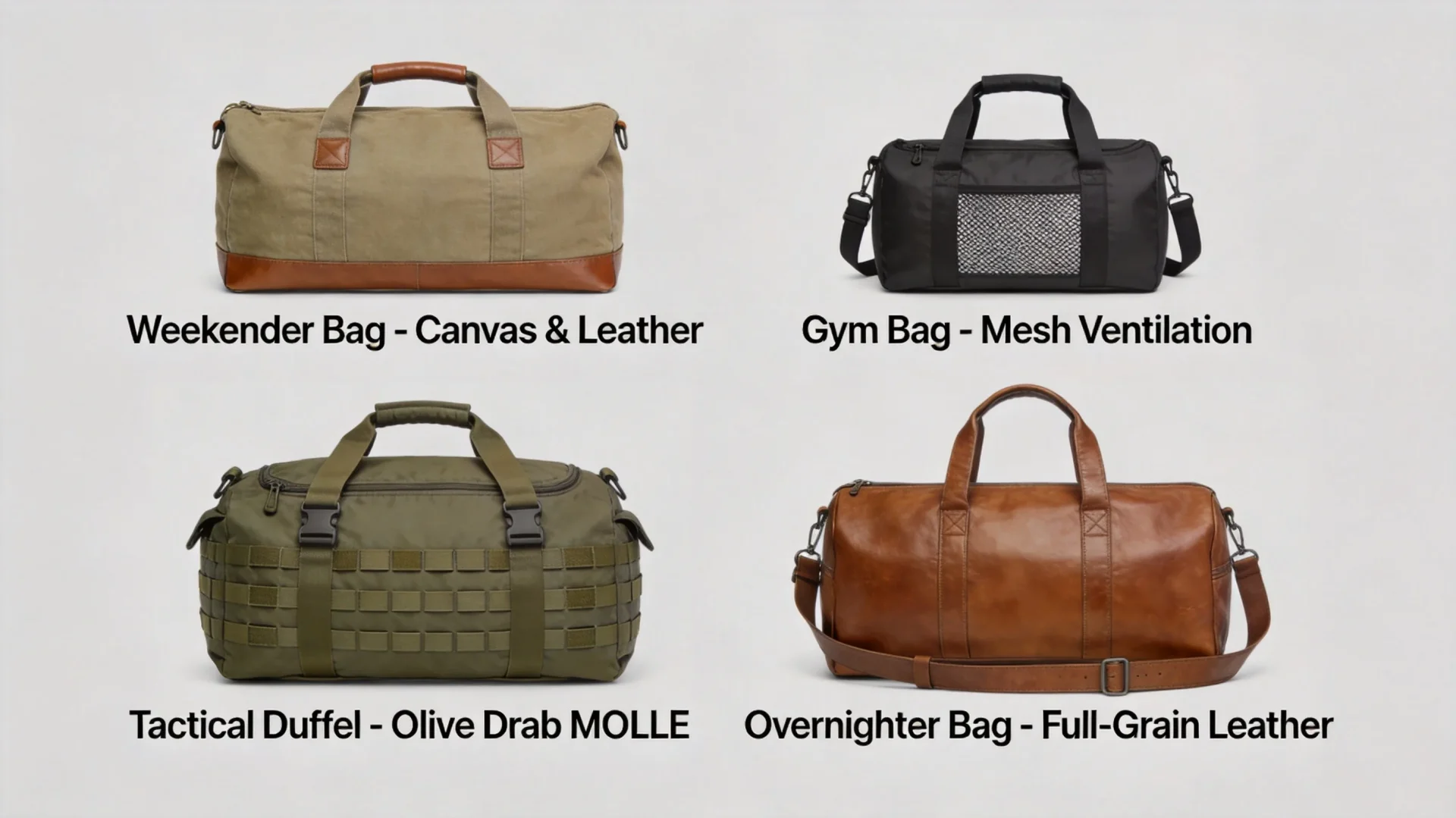
| Weekender Bag | 45-55L | Leather or canvas exterior, shoe compartment, laptop sleeve, premium hardware | Fashion brands, lifestyle labels |
| Gym Bag | 25-40L | Ventilated shoe pocket, wet/dry divider, water bottle holder, lightweight nylon | Fitness brands, sporting goods companies |
| Travel Duffel | 50-80L | TSA-compliant sizing options, lockable zippers, backpack strap convertible | Travel gear brands, outdoor companies |
| Sports Team Bag | 30-60L | Team logo embroidery, player name customization, durable polyester | Sports leagues, clubs, universities |
| Military/Tactical Duffel | 40-90L | MOLLE webbing, drainage grommets, IR-compliant fabrics, reinforced base | Defense contractors, government agencies |
| Leather Duffel | 35-50L | Full-grain or top-grain leather, brass hardware, cotton twill lining | Luxury brands, heritage labels |
Understanding which category your target product falls into is the critical first step in the manufacturing process. A partner with a experienced duffel bag manufacturer like JUNYUAN BAGS can help you navigate the trade-offs between categories and optimize your design for your specific market segment.
For brands operating in adjacent categories — such as golf bags or general sports bags — the manufacturing principles overlap significantly, but duffel-specific construction details (barrel shape, dual handles, convertible straps) set this product class apart. For brands specifically in the golf category, our separate golf bag manufacturing guide covers that niche in depth.
2. Design Elements: Size Planning, Compartments, Shoe Storage & Handle/Strap Ergonomics
The design phase of duffel bag manufacturing determines both the product market appeal and its manufacturing cost. Unlike backpack manufacturing, where the ergonomic focus is on back panels and lumbar support, duffel design centers on carry-handle comfort, compartmental logic, and the balance between open capacity and organizational structure.
2.1 Size Planning & Volume Optimization
Duffel bags are traditionally measured by their internal volume in liters. The cylindrical barrel shape means that small changes in diameter have a larger volume impact than equivalent changes in length:
| Size Tier | Dimensions (L x D) | Volume | Typical Use |
|---|---|---|---|
| Small (S) | 40 x 25 cm | ~20L | Overnight / gym session |
| Medium (M) | 50 x 30 cm | ~35L | 2-3 day trip / regular gym |
| Large (L) | 55 x 35 cm | ~50L | Weekender / extended gym use |
| X-Large (XL) | 65 x 40 cm | ~75L | Extended travel / team sports gear |
When planning size, consider airline carry-on restrictions. A growing trend in travel duffel design is to create models that fit overhead bins while maximizing the flexible advantage of soft-sided construction over hard-shell alternatives. Many airlines allow duffel bags slightly larger than rigid carry-on limits because the soft structure can compress to fit sizers.
2.2 Compartment Architecture
Modern duffel bags have evolved far beyond the single-cavity gym sack format. Today buyers expect organized interiors that serve specific use cases. Key compartment design considerations include:
- Main compartment: Full-open U-zip or end-loading. U-zip designs offer 30% better accessibility but require longer zipper pulls, adding $0.30 to $0.80 per bag in hardware costs. End-loading is cheaper but limits access to the front portion of the bag.
- Shoe compartment: A ventilated, bottom-access shoe pocket is now standard in gym and weekender bags. Typical dimensions: 30 x 15 x 12 cm, separated from the main cavity by a full-width internal partition. This compartment uses a separate zipper circuit and adds approximately 8 to 12 minutes of sewing time.
- Wet/dry separation: A TPU-lined wet pocket (commonly 20 x 25 cm) is essential for gym bags. The lining material costs $0.50 to $1.20 per panel depending on thickness and provides a waterproof barrier between damp workout clothes and dry belongings.
- Laptop/tablet sleeve: Increasingly common in weekender bags targeting business travelers. A padded sleeve (5mm EVA foam with tricot lining) adds $1.50 to $3.00 in materials and labor but significantly increases the target retail price.
- External quick-access pockets: Zippered side or end pockets for phone, keys, and small items. Each additional external pocket adds $0.40 to $0.90 in production cost but provides visible differentiation on retail shelves.
2.3 Handle & Strap Ergonomics
The handle and strap system is what distinguishes a duffel bag from a tote bag or simple carry sack. Duffel bags traditionally feature two carry handles that meet at the center top, creating a balanced hand-carry position. This design has remained fundamentally unchanged for decades, but the execution details vary enormously in quality.
Handle design specifications:
- Standard dual handles: 45-55 cm length measured from base attachment to apex, 3.5-5 cm width with foam or EVA padding. Webbing material: 25mm or 38mm nylon or polyester, bar-tacked at attachment points with a minimum of 6 rows of stitching for durability.
- Padded carry handles: For premium bags, handles wrapped in neoprene or memory foam with a microfiber lining. Cost impact: +$0.80 to $1.50 per pair. This upgrade is particularly valued in the weekender and travel segments where bags are frequently carried at full capacity.
- Adjustable shoulder strap: A detachable, adjustable strap (100-140 cm range) with a padded shoulder pad. Attachment via metal D-rings or swivel hooks. The strap itself costs $1.20 to $3.50 depending on padding quality and hardware selection.
- Convertible backpack straps: Some travel duffels now feature stowable backpack straps, transforming the bag into a hybrid carry system. This is a significant design commitment that adds $4.00 to $7.00 to production costs but opens the product to a broader audience.
Handle placement is critical: handles should be positioned at the geometric center of the bag loaded balance point, which is typically offset from the visual center by 2 to 5 cm toward the heavier end. Poor placement results in a bag that tilts when carried, which is a common complaint in consumer reviews of lower-quality duffels.
3. Material Engineering: Nylon, Canvas, Leather, RPET & Coatings
Material selection is the single most impactful decision in duffel bag manufacturing. It determines durability, weight, water resistance, aesthetic appeal, price positioning, and even the manufacturing process itself. For example, leather requires different sewing machines and needle types than nylon. Below is a technical breakdown of each major material category used in duffel bag production.
3.1 Nylon Fabrics
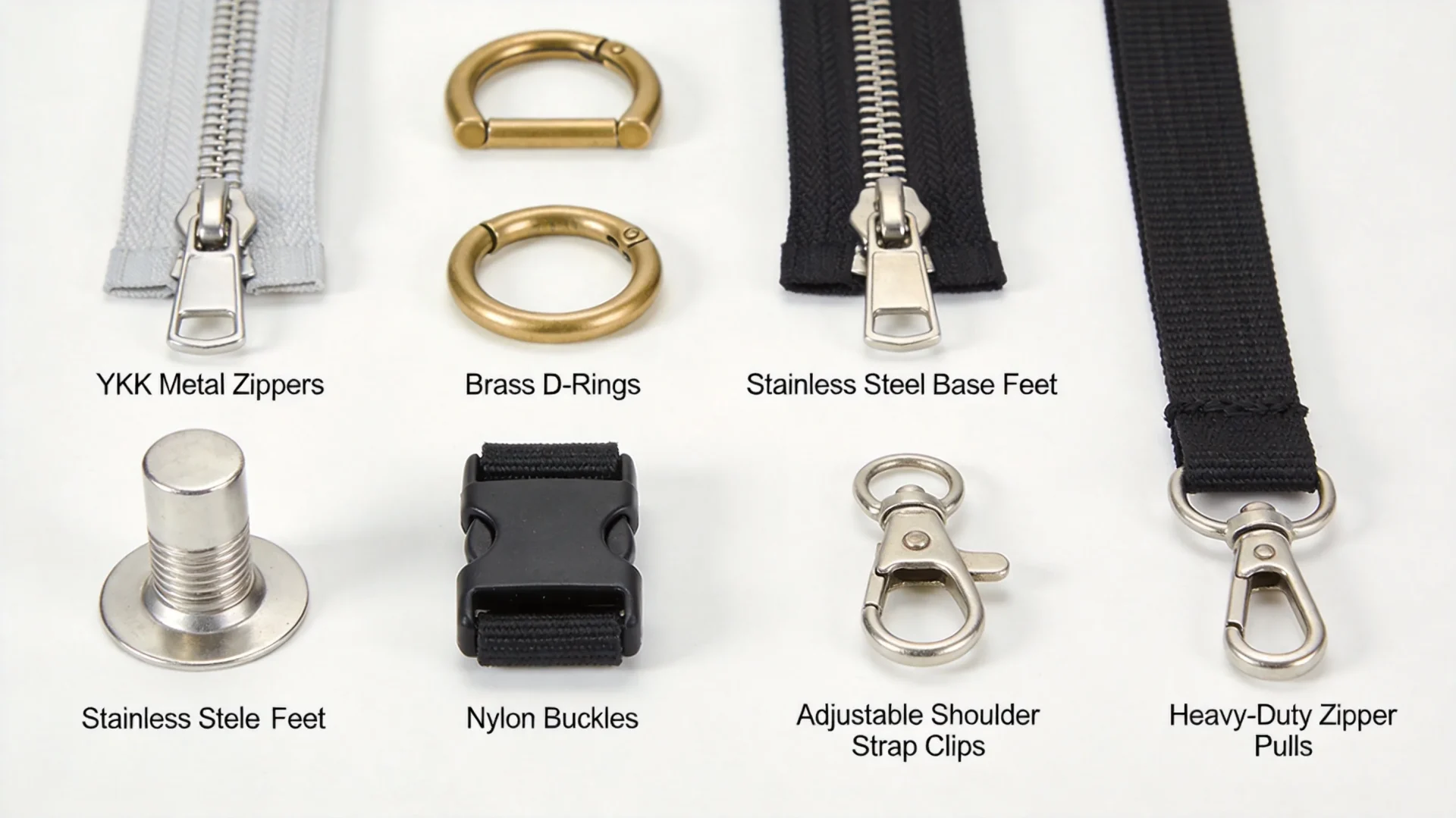
Nylon is the dominant material for mid-range and performance duffel bags. The key specification is denier (D), the weight in grams of 9,000 meters of yarn. Higher denier means heavier and more durable fabric.
| Nylon Type | Denier | Weight (g/m2) | Tensile Strength | Best For | Cost/meter |
|---|---|---|---|---|---|
| Nylon 210D | 210D | 80-90 | Low | Budget gym bags, linings | $0.80-$1.20 |
| Nylon 420D | 420D | 130-150 | Medium | Mid-range duffels, sports bags | $1.50-$2.20 |
| Nylon 600D | 600D | 180-210 | High | Premium travel duffels, tactical | $2.50-$3.80 |
| Nylon 1000D Cordura | 1000D | 290-330 | Very High | Military, heavy-duty expedition | $4.00-$6.50 |
| Ripstop Nylon | 70D-210D | 40-100 | Medium (tear-resistant) | Ultralight packable duffels | $1.80-$3.00 |
Cordura vs. Generic Nylon: Invista Cordura brand nylon commands a 30-50% price premium over generic 1000D nylon but offers proven abrasion resistance (7x more than standard nylon in standardized tests). Many brands specify Cordura for high-wear areas such as base panels and handles while using generic nylon for the body to manage overall costs.
3.2 Canvas & Woven Cotton
Canvas is measured in ounces per square yard (oz) rather than denier. Common weights for duffel bags include:
- 8 oz canvas: Lightweight option used for fashion duffels and promotional bags. Soft hand feel but limited abrasion resistance for heavy use.
- 10-12 oz canvas: The sweet spot for most canvas duffels. Durable enough for regular use, takes wax coatings well for water resistance, and provides the heritage aesthetic that many lifestyle brands seek.
- 14-18 oz canvas: Heavy-duty option used for heritage-style leather-trimmed duffels. Extremely durable but adds significant weight of 300-500 g per square meter.
Waxed canvas treated with beeswax or paraffin provides natural water repellency and a distinctive aged patina that improves with use. Cost premium for wax treatment is approximately $1.00 to $2.00 per meter of fabric.
3.3 Leather
For luxury and heritage-positioned duffel bags, leather remains the premium material of choice. The leather bag manufacturing process differs significantly from fabric-based production in terms of tooling, sewing equipment, and quality standards.
| Leather Type | Thickness | Durability | Cost (per sq ft) | Typical Application |
|---|---|---|---|---|
| Full-Grain Leather | 1.2-1.6 mm | Highest | $8-$15 | Luxury weekender bags |
| Top-Grain Leather | 1.0-1.4 mm | High | $5-$10 | Premium fashion duffels |
| PU Leather (Vegan) | 0.8-1.2 mm | Medium | $1.50-$3.50 | Budget leather-look duffels |
Full-grain leather develops a patina over time, which luxury brand buyers specifically value as a sign of quality and character. Top-grain leather is sanded and refinished for a more uniform appearance. PU leather, while affordable, lacks the longevity of genuine leather and is best suited for trend-driven fashion pieces rather than investment goods.
3.4 RPET (Recycled Polyester)
Sustainability is no longer optional in the bag industry. RPET fabric, made from recycled plastic bottles, has become a mainstream material choice. The RPET recycled backpack manufacturing guide covers similar material science that applies directly to duffel bags.
Key facts about RPET for duffel bags:
- Source material: Post-consumer PET bottles, typically 6 to 12 bottles per duffel bag depending on size and fabric weight.
- Certification: Look for GRS (Global Recycled Standard) certification. This is increasingly required by EU and North American brand buyers.
- Cost premium: RPET fabrics cost 10-25% more than virgin polyester, but the gap is narrowing as supply scales.
- Performance parity: Modern RPET fabrics match virgin polyester in tensile strength, color fastness, and abrasion resistance. There is no functional compromise.
3.5 Waterproof & Water-Resistant Coatings
Duffel bags used in outdoor, military, and travel contexts require water protection. The main coating technologies available include:
| Coating Type | Water Resistance | Durability | Cost Impact |
|---|---|---|---|
| PU (Polyurethane) Coating | 1,000-3,000 mm | Good | +$0.30-$0.80/m |
| PVC Lamination | 3,000-5,000 mm | Very Good | +$0.50-$1.20/m |
| TPU (Thermoplastic Polyurethane) | 5,000-10,000 mm | Excellent | +$1.00-$2.50/m |
| DWR (Durable Water Repellent) | Surface repellency only | Moderate (needs reapplication) | +$0.20-$0.50/m |
Each coating type has different cost implications and performance characteristics. PU coating is the most cost-effective option for basic water resistance and is specified on most mid-range travel duffels. PVC lamination provides stronger waterproofing at a moderate cost increase and is common in tactical and outdoor duffels. TPU membrane offers the highest performance for premium products. DWR treatment is applied to the fabric surface and provides initial water repellency but must be reapplied by the end user over time.
For fully waterproof duffels such as dry bags for marine use, manufacturers use RF (radio frequency) welding instead of sewing, eliminating needle holes entirely. This is a fundamentally different production process from standard sewn duffel bags and requires specialized equipment and trained operators.
4. Complete Manufacturing Process: From Cutting to Packaging
Understanding the duffel bag production process helps buyers create realistic timelines, anticipate cost drivers, and communicate effectively with their manufacturing partners. Below is the complete production workflow for a standard sewn duffel bag, based on our led by a founder with bag industry experience dating from 2004 at JUNYUAN BAGS.
4.1 Step 1: Pattern Making & Fabric Spreading
Every duffel bag begins with a set of patterns, which are template pieces for each component including main body panels, end panels, base panel, gussets, pocket pieces, handle tabs, and strap attachments. Patterns are created in CAD software such as Gerber, Lectra, or CLO 3D and then plotted on paper or directly cut via automated cutting machines.
Key considerations:
- Fabric spreading must account for pattern direction (especially for printed fabrics), nap direction for canvas, and stripe or plaid alignment for fashion duffels.
- Marker efficiency, the ratio of pattern area to total fabric consumed, typically runs 82-88% for duffel bags. Higher efficiency means less waste and lower material cost per unit.
- For multi-color bags, each color requires separate spreading and cutting runs, which impacts both timeline and cost.
4.2 Step 2: Cutting
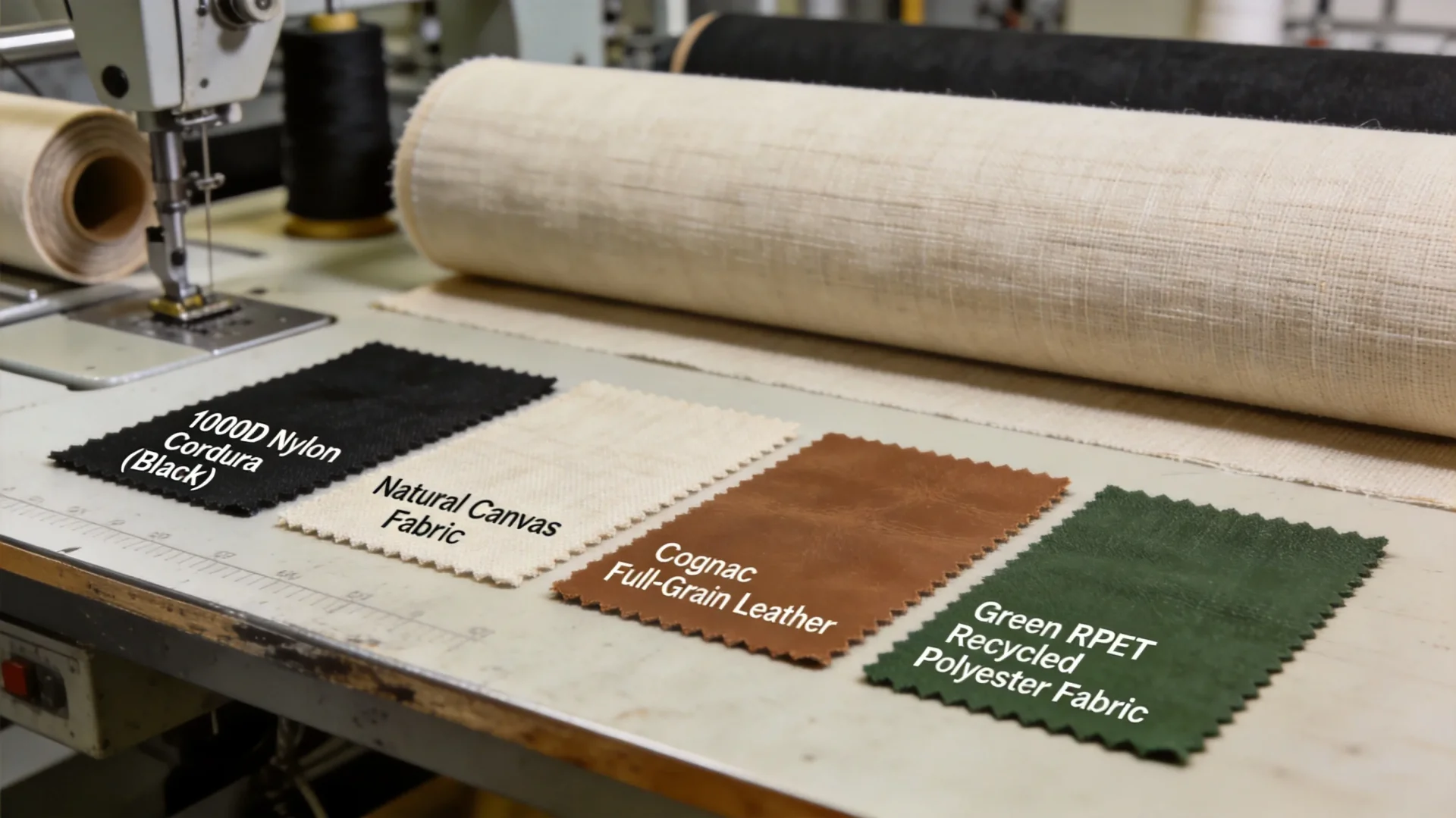
Fabric stacks (typically 30-80 layers high, depending on fabric thickness) are cut using several methods. Straight knife cutting machines handle long straight cuts on main panels. Band knife machines provide greater precision on curved cuts such as rounded end panels. Die cutting via clicker presses is used for high-volume orders where per-unit cost savings justify the $300-$800 die fabrication cost. Laser cutting is used for synthetic fabrics where edge sealing is needed and for precision-cut mesh panels for ventilated shoe compartments.
4.3 Step 3: Printing, Embroidery & Logo Application
Brand logos and graphics are applied either before or after cutting, depending on the method chosen. Silkscreen printing is the default for simple logos at $0.15-$0.60 per unit. Heat transfer printing handles full-color graphics at $0.30-$1.00. Embroidery provides premium positioning at $0.50-$2.50. Woven labels, rubber patches, and debossing (for leather) offer additional brand differentiation options.
4.4 Step 4: Sewing & Assembly
This is the most labor-intensive phase. A standard medium-sized duffel bag requires 45-90 minutes of sewing time depending on complexity. The assembly sequence follows a specific order: sub-assembly of small parts, internal pocket construction, main body seaming using flat-felled seams for strength, end panel attachment (the most skill-dependent operation), zipper installation, handle and strap attachment (the critical quality checkpoint), and final assembly connecting internal compartments to the main body.
4.5 Step 5: Hardware Installation
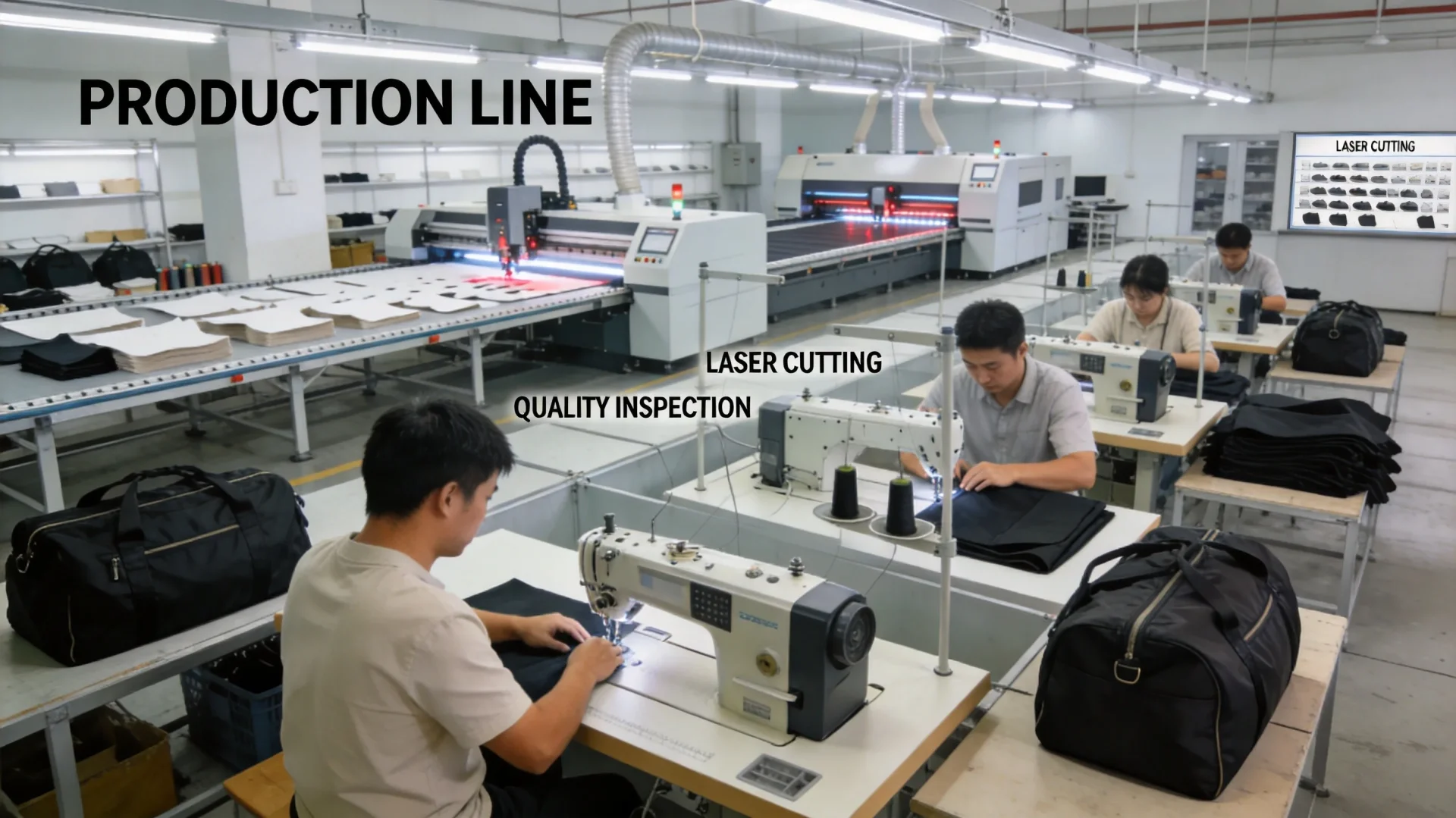
After sewing, metal and plastic hardware is installed, including swivel hooks on shoulder straps, zipper pulls, bottom feet or base studs, buckles and adjusters on shoulder straps, and D-rings and lash points. See Section 5 for detailed hardware selection guidance and cost analysis.
4.6 Step 6: Quality Control & Inspection
Every bag passes through a multi-point QC checklist before packaging. See Section 7 for the complete quality standards framework and testing protocols.
4.7 Step 7: Pressing, Stuffing & Packaging
Finished bags are steam-pressed for shape, stuffed with tissue paper or poly-fill to maintain form during transit, and packed per the buyer specifications. See Section 8 for packaging and shipping optimization details.
5. Hardware & Trim Selection: Zippers, D-Rings, Base Plates & Feet
Hardware is the jewelry of a duffel bag, affecting both function and perceived quality. For B2B buyers, hardware selection is a key lever for cost optimization and brand positioning.
5.1 Zipper Selection
Zippers are the single most expensive trim component on a duffel bag and the most common failure point. Understanding zipper specifications is essential for making the right quality-to-cost trade-offs. YKK zippers command a 3-5x price premium but offer unmatched reliability. For mid-to-premium duffel bags, we recommend YKK zippers for the main compartment where failure is catastrophic and SBS or equivalent for secondary pockets where the cost savings are meaningful.
Waterproof zippers: For water-resistant duffels, YKK Aquaguard or equivalent waterproof coil zippers add $1.50-$3.00 per zipper but are essential for outdoor and tactical applications. These zippers feature a sealed track design that prevents water ingress through the zipper teeth while maintaining smooth operation.
Custom-branded zipper pulls: Many brands invest in custom zipper pulls featuring their logo as a brand differentiation element. The mold cost ranges from $200-$500 depending on complexity, and the per-unit cost ranges from $0.30-$1.50 depending on material (zinc alloy, aluminum, or silicone). For orders above 1,000 pieces, the mold cost amortizes to a negligible per-unit amount and is well worth the investment for brand recognition.
Zipper color matching: A frequently overlooked detail is zipper tape color matching to the bag fabric. Stock zipper colors (black, white, grey, navy) are available at base pricing, but custom-dyed zipper tapes to match specific Pantone colors add $0.20-$0.50 per zipper and typically require a 2-3 week lead time for dyeing. This detail matters significantly for premium and fashion duffels where visual consistency is expected.
5.2 D-Rings & Attachment Points
D-rings serve as shoulder strap attachment points and functional lash points. They are available in zinc alloy (most common), stainless steel (marine/military), or plated brass (leather bags). Standard sizes range from 25mm for light-duty to 50mm for heavy-duty tactical applications. Cost ranges from $0.15 to $0.80 per pair depending on material and finish.
5.3 Base Plates & Bottom Feet
Bottom feet protect the bag base from abrasion and moisture when set on the ground. They are especially critical for duffel bags since the cylindrical shape means the base is the primary contact surface. Options include plastic feet at $0.08-$0.15 each, metal feet at $0.20-$0.50 each, and molded base plates at $0.80-$2.00 per plate. The trend in modern duffel design is toward molded rubber base plates that integrate feet, branding, and protection into a single component.
6. Cost Structure Analysis: Material, Labor & MOQ Impact
Understanding the cost structure of duffel bag manufacturing enables buyers to make informed trade-offs between materials, features, and order quantities. Below is a detailed breakdown based on a representative medium-size 35L nylon gym duffel bag produced in a Chinese factory.
6.1 Bill of Materials (BOM) Breakdown
The total material cost for a standard 35L gym duffel ranges from $7.40 to $10.95, representing 51-65% of the total production cost. Main fabric accounts for 18-22% ($2.50-$3.50), lining fabric for 5-7% ($0.80-$1.20), zippers for 10-14% ($1.50-$2.20), webbing and handles for 6-8% ($0.90-$1.30), hardware for 5-7% ($0.70-$1.10), foam padding for 3-4% ($0.40-$0.60), thread and sundries for 2-3% ($0.30-$0.45), and logo application for 2-4% ($0.30-$0.60).
6.2 Labor & Overhead
Direct labor for cutting, sewing, and assembly accounts for 18-22% of total cost ($2.80-$3.50). QC and inspection adds 3-5% ($0.45-$0.75), and factory overhead including rent, utilities, and management adds 8-12% ($1.20-$1.80).
6.3 Profit Margin & FOB Price
Factory profit margin typically ranges from 8-15% depending on order volume and complexity. For the representative bag described above, the FOB price lands in the $14.00-$19.50 range per piece.
6.4 MOQ Impact on Unit Price
MOQ is one of the most significant price levers in duffel bag manufacturing. The relationship between order quantity and unit cost follows a clear pattern. Orders of 500 pieces carry a 15-25% surcharge because fixed costs like pattern making, sample development, and machine setup are distributed across fewer units. Orders of 500-1,000 pieces represent the standard base price tier for most factories. Orders of 1,000-3,000 pieces receive a 5-8% discount as volume purchasing power reduces material costs and labor efficiency improves through repetition. Orders above 3,000 pieces achieve 10-15% savings through maximum economies of scale, including optimized production line scheduling and bulk material purchasing.
| Order Quantity | Price Impact | Notes |
|---|---|---|
| 500 pcs | +15-25% vs base price | Small batch surcharge for setup costs |
| 500-1,000 pcs | Base price | Standard MOQ for most factories |
| 1,000-3,000 pcs | -5-8% vs base price | Volume discount on materials and labor |
| 3,000-5,000+ pcs | -10-15% vs base price | Maximum economies of scale |
At JUNYUAN BAGS, our monthly line capacity of 200,000 pieces (SGS-verified); current monthly output around 200,000 pieces means we can accommodate both small-batch orders for new brand launches and large-scale production runs with consistent pricing and quality. We recommend that new brands start with a 500-piece trial order to validate design and quality before scaling.
7. Quality Standards & Testing Protocols
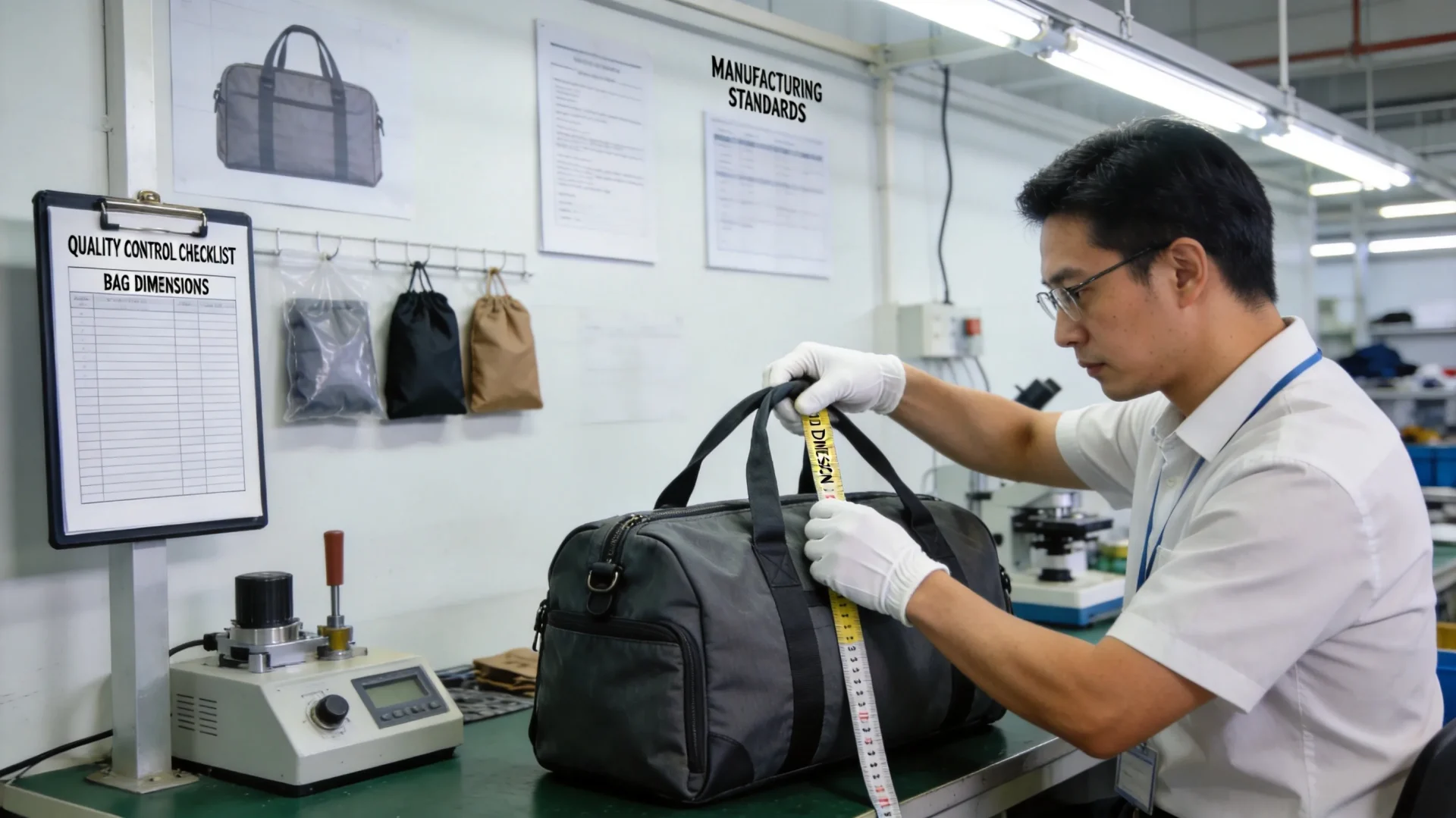
Quality control in duffel bag manufacturing is not a single inspection at the end of production. It is a system of in-line checks, end-of-line inspections, and laboratory testing. Buyers who understand these standards can specify requirements with confidence and hold their manufacturing partners accountable.
7.1 In-Process Quality Checks
- Fabric inspection: 4-point system inspection on arrival. Fabric with more than 12 defects per 100 square meters is rejected before any cutting begins.
- Cutting accuracy: First-piece verification against CAD patterns with a tolerance of plus or minus 2mm on all dimensions.
- In-line sewing audit: AQL 2.5 inspection at 30%, 50%, and 70% production completion, focusing on stitch density (minimum 8-10 stitches per inch for woven fabrics), seam strength, and alignment.
- Hardware attachment verification: Pull-test on 10% of handles and D-rings per batch. Minimum holding force: 80N for handles, 50N for D-rings.
7.2 End-of-Line Inspection
We follow AQL (Acceptable Quality Level) standards for final inspection, typically AQL 2.5 for major defects and AQL 4.0 for minor defects. Critical defects such as broken zippers, wrong sizes, or safety hazards have zero tolerance. Major defects include handle stitching under 6 rows, zipper misalignment over 3mm, or color mismatch beyond Gray Scale 4.
7.3 Laboratory Testing Standards
For branded duffel bags, laboratory testing to recognized standards is essential. Key tests include load and weight testing (150% of rated capacity for 4 hours with no seam failure), zipper fatigue testing (500 cycles minimum), color fastness testing for both rubbing and light exposure, water resistance testing per ISO 811, seam slippage testing per ASTM D434, and handle and strap pull testing (80N minimum for 30 seconds). Chemical compliance testing to REACH and CPSIA standards is conducted annually or per buyer request.
7.4 Certification & Compliance
JUNYUAN BAGS maintains the following certifications relevant to duffel bag quality and compliance: ISO 9001 for quality management systems, BSCI for social compliance, and SGS for third-party testing and inspection. For buyers in specific markets, we also accommodate OEKO-TEX Standard 100, GRS for recycled materials, and proprietary brand compliance programs.
7.5 How to Specify Quality Requirements in Your Tech Pack
When communicating quality expectations to your manufacturing partner, specificity is essential. A well-structured tech pack should include the exact fabric specifications with denier or ounce rating, coating type and water resistance rating in millimeters, zipper brand and size for each application point, thread type and stitch density requirements, bar-tack specifications for all stress points including number of rows and pattern dimensions, pull-test requirements for handles and attachment points with minimum force values and duration, and AQL levels for final inspection. Providing this level of detail upfront eliminates ambiguity and ensures that both parties share the same quality expectations from the start of production.
8. Packaging & Shipping Optimization
Packaging and shipping significantly impact landed cost, especially for duffel bags which are bulky relative to their weight. Smart packaging decisions can save 10-20% on shipping costs.
8.1 Folding & Stuffing Methods
For high-volume orders of nylon or polyester duffels, flat folding provides 40-50% volume reduction at $0.10-$0.20 per bag. Rolled packing achieves 50-60% reduction at $0.15-$0.25. For leather duffels, stuffing with tissue paper and a dust bag is essential to prevent creasing, costing $0.50-$3.00 per bag depending on packaging quality level.
8.2 Container Loading
A 20ft container holds approximately 2,500-3,500 medium duffel bags. A 40ft container accommodates 5,500-7,500 bags. A 40ft HQ container, the most cost-effective option for full-container orders, holds 6,500-9,000 medium duffel bags.
8.3 Shipping Methods
Sea freight FCL takes 25-40 days at $30-$80 per CBM and is best for full container orders. Sea freight LCL takes 30-45 days at $60-$120 per CBM for sample or small orders. Air freight takes 5-10 days at $4-$8 per kg for urgent orders. Express couriers (DHL, FedEx, UPS) deliver in 3-7 days at $5-$12 per kg for samples and emergency replenishment. The choice of shipping method should be evaluated against your inventory planning cycle, product margins, and time-to-market requirements.
Pro tip: For new product launches, consider a split shipment strategy. Air freight the first 500 pieces for launch inventory, followed by sea freight for the remaining bulk order. This gets product to market faster while keeping overall logistics costs reasonable. This approach is particularly effective when launching on Amazon or Shopify, where early inventory availability directly impacts search ranking and launch momentum.
8.5 Insurance & Risk Management
For high-value duffel bag shipments, marine cargo insurance is strongly recommended. The typical cost is 0.3-0.5% of the declared cargo value. This covers loss or damage during transit due to vessel accidents, piracy, severe weather, or handling errors at ports. For leather duffel bags or bags with premium hardware, insurance provides critical protection against claims disputes. Most freight forwarders can arrange insurance as part of the shipping documentation package.
8.4 Customs & Import Documentation
International duffel bag shipments require proper documentation for customs clearance. The standard package includes a commercial invoice with HS code (typically 4202.12 or 4202.92 for textile duffel bags), a packing list with carton specifications, bill of lading for sea freight, certificate of origin for preferential tariff treatment, and testing reports from SGS, Intertek, or Bureau Veritas for compliance verification.
For buyers importing into the European Union, REACH compliance documentation is mandatory for textile products. This includes SVHC test results showing that all materials are below the 0.1% threshold. JUNYUAN BAGS provides REACH test reports for all production batches upon request.
9. Common Design Mistakes to Avoid in Duffel Bag Manufacturing
led by a founder with bag industry experience dating from 2004, through 200+ brand partnerships, we have identified recurring design mistakes that increase costs, reduce quality, or create warranty issues. Here are the most common pitfalls and how to avoid them.
9.1 Over-Engineering Compartments
More pockets do not always equal a better product. Each additional internal pocket adds $0.40 to $0.90 in production cost and 5 to 15 minutes of sewing time. For gym bags, we recommend a maximum of 3 to 4 compartments including main, shoe, wet, and one quick-access pocket. More than this creates complexity that end users rarely utilize and that drives up manufacturing costs without corresponding retail price increases.
9.2 Undersized Zipper Pulls
A frequent complaint in consumer reviews is difficulty zipping duffel bags when fully loaded. The fix is simple: specify zipper pulls that are at least 30mm long for number 5 zippers or 40mm long for number 8 zippers. Cord-style pulls with a paracord loop are the most user-friendly option and add only $0.10 to $0.20 per zipper. This small investment dramatically improves the end-user experience.
9.3 Ignoring Handle Balance Point
When a loaded duffel bag tilts to one side during carry, it is almost always due to incorrect handle placement. Handles must be positioned at the geometric center of the loaded balance point, which is typically offset from the visual center by 2 to 5 cm toward the heavier end where the shoe compartment or base plate is located. This is a CAD-level adjustment that costs nothing in production but has a significant impact on user satisfaction.
9.4 Mismatched Fabric Weight and Bag Size
Using 210D nylon on a 75L travel duffel is a structural failure waiting to happen. The rule of thumb: bags under 30L can use 210D to 420D nylon; bags 30 to 50L should use 420D to 600D; bags above 50L need 600D minimum with reinforced stress points. Failure to match fabric weight to bag volume results in seam splitting and fabric tearing within the first months of regular use.
9.5 Neglecting Bottom Reinforcement
The base of a duffel bag takes the most abuse. It is dragged across gym floors, dropped onto airport conveyor belts, and set on wet ground. A 600D base panel with an additional layer of 1000D reinforcement or a molded rubber base plate is essential. This adds $0.80 to $2.00 to production cost but dramatically reduces warranty claims and improves perceived product quality.
10. Sustainability & Ethical Manufacturing
Sustainability is no longer optional for bag manufacturers. Brand buyers increasingly demand transparent supply chains, certified materials, and verified ethical manufacturing practices.
10.1 Material Sustainability Certifications
| Certification | What It Covers | Relevance to Duffel Bags |
|---|---|---|
| GRS (Global Recycled Standard) | Recycled content verification | RPET fabrics, recycled nylon linings |
| OEKO-TEX Standard 100 | Harmful substances testing | All textile components, linings, webbing |
| bluesign | Chemical management and environmental emissions | Fabric dyeing and finishing processes |
| LWG (Leather Working Group) | Leather environmental compliance | Leather duffel bag materials |
10.2 Social Compliance
For brands selling in Europe and North America, social compliance audits are mandatory in most procurement processes. JUNYUAN BAGS maintains BSCI (Business Social Compliance Initiative) certification, which covers working conditions, fair compensation, working hours, and prohibition of child and forced labor. We also accommodate SMETA, SA8000, and proprietary brand audit programs.
For buyers who need to report on their supply chain sustainability, as increasingly required under EU CSRD directives and the California Transparency Act, we provide annual sustainability reports covering energy consumption, water usage, waste management, and social compliance metrics from Our affiliated factory — part of a manufacturing network of about SGS-verified 4,950 sqm main plant across affiliated and partner facilities.
10.3 Reducing Environmental Impact in Duffel Bag Production
Beyond material selection, there are several production-level strategies that reduce the environmental footprint of duffel bag manufacturing. Optimizing marker efficiency reduces fabric waste; our automated nesting software achieves 85-88% efficiency on standard duffel patterns. Implementing water-based adhesives instead of solvent-based alternatives eliminates VOC emissions during production. Using recycled polyester thread and trims where possible reduces the virgin material content of the finished product. Finally, investing in energy-efficient sewing equipment and LED lighting across the factory floor reduces our operational carbon footprint, a benefit that flows through to the brands we serve.
Why Partner with JUNYUAN BAGS for Custom Duffel Bag Manufacturing?
led by a founder with bag industry experience dating from 2004, JUNYUAN BAGS has built a vertically integrated production facility that covers the entire duffel bag manufacturing process, from material sourcing and cutting through sewing, hardware assembly, quality control, and packaging.
Our duffel bag manufacturing advantages:
- an affiliated factory — SGS-verified at 4,950 sqm with dedicated production lines for nylon, canvas, and leather bags
- monthly line capacity of 200,000 pieces (SGS-verified); current monthly output around 200,000 pieces that scales from 300-piece trial orders to 100,000+ piece production runs
- 200+ brand partnerships across fitness, fashion, military, travel, and outdoor segments
- 100+ export countries with full compliance documentation including REACH, CPSIA, and OEKO-TEX
- ISO 9001, BSCI, and SGS certified for quality, social compliance, and material testing
- In-house design team that develops concepts from sketch to production-ready sample in 7-15 days
- Vertical integration ensuring every step is controlled for consistent quality and reduced lead times
For brands looking to diversify their product lines, duffel bags represent one of the most versatile categories in the bag industry. A well-designed duffel can serve multiple use cases, from gym to weekend travel, while premium hardware and materials command retail prices 3 to 5 times higher than basic alternatives. Our design team works with brands at every stage, from startups developing their first product to established companies expanding into new categories.
How to Get Started with JUNYUAN BAGS
The process begins with an initial consultation where we discuss your product concept, target market, estimated quantities, and timeline. From there, our design team creates a detailed tech pack and 3D rendering for your review. Once the design is approved, we produce a physical sample using production-intent materials for your evaluation. After sample approval and pricing confirmation, we schedule production and provide regular updates through every stage of manufacturing. Our dedicated project managers serve as your single point of contact throughout the entire process, ensuring clear communication and on-time delivery.
Our sample development process typically takes 7-15 days from design approval, and we offer competitive sampling fees that are credited back against your first production order. This approach lowers the barrier to entry for brands exploring new product categories and allows you to validate quality before making a full production commitment.
Frequently Asked Questions
Q1: What is the typical lead time for custom duffel bag manufacturing?
A: Standard lead time is 35-50 days from sample approval to shipment, depending on order quantity and complexity. Sample development takes 7-15 days. Rush orders can be accommodated with a 25-30 day production window for simpler designs.
Q2: What is the minimum order quantity (MOQ) for custom duffel bags?
A: Our standard MOQ is 500 pieces per design and color. For trial orders of new brands, we can accommodate 500 pieces with a small-batch surcharge of 15-25%. Orders above 3,000 pieces receive volume pricing discounts.
Q3: Can you produce duffel bags using our own designs and specifications?
A: Absolutely. We offer both OEM (producing from your exact specifications and tech pack) and ODM (developing designs based on your concept and market requirements). Our design team can create 3D renderings and physical samples for your approval before production begins.
Q4: What materials do you recommend for a waterproof duffel bag?
A: For water-resistant duffels, we recommend 600D polyester or nylon with a PU coating (1,000-3,000mm hydrostatic rating) and water-resistant zippers such as YKK Aquaguard. For fully waterproof duffels, RF-welded TPU construction is the gold standard, though this requires a different production process.
Q5: How do you ensure quality consistency across large production runs?
A: We implement a three-tier QC system: in-line inspections at 30%, 50%, and 70% production milestones using AQL 2.5 standards; 100% end-of-line inspection for every bag; and laboratory testing for fabric, zippers, and hardware per international standards. Our ISO 9001 certification ensures these processes are documented and consistently applied.
Q6: What is the cost difference between nylon and canvas duffel bags?
A: A comparable medium-size duffel in 600D nylon typically costs 10-20% less than the same design in 12oz cotton canvas, primarily because nylon fabric is less expensive per meter and requires less sewing time due to its lighter weight. However, canvas duffels command a higher retail price in many markets due to the natural material perception.
Q7: Do you offer eco-friendly or recycled material options for duffel bags?
A: Yes. We produce duffel bags using GRS-certified RPET (recycled polyester from plastic bottles), recycled nylon, and organic cotton canvas. RPET fabrics cost 10-25% more than virgin materials but are increasingly demanded by brands in the EU and North American markets.
Q8: Can you ship directly to Amazon FBA warehouses?
A: Yes. We regularly ship to FBA warehouses, third-party logistics providers, and direct-to-doorstep for e-commerce brands. We handle all FBA labeling, packaging, and carton requirements including FNSKU labels, suffocation warnings, and carton weight and dimension compliance.
Get Your Custom Duffel Bag Quote Today
Ready to start your custom duffel bag project? Whether you need a prototype sample or a 100,000-piece production run, our team is here to help you from concept to container.
Contact JUNYUAN BAGS — Your Trusted Duffel Bag Manufacturing Partner
Email: [email protected]
WhatsApp: +86 17750020688
expertise dating from 2004 experience | 200,000 per month (SGS-verified)+ annual capacity | 200+ brands served | ISO 9001 / BSCI / SGS certified
Additional note: When evaluating potential manufacturing partners for your duffel bag project, always request factory audit reports, sample quality assessments, and client references before committing to production. A reliable partner should be transparent about their capabilities, lead times, and quality control processes.