Quick facts: the numbers this guide is built on
| Parameter | Standard figure | What it changes on a tote bag order |
|---|---|---|
| Minimum order quantity | 500 pcs per style and colour | Sets the dye lot and the screen burn; cannot be split across colourways |
| Sampling lead time | 6–10 business days | Starts at spec lock, not at first enquiry |
| Bulk production | 35–50 days after written proof approval | The clock starts on approval, not on the PO date |
| Pre-shipment inspection | AQL 2.5 major / 4.0 minor, zero critical | 50 pcs sampled from a 500-piece lot |
| Handle load target | 8–12 kg for retail, 12–18 kg for grocery | Decided by attachment, not by fabric weight |
| Incoterm | FOB Xiamen | Buyer controls freight and the arrival date |
| Workmanship warranty | 12 months from delivery | Covers seams, hardware and print adhesion |
Why These Five Mistakes Keep Repeating
Tote bags look simple, so the brief is usually written in a few lines: a fabric name, a size, a logo and a quantity. That brief is enough to obtain a price, but not enough to obtain a bag. The gap between the two is where every one of the five mistakes below originates, and the gap widens because three commercial pressures push in the same direction.
- Quotations reward brevity. A supplier who asks five clarifying questions loses to a supplier who quotes the same brief in an hour. The quote is therefore built on assumptions that never appear on the PO.
- Sampling is treated as a formality. The sample is approved as a picture rather than as a construction, so the physical differences that matter — handle stitch count, ink spread, fabric hand — are never actually reviewed.
- The calendar is built backwards from a launch date. Marketing sets the date, the freight forwarder takes their slice, and inspection plus proof approval are absorbed into whatever time is left, which is usually none.
The five sections below follow the sequence of a real order, so each fix can be applied to a live project without waiting for the next one.
Mistake 1: Specifying Tote Bag Fabric by Name Instead of by Weight and Construction
Where a fabric brief actually breaks down
The brief says “12oz cotton canvas” or “recycled material” and stops there. There is no gramme weight, no tolerance, no yarn count and no shrinkage allowance. Two factories then quote the same brief at prices 30% apart, and both quotes are technically compliant, because the brief never defined the thing being bought.
What a 10% weight shortfall costs downstream
A 10% weight shortfall on a 12oz shell is invisible in a photograph and obvious in the hand. The bag feels thinner, the handle seam starts to pull at 6–8 kg instead of 12 kg, and the print sits flatter because there is less fabric loft to absorb the ink. The cost surfaces as returns and reorders, long after the invoice has been paid, and it cannot be recovered from the supplier because the specification allowed it.
How to write a fabric spec that holds
- Write the spec in grammes per square metre with an explicit tolerance, for example 400 gsm ± 5%, cotton canvas, 10–12 oz equivalent.
- Add the construction that decides strength: yarn count, weave, and the shrinkage allowance for the wash the bag will receive.
- Name the standard the material must meet, and ask for the mill’s test report with the quote rather than after the order.
- Keep a signed material swatch as the approved reference, and make the bulk lot match the swatch, not the description.
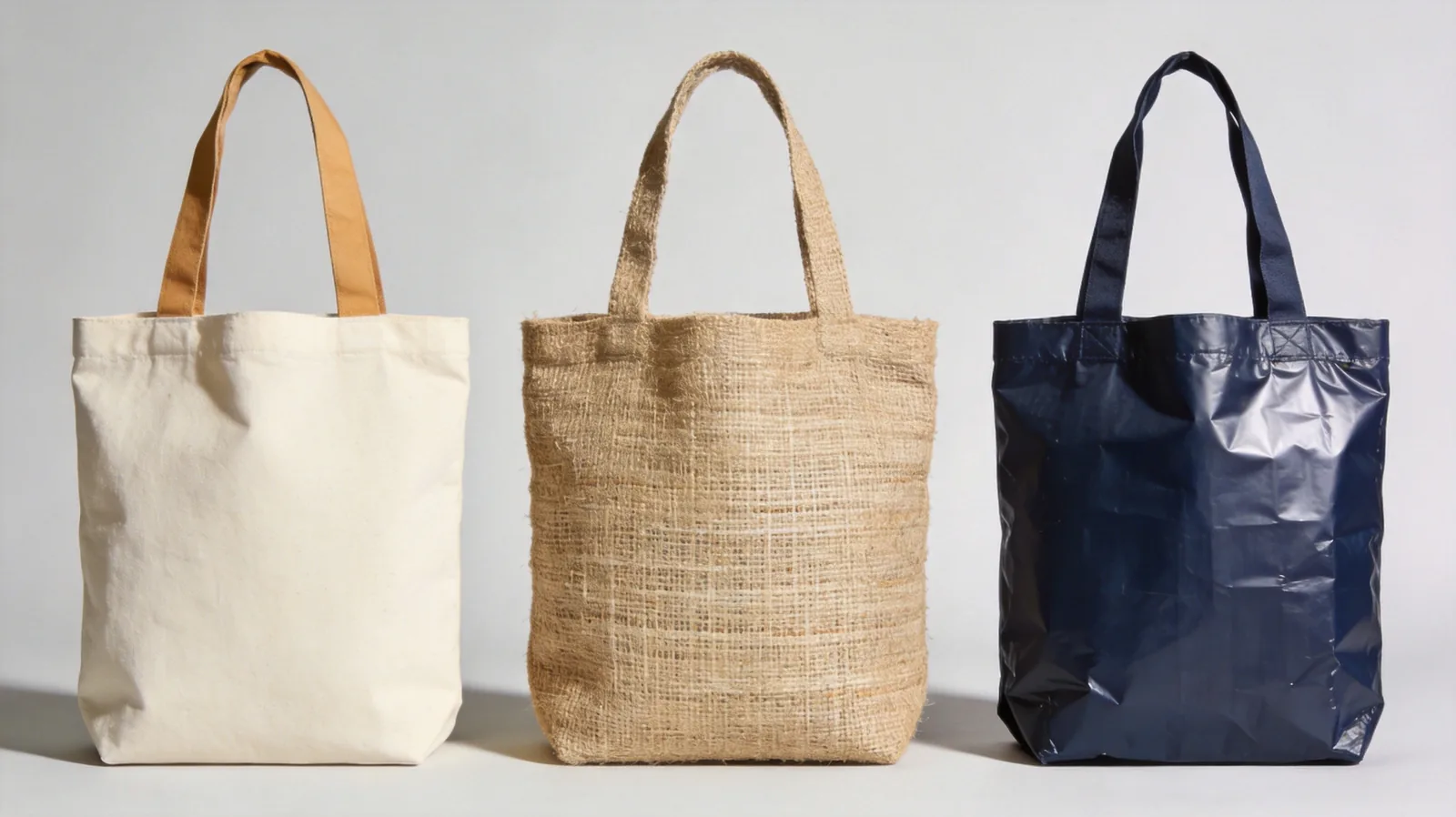
Reference table: what each common tote fabric actually carries
| Fabric and weight | Typical use | Load it realistically carries | Failure mode when under-specified |
|---|---|---|---|
| Cotton canvas 6oz / 200–210 gsm | Giveaway and event totes | 3–5 kg | Fabric tears at the handle seam before the stitch fails |
| Cotton canvas 10oz / 340–350 gsm | Retail and bookstore totes | 8–10 kg | Handle pulls through the shell if the attachment is single-stitched |
| Cotton canvas 12oz / 400–410 gsm | Grocery and daily carriers | 12–15 kg | Seam grin at the top hem under sustained load |
| Cotton canvas 16oz / 540–560 gsm | Premium, tool and hardware totes | 18–20 kg | Handle webbing becomes the weakest component |
| Jute 280–320 gsm | Eco-positioned retail totes | 6–9 kg | Shedding and stiffness complaints; poor print adhesion on uncoated jute |
| Recycled rPET 600D | Branded sustainability programmes | 10–14 kg | Unverified recycled content claim, not a physical failure |
| Non-woven PP 80–100 gsm | Lowest-cost promotion | 2–4 kg | Handle weld separates; bag is single-use by design |
Load figures are the working range JUNYUAN BAGS quotes against on production runs, measured on finished bags with the standard handle attachment for that weight class. They are not laboratory tensile results and should not be used as such.
Mistake 2: Treating Handle Attachment as a Detail
What the brief leaves out about the handle
The handle is specified as a length and a colour, and the attachment method is left to the factory. Since the cheapest acceptable attachment is a straight single stitch, that is what a cost-driven factory will use, and the sample will look perfectly fine because an empty bag has no load in it.
Why the handle, not the fabric, is the failure point
The handle attachment, not the fabric, is the failure point of most tote bags in service. A straight seam begins to grin at 8–12 kg of repeated load, and once one stitch run opens, the bag is functionally finished. Because the failure appears at the point of use rather than at the point of receipt, it is charged to the brand’s quality reputation rather than to the supplier.
How to name the attachment on the purchase order
- Put the attachment method in the purchase order as a named construction, with the stitch type and the stitch density per 10 cm.
- Ask for a loaded handle test on the sample: hang the bag with the target load for 24 hours and inspect the seam.
- Match the attachment to the load class in the table below rather than to the price target.
- Photograph the approved attachment at the factory and attach it to the PO as the acceptance reference.
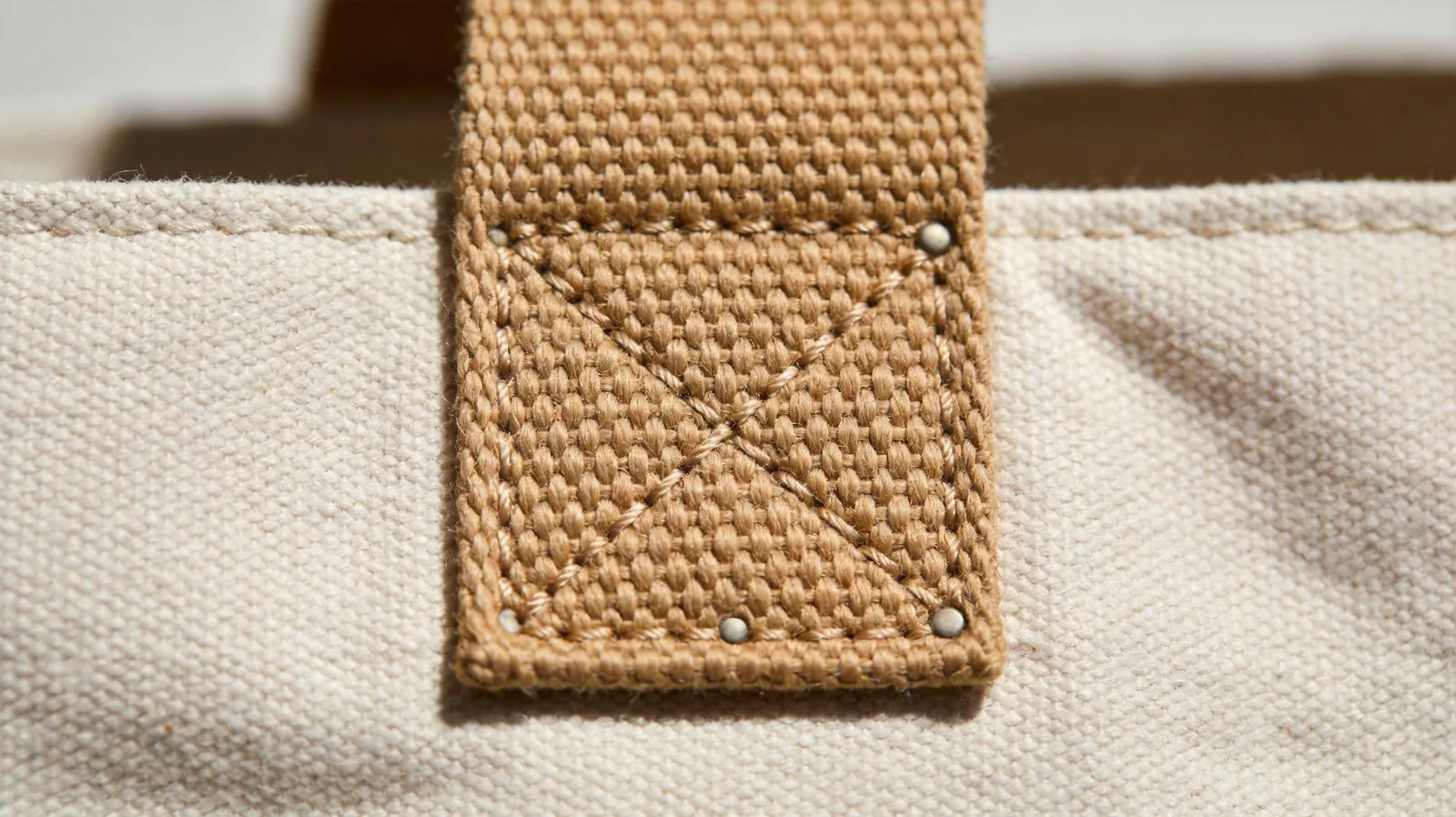
Reference table: handle attachment methods and what they carry
| Attachment method | Realistic load | Cost impact on unit price | When to specify it |
|---|---|---|---|
| Straight single stitch | 3–5 kg | Baseline | Giveaway totes with a defined short life |
| Box-X stitch, both ends | 8–12 kg | +2–4% | Retail, conference and bookstore totes |
| Cross-stitch plus bartack | 12–18 kg | +5–8% | Grocery, book and tool totes |
| Riveted plus stitched | 15–20 kg | +8–12% | Hardware-heavy bags and heavy retail |
Mistake 3: Approving Artwork Without a Physical Proof
Approving a screen instead of a bag
The artwork is approved from a PDF or a phone screen. The PDF was built in RGB, the bag will be printed in pigment, and the fabric under the ink is an absorbent woven surface. Three variables have changed and none of them appear in the approval.
What a full reprint really costs at 500 pieces
A four-colour process print on 12oz natural canvas loses roughly one full shade of saturation against the screen proof, fine reversed type below 6 pt fills in, and ink spread of 0.2–0.4 mm closes the gaps in a fine-line logo. At 500 pieces the reprint is a full second run, because screens are burned per colour and the fabric is dyed per lot. This is the single most expensive mistake in the list, and the cheapest to prevent.
How to run a proof that actually holds
- Require a physical strike-off on the production fabric, in the production ink, at the production size, before the bulk run.
- Approve colour against a Pantone reference measured on the fabric, not against a screen; accept up to 2 Delta-E on natural cotton.
- Set a minimum line weight and a minimum reversed type size in the artwork guidelines so the design survives the substrate.
- Sign the strike-off, keep one copy with the factory and one with your own quality file, and reference it in the PO.
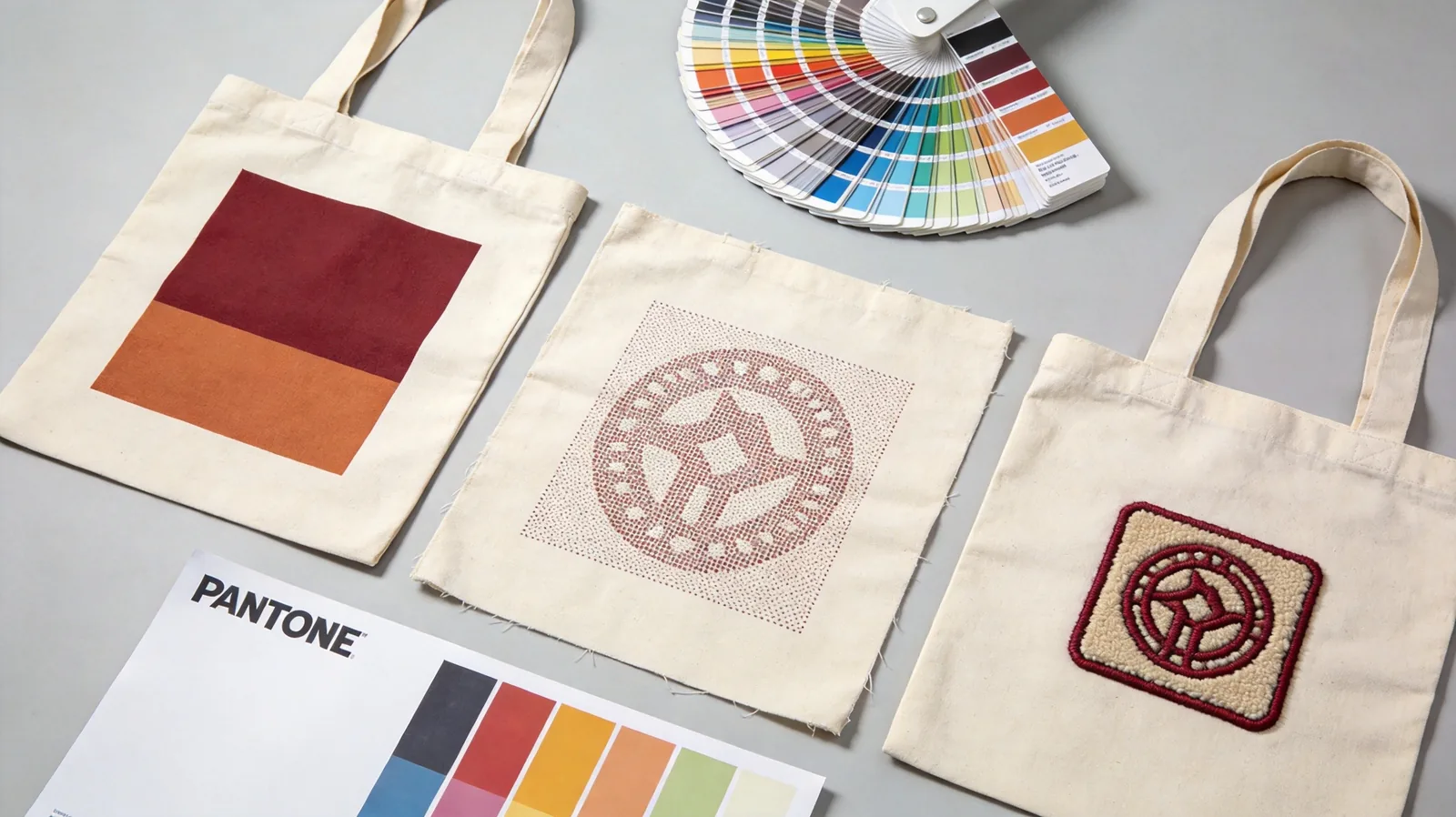
Reference table: printing methods and their real constraints
| Method | Best for | Practical limits | What to watch on canvas |
|---|---|---|---|
| Screen print | 1–3 flat spot colours, high volume | One screen per colour; setup cost per colour | Ink spread closes fine detail below 6 pt; dark ink on natural canvas reads darker |
| Digital transfer | Photographic or gradient artwork | Higher unit cost above 1,000 pcs | Hand feels stiffer on the print area; wash durability below screen print |
| Embroidery | Premium logo, textured look | Up to 12 thread colours; stitch count drives cost | Dense logos stiffen the panel; backing shows through thin canvas |
| Heat transfer | Small runs, full colour | Shorter service life under abrasion | Edge lift after repeated folding; avoid on high-friction panels |
Mistake 4: Compressing the Sampling and Production Calendar
Building the calendar backwards from the launch date
The launch date is fixed first, freight is booked second, and production plus sampling are asked to fit the remainder. When the calendar tightens, the first things removed are the physical proof and the pre-shipment inspection, which are exactly the two controls that prevent a reprint.
The price of a compressed production window
Air freight to recover a late sea shipment costs roughly four to six times the sea rate per kilo, and a reprint costs a second full production run plus a second freight booking. Both outcomes are more expensive than the three to five days that a proper proof and inspection sequence would have added at the start.
How to sequence the calendar gates forward
Build the calendar forward from spec lock rather than backwards from the launch date, and hold the inspection and proof milestones as fixed gates. The table below is the planning window JUNYUAN BAGS works to on tote bag programmes; treat the total as the minimum, not the target.
Reference table: forward-built tote bag calendar
| Stage | Working days | What starts the clock |
|---|---|---|
| Spec lock and quotation | 1–2 | Complete brief with fabric weight, attachment and print method |
| Sampling | 6–10 | Spec lock plus artwork release |
| Physical proof approval | 1–3 | Sample in the buyer’s hands |
| Bulk production | 35–50 | Written proof approval, not PO date |
| Pre-shipment inspection | 1–2 | Production complete and packed |
| Sea freight to US West Coast | 18–28 | Vessel departure from Xiamen |
| Total planning window | 65–95 | Spec lock to goods received |
Add 2–3 weeks if the order crosses Chinese New Year, and add 5–8 days for air freight if the sea window cannot be held.
Mistake 5: Skipping Pre-Shipment Inspection on Tote Bags
Approving a shipment from factory photos
The factory sends photos of a few finished bags, the buyer approves from the photos, and the cartons ship. Photos are selected, well lit and taken of the best unit on the line; they are not a sample, and they cannot detect a 4% rate of skipped stitches at the handle attachment.
What happens once the defect clears customs
A defect rate that would have been caught and reworked at the factory becomes a customer-visible problem after the goods clear customs. At that point the only options are sorting in a third-party warehouse, discounting, or destroying the affected units — all of which cost more than the inspection, and none of which recover the launch date.
How to write the AQL plan into the PO
- Put an AQL plan in the PO: AQL 2.5 major, AQL 4.0 minor, zero critical, under ISO 2859-1 general inspection level II.
- Inspect after packing, pulling the sample from finished cartons rather than from the production line.
- Define major and minor defects in writing for this specific bag, so the inspector is not inventing the classification.
- Hold final payment against the inspection report, not against the loading photo.
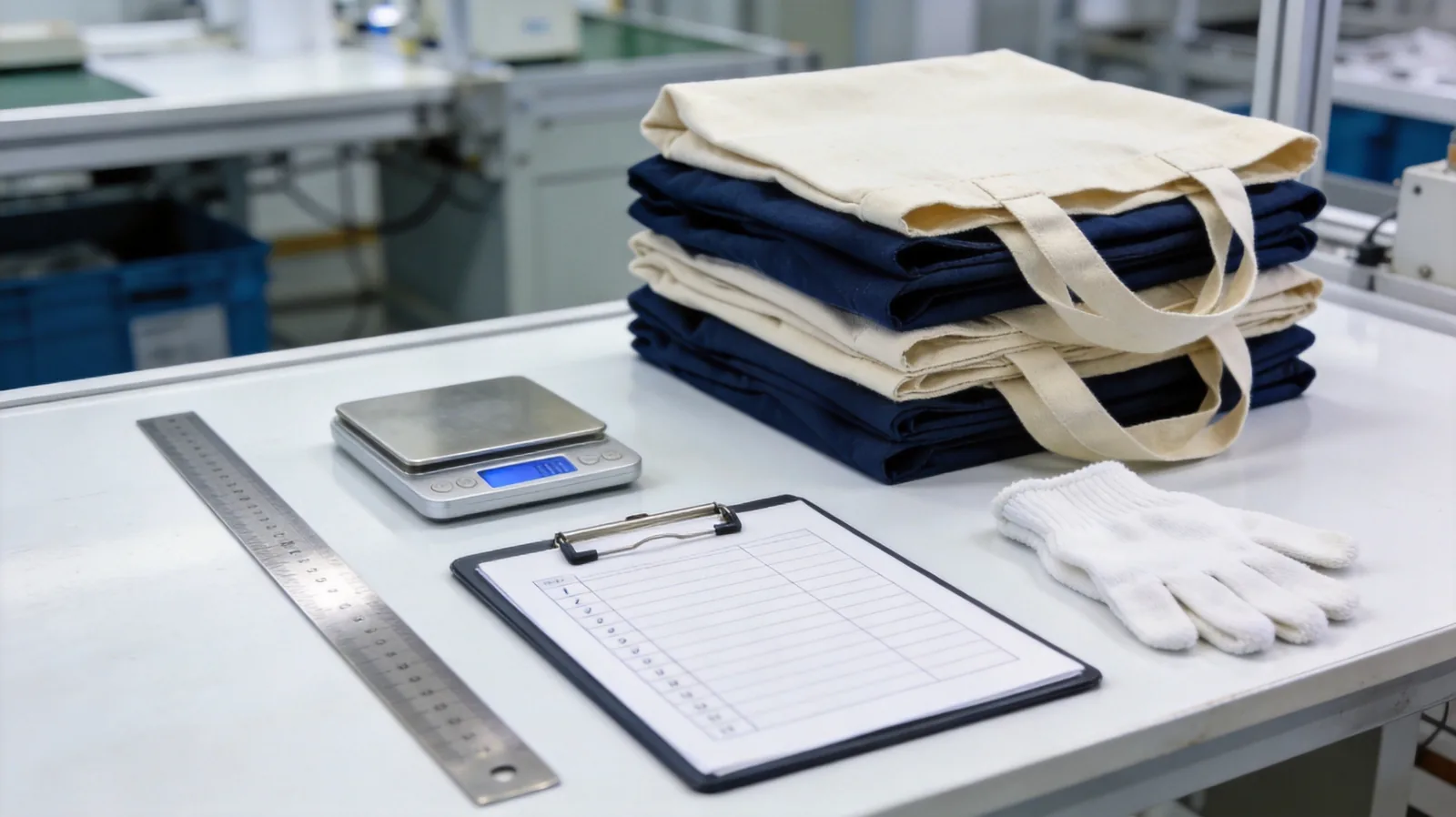
Reference table: defect classification used on tote bag orders
| Defect class | AQL | Examples on a tote bag | Disposition |
|---|---|---|---|
| Critical | 0 (zero tolerance) | Needle damage, mould, prohibited substance, wrong artwork content | Lot rejected |
| Major | 2.5 | Broken or skipped stitch at the handle attachment, print off-register above 3 mm, wrong colourway, non-functional zip | 100% sorting and rework at factory cost |
| Minor | 4.0 | Loose thread, shade variation inside the approved tolerance, light crease, label misalignment under 3 mm | Accept with a written note |
How to Audit Your Own Tote Bag Brief in 10 Minutes
Run the current brief against this list before the next quotation request. Any unanswered line is a decision the factory will make for you.
- Fabric: gramme weight with a tolerance, weave, yarn count and shrinkage allowance — not a trade name.
- Load class: the weight the bag must carry in normal use, stated as a number.
- Handle attachment: named construction, stitch type and stitch density per 10 cm.
- Print: method, number of colours, Pantone references, minimum line weight and reversed type size.
- Proof: who signs the physical strike-off, and on what date.
- Inspection: AQL plan, inspection point in the process, and the document that releases final payment.
- Calendar: spec lock, proof approval, production start, inspection and departure dates, with freight mode.
- Colourways: how many distinct fabric colours, each of which carries its own 500-piece minimum.
A brief that answers all eight lines is quotable in 48 hours and comparable between suppliers, because every supplier is pricing the same object. That comparability is worth more than the few percent of unit price that a vague brief appears to save.
Sourcing Note: How JUNYUAN BAGS Covers These Five Points
Brand, specification and provenance in one place
JUNYUAN BAGS has supplied OEM and ODM bags since 2014, with a founding team in the bag trade since 2004, working through affiliated and partner factories in Fujian. Tote bag programmes run at 500 pcs per style and colour, sample in 6–10 business days, and produce in 35–50 days after written proof approval, inspected to AQL 2.5 major / 4.0 minor and shipped FOB Xiamen under a 12-month workmanship warranty. Fabric is specified in gsm with a tolerance and a signed swatch, handle attachment is named on the PO, and every order gets a physical strike-off before bulk begins.
Start from the custom tote bag manufacturing programme, the canvas tote bag range and the wholesale tote bag terms. For the full production sequence see the custom tote bag manufacturing guide, for supplier benchmarking see the top tote bag manufacturers in China, and for other bag categories see the OEM / ODM service page. Send specs to [email protected] or +86 17750020688.
Frequently Asked Questions About Custom Tote Bag Ordering
Q1. What is the most common mistake brands make when ordering custom tote bags?
Specifying fabric by trade name instead of by weight and construction. A brief that says “12oz canvas” without a gramme-per-square-metre tolerance, yarn count or shrinkage allowance leaves the mill free to deliver anything from 380 to 420 gsm, and a 10% weight drop at the same price is invisible until the bags are in store. The second most common is approving a digital proof instead of a physical strike-off, which is how a two-colour logo turns into a four-colour misregistration.
Q2. What GSM canvas should I specify for a custom tote bag?
Match the gramme weight to the load, not to the budget: 200–210 gsm (about 6oz) for light promotional totes up to 5 kg, 340–350 gsm (10oz) for retail totes up to 8 kg, 400–410 gsm (12oz) for grocery and book totes up to 12 kg, and 540–560 gsm (16oz) for premium, tool and hardware totes up to 20 kg. Below 200 gsm the fabric itself, not the seam, becomes the failure point.
Q3. Is 6oz cotton canvas too thin for a branded grocery tote?
Yes, for grocery use. A 6oz (200–210 gsm) shell on a grocery tote fails at the handle seam first, typically between 5 and 8 kg of repeated load, because the fabric cannot carry the stitch density needed for a load-bearing attachment. 10oz is the practical floor for weekly grocery use and 12oz is the norm for a bag expected to survive two years of retail handling.
Q4. How much weight can a stitched tote bag handle actually carry?
It depends entirely on the attachment, not on the fabric. A straight single-stitch seam carries 3–5 kg, a box-X stitch at both ends carries 8–12 kg, cross-stitch plus bartack carries 12–18 kg, and riveted-plus-stitched handles carry 15–20 kg. The same 12oz shell moves from a 5 kg bag to an 18 kg bag purely by changing the handle attachment.
Q5. Do I need box-X stitching or cross-stitch on tote bag handles?
Specify box-X when the bag will be loaded above 8 kg or handled by many different people, which covers retail, grocery and conference totes. Specify cross-stitch plus bartack when the bag is a daily-use carrier above 12 kg. Straight stitching is acceptable only on giveaway totes under 5 kg where the bag is expected to have a short life.
Q6. Why does my printed logo look different from the digital proof?
Because a screen shows additive RGB light and the bag carries subtractive pigment on a textured, absorbent surface. Ink on 12oz canvas spreads by roughly 0.2–0.4 mm, dark shades print darker on natural canvas than on screen, and Pantone references shift up to 2 Delta-E on unbleached cotton. The only reliable control is a physical strike-off on the production fabric, approved in writing before the bulk run starts.
Q7. How many business days should I allow for custom tote bag sampling?
Six to ten business days from spec lock and artwork release, which covers material sourcing, one print or embroidery strike-off, and courier transit of the physical sample. Add three to five days if the bag needs a new die, a custom handle length or a hardware item that is not in stock.
Q8. How long does bulk custom tote bag production take after proof approval?
Thirty-five to fifty days after written proof approval for a 500 to 5,000 piece run. The clock starts on the approval date, not on the purchase order date, and it excludes sampling, Chinese New Year closures and sea freight.
Q9. What is a realistic door-to-door lead time from China to the US for tote bags?
Plan 65 to 95 days: 1–2 days for spec lock and quotation, 6–10 days for sampling, 1–3 days for proof approval, 35–50 days for bulk production, 1–2 days for inspection, and 18–28 days of sea freight to a US West Coast port plus customs clearance. Air freight cuts the freight leg to 5–8 days at roughly four to six times the cost per kilo.
Q10. What AQL level should a custom tote bag order be inspected to?
AQL 2.5 for major defects and AQL 4.0 for minor defects, with zero tolerance for critical defects. On a tote bag, a major defect is a broken or skipped stitch at the handle attachment, print off-register by more than 3 mm, a wrong colourway, or a non-functional zip; a minor defect is a loose thread, a shade variation within the approved tolerance, or a light crease.
Q11. How many tote bags are inspected in a pre-shipment AQL check?
Under ISO 2859-1 general inspection level II at AQL 2.5, a 500-piece lot is sampled at 50 pieces and a 3,200-piece lot at 125 pieces, with acceptance on 3 major defects or fewer for the 50-piece sample. Inspection is done after packing, so the sample can be pulled from finished cartons rather than from the line.
Q12. What is the minimum order quantity for custom tote bags?
500 pieces per style and colour at JUNYUAN BAGS. Styles, sizes and print layouts can be mixed inside that quantity, but each distinct fabric colourway and each distinct print setup needs its own 500-piece run because the material is dyed and the screen is burned for that colourway.
Q13. Can I mix colours or sizes within one 500-piece tote bag order?
Yes for sizes and for print placement; no for fabric colourways below 500 pieces each. A 500-piece order can be split into, for example, 200 small, 200 medium and 100 large in one natural canvas colourway, but a second fabric colour starts a second 500-piece minimum because dye lots cannot be split economically.
Q14. What happens if a custom tote bag order fails inspection?
The lot is held, the defect is classified against the approved AQL plan, and the factory reworks or replaces the affected units before shipment. Major defects found at AQL 2.5 trigger 100% sorting of the lot at the factory’s cost, and the re-inspection is billed against the same AQL plan so the acceptance criteria do not move. JUNYUAN BAGS covers workmanship defects for 12 months after delivery.
Sources and further reading
Figures and standards in this guide are cross-checked against the primary sources below.
· U.S. Federal Trade Commission — Green Guides for environmental marketing claims
· eCFR — 16 CFR Part 260, Guides for the Use of Environmental Marketing Claims
· Cotton Incorporated — cotton fibre, fabric construction and performance research
· U.S. Customs and Border Protection — Basic Importing and Exporting
Recycled-content and environmental claims on tote bags are held to the FTC Green Guides and 16 CFR Part 260, which is why this guide treats an unverified rPET claim as a compliance risk rather than a material failure. Manufacturing parameters quoted above reflect JUNYUAN BAGS’ own quotation terms as of 2026.