What Actually Makes a Backpack “Smart” in 2026
The category is no longer a novelty shelf. The global smart backpack market is put at USD 730.9 million in 2026, with forecasts of more than USD 1.29 billion by 2033, and anti-theft smart models alone are estimated to hold 31.4% of the segment. That growth has changed what buyers ask for. In 2020 the question was whether a bag could charge a phone at all. In 2026 the questions are what wattage arrives at the phone, whether the battery can legally fly, and what happens when the port fails inside the warranty period.
Those three questions are engineering and compliance questions, not styling questions, and they are where most programmes go wrong. A bag can look correct in a sample room and still fail at the airport, at customs, or in the returns department six months later. This guide works through the electronics, the test regimes that govern them, and the design decisions that decide whether a smart backpack survives its first season. For the retail-facing comparison of what is currently on shelves, the 12 best charging backpacks round-up covers that side of the question.
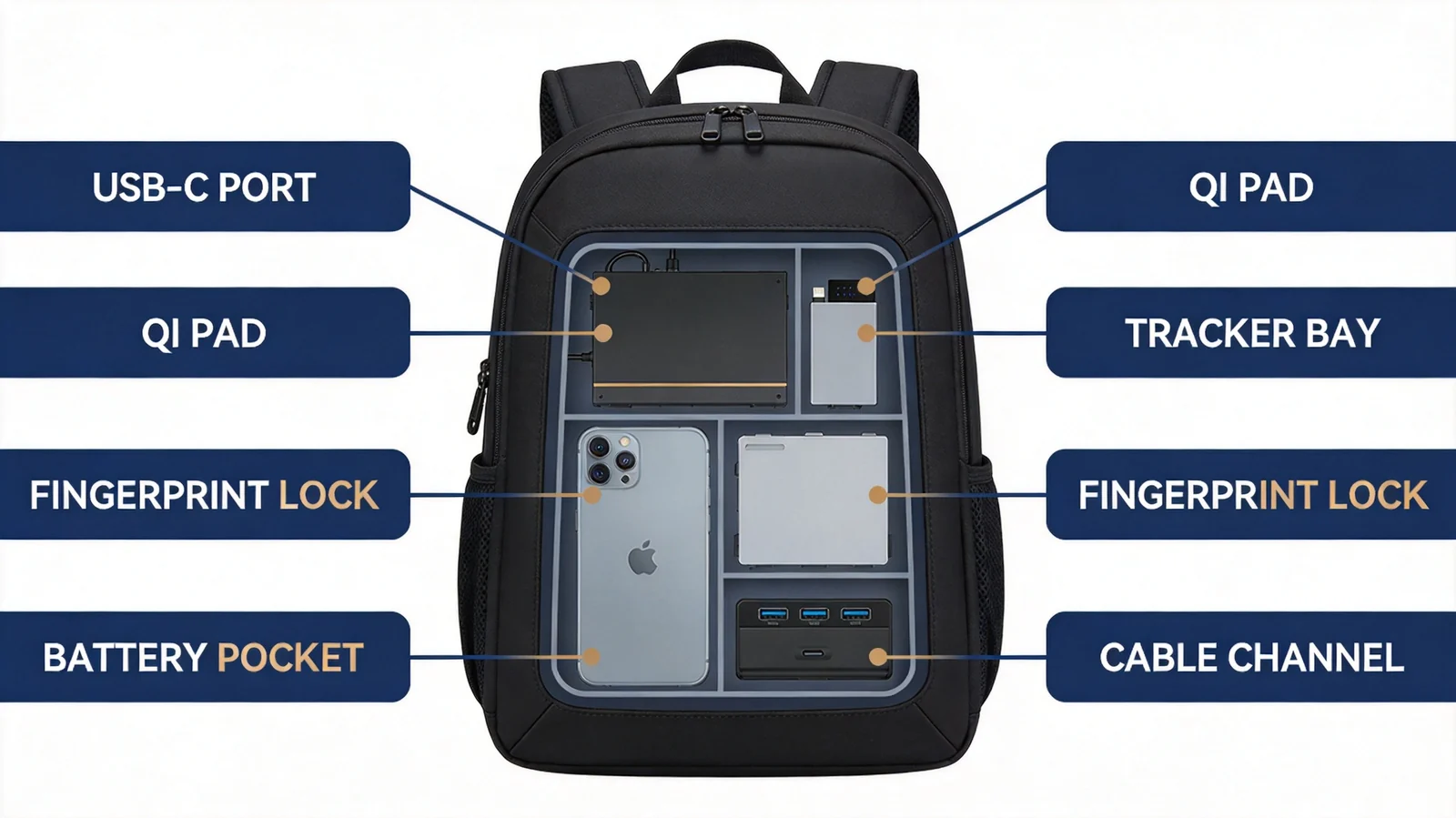
Quick Facts: Smart Backpack Specs at a Glance
| Parameter | Typical 2026 spec | What buyers should verify |
|---|---|---|
| Battery capacity | 5,000–20,000 mAh internal, or none (pass-through only) | Wh rating, not just mAh — 100 Wh is the airline carry-on ceiling |
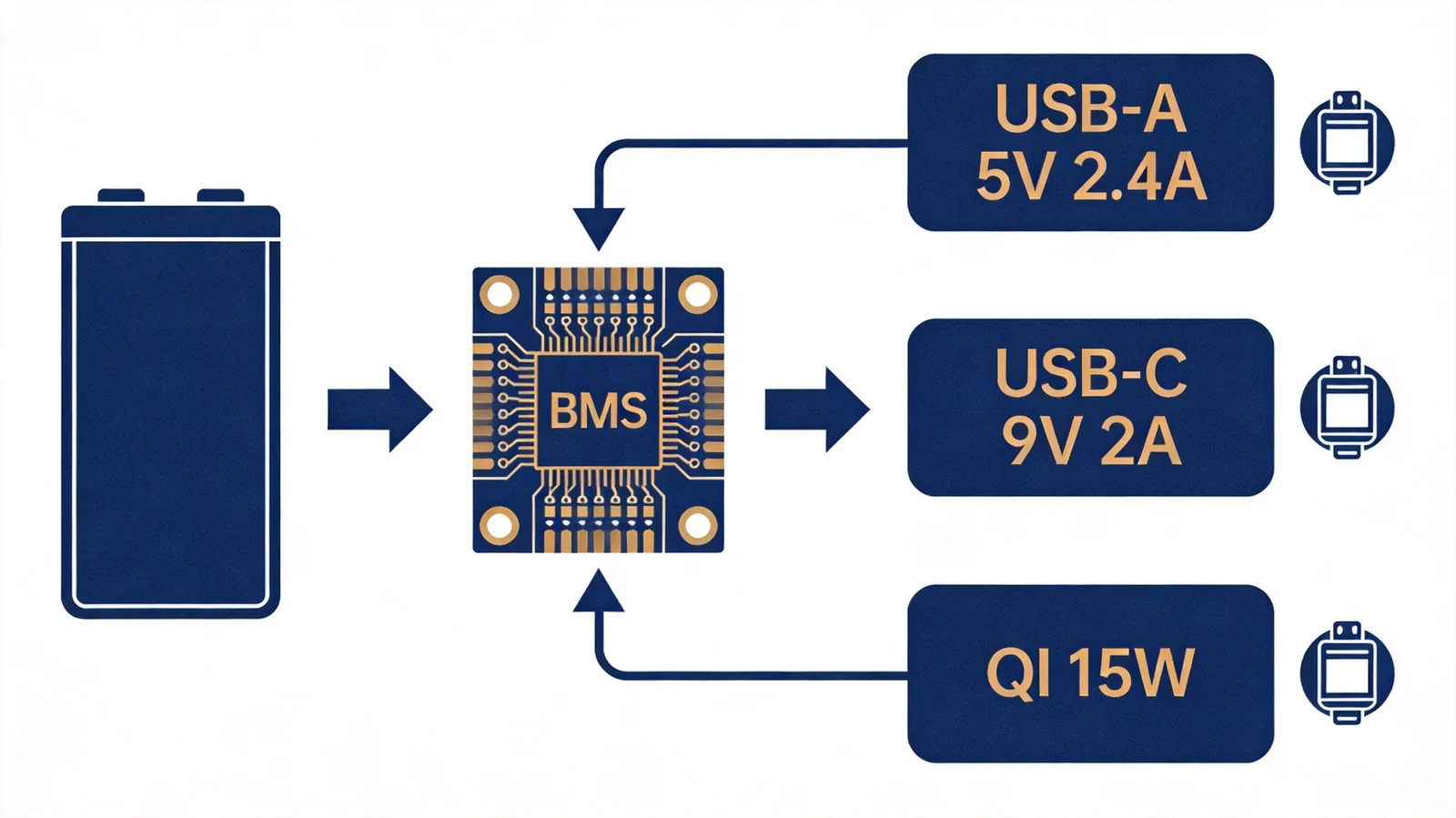
| USB output | USB-A 5 V / 2.4 A (12 W); USB-C PD 9 V / 2 A (18 W) | Whether the port is PD-negotiated or fixed 5 V |
| Wireless charging | Qi 5 W (BPP), 10 W, or 15 W (EPP) | Whether the pad is behind fabric — expect 25–40% loss |
| Tracking | Bluetooth LE / Find My / Tile-compatible module | Replaceable battery or sealed; 6–12 month life |
| Access control | Fingerprint, app lock, TSA combination | FAR below 0.002%, FRR below 3%, manual override present |
| Transport test | UN38.3 eight-test summary per battery model | Report must name the exact model that ships |
| Product safety | IEC 62133-2 plus IEC 62368-1 where applicable | CB certificate transferable to 54 IECEE members |
| Wireless approval | CE RED in the EU; FCC Part 15 in the US | Module approval does not cover the finished bag |
| MOQ | 500 pcs per style and colour | Whether electronics MOQ differs from bag MOQ |
| Sampling / bulk | 6–10 business days / 35–50 days | Whether battery certification runs in parallel or in series |
The Five Electronic Modules That Actually Ship in 2026
Trade listings advertise a long menu of features. In practice almost every commercial smart backpack is built from five modules, and each has a characteristic failure mode that is decided at the design stage rather than in production. Knowing the cost band and the failure risk together is what lets a buyer judge whether a quoted price is realistic. The shell-side work — port module integration and cable routing — is covered separately in the USB charging backpack manufacturing guide.
| Module | What it does | Power draw | BOM cost band (USD) | Failure risk |
|---|---|---|---|---|
| USB output board | Pass-through or boost charging from an internal or external pack | 0 W idle | 0.60–1.80 | Port pulls free of fabric under repeated cable torque |
| Qi wireless pad | Cable-free charging through a strap or front pocket | 0.05 W standby | 2.20–4.50 | Coil misalignment; heat build-up behind padding |
| BLE / GPS tracker | Item location via Find My, Tile or a vendor app | 0.01–0.05 W broadcast | 1.80–3.20 | Sealed cell dies silently; no user replacement |
| Fingerprint lock | Biometric access to the main compartment | 0.02 W standby | 6.00–12.00 | Sensor fouling in dust; no mechanical override |
| LED / display panel | Pixel display, reflective strip, or brand animation | 1–5 W when active | 8.00–18.00 | Flex cable fatigue at the hinge point |
Why the module count stays at two or three
Adding modules is not free. Each one adds a cable run, a connector, a potential water ingress point and a warranty obligation. Bags that carry four or five modules usually weigh 250 to 400 g more than a comparable non-smart shell, and that weight sits in the back panel where it is most noticeable. The commercially successful pattern is one charging function plus one security function — typically USB-C output plus a tracker or a lock — and nothing else. Programmes that add an LED panel on top of that are usually chasing a specific retail channel rather than general demand.
Output Specs: What USB-A, USB-C and Qi Deliver in Real Use
Rated wattage and delivered wattage are not the same number. Cable resistance, connector loss and conversion efficiency together take 8 to 15 percent off a wired output, and 25 to 40 percent off a wireless one. The table below converts the marketing figure into what actually reaches a phone.
| Output | Rated | Real delivered power | Time to charge a 4,000 mAh phone |
|---|---|---|---|
| USB-A 5 V / 1 A | 5 W | 4.2–4.6 W after cable loss | about 3 h 30 min |
| USB-A 5 V / 2.4 A | 12 W | 10.5–11.2 W | about 1 h 40 min |
| USB-C 5 V / 3 A | 15 W | 13.5–14.2 W | about 1 h 25 min |
| USB-C PD 9 V / 2 A | 18 W | 16.5–17.4 W | about 1 h 10 min |
| USB-C PD 20 V / 3 A | 60 W | 54–57 W | not applicable — laptop class only |
| Qi 5 W through fabric | 5 W | 3.0–3.8 W | about 2 h 10 min |
| Qi 15 W through fabric | 15 W | 9.0–11.3 W | about 55 min |
The 5 V trap
A large share of budget charging backpacks ship a fixed 5 V rail and describe it as fast charging. A fixed 5 V / 1 A port delivers about 4.2 to 4.6 W after loss, which takes over three hours to fill a 4,000 mAh phone. That is not fast charging by any current definition, and it is the most common reason a charging backpack collects one-star reviews. If the brief says fast charging, the specification has to say PD-negotiated USB-C with a stated voltage and current, and the inspection has to verify the rail with a load tester rather than by plugging in a phone and watching the screen.
Wireless Charging: Why 15 W Rarely Arrives at the Phone
Qi pads in backpacks are usually placed in a strap pocket or a front panel, which means the coil sits behind 2 to 4 mm of fabric, padding and sometimes a lining. Every millimetre costs efficiency. A 15 W EPP pad behind 2 mm of padded fabric typically delivers 9 to 11.3 W at the phone; the same pad behind 4 mm of foam drops to 7 to 8 W and starts thermally throttling within 10 to 15 minutes.
Three design rules for a Qi pad in a bag
- Keep the gap between coil and phone surface under 5 mm. Anything above that is a heater, not a charger.
- Never place the coil against foam thicker than 3 mm. Use a flat panel or a strap pocket with a thin lining.
- Add an alignment magnet or a stitched outline. Coil misalignment of 8 to 10 mm is enough to halve the delivered power.
There is also a compliance point that catches programmes late: a Qi pad is a radio emitter under most regulatory regimes, so it belongs in the same RED or FCC file as the Bluetooth module. Adding a wireless pad after the EMC file has been issued usually means reopening the file.
Bluetooth and GPS Tracking: The Power Budget Nobody Publishes
Tracker modules are the cheapest electronic feature to add and the one most likely to disappoint in month eight. A Bluetooth LE module broadcasting at 0.01 to 0.05 W will run 6 to 12 months on a small cell, but almost all of that life is decided by whether the cell is replaceable. Sealed trackers turn the whole bag into a disposable item once the battery dies, which is a poor position for a bag priced above USD 100.
Network compatibility matters as much as battery life. Apple Find My certification is a separate commercial agreement, not a firmware flag, and without it a tracker only works inside the vendor’s own app. Buyers who compare listings rarely notice the difference until after purchase. For programmes aimed at travel, a tracker with a 90 dB or louder alarm is worth more than one with a longer radio range, because the alarm is what actually recovers a bag.
Fingerprint and App Locks: Where They Fail
Biometric locks moved from novelty to mainstream in this cycle, but the specification language around them is loose. Two numbers decide whether a lock is usable: the false acceptance rate, which should be below 0.002%, and the false rejection rate, which should be below 3%. A lock with a 5% false rejection rate gets disabled by the user within a week, and a disabled lock is a warranty claim waiting to happen.
The mechanical override is not optional
Every electronic lock needs a physical override — a key, a combination dial, or a documented recovery procedure. Without one, a flat lock battery strands the user’s belongings, and in some markets that creates a consumer-protection problem for the brand rather than just an inconvenience. Specify the override in the tech pack and test it at inspection, not at sample review. Lock hardware is usually developed alongside the fabric and zipper security package described in the anti-theft backpack manufacturing guide.
Battery Placement: Pouch, Sleeve or Zip-Out Module
Where the battery sits decides the carry comfort, the service model and the washability of the bag. There are three viable patterns and each has a clear trade-off.
- Fixed pouch in the back panel. Shortest cable run, best weight distribution, but the bag cannot be washed and a failed battery scraps the unit.
- Sleeve in the front compartment. Accessible and serviceable, but the cable run to the shoulder-mounted port is 400 to 600 mm longer and the weight sits forward.
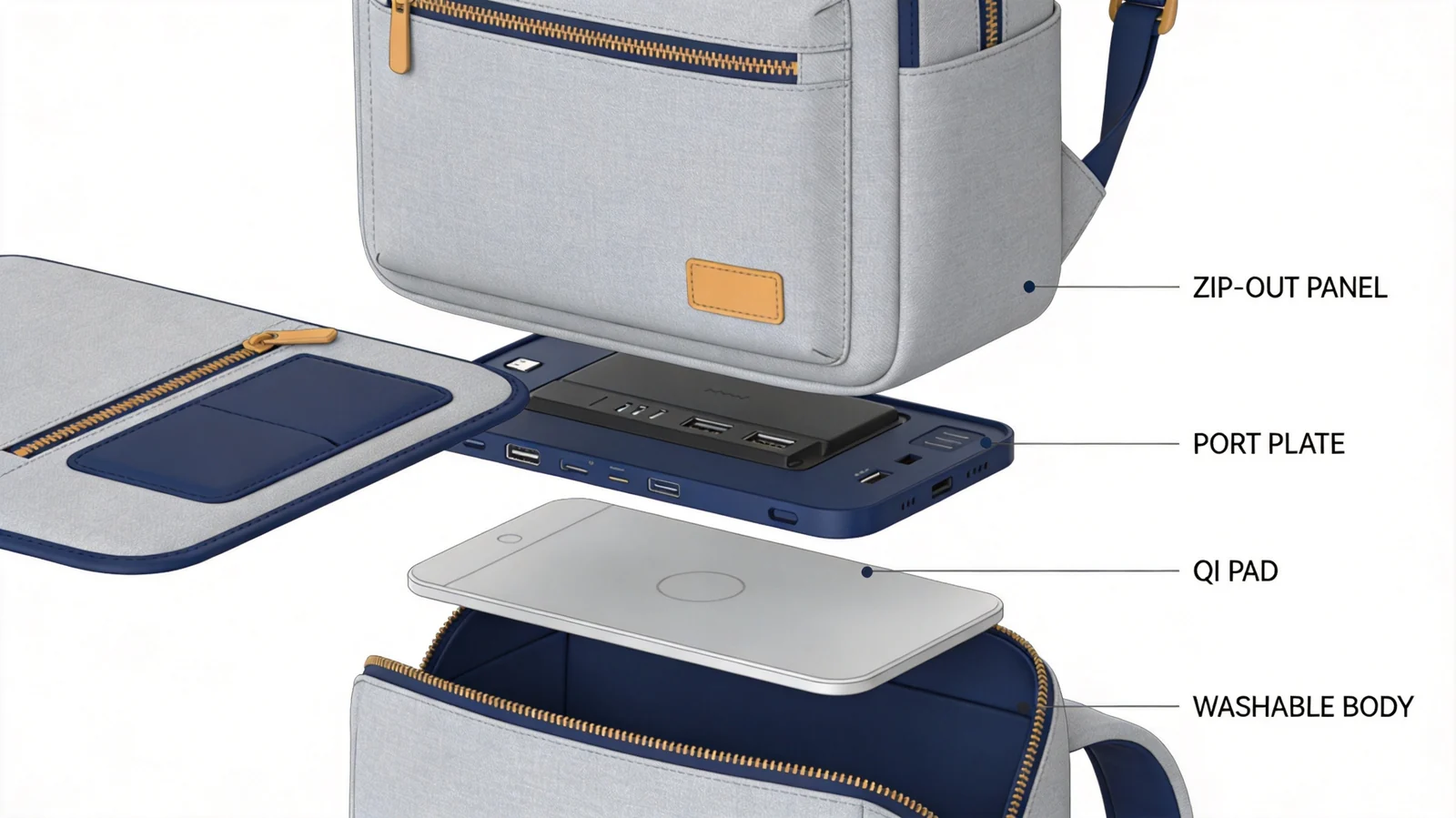
- Zip-out cassette. The only pattern that allows both washing and module-level warranty replacement. Costs roughly USD 1.20 to 2.00 more per unit in materials and assembly, and repays it on the first warranty claim.
Whichever pattern is chosen, the battery pocket competes for the same back-panel volume as the laptop sleeve. Sleeve construction, EPE and EVA selection and 13 to 17-inch configurations are covered in the laptop backpack OEM guide, and the sleeve depth decides how much space is left for a cassette.
UN38.3: The Eight Tests Your Battery Must Survive
UN38.3 is Section 38.3 of Part III of the UN Manual of Tests and Criteria. It applies to virtually every lithium-ion and lithium-metal cell and battery, whether shipped on its own, installed in equipment, or packed with equipment. The eight tests run in sequence on the same batch of samples, and all must pass. A typical submission uses at least 22 cells or packs per model, depending on the laboratory’s arrangement.
| Test | What is done to the cell or pack | Pass requirement |
|---|---|---|
| T.1 Altitude simulation | Held at 11.6 kPa or below for at least 6 h at 20 ± 5 °C | No leakage, venting, disassembly, rupture or fire; OCV at least 90% of pre-test |
| T.2 Thermal cycling | 10 cycles between +72 ± 2 °C and −40 ± 2 °C, 6 h at each extreme, then 24 h ambient | Same as T.1, including OCV at least 90% |
| T.3 Vibration | Sine sweep 7–200 Hz and back in 15 min, 12 times per axis on three axes | No leakage, venting, disassembly, rupture or fire; OCV at least 90% |
| T.4 Shock | Half-sine 150 gn / 6 ms, three shocks per direction, 18 in total | Same as T.1 |
| T.5 External short circuit | Case stabilised at 55 ± 2 °C, then shorted through under 0.1 Ω | Case temperature 170 °C or below; no disassembly, rupture or fire during the test and 6 h after |
| T.6 Impact / crush | Cylindrical cells 18 mm and larger: 9.1 kg dropped 61 cm onto a 15.8 mm bar. Prismatic and pouch: crushed to 13 kN | Temperature 170 °C or below; no disassembly or fire during the test and 6 h after |
| T.7 Overcharge | Charged at twice the rated current up to twice the rated voltage, held 24 h | No disassembly or fire within 7 days |
| T.8 Forced discharge | Forced reverse discharge at maximum rated current | No disassembly or fire within 7 days |
Two practical points get missed. First, T.1 to T.5 run back to back on the same unit, so one battery has to survive altitude, thermal cycling, vibration, shock and external short circuit in succession — it is not five separate samples. Second, the thermal cycling test alone takes at least a week, which is why a full UN38.3 cycle is 2 to 3 weeks rather than a few days.
UN38.3 is a type test, not a certificate scheme. What the manufacturer holds is a test summary report issued by an accredited laboratory, and it must name the exact model that ships. Carriers and customs ask for it by model number.
IEC 62133-2 versus UN38.3: Two Standards, Two Different Jobs
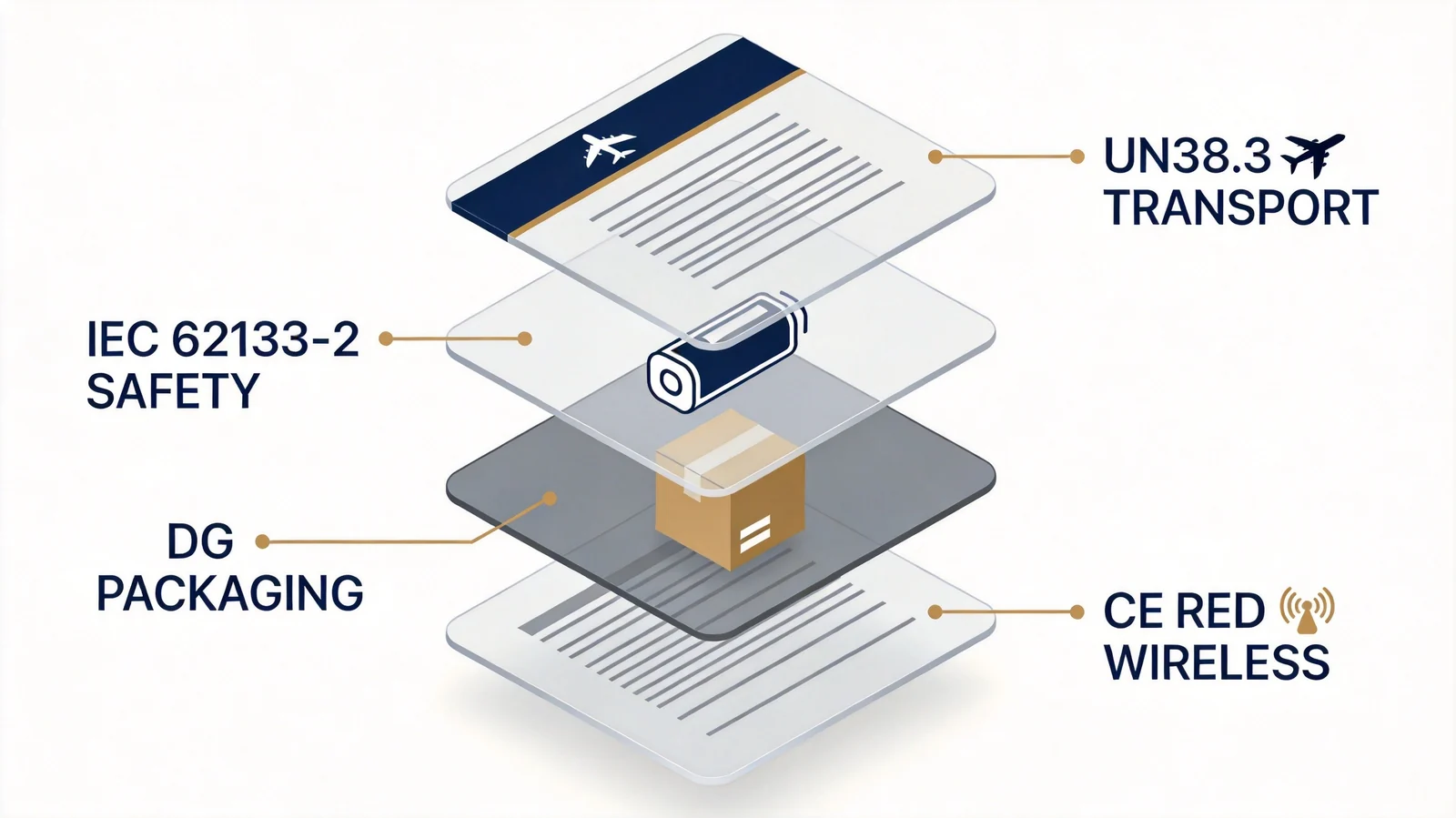
These two are routinely confused, and the confusion is expensive because a programme that only holds UN38.3 can ship but cannot sell into most retail channels. UN38.3 asks whether the battery survives transport. IEC 62133-2 asks whether the battery is safe in normal use and foreseeable misuse. The parameters differ and neither substitutes for the other.
| Standard | What it protects | Who asks for it | Typical test cycle |
|---|---|---|---|
| UN38.3 | Transport safety — air, sea, rail, road | Airline, shipping line, customs, freight forwarder | 2–3 weeks (thermal cycling alone takes 1 week) |
| IEC 62133-2 | Product safety in normal use and foreseeable misuse | Retail buyer, marketplace, CB scheme | 4–8 weeks |
| IEC 62368-1 | Equipment-level electrical safety of the finished article | EU importer, NRTL in the US | 3–6 weeks |
| Dangerous goods packaging | The packaging the battery travels in | Carrier, port authority | Air 3 months validity, sea 12 months |
| CE RED 2014/53/EU | Radio equipment — Bluetooth, Wi-Fi, GPS modules | EU market surveillance | 4–8 weeks including RF exposure file |
| FCC Part 15 | Unintentional and intentional radiators in the US | US importer, marketplace | 3–6 weeks |
What IEC 62133-2 actually tests
At cell level the standard runs a continuous low-rate charge held for 28 days, an external short circuit at 55 °C and at 20 °C through an 80 ± 20 mΩ resistance, a thermal abuse ramp of 5 ± 2 °C per minute up to 130 °C held for 10 minutes, and an overcharge at twice the recommended voltage for 24 hours. At pack level it tests overcharge protection, external short-circuit protection, a 1 m free drop onto concrete three times, and the safety information marking. Pass criteria are no fire and no explosion within 7 days for the abuse tests, with a 150 °C surface limit on the short-circuit case.
The CB certificate that comes out of this work is transferable to 54 IECEE member countries and can be converted into CE, PSE, KC, RCM and other local marks with minimal additional testing. For a programme selling into several markets, that transferability is worth more than the certificate itself.
Dangerous Goods Packaging: Air Three Months, Sea Twelve
Battery certification is only half the paperwork. The packaging the battery travels in is separately regulated, and the validity periods differ by transport mode in a way that catches exporters repeatedly.
| Item | Air freight (IATA DGR) | Sea freight (IMDG Code) |
|---|---|---|
| Performance certificate validity | 3 months | 12 months |
| Use appraisal certificate | Single shipment | Single shipment |
| State of charge limit | 30% or below | 30–50%, varies by carrier |
| Packaging test standard | PG II, 1.2 m drop | PG II, 1.2 m drop |
| Class 9 label size | 120 mm × 110 mm | 100 mm × 100 mm |
| UN marking character height | 12 mm minimum | 12 mm minimum |
| SP188 threshold | Cell 20 Wh or less, battery 100 Wh or less | Same |
| SP188 package limit | Net quantity limits apply | 10 kg gross per package |
When SP188 applies
Special Provision 188 relaxes the packaging burden for small batteries: lithium-ion cells rated 20 Wh or less, and batteries rated 100 Wh or less. Under SP188 the performance certificate, the use appraisal certificate, the maritime dangerous goods declaration and the Class 9 label are not required, and the package does not need UN marking — but it must still pass a 1.2 m drop test, and the batteries must still hold a UN38.3 summary. SP188 simplifies paperwork; it does not exempt the product from testing. For sea, road and rail the SP188 package limit is 10 kg gross.
A 10,000 mAh power bank at 3.7 V nominal is 37 Wh, comfortably inside SP188. A 20,000 mAh pack at 74 Wh is still inside it. The 100 Wh line is crossed at roughly 27,000 mAh at 3.7 V, which is why almost every backpack battery on the market is specified just below it.
The Carry-On Rules Your Buyer Will Ask About
This is the single question that generates the most pre-sale messages for any smart backpack brand, and getting it wrong produces returns and chargebacks. The rules are set by IATA and adopted by essentially every major carrier.
| Watt-hour rating | Carry-on | Checked baggage | Airline approval |
|---|---|---|---|
| Under 100 Wh | Allowed, no quantity limit for personal use | Not allowed for power banks | Not required |
| 100–160 Wh | Allowed, usually 2 spares maximum | Not allowed for power banks | Airline approval required |
| Over 160 Wh | Not allowed | Not allowed | Cargo only, as dangerous goods |
| Installed in the bag (under 100 Wh) | Allowed as part of the bag | Allowed as part of the bag | Not required, but declare if asked |
| Removable power bank | Carry-on only, no exceptions | Prohibited | Not required |
The rule that surprises people is the last row. A power bank is classified as a spare, uninstalled lithium battery regardless of capacity, so it is carry-on only with no exceptions — a 5,000 mAh bank is treated exactly like a 20,000 mAh one. A battery that is genuinely installed in the bag and stays there is treated as part of the bag. This is the design argument for making the battery fixed rather than removable if the target market is air travellers, and the reverse argument if the target market is commuters who want to swap packs.
CE RED, FCC and the Wireless Module Path
A Bluetooth module, a GPS receiver or a Qi pad all make the finished backpack a radio device. That moves the compliance question from electrical safety to radio equipment approval, and the module supplier’s own paperwork is not enough on its own.
- EU: Radio Equipment Directive 2014/53/EU, with an assessment of radio-frequency exposure for the finished article. EMC and low-voltage files alone do not cover it.
- US: FCC Part 15 authorisation for the intentional radiator, plus Part 15B for unintentional emissions from the charging circuitry.
- Japan: the Electrical Appliances and Materials Safety Act (PSE) applies to the charging circuitry, and radio law applies separately to the module.
- Any market: the antenna environment changes once the module is sewn into a fabric bay next to a battery, so the approval must be granted for the assembled bag, not for the bare module.
Washability: Why Detachable Beats Waterproof
Every smart backpack eventually gets dirty, and the electronics decide whether it can be cleaned. Sealed electronics force hand-wash instructions that most consumers ignore, and the corrosion failures that follow are usually classified as user damage rather than a manufacturing defect — which means the brand absorbs the reputational cost without the warranty cover.
The practical answer is a zip-out cassette. The bag body becomes a normal textile product that can be washed to the same standard as any non-smart backpack, and the electronics become a serviceable part. It costs more per unit at the BOM level, but it converts a whole-bag warranty replacement into a module-level one, and it gives the brand a spare-parts revenue line that a sealed design cannot offer.
Failure Modes We See in Field Returns
The published reviews of charging backpacks are unusually consistent about what breaks. Ports work loose from the fabric. Cables break at the port root. Batteries swell in sealed pockets. Charging turns out to be far slower than the listing claimed. Each of these maps to a specific design decision that is cheap to fix at the tech-pack stage and expensive to fix after the first container ships. For a single-product teardown of how one brand implemented wireless charging, the HEX technical backpack review is a useful reference point.
| Field failure | Root cause | Design countermeasure | Cost if caught late |
|---|---|---|---|
| USB port pulls out of the fabric | No backing plate; all load carried by the fabric seam | Riveted or stitched ABS backing plate behind the port | Whole batch rework, 100% inspection |
| Cable breaks at the port root | Sharp 90° exit with no strain relief | Overmoulded strain relief with a 12 mm bend radius | Field returns inside warranty |
| Battery swells inside a sealed pocket | No BMS, or a BMS with no overcharge cut-off | BMS with overcharge, over-discharge and thermal cut-off | Safety incident, recall exposure |
| Port feels loose, charges intermittently | Low-retention USB-A receptacle, under 5,000 mating cycles | Receptacle rated 10,000 mating cycles | Marketplace review damage |
| Charging is far slower than advertised | Fixed 5 V rail marketed as fast charging | PD-negotiated USB-C with a stated wattage | Returns and platform delisting risk |
| Water gets into the electronics bay | Coating claim applied to the whole bag, not just the module | Separate IP-rated module housing plus a drain channel | Corrosion failures after one season |
| Zipper fails before the electronics do | Cheap slider on a heavy loaded panel | YKK or equivalent slider, 8 mm coil on load-bearing seams | Structural failure, no repair path |
The port backing plate is the highest-leverage part in the bag
If a programme changes one thing, it should be this. A port stitched directly into fabric carries every cable insertion and removal load through the seam. A port mounted on a riveted or stitched ABS backing plate spreads that load over 30 to 50 times the area and effectively removes the failure mode. The cost difference is a few cents per unit. The difference in return rate is measured in whole percentage points.
Cost Drivers: What Moves the Unit Price
Smart backpack quotes vary by a factor of four for what looks like the same bag, and the variation is almost entirely in the electronics and the fabric, not in the labour. The bands below are indicative 2026 BOM costs at 500-piece quantities and are useful for sanity-checking a quotation.
| Cost driver | Low end | Mid end | High end | Comment |
|---|---|---|---|---|
| Battery pack | USD 3.50 | USD 6.80 | USD 14.00 | 5,000 / 10,000 / 20,000 mAh, BMS included |
| USB output board | USD 0.60 | USD 1.20 | USD 1.80 | Fixed 5 V versus PD-negotiated |
| Qi wireless pad | — | USD 2.20 | USD 4.50 | 5 W versus 15 W EPP with alignment magnet |
| BLE tracker module | — | USD 1.80 | USD 3.20 | Vendor app versus Find My certification |
| Fingerprint lock | — | USD 6.00 | USD 12.00 | Capacitive sensor plus solenoid latch |
| LED panel | — | USD 8.00 | USD 18.00 | Reflective strip versus addressable pixel matrix |
| Shell fabric | USD 1.90 | USD 3.40 | USD 6.20 | 600D polyester versus 1680D ballistic nylon |
| Certification amortisation | USD 0.40 | USD 1.10 | USD 2.60 | Spread over 500 / 2,000 / 5,000 pcs |
Certification amortisation is the line buyers most often overlook. A UN38.3 summary plus an IEC 62133-2 CB file for one battery model runs into several thousand US dollars before any packaging certificate work. Spread over 500 pieces that is a visible per-unit cost; spread over 5,000 it nearly disappears. This is the structural reason small brands are pushed toward off-the-shelf battery modules that already hold reports, and the reason a genuinely custom battery is a volume decision rather than a design one.
MOQ, Sampling and Lead Times for Custom Smart Backpacks
The bag timeline and the electronics timeline are different lengths, and the programme is only as fast as the slower one. Planning them in series rather than in parallel is the most common cause of a missed launch date.
| Stage | Standard programme | What it covers | Notes |
|---|---|---|---|
| MOQ | 500 pcs per style and colour | Bag body plus electronics assembly | Electronics modules may carry their own MOQ from the module supplier |
| Sampling | 6–10 business days | Pre-production sample with the specified modules fitted | Sample charge refunded against the first bulk order |
| Battery certification | 2–3 weeks for UN38.3; 4–8 weeks for IEC 62133-2 | Runs against the chosen battery model, not the bag | Start before sampling is signed off, or it becomes the critical path |
| Bulk production | 35–50 days | Cut, sew, electronics fit-out, function test, packing | Counted from sample approval and deposit |
| Inspection | AQL 2.5 major / 4.0 minor | Visual, dimensional and functional | Functional test covers every port on every unit |
| Warranty | 12 months | Bag construction and electronics | Module-level replacement, not whole-bag replacement |
The sequencing rule that works: lock the battery model first, start UN38.3 and IEC 62133-2 immediately, and run bag sampling in parallel against that fixed battery. If the battery model changes after sampling, the certification restarts and the schedule slips by the full test cycle. For a programme targeting a specific retail window, that single decision is worth more than any production optimisation.
How to Vet a Smart Backpack Manufacturer
Most factories that can sew a backpack cannot engineer electronics, and the gap is not visible in a sample room. These are the checks that separate an assembler from a manufacturer.
- UN38.3 test summary with the model number visible. Not a certificate of compliance — the actual test summary, naming the battery that will ship.
- IEC 62133-2 or CB certificate number, verifiable with the issuing body. Call the issuing laboratory if the number does not resolve.
- Mating-cycle rating of the USB receptacle actually fitted. Ask for the component datasheet, not the bag specification. 10,000 cycles is the target; 5,000 is the budget part.
- A functional test record showing every port on every unit. Sample-based port testing is how a 2% dead-port rate reaches the customer.
- The mechanical override on any electronic lock. Ask to see it operate on a production unit.
- Who owns the battery certification. If the factory cannot name the certificate holder, the brand may be shipping on someone else’s paperwork.
A factory that can produce the first two but not the last four is buying modules on price and fitting them into a bag. That is a legitimate business model, but it is not the same product, and it should be priced and warranted differently.
Ten Smart Backpacks Currently on the Market: Spec Reference
The models below are the ones that consistently appear in 2026 buying guides and marketplace rankings. They are listed here as specification reference points for benchmarking a custom programme — not as purchasing recommendations, and none of them is a JUNYUAN product. More of these reviews are collected in the laptop and tech backpack review hub.
Tzowla business laptop backpack
A 15.6-inch commuter bag with a USB pass-through and a fixed 5 V rail. The reference point for the entry tier: it demonstrates how much of the market still ships a non-negotiated port.

Oscaurt laptop backpack
Anti-theft travel format with a USB port and a rear zip. Useful as a benchmark for how a low-cost bag handles the port backing problem — usually with a stitched fabric tab rather than a rigid plate.

Multi-purpose smart backpack with laptop compartment
A convertible format that carries the electronics in the front panel. It shows the trade-off described earlier: front-panel placement shortens nothing and lengthens the run to a shoulder-mounted port.

CYB smart LED backpack
An addressable pixel LED panel driven from a phone app. The high end of the module cost table, and the clearest example of a bag whose electronics define the product rather than support it.

Matein travel laptop backpack
One of the highest-volume charging backpacks on the market and the one whose port failure pattern is most documented in buyer reviews. A useful negative reference for the backing-plate argument.
Mancro anti-theft laptop backpack
Budget anti-theft format with a USB port and a combination lock. Reviews consistently note port stability as the weak point, which is the same mechanical issue in a different shell.

Modoker vintage laptop backpack
A canvas-look format where the electronics are secondary to the material story. Illustrates that a smart feature can be a single USB pass-through and still qualify the bag for the category.

Korin Design ClickPack Pro
A security-focused design with a rigid shell and organised interior. The reference for programmes where the electronics budget is small but the security story carries the price.
17-inch Sosoon travel backpack
A large-format travel bag with a USB port. Shows how the electronics bay moves further from the shoulder straps as capacity grows past 35 litres, and why cable routing becomes a design problem at that size.

YOREPEK 18.4-inch laptop backpack
The oversized end of the market, built around a 18.4-inch laptop sleeve. Included because it is the clearest case where the battery pocket and the laptop sleeve compete for the same back-panel volume.

Why You Cannot Put Your Own Logo on Any Bag in That Table
Every model above is a finished consumer product owned by another brand. Nothing in this guide is an offer to supply them, and their designs, tooling and trademarks are not available for private label. What is available is the reverse arrangement: a custom programme built to your specification, with your branding, from a factory that also builds for the trade.
The practical route for a brand is to take the specification lessons from the table — port backing, output wattage, battery placement, compliance stack — and apply them to an original design. Benchmarking specifications is normal industry practice; copying a finished product is not, and it is the fastest way to lose a marketplace account.
JUNYUAN BAGS — smart backpack specification review
If you already have a module list and a target market but are unsure which certification stack applies, send the specification and we will return a written compliance map and a costed BOM rather than a single unit price. This is a technical review, not a sales sheet: it states which tests the chosen battery model still needs, which markets those tests unlock, and how long each takes.
Programme terms for reference. MOQ 500 pcs per style and colour. Sampling 6–10 business days, sample charge refunded against the first bulk order. Bulk production 35–50 days from sample approval and deposit. Inspection to AQL 2.5 major / 4.0 minor with a functional test on every port of every unit. 12-month warranty on construction and electronics. FOB Xiamen.
Send these five inputs. Target capacity in litres, laptop size, the electronic modules and their output specification, target market (this decides the certification stack), and estimated annual volume.
Contact: [email protected] · +86 17750020688 · custom smart backpack manufacturer · OEM / ODM service
Sourcing Note: Where the Detail Lives Elsewhere
This guide deliberately stops at the electronics and compliance layer. The shell-side questions — port module integration, cable routing and power bank compartment design — belong to the USB charging backpack manufacturing guide. Fabric and hardware security, including cut-resistant panels, locking zippers and RFID blocking, belong to the anti-theft backpack manufacturing guide. Compartment engineering for 13 to 17-inch laptops belongs to the laptop backpack OEM guide. Each of those topics is covered in depth on its own page, and repeating them here would only weaken both.
On the finished-product side, retail comparison and single-product teardowns are handled in the charging backpack round-up, the laptop and tech backpack review hub and the HEX technical backpack review linked earlier in this article.
For a custom programme, the four pages below cover the commercial side: capability and process, laptop formats specifically, the OEM and ODM model itself, and wholesale volume terms.
- Custom backpack manufacturer — development and production capability across backpack formats.
- Custom laptop bag manufacturer — laptop-specific programmes from 13 to 18.4-inch sleeve formats.
- Custom bag manufacturer, OEM and ODM — how the two engagement models differ in tooling, IP ownership and MOQ.
- Wholesale factory programme — volume pricing, consolidation and repeat-order terms.
- The full programme overview — capability, materials, QC and order flow — sits on the custom smart backpack manufacturer page linked in the contact box above. This article covers the electronics and compliance layer; that page covers the commercial process.
Frequently Asked Questions About Smart Backpacks
Q1. What makes a backpack a smart backpack rather than just a laptop backpack?
A smart backpack carries at least one powered electronic function that the user operates while wearing it — most commonly a USB charging output, a Qi wireless charging pad, a Bluetooth tracker, or a biometric lock. A laptop backpack without electronics is not a smart backpack regardless of how many compartments it has. In practice the USB output is the single feature that defines the category: a bag with no port at all is rarely sold or searched as smart.
Q2. How many litres should a smart backpack be for daily commuting?
20 to 28 litres covers a 15.6-inch laptop, a charger, a light jacket and lunch for most commuters. 28 to 35 litres is the usual band for travel and for 16-inch laptops. Above 35 litres the electronics bay gets far from the shoulder straps, so cable runs get longer and the weight distribution gets worse. If the design brief is commute plus occasional travel, 26 to 30 litres is the safest single SKU.
Q3. What USB output power should I specify for a smart backpack?
Specify USB-C PD at 18 W (9 V / 2 A) as the primary port and keep one USB-A 5 V / 2.4 A port for legacy cables. 18 W charges a 4,000 mAh phone from flat in roughly 70 minutes after cable loss. A fixed 5 V / 1 A port delivers only about 4.5 W and takes over three hours — that gap is the most common source of negative reviews on charging backpacks, because the listing says fast charging while the rail is fixed at 5 V.
Q4. Does Qi wireless charging actually work through backpack fabric?
Yes, but it loses 25 to 40 percent of its rated power. A 15 W pad behind 2 mm of padded fabric typically delivers 9 to 11.3 W at the phone. Two design rules matter: keep the gap between coil and phone surface under 5 mm, and never place the coil against foam thicker than 3 mm or the pad will thermally throttle within 10 to 15 minutes. Put the pad in a strap pocket or a flat front panel, not in a padded back panel.
Q5. What is UN38.3 and does my smart backpack battery need it?
UN38.3 is the United Nations transport-safety test series that virtually every lithium-ion and lithium-metal cell and battery must pass before it ships by air, sea, rail or road. It consists of eight tests, T.1 to T.8, run in sequence on the same batch of samples. Any smart backpack with a lithium battery installed or packed with it needs a valid UN38.3 test summary naming that exact battery model. A freight forwarder can and will refuse the shipment without it.
Q6. How long is a UN38.3 report valid?
There is no fixed statutory expiry date, but the report must match the exact model that ships. Any substantial change in cell chemistry, capacity, internal structure, protection circuit or electrolyte requires retesting. Airlines commonly recommend refreshing the report every 3 to 5 years, and carriers may reject a report that does not name the shipping model. Budget 2 to 3 weeks for a full test cycle on a new model.
Q7. What is the difference between UN38.3 and IEC 62133-2?
UN38.3 is a transport test — it asks whether the battery can survive being shipped. IEC 62133-2 is a product safety standard — it asks whether the battery is safe in normal use and foreseeable misuse. They overlap in method but use different parameters and neither substitutes for the other. Most export programmes need both, plus IEC 62368-1 for the finished article. IEC 62133-2 runs 4 to 8 weeks and its CB certificate transfers to 54 IECEE member countries.
Q8. How long is a dangerous goods packaging certificate valid?
Three months for air freight under IATA DGR, and twelve months for sea freight under the IMDG Code. This is the single most common planning trap for battery exporters: a certificate issued in January is still valid for sea freight in December but expired for air freight in April. If a programme uses both modes, either hold two certificates or schedule air shipments inside the first quarter of each certificate cycle.
Q9. Can a smart backpack with a built-in battery go in checked baggage?
Only if the battery stays under 100 Wh and is genuinely installed in the bag rather than removable. A removable power bank is treated as a spare lithium battery and is carry-on only, with no exceptions, at any capacity. If a cabin bag is gate-checked, the power bank must be taken out and kept with the passenger. The 100 to 160 Wh band needs airline approval and is usually limited to two spares.
Q10. What certification does the Bluetooth or GPS module need?
In the EU the module falls under the Radio Equipment Directive 2014/53/EU, so the finished bag needs a RED assessment including radio-frequency exposure, not just EMC and low-voltage files. In the US it needs FCC Part 15 authorisation. A module supplier’s own approval does not automatically cover the finished backpack: the antenna environment changes once the module is sewn into a fabric bay next to a battery.
Q11. Should the electronics be removable for washing?
Yes, and it should be designed in from the start rather than added later. A zip-out electronics cassette lets the bag body be cleaned and lets a failed module be replaced under warranty without scrapping the whole unit. Sealed-in electronics force hand-washing instructions that most consumers ignore, which is where corrosion failures come from. A removable cassette also simplifies battery replacement at end of life.
Q12. Why do USB ports on backpacks fail so often?
Almost always because the port is stitched into fabric with no rigid backing. Every time a cable is plugged in and pulled out, the load goes straight into the seam, and the port works its way free. The fix is mechanical, not electrical: a riveted or stitched ABS backing plate behind the port, plus overmoulded strain relief with a 12 mm minimum bend radius. Specify a receptacle rated for 10,000 mating cycles rather than the 5,000-cycle parts that are usually quoted.
Q13. Why does battery certification decide the launch date of a smart backpack?
Because the electronics timeline is longer than the bag timeline and the two only overlap if you plan them to. Bag sampling is 6 to 10 business days and bulk production 35 to 50 days, but UN38.3 alone takes 2 to 3 weeks and IEC 62133-2 takes 4 to 8 weeks — and both run against the battery model, not the bag. If the battery model is changed after sampling is signed off, the certification restarts and the launch slips by the full test cycle. Lock the battery model first and run certification in parallel with sampling.
Q14. How do I check that a smart backpack manufacturer can actually do electronics?
Ask for four things and check them against each other. First, the UN38.3 test summary with the battery model number visible. Second, the IEC 62133-2 or CB certificate number, verifiable with the issuing body. Third, the mating-cycle rating of the USB receptacle they actually fit. Fourth, a functional test record showing every port tested on every unit, not a sample. A factory that can only produce the first two is assembling modules bought on price, and the third and fourth will show it.
Sources and Further Reading
Figures and standards in this guide are cross-checked against the primary sources below.
· eCFR — 49 CFR 173.185, Lithium cells and batteries
· IATA — Dangerous Goods Regulations (HAZMAT)
· Consumer Product Safety Office Singapore — Safety tips on power banks
· European Commission — Radio Equipment Directive 2014/53/EU
· METI Japan — Electrical Appliances and Materials Safety Act (PSE)
· Persistence Market Research — Smart Backpack Market
Test parameters and validity periods above follow the published primary sources listed here. Certification requirements change; confirm the current edition of each standard with the issuing body or your testing laboratory before committing a production run.