
Leather Duffle Bags: A B2B Buyer’s Guide for Brands and Retailers
Leather duffle bags occupy a durable niche in the global bag market: they carry higher perceived value than nylon or canvas, age well with use, and attract buyers in travel, corporate gifting, and premium lifestyle segments. For brands and retailers sourcing private label or OEM leather duffles, the decisions that matter most are leather type, hardware quality, construction method, and minimum order economics—not runway trends.
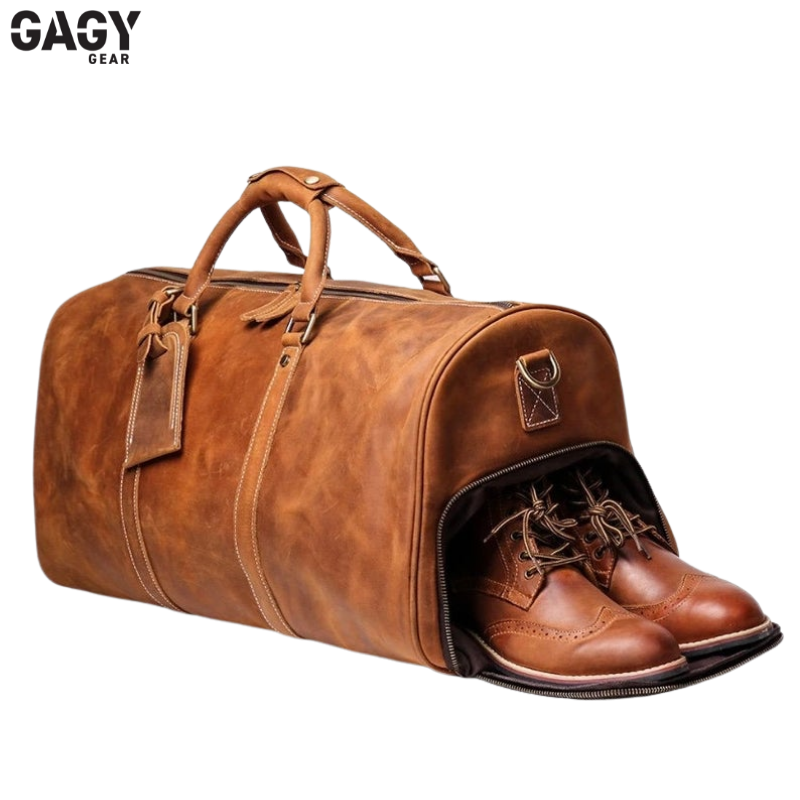
This guide covers what sourcing managers, brand owners, and procurement teams need to evaluate when commissioning custom leather duffle bags. We focus on the factors that affect unit cost, lead time, and long-term customer satisfaction, drawing on over a decade of bag manufacturing experience at JUNYUAN BAGS.
Key Takeaways
- Full-grain leather offers the best longevity; top-grain balances cost and durability; split-grain and bonded leather suit budget lines.
- Hardware (zippers, buckles, D-rings) is the most common failure point—specify YKK or equivalent and metal rather than plated plastic.
- MOQ for custom leather duffles typically starts at 500 pieces per color, higher than nylon bags due to leather cutting waste.
- Construction method matters: saddle stitching and box-stitched stress points outperform bar-tack-only assembly.
- Lead times run 35-50 days for production plus 6-10 days for sample approval.
Types of Leather Used in Duffle Bag Manufacturing
Not all leather is equal, and the grade you choose directly affects both retail positioning and production cost. Understanding the hierarchy helps you match material to price point.
Full-Grain Leather
Full-grain is the strongest and most expensive option. It retains the entire grain layer, develops a patina over time, and resists moisture and tearing better than any other grade. Premium travel and heritage brands often specify full-grain cowhide or buffalo hide. Expect higher cutting waste because natural marks and scars must be avoided, which raises material cost by 20–35% compared to corrected-grain alternatives.
Top-Grain Leather
Top-grain leather has the outer grain layer sanded and corrected for uniformity. It is thinner, more pliable, and more consistent than full-grain, making it the most common choice for mid-range fashion duffles. It accepts embossing and color finishes well, which is ideal for branded or private label products. The trade-off is slightly less durability—it will not develop the same depth of patina.
Split-Grain and Suede
Split-grain is the lower layer separated from the top grain during processing. When sanded and finished, it becomes suede or “genuine leather.” It costs significantly less but is more susceptible to abrasion and moisture damage. Split-grain duffles are suitable for fashion-forward lines where appearance at a price point matters more than multi-year durability.
Bonded Leather and PU Blends
Bonded leather consists of shredded leather fibers bonded with polyurethane. It contains real leather but behaves more like synthetic material. For budget promotional lines, consider full PU or vegan leather instead—bonded leather tends to peel and crack within 12–18 months, generating returns and brand damage.
Hardware and Construction: Where Quality Is Won or Lost
Buyers judge a leather duffle by its look; they return it because of its hardware. Zippers, buckles, rivets, and handle attachments are the stress points that fail first under real-world use. Specifications worth writing into your tech pack include:
- Zippers: YKK #8 or #10 metal or coil for main closure; #5 for exterior pockets. Avoid unbranded zippers—they are the single highest source of warranty claims.
- Buckles and D-rings: Solid brass, zinc alloy, or stainless steel. Plated plastic hardware cracks in cold weather and tarnishes quickly.
- Stitching: Bonded nylon or polyester thread in ticket size #69 or #92. Stress points should use box-stitch or saddle-stitch patterns, not single bar tacks.
- Lining: Cotton canvas or 210D polyester ripstop. Avoid unbacked “open” linings that sag and expose raw edge seams.
- Edge finishing: Burnished and waxed edges on premium lines; painted and sealed edges on mid-range. Raw cut edges signal low quality.
Customization Options for Private Label and OEM Orders
As a custom bag manufacturer, JUNYUAN BAGS supports a range of customization that lets brands differentiate without commissioning a fully proprietary mold. Typical options include:
- Debossed or embossed logos on leather patches or directly into the bag surface—no thread, no peeling, premium appearance.
- Custom hardware colors: antique brass, gunmetal, polished gold, matte black.
- Detachable shoulder straps with padded sections and custom webbing patterns.
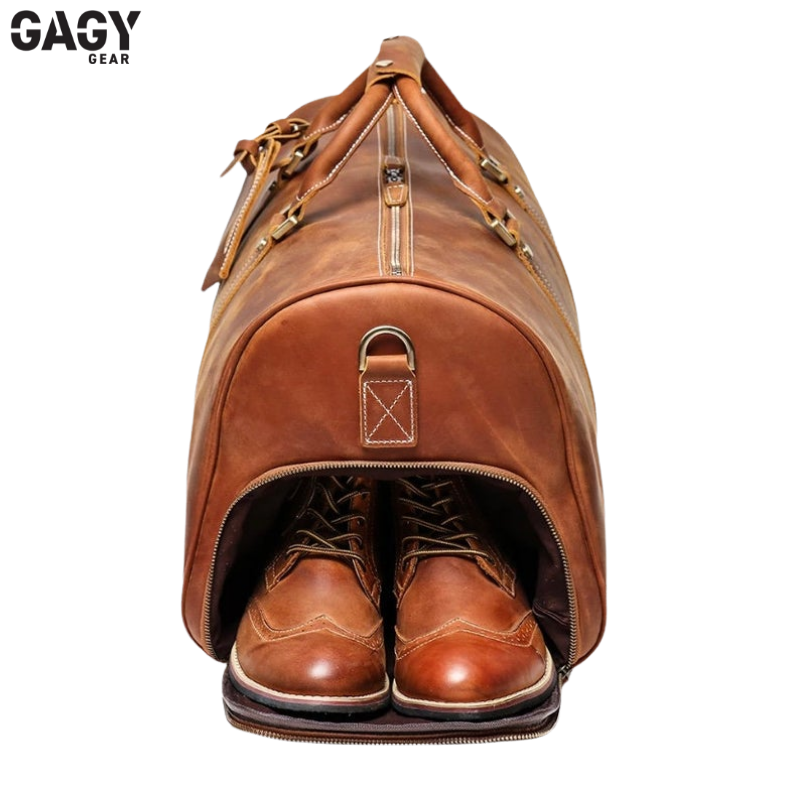
- Shoe compartments or laundry dividers, common in travel duffel designs.
- Custom lining prints with brand patterns or seasonal colorways.
- Hang tags, dust bags, and branded packaging for retail-ready presentation.
MOQ, Pricing, and Lead Times
Leather duffles carry higher minimums than synthetic bags because leather is purchased by the hide, not by the yard, and cutting waste can reach 25–30%. Typical commercial terms:
- MOQ: 500 pieces per style, per color. Full-grain orders may start at 500 due to hide purchasing minimums.
- Sample lead time: 6-10 business days for a pre-production sample in your specified leather and hardware.
- Production lead time: 35-50 days after sample approval, depending on order quantity and tannery availability.
- FOB pricing range: $18–$45 per unit for top-grain, $35–$80 for full-grain, depending on size, hardware, and quantity. These are indicative ranges; request a formal quote for your spec.
For brands that need lower minimums to test a market, consider a hybrid construction—leather accents (handles, patches, trim) on a canvas or waxed cotton body. This brings MOQ down to 500 pieces while retaining the leather aesthetic. Our custom duffel bag manufacturing guide covers this in detail.
How to Choose a Leather Duffle Bag Supplier
The supplier you choose should demonstrate leather-specific expertise—not just general bag manufacturing. Before placing an order, verify the following:
- Material traceability: Can they provide tannery origin and leather test reports (colorfastness, tear strength, AZO dye compliance)?
- Sample quality: Evaluate edge finishing, stitch consistency, and hardware operation on a physical sample—not just photos.
- Quality control process: Ask whether they conduct in-line and final inspections, and whether AQL standards are applied.
- Export experience: Confirm familiarity with destination market labeling requirements (California Prop 65, EU REACH, CPSIA if applicable).
- Capacity and references: A factory producing 50,000+ bags monthly can scale with you; a small workshop may struggle with reorders.
For a broader framework on evaluating manufacturers, see our guide on choosing the right bag manufacturer in China. If you are comparing leather specialists with generalist factories, our custom leather bag manufacturing guide breaks down the leather-specific production process.
Partner with a Leather Duffle Bag Manufacturer
Leather duffle bags reward brands that get the material and construction details right. They command higher margins, generate repeat customers, and age into products that people keep for years. The key is specifying the right leather grade, hardware, and stitching method from the outset—and working with a manufacturer that understands leather as a material, not just another fabric.
JUNYUAN BAGS has manufactured custom duffel bags and leather goods for brands in 100+ countries since 2014. Our 4,950 m² facility handles sampling, cutting, stitching, QC, and export documentation under one roof. Contact us with your design brief or tech pack, and we will provide a sample within 6-10 business days.
Related Guides
- Custom Duffel Bag Manufacturing: The Complete B2B Guide
- Custom Leather Bag Manufacturing: The Complete B2B Guide
- 10 Things to Check Before Ordering Custom Duffel Bags
- Custom Duffel Bags That Convert on Kickstarter
- How to Choose the Right Bag Manufacturer in China: 10 Key Criteria
- 10 Best Gym Duffle Bag Manufacturers for Fitness Brand Collaboration
FAQ: Leather Duffle Bag Sourcing
What is the minimum order quantity for custom leather duffle bags?
MOQ typically starts at 500 pieces per style and color. Full-grain leather orders may require 500 pieces because hides are purchased in batches and cutting waste is higher. Hybrid designs with leather trim on a canvas body can lower MOQ to 500 pieces.
How much does a custom leather duffle bag cost to manufacture?
FOB pricing generally ranges from $18–$45 per unit for top-grain leather and $35–$80 for full-grain, depending on bag size, hardware specification, lining quality, and order quantity. Bonded leather or PU blends can cost under $12 but typically carry higher return rates. Request a formal quote based on your tech pack for accurate pricing.
What is the difference between full-grain and top-grain leather?
Full-grain leather retains the complete outer grain layer, making it the strongest and most durable grade; it develops a natural patina over time. Top-grain leather has been sanded and corrected for a uniform appearance, making it thinner, more pliable, and less expensive, but slightly less durable. Full-grain is preferred for premium heritage brands; top-grain is the standard for mid-range fashion and private label lines.
How long does leather duffle bag production take?
Pre-production samples take 6-10 business days. After sample approval, mass production runs 35-50 days depending on order quantity, tannery availability, and hardware sourcing complexity. Shipping from China to major US or EU ports adds 25–35 days by sea or 5–7 days by air.
Can I order a leather duffle bag with my own brand logo and custom hardware?
Yes. Standard customization includes debossed or embossed logos, custom zipper pulls, branded buckles and D-rings in antique brass, gunmetal, matte black, or polished gold finishes, custom lining prints, and branded packaging such as dust bags and hang tags. Most hardware customization has a one-time mold fee; debossed logos typically do not.
What certifications should a leather duffle bag factory have?
For the US market, factories should comply with California Prop 65 (lead and phthalate content) and CPSIA if the bag could be used by children. For the EU market, REACH compliance and AZO-free dye certification are required. ISO 9001 quality management and BSCI or Sedex social audit reports are increasingly requested by major retailers. Ask for test reports from accredited labs such as SGS or Intertek.
Frequently Asked Questions
What is the minimum order quantity for custom leather duffle bags?
Custom leather duffle bags follow our standard MOQ of 500 pieces per style/color. Because leather is purchased by the hide and cutting waste is higher, this keeps the economics predictable for both full-grain and top-grain programs.
What leather grades do you offer?
We work with full-grain (strongest, develops a patina), top-grain (sanded for a uniform mid-range finish), and split-grain/suede for value lines, plus full PU or vegan options instead of bonded blends.
What hardware should I specify for a leather duffle?
Specify YKK #8 or #10 metal or coil zippers for the main closure and #5 for exterior pockets, solid brass/zinc-alloy/stainless buckles and D-rings, and bonded nylon or polyester thread (ticket #69 or #92) with box-stitched or saddle-stitched stress points.
How long does a leather duffle bag sample take?
A pre-production sample in your specified leather and hardware is ready in about 6-10 days from design approval before shipping.
How long does bulk production take?
Bulk production runs 35-50 days after sample approval depending on quantity and tannery availability, with inspection to AQL 2.5 and a 12-month warranty on manufacturing defects.
Can I add my own logo and custom hardware?
Yes. We offer debossed or embossed logos, custom zipper pulls, branded buckles and D-rings in antique brass, gunmetal, matte black or polished gold, custom lining prints, and packaging such as dust bags and hang tags.
What certifications should a leather duffle factory have?
For the US market we comply with California Prop 65 and CPSIA when relevant; for the EU market we support REACH and AZO-free dye certification, and we maintain ISO 9001 and BSCI/Sedex social-audit reports for large retailers.
How can I test the market with lower minimums?
A hybrid construction – leather handles, patches and trim on a canvas or waxed-cotton body – lets you start with a smaller trial order while keeping the leather look, before scaling to the standard MOQ.