
Yes, you can take a golf bag on a plane, but only as checked luggage – it almost never fits carry-on, and it is subject to each airline’s size and weight limits (commonly 158 cm / 62 in linear and 23 kg / 50 lb). The U.S. Transportation Security Administration (TSA) prohibits golf clubs in the cabin because they can be used as bludgeons, so you must check your bag as oversized or sporting equipment. Book a sports-gear allowance, protect clubs with a padded travel cover, and confirm the exact limits and fee of your airline and route before you fly, as both dimensions and charges vary widely by carrier.
1. Can the golf bag go carry-on? (Almost never)
Standard golf bags exceed the 56 x 45 x 25 cm (22 x 14 x 9 in) carry-on limit used by most airlines, so they are treated as oversized checked luggage. Per the TSA’s official rules, golf clubs are not permitted in carry-on bags and must travel in checked baggage – even a single putter is classed as a potential bludgeon. Only ultra-compact “travel” or “sunday” bags might squeeze under the carry-on dimensions, but club length – usually 34 to 44 inches once packed in a bag – rules that out in practice.
This is not a suggestion: it is a security-screening rule. If you bring clubs to the gate, the TSA officer will send you back to the check-in counter, and you risk missing your flight. Plan for a checked golf bag from the start, and weigh your case before you leave home so you are not caught out at the counter.
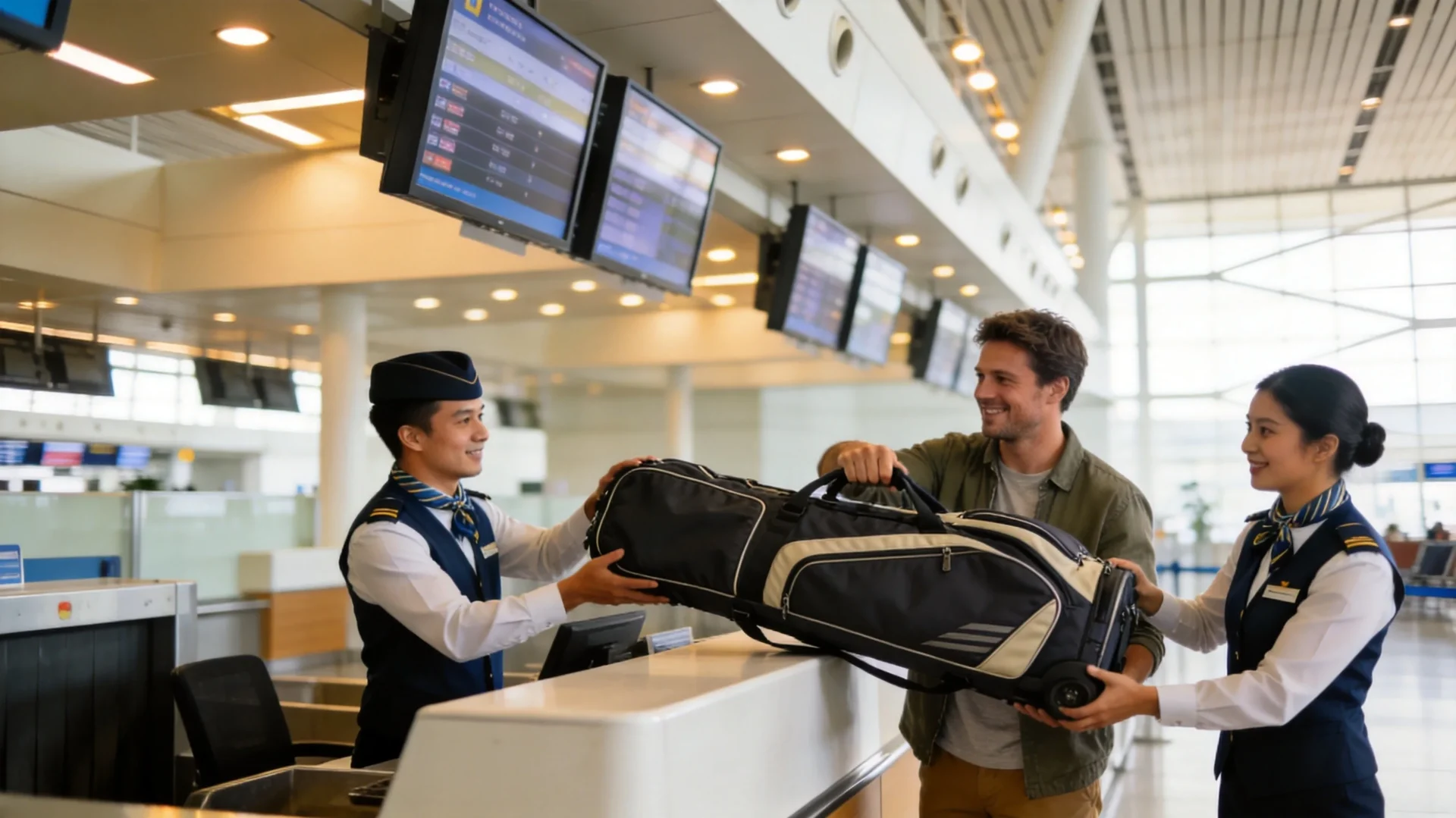
2. Standard airline limits for checked golf bags
Most airlines use a linear (length + width + height) ceiling plus a weight allowance. The widely used industry default is 158 cm / 62 in total linear and 23 kg / 50 lb, a baseline set by the IATA baggage standards. Premium cabins on several carriers allow more weight, and low-cost or regional carriers may impose tighter limits. Because limits and fees vary by airline, route, and season, verify on the carrier’s website before booking – not after.
Two things matter more than the printed limit: whether the airline treats your golf bag as a standard checked item or a specialty item, and whether an oversize fee applies at all. On many full-service carriers a golf bag counts as one standard checked bag – so if your ticket already includes a free checked bag, your clubs may fly at no extra charge at all.
3. Airline-by-airline golf-bag policy comparison
Policies differ enough that a blanket answer is risky. The table below summarizes published policies from carrier websites (sources linked below each section); fees change frequently and vary by route and season, so treat these as planning figures and always reconfirm on the airline’s site before booking.
| Airline | Checked as standard? | Oversize fee | Key condition & typical fee |
|---|---|---|---|
| United | Yes | Waived for one golf bag | Soft-sided case needs a limited-liability release; overweight over 50 lb (23 kg) fees apply. Standard checked fee roughly $45 prepaid. |
| Delta | Yes | Waived up to 115 linear in (292 cm) | One golf bag per passenger as standard checked item; overweight over 50 lb charged. Oversize 63–80 in incurs about $200 when it applies. |
| American | Yes | Waived | Standard checked fees (1st bag $50, or $45 online) up to 50 lb / 23 kg; overweight fee over 50 lb and up to 70 lb. |
| British Airways | Yes | Treated as oversize item | Counts as one checked-bag item in a rigid or safe case; may include an umbrella, a dozen balls, tees, and one pair of shoes. |
| Southwest | Yes | None (included) | Golf bag counts toward your two free checked bags; one of the friendliest US carriers for golfers. |
| Xiamen Air (int’l) | Yes | Free to 23 kg / 158 cm | One set of golf equipment is free within the checked allowance (23 kg, 158 cm) on international routes. |
Sources: United Sports Equipment · Delta Sporting Equipment · American Airlines Golf Baggage · British Airways Sports Equipment. Reconfirm before booking.
4. How to pack to protect your clubs
Clubs get damaged in transit far more often by loose movement inside the bag than by the bag itself being crushed. The goal is to lock the weight of the set in place and stop the club heads from striking each other. A good packing routine takes only a few minutes but is the difference between arriving ready to play and arriving with a bent shaft.
- Use a padded travel cover with a club-protector sleeve that clamps around the heads.
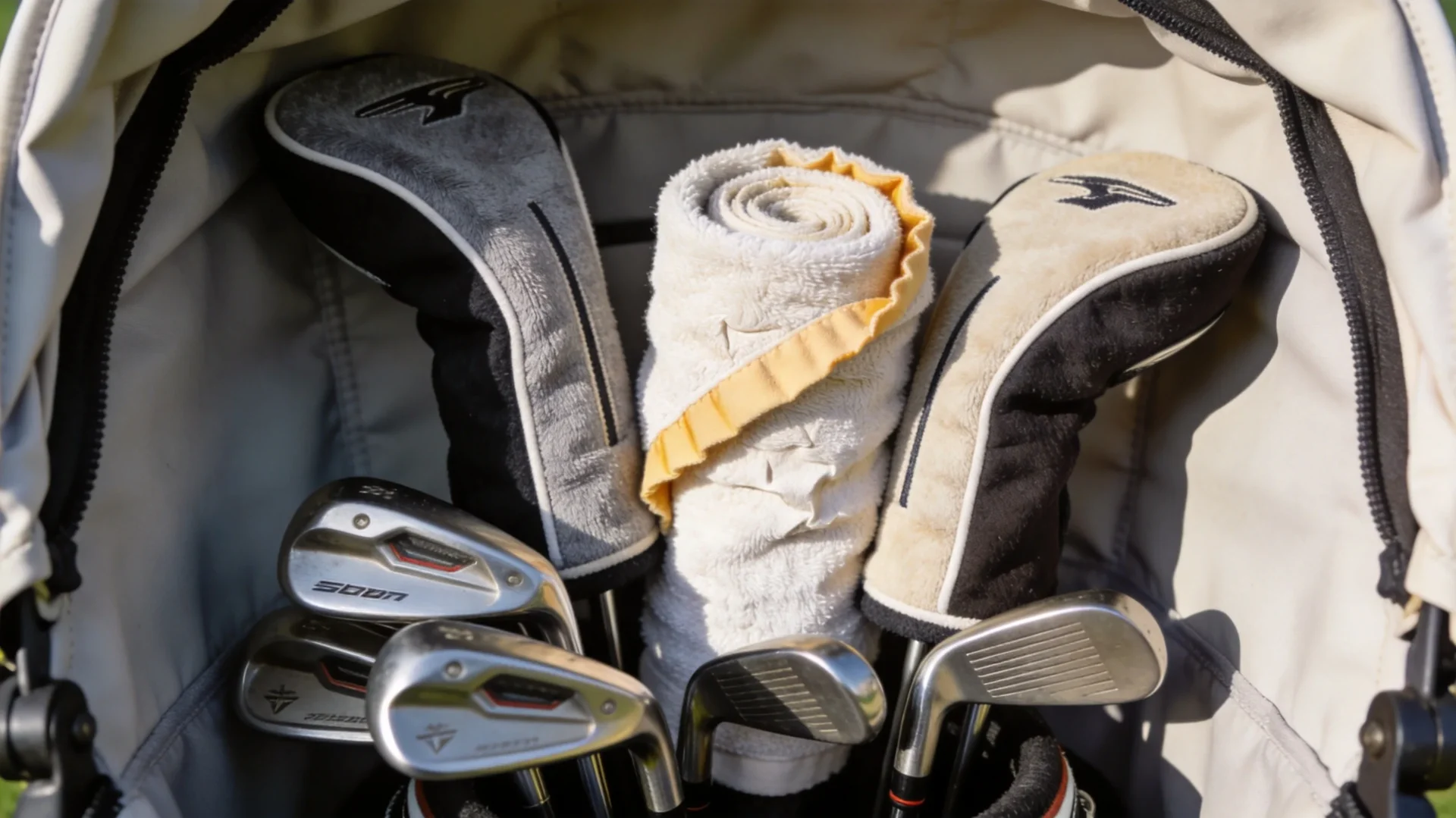
- Add a rolled towel or bubble wrap between irons so the faces and shafts do not contact each other.
- Remove the driver and woods heads if detachable; keep them in the head covers, tucked inside the bag.
- Fill empty space (a towel in the umbrella sleeve) to stop the whole set from shifting in transit.
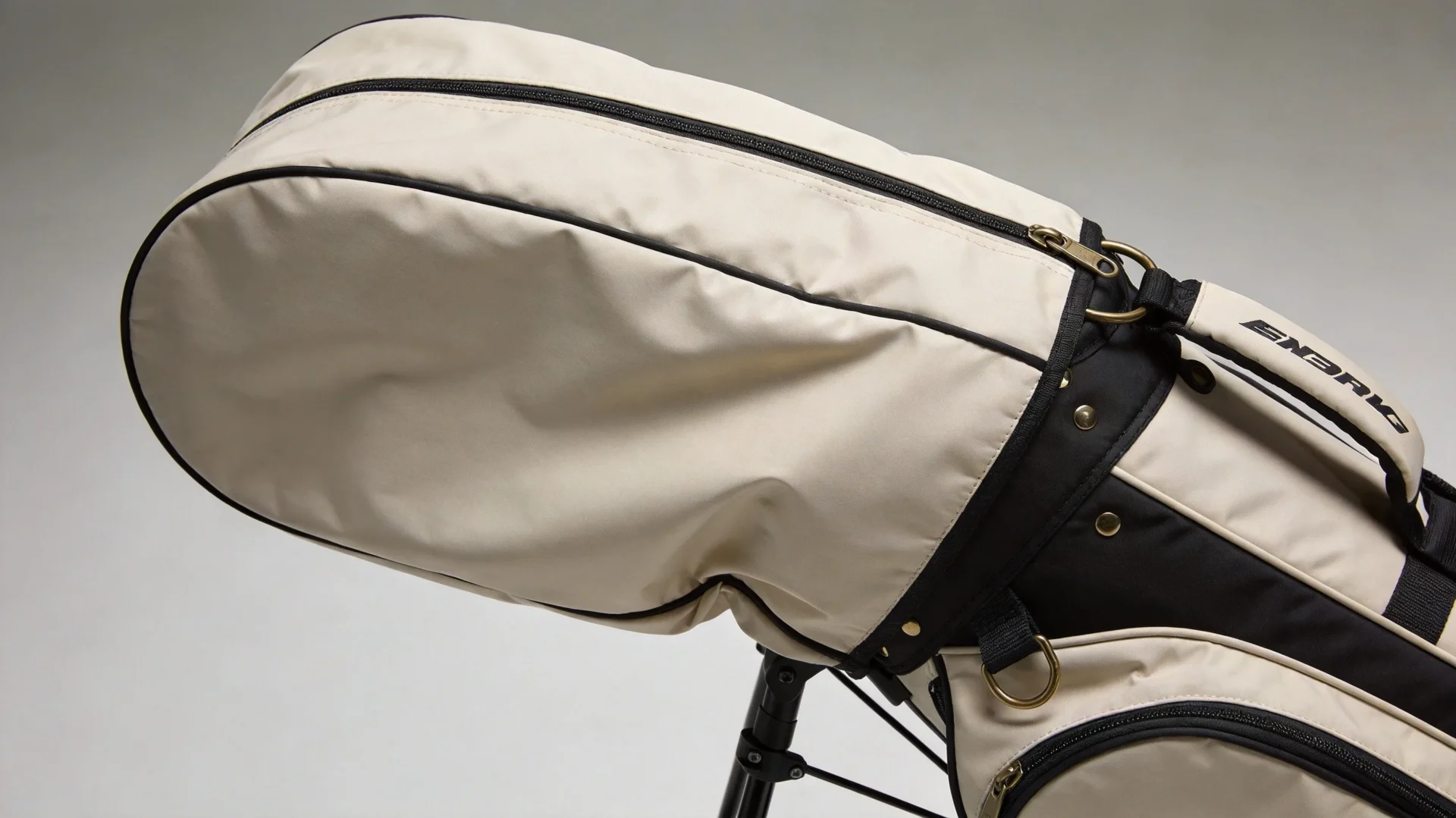
- Close the rain hood over the heads for an extra layer, then label the bag with your name and contact information.
If you fly often, a hard-sided travel case dramatically reduces risk and is required by some operators, while a soft-sided bag packs flat when stored. Whichever you use, keep the full set at or below 23 kg / 50 lb so you stay inside the standard checked-bag weight and avoid overweight charges.
5. What to remove before flying
Every extra that rides in the bag adds weight and risk. Strip it down before you leave home:
- Loose balls, tees, and small accessories – they spill and quietly push you over the weight limit.
- Any prohibited item – fuels, pressure canisters, or oversized multi-tools that security or the carrier will reject.
- Valuables such as rangefinders, watches, and electronics that should never be in checked baggage; carry them with you instead.
Empty the side pockets of old wrapper and forgotten gear, too. A few stray tees and a can of balls can be the difference between a free checked bag and a $60 overweight fee at the counter.
6. Arrival and transit tips for flying with golf bags
The flight itself is rarely the problem – the connections are. Golf bags are long and heavy, and they take time to be moved between aircraft. If you connect, build in buffer time; sporting gear is notoriously slow on tight transfers and is among the first items to miss a short connection.
- Check length in international conversions – a 20-in carry-on converts fine, but club length often pushes the bag near the 62-in ceiling.
- For connections, book a layover long enough for both you and your clubs to make it.
- Opt for an airline-friendly soft-sided travel bag that meets common limits for repeat trips.
- On arrival, inspect the bag before you leave the baggage hall so you can file a damage claim on the spot, while witnesses and staff are nearby.
7. Does airline liability cover your clubs?
Checked bags are generally covered only up to a liability cap set by the airline or by treaty – under the Montreal Convention this is roughly 1,288 SDR (special drawing rights) internationally, which usually does not reflect the real value of a full golf set. For expensive or tournament clubs, frequent travellers often add baggage coverage through their travel insurance, credit card benefits, or a dedicated sports-equipment policy. If clubs are damaged, report it to the airline before leaving the airport and keep the case and photos as evidence.
8. A pre-trip packing checklist
Running the same checklist every trip saves time and money at the airport. Before you leave home: weigh the full packed bag against the 50 lb limit; confirm the airline’s current golf-bag policy, including whether it counts toward a free checked bag or attracts a specialty fee; confirm the route’s linear and weight ceiling in the right units. On the day of travel, arrive with enough buffer to check in at the counter rather than a kiosk, because a golf bag often needs a staff check.
Keep your booking reference and any sports-equipment purchase receipt handy in case you need to dispute a fee. If you travel on the same airline regularly, check whether your loyalty status or co-branded card includes free checked bags – many elite tiers and cardholders do, which can turn a $45 to $150 golf-bag charge into $0. A little planning turns one of the most annoying parts of a golf trip into a non-event.
9. Hard case vs soft travel bag: which should you buy?
Both carry clubs safely, but they suit different travellers. A hard-sided case offers the best impact protection – it spreads a crush load across the whole shell – and many carriers insist on one for fragile contents. It is heavier (often 4 to 7 kg empty), bulkier to store, and more expensive, but it is the safest choice for frequent flying and high-value sets. A soft-sided travel bag is lighter, packs flat when not in use, and usually fits inside the standard checked-bag allowance more easily; United still accepts it, though it asks you to sign a limited-liability release.
There is a practical middle ground: a soft bag with a hard protective base and a stiff club-head sleeve protects the two most vulnerable points (heads and base) while staying light enough to keep your full set under 23 kg / 50 lb. For most golfers flying a few times a year, this is the most practical buy; for tournament players flying monthly, a hard case is worth the weight.
10. Weight, fees, and the 50 lb ceiling
The single most common reason a golf bag triggers an extra charge is not size – it is weight. Almost every full-service airline uses 23 kg / 50 lb as the checked-bag ceiling, and a fully packed golf bag full of balls, towels, and a rangefinder can easily creep past it. Overweight fees are charged per bag, and some carriers apply them at escalating rates.
Practical ways to stay under the ceiling: empty loose balls, leave heavy towels at home and use bubble wrap, remove the detachable rangefinder and carry it in your hand bag, and weigh your case on a bathroom scale before you leave. A one-pound mistake at the counter can cost $50 to $200 depending on the airline and route. When you order a custom travel bag, ask the factory for the empty-bag weight – a spec that is too heavy eats into your packing budget before you add a single club.
11. An airline-friendly golf travel bag – a JUNYUAN manufacturer’s view
Flying is the reason most golfers buy a travel bag in the first place, and the traveller experience lives or dies on a few design choices: empty weight low enough to hold a full set under 50 lb, a protective head zone, a stable base, and packed dimensions close to the 158 cm / 62 in IATA ceiling. These are engineering considerations, not just style.
JUNYUAN BAGS designs and manufactures airline-friendly golf travel bags through an affiliated OEM factory (founded 2013, 4,950 sqm, 7 production lines, 149 machines, 137 staff) with a monthly capacity of 200,000 pieces (SGS-verified). We engineer soft-side shells that meet the common weight and size ceilings, use padded dividers and reinforced bases, and test to the same QC standard (AQL 2.5) as our other lines. MOQ 500 pcs; sampling 6–10 days; bulk production 35–50 days.
For brands and retailers launching a golf travel bag line, this matters: a design that pushes the empty bag weight too high will push buyers past the 50 lb checked limit once they pack a full set. A manufacturer who understands the airline rules can spec materials to keep the empty bag lean while protecting the contents – cutting buyer friction and returns.
Flying with a custom golf travel bag that fits the rules? Talk to us for OEM/ODM golf travel bags with padded dividers – MOQ 500 pcs, sampling in 6–10 days.