
A bag manufacturer established in 2014, with our founder working in the golf and bag trade since 2004. This page is written for the buyer, product developer or sourcing manager who has to place a cart-bag order and defend the price, the tooling spend and the delivery date to someone above them. It is a procurement engineering document — specification, cost structure, one-time tooling, test protocol, inspection gates, carton cube and programme management — not a product brochure. For the product itself, the construction range and the finish options, start on our custom golf cart bags page and come back here when you need the numbers behind it.
Short answer for buyers: a custom golf cart bag programme has three costs, not one. There is the unit FOB, there is the one-time tooling and sampling spend that never appears on the purchase order until you ask for it, and there is the cost of getting the specification wrong — which shows up eighteen months later as a returns rate on a strap channel that chafed through or a divider top that cracked in a cold container. On a mid-market 14-way cart bag in PU-backed 900D–1200D polyester, labour is roughly a quarter of FOB, fabric and lining about a fifth, and the moulded divider top plus frame about a fifth combined; that ratio is why “can you take 8% out of the price” almost always means “can you take a component out of the bag”. Tooling for a new divider-top geometry runs USD 1,800–3,200 and amortises to USD 3.60–6.40 per piece at 500 units, or USD 0.90–1.60 at 2,000. We build cart bags at 500 pieces per style, sample in 6–10 working days from a locked spec, run mass production 35–50 days after sample approval, and inspect to AQL 2.5 major / 4.0 minor.
What a Cart-Bag Manufacturer Actually Sells You — and What It Does Not
Most first-time cart-bag buyers assume they are buying a bag. They are actually buying four separable things, and only one of them is the bag: the design and tooling, the material conversion, the compliance paperwork, and the logistics. Factories quote differently on each, which is why two quotations for “the same” 14-way cart bag can land 30% apart and both be honest.
The table below is the scope-of-supply matrix we use in the first call with a new buyer. Read down the left column and decide, line by line, whether you are buying that from us or doing it yourself. The classic failure is a brand that assumes labelling and EU responsible-person duties sit with the factory, then discovers at the port that they do not.
| Scope item | OEM (you own the design) | ODM (we own a platform) | Private label / white label | Who normally pays |
|---|---|---|---|---|
| Design & tech pack | You supply drawings, dimensions, artwork | We supply a base platform; you choose colours, pockets, branding | Existing platform, your label only | You, in engineering time |
| Tooling (divider top, base, logo plate) | New moulds, you may own them | Shared mould, no tooling fee | Shared mould, no tooling fee | You — or amortised into unit price |
| Fabric development / lab dips | Full development, 5–7 days per round | Colour chosen from a held card | Held card only | Included up to 3 lab dips |
| Sampling | Proto + salesman + pre-production | Salesman sample only | Photo sample only | You, credited against the order |
| Third-party testing | Per your protocol, lab of your choice | Standard protocol, our lab panel | Standard protocol | You, per report |
| Retail labels, UPC, care labels, GPSR data | You supply files, we apply | You supply files, we apply | You supply files, we apply | You |
| EU responsible person / UK RP | Your obligation | Your obligation | Your obligation | You — we are not an RP |
| Export cartons, palletisation, marking | Included to your marking spec | Included | Included | Us, in FOB |
| Ocean freight, duty, destination charges | Not included | Not included | Not included | You, or your forwarder |
| Product liability insurance | Your policy | Your policy | Your policy | You |
Two lines in that matrix cause most of the arguments. The first is tooling ownership. If you pay for a divider-top mould, say so in writing and get it recorded as your property, because a mould is the only part of a cart bag that can make your SKU impossible to copy cheaply. We will sign that; plenty of factories will not. The second is the EU General Product Safety Regulation, in force since 13 December 2024, which requires an economic operator established in the EU to be named on the product or its packaging, along with traceability information. That operator is you or your EU importer. A Chinese factory cannot be your responsible person, and any supplier who says they will “handle GPSR” is describing label artwork, not legal responsibility.
The Specification Sheet: Twenty-Four Parameters to Fix Before You Ask for a Quote
An RFQ that says “500 custom golf cart bags, 14-way, black, with our logo” will produce five quotations that cannot be compared, because each factory will fill the gaps with whatever is cheapest in its own sample room. The sheet below is the minimum we need before a price is meaningful. It is also the document that protects you at final inspection: anything not written here cannot be argued about later.
| # | Parameter | Options we build | What to specify | Tolerance / note |
|---|---|---|---|---|
| 1 | Construction | Cart / stand / staff / sunday | Cart | Not interchangeable — different frame and base |
| 2 | Divider top | 6, 7, 14, 15-way; ABS, EVA, nylon web | Way count + material + tube type | ±1 mm on slot pitch |
| 3 | Divider depth | Full-length tubes / partial grid | Full-length above 8-way | State it — this is the #1 silent downgrade |
| 4 | Body fabric | 600D–1680D polyester, ripstop nylon, PU leather | Denier + backing + colour | ±5% weight per roll |
| 5 | Lining | 210D, 190T, 75D taffeta, brushed tricot | Fabric + colour | Must be named, not “matching” |
| 6 | Frame | PP board, EVA, wire frame + foam | Type + thickness | ±0.5 mm board thickness |
| 7 | Base | Moulded EVA, moulded PP, flat reinforced | Type + diameter | ±3 mm diameter |
| 8 | Cart strap channel | Open slot, reinforced pass-through, D-ring | Type + reinforcement | Bar-tack at both ends |
| 9 | Pocket count | 6–10 external + valuables + cooler | Count and function of each | List each pocket, not a total |
| 10 | Zips | #5, #8, #10 coil; moulded; water-resistant | Size + type + brand if required | Storm flap on exposed pockets |
| 11 | Hardware | Acetal, nylon, plated metal, stainless | Material per part | Salt-spray 48 h for metal |
| 12 | Top handle | Moulded, webbing, padded leather-look | Type + attachment | Bar-tack + rivet |
| 13 | Shoulder strap | Single, dual, detachable, none | Include or delete | Cart bags often delete it — ask |
| 14 | Umbrella sleeve | None, side, integrated | Include + position | Drain eyelet required |
| 15 | Rain hood | None, sleeve pocket, attached | Include + storage | Must be listed or it will not ship |
| 16 | Cooler pocket | None, insulated, removable liner | Volume in litres | State liner material |
| 17 | Weight target | 2.5–4.0 kg band | Target and maximum | ±150 g per piece |
| 18 | Branding method | Embroidery, heat transfer, silicone, metal plate, print | Method + position + size | Per method, per colour |
| 19 | Colour standard | Pantone TCX / TPX | Reference per material | ΔE ≤ 1.5 target, ≥4 grey scale |
| 20 | Labels | Woven main, care, UPC, RFID optional | Positions and content | You supply artwork files |
| 21 | Packing | 1 pc/polybag, 4 pcs/ctn; retail-ready | Carton config + marking | Drives freight per unit |
| 22 | Test protocol | Standard 13-test panel or yours | Attach your protocol | Report per lot or per style |
| 23 | Inspection standard | AQL 2.5 / 4.0 (ISO 2859-1, GII) | Confirm or state yours | Sampling plan in the PO |
| 24 | Delivery term | FOB Xiamen, EXW, CIF | Term + port | FOB is our default |
If you only fix six of those twenty-four, fix numbers 2, 3, 8, 17, 21 and 22. Divider geometry and divider depth are where a quotation quietly gets 12% cheaper; the strap channel is where the bag fails first; weight is where the retail spec sheet gets challenged by a customer with a kitchen scale; carton configuration changes your landed cost more than a 5% FOB movement; and the test protocol is the only thing that turns a quality argument into a measurement.
The BOM: Where the FOB Actually Goes
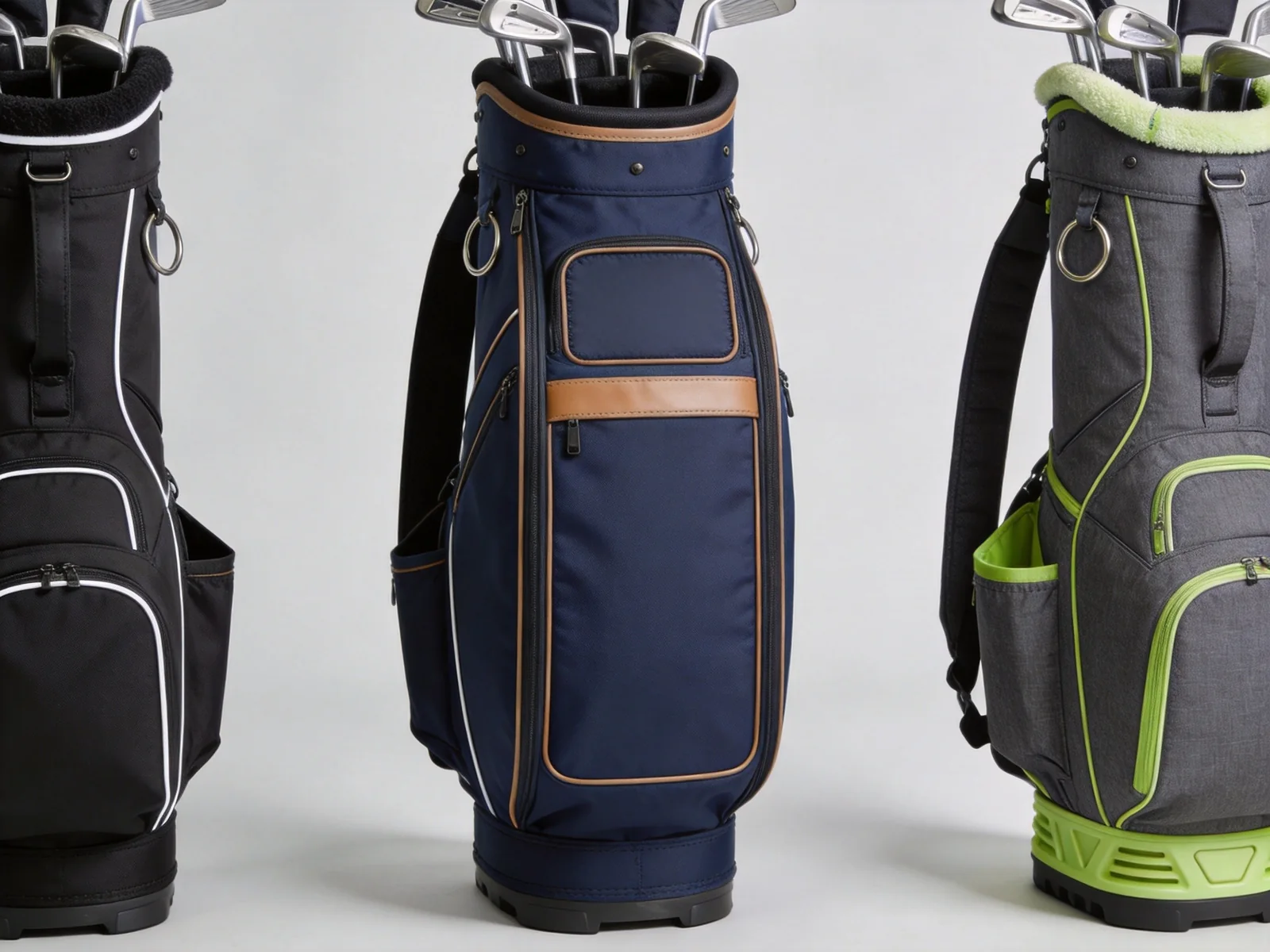
Buyers ask for a cost breakdown for one of two reasons: to negotiate, or to decide which specification to cut. A breakdown is only useful for the second purpose, so the table below is built that way — every line shows the share of FOB, what drives it, and what happens to the bag if you take it out. The worked example is a 14-way cart bag in PU-backed 900D polyester with a moulded EVA base, 8 external pockets, embroidery at one position, at a quoted FOB of USD 42.00 for 500 pieces. Your own number will differ by fabric and by port, but the proportions hold across the category.
| Cost element | Share of FOB | At FOB 42.00 | What drives it | If you cut it |
|---|---|---|---|---|
| Body fabric and lining | 18–24% | 8.80 | Denier, backing coats, yardage per bag (2.4–3.1 m of 1.5 m goods) | Drop 900D to 600D: −6% FOB, tear strength down ~30% |
| Divider top, tubes, collar | 8–12% | 4.20 | Mould size, ABS grade, tube count, foam padding | Partial dividers instead of full-length tubes: −4% FOB, grips tangle |
| Frame, base and EVA mouldings | 7–9% | 3.40 | Board thickness, base moulding, foam fill | Flat board base instead of moulded: −2% FOB, bag leans on the cart |
| Zips and hardware | 7–9% | 3.40 | Zip size and brand, metal vs acetal, D-rings, towel ring | #5 coil instead of #8: −1.5% FOB, zip is the first claim item |
| Pocket build and padding | 6–8% | 2.90 | Pocket count, gusset depth, fleece-lined valuables pocket | Two pockets fewer: −2% FOB, retail spec loses its story |
| Direct labour | 22–26% | 10.10 | Piece count per operator per day, stitch density, bar-tack count | This is the line most “cheap” quotes cut — via fewer bar-tacks, not lower wages |
| Branding | 3–6% | 1.70 | Method, number of colours, number of positions | One embroidery position instead of three: −2% FOB |
| Packaging | 2–3% | 1.10 | Polybag, hangtag, carton grade, retail-ready vs bulk | Bulk carton only: −0.6% FOB, but retail-ready re-packing costs more at destination |
| Testing and documentation | 1–2% | 0.60 | Number of reports, whether per style or per lot | Skip it and you own the risk entirely — not recommended |
| Factory overhead and margin | 12–15% | 5.80 | Volume, payment terms, season, order frequency | The line to negotiate on volume, never on specification |
Read the labour line against the material lines and the logic of cart-bag pricing becomes obvious. Labour is the single largest block at roughly a quarter of FOB, but it is also the least compressible without changing the bag: a cart bag has around 180–260 separate stitch operations, and the difference between a USD 42 bag and a USD 33 bag is usually 40 of those operations plus a lighter substrate — not a cheaper workforce. When a quotation comes in 20% under the field, ask which of these five things happened: denier reduced, divider tubes removed, bar-tack count reduced, zip size reduced, or backing coats reduced from two to one. In our experience of re-quoting other factories’ samples, it is almost always two or three of them at once.
What “the same bag, cheaper” really means
There is one legitimate way to take 8–12% out of a cart-bag FOB without degrading the product: change the order structure, not the specification. Longer runs, fewer colourways, one branding position instead of three, a forecast instead of a single spot order, and a booking placed outside the August-to-October peak all move the price. The moulded parts are the clearest example — the divider top mould is the same whether you run 500 or 3,000 pieces, so the tooling amortisation, the machine set-up and the first-off inspection all spread over six times as many units.
Tooling and One-Time Costs — the Line That Is Not on the Quotation
Cart bags carry more tooling than any other bag in the catalogue, because they carry more moulded parts. A tote bag can be tooled with a knife and a screen; a 14-way cart bag needs an injection mould for the divider top, a second mould or compression tool for the base, and usually a plate or die for the badge. None of that appears in a per-unit FOB quotation unless you ask, and the surprise lands after you have chosen your supplier.
| One-time item | Typical cost (USD) | Lead time | Ownership | Notes |
|---|---|---|---|---|
| Divider top injection mould, 14-way | 1,800–3,200 | 18–25 days | Negotiable, we will assign to you | Cost scales with slot count and undercuts |
| Divider top mould, 6-way or 7-way | 1,200–2,200 | 15–20 days | Negotiable | Cheaper geometry, fewer slides |
| Base mould (EVA compression or PP injection) | 900–1,600 | 15–22 days | Negotiable | Only needed if you change base diameter or profile |
| Handle or badge insert | 300–600 | 10–15 days | Yours | Insert swaps into an existing mould base |
| Metal badge die | 200–450 | 10–14 days | Yours | Etched or stamped; per artwork |
| Silicone or PVC patch tooling | 250–550 | 10–15 days | Yours | Per design, per size |
| Embroidery digitising | 60–120 | 2–4 days | Yours | One-off per logo, reusable across styles |
| Screen print frame | 60–110 per colour | 3–5 days | Yours | Per colour, per position |
| Woven label jacquard plate | 120–260 | 7–10 days | Yours | Per label design |
| Prototype sample fee | 120–260 | 6–10 days | Credited at 500 pcs | Credited against the first order |
| Pre-production (PP) sample | 180–320 | +4–6 days after proto approval | Credited at 1,000 pcs | Built from production materials, not sample-room stock |
| Third-party test report | 350–900 per report | 10–18 days | Yours | Paid to the lab, not to us |
Amortisation, worked through
Take a programme that needs a new 14-way divider top, a new base profile and one embroidery logo: tooling at USD 2,600 + 1,200 + 90, plus two prototype rounds at USD 200 each. Call it USD 4,290 before freight. At 500 pieces that is USD 8.58 per bag — 20% on top of a USD 42 FOB, which is enough to kill a programme if it is discovered late. At 2,000 pieces it is USD 2.15, or 5%. At 5,000 it is USD 0.86, or 2%.
Three practical consequences. First, if your first order is 500 pieces, do not change the divider-top geometry unless the retail story depends on it — use an existing mould and spend the money on fabric and branding, which are visible to the customer. Second, ask for the tooling to be invoiced separately rather than amortised into the unit price: it is cleaner for your cost accounting, it makes ownership explicit, and it means a reorder does not carry a tooling charge that has already been paid. Third, if you plan a three-season programme, negotiate mould ownership in writing at the quotation stage, because it is much easier to obtain before the tool is cut than after.
The MOQ Ladder and What Each Price Break Is Actually Buying
Our floor is 500 pieces per style. Below that, three costs stop amortising: the fabric mill’s minimum on a custom colour, the cutting spread (a 500-piece run uses roughly 1,500 m of goods, which is the smallest economical lay for a cart-bag panel set), and the line set-up on the moulding machines. Colourways can be mixed inside the 500 as long as the total per fabric and per colour meets the mill minimum, which is usually 300–500 m.
| Order quantity | Price index | Tooling per unit (USD 4,290) | What changes operationally |
|---|---|---|---|
| 500 pcs | 100 | 8.58 | Single line, single run, standard 35–50 day window |
| 1,000 pcs | 95–97 | 4.29 | Fabric booked as one dye lot, cutting spread improves |
| 2,000 pcs | 90–93 | 2.15 | Two runs; moulding set-up amortised; better zip and hardware pricing |
| 3,000–5,000 pcs | 87–90 | 1.43–0.86 | Dedicated line window, staged deliveries, negotiated component pricing |
| Below 500 pcs | Quoted individually | — | Only with an existing mould and a stock fabric; expect +15–25% |
Note what the ladder does not buy: it does not buy a lighter bag or a cheaper zip. Volume discounts in this category come from set-up amortisation and component purchasing, not from the sewing floor, which is why a 5,000-piece order still cannot be 30% cheaper than a 500-piece order unless the specification changes. When a supplier offers that, the specification has changed.
Cart-Fit Engineering: The Six Measurements That Decide Your Returns Rate
A cart bag that does not sit still on a cart is a return, a one-star review and, for a pro-shop buyer, a shelf problem. Fit is entirely a matter of six dimensions plus the strap channel, and all seven can be specified, measured and inspected. The table below gives the ranges we build to, based on the carts most often named by our buyers — Club Car, EZGO and Yamaha on the riding side, PowaKaddy and Motocaddy on the push side. If your market is dominated by a cart we have not built for, send us the cart’s bag-well measurements and we will build a fit sample.
| Dimension | How it is measured | Range we build | Inspection tolerance | What happens if it is wrong |
|---|---|---|---|---|
| Strap channel height | Base bottom to channel centre line | 150–220 mm | ±5 mm | Strap rides over the pocket seam and chafes through in a season |
| Channel clear width | Inside edge to inside edge | 55–75 mm | ±3 mm | Strap will not pass, or the bag shifts under braking |
| Base width | Widest point of the moulded base | 200–260 mm | ±3 mm | Bag will not seat in the well, or tips forward |
| Base depth | Front to back of the base | 150–190 mm | ±3 mm | Rocking on the cart platform |
| Overall height | Base bottom to top of collar | 850–950 mm | ±10 mm | Fouls the cart’s upper bracket or the rain canopy |
| Overall width at widest pocket | Loaded bag, pockets full | 300–380 mm | ±8 mm | Bag cannot be removed with the strap engaged |
| Top opening | Long axis × short axis of the divider top | 240 × 200 mm typical | ±4 mm | Clubs foul the collar on entry |
The fit-test protocol we run on every new cart-bag geometry
A fit sample is not a photo sample. We build one piece, fill it with 14 clubs including a 460 cc driver and a mallet putter, load every pocket to its intended retail weight — 1.5 kg in the ball pocket, 1.2 kg in the cooler, 0.8 kg in the valuables pocket — then run four checks: static seat in a cart well (no rocking, base fully supported), strap pass-through at the specified channel height (strap engages with the bag loaded, no pocket compression), removal and re-fitting with the strap engaged (should take one person under five seconds), and a 20-minute drive simulation on a vibrating table at 8 Hz with the strap tensioned to 40 N. Any mark on the fabric after that run is a specification problem, and it is far cheaper to find it on one sample than on 500 bags.
Test Protocol: Thirteen Checks and What Each One Is Really For
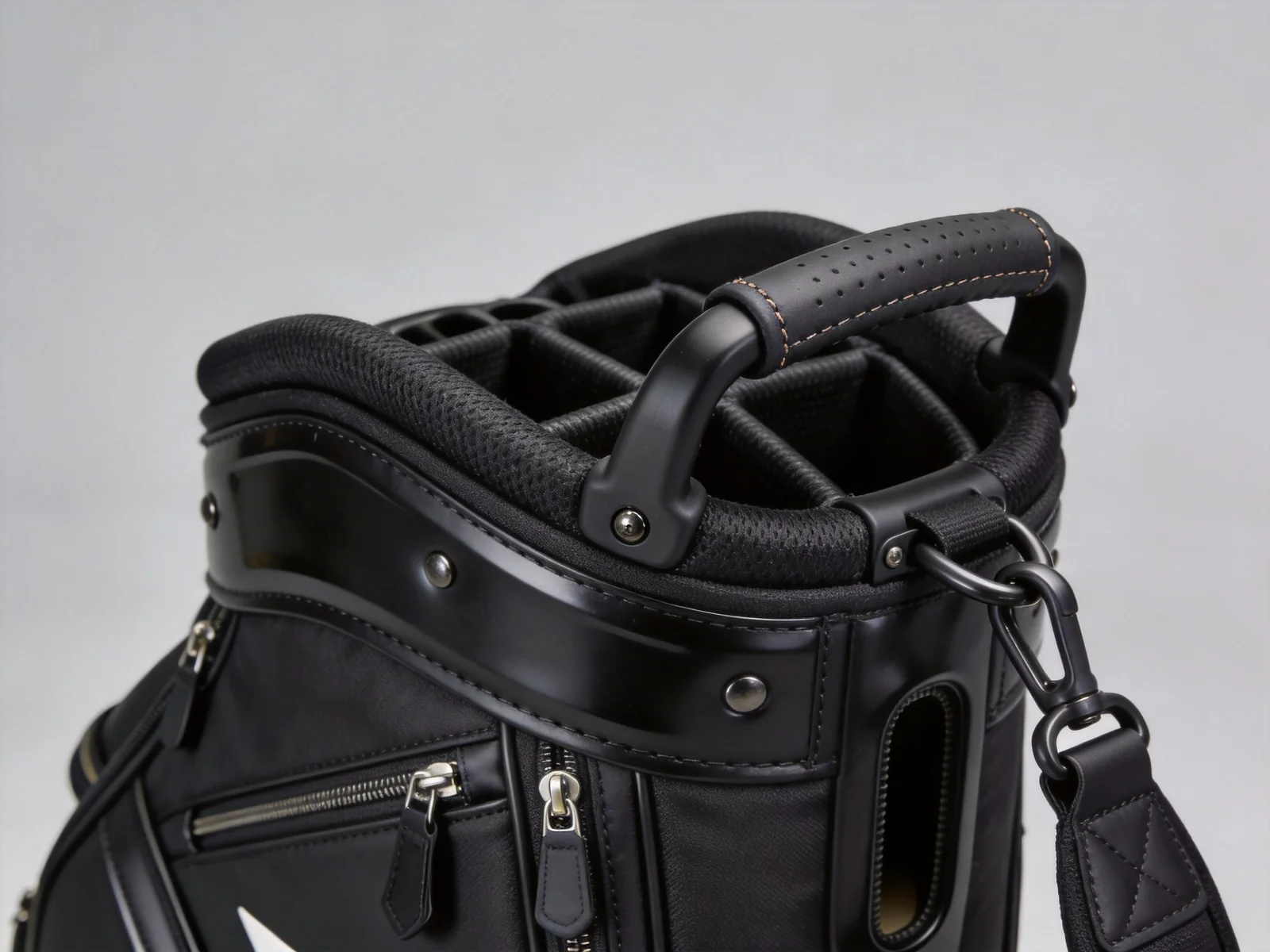
Cart bags are tested harder than any other bag we build, because they live outdoors for four hours at a time, strapped to a vibrating machine, in sun and rain. The panel below is our standard protocol. It is not a marketing list — each test exists because we have seen the failure it catches. Where a buyer has their own protocol, we run theirs instead, and we will tell you in advance which of their tests our standard construction would fail.
| # | Test | Method / condition | Accept criterion | Failure it catches |
|---|---|---|---|---|
| 1 | Cart-strap abrasion | 50 mm webbing strap, 20 kg load, 5,000 cycles over the channel | No substrate breakthrough; coating intact | The single most common field failure on cart bags |
| 2 | Static top load | 25 kg on the divider top, 24 h, 23 °C | Permanent set ≤5 mm; no cracking | Collapsed or crazed divider tops |
| 3 | Handle pull | 300 N, 10 s, 10 cycles, both directions | No stitch failure, no tear-out | Handle pulling out of the collar on the first lift |
| 4 | Drop test | 1.2 m, six faces, bag filled to 8 kg | No structural failure, no hardware fracture | Base and frame shock damage in transit |
| 5 | Zip cycle | 3,000 open/close cycles at the ball pocket | No skipped teeth, pull and slider intact | Zip is the number one claim item after strap chafe |
| 6 | Fabric tear | Trouser tear, warp and weft | ≥40 N warp on 900D body | Pocket corner and channel-edge tearing |
| 7 | Seam strength | Grab test on main body and base seams | ≥250 N per 50 mm | Seam burst at the base gusset |
| 8 | Abrasion | Martindale, 12 kPa | 25,000 cycles, no hole | Cart-well contact wear |
| 9 | Colourfastness to rubbing | Dry and wet crock | ≥4 grey scale | Dye transfer onto light trousers and cart seats |
| 10 | Colourfastness to light | 200 h xenon arc | ≥4 grey scale; no coating chalk | Navy and black fading to grey in one summer |
| 11 | Cold crack | −20 °C, 4 h, then flex | No coating crack | PU backing cracking in an unheated container or a cold-climate season |
| 12 | Salt spray | 48 h neutral salt fog on metal parts | No red rust | Towel rings and D-rings rusting at the coast |
| 13 | Water resistance | Spray rating on exposed panels | ≥4 for a water-resistant claim | Any “waterproof” wording that the fabric cannot support |
Compliance: what we can issue, and what we cannot
This is the section where suppliers are most often vague, so it is worth being precise. We are a manufacturer, not a notified body, a test house or an authorised representative. What we can give you is: mill-issued test reports and transaction certificates for the fabric where the mill provides them, third-party test reports from an accredited laboratory commissioned on your behalf, a bill of materials with full component disclosure, a draft declaration of conformity for your review and signature, and label artwork to your specification. What we cannot give you is a certificate in our own name that makes your product compliant — no factory can, whatever the certificate on the wall says.
- EU General Product Safety Regulation (EU) 2023/988, applicable since 13 December 2024 — requires an EU-established responsible economic operator, traceability information on the product or packaging, and risk documentation. We supply the traceability data; you or your EU importer hold the responsibility.
- REACH — we test against the current SVHC candidate list on request and provide the component declaration. Azo dyes, phthalates and heavy metals are the three families that matter for bag hardware and coatings.
- California Proposition 65 — relevant for PVC components and for printed or coated surfaces. We will supply the material declarations you need for your warning assessment.
- CPSIA — if you are building junior or kids cart bags, the classification changes and third-party testing becomes mandatory. Tell us at the brief stage, not at the PO stage.
- Packaging EPR — France, Germany, Spain and others require registration and reporting on packaging placed on market. Carton weights and material composition are on our packing list for exactly this reason.
- Claim substantiation — “waterproof”, “recycled”, “eco-friendly” and “carbon neutral” are all claim types with different evidence requirements. We will not print a claim on a cart bag that the test report or transaction certificate does not support, and we will say so before the artwork is approved rather than after.
Four Inspection Gates, and the Defect Definitions That Make Them Work
AQL 2.5 major / 4.0 minor only means something if “major” and “minor” are defined for cart bags specifically. Our definitions are below, together with the four gates at which inspection happens. The gates matter more than the AQL number: a cart bag that is inspected only at the end has already absorbed the cost of the defect.
| Gate | When | Scope | Sample | What it stops |
|---|---|---|---|---|
| IQC — incoming | On fabric, zips and hardware receipt | Shade, weight, width, coating, zip pull force, hardware plating | 10% of rolls, 4-point fabric inspection; 20 pcs per hardware lot | Wrong dye lot entering the cutting room |
| First-off / pilot | First 3 pieces off the line | Full dimensional and visual check against the spec sheet | 100% of pilot pieces | A systematic error repeated 500 times |
| IPQC — in-line | Every 2 hours during sewing and assembly | Stitch density, bar-tack count, channel alignment, hardware torque | 3 pcs per bundle per check | Drift after a shift change or a thread change |
| Final AQL | Before packing | Function, dimensions, appearance, branding, packing | ISO 2859-1, general inspection level II, AQL 2.5 major / 4.0 minor | Defectives reaching the carton |
| Pre-shipment | After packing | Carton count, marking, drop test on 3 cartons, 10% open check | 100% carton count | Short shipment and transit damage |
Defect classification for cart bags: critical — any sharp edge or exposed mould flash at the divider top, any broken tube or shard, any hardware that releases under load; zero acceptance, the piece is scrapped. Major — skipped stitches over 20 mm on a stress seam, a zip that fails the pull test, a cart strap channel misaligned by more than 5 mm, wrong colourway or wrong branding position, a base that rocks. Minor — thread tails, label skew under 3 mm, chalk marks, shading within the approved grey scale. A cart bag with three minors is still shippable; a cart bag with one major is a claim waiting to happen.
Sampling: What Six to Ten Working Days Buys You
We quote 6–10 working days for a prototype from a confirmed specification. That clock starts when three things exist: a locked spec sheet, approved artwork for branding, and fabric either in stock or lab-dipped and approved. It stops being meaningful if any of those three is still moving, which is why the most common cause of a “late sample” is not the factory.
| Sample stage | What it is | Lead time | What it proves | What it does not prove |
|---|---|---|---|---|
| A — Prototype | First physical build from the tech pack, no branding or placeholder branding | 6–10 working days | Proportions, geometry, pocket architecture, cart fit | Production materials, colour accuracy, branding quality |
| B — Salesman sample | Finished piece with correct fabric, colour and branding | 8–12 working days | Retail appearance, branding position and legibility | Sewing consistency across a line, packing behaviour |
| C — Pre-production (PP) | Built on the line from production materials by the production team | +4–6 working days after B approval | The bag that will actually ship, including weight | Long-run drift — that is what IPQC is for |
| D — Shipment sample | Piece pulled from the finished lot, retained | At final inspection | Your reference for the reorder | — |
Two things worth insisting on. First, ask for the prototype to be weighed and measured, not just photographed: a 120 g weight drift between sample and production is normal, but 300 g is a specification change and you should hear about it before the PO, not after. Second, keep the shipment sample. When a reorder arrives two seasons later with a slightly different channel height, the retained piece is the only argument that ends the conversation quickly.
The Production Calendar: 35 to 50 Days, Broken Down
Thirty-five to fifty days from sample approval to goods ready at the port is the window we commit to. The spread is not vagueness — it is the difference between a single-colour order in a stock fabric and a multi-colourway order with a custom mould and a peak-season booking. The table shows where the days go and, more usefully, which stages are the ones that slip.
| Stage | Days | Depends on | Typical slippage cause |
|---|---|---|---|
| PO, deposit, spec lock | 0 | Signed spec sheet, 30% deposit | Artwork approval arriving after the deposit |
| Material booking and IQC | 1–6 | Fabric in stock or mill lead time (10–18 days if custom) | Custom dye lot booked late — the biggest single cause of delay |
| Moulding: divider tops, bases | 4–12 | Mould existing or new | New mould first-off approval |
| Cutting | 5–9 | Fabric released from IQC | Shade rejection at IQC forcing a re-book |
| Panel printing and embroidery | 6–12 | Approved artwork, digitised file | Pantone mismatch on the first strike-off |
| Sewing — sub-assembly | 9–22 | Cut panels, thread, zip | Absenteeism around public holidays |
| Assembly: frame, base, top, hardware | 20–32 | Moulded parts and sewn bodies | Hardware shortfall from a sub-supplier |
| Finishing and hardware torque check | 30–38 | Assembly complete | Rework after in-line findings |
| Final AQL inspection | 36–43 | 100% of the lot finished | A failed lot and a re-inspection |
| Packing and carton marking | 40–46 | Cartons, polybags, hangtags on site | Retail hangtags arriving from your printer |
| Handover to forwarder | 45–50 | Booking, container or LCL cut-off | Peak-season space, Chinese New Year cut-off |
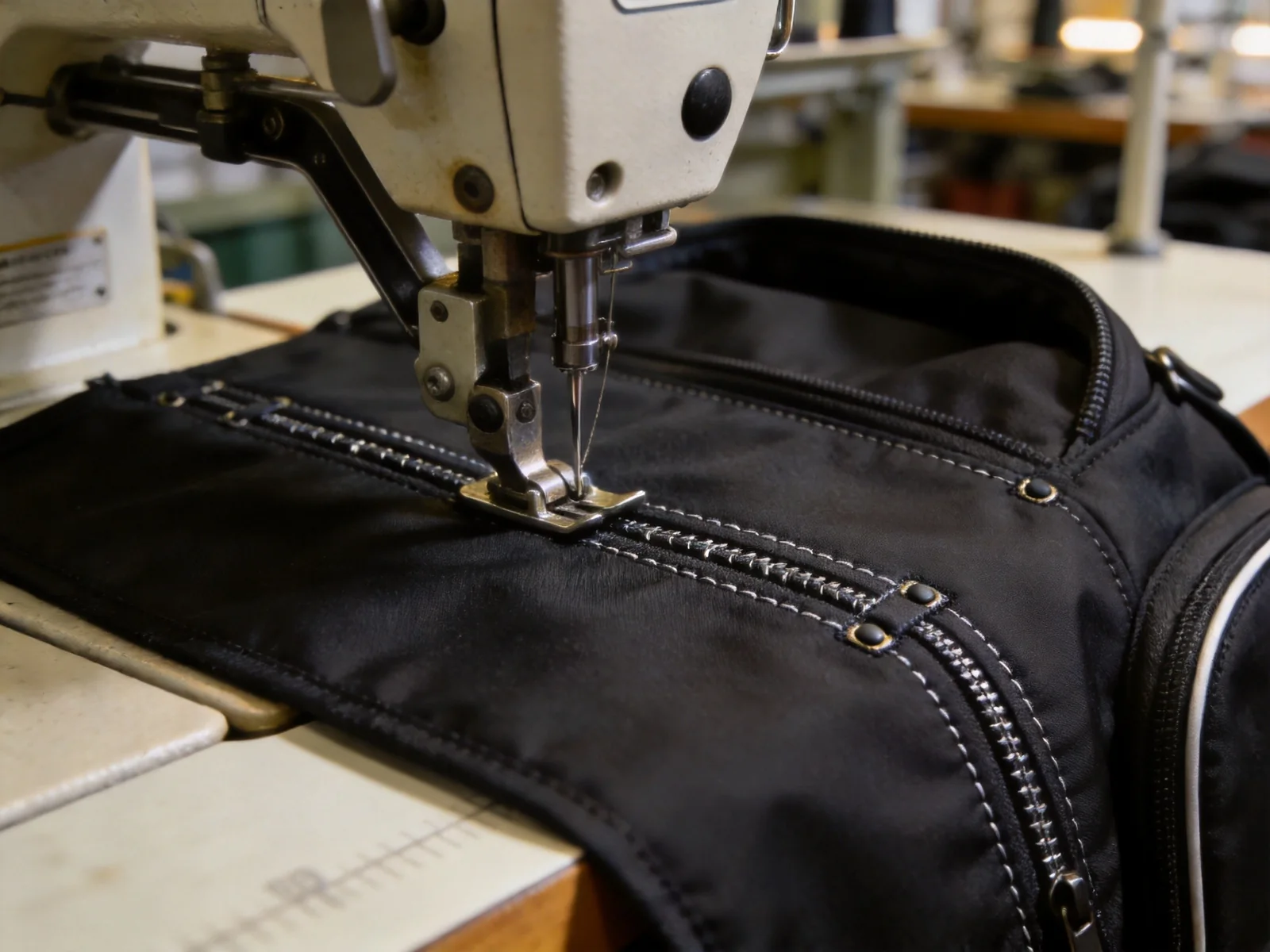
Two calendar rules we give every new buyer. Book custom fabric at the same time as the PO, not after — a 10–18 day mill lead time inside a 35–50 day window is 30–40% of the schedule. And if your delivery date is immovable — a tournament, a trade show, a retail reset — tell us the date and work backwards: we would rather move the fabric choice than move the ship date.
Packaging, Carton Cube and the Freight Number Nobody Budgets For
Cart bags are long, light and bulky, which makes freight a material part of landed cost rather than a rounding error. A 900 mm bag cannot be folded, so the carton geometry is fixed by the product and the only variables are pieces per carton and how much air you are willing to ship.
| Packing configuration | Carton (cm) | CBM per carton | CBM per piece | 40HQ load | Effect |
|---|---|---|---|---|---|
| 1 pc / polybag, 4 pcs / carton (our default) | 95 × 42 × 38 | 0.152 | 0.038 | 428 ctn = 1,712 pcs | Best cube per piece; goods arrive flat-packed with heads compressed |
| 1 pc / polybag, 2 pcs / carton | 95 × 42 × 24 | 0.096 | 0.048 | 677 ctn = 1,354 pcs | +26% freight per piece; easier handling at destination |
| Retail-ready, 1 pc / carton | 95 × 42 × 38 | 0.152 | 0.152 | 428 pcs | 4× freight per piece — only for drop-ship or e-commerce |
| 20GP reference, default packing | 95 × 42 × 38 | 0.152 | 0.038 | 184 ctn = 736 pcs | Useful for a first order that will not fill a 40HQ |
At a representative USD 2,800 for a 40HQ, the default packing lands at about USD 1.64 per bag in ocean freight, and retail-ready packing lands at about USD 6.55. That gap is usually larger than the entire margin a retailer makes on the accessory, which is why retail-ready cartons are reserved for e-commerce programmes and why a 500-piece first order should almost always ship in four-piece cartons.
Reorders, Engineering Changes and Spare Parts
A cart bag programme that runs three seasons will have at least one engineering change and at least one reorder, and both are where good supplier relationships are either used or lost. Three mechanisms are worth writing into the first purchase order.
- A frozen specification document. One versioned spec sheet, attached to the PO, with the shipment sample as its physical reference. Every later change is a numbered ECN against that document, with a price and lead-time impact quoted before it is implemented.
- Component continuity. Name the zip, the hardware and the fabric supplier in the spec. Substitution without written approval is the most common way a reorder arrives “the same but different”, and it is entirely preventable.
- Spare parts and service kits. Divider tops, bases and hardware are the parts that break. We will ship a service kit — typically 2% of order quantity in tops, bases, handle assemblies and zip sliders — so that a retailer can repair rather than refund. For a pro-shop or rental fleet buyer this single line pays for itself.
Eight Failure Modes That Generate Claims — and the Spec Fix for Each
This list is compiled from our own final-inspection findings and from the claims our buyers report back. It is deliberately blunt: every item is a specification decision, not bad luck, and every fix costs less than the claim.
| Failure mode | Where it shows | Root cause | Spec fix |
|---|---|---|---|
| Strap channel chafe-through | Side panel behind the channel, 4–8 months | Unreinforced channel, single-stitch pocket edge under the strap | Reinforced pass-through, bar-tack both ends, 1680D patch or PU-leather overlay |
| Divider top rim crack | Rim and slot edges, cold weather | Unmodified ABS, sharp internal corners, no foam backing | Impact-modified ABS, radiused corners, EVA foam under the top |
| Base sag or lean | Base corners, bag leans on the cart | Flat board base, no moulded seat, board too thin | Moulded EVA or PP base with rigid internal board at 1.5 mm minimum |
| Zip pull tear-out | Ball pocket and cooler pocket | #5 coil under load, zip sewn directly to single-layer fabric | #8 water-resistant coil, zip tape backed with 210D tape or a fabric facing |
| Handle tear-out | Collar area, first lift | Single bar-tack, handle sewn to lining only | Bar-tack plus rivet, handle anchored through to the frame |
| UV fade and coating chalk | Top surfaces, one summer | Low-grade pigment, single thin PU coat | Light-fast pigment to ≥4, two-coat PU, solution-dyed option for dark navy and black |
| Pocket gusset seam burst | Loaded side pockets | Gusset sewn to lining, insufficient seam allowance | Gusset anchored to the body panel, 12 mm allowance, double-stitched |
| Hardware corrosion | Towel ring, D-rings, clips | Thin decorative plating on steel | Acetal or stainless at exposed points, 48 h salt spray acceptance |
Supplier Vetting: Twelve Questions and the Answers That Should Worry You
Most cart-bag sourcing failures are visible in the first fifteen minutes of a conversation, if you know which answers are wrong. These are the twelve questions we expect a serious buyer to ask, together with the answer that should make you slow down. We have answered them the way we would answer them ourselves.
| # | Ask | Answer that should worry you | What a good answer sounds like |
|---|---|---|---|
| 1 | Who moulds your divider tops? | “We buy finished tops from a trading company” | A named moulding partner, in-house assembly, mould ownership documented |
| 2 | Can I see the last three cart-bag POs you shipped? | Refusal, or photos only | Redacted POs with quantities, dates and destination ports |
| 3 | What is your AQL and who inspects? | “100% inspection, no need for AQL” | ISO 2859-1 GII, AQL 2.5/4.0, named in-house QC team plus third-party option |
| 4 | Which tests do you run on a cart bag? | A list of certificates instead of tests | Test names, methods and accept criteria — the table above |
| 5 | Can you show a cart-fit sample? | “All our bags fit all carts” | Dimensioned drawing and a fit test on a named cart |
| 6 | What is your real MOQ on a custom colour? | “No minimum” then a price that quadruples | 500 pcs per style, with the mill minimum disclosed |
| 7 | Who owns the tooling I pay for? | Silence, or “we keep it for you” | Written assignment, or a clear statement that it stays with the factory |
| 8 | What is your on-time delivery rate? | “100%” | A number with a definition — e.g. 94% within the quoted window over the last 12 months |
| 9 | How do you handle a failed final inspection? | “It never happens” | Rework and re-inspection at their cost, with a defined re-inspection window |
| 10 | Can you supply the BOM with component weights? | “That is confidential” | A full BOM — you cannot assess a claim, a duty or a repair without it |
| 11 | Are you the factory or a trading company? | Evasive | Direct answer, plus a video walk-through or an audit |
| 12 | What would you refuse to build? | “Anything you want” | A specific list — ours includes claims we cannot substantiate and constructions we know fail |
Why Buyers Consolidate Cart-Bag Programmes With Us
We are not the cheapest cart-bag factory in Fujian and we do not try to be. What we offer is a programme that can be defended: a specification you can inspect against, a cost structure you can see, tooling you can own, a test protocol that catches the eight failures listed above, and a cart-fit sample built on a named cart before you commit to 500 pieces. Four practical reasons buyers consolidate here:
- One factory across the golf range. Cart bags, stand bags, staff bags, sunday bags, travel covers, headcovers, shoe bags, cooler caddies and den caddies come off the same floor with the same fabric card, so a colour-matched range is one approval cycle instead of six. See the range on custom golf cart bags and custom golf bags.
- Moulding in the same building as sewing. Divider tops and bases are moulded next to the assembly line, which is what makes a 6–10 day sample and a 35–50 day production window realistic rather than optimistic.
- Bag engineering, not just golf. The same team builds tactical, EVA hard-case and cooler-caddy programmes, so structural questions — frame stiffness, moulded bases, water-resistant zips — are routine rather than experimental. See custom EVA case manufacturing and custom tactical bags.
- Honest scope. We will tell you which claims we cannot support, which tests our standard construction would fail, and which of your target prices is achievable without degrading the bag. Read how we separate manufacturing from trading on bag manufacturer vs supplier.

Frequently Asked Questions
Send the Specification, Not the Slogan
Send us your spec sheet, your target FOB and your delivery date. Within two working days you will get a quotation with the tooling listed separately, a cart-fit drawing, a BOM with component weights and a realistic production calendar — or an honest statement of which of your three targets cannot be met.
Related Capabilities and Platforms
- Custom Golf Cart Bags — product range
- Custom Golf Bag Manufacturer
- Custom Golf Stand Bag Manufacturer
- Golf Staff Bag Private Label
- Custom Sunday Golf Bag
- Custom Golf Bag Accessories
- Custom Golf Headcovers
- Custom Golf Shoe Bag
- Custom Golf Den Caddy
- Custom Cooler Caddy Manufacturer
- Custom EVA Case Manufacturer
- Custom Tactical Bag Manufacturer
- OEM / ODM Service
- Factory Audit
- Wholesale Bag Factory
- Bag Manufacturer vs Trading Supplier
- Frequently Asked Questions