A bag manufacturer established in 2014, with our founder working in the bag trade since 2004. We build private-label bags in recycled polyethylene terephthalate — rPET oxford and ripstop from 210D to 1680D, rPET taffeta linings from 75D, and 12 oz and 16 oz recycled-canvas blends — for retail brands, promotional distributors, supermarket and grocery chains, corporate-gifting programs, outdoor and travel labels and sustainability-led DTC startups. Every recycled claim we put on a bag is backed by a mill-issued Transaction Certificate, not by a logo.
Short answer for buyers: an RPET bag is only as credible as its paper trail. The fabric is recycled polyester filament spun from post-consumer PET bottle flake, woven into oxford or canvas, then backed with PU, TPU or acrylic so it behaves like virgin polyester on the sewing floor. Three things decide whether an RPET program survives its first season: the substrate actually specified (210D rPET tears at the strap attachment where 600D does not), the certification chain (a Global Recycled Standard Transaction Certificate issued by an accredited body in the mill’s name, matched weight-for-weight against your purchase order), and the honest percentage (a bag described as “100% recycled” almost never is, because the PU backing, zipper tape, thread and POM hardware are not recycled — a realistic total is 55–75% by weight). On a like-for-like 500-piece order the rPET premium over virgin polyester runs about 3–8% on finished FOB, most of which is yarn cost plus certification administration, not labour. We build RPET bags at 500 pieces per style, sample them in 6–10 working days, run mass production 35–50 days after sample approval, and inspect to AQL 2.5 major / 4.0 minor.
What “RPET” Actually Means at the Fabric Level — Six Substrates Sold Under One Word
RPET is a feedstock description, not a fabric specification. Two mills can both ship “600D RPET oxford” and hand you fabrics that differ by 40% in tear strength, by two points of colourfastness and by whether the coating survives a summer container. The word tells you where the polymer came from. It tells you nothing about denier, yarn tenacity, weave density, backing chemistry, or whether the recycled content was mechanically or chemically recycled. Buyers who specify only “RPET” get whatever the mill had on the shelf that week.
The substrate table below is the one we quote from. Every line is a fabric we hold or can develop, with the numbers that actually predict field performance: denier, finished weight including backing, recycled content by weight of the fabric alone, tear strength in the warp, and the abrasion cycles at which the first hole appears. Note that recycled content is stated for the fabric, never for the finished bag — that distinction is where most green claims fall apart.
| Code | Substrate | Yarn / construction | Weight (g/m²) | rPET content (fabric) | Trouser tear, warp | Martindale to hole | Typical use |
|---|---|---|---|---|---|---|---|
| RP-01 | 210D rPET oxford | 210D/3 filament, 1/1 plain, PU 1 coat | 110–130 | 88–92% | 14–18 N | 12,000–15,000 | Foldable shopping bags, drawstring sacks, linings-grade outer for light totes |
| RP-02 | 420D rPET oxford | 420D/2 filament, 2/2 basket, PU 1 coat | 190–220 | 88–92% | 26–32 N | 18,000–22,000 | Promotional totes, conference bags, light backpacks |
| RP-03 | 600D rPET oxford | 600D/2 filament, 2/2 basket, PU or water-based PU | 260–300 | 87–91% | 40–52 N | 25,000–32,000 | Backpacks, duffels, cooler outers, school bags — the workhorse |
| RP-04 | 600D rPET ripstop | 600D with 5 mm grid, PU 2 coat | 290–330 | 86–90% | 45–58 N | 28,000–35,000 | Outdoor daypacks, bike bags, travel duffels |
| RP-05 | 840D / 1680D rPET ballistic-look | 840D or 1680D, 2/2 or 4/4, PU 2 coat | 330–560 | 85–90% | 70–110 N | 40,000–60,000 | Luggage, tool bags, premium corporate ranges |
| RP-06 | 12 oz / 16 oz recycled canvas | Recycled cotton–rPET intimate blend, plain weave | 340–450 | 35–55% (blend) | 35–60 N | 25,000–40,000 | Tote bags, grocery shoppers, wine totes, print-heavy promotional work |
| RP-07 | 75D / 150D rPET taffeta lining | 75D or 150D filament, plain, calendered | 58–85 | 90–95% | 8–14 N | 8,000–12,000 | Linings for backpacks, totes, garment bags |
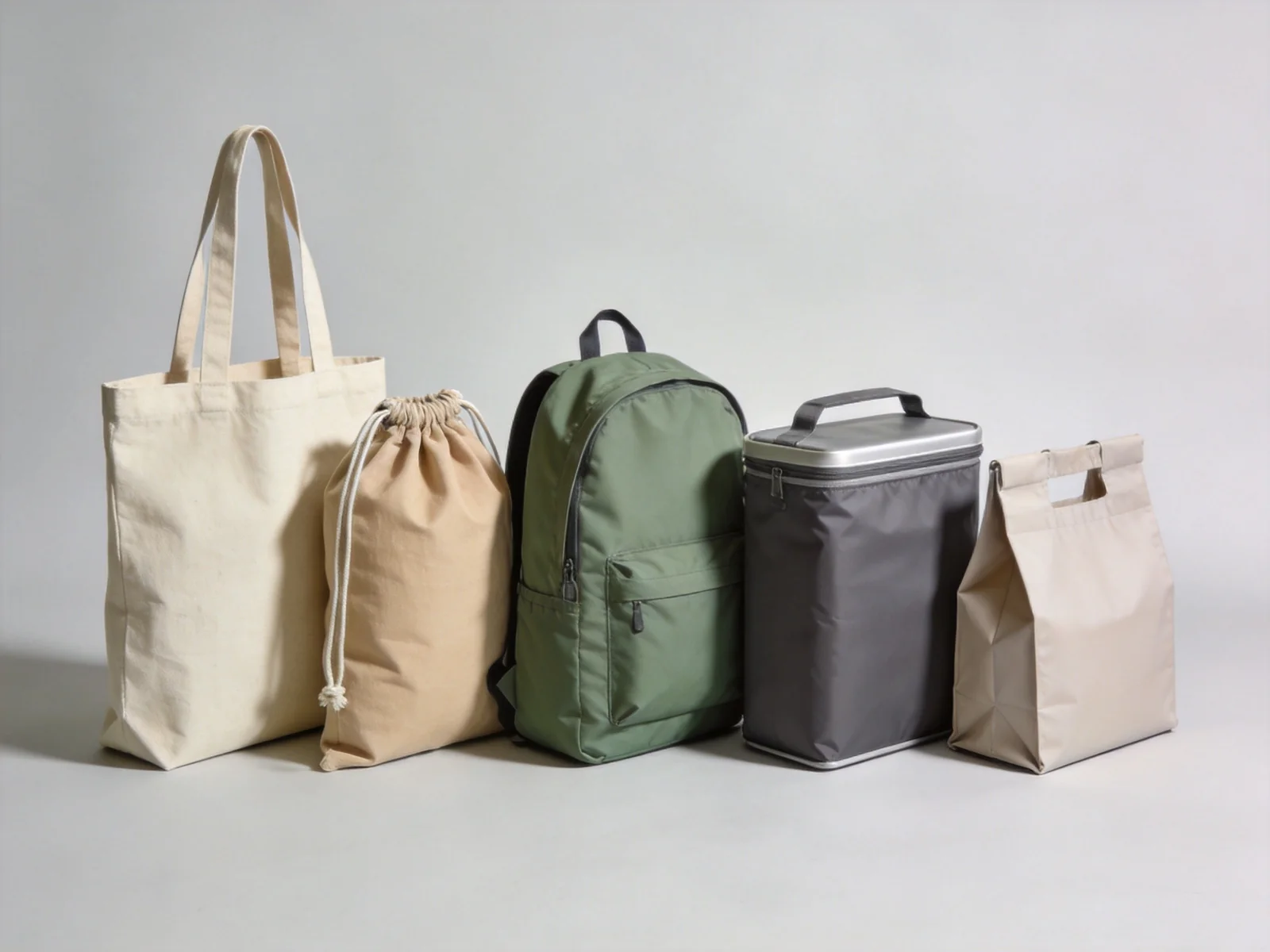
Two numbers in that table deserve a note because they are routinely mis-sold. The first is weight including backing: a “300 g/m²” rPET oxford usually means 240 g/m² of woven polyester plus 50–60 g/m² of PU. If a quotation looks 15% cheap, check whether the backing coat was reduced from two passes to one — the fabric will feel identical in a swatch and will delaminate in a humid container within one season. The second is recycled content of the fabric: the PU backing is virgin petrochemical polymer, so a 600D rPET oxford with a heavy two-coat PU backing can drop from 91% to 86% recycled content by weight purely through coating weight. When a buyer asks us for “the highest recycled percentage we can get”, the honest answer is usually to specify a lighter single-coat backing and accept slightly lower water resistance, not to change the yarn.
How the bottle becomes the yarn — and why the ratio matters
Post-consumer PET bottles are collected, sorted by colour and polymer, washed, and either flaked and re-pelletised or processed bottle-to-yarn directly. The flake goes through melt spinning into POY or FDY filament, then texturising or flat yarn, then weaving. Each thermal pass degrades intrinsic viscosity slightly, which is why rPET filament typically lands 5–12% lower in tenacity than virgin filament at the same denier, and why a mill that over-recycles regrind to save cost produces a fabric that fuzzed at the seam after ten washes.
Bottle-to-yarn ratios are quoted freely in marketing and are almost always wrong, because they depend on bottle weight and spinning yield. For a 10–12 g clear 500 ml bottle and a 92–95% yarn yield, one kilogram of rPET filament corresponds to roughly 80–95 bottles. A 600D backpack using about 0.9 kg of shell fabric and 0.25 kg of lining therefore carries roughly 85–110 bottles of recycled content, not the “24 bottles” figure that appears on so many hangtags. We quote the ratio per fabric lot from the mill’s own input records, and we will not print a bottle count on a hangtag that the Transaction Certificate cannot support.
RPET vs Virgin Polyester vs Other Recycled Substrates — an Honest Comparison
The most expensive mistake in a recycled range is choosing the substrate for the story instead of for the performance. RPET is the right answer for most bag programs because it behaves like polyester on the sewing floor: same needle, same thread, same heat sensitivity, same print methods, near-identical hand-feel at equal denier. It is the wrong answer when a buyer needs a genuinely different mechanical property, and it is definitely the wrong answer when a buyer needs a compostable or bio-based claim.
| Substrate | Recycled content achievable | Relative fabric cost | Performance vs virgin | Certification route | Choose it when |
|---|---|---|---|---|---|
| rPET filament (oxford, ripstop, taffeta) | 85–95% of fabric weight | 1.05–1.12 × virgin PET | −5 to −12% tenacity, equal or better abrasion with same backing | GRS, RCS | Default for totes, backpacks, shoppers, coolers, promotional ranges |
| Recycled nylon 6 (chemical recycling) | 90–100% of fabric weight | 2.4–3.4 × virgin PET | Higher tear and abrasion, better softness, lighter for equal strength | GRS, RCS | Premium outdoor, luggage, high-abrasion technical packs |
| Recycled polypropylene (rPP) | 80–95% | 0.95–1.05 × virgin PP | Lower heat resistance, poor print receptivity, cheaper | RCS, GRS where eligible | Woven sacks, non-woven promotional bags, budget volume |
| Mechanically recycled cotton canvas | 35–60% in blend | 1.00–1.10 × conventional canvas | Shorter staple, 10–20% lower tear, softer hand, better print base | GRS, RCS | Print-heavy totes, grocery and retail shoppers, natural-look ranges |
| Organic cotton canvas (not recycled) | 0% recycled (a different claim) | 1.10–1.30 × conventional | Same as conventional cotton | GOTS, OCS | Buyer’s claim is “organic”, not “recycled” — do not conflate |
| Virgin polyester | 0% | 1.00 (baseline) | Baseline | None needed | Cost-critical programs with no sustainability claim |
Three practical consequences follow from that table. First, RPET is a materials-substitution claim, not a performance upgrade: if a virgin 210D tote tore at the handle on your last program, an RPET 210D tote will tear in the same place, and the fix is 420D or a bar-tacked box-X, not a different polymer. Second, recycled nylon is the only substrate on the list that lets a buyer claim both recycled content and improved mechanicals, and it costs two to three times as much — which is why it belongs on a hero SKU, not on a full range. Third, recycled cotton and organic cotton answer different questions; a canvas tote cannot be described as “organic and recycled” unless it genuinely carries both certificates for the same lot, and in practice almost none do.
The Certification Chain — GRS, RCS and What a Transaction Certificate Proves
Recycled content is invisible. Nobody can look at a swatch and tell you whether the filament came from bottles or from a naphtha cracker. The entire credibility of an RPET program therefore rests on documents, and the documents have a specific shape that buyers should learn before they sign a purchase order.
The Global Recycled Standard (GRS) is the most widely requested scheme in soft goods. It requires a minimum of 20% recycled content for a product to be certified at all, adds social, environmental and chemical requirements at the processing facility, and — critically — runs a chain-of-custody system that issues a Transaction Certificate (TC) for each shipment. The Recycled Claim Standard (RCS) is the lighter sibling: same chain of custody, minimum 5% recycled content, no social or chemical requirements. A buyer who only needs to substantiate “contains recycled material” can use RCS; a buyer whose retail customer has a published GRS requirement cannot.
| Document | Issued by | What it covers | What it does not prove | When you receive it |
|---|---|---|---|---|
| Scope Certificate (SC) | Accredited certification body, in the mill’s or factory’s name | That the named facility is certified to process GRS/RCS material, and which product categories | Nothing about your specific order | Before the order, on request |
| Transaction Certificate (TC) | The same body, on application by the seller | Product, quantity in kg, recycled input percentage, buyer name, TC number | Nothing about performance, colour or delivery | 7–15 days after shipment |
| Material declaration | Mill, on letterhead | Fibre composition, weight, coating chemistry, country of origin | Not third-party verified | With the lab dip |
| OEKO-TEX Standard 100 report | OEKO-TEX institute | Finished article tested against limit values for harmful substances | Not a recycled-content document | With the bulk, if the mill’s certificate covers the article |
| REACH SVHC / Prop 65 declaration | Factory | Statement against the candidate list and California list | Not a test report unless stated | With the bulk |
The chain only holds if it is unbroken at every handover: bottle collector to flake processor, flake to spinner, spinner to weaver, weaver to bag factory. A TC can only be issued for a shipment where the seller holds a valid input TC for the material it consumed. This is where substitution happens in the market — a converter buys greige without a TC, weaves it into “RPET oxford”, and sells it to a factory that has no way of knowing. By the time the brand asks for a TC, the chain has a hole in it and no amount of paperwork can close it.
Our practice is deliberately conservative. We buy rPET fabric only from mills that hold a current GRS or RCS scope certificate and that issue a TC for each shipment, and we pass the mill’s TC through to the buyer together with the invoice reference so the weights can be reconciled. We do not issue a GRS certificate in our own name, and we will not describe a bag as “GRS certified” — the correct wording is that the bag is made with GRS-certified fabric and the TC is supplied. If a buyer needs the finished article itself to carry a certification, that has to be arranged with the mill and the certification body in advance, because it changes the sampling timeline.
Claim Language — What You May Print and What Will Get You Fined
Green claims are now regulated in the markets most of our buyers sell into. The EU’s Empowering Consumers Directive and the proposed Green Claims Directive require substantiation for environmental claims, ban generic claims that cannot be demonstrated, and restrict the use of carbon-neutrality claims based on offsetting alone. The UK CMA’s Green Claims Code takes a similar position, and several EU member states already enforce against unqualified “eco-friendly” and “100% sustainable” wording. A hangtag written by a marketing team that has never seen a TC is a liability, not a selling point.
| Claim | Status | Why | Correct alternative |
|---|---|---|---|
| “100% recycled bag” | Not defensible | Backing, zipper tape, thread, webbing and POM hardware are not recycled; total is typically 55–75% | “Made with GRS-certified recycled polyester fabric; 68% recycled content by weight of the finished bag” |
| “Made from 24 plastic bottles” | Only with input records | Bottle count depends on bottle weight and yield and is rarely traced per lot | “Shell fabric made from post-consumer PET bottles, GRS TC no. XXXX, 0.9 kg fabric” |
| “Eco-friendly” / “sustainable bag” | Generic, unsubstantiated | Banned as a standalone claim in several EU markets | Name the specific attribute: recycled content, PFC-free DWR, water-based PU |
| “Biodegradable” / “compostable” | False for PET | PET does not biodegrade in landfill or marine conditions | Remove the claim entirely |
| “Carbon neutral” | Restricted | Offset-based neutrality claims are being curtailed | Report measured emissions per unit if you have them |
| “GRS certified bag” | Only if the article is certified | Scope certificate applies to facilities, not to your bag by default | “Made with GRS-certified fabric, TC supplied with each shipment” |
| “PFC-free water repellent” | Defensible with a declaration | Verifiable chemistry statement from the mill | Keep it, and attach the mill’s DWR declaration |
| “Recycled and organic” | Only with both certificates on the same lot | Two different schemes, two different inputs | Choose one claim per SKU unless both are documented |
We will print any of the defensible wordings on a hangtag, a woven label or a heat transfer, and we will refuse the indefensible ones even when a buyer insists, because a rejected container at a European border costs more than the order. If a buyer’s legal team needs a specific phrase, send it to us before the label artwork is approved — rewording after printing is a 100% loss on the label run.
Where the Recycled Content Actually Sits — the Percentage Arithmetic
Almost every failed recycled claim comes from a percentage calculated on the fabric and printed on the bag. The fabric is one of six or seven components. We build the arithmetic for every RPET program before sampling, because the answer determines what the hangtag can say and sometimes determines whether the program is worth running at all.
| Component | Typical weight share (600D backpack) | Recycled? | Note |
|---|---|---|---|
| Shell fabric (600D rPET oxford, PU-backed) | 58–64% | Yes, 87–91% | Backing coat is virgin PU and counts against the percentage |
| Lining (75D rPET taffeta) | 10–14% | Yes, 90–95% | Highest recycled share in the build |
| Webbing and binding tape | 6–9% | Usually yes (rPET) if specified | Must be requested explicitly; virgin PP webbing is the default in most factories |
| Zippers | 4–7% | Partly — PET tape can be recycled, coil and sliders are not | Recycled zipper tape is available; sliders are POM or zinc alloy |
| Foam, EVA or PE board | 5–12% | No (standard) | Recycled PE board exists but is rarely certified |
| Hardware (buckles, D-rings, adjusters) | 2–4% | No | POM, nylon or metal; no recycled route in practice |
| Thread | 1–2% | Rarely | rPET thread exists; most factories use virgin spun polyester |
| Total recycled content, finished bag | 100% | 55–75% | Achievable ceiling is about 78% with every option specified |
The arithmetic is unforgiving in a useful way. Switching webbing from virgin PP to rPET webbing adds roughly 6% to total recycled content and about USD 0.04 to unit cost — the cheapest percentage points available anywhere in the build. Switching thread adds 1.5% and is usually not worth the supply risk. Adding a recycled PE board adds 8% but the certification route is thin, so we normally recommend leaving the board virgin and being precise in the claim instead. The one option that moves the number most is also the least honest: reduce the PU backing coat, gain two points of fabric recycled content, and lose the water resistance the buyer actually paid for.
Cost Structure — the Real Size of the rPET Premium
Buyers routinely expect a recycled bag to cost 25–40% more, and are then suspicious when it does not. The truth is that the polymer premium is small at the fabric level and almost disappears at the bag level, because bag cost is dominated by labour, hardware and logistics, none of which change. What does change is the administrative overhead of the certification chain, and that overhead is largely fixed per order rather than per unit — which is why small orders feel the premium much more than large ones.
| Cost line | Virgin PET baseline | RPET equivalent | Delta | Comment |
|---|---|---|---|---|
| 600D oxford fabric | Index 1.00 | Index 1.05–1.12 | +5 to +12% | Driven by flake availability and spinning yield |
| Fabric certification (TC admin) | 0 | USD 150–400 per shipment | Fixed | Charged by the certification body, not by us |
| Cutting and sewing labour | Index 1.00 | Index 1.00–1.03 | +0 to +3% | rPET filament is slightly less uniform; edge sealing adds a step |
| Hardware, zippers, thread | Index 1.00 | Index 1.02–1.08 | +2 to +8% | Only if rPET tape and webbing are specified |
| Printing | Index 1.00 | Index 1.00 | 0 | rPET takes sublimation and screen print the same way as PET |
| Finished FOB, 500 pcs | Index 1.00 | Index 1.03–1.08 | +3 to +8% | Whole-bag effect |
| Finished FOB, 5,000 pcs | Index 1.00 | Index 1.02–1.05 | +2 to +5% | Fixed certification cost amortised across more units |
Two conclusions follow. First, an RPET quotation that comes in 30% above a virgin quotation is not a materials premium — it is either a different substrate, a lower order quantity, or a margin decision. Ask for the fabric index separately. Second, the fixed certification cost means that consolidating SKUs into one order materially improves the economics: three styles of 500 pieces shipped together share one TC process, whereas three separate 500-piece shipments pay three times.
Eight Bag Platforms We Build in RPET
RPET is a substrate, so it fits any platform where polyester oxford or canvas would fit. The eight below cover the overwhelming majority of inquiries, and each has a default specification that we have found survives a full season in the field. The defaults are a starting point, not a limit — they exist so that a first sample does not waste a round on a specification that was never going to work.
| Platform | Default substrate | Key construction | Typical buyer | Watch-out |
|---|---|---|---|---|
| Reusable shopping / grocery tote | RP-01 210D or RP-06 12 oz canvas | Box-X handle stitch, bound top edge, gusset 10–12 cm | Supermarket chains, retail grocers, municipalities | Handle attachment is the failure point; 210D needs bar-tack plus box-X |
| Drawstring / cinch sack | RP-01 210D, sometimes RP-02 | Single-needle side seams, 8–10 mm cord, metal or plastic eyelets | Sports clubs, events, promotional distributors | Cord channel width must exceed cord diameter by 3 mm or it locks |
| Everyday backpack | RP-03 600D body, RP-07 75D lining | Foam-padded back panel, padded straps, YKK-grade coil zips | Retail brands, corporate gifting, school ranges | Strap attachment load; specify bar-tack at four points minimum |
| Insulated cooler bag | RP-03 600D outer, PE foam 3–5 mm, food-grade PEVA liner | Heat-sealed liner seams, #5 zip, webbing handle | Grocery retail, beverage brands, outdoor labels | Cold-chain claims need a tested hold time, not a foam thickness |
| Foldable shopper | RP-01 210D | Elastic loop or stuff pouch, single-panel construction | Retail promotions, airline and hotel programs | Fold memory; specify fold board dimensions before patterning |
| Duffel / weekender | RP-04 600D ripstop or RP-05 840D | Rolled webbing handles, detachable shoulder strap, base board | Travel labels, sports brands, corporate travel kits | Base panel abrasion; 600D plain is marginal, use ripstop or 840D |
| Packing cubes and organisers | RP-01 210D shell, RP-07 75D lining, mesh panel | #3 or #5 zip, compression zip, top grab handle | Travel brands, DTC organisers, gift sets | Zip-to-shell ratio; thin fabric needs a bound seam to avoid fraying |
| Dry bag and marine pouch | RP-03 600D with TPU laminate, or 500D TPU film | Welded or heat-sealed seams, roll-top with buckle | Outdoor, marine, dive and watersports brands | RPET with a stitched seam is not a dry bag; it must be welded |
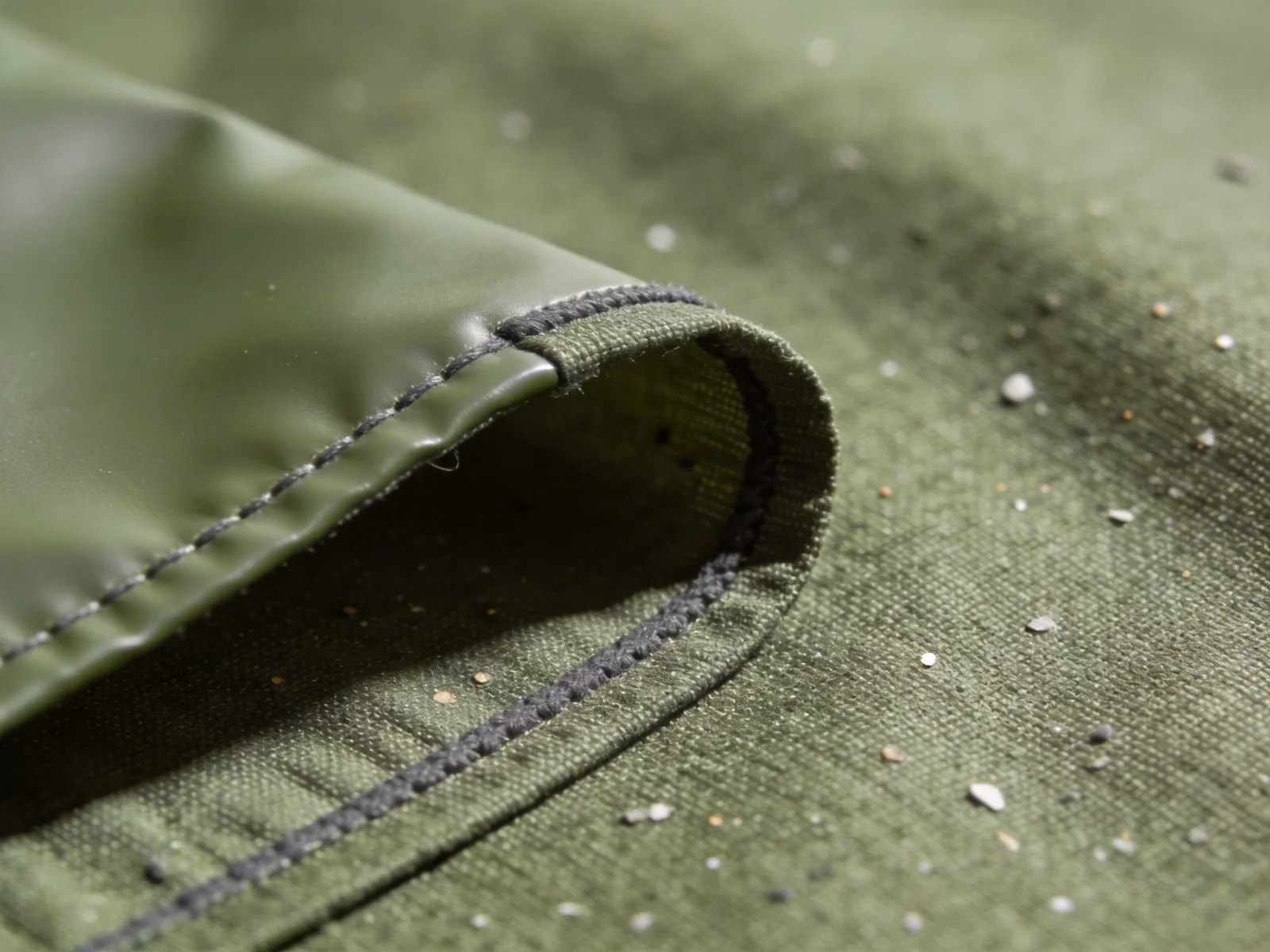
One platform on that list needs a warning rather than a note. A dry bag made from RPET oxford with stitched seams is not a dry bag, no matter how good the coating is; water enters through the needle holes in under a minute of immersion. Genuine dry bags need welded TPU, either laminated to a recycled polyester base or as a standalone film, and welding is a different process with a different tooling cost. We build both, and we will say plainly when a buyer’s brief has asked for the impossible combination of a stitched seam and a waterproof claim.
Construction: How rPET Behaves Differently on the Sewing Floor
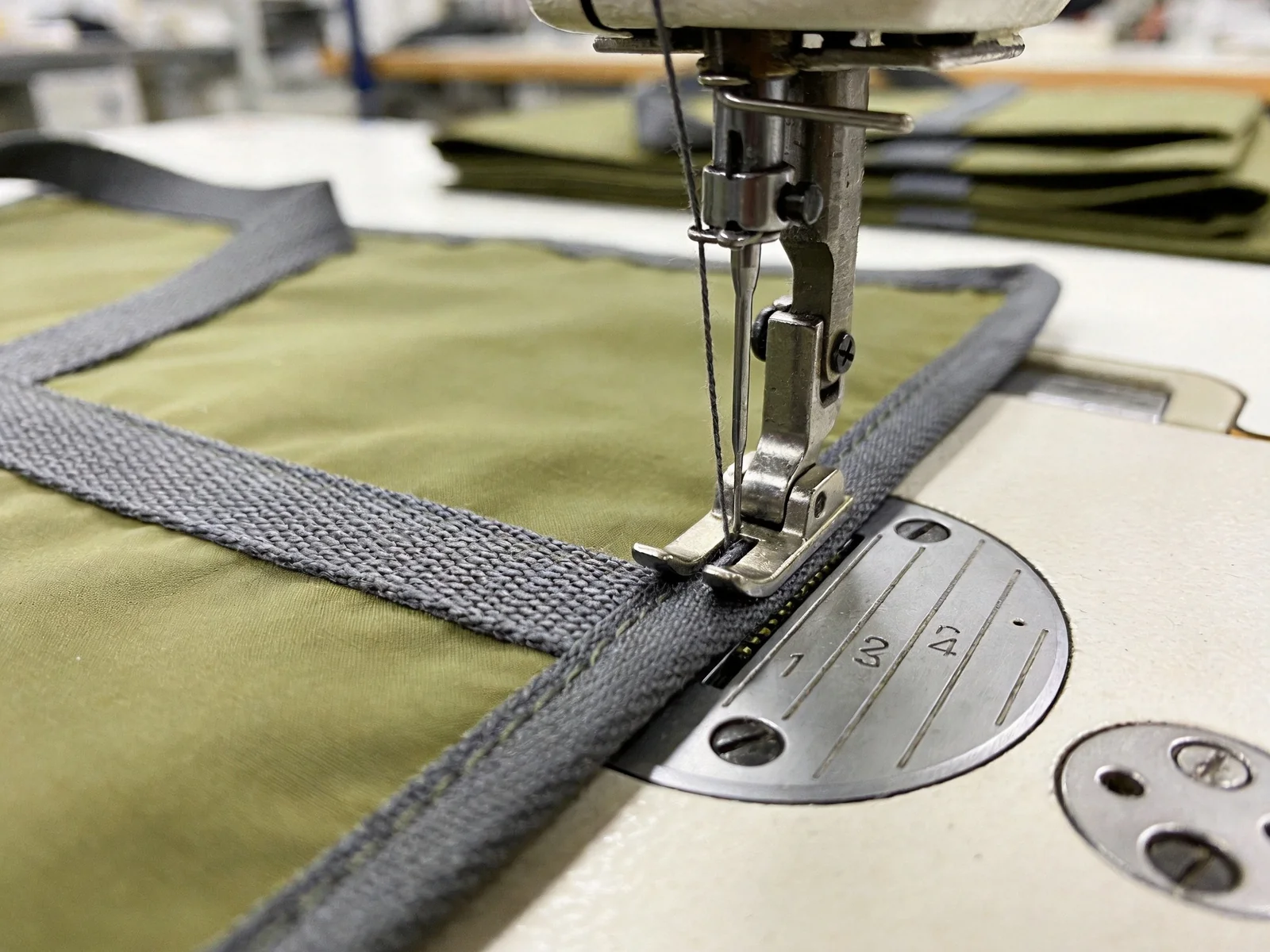
On the floor, rPET oxford is close enough to virgin oxford that a pattern can move between them without redesign — but only if four process settings are adjusted. The differences come from filament irregularity (recycled yarn has slightly wider denier variation), from the coating, and from the fact that a coated fabric does not forgive a dull needle. Getting these four right is the difference between a clean seam and a line of pinhole leaks.
| Process | Virgin PET setting | rPET adjustment | Why |
|---|---|---|---|
| Needle | 90/14 or 100/16 sharp | 100/16 to 110/18 round point, changed every 8 hours | Denier variation plus coating; sharp points cut filaments and start a tear |
| Stitch density | 8–10 SPI | 7–8 SPI on 600D+, 9–10 SPI on 210D | Too dense perforates coated fabric; too loose slips on 210D |
| Edge finish | Overlock or plain fold | Hot-knife or ultrasonic cut, then bound or French seam | rPET oxford frays more at a cut edge; sealing stops it before it starts |
| Seam type at load points | Single row plus bar-tack | Double row plus box-X plus bar-tack | rPET tenacity is 5–12% lower; the seam must carry the difference |
| Thread | Virgin spun polyester 40/2 | Bonded polyester 40/2 or 30/2, or rPET filament | Bonded thread resists abrasion at the needle eye; unbalanced thread snaps |
| Presser foot | Standard | Roller or walking foot on coated rPET | Coating grips the foot and stretches the seam line |
Printing is where rPET is actually easier than most alternatives. Polyester takes dye sublimation properly, which means photographic full-colour decoration with no hand-feel penalty, and sublimation is the lowest-cost route to a multi-colour promotional bag. The constraint is the coating: sublimation ink needs to reach the polyester, so a heavy two-pass PU backing on the face will block it. On coated substrates we either print before coating at the mill, or switch to screen print with a water-based ink, or use heat-transfer vinyl for small logos. Embroidery works normally at 12 stitches per centimetre, with a water-soluble topping on the coated face and a tear-away backing underneath.
Colour: Dope-Dyed vs Piece-Dyed, and the Shade-Banding Problem
Colour is the single most common cause of a rejected RPET order, and almost always because of a mismatch between what the buyer assumed and what the mill can actually do. There are two routes, and they behave very differently.
| Attribute | Dope-dyed (solution-dyed) | Piece-dyed |
|---|---|---|
| How colour enters | Pigment added to the polymer before spinning | Fabric dyed after weaving |
| Colourfastness to light | Excellent, typically grade 6–7 | Good, grade 4–5 |
| Colourfastness to rubbing | Excellent, grade 4–5 dry | Good, grade 3–4 wet on dark shades |
| Water and energy use | Very low | High; dyeing is the wet process |
| Palette | Limited to yarn stock colours, typically 15–30 | Open; Pantone matching is routine |
| Minimum at yarn level | Often 1,000–3,000 kg per colour | 300–500 kg per colour is workable |
| Shade consistency across lots | Very good | Needs lot control; ΔE can drift 1.5–2.5 between lots |
| Best for | Volume ranges, black and navy programs, outdoor | Brand palettes, seasonal colour, small runs |
For a 500-piece order, piece dyeing is almost always the only viable route, which means lot control matters. Our standard is a lab dip approved against a physical Pantone chip, ΔE ≤ 1.0 within a lot and ΔE ≤ 1.5 between lots, with the mill retaining a sealed bulk sample per lot. When a program spans more than one fabric lot — which happens on any order above roughly 3,000 bags — we ask for a shade band check on the cutting table before the panels are bundled, because the cheapest fix is to cut matched panels into the same bag rather than to argue about a ΔE number after the goods have shipped.
Durability and Test Protocol
Performance claims on recycled fabric need the same test regime as virgin fabric, plus two tests that only matter for recycled and coated goods. The first is hydrolysis resistance of the PU backing: recycled polyester is often paired with a water-based or recycled-content PU, and those backings are more sensitive to heat and humidity than solvent PU. The second is seam strength as a percentage of fabric strength, because rPET’s lower tenacity shows up at the seam before it shows up in the panel.
| Property | Test method | Target for 600D rPET oxford | Target for 12 oz recycled canvas | Why it matters |
|---|---|---|---|---|
| Abrasion resistance | Martindale, ISO 12947-2, 12 kPa | 25,000 cycles to hole | 25,000 cycles to hole | Predicts base and corner wear |
| Trouser tear | ISO 13937-2 | ≥ 40 N warp, ≥ 38 N weft | ≥ 35 N warp | Predicts rip propagation from a pinhole |
| Tensile strength | ISO 13934-1 strip | ≥ 1,200 N warp | ≥ 700 N warp | Baseline for handle and strap loading |
| Seam strength | ISO 13935-2 | ≥ 80% of fabric tensile | ≥ 75% | rPET’s weak link is the seam, not the panel |
| Seam slippage | ISO 13936-2 | ≤ 3 mm at 200 N on 210D | ≤ 3 mm | 210D shoppers open at the seam first |
| Colourfastness to rubbing | ISO 105-X12 | Grade 4 dry / 3 wet minimum | Grade 4 dry / 3 wet minimum | Dark shades on light garments |
| Colourfastness to light | ISO 105-B02 | Grade 4–5 | Grade 4 | Window display and outdoor use |
| Water repellency | AATCC 22 spray rating | 80 (ISO 4) after 3 washes with C0 DWR | 70 (ISO 3) or none | Only claim what the rating supports |
| Coating adhesion | Internal peel, 180° | ≥ 3 N/cm | n/a | Predicts delamination in transit |
| Hydrolysis resistance | 7 days at 70 °C / 85% RH, then peel and hand test | No tackiness, peel ≥ 2.5 N/cm retained | n/a | The test that prevents a sticky container |
Not every program needs every test, and we say so rather than quoting a full battery by reflex. A 500-piece promotional tote needs abrasion, tear, seam strength and colourfastness to rubbing. A cooler bag going into grocery retail needs the hydrolysis test and a hold-time validation. A bag with a water-repellent claim needs the spray rating after washing, not before, because the first wash is what removes a poorly fixed DWR.
Compliance and the Documentation Pack
We supply documents that we can actually stand behind, and we decline the ones we cannot. A buyer who needs a specific certificate that is not on this list should raise it before sampling, because most third-party testing adds 10–20 days to the calendar and cannot be retrofitted after the goods are made.
| Document | Availability | Timing | Notes |
|---|---|---|---|
| GRS / RCS Transaction Certificate (mill-issued) | Yes, for certified fabric | 7–15 days after shipment | Passed through with the invoice reference so weights reconcile |
| Mill scope certificate copy | Yes, on request | Before order | Confirms the mill’s certification is current |
| REACH SVHC declaration | Yes | With bulk | Statement against the current candidate list |
| California Prop 65 declaration | Yes | With bulk | Statement, not a test report |
| AZO / formaldehyde / heavy metal test | Yes, third-party | +10–15 days | Quoted per style; destructive, so bulk fabric only |
| OEKO-TEX Standard 100 | Depends on the mill’s certificate scope | Before order | Belongs to the mill or the article, not to us |
| PFC-free DWR declaration | Yes, when C0 chemistry is specified | With lab dip | Verifiable chemistry statement |
| BSCI / SMETA / ISO 9001 in our name | No | — | We do not hold or claim these; social audits are arranged by the buyer |
| Biodegradability or compostability | No | — | PET is not biodegradable; we will not issue a claim |
Sampling: What Six to Ten Days Buys You, and What It Does Not
Our sampling window is 6–10 working days from a confirmed specification, and it is deliberately short because a first sample’s job is to answer structural questions, not to prove the fabric. Understanding the limit of a sample prevents the most expensive misunderstanding in the whole process.
| A sample does prove | A sample does not prove |
|---|---|
| Pattern dimensions and proportion | That the bulk fabric lot will match the sample’s shade |
| Whether the construction is sewable at the specified denier | That the PU backing will survive a 40-day container in summer |
| Handle and strap attachment geometry under hand load | Martindale or tear performance — that needs a lab and a week |
| Print placement, size and legibility | Print durability after 20 washes |
| Hardware function and zip pull feel | Zipper cycle life beyond a few hundred cycles |
| Packaging dimensions and carton count | Actual carton weight tolerance and CBM until the bulk is packed |
Three things shorten sampling dramatically, and buyers who supply them get to a production-ready sample in one round instead of three: a physical reference bag (even a competitor’s), a Pantone number per colourway rather than a photograph, and a firm statement of what the bag must carry. Three things lengthen it: a logo supplied as a low-resolution image, a colour specified as “like the photo”, and a request to “make it lighter” without a target weight.
MOQ 500 and the Order Calendar
Our MOQ is 500 pieces per style, and colourways can be mixed within that 500. That is a genuine constraint rather than a negotiating position: below 500 the fabric minimum, the cutting setup, the label and hangtag minimums and the certification administration stop amortising, and the unit price rises faster than most buyers expect. Above 500 the price falls predictably, which is why we publish the calendar rather than the discount.
| Stage | Duration | What the buyer must supply | What can go wrong |
|---|---|---|---|
| Specification review | 1–3 days | Reference bag, contents list, target FOB, market | Vague brief; no reference |
| Lab dip | 5–7 days | Pantone per colourway | Shade approved from a screen |
| Sampling | 6–10 working days | Artwork at vector quality, logo placement | Artwork changes after the sample is sewn |
| Sample approval | 3–7 days | Written comments, signed sample | Verbal approval with no signed reference |
| Bulk fabric and trims | 12–20 days | TC requirement confirmed | Certified fabric not in stock in the chosen colour |
| Cutting and sewing | 18–28 days | — | Peak-season capacity |
| Inspection | 2–3 days | Inspection standard confirmed (AQL 2.5 / 4.0) | Standard agreed after production |
| Packing and handover | 3–5 days | Carton marking, shipping marks | Retail carton spec supplied late |
| Total, sample approval to FOB | 35–50 days | — | — |
| TC issuance | 7–15 days after shipment | — | TC requested before the mill has issued its input TC |
Quality Control — AQL Plus Ten Checks Specific to Recycled Fabric
We inspect to AQL 2.5 major / 4.0 minor at final random inspection, which is the standard most retail buyers specify and the one we quote by default. That sampling plan catches defects in workmanship. It does not catch the failure modes that belong to recycled and coated fabric, so those are handled by ten inline checks at the cutting and sewing stations, before the goods ever reach the inspection table.
| # | Inline check | Station | Accept criterion |
|---|---|---|---|
| 1 | Shade band verification against the sealed lot standard | Cutting | ΔE ≤ 1.5; mismatched rolls cut into separate bundles |
| 2 | Fabric weight spot check, g/m² | Cutting | Within ±5% of the approved specification |
| 3 | Coating continuity on the reverse, visual under angled light | Cutting | No uncoated streaks or pinholes |
| 4 | Edge seal quality after hot-knife cutting | Cutting | No frayed filaments; sealed edge 1–2 mm |
| 5 | Needle condition log | Sewing | Changed every 8 hours or on any pull |
| 6 | Stitch density and seam allowance gauge | Sewing | 7–8 SPI on 600D; allowance per tech pack ±2 mm |
| 7 | Load-point reinforcement presence | Sewing | Box-X plus bar-tack at every strap and handle end |
| 8 | Zip run and slider pull force | Assembly | Smooth full travel; no fabric catch at the curve |
| 9 | Print registration and adhesion tape test | Decoration | No lift on 3M tape pull; registration within 1.5 mm |
| 10 | Metal detection and needle sweep | Packing | Zero findings per carton |
Six Failure Modes That Kill RPET Programs
These six account for most of the RPET complaints we are asked to diagnose on other factories’ goods. They are listed with the fix, because a buyer who knows them can write them into a purchase order and avoid the argument later.
| Failure | How it presents | Root cause | Prevention |
|---|---|---|---|
| Backing hydrolysis | Bag feels tacky, panels stick together, coating peels in patches | Water-based or thin PU backing, 40+ days in a hot humid container | Specify the 7-day 70 °C / 85% RH test; request desiccant and ventilated stowage |
| Shade banding across lots | Visible tonal difference between bags in the same carton | Two fabric lots cut without a band check | Sealed lot standard; cut matched panels into the same bag; ΔE ≤ 1.5 gate |
| Broken certification chain | TC arrives with a different mill name, or weight that cannot be reconciled | Greige bought without an input TC | Buy only from mills with a current scope certificate; reconcile TC kg against the invoice |
| Claim overreach | Retailer rejects the hangtag, or a regulator contacts the brand | “100% recycled” or “eco-friendly” printed without substantiation | Use the percentage arithmetic; print the TC number; remove generic claims |
| Load-point tear | Handle or strap pulls out of the panel within weeks | 210D specified for a load it cannot carry, or single-row stitching | 420D minimum for loaded totes; box-X plus bar-tack; seam strength ≥ 80% |
| Needle-cut leaks | Water seeps through a stitched seam on a “waterproof” bag | Stitched seams on a bag that needs welding | Weld TPU for dry bags; or state water resistance, not waterproof |
Packaging, Cartons and CBM
Packaging decisions are made late on most programs and then cost more than expected, because retail carton specifications and e-commerce drop-test requirements change the carton count and therefore the freight. The table below is what we typically pack for the four highest-volume RPET platforms at 500 pieces, and it is a starting point for a freight estimate rather than a quotation.
| Platform | Individual packing | Pieces per carton | Carton dimensions (cm) | CBM per carton |
|---|---|---|---|---|
| Foldable shopper, 210D | Polybag, 10 pcs per inner | 200 | 55 × 40 × 35 | 0.077 |
| Canvas tote, 12 oz | Polybag, hangtag attached | 50 | 55 × 40 × 35 | 0.077 |
| Drawstring sack, 210D | Polybag, 20 pcs per inner | 200 | 60 × 40 × 40 | 0.096 |
| Backpack, 600D | Polybag, stuffed with tissue | 20 | 60 × 45 × 45 | 0.122 |
| Cooler bag, 600D | Polybag, flat packed | 30 | 60 × 45 × 40 | 0.108 |
Three packaging notes that save money. Stuffing backpacks with tissue increases carton volume by 15–25% and is only worth it if the retail channel requires shape retention. Polybag thickness below 40 micron fails most EU retail specifications and, separately, several markets tax thin single-use plastic bags — a paper belly-band is often cheaper than the compliance risk. And carton marking must be agreed before packing, because re-marking cartons at the warehouse costs more than the cartons.
Why Buyers Consolidate RPET Programs With Us
The practical argument for consolidating an RPET range with one factory is not price — it is that the certification chain, the substrate library and the shade control all live in one place. A buyer splitting an RPET range across three factories ends up with three fabric lots, three TCs, three shade standards and three interpretations of “600D”, and then spends the season explaining to a retailer why the totes do not match the backpacks.
We hold seven rPET substrates as standard, quote from a single MOQ of 500 per style, sample in 6–10 working days, produce in 35–50 days, inspect to AQL 2.5 / 4.0, and ship FOB Xiamen. The company was established in 2014 and our founder has worked in the bag trade since 2004, which means the substrate knowledge on this page comes from programs that shipped, not from a specification sheet. If your range spans totes, backpacks, coolers and organisers in recycled polyester, one factory with one fabric library is a materially easier program to run than four.
Frequently Asked Questions
Start an RPET Program With a Specification, Not a Slogan
Send us a reference bag, a Pantone number per colourway, the contents the bag must carry and your target FOB. We will come back with a substrate recommendation, the recycled percentage the build can actually support, and a sample in 6–10 working days at MOQ 500.
Related Capabilities and Platforms
- Custom Tote Bag Manufacturer
- Custom Backpack Manufacturer
- Custom Canvas Shopping Bag Manufacturer
- Custom Drawstring Bag Manufacturer
- Custom Cooler Bag Manufacturer
- Custom Dry Bag Manufacturer
- Custom Organizer Case Manufacturer
- Custom Packing Cubes Manufacturer
- RPET Backpack OEM Capabilities
- Custom Travel Bag Manufacturer
- Custom Waterproof Bag Manufacturer
- Custom Garment Bag Manufacturer
- Custom Laundry Bag Manufacturer
- Custom Shoe Bag Manufacturer
- Bag Manufacturer vs Trading Supplier