A bag manufacturer established in 2014, with our founder working in the bag trade since 2004. We build private-label airline pet carriers, in-cabin soft carriers, expandable travel carriers, backpack and sling pet carriers, rolling carriers, hard-shell cabin carriers and IATA-pattern cargo crates for pet brands, pet retail chains, marketplace sellers, travel-accessory brands, veterinary suppliers and pet relocation services — in 600D and 300D ripstop polyester, 1680D ballistic nylon, waxed canvas, recycled RPET, EVA-laminated panels and injection-moulded PP.
Short answer for buyers: an airline pet carrier is a containment and compliance product before it is a comfort product, and three specifications decide whether a program works. First, external dimensions against the cabin envelope of the airline the product is sold for — most US major carriers publish about 18 × 11 × 11 in (45 × 28 × 28 cm) for a soft-sided carrier that must slide under the seat, while EU carriers more often publish a 55 × 40 × 20 cm envelope with an 8 kg limit for pet plus carrier. Second, containment: self-locking zips with metal sliders, a sewn-in safety tether, bar-tacked strap anchors and a rigid base insert, because the failure that ends a brand is a pet getting out on a jet bridge, not a crooked stitch. Third, ventilation area and mesh burst strength, which is what welfare reviewers and cargo handlers actually test. We build carriers at 500 pieces per style, sample them in 6–10 working days, run mass production 35–50 days after sample approval, and inspect to AQL 2.5 major / 4.0 minor. No factory can issue an “airline approved” certificate — approval is granted per flight by the operating carrier — so what we deliver is a carrier built to a documented envelope, with the dimension, material and test paperwork to prove it.
Why “Airline Approved” Is a Claim, Not a Certificate
Every week a buyer sends us a competitor’s listing that says “airline approved” and asks us to match the claim. The honest answer is that the phrase has no issuing body. In-cabin carriage is governed by each airline’s own conditions of carriage, applied by the check-in agent and the cabin crew on the day, on the specific aircraft type operating the route. A carrier that fits under an A320 seat may not fit under a regional jet seat, and an airline that accepts 45 × 28 × 28 cm on one route may apply a different limit on a codeshare. Cargo carriage is different again: it follows the IATA Live Animals Regulations (LAR), which set container construction and ventilation standards that ground handlers and carriers audit at acceptance.
That distinction changes how a carrier range should be engineered. A brand that prints “airline approved” on a box without qualification is building a complaint queue, because the customer’s flight, aircraft and fare class are variables the brand does not control. A brand that prints “fits most US domestic cabin envelopes — 45 × 28 × 28 cm — confirm with your airline” is making a claim it can support, and it converts better because the buyer can check it in ten seconds. We build to the second model, and we supply the measured external dimensions, the packed weight and the material sheet that make the claim defensible.
| Market | Envelope commonly published | Pet + carrier limit | What it changes in the pattern |
|---|---|---|---|
| US and Canada, major carriers | About 18 × 11 × 11 in (45 × 28 × 28 cm) exterior, soft-sided, must slide under the seat | Commonly 20 lb (9 kg) combined | 43 cm base width, 2 mm EVA frame with a compressible top, no rigid wheel housing, soft handles that fold flat |
| EU scheduled carriers | About 55 × 40 × 20 cm exterior | Commonly 8 kg combined | Long and shallow: 20 cm maximum height, wide base board, top-load access rather than tall front door |
| Gulf and Asian carriers | Roughly 40 × 30 × 20 cm, with wide variation by carrier | Commonly 7–8 kg combined | Compact cube, mesh on three faces, short shoulder strap, no expansion panel |
| UK and Ireland scheduled | Cabin pets limited to assistance dogs on most carriers | — | Demand shifts to cargo crates, car carriers and train-compatible soft carriers |
| Australia and New Zealand | Cabin carriage generally not permitted; import permits and quarantine apply | — | Cargo crates built to IATA LAR, biosecurity-friendly smooth interiors, no timber packing |
| Car, rail and ferry | No envelope; footprint and belt routing matter | — | 45–55 cm footprint, seat-belt routing slot, rigid base, wipe-clean lining |
Two practical consequences follow. A serious carrier range is a size matrix, not a single SKU: the same shell pattern at 40, 45 and 50 cm covers US cabin, EU cabin and car use, and the three sizes share tooling, hardware and branding artwork. And the frame has to be compressible by design — a carrier that measures 28 cm only when empty but bulges to 31 cm with a 6 kg cat inside will be refused at the gate, which is why we specify the external dimension at loaded condition, not flat.
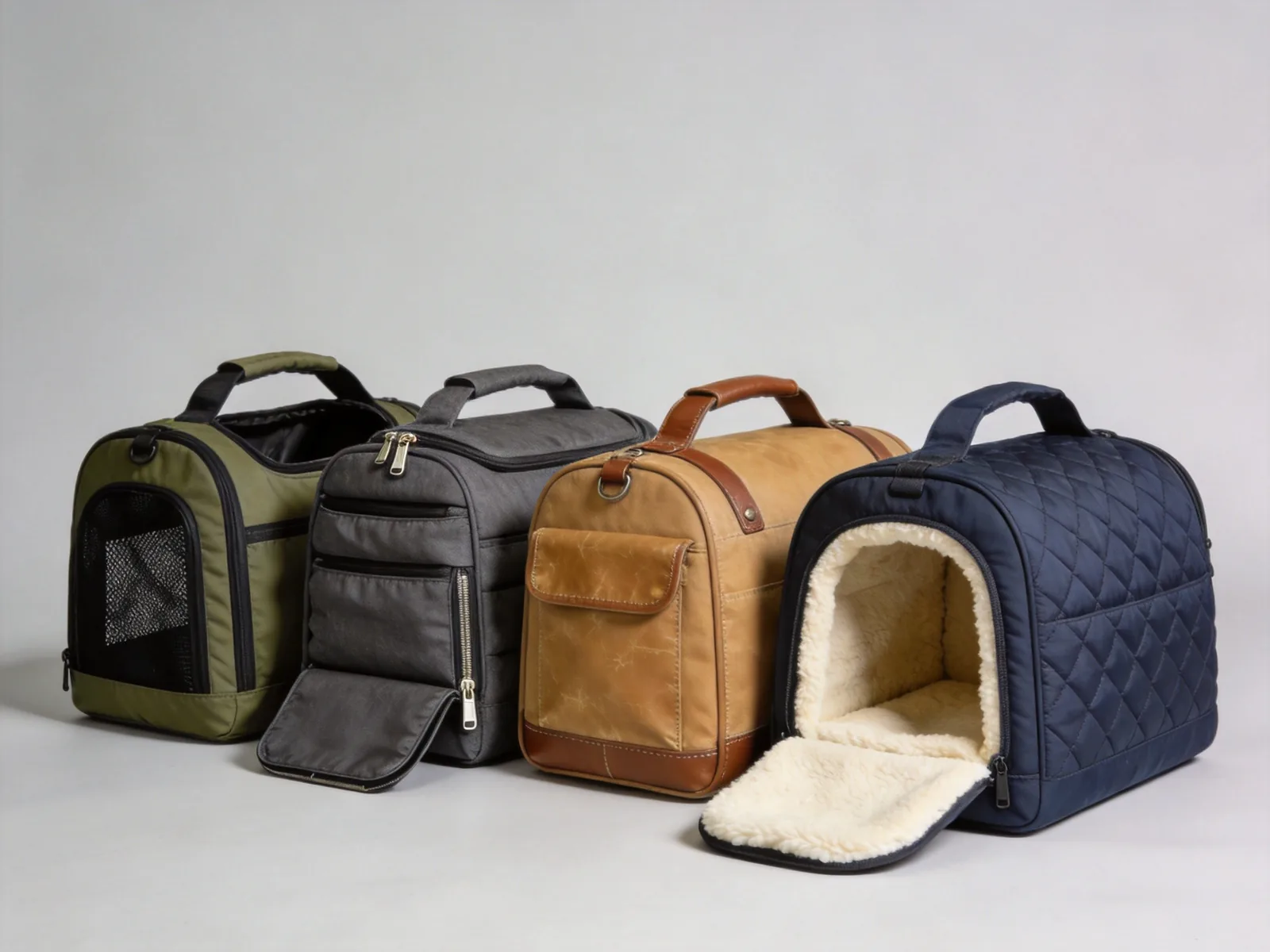
The Buying Landscape: Six Buyer Types and What Each One Actually Needs
Carriers reach us from six kinds of buyer, and the brief changes completely between them. A pet DTC brand building a 12-SKU travel line and a relocation service ordering 300 cargo crates a year are not buying the same product, even when both call it a pet carrier.
| Channel | Typical order | Construction that wins | Non-negotiable requirement |
|---|---|---|---|
| Pet product DTC brands | 1,000–8,000 pcs per colourway, 2–3 drops a year | In-cabin soft carrier with top-load and front mesh door, EVA frame, self-locking zips | Photography-ready interior; consistent colour across the range; measured external dimensions stated on the listing |
| Pet retail chains and distributors | 2,000–20,000 pcs, planogram cycles | Two or three sizes of the same pattern, retail-ready carton, hangtag | Repeatable dimensions between batches; barcode and carton marks; shelf-ready packaging that survives pallet stacking |
| Marketplace and DTC sellers | 500–3,000 pcs per SKU, frequent reorders | Expandable soft carrier in 600D RPET, four to six colours | Low unit cost at 500; packed volume that keeps freight per unit down; replacement pads as a repeat-purchase accessory |
| Travel and luggage brands | 1,000–5,000 pcs, bundled with luggage | Rolling carrier or carrier that sleeves over a trolley handle | Hardware matching the luggage range; telescopic handle and wheel spec that survives baggage handling |
| Veterinary, rescue and relocation services | 300–3,000 pcs, contract cycles | IATA-pattern cargo crate, or wipe-clean soft carrier with rigid base | Ventilation area and door security that pass acceptance inspection; smooth interior with no trap points |
| Promotional and gifting distributors | 5,000–30,000 pcs | Lightweight 210D–420D carrier, single-colour print, folding pad | Unit cost at volume; print area; survives compression packing and bulk freight |
The ranges above are what we see in practice rather than a policy. The commercial threshold is 500 pieces per style, and inside that 500 a buyer can mix up to three colourways and two branding layouts. That is usually enough to test a colour direction or a second channel without committing a full run to one variant — which matters in this category, because carrier colour is often tied to a brand’s textile range rather than to the carrier pattern.
Eight Carrier Constructions and What Each One Is For
The word “carrier” covers eight structures that share almost no tooling. Before a quotation is meaningful, the buyer has to decide which of them the range needs, because a 25-litre in-cabin soft carrier and a 90-litre cargo crate differ by a factor of four in material consumption and by an order of magnitude in tooling.
| Code | Construction | Volume | Frame and base | Typical buyer | Design note |
|---|---|---|---|---|---|
| PC-01 | In-cabin top-load soft carrier | 25–32 L | 2 mm EVA laminated frame, 2 mm PP base board | DTC pet brands, travel brands | Top opening plus front mesh door; handles fold flat so the bag compresses under a seat |
| PC-02 | Expandable soft carrier | 25 L to 38 L | EVA frame plus zip-out panel with its own board | Marketplace sellers | Expansion adds volume, not length; the expanded bag must still pass the loaded-dimension check |
| PC-03 | Backpack pet carrier | 30–42 L | HDPE back panel, padded shoulder straps, chest strap | Outdoor and hiking brands | Ventilation on three faces, load path through the back panel rather than the mesh |
| PC-04 | Sling or head-out carrier | 8–12 L | Foam-padded base, no rigid frame | Small-pet and fashion brands | Safety tether and collar clip are the containment system; sizing is by pet chest girth |
| PC-05 | Rolling pet carrier | 35–45 L | Board base, 55–70 mm wheels, telescopic handle | Travel and luggage brands | Wheel housing is the weak point; it must be bolted through the board, not stitched to the shell |
| PC-06 | Hard-shell cabin carrier | 28–35 L | Injection-moulded PP shell or 3 mm EVA shell with mesh door | Premium pet brands | Fixed dimensions are an advantage for compliance; weight and storage are the trade-off |
| PC-07 | IATA-pattern cargo crate | 60–200 L | Injection-moulded PP, metal grille door, steel bolts | Relocation services, airline suppliers | Ventilation on three or four faces, spacer bars, food and water access from outside |
| PC-08 | Car-seat carrier | 30–40 L | Rigid board with seat-belt routing slot | Pet auto-accessory brands | Belt routing and base grip decide stability; crash performance is a tested claim, not a design intent |
Most of our programs start with PC-01 and PC-02, because those two cover the largest share of search demand and can be cut from the same pattern with one panel change. Buyers who add PC-03 or PC-05 later usually keep the same shell fabric, mesh colour and zip specification, so the range reads as one family on a shelf even though the structures are different.
Sizing: Building a Matrix Around Pets Instead of Around Looks
Sizing is where most first-time carrier ranges fail. The pattern is usually drawn to a round number that photographs well, and the result is a bag that a 7 kg cat cannot turn around in or that a 6 kg dog pushes out of shape. We work from three internal dimensions and then add structure, rather than the other way round.
- Length: nose to tail base plus 10–12 cm, so the animal can lie down fully extended without its nose touching the mesh.
- Width: shoulder width multiplied by roughly two, which is the practical test for whether the animal can turn around inside.
- Height: standing height to the top of the head (or to the ears, for cats) plus 5–8 cm. For cargo crates the same rule applies more strictly, because an animal that cannot stand upright will be refused at acceptance.
| Size | External L × W × H (cm) | Internal L × W × H (cm) | Pet guide | Primary use | Pcs per carton |
|---|---|---|---|---|---|
| S | 40 × 25 × 25 | 37 × 22 × 22 | Cats and dogs to 5 kg | Regional-jet cabin, car, rail | 10 |
| M | 45 × 28 × 28 | 42 × 25 × 25 | 5–8 kg | US domestic cabin standard | 8 |
| L | 50 × 32 × 32 | 47 × 29 × 29 | 8–12 kg | EU cabin envelope, car | 6 |
| XL | 55 × 36 × 36 | 52 × 33 × 33 | 12–18 kg | Car, rail, soft cargo | 5 |
| Cargo 1 | 60 × 40 × 40 | 57 × 37 × 37 | Cats and small dogs to 10 kg | IATA cargo | 2 |
| Cargo 2 | 70 × 50 × 50 | 67 × 47 × 47 | Medium dogs 10–20 kg | IATA cargo | 1 |
The number that matters commercially is not the size but the loaded size. A 45 cm carrier with a 2 mm EVA frame and a 2 mm base board grows by 2–3 cm in width once a 6 kg animal settles against the side, and that is exactly the increment that loses a boarding argument. We build the pattern 2–3 cm inside the target envelope and run a loaded-dimension check at final inspection, with the bag filled to its rated weight.
The Frame: Four Ways to Make a Soft Bag Hold Its Shape
A soft carrier is a frame wrapped in fabric. The frame choice sets weight, packability, shape retention and cost, and it is the decision most likely to be made by accident — usually by copying whatever the reference sample used.
| Frame type | Weight added | Shape retention | Packs flat | Best for | Cost index |
|---|---|---|---|---|---|
| 2–3 mm EVA laminated panel | 120–200 g | Good; holds a soft rectangular form | Yes, folds once | PC-01, PC-02 in-cabin carriers | Medium |
| 1.5–2 mm PP or HDPE board | 90–160 g | Rigid base only; walls stay soft | Yes | Base inserts, backpack back panels | Low |
| Spring-steel wire frame | 150–260 g | High; pops back after compression | Twist-fold only | Pop-up carriers, expandable panels | Medium-high |
| Moulded PP or EVA shell | 600–1,400 g | Absolute; fixed dimensions | No | PC-06 cabin hard shell, PC-07 crates | High (tooling) |
Two rules come out of the failures we see. First, an EVA frame must be laminated to the shell fabric across its full face, not stitched only at the perimeter, because a perimeter-only attachment creates a hinge line that creases within a season. Second, a board base needs a removable cover, not a sewn-in one: owners wash carriers, and a sewn-in board is a board that delaminates after the third wash.
Ventilation and Visibility: Specifying Mesh Like an Engineer
Mesh is the panel that decides whether the product is humane and whether it survives a cat. It is also the cheapest place to cut cost and the first place a reviewer photographs. We specify it with three numbers: aperture, open area and puncture resistance.
| Mesh specification | Aperture | Open area | Claw and puncture resistance | Where we use it |
|---|---|---|---|---|
| PVC-coated polyester, 6 × 6 mm | 6 mm square | About 55% | Moderate; the standard for cat carriers | Front and side panels, PC-01 to PC-05 |
| PVC-coated polyester, 4 × 4 mm | 4 mm square | About 45% | Good; resists claw hooking | Small-pet and sling carriers |
| Nylon honeycomb, 3 mm | 3 mm | About 40% | Good, but softer hand | Premium carriers where mesh softness matters |
| Welded steel or aluminium grille | 20–50 mm | About 70% | Very high | Cargo crate doors, PC-07 |
| Clear TPU window with perforation | 1.5 mm holes | About 12% | High puncture, low airflow | Accent windows only, never the main vent |
| Laser-perforated EVA panel | 2–3 mm holes | About 8% | High | Hard-shell carriers as secondary vent |
For cabin carriers we aim for mesh on at least two faces plus the door, which in practice gives 35–45% of the wall area as open mesh and satisfies the welfare expectations of both airlines and reviewers. For cargo crates the IATA LAR pattern is more prescriptive — ventilation openings across a large share of the wall area, positioned in the upper section, with spacer bars or rims so that a neighbouring crate cannot block them. We build crates to that pattern and mark the ventilation faces on the drawing, because handlers load crates side by side and the spacer bars are what keep the openings functional.
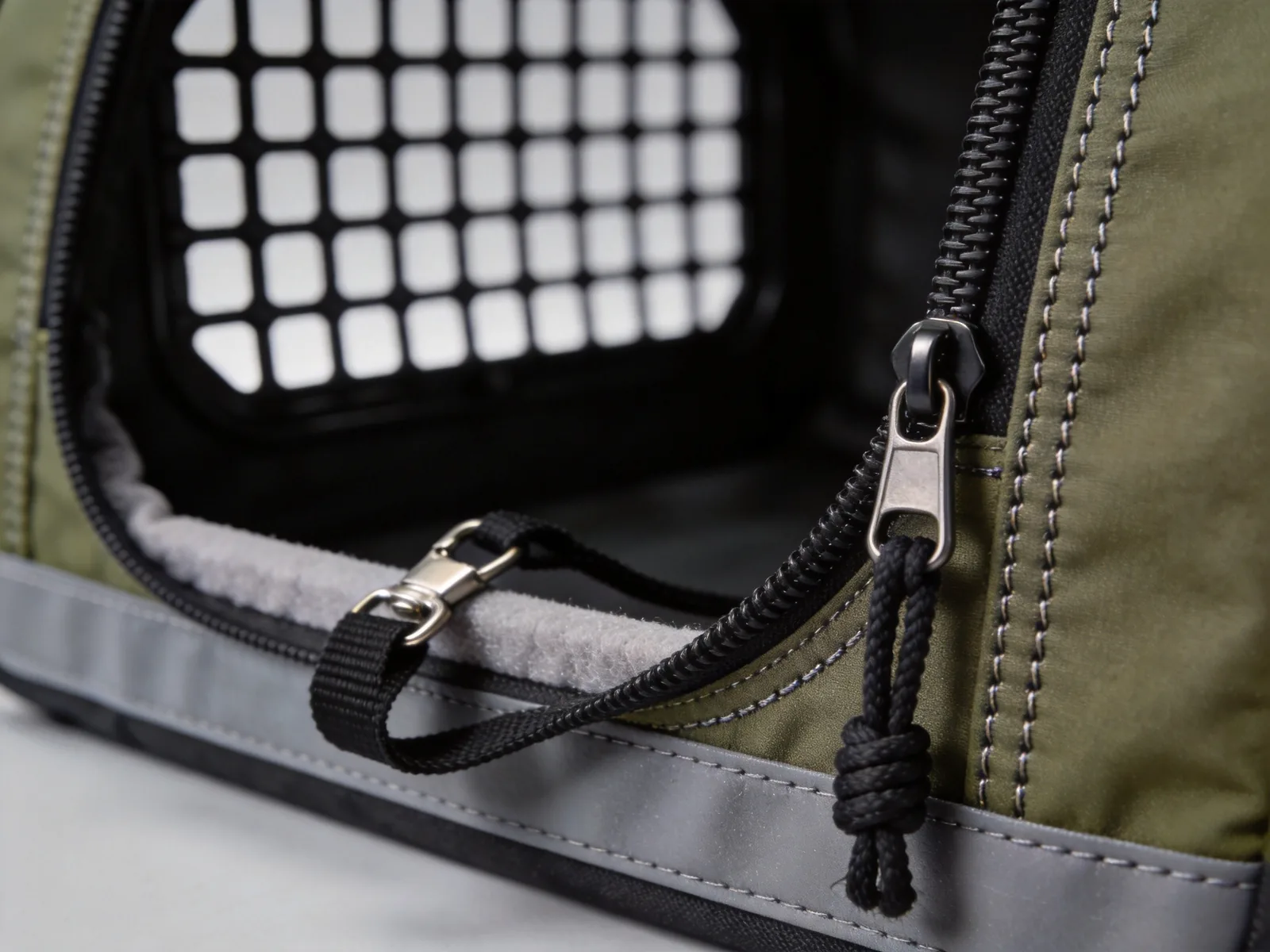
Containment: Zips, Tethers, Seams and the Jet-Bridge Test
Containment failures are not exotic. They are a slider that creeps open when the bag is squeezed, a mesh seam that splits where the needle perforated the coating, a tether anchor that pulls out of a single row of stitching, or a top panel that opens because the zip was loaded in tension rather than in shear. Each of those has a known fix, and each fix costs cents rather than dollars.
- Self-locking sliders, both directions. A carrier has two sliders that meet in the middle; if only one locks, the other walks open under vibration in a car or under the bag’s own weight when carried by the top handle. We specify locking bodies on both and metal sliders from #8 coil upward, with plastic sliders only on promotional-grade carriers.
- A zipper garage or storm flap at the meeting point. This is what stops a determined cat from working a claw into the slider gap, and it also keeps rain and road spray out of the coil.
- A sewn-in safety tether, 20–25 cm, with a swivel snap. Anchored through a bar-tacked webbing tab on the base or the back panel, never to the lining. The tether is the second containment system and the reason a carrier can be opened at a vet clinic without a hand on the collar.
- Bar-tacks at every strap and D-ring anchor. A single-row stitch at a handle anchor is a 20 kg load on six stitches; a bar-tack plus a box-X spread the same load over 40 mm of webbing and two layers of shell.
- Seam construction at the mesh. Mesh is joined to the shell with a binding tape underlay and a double row of stitches at 7–9 stitches per inch, and the mesh edge is turned under so the cut edge cannot unravel. Where the shell is coated, we keep the stitch line outside the coated face or seal it, because every needle hole is a leak path.
We test containment with a protocol rather than an opinion: load the carrier to its rated weight with a sand bag, invert it for 60 seconds, shake it 20 times at roughly 2 Hz, then work every zip, clip and tether by hand and inspect the seam line at 30 cm under 500 lux. Anything that opens, splits or deforms is a pattern change, not an inspection reject.
Materials: Seven Shells and What Each One Is For
Fabric choice in this category is driven by three things: how the product is cleaned, how it is carried, and what the brand’s sustainability story is. Weight and cost follow.
| Material | Weight | Abrasion | Water resistance | Hand | Best for |
|---|---|---|---|---|---|
| 600D polyester, PU-backed | About 230 g/m² | Good | Water-repellent, not waterproof | Firm, structured | Default for PC-01 and PC-02 |
| 300D ripstop polyester | About 150 g/m² | Moderate | Water-repellent | Light, packable | Promotional and travel-fold carriers |
| 1680D ballistic nylon | About 420 g/m² | Very good | Water-repellent | Heavy, premium | Premium carriers and cargo soft bags |
| 18 oz waxed canvas | About 500 g/m² | Very good | Shower-resistant, not washable | Stiff, ages well | Heritage and lifestyle carriers |
| 600D recycled polyester (RPET) | About 240 g/m² | Good | Water-repellent | Firm | Brands with a documented recycled claim |
| 3 mm EVA laminated panel | About 900 g/m² | Good | Water-resistant | Rigid, smooth | Frames, hard-shell cabin carriers |
| Injection-moulded PP | Shell weight 700–1,600 g | Very good | Waterproof | Hard | Cargo crates, hard cabin shells |
Two specification notes that save programs later. First, the interior lining should be a light colour: dark linings hide stains in product photography and hide mess from the owner, and both are complaints. Second, where the brand will claim machine washability, the frame has to be removable and the lining has to be a separate, replaceable pad — a carrier with a laminated EVA frame is spot-clean only, and saying so on the care label prevents the returns that follow a 40 °C wash cycle.
Hardware, Straps and Load Paths
Carriers are carried by a handle, a shoulder strap or a pair of backpack straps, and each of those is a load path that has to terminate in structure rather than in lining. The hardware list is short but every item is a failure point if it is specified by price alone.
| Component | Our standard specification | Why it matters |
|---|---|---|
| Shoulder strap webbing | 25 mm PP or polyester, 1.2–1.5 mm thick, adjustable to 130 cm | Load rating and comfort; PP is cheaper, polyester wears better |
| Buckles and adjusters | POM, 25 mm or 38 mm, tested to 250 N | Nylon buckles creep under load; POM holds and does not squeak |
| D-rings and swivel snaps | Zinc-alloy or stainless, 20–25 mm, load rated | Plated zinc corrodes in coastal markets; stainless costs more and lasts |
| Handle | Rolled webbing or padded grip, bar-tacked through the frame | The handle is the first thing that fails when it is stitched only to the shell |
| Luggage pass-through | 50–60 mm sleeve on the back panel | Lets the carrier ride on a trolley handle, which is a real travel purchase driver |
| Seat-belt routing slot | 50 mm slot with reinforced binding, PC-08 only | Keeps the carrier on the seat under braking; not a substitute for a tested restraint |
| Wheels and telescopic handle | 55–70 mm PU wheels, two-stage aluminium handle, bolted through the base board | Stitched wheel housings tear out on the first kerb |
| Base feet | 5–8 mm moulded studs or a TPU skid strip | Stops the base fabric from grinding through on concrete |
Comfort, Hygiene and the Washability Question
Comfort is where a carrier stops being a bag and becomes a product the owner keeps on the floor of the living room. It is also the cheapest place to add perceived value: a removable fleece pad, a waterproof liner and a small mesh pocket cost a few cents each and appear in every review photograph.
What we build as standard on a mid-tier carrier: a 15–20 mm quilted fleece pad with a waterproof PEVA backing, removable through a zip or a hook-and-loop flap; a rigid base board with a removable, wipe-clean cover; a short internal tether; one exterior mesh pocket for treats and documents; and a machine-washable pad as a separate SKU. Owners replace pads far more often than carriers, which makes the pad a genuine repeat-purchase item rather than an afterthought.
The hygiene question deserves a straight answer on the packaging. Fabric shells with a laminated frame should be labelled spot-clean only, because a 40 °C cycle delaminates EVA and shrinks PU coating. Shells built without a laminated frame — 300D ripstop promotional carriers, for example — can carry a machine-washable claim if the board is removable and the hardware is stainless. We will not put a machine-washable claim on a framed carrier, and we will tell a buyer when their artwork asks for one.
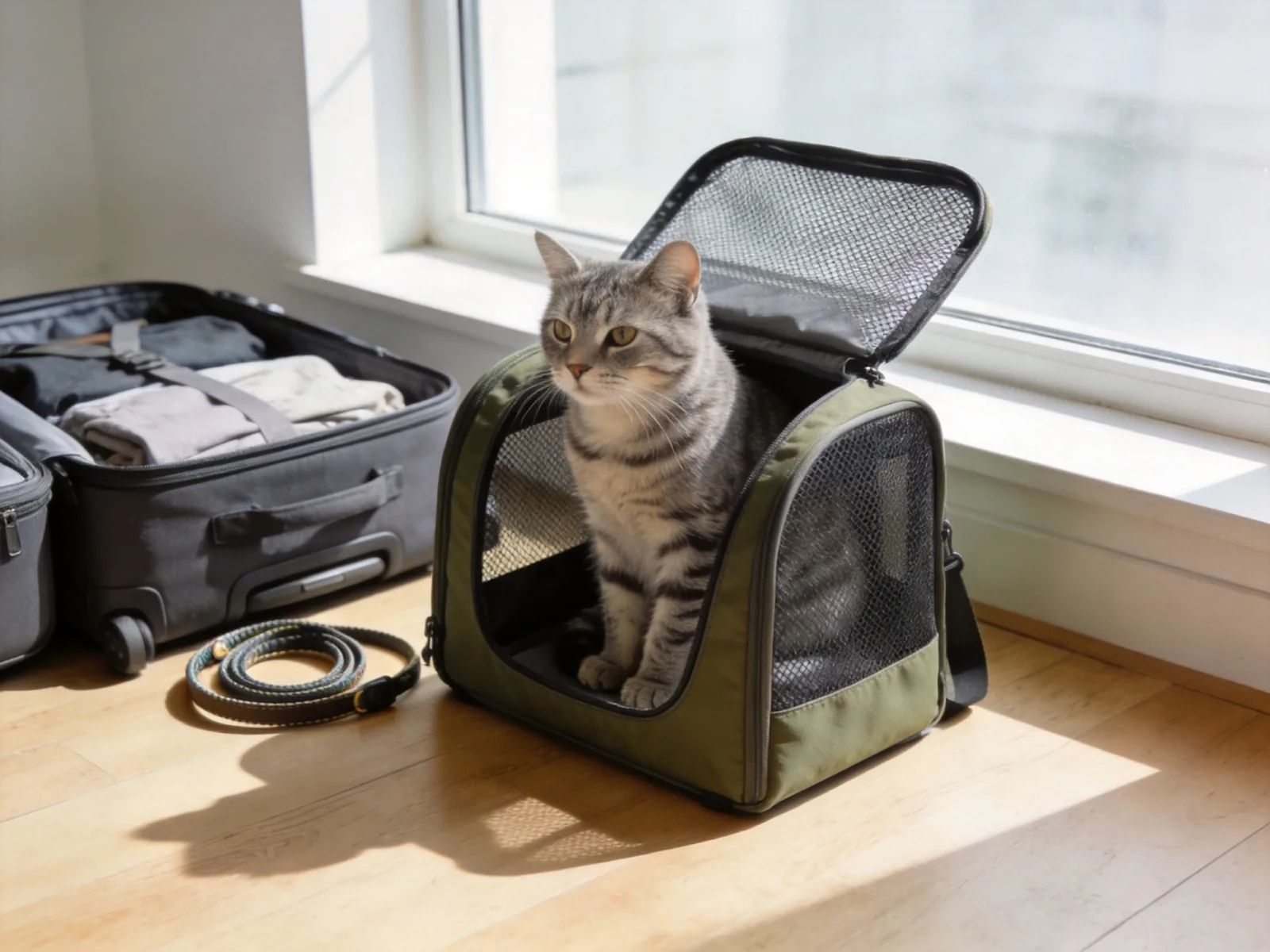
Branding: Seven Methods That Work on a Soft Panel
A carrier offers less flat, stable print area than a tote. The front panel curves, the top panel moves, and the mesh cannot be printed at all. The methods that work are the ones that survive being folded, squeezed and washed.
| Method | Minimum detail | Colours | Durability | Best placement | Caveat |
|---|---|---|---|---|---|
| Embroidery | 3 mm stroke, 6 mm minimum height | Up to 8 threads | Excellent | Front panel, top panel | Dense logos stiffen a soft panel; keep stitch count under 6,000 |
| Woven main label | 1 mm detail | Up to 6 colours | Excellent | Side seam or front panel | Needs a seam allowance; not suitable for curved placement |
| TPU or PVC patch | 1.5 mm detail | Full colour | Very good | Front or top panel | Patch edge must be high-frequency welded or stitched, or it peels |
| Heat transfer | 1 mm detail | Full colour | Good on polyester | Side panels, small areas | Will not bond to waxed canvas or silicone-coated surfaces |
| Screen print | 2 mm line | 1–4 colours | Good | Flat side panels | Plastisol cracks on folds; water-based ink needs a heat cure |
| Silicone or high-density print | 1.5 mm line | 1–3 colours | Very good | Front panel | Raised edge collects pet hair; specify a matte finish |
| Metal plate or leather patch | Engraved detail | 1 metal tone | Excellent | Front panel, premium ranges | Adds 8–15 g and a hard point; needs a backing plate |
Practical limits worth knowing before artwork is finalised: the usable front field on a 45 cm carrier is roughly 160 × 90 mm once the zip garage and binding are excluded, and the top panel is usually the better branding surface because it faces the camera when the carrier is carried. A patch that overlaps a mesh panel reduces ventilation and will be flagged in review, so branding placement and ventilation layout have to be designed together.
Six Failure Points We Design Out
1. The slider creeps open under load
A carrier is carried by its handle, which loads the top zip in shear; add a 7 kg cat pushing against the door and a single non-locking slider will walk open within a journey. We specify locking sliders on both ends, a zipper garage at the meeting point, and a storm flap behind the coil so the slider cannot be reached from inside. On carriers sold into cat markets we also add a small clip between the two sliders, which costs about three cents and removes the complaint entirely.
2. The mesh splits along the seam
PVC-coated mesh is a coated fabric, and every needle hole is a stress riser. Mesh that is stitched directly to a 600D shell with a single row will split at the seam after a few months of a cat pushing at the door. The fix is a binding tape underlay, a turned edge and a double row at 7–9 stitches per inch, plus a slightly larger stitch length so the coating is perforated less densely.
3. The frame creases and the bag sags
A perimeter-stitched EVA frame hinges along the stitch line and creases within a season, after which the carrier no longer stands up and no longer fits the stated external dimension. We laminate the frame across its full face, bind the edge rather than topstitch through it, and check the loaded dimension at final inspection.
4. The strap anchor pulls out
A shoulder-strap D-ring anchored to the lining, or to the shell with a single row, will tear out under a loaded carry. Every anchor is bar-tacked through a webbing tab that is itself caught into a structural seam, and we pull-test 300 N on a sample per lot.
5. The base board soaks and the carrier smells
Boards are the forgotten component. A non-woven or paper-based board wicks moisture from a wet animal, then delaminates and holds odour. We use PP or HDPE board with a removable wipe-clean cover, and where the brand wants a soft base we use a closed-cell foam that does not absorb.
6. The loaded carrier no longer fits the envelope
The quietest failure in this category: a carrier measured at 45 × 28 × 28 cm empty, bulging to 47 × 31 × 30 cm with an animal inside, refused at the gate. We build 2–3 cm inside the target envelope, keep the expansion panel on the short axis where possible, and state the loaded dimension on the spec sheet rather than the flat one.
Customization: What We Actually Change on a 500-Piece Order
At 500 pieces the economics allow real customization — not a stock bag with a printed logo, but a pattern change, a hardware change and a packaging change. The list below is what buyers most often modify, in the order they usually modify it.
| Element | What can change at 500 pcs | Effect on lead time | Effect on unit cost |
|---|---|---|---|
| Size | Any of the six matrix sizes, or a new size within the same frame family | Pattern adjustment, no added lead time | Material-driven, roughly proportional to surface area |
| Shell fabric and colour | 600D, 300D ripstop, 1680D, waxed canvas, RPET; up to three colourways per 500 | Stock colours none; custom-dyed adds 10–15 days | Custom dye adds 3–8% at this volume |
| Mesh colour and aperture | Black, grey, tan, olive; 4 mm or 6 mm aperture | None for stock mesh | Negligible |
| Lining and pad | Fleece colour, pad thickness, removable or fixed | None | Pad thickness is the main driver |
| Zips and hardware | Zip size and colour, metal or plastic sliders, POM buckles, stainless D-rings | Non-stock zip colour adds 7–12 days | Metal sliders and stainless add 2–5% |
| Branding | Embroidery, woven label, TPU patch, heat transfer, metal plate; two layouts per 500 | Artwork-dependent, typically none | Per method, from negligible to 4% |
| Functional add-ons | Luggage pass-through, exterior pocket, seat-belt slot, expansion panel, tether | Pattern change, no added lead time | 1–3% per add-on |
| Packaging | Polybag, retail box, hangtag, barcode, carton mark to your artwork | Box tooling adds 7–10 days if new | Packaging is often 4–9% of landed cost |
Quality Control: The Inspection Plan and the Tests Behind It
Our inspection plan for carriers has ten checkpoints, and the tests are chosen because they map to the failures listed above rather than because they are easy to run. Final random inspection is to AQL 2.5 major / 4.0 minor.
| Stage or test | Method | Sample | Accept criteria |
|---|---|---|---|
| Incoming fabric | Weight, shade, coating continuity, width | 10% of rolls | Within ±5% of approved swatch weight; no coating gaps |
| Cut panel dimensions | Measured against the pattern card | 5 pcs per size per lot | ±3 mm on structural panels, ±5 mm on cosmetic |
| Stitch density | Counted over 25 mm | In-line, hourly | 7–9 stitches per inch; no skipped stitches |
| Mesh seam strength | Tensile pull at the mesh-to-shell seam | 3 pcs per lot | No delamination or stitch pull below 180 N/50 mm |
| Zip cycling | 3,000 open-close cycles, loaded | 3 pcs per lot | No slider creep, no coil separation, no tape fray |
| Strap and handle pull | 300 N static for 60 seconds | 3 pcs per lot | No anchor pull-out, no bar-tack failure |
| Loaded dimension check | Filled to rated weight, measured externally | 5 pcs per size per lot | Within the stated envelope, +0 / −10 mm |
| Colour fastness | AATCC 8 (crock) and AATCC 16 (light) | 1 per colour per lot | Grade 4 minimum |
| Hardware corrosion | Salt spray, 24 hours | Per hardware lot | No red rust on plated parts |
| Final random inspection | AQL 2.5 major / 4.0 minor, plus packaging and carton marks | ISO 2859-1 sampling | Accept on AQL; defects photographed and dispositioned |
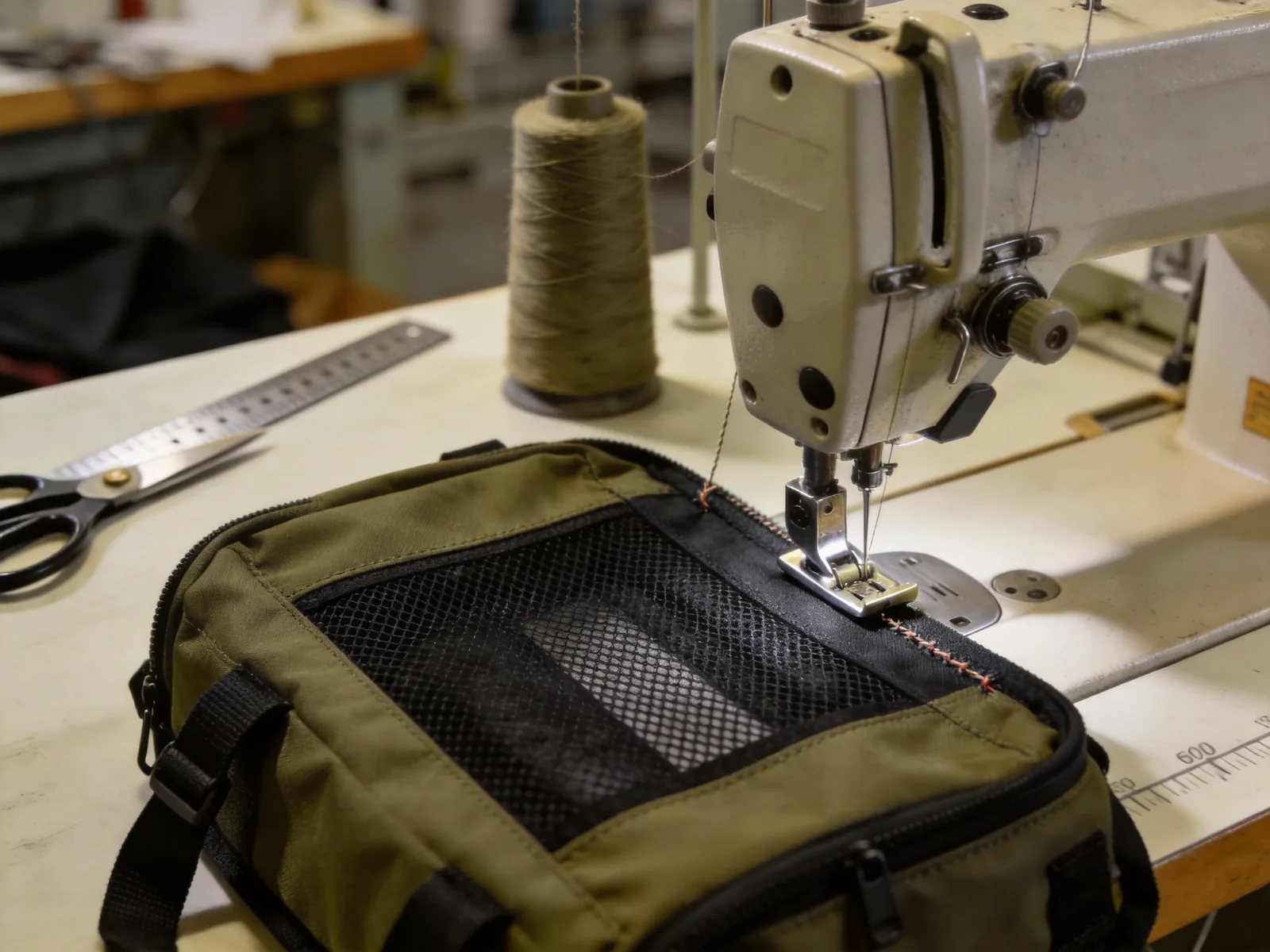
MOQ, Sampling and Production Timeline
Carrier programs move on component lead time, not on sewing capacity. A pattern can be cut in a day; a custom zip colour, a moulded buckle or a printed retail box cannot. The timeline below is what we hold ourselves to on a confirmed specification.
| Stage | Duration | What has to be settled to start |
|---|---|---|
| Specification review and quotation | 2 working days | Reference sample or drawing, size, target market, quantity |
| First sample | 6–10 working days | Confirmed spec, artwork, target dimensions |
| Sample revision round | 5–7 working days per round | Written comments; two rounds is typical |
| Pre-production sample and approval | 5–7 working days | Signed spec sheet, colour approval |
| Mass production | 35–50 days after approval and deposit | Fabric and hardware booked; packaging artwork released |
| Final inspection and shipping | 3–5 days | Inspection passed; carton marks confirmed |
The MOQ is 500 pieces per style, with up to three colourways and two branding layouts inside that 500. Below 500 the unit price stops reflecting material and starts reflecting setup, cutting and sampling time, which is why most brands begin at 500 and add colourways once the pattern is proven. Where a buyer needs to test four colours before committing, we will usually quote 500 as 3 + 1 rather than pushing to 2,000.
Cost Drivers: Where the Money Actually Goes
Two carriers that look identical in a photo can differ by 30% in FOB price, and the difference is almost never the shell fabric. It is the frame, the zip, the hardware and the packaging.
| Cost element | Share of FOB, typical soft carrier | How to move it |
|---|---|---|
| Shell and lining fabric | 18–24% | 600D to 300D ripstop saves 4–6%; RPET adds 2–4% |
| Frame and base board | 10–16% | EVA to board-only base saves 3–5%, at a shape-retention cost |
| Mesh | 5–8% | 6 mm to 4 mm aperture adds cost and claw resistance |
| Zips and hardware | 12–18% | Plastic to metal sliders adds 2–4%; stainless adds more |
| Labour and stitching | 22–28% | Panel count is the driver; every extra panel adds a seam and a minute |
| Branding | 2–6% | Woven label is the cheapest durable option |
| Packaging | 4–9% | Polybag to retail box can double packaging cost and freight volume |
| Inspection and overhead | 8–12% | Fixed; not the place to negotiate |
The freight trap is worth flagging early. A carrier that ships flat in a polybag occupies a fraction of the volume of the same carrier in a rigid retail box, and at 500 pieces that difference is often larger than the entire branding budget. We quote both packing formats and give the carton dimensions and gross weight, so the buyer can see landed cost rather than FOB price.
Compliance: What Can Be Documented and What Cannot
Compliance in this category is mostly about claims. A carrier sold into the EU or the US touches chemical restrictions, recycled-content claims and, increasingly, PFAS restrictions on textile articles. We supply documentation for what we can actually test or trace, and we say plainly when a claim cannot be supported.
What we can document: fabric composition and weight; coating type and whether the DWR is PFAS-free; hardware material and plating; AZO-free and phthalate-free declarations for dyed fabric and PVC mesh from our suppliers; heavy-metal screening on printed and coated components; GRS transaction certificates for recycled polyester where the order is placed against a certified mill lot; and the test reports from the protocols in the inspection table above.
What we cannot issue: an “airline approved” certificate, because no such certificate exists — approval is per flight and per carrier. An “IATA certified” document, because IATA publishes the Live Animals Regulations as a standard and does not certify individual containers; what a crate can have is a construction that follows the LAR pattern, and we will document the ventilation area, door security and internal dimensions so a handler can verify it. A “crash tested” claim, unless the specific carrier has been tested by a recognised facility — we will not print it on a box because a board and a belt slot are not a tested restraint. And any medical, antibacterial or “hypoallergenic” claim without a test report behind it.
Why Brands Consolidate Pet Carriers With Us
Most of our carrier programs sit inside a larger bag range, and the reason is operational. A carrier uses the same cutting room, the same walking-foot machines, the same bonded nylon thread, the same mesh supplier and the same hardware vendors as a backpack or a duffel, so a brand already running a bag program adds a travel carrier line without adding a second supply chain, a second colour approval cycle or a second carton specification.
The technical capability that matters here is small-panel work with dimension-critical assembly: a carrier is essentially a box built from six soft panels, and a 3 mm error at the frame corner becomes a 10 mm error at the loaded external dimension. That is the same discipline we apply to tactical bags and EVA cases, where a panel that is 2 mm out is a functional defect rather than a cosmetic one. It is also why a carrier program usually goes from reference sample to a working prototype in one round.
This page covers the airline and travel side of the category — in-cabin compliance, containment and ventilation. For the wider pet bag range, including general pet totes, grooming bags and everyday pet carriers without a cabin envelope constraint, see our custom pet bags and pet carriers page. Brands that extend from carriers into backpacks, duffel bags or packing cubes build those on the same cells, and buyers adding wet-weather travel products usually pair the carrier with our waterproof bags and dry bags.
Frequently Asked Questions
Start a Pet Carrier Program
Send the target market and the airline envelope you are building for, the pet weight range, the construction you want (or a reference product), the shell material, the branding artwork and the packaging format. We will come back inside two working days with a construction recommendation, a size sheet with internal and external dimensions, a mesh and zip specification, and a quotation. If the construction is not settled, we can start from one of the eight builds above and adapt it — most carrier programs begin with an existing pattern and one meaningful change, not a new design from zero.
What we need to quote accurately: target envelope and market, pet weight range, construction type, shell preference, frame type, mesh specification, zip and hardware grade, branding method and artwork, packaging format, order quantity and required delivery window. What we will tell you honestly: where a requested envelope will not survive a loaded-dimension check, where a compliance or performance claim cannot be documented, and where a cheaper frame will cost more in returns over the life of the product.
Request a Pet Carrier Quote
500 pcs MOQ · 6–10 day sampling · 35–50 day production · AQL 2.5 major / 4.0 minor · OEM/ODM since 2014
Related Manufacturing Pages
- Custom Bag Manufacturer — OEM/ODM Hub
- Custom Pet Bags & Pet Carriers
- Pet Carrier Bag Manufacturing Guide
- Custom Trolley Bag Manufacturer
- Custom EVA Case Manufacturer
- Custom Tactical Bag Manufacturer
- Custom Waterproof Bag Manufacturer
- Custom Dry Bag Manufacturer
- Custom Hiking Backpack Manufacturer
- Custom Backpack Manufacturer
- Custom Duffel Bag Manufacturer
- Custom Packing Cubes Manufacturer
- Custom First Aid Bag Manufacturer
- Custom Clear PVC Bag Manufacturer