
Junyuan Bags is a custom electric guitar bag manufacturer producing OEM and ODM gig bags for Stratocaster, Telecaster, Les Paul, SG and superstrat body shapes. 20–25mm EPE padding, reinforced bridge pocket, stitch-through velvet neck rest, and single or dual backpack strap options. Sampling in 6–10 business days from our affiliated and partner factories in Quanzhou, China.
What Makes an Electric Guitar Bag Different?
An electric guitar bag is not simply a smaller version of an acoustic gig bag. Solid-body electric guitars are heavier relative to their size, have exposed hardware — bridge saddles, pickup selector switches, output jacks — and come in body shapes that differ significantly in width, depth and contour. A bag built for a Les Paul will be too wide and too shallow for a Stratocaster.
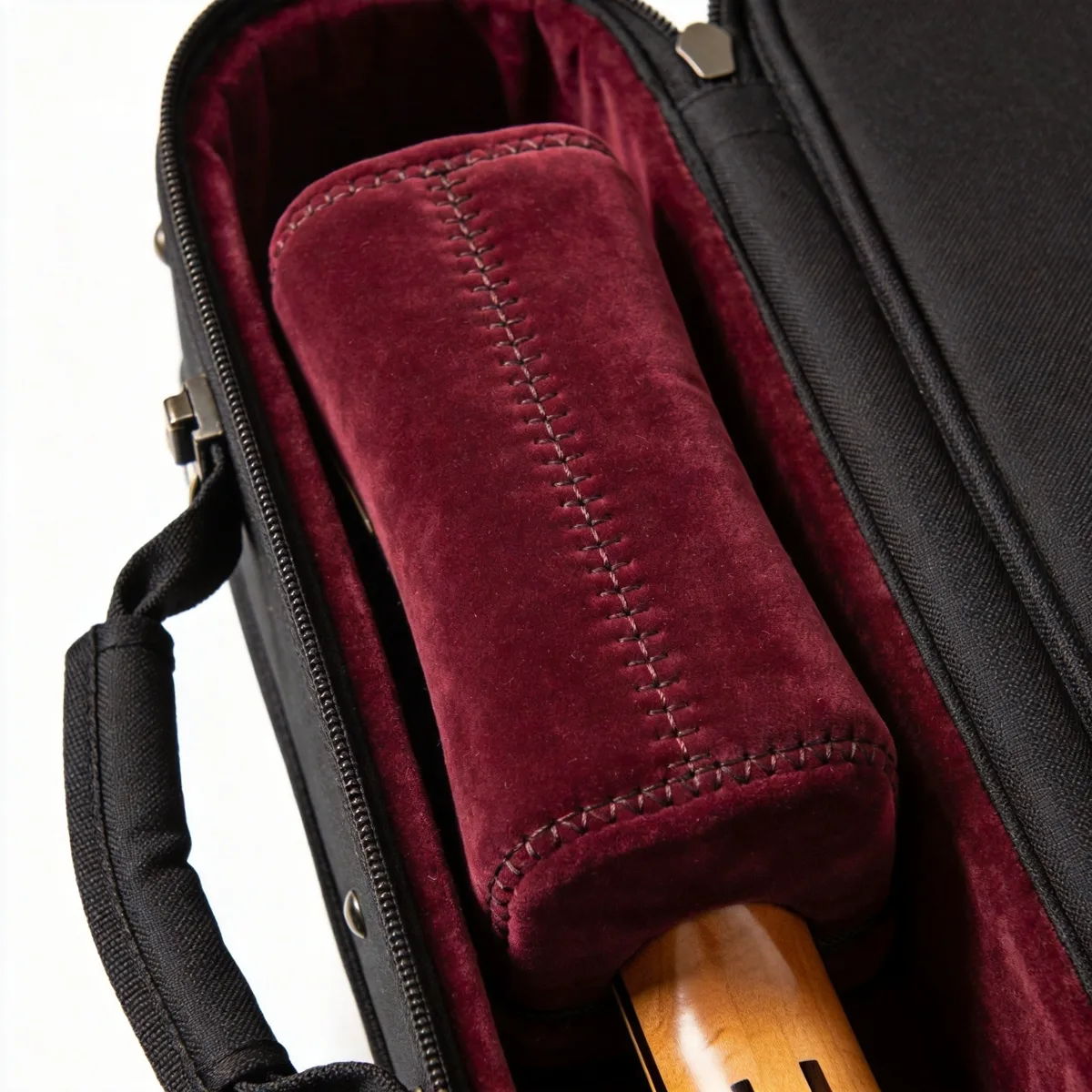
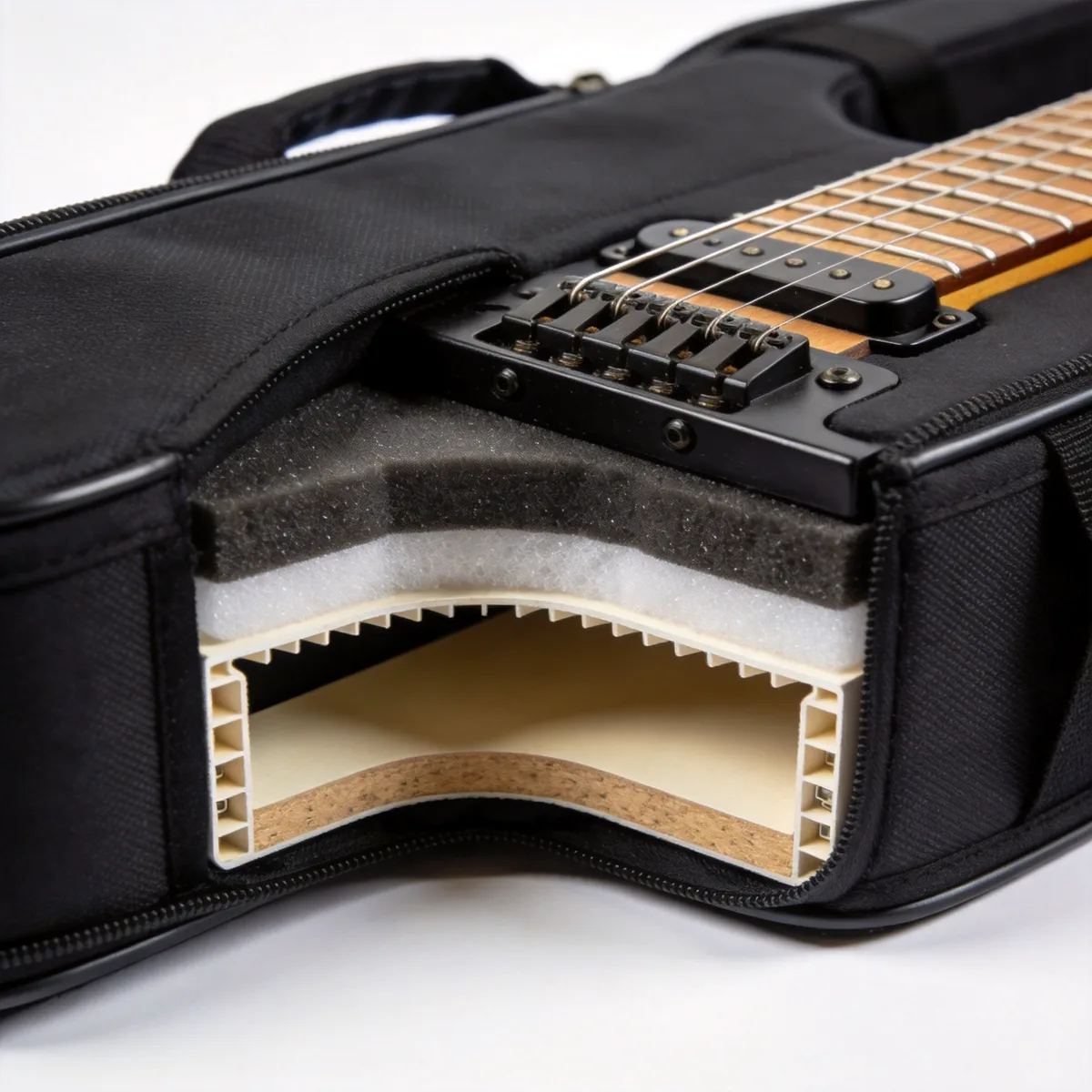
As a dedicated electric guitar bag manufacturer, we build every pattern around the actual instrument dimensions rather than working from a generic template. The instrument sits snugly, the bridge and pickups are protected by a reinforced foam pocket, and the neck rests on a velvet-covered foam block that is stitched through the shell — not glued in place.
- ✓ Electric guitars weigh 3–5 kg — more than acoustic instruments of similar length — so strap anchor points carry real structural load.
- ✓ Bridge saddles and pickup poles are the first things to show impact marks when padding is too thin. A 20–25mm EPE shell with bridge-pocket reinforcement eliminates this.
- ✓ Body depth varies from 35mm (thin-line semi-hollow) to 55mm (chambered Les Paul). One depth does not fit all.
- ✓ A snug-fitting electric guitar bag reduces warranty claims and retail returns — sizing is the number-one source of both.
Electric Guitar Body Shapes & Bag Sizing
The five most common electric guitar body shapes — Stratocaster, Telecaster, Les Paul, SG and superstrat — each need a different internal width and depth. Below are the starting dimensions we use before adjusting to a buyer’s actual instrument.
| Body Shape | Body Length | Lower Bout Width | Body Depth | Overall Bag Length | Notes |
|---|---|---|---|---|---|
| Stratocaster | 330 mm | 320 mm | 40–45 mm | 100–102 cm | Contoured body; contoured pocket at lower bout |
| Telecaster | 330 mm | 305 mm | 40–45 mm | 100–102 cm | Slightly narrower; straighter cutaway |
| Les Paul | 335 mm | 330 mm | 50–55 mm | 100–103 cm | Deeper body; thicker padding at bridge |
| SG | 320 mm | 300 mm | 40–45 mm | 98–100 cm | Thinner, lighter; less body depth required |
| Superstrat | 340 mm | 330 mm | 42–48 mm | 102–105 cm | Extended scale; wider lower bout; deeper cutaway horns |
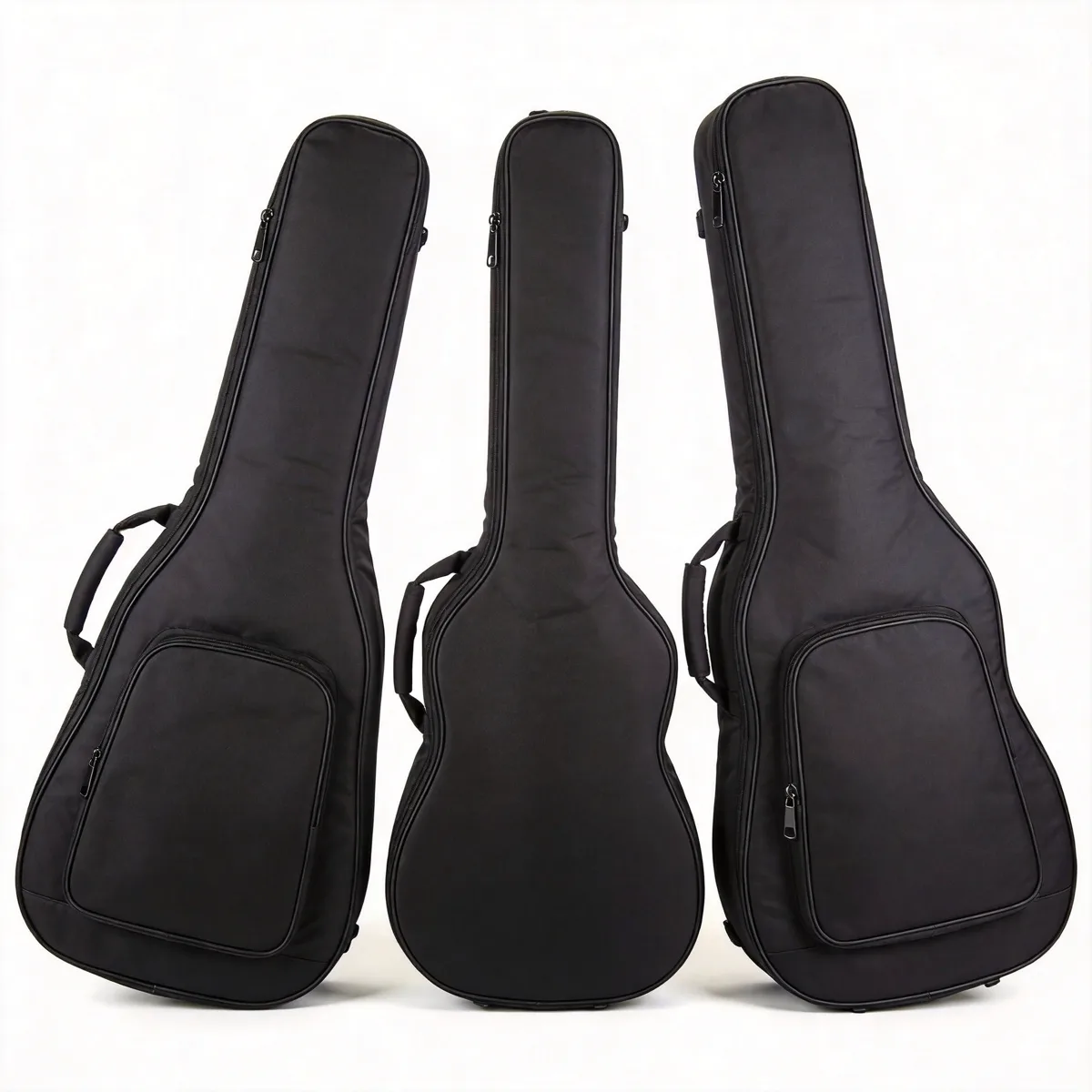
Getting these dimensions wrong is the most expensive mistake in this category. A bag 15mm too narrow will not close; a bag 15mm too wide lets the instrument shift in transit, which is where finish scratches come from. Send us one physical instrument and we will pattern from it at no extra cost at the sampling stage.
Our OEM Electric Guitar Gig Bag Capabilities
Junyuan Bags was established in 2014 in Quanzhou, Fujian — one of China’s two largest bag-making clusters. Our founder entered the bag trade in 2004, and we work with affiliated and partner factories qualified over more than a decade. For electric guitar bags, we place orders in facilities that already run padded instrument bag construction daily.
We quote against your instrument’s measurements or drawing, build a pre-production sample with your logo before the bulk run, and inspect to AQL 2.5 major / 4.0 minor. We do not sell ready-made stock — every OEM electric guitar gig bag order is built to your specification.
| Capability | What We Deliver | Typical Range |
|---|---|---|
| Body shapes | Stratocaster, Telecaster, Les Paul, SG, superstrat, semi-hollow, offset, baritone, 7/8-string | All electric formats |
| Outer shell | 600D / 900D / 1680D polyester, ballistic nylon, ripstop | 300D–1680D |
| Padding | 20mm EPE standard, 25mm EPE + PE board premium | 10mm–30mm |
| Interior lining | Velvet, short-pile plush, brushed tricot, 210D polyester | Soft-touch standard |
| Neck rest | Velvet-wrapped foam, stitched through | Standard on all orders |
| Bridge pocket | Reinforced EPE + optional PE board insert | Standard / reinforced |
| Zippers | YKK #8 / #10 reverse-coil waterproof | YKK standard |
| Branding | Embroidery, woven label, silicone patch, heat transfer, rubber badge | 5 methods |
| MOQ | 500 pcs per style and colour | From 500 pcs |
| Sampling | Pre-production sample with logo | 6–10 business days |
| Production | Bulk run after sample sign-off | 35–50 days |
Padding, Bridge Reinforcement & Neck Rest Construction
Padding is the first thing a retail customer squeezes and the component that determines whether a bag protects against scuffs or drops. For electric guitar bags, padding decisions also need to account for the bridge and pickup area — the most exposed hardware on the instrument — and the neck rest, which is where cheap bags fail first.
| Spec Level | Padding | Bridge Area | Neck Rest | Best For |
|---|---|---|---|---|
| Entry | 10mm EPE | Single layer | Glued foam block | Promo giveaways, in-store trial bags |
| Standard | 20mm EPE | 20mm EPE + 5mm laminated panel | Velvet-wrapped, stitched through × 2 | Private-label retail programs |
| Premium | 25mm EPE + PE board | 25mm EPE + PE board insert | 40mm contoured, plush × 3 anchor + headstock cradle | Brands competing on protection |
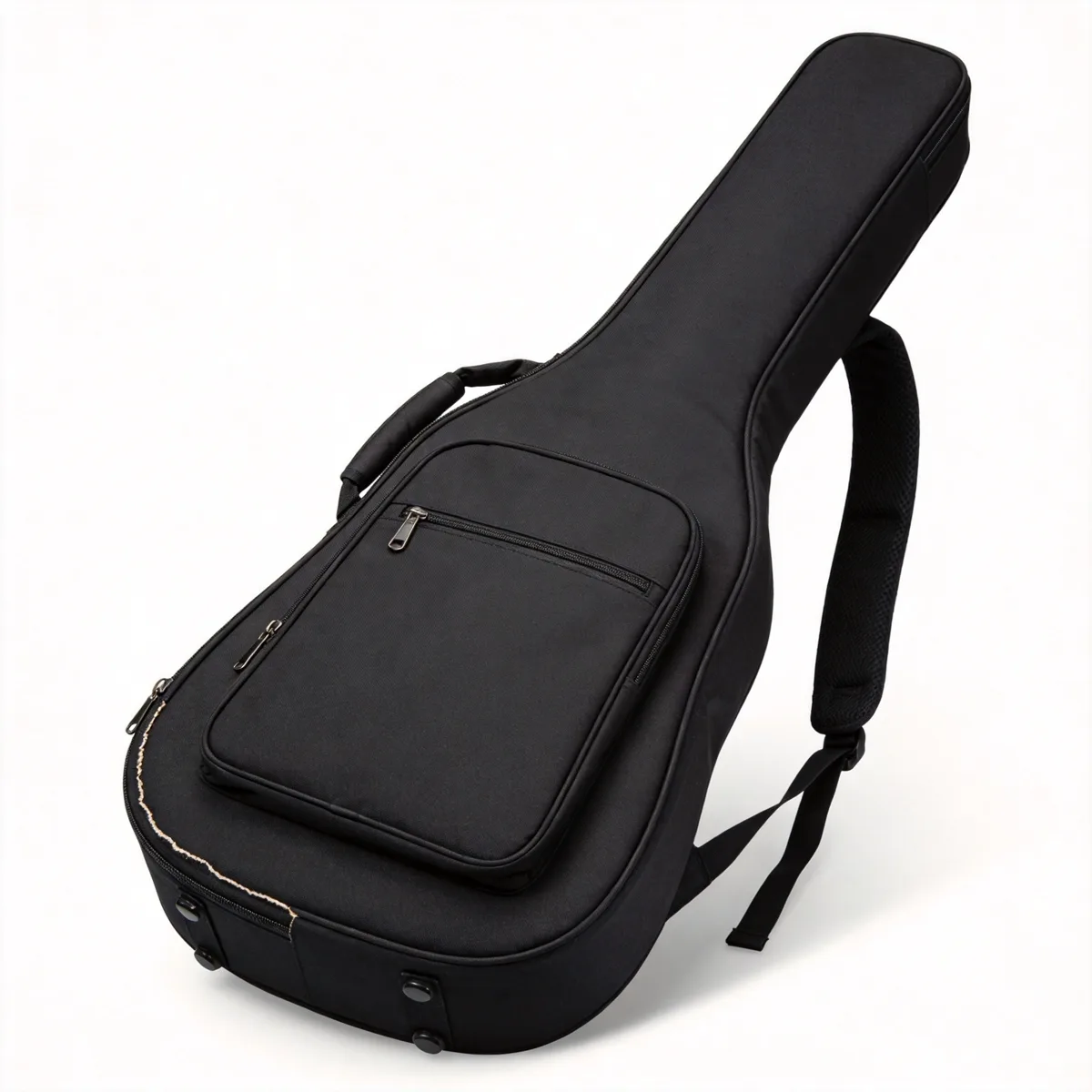
Above 20mm, the limiting factor stops being the foam and becomes the shell stiffness. Our premium spec pairs 25mm EPE with a PE board behind the body area rather than simply adding more foam — the board distributes impact across a larger surface.
Bridge pocket reinforcement
On a Stratocaster or Telecaster, the bridge saddles protrude 8–12mm above the body surface. In a thin-padded bag, those saddles press directly against the shell. We build a dedicated reinforced pocket — an extra layer of EPE laminated over the bridge zone — so the saddles sit in a recessed cavity rather than pushing against the outer shell.
Stitch-through neck rest
The neck rest is the small raised block under the guitar neck inside the bag. On cheap bags it is foam glued to the lining. On a proper electric guitar gig bag it is a velvet-wrapped foam block stitched through the shell fabric. A 3 kg Les Paul puts roughly 800g of force through the neck rest every time the bag is carried upright. Glued blocks peel off in hot containers when adhesive softens at 50°C. Stitched-through blocks do not move.
Single vs Dual Backpack Strap Options
Electric guitar gig bags are carried in two modes, and the strap system needs to support both without adding unnecessary weight. A single shoulder strap is preferred for quick carry; dual backpack straps for longer carries — commuting, festival grounds, loading multiple bags.
| Feature | Single Shoulder Strap | Dual Backpack Straps |
|---|---|---|
| Carry mode | Over-shoulder or hand carry | Both hands free, weight distributed |
| Strap width | 50mm padded | 40mm padded, adjustable |
| Weight impact | +120g | +220g |
| Best for | Studio use, short distance | Touring, commuting, festivals |
| Standard build | Included as default | Concealable straps zip into rear panel |
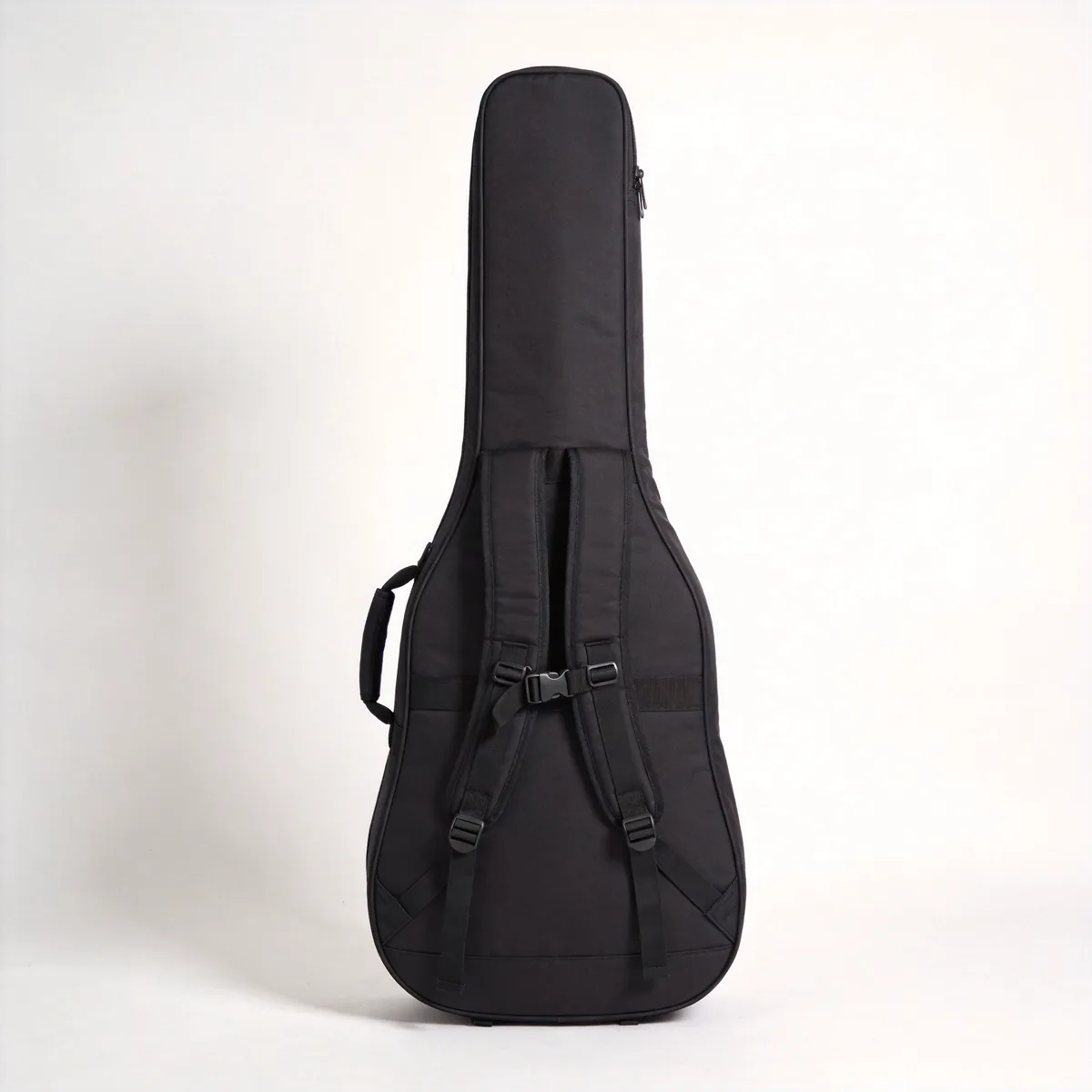
Our standard build includes both in one bag: a detachable shoulder strap plus backpack straps that conceal into a zippered rear panel. When hidden, the rear panel is flat and clean for branding. The strap-hiding mechanism on cheap bags is a zip-on fabric cover that detaches within months. We build it as a stitched-in panel that is part of the bag’s structure.
Materials & Build Quality
Electric guitar bag quality comes down to five material decisions, each a cost lever visible to your customer within the first month of use.
| Component | Entry Spec | Standard Spec | Premium Spec |
|---|---|---|---|
| Outer shell | 600D polyester, PU coated | 900D polyester, PU 3000mm | 1680D ballistic nylon |
| Padding | 10mm EPE | 20mm EPE | 25mm EPE + PE board |
| Interior lining | 210D polyester | Brushed tricot | Short-pile velvet |
| Zipper | #8 nylon coil | YKK #8 two-way | YKK #10 reverse-coil waterproof |
| Stitching | Single-row 210D/3 nylon | Double-row lock stitch at load points | Double-row + bartack at stress points |
Shell fabric and zippers
600D polyester handles normal transport but a sharp corner impact can puncture it. 900D with 3000mm PU coating is our standard: handles rain, resists abrasion. 1680D ballistic nylon is the top tier — heavy but virtually puncture-proof. We use YKK #8 as standard and YKK #10 reverse-coil where water resistance matters. Reverse-coil sits the coil on the inside of the tape so the zipper cannot scratch the instrument’s finish. Pullers are cord or rubberised — never bare metal.
Water resistance
We quote three levels: PU coating at 3000mm for rain and spillage; reverse-coil zipper plus seam sealing for sustained exposure; welded or taped seam construction for outdoor and touring markets. We do not claim any electric guitar bag is waterproof — a soft bag with a zipper opening cannot be.
Quality Standard: AQL 2.5 & Inspection
Every electric guitar bag order is inspected to AQL 2.5 for major defects and AQL 4.0 for minor defects, using ISO 2859-1 sampling tables. For electric guitar bags specifically, we check:
- ✓ Dimensional check — internal length, lower bout width, body depth and headstock width against approved sample. Tolerance ±2mm on length, ±1mm on width and depth.
- ✓ Padding thickness — measured at body centre, bridge pocket, neck rest and headstock. Bridge pocket must meet spec or the lot is rejected.
- ✓ Neck rest pull test — static load applied to verify stitch-through anchoring. Glued-only rests fail; stitched-through rests do not.
- ✓ Zipper and strap load — full open/close cycles plus static load on strap anchors and main handle. Tested to 15kg for shoulder straps, 25kg for the handle.
- ✓ Fit test — where the buyer supplies the instrument model, we test-fit a physical unit before releasing the lot.
Inspection is documented with a photo report covering sampled units, measurements and defects, issued before shipment.
How to Order & Private Label Options
The process from first enquiry to container is typically 8–11 weeks, and most of that is your decision time rather than production time.
- Step 1 — Brief: Send instrument model or dimensions, target quantity, target FOB. Written quotation in 2–3 days.
- Step 2 — Sample: Pre-production sample built to agreed spec with your logo. 6–10 business days. Logo artwork needed as AI, EPS or PDF vector with Pantone references.
- Step 3 — Approval: You test-fit the instrument and sign off, or send marked-up changes.
- Step 4 — Bulk: 35–50 days after sample sign-off. In-line inspection during production.
- Step 5 — Ship: AQL inspection, photo report, booking. FOB Fujian ports standard; CIF or DDP available.
Branding options
Every custom order carries the buyer’s branding — no Junyuan label appears unless you ask for one. We offer woven labels (no tooling cost), embroidery (digitising file required), silicone or PVC patches (mould required), heat transfer print and rubberised badges. Custom lining colour, zipper puller, hardware finish and retail packaging are all available. We do not sell your colourway and pattern combination to another buyer in your market.
Why buyers stay
- ✓ Company established 2014, founder entered the bag trade in 2004. We have quoted bags through enough material cycles to know which spec will still be buildable at the same price in six months.
- ✓ Affiliated and partner factories, matched to construction. We place each program where that construction already runs daily.
- ✓ Specification discipline. The approved sample becomes the inspection standard.
- ✓ AQL 2.5 documented before shipment. Photo report issued before the container leaves.
- ✓ One supplier across the electric guitar family. All body shapes on one purchase order.
- ✓ Direct communication. [email protected] and +86 17750020688.
For buyers comparing supplier models, our custom guitar bag manufacturer page covers the full range of guitar bag types we produce.
Ready to Start Your Custom Electric Guitar Bag Order?
Send us the electric guitar model your bag must fit, the quantity per style and colour, and your target price. Written quotation within 2–3 working days, physical sample with your logo in 6–10 days.
Email: [email protected] | WhatsApp / Tel: +86 17750020688
Frequently Asked Questions About Custom Electric Guitar Bags
Q1: What is the MOQ for custom electric guitar bags?
Q2: Can you make bags for all electric guitar body shapes?
Q3: What padding do you recommend for electric guitar bags?
Q4: How does the bridge reinforcement work?
Q5: What is stitch-through neck rest construction?
Q6: Do you offer single and dual strap options?
Q7: How long do sampling and bulk production take?
Q8: Do you use YKK zippers on electric guitar bags?
Q9: Can I order a sample before committing to bulk?
Q10: What quality standard do you inspect to?
Related Products From Junyuan Bags
- Custom Guitar Bag Manufacturer — full range: acoustic, bass, classical, double
- Custom Acoustic Guitar Bag Manufacturer — dreadnought, jumbo, GA, OM and 000 patterns
- Custom Gig Bag Manufacturer — padded gig bags for all instruments
- Custom Equipment Bag Manufacturer — protective bags for gear
- Custom Waterproof Bag Manufacturer — waterproof bags and packs
- Sports Bags Manufacturer — gym, duffel and training bags
- Custom Backpack Manufacturer — daypacks and laptop bags
- Custom Travel Bag Manufacturer — carry-on and luggage
- Bag Manufacturer vs Supplier — what changes when you buy direct
- REACH Compliance for Custom Bags — EU documentation