
Junyuan Bags is a custom acoustic guitar bag manufacturer producing OEM and ODM gig bags for dreadnought, jumbo, grand auditorium, OM and 000 body shapes. 20–25mm EPE padding, a 5mm laminated panel over the top, a separate padded headstock compartment, 1680D or TPU abrasion panel at the base, and a moisture-resistant lining. Standard 41-inch bags run 104–108 cm internal length. Sampling in 6–10 business days from our affiliated and partner factories in Quanzhou, China.
What Is a Custom Acoustic Guitar Bag?
A custom acoustic guitar bag is a padded soft case built to one instrument family’s real geometry — not a generic guitar pattern in a bigger size. An acoustic guitar has a wide, hollow, thin-walled body, a 2.5–3 mm solid or laminated soundboard, a glued bridge with protruding saddle and bridge pins, and an angled headstock with tuners that stick out beyond the neck line. Every one of those features needs a specific answer inside the bag.
We build acoustic bags for four groups of buyers. Acoustic and singer-songwriter brands that want their own logo, colourway and interior on an accessory they currently buy from a trading company. Distributors who need one dreadnought guitar bag supplier across full-size, jumbo, OM and 000 models on a single purchase order. Music shops and education distributors buying in bulk for rental fleets and teaching programmes, where durability and identical sizing matter more than fashion. And OEM buyers who ship a bag in the same carton as the instrument they manufacture, where the bag has to fit one exact model with no tolerance for error.
- ✓ Wider lower bout. A dreadnought lower bout is 396–400 mm against 320–330 mm on a Stratocaster. The body cavity, not the length, is what makes the pattern different.
- ✓ Fragile top. The soundboard is 2.5–3 mm of spruce or cedar with bracing underneath. Point pressure from a strap buckle or a stacked carton will crack it; distributed load will not.
- ✓ Protruding tuners. Acoustic headstocks are wider and the tuner buttons stand proud. Without a separate headstock compartment the tuners press into the bag end and the headstock takes the load.
- ✓ Humidity sensitivity. Solid wood moves with relative humidity. A bag that traps damp air is worse than no bag at all, which is why lining choice is a technical decision, not a cosmetic one.
- ✓ Floor contact. Acoustic bags get stood on their base far more often than electric bags. The base panel is a wear part.
This page covers the acoustic programme only. For the full range across electric, bass, classical, double and ukulele formats, see our custom guitar bag manufacturer hub page.
Acoustic Guitar Body Shapes: Dreadnought, Jumbo, Grand Auditorium, OM and 000
Five body shapes account for most of the acoustic market, and they do not share a bag. The differences below are the starting point we use before adjusting to a buyer’s actual instrument. Figures are for 14-fret instruments at full size; 12-fret versions are shorter and we adjust the body block accordingly.
| Body Shape | Lower Bout Width | Body Length | Body Depth | Bag Internal Length | Bag Internal Width |
|---|---|---|---|---|---|
| Dreadnought (41″) | 396–400 mm | 505–510 mm | 120–125 mm | 104–108 cm | 42–44 cm |
| Jumbo (42″) | 425–432 mm | 525–535 mm | 120–127 mm | 108–111 cm | 45–47 cm |
| Grand Auditorium | 400–406 mm | 500–510 mm | 115–120 mm | 104–107 cm | 43–45 cm |
| OM / Orchestra | 378–385 mm | 485–495 mm | 100–108 mm | 103–106 cm | 40–42 cm |
| 000 / Triple-O | 378–385 mm | 480–492 mm | 100–105 mm | 102–105 cm | 40–42 cm |
| Parlour / Travel | 330–345 mm | 455–470 mm | 90–100 mm | 96–100 cm | 35–38 cm |
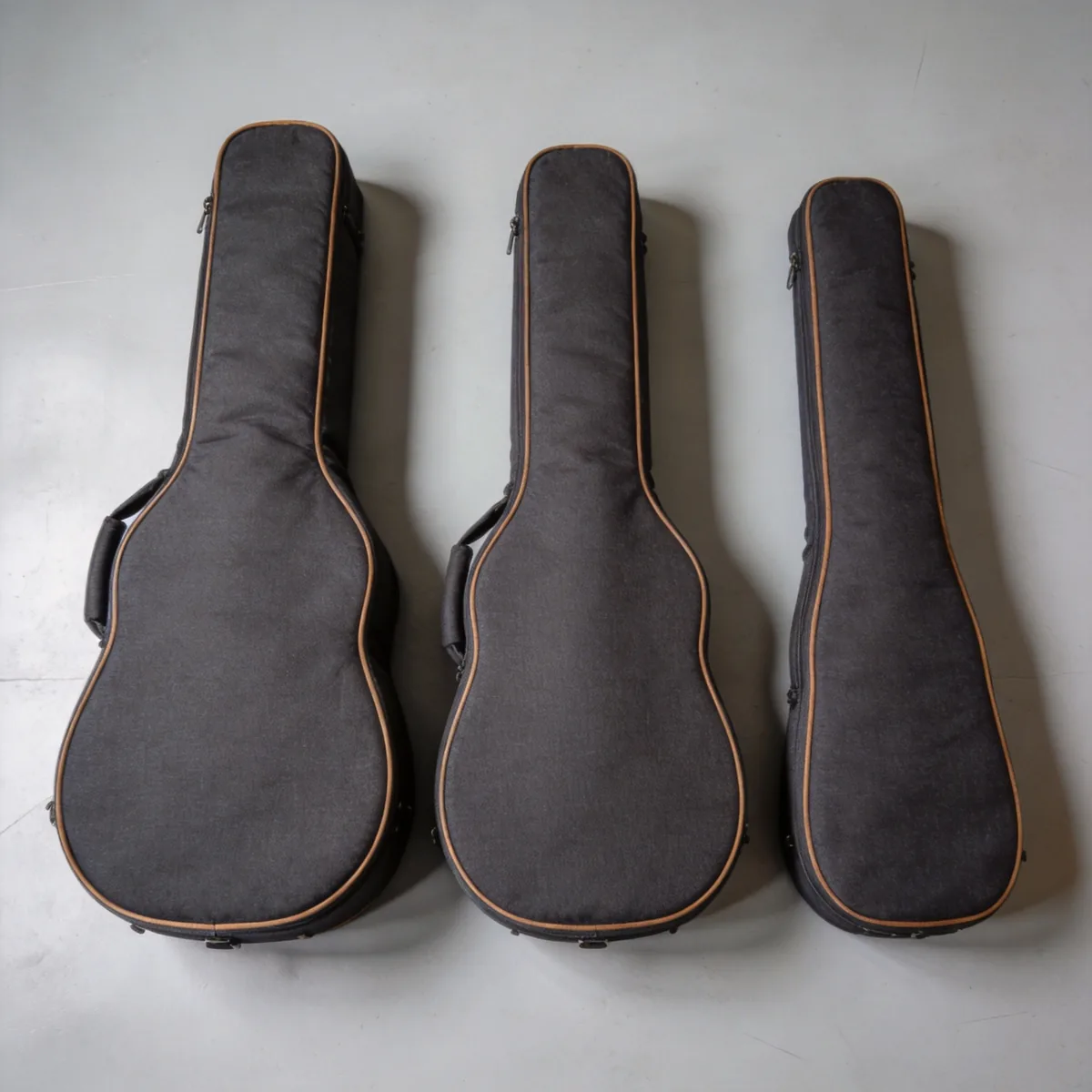
Two traps come up on almost every acoustic programme. The first is the 000 and OM pair: the outlines are nearly identical, so buyers assume one pattern covers both, but the OM’s longer 25.4-inch scale pushes the bridge 13 mm further from the tail and the neck sits deeper into the body. The second is cutaway bodies. A cutaway removes material at the upper bout, but the bag still has to hold the full lower bout, so a cutaway pattern is not smaller — only the upper-bout foam block changes shape.
Why an Acoustic Guitar Bag Is Not a Resized Electric Bag
The most common quality failure we see in competitor samples is an acoustic bag built on an electric pattern with the body widened. It looks correct on a hanger and fails in three specific ways.
Top pressure. An electric guitar’s body is 40–55 mm of solid wood with a bolted neck; an acoustic top is 2.5–3 mm of spruce over bracing. A bag that relies on a single 15 mm foam layer transfers every knock straight to that top. Our acoustic build adds a 5 mm laminated board panel across the upper bout and waist — the area a carried bag actually takes impacts on — so the load is spread over the panel instead of a point.
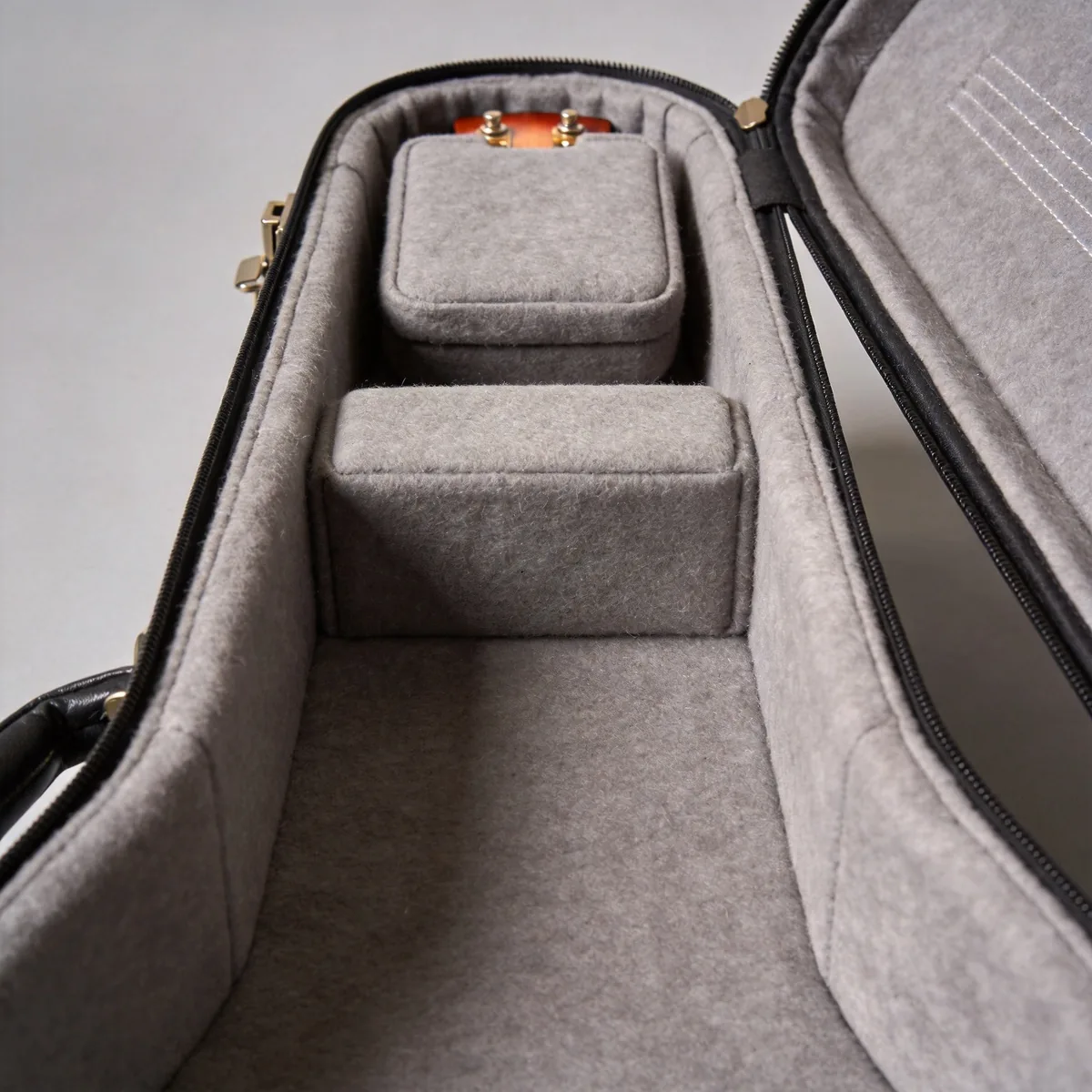
Headstock load. Acoustic headstocks are 45–50 mm wide with tuner buttons protruding a further 15–20 mm each side. In a bag with no dedicated headstock compartment, the headstock rests against the end wall and the full weight of the instrument hangs from the neck joint every time the bag is stood upright. We build a separate padded compartment with a divider across the top, sized to the headstock plus tuners, and the neck rests on a stitched-through foam block below it.
Base wear. Acoustic bags are stood on the floor at gigs, in shops and in storerooms. The base corner is the first thing to wear through, and once the outer shell goes, the foam follows within weeks. Our standard acoustic base is a 1680D oxford abrasion panel; a 1.0 mm TPU welded patch is the upgrade for rental fleets and school programmes.
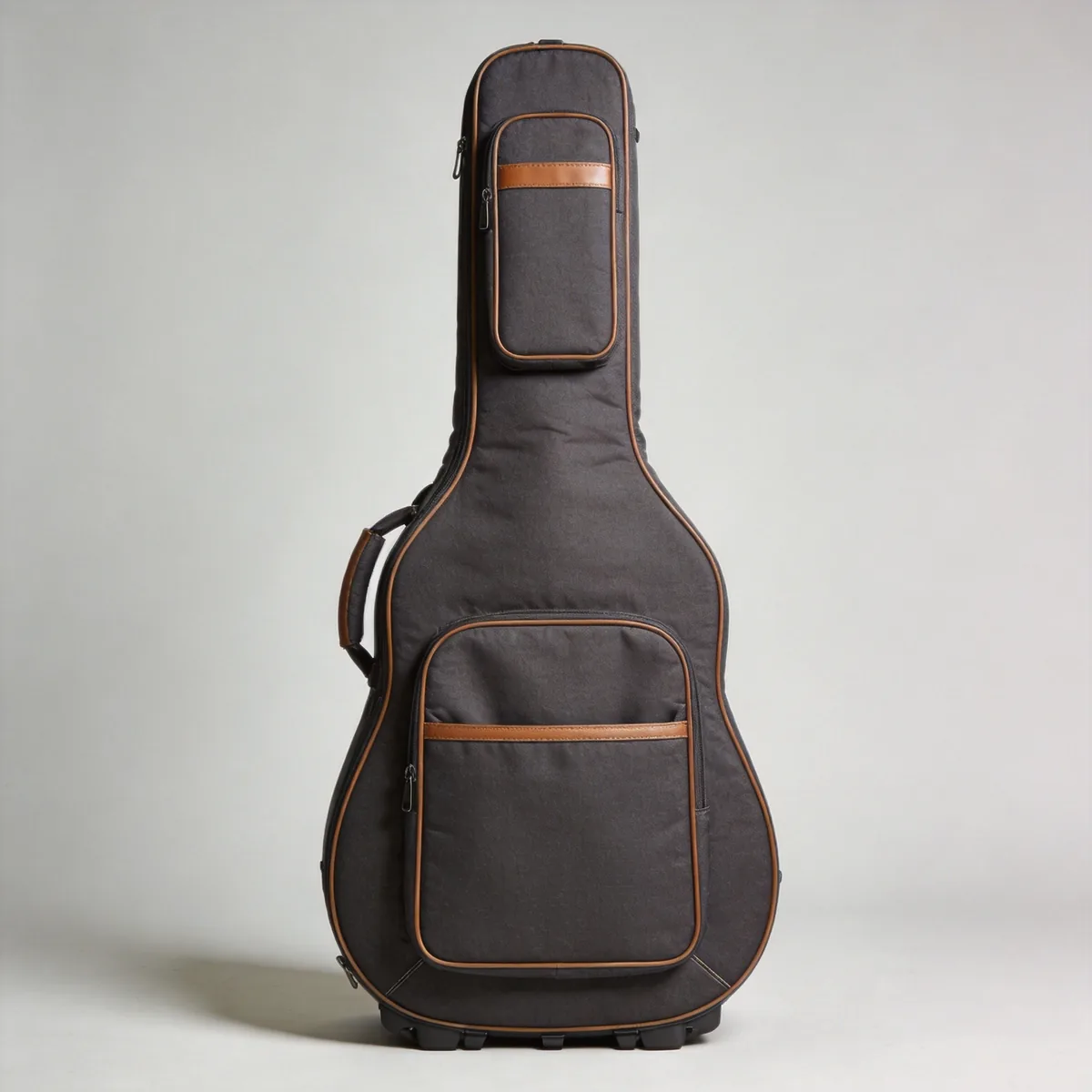
Construction: 5mm Laminated Top Panel, Headstock Compartment and 1680D Base
Everything below is quoted per order, so a buyer can move any line up or down against cost. We send a spec sheet with the sample so the differences are documented rather than argued about at inspection.
| Layer | Standard Build | Upgrade | Why It Matters on an Acoustic |
|---|---|---|---|
| Outer shell | 600D polyester, PU coated | 1680D ballistic nylon / waxed canvas | Abrasion resistance on a bag that is stood down and dragged daily |
| Top panel | 20 mm EPE + 5 mm laminated board | 25 mm EPE + 5 mm board + 2 mm EVA | Spreads point load across the fragile soundboard |
| Body padding | 15–20 mm EPE | 25 mm EPE with contoured lower-bout blocks | Holds a wide lower bout without the bag sagging when carried |
| Headstock compartment | Padded divider + 10 mm foam | PE board reinforced end wall | Keeps tuners off the end wall; removes load from the neck joint |
| Neck rest | Velvet-wrapped foam, stitched through | Double-stitched, wider block | Glued blocks peel in hot containers; stitched blocks do not move |
| Base panel | 1680D oxford abrasion patch | 1.0 mm TPU welded patch | First wear point on every acoustic bag |
| Interior lining | 210D polyester taffeta | Brushed tricot / short-pile plush velvet | Finish protection; velvet is specified when the bag is opened on stage |
| Zipper | YKK #8 nylon coil | YKK #10 reverse-coil, waterproof tape | Reverse-coil keeps metal away from the instrument finish |
| Hardware | Acetal D-rings, nylon webbing | Metal D-rings, seat-belt webbing | Carry load on a 5 kg instrument plus bag |
| Stitching | Nylon bonded #69 | #92 at strap and base stress points | Seam failure at the base is the second most common warranty claim |
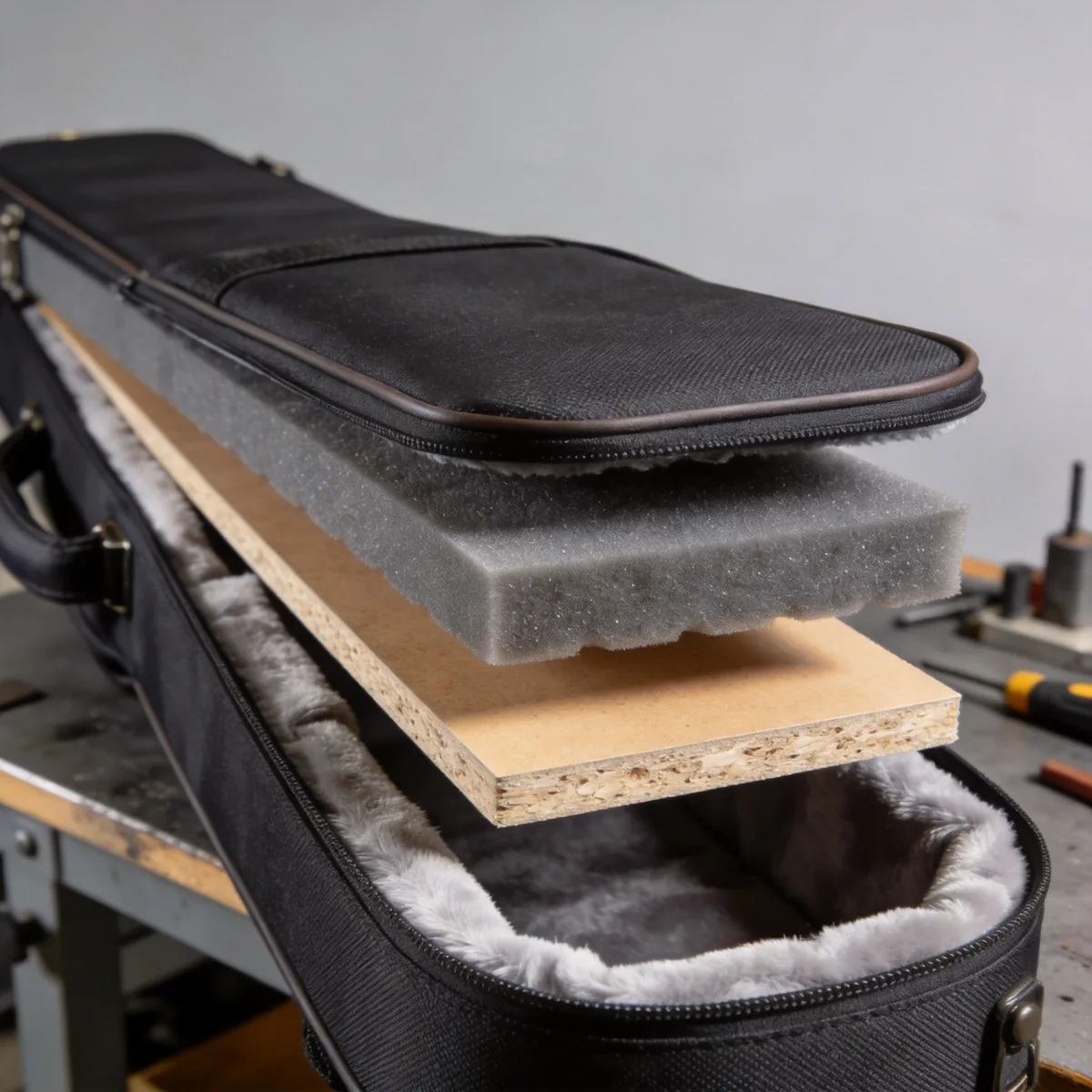
The 5 mm laminated board is the single change buyers notice most when they compare samples. It adds roughly 90–140 g to the finished bag and a small unit cost, and it is the difference between a bag that survives a van journey and one that arrives with a soundboard crack claim. We quote it as standard on acoustic patterns and will only remove it on an explicit written instruction.
Sizing Guide: 41-Inch Bags and 104–108 cm Internal Length
“41-inch acoustic guitar bag” is a retail label, not a specification. A full-size dreadnought measures 103–105 cm from tail to headstock tip, so a bag quoted as 41 inch needs an internal length of 104–108 cm to leave working clearance at both ends. Measure the instrument, not the label.
| Instrument Size | Scale Length | Instrument Overall Length | Bag Internal Length | Typical Buyer |
|---|---|---|---|---|
| Full size 41″ (dreadnought) | 25.4″ / 645 mm | 103–105 cm | 106–108 cm | Brands, distributors, retail chains |
| Full size 40″ (GA / OM) | 25.4″ / 645 mm | 100–102 cm | 104–106 cm | Fingerstyle and singer-songwriter brands |
| Jumbo 42″ | 25.4″ / 645 mm | 106–108 cm | 109–111 cm | Bluegrass and country programmes |
| 000 / 12-fret | 24.9″ / 632 mm | 98–100 cm | 102–104 cm | Blues and vintage-style brands |
| 3/4 student (36″) | 22.8″ / 580 mm | 91–93 cm | 94–96 cm | Music schools, rental fleets |
| 1/2 student (34″) | 20.9″ / 530 mm | 86–88 cm | 89–91 cm | Education distributors |
| Travel / parlour | 23–24.5″ | 92–96 cm | 96–99 cm | Travel brands, airline programmes |
Three measurements decide the fit and all three need to be on the spec sheet: internal length (tail to headstock cavity), internal lower-bout width, and internal depth at the deepest point. A bag that is 10 mm short will not close over the headstock; a bag 20 mm too wide lets the instrument slide, and every slide is a scratch on a lacquered back. Send us one physical instrument and we pattern from it at no extra cost during sampling — for OEM buyers bundling a bag with a specific model this is the cheapest insurance in the whole project.
Humidity Control and Moisture-Resistant Linings
Solid-wood acoustic guitars are built at 45–55% relative humidity. Below 40% the top sinks and fret ends protrude; above 60% the wood swells, action rises and glue joints suffer. A gig bag cannot control humidity the way a sealed hard case can, but it can either help or actively hurt, and the lining is what decides which.
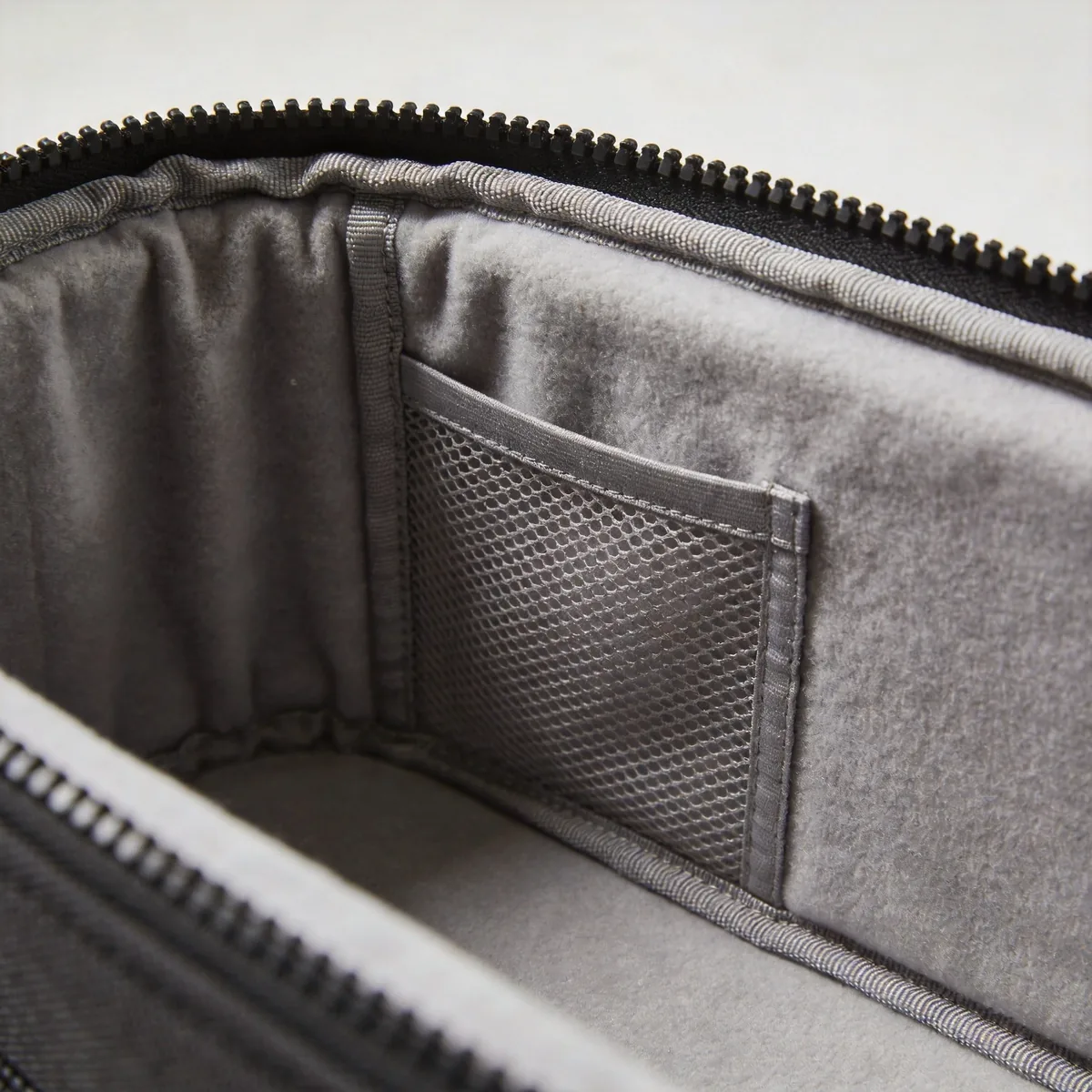
Our standard acoustic lining is a PU-backed 210D taffeta that resists absorbing ambient moisture and wipes clean. The upgrade is a brushed tricot or short-pile plush with a moisture-barrier backing, plus an optional mesh pocket on the inner wall sized for a desiccant pack or a small hygrometer. For buyers shipping into humid markets — Southeast Asia, the Gulf, coastal Latin America — we add taped seam edges on the lining and a ventilation gusset behind the headstock compartment so the bag does not trap warm damp air after a gig.
We are deliberate about what we do not claim. A zippered soft bag is not waterproof and is not a humidity-controlled environment; a supplier who says otherwise has not tested their own product. What we will state, and document on the spec sheet, is the coating weight of the shell fabric, the water-repellent finish, whether seams are taped, and the moisture barrier on the lining. Buyers who need a genuinely sealed environment should be looking at a hard case, and we say so before the order rather than after.
OEM Options: Shell Fabrics, Padding Grades and Branding
Every acoustic programme is quoted from a spec sheet, so options are priced against a defined build rather than a catalogue number. The matrix below covers what changes most often. MOQ stays at 500 pcs per style and colour across all of it.
| Option | Choices | Effect on Cost / Lead Time |
|---|---|---|
| Shell fabric | 600D polyester, 900D, 1680D ballistic nylon, waxed canvas, rPET recycled polyester | 600D baseline; 1680D and waxed canvas add cost and 3–5 days |
| Padding grade | 15 mm, 20 mm, 25 mm EPE; +5 mm laminated board standard on acoustic | Each step adds unit cost; 25 mm adds 2–3 days |
| Lining | 210D taffeta, brushed tricot, short-pile plush, velvet | Plush and velvet add cost; no lead-time impact |
| Colourways | Any Pantone; 2–4 colours per style can be combined to reach 500 pcs | No extra charge for splitting colours |
| Branding | Woven label, embroidery, silicone or PVC patch, heat transfer, rubber badge, metal plate | Woven and embroidery have no tooling; patches need a one-off mould |
| Pockets | Single front, double front, sheet-music pocket, accessory pouch, cable pocket | Each pocket adds material and sewing time |
| Carry system | Single shoulder strap, dual backpack straps, concealable harness, side handle | Concealable harness adds cost and 2–3 days |
| Base | 1680D abrasion patch, 1.0 mm TPU welded patch, rubberised corner caps | TPU welding adds cost and 3 days |
| Packaging | Poly bag, non-woven dust bag, printed hangtag, barcode label, FNSKU labelling | Retail packaging adds 2–4 days |
| Compliance | REACH documentation, CA Prop 65, material declarations, destination labelling | Testing quoted separately against the market |
Branding sits on the front pocket face or the upper body panel, never across the waist seam where the bag flexes. Artwork should be AI, EPS or PDF vector with Pantone references; we will trace raster logos and return the vector for approval before sampling. No Junyuan label appears on a custom order unless the buyer asks for one, and hangtags, barcodes and polybag warnings are produced to the buyer’s artwork.
MOQ, Sampling and Production Timeline
MOQ is 500 pcs per style and colour, and acoustic orders run in affiliated and partner factories that already build padded instrument bags daily. Where a buyer needs three colourways, those three colours of the same style can be combined to reach the 500-piece threshold with no extra charge — the constraint is fabric bought per colour, not the sewing line. Different body shapes are different styles and are counted separately.
| Stage | Duration | What Happens | Buyer Action |
|---|---|---|---|
| Brief & spec sheet | 1–3 days | Body shape, dimensions, padding, lining, colour, logo, packaging, destination market | Send instrument measurements or one physical unit |
| Quotation | 2–3 working days | Unit price at 500 / 1,000 / 3,000 pcs, tooling and sample charges | Confirm target price and quantity |
| Sampling | 6–10 business days | Pre-production sample built to spec with your logo and labelling | Test-fit the instrument; mark up changes |
| Sample approval | Buyer’s schedule | Written approval locks the pattern, materials and colour | Approve in writing before the bulk run starts |
| Bulk production | 35–50 days | Cutting, padding, sewing, hardware, final assembly | Mid-production photo update on request |
| Inspection | 1–2 days | AQL 2.5 major / 4.0 minor with photo report | Review report before shipment |
| Booking & shipping | 3–5 days | FOB, CIF or DDP per the quotation | Confirm shipping documents |
Brief to container is typically 8–11 weeks, and in most projects the longest single block is the buyer’s own sample approval rather than production. Sample charges are refunded against the first bulk order once it reaches the agreed quantity. We inspect to AQL 2.5 major / 4.0 minor using ISO 2859-1 sampling tables, with zero tolerance on critical defects — exposed hardware inside the cavity, a zipper that separates under load, a strap anchor pulling out — and every lot ships with a photo report covering sampled units, measurements and defects found.
Ready to Start Your Custom Acoustic Guitar Bag Order?
Send us the body shape your bag must fit, the instrument’s overall length and lower-bout width, the quantity per style and colour, and your target price. Written quotation within 2–3 working days, physical sample with your logo in 6–10 business days.
Email: [email protected] | WhatsApp / Tel: +86 17750020688
Frequently Asked Questions About Custom Acoustic Guitar Bags
Q1: What is the MOQ for a custom acoustic guitar bag?
Q2: Which acoustic body shapes can you pattern?
Q3: What internal length should a 41-inch acoustic bag have?
Q4: Why do you specify a 5mm laminated panel over the top?
Q5: Do you build a separate headstock compartment?
Q6: What lining do you recommend for humidity?
Q7: Can the bag fit a guitar with a pickup, preamp or cutaway?
Q8: How long do sampling and bulk production take?
Q9: Can I mix body shapes or sizes to reach the 500-piece MOQ?
Q10: What quality standard do you inspect to?
Related Bag Programs From Junyuan Bags
- Custom Guitar Bag Manufacturer — full range: electric, acoustic, bass, classical, double
- Custom Electric Guitar Bag Manufacturer — solid-body patterns for Strat, Tele, Les Paul, SG and superstrat
- Custom Gig Bag Manufacturer — padded gig bags for all instrument types
- Guitar Bag Collection — browse our guitar bag range
- Custom Equipment Bag Manufacturer — protective bags for gear and instruments
- Custom Waterproof Bag Manufacturer — waterproof bags and packs
- Sports Bags Manufacturer — gym, duffel and training bags
- Custom Backpack Manufacturer — daypacks, commuter and laptop bags
- Custom Travel Bag Manufacturer — carry-on, weekender and luggage
- Bag Manufacturer vs Supplier — what actually changes when you buy direct
- REACH Compliance for Custom Bags — EU documentation explained