
Why Quality Control Matters for Golf Bags
Golf bags represent a significant investment for both manufacturers and buyers, making quality control an essential component of the production process. Whether you’re sourcing custom golf bags for your brand or purchasing in bulk for distribution, implementing rigorous quality assurance protocols protects your reputation and bottom line. The complete golf bag manufacturing process involves multiple stages where defects can occur, from material selection to final assembly, each presenting unique quality challenges.
For B2B buyers, establishing comprehensive golf bag quality control standards ensures consistency across production runs, reduces return rates, and builds customer loyalty. A single defective batch can damage relationships with retailers and end consumers, making proactive inspection protocols non-negotiable in today’s competitive market. Golf bags are distinctive in that they must withstand constant movement, heavy loads, and outdoor exposure—conditions that accelerate the appearance of any manufacturing flaws. This makes quality control a strategic business imperative that directly affects brand perception and customer retention.
Common Quality Issues in Golf Bag Manufacturing
Understanding the most frequent defects helps QC teams focus their inspection efforts effectively. Golf bag inspection should address several critical areas where problems commonly emerge across different manufacturing stages.
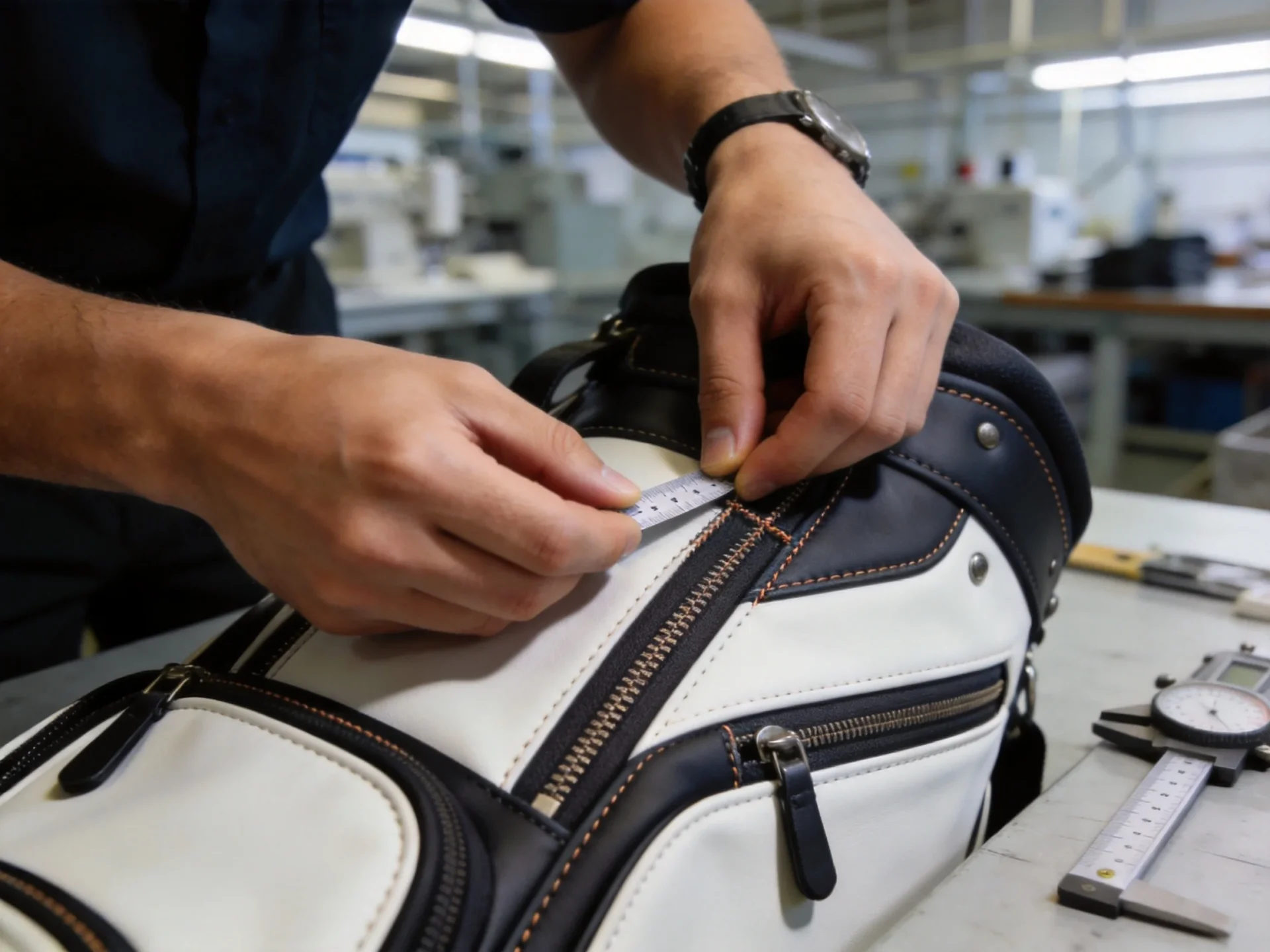
Stitching and Seam Failures: Poor stitch density, skipped stitches, or inadequate thread tension lead to seam separation under load. Golf bags carry substantial weight—clubs, accessories, and equipment—making structural integrity paramount. Inspectors must verify stitch counts per inch, thread quality, and seam reinforcement at stress points. Common failures include insufficient bar-tack reinforcement and incorrect needle size causing fabric damage.
Zipper Malfunctions: Zippers represent one of the most failure-prone components in golf bag construction. Issues include misaligned teeth, weak slider mechanisms, inadequate attachment to fabric, and poor-quality zipper pulls that break under repeated use. High-quality golf bags require YKK or equivalent zippers with reinforced stitching at attachment points. Inspectors should test every zipper through a minimum of 50 complete open-close cycles during final inspection.
Material Defects: Fabric inconsistencies, incorrect thickness, poor water resistance, or color variations between batches compromise both aesthetics and functionality. Golf bag quality standards demand strict material specifications, including denier count, coating type, and UV resistance ratings. Common material issues include inconsistent dye lots and insufficient waterproof coating.
Structural Integrity Problems: Weak dividers, collapsing full-length dividers, poorly constructed club cuffs, and inadequate base support lead to functional failures. The bag must maintain its shape when loaded with 14 clubs and additional gear weighing 20-30 pounds. Internal frames made from substandard plastic or improperly formed aluminum can bend or crack within months of regular use.
Hardware and Attachment Failures: Strap buckles, D-rings, Velcro closures, and handle attachments must withstand repeated use without breaking or detaching. Pull testing and cycle testing reveal weaknesses before shipment. Low-quality plastic buckles crack in cold weather, while poorly plated metal hardware corrodes with moisture exposure.
Golf Bag Quality Standards & Industry Certifications
Establishing clear quality benchmarks requires understanding both industry standards and customer-specific requirements. While no single universal standard governs golf bag manufacturing, several frameworks guide quality expectations across global markets.
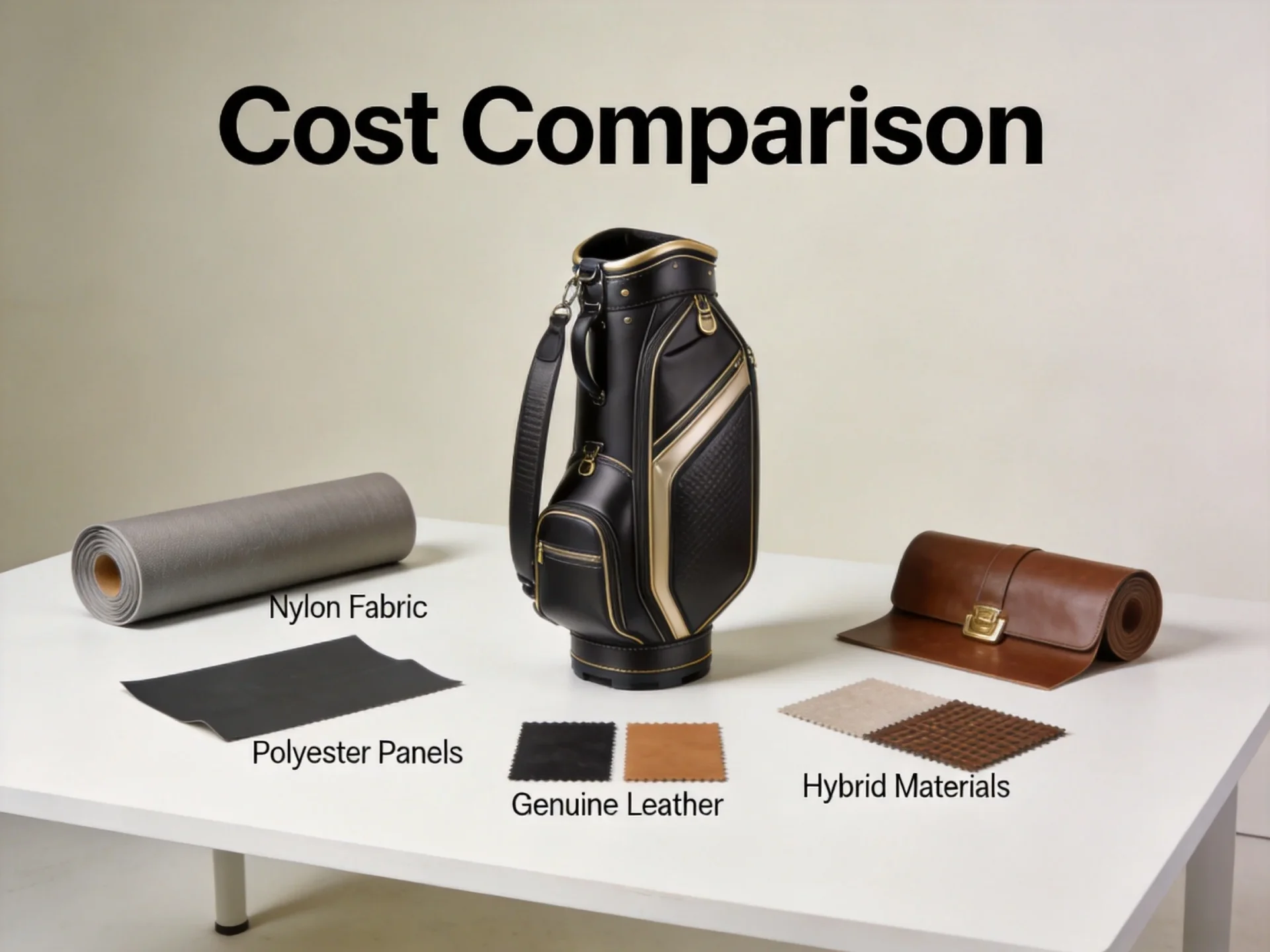
Material Standards: Fabrics should meet ISO 1420 (textile strength), ISO 10993 (material safety), and relevant ASTM standards for tensile strength and abrasion resistance. Water-resistant coatings require testing per AATCC standards for hydrostatic pressure resistance.
Zipper Performance: Zippers should comply with ASTM D2061 for zippers and meet minimum cycle test requirements—typically 1,000+ open/close cycles for premium bags and 500+ for mid-range products.
Load Testing: Golf bags must support rated weight without structural failure. Industry practice involves load testing at 1.5x the intended weight for 24 hours to simulate long-term use.
Chemical Compliance: For international markets, ensure materials meet REACH (EU), CPSIA (US), and Proposition 65 (California) requirements for lead, phthalates, and restricted substances.
Brand-Specific Standards: Major golf brands like Titleist, Callaway, and TaylorMade often exceed baseline standards with proprietary testing protocols. Custom golf bag QC programs should align with your target market’s expectations and price positioning, often requiring testing beyond the minimum industry requirements.
Pre-Production Inspection Checklist
Preventing defects begins before production starts. A comprehensive pre-production inspection protocol catches issues when they’re least expensive to correct, saving significant time and cost downstream in the manufacturing process.
Material Verification: Confirm fabric type, color, weight, and finish match approved specifications. Check material certifications and test reports from textile suppliers. Verify coating quality and water resistance ratings match requirements. Cross-reference purchase orders with delivered materials to prevent substitution of inferior materials.
Component Quality Check: Inspect zippers, buckles, D-rings, Velcro, and hardware for quality consistency. Verify supplier certifications and conduct random pull tests on hardware samples. Confirm Pantone matching and coating durability for custom hardware.
Pattern and Cutting Review: Examine cutting patterns for accuracy and fabric utilization. Check that all pieces are cut to specification with proper grain alignment and seam allowances. Review marker efficiency to minimize waste.
Sample Approval: Review pre-production samples for construction quality, aesthetics, and functionality. Ensure samples represent production capabilities rather than hand-made prototypes that cannot be replicated at scale. Sign and seal pre-production samples as the golden reference.
Production Line Setup: Verify sewing machines are calibrated for correct stitch density and thread tension. Confirm operators understand construction sequences and quality standards. Check that jigs, templates, and fixtures match approved specifications and are in good condition.
Color Fastness Testing: Conduct wash tests and light exposure tests on fabric samples to ensure colors won’t bleed or fade during the product’s expected lifespan. For multi-color bags, test color migration under moisture and heat.
In-Process Quality Checks During Manufacturing
Ongoing inspection during production catches defects early, preventing costly rework and waste. Golf bag inspection at critical production stages ensures issues don’t compound through subsequent assembly steps, where fixing problems becomes exponentially more difficult and expensive.
Cutting Stage Inspection: Verify all cut pieces match patterns within tolerance (typically ±1-2mm). Check for fabric defects, incorrect layering, or misaligned patterns before pieces move to sewing.
Sewing Quality Monitoring: Conduct hourly checks on stitch quality, tension, and density. Verify seam allowances are consistent and reinforcement stitching is present at all stress points including strap attachment zones, base corners, and pocket openings. Check that operators follow specified construction sequences to prevent hidden quality issues.
Sub-Assembly Verification: Inspect pockets, dividers, and strap systems before final assembly. Test zippers, Velcro, and closures for proper function at this stage. Ensure internal frames and stiffeners are correctly positioned and secured.
Dimensional Checks: Measure critical dimensions at multiple stages—height, width, depth, strap length, divider spacing. Catch dimensional drift before final assembly makes corrections impossible. Use calibrated measurement tools and record data for statistical process control analysis.
Visual Quality Audits: Conduct random visual inspections for fabric defects, thread quality, color consistency, and workmanship issues. Document findings with photos and lot numbers for supplier feedback and traceability.
Functional Testing: Test zippers, closures, and adjustable features throughout the production process. Verify club dividers function smoothly and straps adjust properly.
Final Random Inspection (FRI) Protocol for Golf Bags
Final Random Inspection represents the last line of defense before shipment. A well-designed FRI protocol provides statistical confidence that the entire production lot meets quality standards.
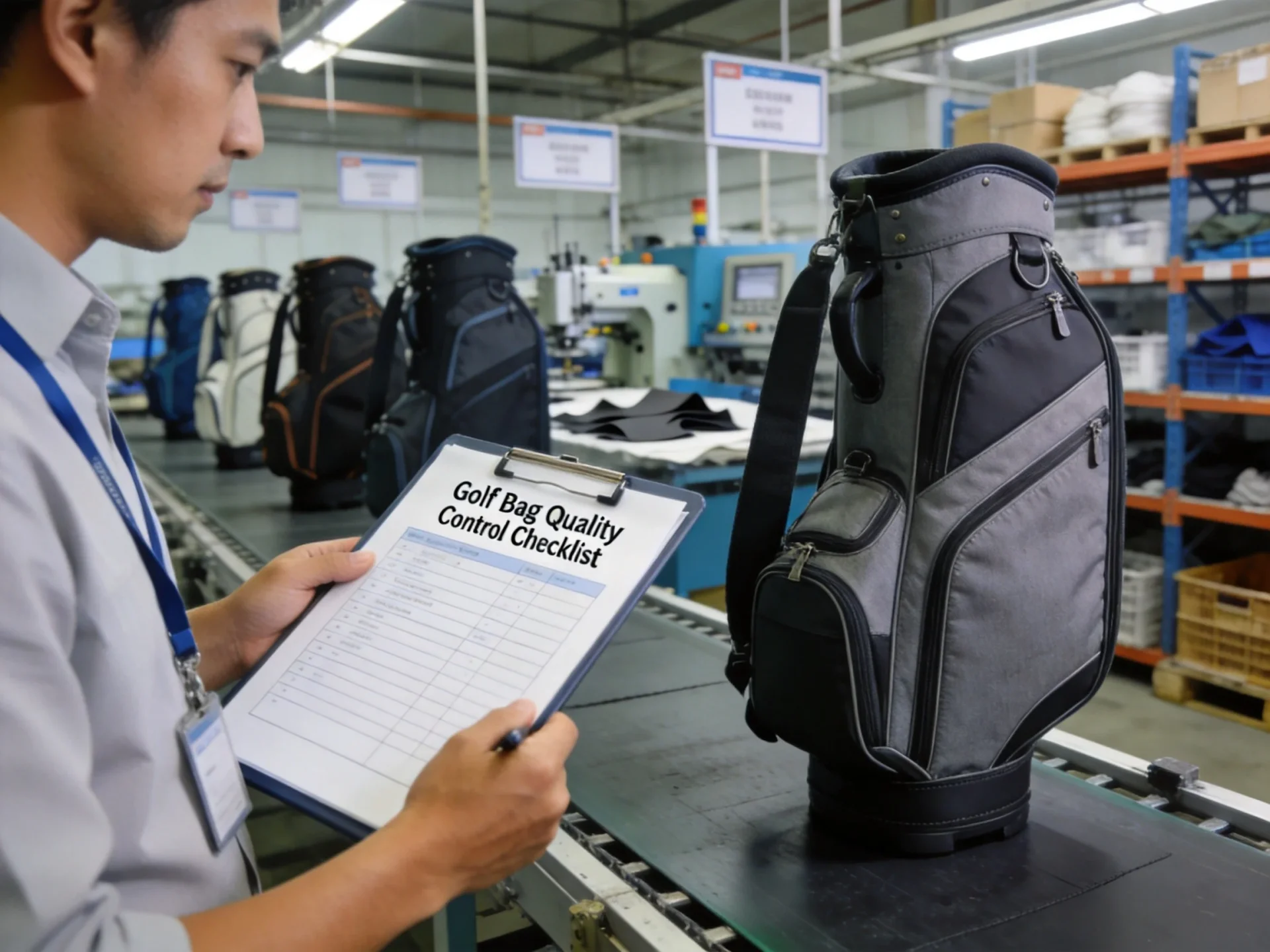
Sampling Plan: Follow ANSI/ASQ Z1.4 (or ISO 2859-1) sampling procedures for statistically valid results. For golf bags, typical AQL levels are 2.5 for major defects and 4.0 for minor defects. Sample size depends on lot size—typically 20 bags for lots of 500 units, 32 for lots of 1,200, and 50 for lots of 3,000.
Comprehensive Inspection Checklist:
- Visual Inspection: Check for fabric defects, color inconsistencies, staining, poor workmanship, and aesthetic flaws. Examine all visible surfaces under consistent lighting conditions.
- Dimensional Verification: Measure height, width, depth, strap lengths, pocket sizes, and divider spacing against approved specifications and golden sample.
- Construction Quality: Examine all stitching for proper density (minimum 8-10 stitches per inch for structural seams), tension, and reinforcement at stress points.
- Hardware Function: Test all zippers, buckles, Velcro, D-rings, and adjustable features for proper operation through multiple cycles.
- Structural Integrity: Load test with 14 clubs plus 25 pounds of weight for 1 hour minimum; check for frame collapse, seam separation, or strap stretch.
- Water Resistance: Spray test coated fabrics and check seam sealing on waterproof models. Verify rain fly or rain hood functionality where applicable.
- Labeling and Packaging: Verify care labels, brand labels, hang tags, UPC barcodes, poly bags, and carton markings match requirements exactly.
- Accessories and Documentation: Confirm included accessories (rain hoods, strap covers, warranty cards, care instructions) are present, correct, and properly packed.
Defect Classification:
- Critical Defects: Safety hazards, incorrect materials, wrong product specification, or regulatory non-compliance—zero tolerance, entire lot must be rejected.
- Major Defects: Functional failures, significant aesthetic flaws, structural weaknesses that affect saleability—lot rejected if found above AQL threshold.
- Minor Defects: Small cosmetic issues that don’t affect function or significantly impact appearance—permitted within minor AQL limits.
Documentation and Reporting: Document all findings with clear photos, precise measurements, and defect counts by category. Provide detailed inspection reports including pass/fail determination, defect breakdown, sampling methodology used, and specific recommendations for corrective action if the lot fails inspection.
How to Set Up a QC Partnership with Your Golf Bag Factory
Effective quality control requires genuine collaboration between buyers and manufacturers. Building a structured QC partnership ensures both parties align on standards and processes, .
Define Clear Specifications: Create detailed technical packages with CAD drawings, material specifications with test requirements, construction details with exploded views, and approved golden samples. Ambiguity in specifications inevitably leads to inconsistency in production. Every measurement, every material, and every construction detail should be documented with tolerances clearly stated.
Establish Quality Agreements: Document acceptable quality levels, testing protocols, inspection frequencies, defect classification criteria, and corrective action procedures in your formal supplier agreement. Both parties should sign off on quality standards before production begins.
Implement Multi-Stage Inspection: Structure your QC program with pre-production meetings to align expectations, in-process checks at defined milestone points (minimum three stages), and comprehensive final random inspection. Don’t rely solely on final inspection—early detection prevents costly problems that compound through the manufacturing process.
Use Third-Party Inspection Services: For critical orders, new supplier relationships, or high-value shipments, engage independent inspection companies like SGS, Bureau Veritas, or Intertek. Third-party inspectors provide objective assessments and detailed documentation without the conflicts of interest that can arise with factory-employed QC staff.
Build Feedback Loops: Share inspection reports with factories within 24-48 hours of completion. Work collaboratively on root cause analysis for defects . Recognize and reward suppliers who consistently meet quality standards .
Invest in Supplier Development: For strategic suppliers representing significant production volume, invest in training programs, equipment upgrades, or process improvements that strengthen their capabilities. Long-term partnerships with continuous improvement yield far better quality results than constantly switching suppliers for marginal short-term cost savings.
Conduct Regular Factory Audits: Beyond product inspection, audit factory management systems, equipment maintenance records, operator training programs, and quality management processes . Systemic quality issues require systemic solutions that only thorough audits can identify and address.
Frequently Asked Questions
What is the acceptable quality level (AQL) for golf bag inspection?
For golf bags, industry standard AQL levels are typically 2.5 for major defects and 4.0 for minor defects, following ANSI/ASQ Z1.4 sampling procedures. Critical defects should have zero tolerance across all sampling plans. These levels may be adjusted based on your specific market positioning—premium brands often require stricter AQL levels of 1.5 for major and 2.5 for minor defects, while value-oriented products may accept 4.0/6.5 thresholds.
How often should in-process inspections occur during golf bag production?
In-process inspections should occur at a minimum of three stages: after cutting (verifying pattern accuracy and fabric quality), during sub-assembly (checking pockets, dividers, and strap systems), and before final assembly (ensuring all components meet specifications). For large production runs exceeding 2,000 units or for entirely new products, hourly sewing quality checks are strongly recommended. Critical operations like zipper attachment, strap bar-tack reinforcement, and structural seam construction warrant 100% inline inspection at those specific stages.
What testing equipment is needed for golf bag quality control?
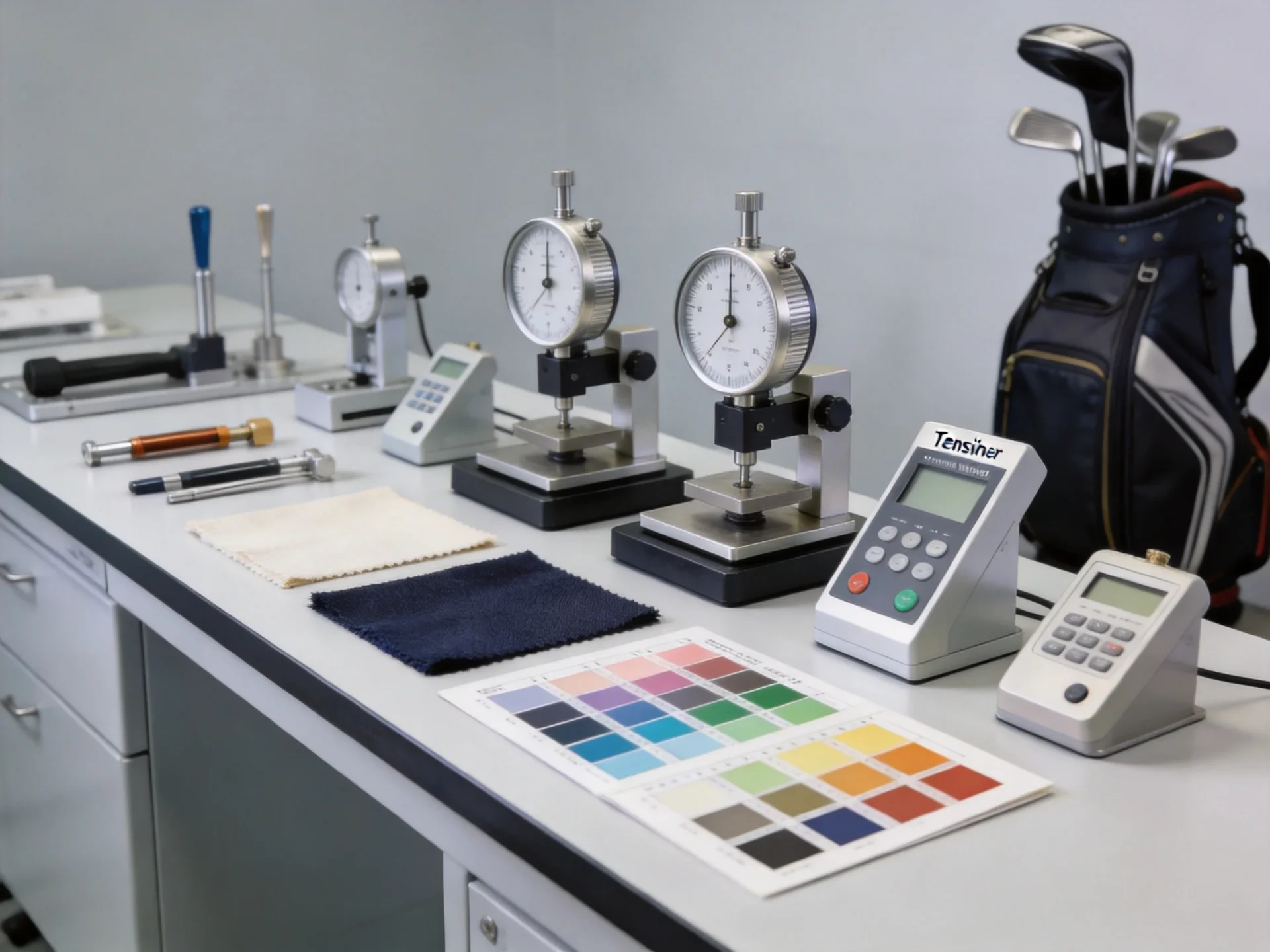
Essential testing equipment for golf bag QC includes digital calipers and steel measuring tapes for dimensional checks, stitch counters for verifying stitch density compliance, pull test gauges for hardware strength testing, durometers for material hardness verification, and color measurement spectrophotometers for consistency checks. For advanced QC programs, consider investing in universal testing machines for tensile strength analysis, Taber abrasion testers for fabric durability assessment, and hydrostatic pressure testers for waterproof coating verification.
Should I use my own QC team or hire third-party inspectors for golf bag production?
Both approaches offer distinct advantages depending on your situation. In-house QC teams develop deeper product knowledge over time and build ongoing relationships with supplier staff, enabling faster communication and resolution. Third-party inspectors provide objectivity, specialized technical expertise, and detailed standardized documentation that holds up in commercial disputes. Many successful buyers employ a hybrid approach: in-house teams handle routine daily in-process checks while third-party inspectors conduct final random inspections for critical orders, new supplier qualification, or when quality issues have been identified in previous shipments.
How do I handle quality disputes with my golf bag supplier effectively?
Handle quality disputes professionally with thorough documentation and clear, factual communication. Always reference your signed quality agreement and detailed inspection reports supported by timestamped photos and measurement data. Focus collaborative discussions on root cause analysis rather than assigning blame. Work together with suppliers on corrective action plans that include specific timelines, responsible parties, and verification methods. For disputes involving significant financial value, consider involving third-party arbitration services or accredited testing laboratories for independent analysis. Maintain comprehensive records of all quality issues, corrective actions, and resolutions to establish patterns and prevent recurrence in future production orders.
Implement Effective Golf Bag Quality Control Today
Quality control isn’t just about catching defects before they ship—it’s about building a systematic, proactive approach that prevents problems from occurring, protects your brand reputation, and delivers consistent value to your customers season after season. Whether you’re launching a new custom golf bag line or managing ongoing production from established suppliers, implementing the inspection protocols and partnership strategies outlined in this guide will help you maintain competitive quality standards that differentiate your products in an increasingly crowded marketplace.
Remember that effective golf bag quality control requires genuine commitment from both buyers and manufacturers. Clear specifications, structured multi-stage inspection processes, transparent communication, and collaborative problem-solving create the foundation for long-term supplier relationships and product excellence. The investment you make in quality control today directly translates to reduced returns, stronger brand loyalty, and sustained market growth tomorrow.
? Related: Want to understand the full golf bag production workflow? Read our Custom Golf Bag Manufacturing Complete Guide — covering materials, production steps, customization options, and quality control at every stage.
Ready to Source Premium Golf Bags?
Partner with experienced manufacturers who understand B2B quality requirements.
Get detailed specifications, competitive pricing, and reliable quality control.
Contact Our QC Team