
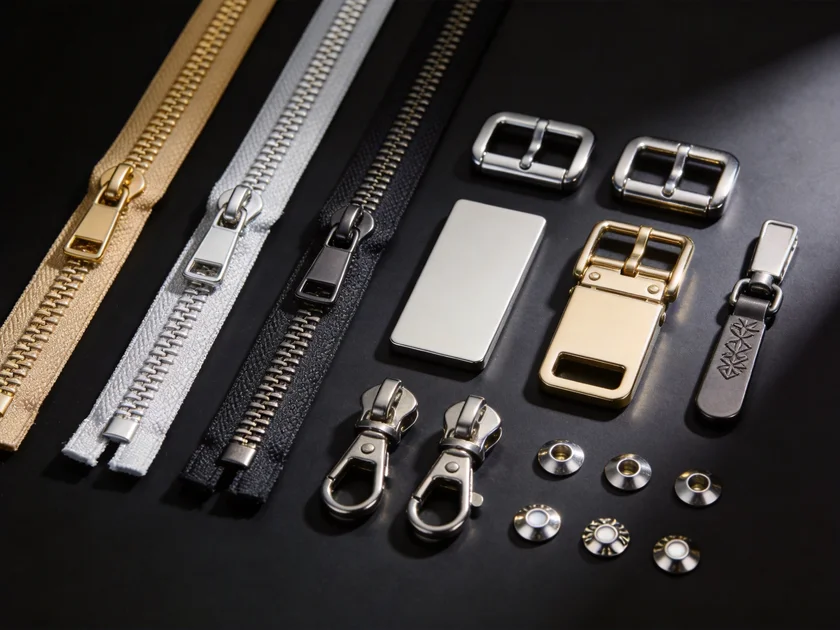
When B2B buyers evaluate bag manufacturers, they often focus on fabric, construction, and price — but the hardware and branding elements are what customers interact with every single day. A smooth-zipping pocket, a satisfying buckle click, and a well-placed logo patch define the tactile brand experience far more than the fabric choice.
Custom hardware and branding options are among the most powerful tools for differentiating your bags in a crowded market. From zipper selection to logo application methods, every hardware decision communicates quality and reinforces brand identity.
At Junyuan Bags, led by a founder with bag industry experience dating from 2004 in custom bag manufacturing for 200+ brands, we’ve helped countless buyers navigate the complex landscape of hardware customization. This comprehensive guide covers everything B2B procurement professionals need to know about custom bag hardware and branding options.
The Anatomy of Bag Hardware: Key Components
Understanding the hardware components that go into a bag helps you make informed decisions about quality, cost, and customization options:
Zippers: The most frequently used hardware component. Types include coil zippers (lightweight, flexible), molded plastic zippers (water-resistant, colorful), metal zippers (premium, durable), invisible zippers (clean aesthetic), and waterproof zippers (sealed, for outdoor/travel bags). Sizes range from #3 (small pockets) to #10 (main compartments).
Buckles and Clasps: Include side-release buckles (quick adjustment), ladder lock buckles (strap adjustment), magnetic clasps (easy access), twist locks (secure closure), and carabiner clips (attachment points). Materials range from POM plastic to zinc alloy and stainless steel.
Sliders and Pulls: Zipper sliders can be customized with brand logos, custom shapes, or unique finishes. Pull tabs offer extensive customization — leather, metal, fabric, rubber, or combinations.
D-Rings and O-Rings: Used for strap attachment, bag-to-bag connection, and decorative elements. Available in various sizes and finishes.
Rivets and Eyelets: Reinforce stress points and add decorative detail. Custom finishes and sizes available.
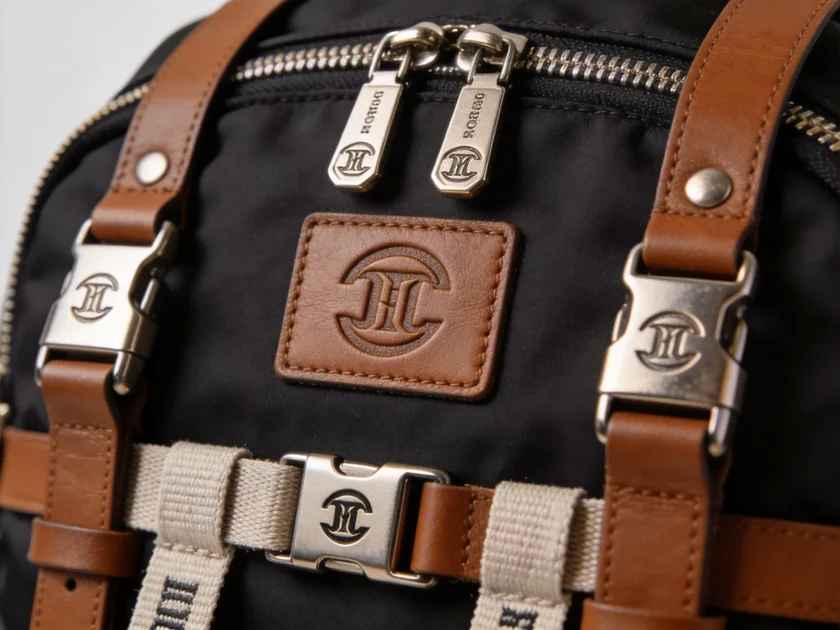
Logo Plates and Patches: Metal logo plates, leather patches, woven labels, rubber patches, and embroidered patches serve as primary brand identification.
Zipper Selection: The Most Critical Hardware Decision
Zippers account for more bag failures than any other hardware component. Selecting the right zipper for your application is crucial for product longevity and customer satisfaction.
Zipper brand tiers:
• Premium: YKK (Japan) — the gold standard, recognized by consumers, exceptional durability. Adds 15-30% to zipper cost but significantly reduces failure rates.
• Mid-range: SBS, 3F, XFG (China) — good quality, widely used in mid-tier brands, reliable performance at competitive pricing.
• Budget: Generic Chinese zippers — functional but higher failure rates. May be acceptable for promotional or short-lifecycle products.
Customization options: Slider customization (engraved logos, custom shapes, specific finishes like antique brass or gunmetal), pull tab customization (leather embossed with logo, custom molded rubber pulls, metal pulls with brand marking), tape color (matching or contrasting with bag fabric), and slider finish (nickel, brass, antique brass, gunmetal, black oxide, rose gold).
Performance specifications to define: Zipper size (#3, #5, #8, #10 — larger numbers = heavier duty), slider type (auto-lock, non-lock, two-way), tape width and material, and stop type (metal, molded, or hidden).
Buckle and Clasp Customization
Buckles and clasps combine functionality with brand expression. Custom options include:
Material choices: POM (polyoxymethylene) plastic — lightweight, durable, available in many colors, cost-effective. Zinc alloy — premium feel, excellent for logo engraving, various plating options. Stainless steel — maximum durability, corrosion-resistant, ideal for outdoor/marine applications. Brass — classic aesthetic, develops patina over time.
Custom branding on buckles: Logo engraving or embossing, custom buckle shapes (within tooling constraints), custom colors through powder coating or anodizing, and laser-etched brand marks.
MOQ considerations: Stock buckles have low or no MOQ. Custom-shaped buckles require mold creation ($200-$800 per mold) with MOQs typically 1,000-3,000 pieces. At Junyuan Bags, we can work with your order quantity to determine the most cost-effective hardware solution.
Logo Application Methods: Choosing the Right Technique
Logo placement and application method significantly impact brand perception and production cost. Each technique has distinct advantages:
Screen Printing: Best for simple, bold logos on flat surfaces. Cost-effective for large quantities. Limited to 1-4 colors per print. Durable but can crack on flexible materials over time.
Heat Transfer Printing: Allows full-color, photographic-quality logos. Good for complex designs. Applied with heat and pressure. Durability varies with quality of transfer material.
Embroidery: Premium, tactile brand expression. Excellent durability — lasts the life of the bag. Best for simple to moderately complex logos. Adds thickness and weight. Common on backpacks, caps, and structured bags.
Debossing/Embossing: Creates a pressed-in (debossed) or raised (embossed) logo on leather or synthetic leather patches. Elegant, understated branding. Common on premium and leather goods.
Woven Labels: Small woven tags sewn into seams or attached to exterior. Cost-effective for detailed logos. Common as secondary branding or size/care labels.
Metal Logo Plates: Premium branding element. Custom cast or stamped metal plates with brand logo. Attached with rivets or adhesive. Common on fashion bags and premium backpacks.
Rubber/PVC Patches: 3D molded rubber or PVC patches with brand logos. Vibrant colors, tactile feel, waterproof. Popular for outdoor and sports bags.
Sublimation: Full-color printing directly onto polyester fabric. Best for all-over designs or complex artwork. Limited to polyester or polyester-coated surfaces.
Hardware Finishes and Color Matching
Hardware finish selection impacts both aesthetics and durability:
Common finishes: Nickel (bright silver, most common), antique brass (warm vintage look), gunmetal (dark grey, modern), matte black (contemporary, scratch-resistant), rose gold (fashion-forward), and chrome (high-shine, premium).
Durability considerations: PVD (Physical Vapor Deposition) coating offers superior scratch and corrosion resistance compared to standard electroplating. For bags exposed to moisture or heavy use, PVD-coated hardware significantly extends appearance life.
Color matching: Provide Pantone references for plastic hardware colors. For metal finishes, request physical samples to verify color under your retail lighting conditions. Hardware colors should complement — not necessarily match — your bag fabric colors.
Cost Impact of Custom Hardware
Custom hardware adds cost, but the investment often delivers outsized returns in perceived quality and brand differentiation:
Tooling costs: Custom zipper pulls ($100-$300 per mold), custom buckles ($200-$800 per mold), custom logo plates ($150-$500 per mold). Tooling is a one-time cost amortized across your order quantity.
Per-unit cost impact: Upgrading from generic to branded zippers adds $0.30-$1.50 per bag. Custom buckle shapes add $0.10-$0.50 per bag. Metal logo plates add $0.20-$0.80 per bag. These incremental costs are often recoverable through premium positioning.
MOQ thresholds: Many custom hardware items have minimum order quantities of 500-3,000 pieces. At Junyuan Bags, our standard MOQ of 500 pieces per style per color aligns well with most custom hardware MOQs, minimizing waste and excess inventory.
Quality Testing for Bag Hardware
Hardware must be tested to ensure it meets durability standards:
Zipper testing: Cycle testing (3,000-5,000 open-close cycles minimum), slider pull-off force testing (should withstand 50N+), lateral strength testing (zipper teeth separation force), and salt spray testing for corrosion resistance (for metal zippers).
Buckle testing: Tensile strength testing (load to failure), cycle testing (open-close durability), and impact testing (drop resistance for plastic buckles).
Logo application testing: Abrasion testing (rub test for printed logos), wash testing (durability after laundering), adhesion testing (pull-off force for patches and plates), and color fastness testing.
At Junyuan Bags, all hardware components undergo incoming quality inspection, and finished products are tested per AQL standards. We can provide test reports for hardware components upon request.
Sourcing Strategy: Stock vs. Custom Hardware
A practical approach to hardware sourcing balances cost, branding, and timeline:
Use stock hardware when: Launching quickly with limited budget, producing promotional or short-lifecycle products, testing a new market with minimal commitment, or when standard hardware meets your quality requirements.
Invest in custom hardware when: Building a premium brand identity, differentiating from competitors, producing high-volume orders where per-unit tooling amortization is favorable, creating signature design elements that define your brand, or when stock hardware doesn’t meet your performance requirements.
Hybrid approach: Many brands use stock zippers with custom pull tabs, stock buckles with custom logo plates, or standard hardware with custom finishes. This approach captures branding benefits while managing costs.
Working With Your Manufacturer on Hardware Customization
Effective hardware customization requires clear communication with your manufacturer:
Provide detailed specifications: Include hardware type, dimensions, material, finish/color (with Pantone references), quantity per bag, and placement position in your tech pack. Reference samples or photos when possible.
Request hardware samples: Before committing to bulk production, request physical hardware samples to verify quality, finish, and functionality. Test zippers for smoothness, buckles for ease of use, and logo applications for clarity.
Plan for lead time: Custom hardware adds 15-35 days to your production timeline depending on complexity and MOQ. Factor this into your overall production planning — see our guide on seasonal bag production planning for timeline guidance.
Establish quality standards: Define acceptable tolerances for hardware dimensions, finish consistency, logo clarity, and functional performance. Include these in your quality control documentation.
Frequently Asked Questions About Custom Bag Hardware
What is the most cost-effective way to add branding to my bags?
Screen printing and woven labels are the most cost-effective branding methods. Screen printing works well for simple logos on flat surfaces at low per-unit costs. Woven labels are inexpensive and can be sewn into existing seam lines with minimal production impact. For a premium feel at moderate cost, embroidered logos on backpacks offer excellent perceived value.
How much does custom hardware tooling cost?
Custom hardware tooling (molds) typically range from $100-$800 depending on complexity. Custom zipper pulls are $100-$300, custom buckles $200-$800, and custom metal logo plates $150-$500. This is a one-time cost amortized across your order. For a 1,000-piece order, a $300 mold adds only $0.30 per bag.
Should I use YKK zippers for my bags?
YKK zippers are the industry gold standard and are recognized by consumers as a mark of quality. They add approximately $0.30-$1.50 per bag over generic zippers but significantly reduce zipper failure rates. For premium brands, outdoor bags, and products where reliability is critical, YKK is strongly recommended. For budget or promotional products, quality Chinese-brand zippers (SBS, 3F) offer good performance at lower cost.
How do I ensure hardware color consistency across production runs?
Specify hardware colors using Pantone references for plastic components and request physical finish samples for metal components. Approve hardware samples before production begins and retain approved samples as color references for future orders. Request that your manufacturer use the same hardware supplier across production runs. At Junyuan Bags, we maintain hardware reference samples for repeat orders to ensure consistency.
What hardware quality tests should I require?
Essential hardware tests include: zipper cycle testing (minimum 3,000 cycles), zipper slider pull-off force (minimum 50N), buckle tensile strength (per application requirements), salt spray testing for metal components (48-96 hours for corrosion resistance), and logo application abrasion testing. Your manufacturer should provide test reports for hardware components, especially for large orders.
Custom Bag Manufacturing. Led by a founder with bag industry experience dating from 2004
led by a founder with bag industry experience dating from 2004, serving 200+ brands across 100+ countries. Factory-direct OEM/ODM with full certification support.
MOQ 500pcs · Factory Direct · Free Sample Available
Looking for a reliable manufacturing partner? Explore our complete guide to custom backpack manufacturing — covering materials, supplier vetting, quality control, cost analysis, compliance, and branding from JUNYUAN, an OEM/ODM factory led by a founder with bag industry experience dating from 2004.