
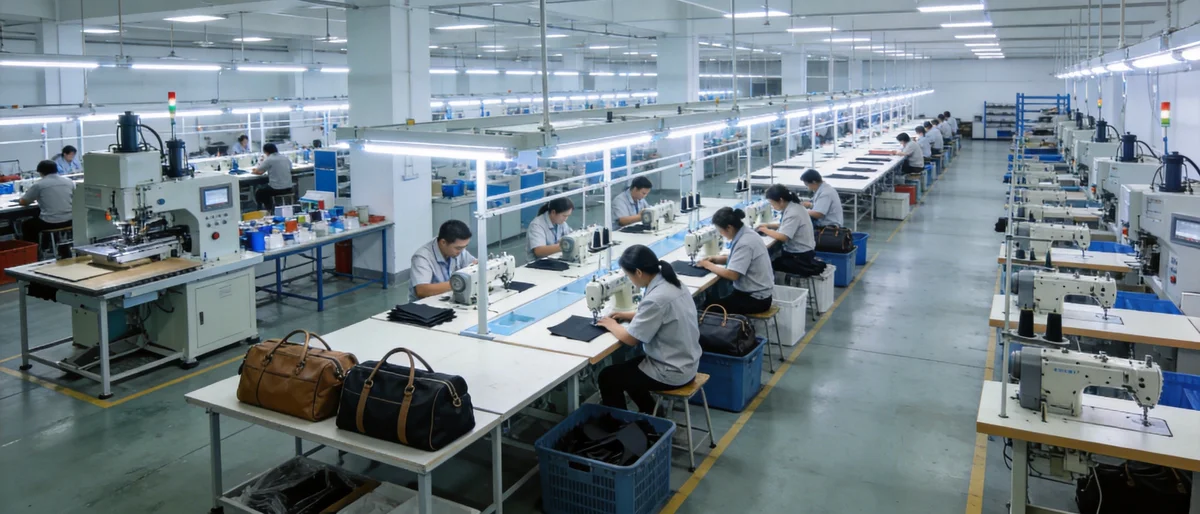
China produces over 70% of the world’s bags, making it the undisputed hub for bag manufacturing. But with thousands of factories to choose from — ranging from small family workshops to large-scale industrial operations — selecting the right bag manufacturer in China is one of the most consequential decisions a B2B buyer will make.
The wrong manufacturer can lead to quality failures, missed deadlines, communication breakdowns, and damaged brand reputation. The right manufacturer becomes a strategic partner that scales with your business, maintains consistent quality, and delivers on time, every time.
At Junyuan Bags, we’ve been manufacturing bags in Quanzhou, China Led by a founder with bag industry experience dating from 2004, serving over 200 brands across 100+ countries. Drawing on our led by a founder with bag industry experience dating from 2004 and our relationships with fellow manufacturers, we’ve compiled the 10 key criteria every B2B buyer should evaluate when choosing a bag manufacturer in China.
Criterion 1: Manufacturing Experience and Specialization
Years in business matter, but specialization matters more. A factory that has been making canvas tote bags for 15 years may not be the right partner for technical backpacks with waterproof zippers and padded laptop compartments.
What to evaluate: How many years has the factory been operating? What product categories do they specialize in? Can they show you a portfolio of similar products they’ve manufactured for other brands? Ask specifically about experience with your bag type — backpacks, duffel bags, messenger bags, cooler bags, or promotional bags.
A manufacturer like Junyuan Bags, led by a founder with bag industry experience dating from 2004 across diverse bag categories, brings accumulated knowledge about material behavior, production techniques, and quality standards that a newer factory simply cannot match.
Criterion 2: Production Capacity and Scalability
Your manufacturer must be able to handle your current order volumes and scale with your growth. A factory operating at 95% capacity may struggle to accommodate your orders during peak seasons.
Key questions: What is the factory’s monthly production capacity? How many production lines do they operate? What is their typical lead time for orders of your size? Can they handle rush orders or seasonal volume spikes?
For context, a mid-sized bag factory in Quanzhou might produce 50,000-100,000 units per month across multiple product lines. Understanding a factory’s capacity utilization helps you assess whether your orders will receive adequate attention.
Criterion 3: Quality Control Systems and Certifications
Quality control is non-negotiable. Look for manufacturers with formal, documented quality management systems rather than those relying solely on experience and intuition.
Essential certifications to verify:
• ISO 9001: International quality management standard — indicates systematic quality processes
• BSCI: Business Social Compliance Initiative — confirms ethical labor practices
• GRS: Global Recycled Standard — validates recycled material claims (essential for sustainable product lines)
• RoHS: Restriction of Hazardous Substances — ensures materials meet chemical safety standards
• ASTM: Material testing standards compliance
Don’t just ask for certificate copies — verify them through the issuing authority’s database. Expired or unverifiable certifications are a red flag.
Criterion 4: Communication and Responsiveness
Effective communication is the foundation of a successful manufacturer relationship. In overseas sourcing, communication gaps cause more problems than production issues.
What to look for: Response time to initial inquiries (should be under 24 hours), English proficiency of your point of contact, availability on your preferred communication channels (email, WhatsApp, WeChat, video calls), proactive communication about production status, and willingness to explain processes and answer questions thoroughly.
A manufacturer who communicates proactively — sharing production updates, flagging potential delays early, and suggesting improvements — is far more valuable than one who only responds when prompted.
Criterion 5: Minimum Order Quantity (MOQ) and Pricing
MOQ and pricing must align with your business model. High MOQs can trap you in overstock situations; low MOQs may indicate a factory that lacks confidence in efficient production runs.
Consider: What is the MOQ per style and per color? Is pricing transparent with clear cost breakdowns? How do prices scale with order volume? Are there additional charges for molds, samples, or custom packaging?
At Junyuan Bags, our MOQ is 500 pieces per style per color — accessible for emerging brands while still efficient for our production processes. FOB Xiamen pricing gives buyers clear visibility into product costs, with shipping arranged separately based on your logistics preferences.
Criterion 6: Sample Quality and Prototyping Process
The sample process reveals a manufacturer’s attention to detail and commitment to your specifications. A well-managed prototyping process produces samples that accurately represent what you’ll receive in bulk production.
Evaluate: How long does it take to produce initial samples? How many revision rounds are included? Do samples match your tech pack specifications in dimensions, materials, and construction? Is there a formal sample approval process?
At Junyuan Bags, our typical prototyping process includes 2-3 rounds with 7-10 business days per round. The approved pre-production sample becomes the binding quality reference for the entire bulk order.
Criterion 7: Location and Infrastructure
China’s bag manufacturing is concentrated in several key regions, each with different strengths. Fujian province (including Quanzhou and Xiamen) is known for backpack, travel bag, and outdoor bag manufacturing with strong export infrastructure. Guangdong province specializes in fashion bags, handbags, and leather goods. Zhejiang province is strong in lightweight bags, drawstring bags, and promotional products.
Location factors: Proximity to export ports (reduces inland shipping costs and time), availability of material suppliers nearby (reduces material lead times), local manufacturing ecosystem (access to specialized subcontractors for embroidery, printing, hardware), and transportation infrastructure for domestic logistics.
Quanzhou, where Junyuan Bags is located, is approximately 100km from Xiamen Port — one of China’s busiest container ports — making FOB Xiamen shipping efficient and cost-effective.
Criterion 8: Sustainability Capabilities
Sustainability is no longer optional for most B2B brands. Consumers and retailers increasingly demand environmentally responsible products, and your manufacturer must support this commitment.
What to look for: Availability of recycled materials (RPET, recycled cotton, organic fabrics), GRS certification for recycled material traceability, eco-friendly dyeing and finishing processes, waste reduction initiatives, and willingness to work with sustainable material innovations like cornstarch-based fabrics or hemp blends.
Junyuan Bags offers extensive sustainable material options including our popular RPET recycled polyester backpacks, and we maintain GRS certification for full recycled material chain of custody documentation.
Criterion 9: OEM/ODM Capabilities
Depending on your needs, you’ll want a manufacturer that can execute your exact designs (OEM) or help develop new products from concept (ODM).
OEM (Original Equipment Manufacturing): You provide complete designs and specifications; the manufacturer produces to your exact requirements. Look for factories with strong sample-making capabilities and strict adherence to tech packs.
ODM (Original Design Manufacturing): The manufacturer provides design support, material recommendations, and production expertise to develop products collaboratively. This is valuable for brands that want manufacturing input on material selection, construction optimization, and cost reduction.
Our full OEM/ODM capabilities include in-house design support, material sourcing, custom hardware development, and end-to-end production management.
Criterion 10: References and Track Record
A manufacturer’s track record with other brands is one of the strongest indicators of reliability. While NDAs may prevent specific brand references, reputable manufacturers can share general information about their client base.
What to ask: How many active clients do you serve? In which countries do your clients operate? Can you share examples of product categories you’ve manufactured (without revealing client names)? Do you have testimonials or case studies? How long is your average client relationship?
A manufacturer serving 200+ brands across 100+ countries — as Junyuan Bags does — demonstrates broad market acceptance and the ability to meet diverse quality and compliance requirements.
Red Flags to Watch For When Choosing a Bag Manufacturer
Be cautious of manufacturers who: quote prices significantly below market average (often indicates quality corners), refuse factory visits or video tours, cannot provide verifiable certifications, have no online presence or verifiable business registration, pressure you for large deposits before samples, or communicate inconsistently or evasively.
Always conduct due diligence: verify business registration through China’s National Enterprise Credit Information system, request a video factory tour if an in-person visit isn’t possible, start with a smaller trial order before committing to large volumes, and use secure payment methods with appropriate trade protection.
Frequently Asked Questions About Choosing a Bag Manufacturer in China
What is the typical MOQ for bag manufacturers in China?
MOQs vary widely: small workshops may accept 100-200 pieces, mid-sized factories typically require 300-500 pieces per style per color, and large manufacturers may set MOQs at 1,000+ pieces. At Junyuan Bags, our MOQ is 500 pieces per style per color, balancing accessibility for growing brands with production efficiency.
How do I verify a Chinese bag manufacturer is legitimate?
Verify the business license through the National Enterprise Credit Information Publicity System, request verifiable certifications (ISO 9001, BSCI, GRS), conduct a video factory tour, check for an established online presence including their own website, and start with a small trial order. Reputable manufacturers welcome verification and transparency.
Should I visit the factory in person before placing an order?
An in-person factory visit is ideal but not always practical. If you can’t visit, request a comprehensive video tour covering production lines, quality control stations, warehousing, and sample rooms. A reputable manufacturer will gladly accommodate video tours and answer all your questions in real time.
What payment terms are standard with Chinese bag manufacturers?
Standard terms are typically 30% deposit with 70% balance before shipment, or 30/70 against copy of Bill of Lading. For new relationships, manufacturers may require higher deposits. Established relationships often negotiate more favorable terms. Always use secure payment channels and consider trade assurance programs for additional protection.
How long does it take to manufacture a bag order in China?
Typical production timelines: sampling 7-15 days, material procurement 7-25 days (depending on customization), bulk production 20-35 days, and ocean shipping 20-30 days to major Western ports. Total timeline from order confirmation to delivery is typically 60-90 days. Rush orders can be accommodated at premium costs.
Custom Bag Manufacturing. Led by a founder with bag industry experience dating from 2004
led by a founder with bag industry experience dating from 2004, serving 200+ brands across 100+ countries. Factory-direct OEM/ODM with full certification support.
MOQ 500pcs · Factory Direct · Free Sample Available
Looking for a reliable manufacturing partner? Explore our complete guide to custom backpack manufacturing — covering materials, supplier vetting, quality control, cost analysis, compliance, and branding from JUNYUAN, an OEM/ODM factory led by a founder with bag industry experience dating from 2004.