
Custom team bags and standard sports bags serve the same purpose – carrying athletic gear – but differ in design, durability, and personalization. Here’s a quick breakdown:
- Custom Team Bags: Tailored for specific teams or sports, these bags feature personalized elements like team logos, player names, and sport-specific compartments. Built with durable materials, they last longer and enhance organization.
- Standard Sports Bags: Mass-produced for general use, these bags are cheaper upfront but lack customization and durability. They often wear out faster and don’t cater to sport-specific needs.
Key Factors to Consider:
- Personalization: Custom bags offer team colors, logos, and player names; standard bags don’t.
- Functionality: Custom bags include compartments for specific gear; standard bags have generic layouts.
- Cost: Custom bags cost more initially but last longer, while standard bags require frequent replacements.
Quick Comparison
| Feature | Custom Team Bags | Standard Sports Bags |
|---|---|---|
| Personalization | Team logos, colors, player names | Minimal (tags or patches) |
| Durability | 3–5 seasons | 1–2 seasons |
| Sport-Specific Features | Yes | No |
| Cost | $40–$80 | $15–$60 |
If you need long-lasting, team-oriented bags, custom options are ideal. For short-term or budget-friendly needs, standard bags may suffice.
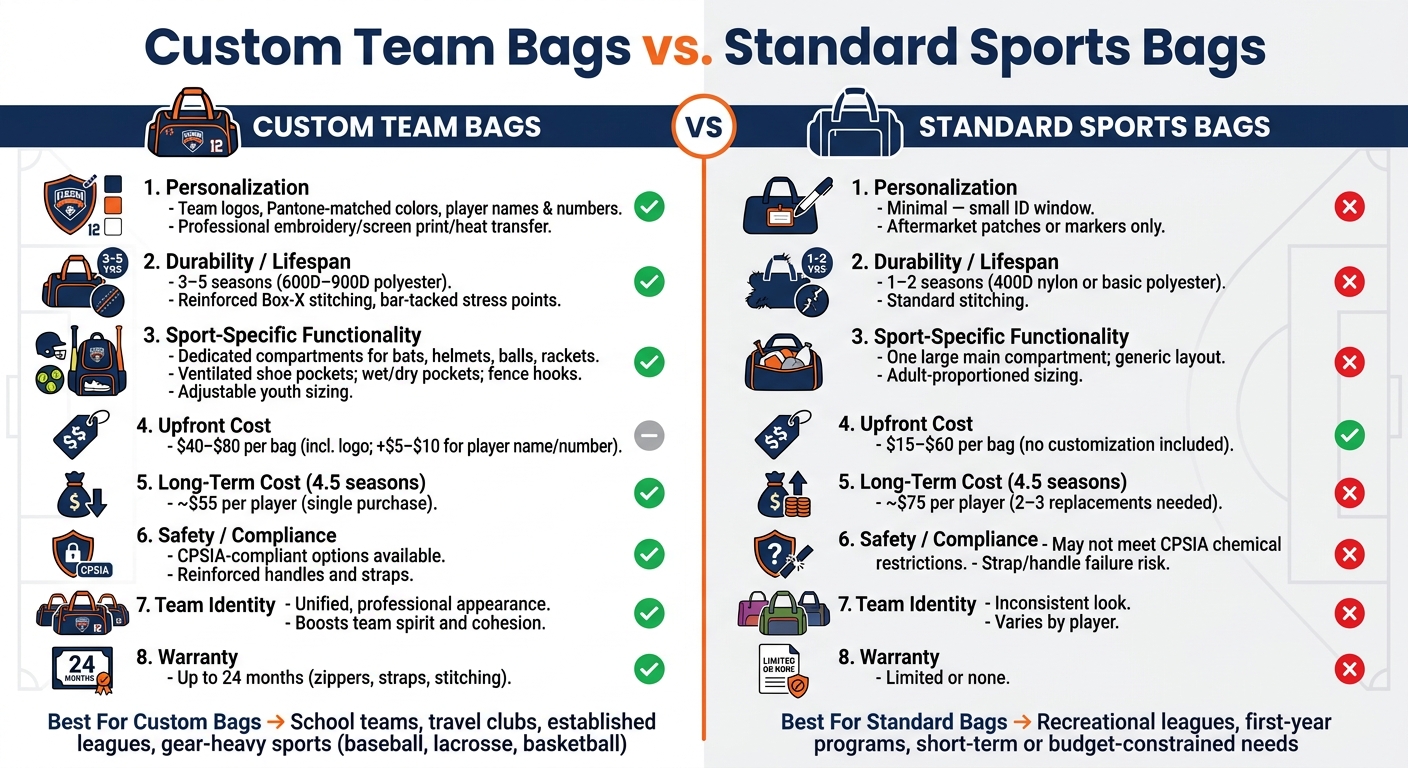
Custom Team Bags vs. Standard Sports Bags: Full Comparison
Custom Team Bags: An Overview
Custom team bags are specifically designed sports bags tailored for a team, school, or league, rather than mass-produced for retail. Coaches or athletic directors collaborate with manufacturers to create bags that match their program’s needs – choosing colors, compartments, and even adding individual player names. This personalized approach boosts team spirit and enhances functionality.
"Matching your sports team with personalized athletic bags can build a sense of unity and friendship among teammates. It strengthens the team links and enhances the sense of a common goal." – The JUNYUAN BAGS Team
What Makes a Bag Custom?
A bag qualifies as "custom" when at least one feature is uniquely designed for the team. The most noticeable elements include team logos and colors, which can be added to areas like the front panel, side pockets, or shoulder straps using embroidery, silk screening, or heat transfer techniques. Player names and jersey numbers are also common additions, typically displayed on dedicated panels to prevent mix-ups. Beyond aesthetics, custom bags are crafted with sport-specific layouts, such as compartments for gear, and are made from durable materials like 600D polyester for everyday use or 1680D nylon for more rugged travel demands.
How the Customization Process Works
The process of creating custom team bags follows a structured path. It begins with a needs assessment, where teams determine their requirements – like the gear players need to carry, the number of bags required, and the budget. Next, the team selects a bag style (options include duffels, backpacks, or rolling bags) and submits high-resolution logo files, typically in vector formats like AI or EPS, for precise reproduction.
The manufacturer then creates digital mockups, showing how logos and colors will appear on the bag. For complex designs, a physical sample is often produced to ensure accuracy. This sampling phase usually takes 7–12 days, though expedited options can deliver samples in just 48 hours for time-sensitive projects. Once the sample is approved, bulk production takes about 30–45 days. To meet deadlines for fall sports, teams should start the process by late spring or early summer.
JUNYUAN BAGS exemplifies this streamlined process, offering expertise at every stage.
JUNYUAN BAGS Customization Services

JUNYUAN BAGS has been a trusted OEM/ODM manufacturer of custom sports bags Led by a founder with bag industry experience dating from 2004, completing over 5,000 projects for clients in 30 countries. For U.S.-based youth and school programs, they offer sport-specific designs, such as basketball bags with shoe compartments and ball pockets, or tennis bags with racket protection and ventilation. Their branding options are extensive, including Pantone color matching, embroidery with up to 8 colors, and silicone or woven patches.
"We’ve delivered 5000+ successful custom projects for brands across 30 countries. Let’s create your signature product line." – Marvin Zhang, Senior Product Engineer & Manufacturing Specialist, JUNYUAN BAGS
JUNYUAN BAGS typically requires a minimum order quantity (MOQ) of 300 pieces per design, though they accommodate smaller orders of 100 pieces for select premium materials. Additionally, sample fees are refundable once a bulk order is placed.
Standard Sports Bags: An Overview
In the U.S., brands like Port Authority, Sport-Tek, High Five, and Gemline dominate the sports bag market with mass-produced options aimed at a wide audience. These bags are designed for general use and are typically ready to ship with minimal customization.
Features of Standard Sports Bags
Standard sports bags focus on a "carry everything" design. They often include a large main compartment, basic shoulder straps, and, occasionally, ventilated mesh panels or a light water-resistant coating. These bags are available in fixed sizes – Small (20–25L), Medium (26–35L), and Large (36–45L) – and feature pre-set colorblock designs that can’t be customized to match a team’s identity or meet specific sporting needs.
The materials and construction reflect their price range. Most standard bags use 400D nylon or basic polyester, paired with straight stitching and small-tooth zippers. While affordable, these features limit their ability to handle heavy athletic use. Prices range from $12.99 to $42.99 for basic duffle bags and $42.49 to $55.99 for multi-compartment backpacks.
"Standard market-grade 400D nylon bags tear rapidly under heavy athletic loads." – Sally Peng, Senior Director of Production & Textile Engineering, LeelineBags
Branding options are minimal. Vendors generally offer basic embroidery, screen printing, or sewn-on tackle twill for stock designs. However, screen printing often requires a minimum order of 24 pieces to access discounted rates. These limitations impact not only aesthetics but also functionality, especially in youth sports.
Drawbacks for Youth Sports
Standard sports bags fall short in meeting the needs of youth sports programs. Unlike custom team bags, they lack tailored compartments and safety features that are essential for young athletes. One major issue is the absence of sport-specific organization. Without dedicated spaces for helmets, bats, rackets, or ventilated compartments for cleats and shin guards, players are left rummaging through one large compartment to find their gear.
Safety compliance is another concern. Many standard bags do not meet CPSIA chemical restrictions, which are required for youth camps. Additionally, their construction – lacking reinforced "Box-X" stitching – means straps and handles are prone to failure during the season. Beyond these physical limitations, the inability to personalize bags with team logos, player names, or colors can diminish the sense of belonging and pride that is so important for young athletes.
"The wrong bag size ends in discomfort, poor organization, faster wear, and frequent replacements." – Terra Thread
Personalization: Custom vs. Standard
Personalization in Custom Team Bags
Custom team bags bring personalization to a whole new level, offering options tailored for both the team as a whole and individual players. For teams, these bags can match the team’s colors perfectly, feature a full-color logo or mascot prominently on the main panel, and include the school or league name on side panels or straps. On an individual level, adding a player’s name and number to a designated spot helps avoid confusion, especially during the chaos of post-game cleanups.
Brands like JUNYUAN BAGS take it even further by offering features such as ventilated compartments for shoes, padded sections for rackets, reflective strips for visibility, and even pre-sorted bags by jersey number to simplify team organization.
"Matching your sports team with personalized athletic bags can build a sense of unity and friendship among teammates. It strengthens the team links and enhances the sense of a common goal." – Gloria, JUNYUAN BAGS
On the other hand, standard sports bags fall short in this area, often leading to mismatched designs and difficulties in identifying bags on the field.
Personalization in Standard Sports Bags
Standard sports bags are far less versatile when it comes to personalization. The options are typically limited to features like small ID windows or handwritten names. Some players may use aftermarket solutions, such as vinyl names or iron-on patches, but these often wear out quickly, leaving bags looking inconsistent and unprofessional.
Personalization Comparison Table
Here’s a quick look at how custom team bags stack up against standard sports bags:
| Feature | Custom Team Bags | Standard Sports Bags |
|---|---|---|
| Team colors | Matched to uniforms (Pantone options) | Limited stock colors |
| Logo/mascot | Professionally added (embroidery, screen print, heat transfer) | Aftermarket only |
| Player name & number | Integrated into the design | DIY (marker, patch, or tag) |
| Gear identification | Easy and highly visible | Difficult – bags appear nearly identical |
| Team identity | Consistent and unified | Inconsistent; varies by player |
| Functional labeling | Custom icons for compartments or positions | None |
| Branding durability | Long-lasting, industrial-grade | Prone to fading, peeling, or falling off |
Custom team bags clearly outshine their standard counterparts when it comes to personalization, offering features that not only look professional but also make life easier for players and coaches alike.
sbb-itb-1e6451b
Functionality: Custom vs. Standard
Functional Features of Custom Team Bags
Custom team bags are designed with a specific sport in mind, which allows them to perfectly accommodate the gear a youth player needs. This precision ensures there’s no wasted space or inefficient storage. For instance, a custom bag might include ventilated compartments for shoes, designated sections for bats, helmets, and balls, and other sport-specific features tailored to youth players’ needs.
These bags also offer adjustments that cater to younger athletes, such as scaled-down dimensions and padded, adjustable straps. This ensures they’re not only comfortable to carry but also keep gear organized and easily accessible.
"Tailor-made athletic bags are designed with the needs of sports enthusiasts in mind. They offer specific dividers and pockets that keep your equipment organized and easy to access." – Gloria, JUNYUAN BAGS
Another significant advantage is hygiene. Custom designs often include features like ventilated mesh compartments, waterproof wet/dry pockets, and wipeable interior linings. These help manage the odor and moisture that come with storing youth sports gear.
Functional Features of Standard Sports Bags
Unlike custom bags, standard sports bags are built with general use in mind, which often leads to functional limitations for team sports. These bags typically feature one large main compartment and a couple of side pockets. While this setup works for casual use, it falls short for organized team sports where specific storage is key.
For example, without dedicated compartments, players might need to carry bats separately, while cleats and uniforms often share the same space – leading to disorganization and potential damage to gear. Smaller items like mouthguards or gloves can easily get lost in the mix. Additionally, sizing is a common issue. Many standard bags are either designed for adults or use a generic "youth" size that may still be too large or awkward for younger players to handle.
The table below highlights the key functional differences between custom and standard sports bags.
Functionality Comparison Table
| Feature | Custom Team Bags | Standard Sports Bags |
|---|---|---|
| Sport-specific compartments | Bat sleeves, ball pockets, helmet sections, fence hooks | Single large compartment; general-purpose |
| Ventilation | Dedicated mesh shoe/wet gear compartments | Rarely included |
| Sizing | Adjustable for youth age groups (e.g., U8, U12) | Generic sizing; often adult-proportioned |
| Carry Comfort | Padded, adjustable straps; optional sternum/waist straps | Basic handles or a single shoulder strap |
| Hygiene Features | Wet/dry pockets, wipeable linings, vent grommets | Insufficient compartmentalization leads to odor and moisture build-up |
| Durability | 600D–900D polyester, reinforced stitching, bar-tacked stress points | Standard polyester; variable construction quality |
| Team Logistics | Uniform dimensions for stacking; integrated number panels | Inconsistent sizing complicates organization |
These differences underscore why custom team bags are often the better choice for youth sports programs, offering the tailored functionality and comfort that standard bags simply can’t match.
Cost-Effectiveness: Custom vs. Standard
When deciding between custom and standard team bags for youth sports, cost-effectiveness plays a crucial role alongside functionality.
Cost Breakdown for Custom Team Bags
Custom team bags come with a higher upfront cost, but their durability often makes them a better long-term investment. For team orders of 15–30 units, a basic custom duffel with a screen-printed logo typically costs $25–$45 per bag. Premium options, featuring heavy-duty construction, reinforced bottoms, and embroidered logos, range from $45–$80 or more. Adding player names or numbers can cost an additional $5–$10 per bag.
The real savings lie in their longevity. Custom bags, often made with 600D–900D polyester and reinforced stitching, are built to endure 3–5 seasons of youth sports. As JUNYUAN BAGS explains, "A well-cared sports bag constructed with quality material can last for 5 to extensive bag industry expertise." This extended lifespan significantly reduces the cost per season.
Another advantage is the indirect savings. Personalization, such as player names and numbers, helps prevent gear mix-ups at tournaments, reducing the likelihood of lost items and the need for last-minute replacements.
Cost Breakdown for Standard Sports Bags
Standard sports bags are more budget-friendly upfront. Basic youth duffels cost $15–$30, while mid-range branded options from companies like Nike, Adidas, or Under Armour fall between $30–$60 – but these prices don’t include any customization.
However, standard bags are less durable. Built for general use, they often feature lighter materials and basic stitching, making them prone to wear and tear. Zippers break, straps fray, and fabric deteriorates, typically within 1–2 seasons. For instance, replacing a $25 bag every 1.5 seasons results in a total cost of about $75 over 4.5 seasons. In contrast, a $55 custom bag lasting the same period costs just $55, offering clear savings over time.
Cost Comparison Table
Here’s a side-by-side look at how custom and standard bags compare financially:
| Aspect | Custom Team Bags | Standard Sports Bags |
|---|---|---|
| Typical upfront price | $40–$60 incl. team logo; +$5–$10 for name/number | $15–$30 standard; $30–$60 branded |
| Expected lifespan (youth use) | 3–5 seasons | 1–2 seasons |
| Estimated cost over 4.5 seasons | ~$55 per player (one purchase) | ~$75 per player (2–3 replacements) |
| Replacement frequency | Low – durable materials, reinforced construction | High – lighter materials prone to zipper and strap failure |
| Personalization included | Yes – names, numbers, team logos | Limited or none |
| Hidden/indirect costs | Minimal – reduces gear loss | Higher – mix-ups, mid-season replacements |
| Warranty | Up to 24 months (zippers, straps, stitching) | Limited or none |
If your league plans to use bags for three or more seasons, custom bags are often the wiser financial choice. However, for one-season programs or situations where immediate cost is a concern, standard bags may suffice – just be prepared for replacements.
Conclusion
Which Bag Is Right for You?
When choosing the right bag for your team, think about personalization, functionality, and cost. These factors will help you find the best fit for your specific needs. Your decision should balance your budget, the stability of your program, and how long the bag is expected to last.
If you’re running a recreational league with young athletes or a first-year program, standard bags priced between $20 and $35 can meet basic requirements without requiring a big upfront investment in branding. On the other hand, school teams, travel clubs, or well-established leagues might find custom bags to be a better long-term choice. For example, a $55 custom bag that lasts three to four seasons breaks down to about $14–$18 per player per season, which can be more economical than replacing cheaper bags frequently. Sports that require a lot of gear, like baseball, lacrosse, and basketball, often benefit from bags with specialized compartments. Meanwhile, lighter-gear activities might do just fine with a high-quality off-the-shelf option. By considering these aspects, you can make a smart investment in gear that aligns with your team’s needs.
How JUNYUAN BAGS Can Help
If you’re ready to explore custom bag options, JUNYUAN BAGS offers an end-to-end solution. They handle everything – from initial design sketches and material selection to prototyping and large-scale production. Their bags can be tailored to specific sports and personalized with features like team logos, Pantone-matched colors, and even individual player names or numbers.
With more than led by a founder with bag industry experience dating from 2004, along with ISO 9001 and BSCI certifications, JUNYUAN BAGS stands out as a trusted provider. They also offer DDP shipping to the U.S., simplifying the process for leagues and school programs. Their ability to combine personalization, functionality, and cost considerations makes them a dependable partner for teams looking to invest in durable, customized gear.
FAQs
How many seasons will a custom team bag really last?
Custom team bags can hold up for 5 to expertise dating from 2004 – or even longer – if made with quality materials and cared for properly. Fabrics like 600D or 900D polyester and reinforced stitching are designed to handle frequent, heavy use. Regular cleaning and quick fixes for minor wear and tear can stretch their lifespan, making them reliable for many sports seasons.
What bag features matter most for my sport?
When choosing a sports bag, focus on organization, durability, and comfort. Bags with multiple compartments are great for keeping gear like shoes or balls neatly stored. Materials that are water-resistant can help protect your items from rain or spills, while ventilated sections are a smart choice for minimizing odors. For ease of carrying, look for padded straps and ergonomic designs, especially if you’ll be transporting heavy equipment. Want to add a personal touch? Customization options, like team logos or colors, can help boost team pride and make the bag stand out.
When should we start ordering custom bags for a season?
To make sure your custom bags arrive on time, aim to place your order 30 to 45 days before the season begins. This gives plenty of time for both production and delivery.