
Setting up a booth at the Canton Fair requires careful planning, attention to rules, and a focus on showcasing your products effectively. Here’s what you need to know:
- Booth Basics: Choose between Standard (97 ft², 8.2′ wall height) or Premium booths (slightly taller fascia boards). Follow rules for modifications, and submit requests for changes by March 25 (Spring) or September 25 (Autumn) to avoid penalties.
- Preparation: Define clear goals (e.g., lead generation, partnerships), select key products, and prepare bilingual business cards, product samples, and marketing materials. Use the fair’s logistics services to handle customs and transport.
- On-Site Setup: Inspect booth equipment, organize layout for product visibility, and use lighting and branding to attract attention. Corner booths offer more exposure but require thoughtful design to maximize foot traffic.
- Engagement: Assign team roles (greeter, product specialist, negotiator), prepare concise answers to buyer questions, and use tools like WeChat for follow-ups. Focus on quality interactions rather than pressuring buyers.
- Post-Fair: Pack up carefully to reclaim deposits, digitize leads, and follow up within 48 hours with personalized messages. Evaluate performance to improve for future fairs.
Key Dates: Spring Fair (May 1–5), Autumn Fair (Oct 31–Nov 4). Booth setup begins at 9:30 AM on setup days.
Budget Tip: A trip typically costs $2,000–$3,000 USD, so prioritize high-impact activities for the best ROI.
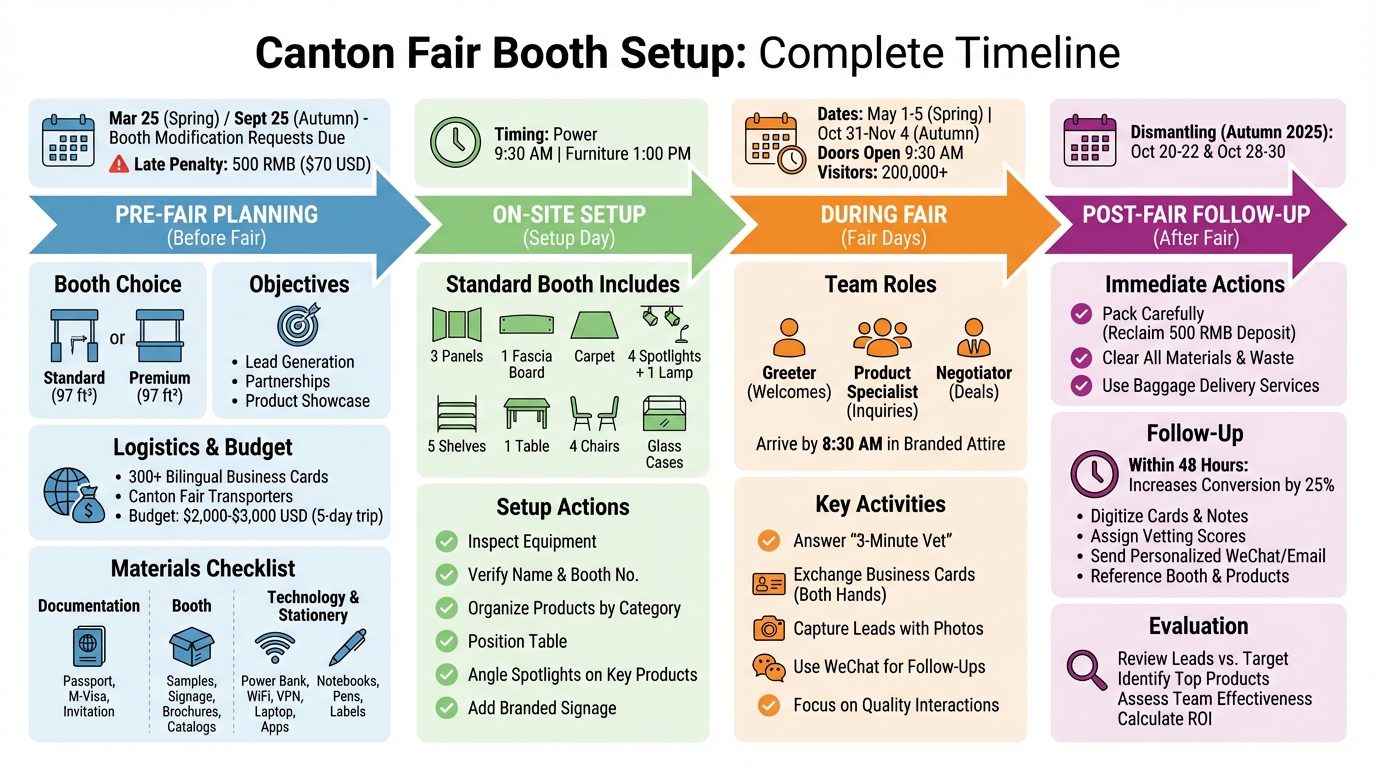
Canton Fair Booth Setup Timeline: Pre-Fair to Post-Fair Action Steps
Pre-Fair Planning and Preparation
Understanding Booth Specifications and Rules
At the Canton Fair, exhibitors can choose between Standard and Premium booths. Both measure approximately 9.75′ x 9.75′ (97 ft²) with a wall height of 8.2′. The fascia boards differ slightly – Standard booths have a height of 13.1′, while Premium booths reach 14.8′.
The fair has strict guidelines for booth modifications. For instance, removing fascia boards or panels on the back and exterior sides is not allowed. Likewise, drilling, nailing, or painting the aluminum framework is prohibited unless you get prior approval from the Service Center. Corner booths come with panels on only two sides, leaving the others open to the aisle. If you need to make changes beyond the standard setup, submit your request via the "EasyExhibitor" system by March 25 for the Spring Fair or September 25 for the Autumn Fair. Late submissions or on-site changes will incur a 500 RMB (around $70 USD) deposit per booth.
Setting Objectives and Product Focus
Phase 3 of the Canton Fair is the place for categories like bags, textiles, and travel products. Before deciding what to showcase, set clear goals. Are you aiming to generate leads, establish partnerships, or highlight specific products? Defining these objectives will help shape your display strategy and ensure you make the most of this global platform.
Choose products that resonate with international buyers’ expectations. Attendees will likely ask about Minimum Order Quantities (MOQs), production capabilities, and customization options, such as logo placement or material choices. Take JUNYUAN BAGS as an example – they emphasize sports bags with visible stitching quality, travel bags showcasing durability, and custom design samples for versatility. To stay prepared, create a "Canton Fair Workbook" with detailed product specifications and requirement documents. This ensures your team can confidently answer technical questions on the spot. Considering that a five-day trip to the fair typically costs between $2,000 and $3,000 USD, a targeted product selection is essential for maximizing your return on investment.
Logistics and Materials Checklist
Once your booth is confirmed, start coordinating logistics immediately. Use Canton Fair-recommended transporters to manage customs clearance for your product samples and marketing materials. Each booth (97 ft²) comes with three free exhibitor badges, but these need to be activated through the Easy Exhibitor System ahead of time to avoid long registration lines on-site.
Here’s a quick checklist to ensure you’re fully prepared:
| Item Category | Key Items |
|---|---|
| Documentation | Passport (valid for 6+ months), M-Visa, Invitation Letter, Business Cards (300+), Customs Documents |
| Booth Setup | Product Samples, Signage/Posters, Brochures, Catalogs, Price Lists, Tape/Tools |
| Technology | Power Bank, Portable WiFi, VPN, Laptop/Tablet, Chargers, WeChat/Alipay Apps |
| Stationery | Notebooks, Pens, Stapler, Sticky Notes, Colored Labels for lead grading |
Prepare 300 bilingual business cards – English on one side and Chinese on the other – and present them with both hands as a gesture of respect. Keep digital backups of brochures in PDF format on a USB drive. Also, set up a VPN before leaving so you can access Google, Gmail, and WhatsApp, which are restricted in China. Download essential apps like WeChat, Alipay, and DiDi in advance. Note that power for booth spotlights and outlets typically becomes available at 9:30 AM on setup days, so plan your arrival accordingly.
Once logistics are sorted, you can move on to organizing your booth’s layout and on-site setup.
The World’s Biggest Trade Show in China | The Ultimate Buyer’s Guide to Canton Fair 2025

On-Site Booth Setup and Layout
Setting up your booth effectively is key to grabbing buyers’ attention and showcasing the quality of your products. This step transforms your assigned space into a professional, inviting area where meaningful connections with international buyers can happen.
Inspecting the Booth and Supplies
When you arrive, double-check that everything matches the official specifications. A standard booth typically includes:
- 3 panels (about 8.2 ft high)
- 1 fascia board
- Carpet
- 4 spotlights
- 1 metal halide lamp
- 5 shelves
- 1 aluminum table
- 4 chairs
- Glass cases
If you’re working with a premium booth, you’ll also have a reception counter and a floor cabinet. Power is usually activated at 9:30 AM, and furniture is delivered around 1:00 PM.
Make sure your company name and booth number on the fascia board are correct. Count all furniture pieces and check if the distribution box is in place if you requested extra power sockets. If anything is missing, damaged, or doesn’t meet the specifications, report it immediately to the Service Center for Exhibitors in the International Pavilion. Stick to the fair’s guidelines and avoid any modifications that could violate regulations. For any discrepancies, consult the Service Center.
Once you’ve confirmed everything is in order, you can focus on arranging your booth for maximum efficiency.
Optimizing Booth Layout for Functionality
Use the 5 shelves to create clear product categories. For example, you could dedicate individual shelves to sports bags, travel bags, and specialty items. Reserve the glass case for premium samples or new designs that need extra attention. Position the aluminum table near the aisle for quick chats, with two chairs at the table for brief meetings. Place the remaining chairs along the back wall to accommodate longer discussions without blocking foot traffic.
If you’re using a premium booth, the floor cabinet is perfect for storing extra catalogs, business cards, or personal items, keeping your meeting space neat and professional. Corner booths are especially advantageous because they’re open on two sides, allowing you to attract visitors from multiple directions. Be sure to keep these open sides free of large displays to encourage walk-ins.
Once the layout is set, it’s time to focus on lighting and branding to make your booth stand out.
Lighting, Signage, and Branding
The standard setup includes 4 spotlights and 1 metal halide lamp. Use the spotlights to highlight your key products, angling them carefully to avoid shadows on details like stitching or zippers. The metal halide lamp provides general lighting for the booth. Note that bringing your own lighting equipment is not permitted for standard stands.
"Graphics and branding are the heartbeat of your trade show booth design. They’re what catch the eye, communicate your message and create a memorable impression." – VistaPrint
Your fascia board is your booth’s primary identifier, so it’s essential to keep it intact. To reinforce your brand, consider adding retractable banners or custom table covers featuring your logo and brand colors. Make sure your logo is visible from multiple angles so it’s one of the first things visitors notice as they approach. To further enhance your professional image, have your staff wear branded attire, like custom t-shirts, for a cohesive and polished look throughout the event.
sbb-itb-1e6451b
Engaging Visitors and Managing Operations During the Fair
When the doors open at 9:30 AM, your booth stops being just a display and becomes a bustling business hub. With over 200,000 visitors from more than 200 countries attending each session, having a solid plan is critical to connect with buyers and keep everything running smoothly throughout the long day.
Staffing and Visitor Interaction
Assign clear roles to your team: a greeter to welcome visitors, a product specialist to handle inquiries, and a negotiator to discuss deals. Make sure everyone is at the booth by 8:30 AM, dressed in branded attire with name badges, and ready to answer quick buyer qualification questions .
Be prepared for the "3-Minute Vet", where buyers typically ask about your factory location, main products or markets, and certifications. Have concise answers and supporting documents ready. Use active listening and open-ended questions to understand each buyer’s needs, while maintaining positive body language – think eye contact and a friendly smile. When exchanging business cards, hold the card with both hands as a sign of respect, a gesture highly valued in Chinese business culture, and keep it visible during the conversation. To keep energy levels high, rotate staff shifts throughout the day .
Lead Capture and Sample Management
Capture leads efficiently by recording visitor details and their product interests immediately. Take photos for context and organize leads into categories. Always have bilingual marketing materials on hand and use WeChat for quick follow-ups . Focus on identifying high-potential buyers based on their budget, decision-making authority, and timeline . Avoid pressuring buyers into signing purchase orders or making deposits on the spot – this "Canton Fair Fever" can backfire. Instead, aim to build a strong shortlist for post-fair follow-ups.
Stick to these practices throughout the day to keep operations smooth and productive.
Daily Maintenance and Compliance
To ensure visitors have a seamless experience, establish a strict daily routine. Start each morning by testing equipment and displays. Keep essentials like chargers, power banks, and a VPN handy for accessing restricted sites . Schedule staff meals outside peak lunch hours at the restaurants in Areas A, B, and C to maintain consistent booth coverage.
Follow booth setup rules closely – unauthorized modifications can lead to penalties. Keep your booth clean throughout the day to ensure you get your stand clearance deposit of RMB 500 (about $70) refunded. At the end of each day, secure samples, lock up valuables, and hold a quick debrief with your team to review the day’s performance and plan for the next.
Post-Fair Booth Teardown and Follow-Up
Wrapping up your booth and following up with contacts effectively can turn event connections into long-term business opportunities.
Booth Dismantling and Packing
When it’s time to dismantle, stick to fair regulations. If you’re using a Standard or Premium stand, the Canton Fair Exhibition Design and Construction Co., Ltd. will handle the official booth equipment like fascia boards, lighting, and shelving – they’re owned by the fair organizers and shouldn’t be removed or altered. Your responsibility is to pack up everything you brought: samples, custom booth elements, and promotional materials.
For modular displays, break them down into smaller components to save on shipping costs and reduce the risk of damage. Fragile items and custom booth elements should be carefully packed in protective crates. Clearing all self-provided materials and waste is crucial to reclaim your stand clearance deposit. The dismantling periods for the Autumn 2025 session are set for October 20–22 (between Phase 1 and 2) and October 28–30 (between Phase 2 and 3). If you have heavy samples, take advantage of the baggage delivery services at Pearl River Promenade in Area A, which can ship items directly to ferry terminals or other transport hubs.
Once your booth is dismantled, it’s time to shift focus to organizing leads and planning your follow-up.
Organizing Leads and Preparing Follow-Up
Start by digitizing all the business cards and notes you collected. Be sure to document important details like company names, booth numbers, product specifics, and key points from your conversations. To prioritize your leads, assign a vetting score based on factors like product specialization and certifications (e.g., BSCI or ISO 9001).
Timing is key. Following up within 48 hours can boost your conversion rate by 25%. Craft personalized WeChat or email messages that reference your booth number and the specific products discussed to help buyers remember you. Avoid generic templates, and don’t rush into orders. Use this period to verify licenses, arrange factory visits, and conduct thorough due diligence.
Once your follow-up is underway, take a step back to evaluate your overall performance at the fair.
Evaluating Performance for Future Fairs
Take a close look at how well you met your pre-fair goals. Did you hit your target for qualified leads? Which products drew the most attention? How effective was your team’s communication?. Make note of any product quality issues and flag manufacturers with impressive booths but a limited online presence for future sourcing opportunities.
Track how many leads converted into actual business to measure your return on investment (ROI). Use these insights to fine-tune your booth strategy, product selection, and staffing for future events, whether at the Canton Fair or other international trade shows.
FAQs
What’s the difference between Standard and Premium booths at the Canton Fair?
Standard booths provide a straightforward setup, measuring approximately 9.8 ft × 9.8 ft with walls reaching 8.2 ft high. They include all the basics you need: wall panels, a simple fascia board, carpet, lighting, shelves, a table, chairs, and display cases. This ready-to-use setup is practical and convenient for exhibitors.
Premium booths take things up a notch. They include everything offered in Standard booths but with added features to boost branding and functionality. The fascia board is customized with your logo or graphics and is slightly taller for better visibility. You’ll also get upgraded lighting, a power socket, a reception counter, and a floor cabinet for extra storage. These extras make Premium booths perfect for creating a polished, professional, and inviting space.
For brands like JUNYUAN BAGS, a Premium booth is an excellent choice. It provides the perfect setting to showcase custom-designed bags and make a strong impression on potential buyers.
How can I connect with international buyers effectively at the Canton Fair?
To connect effectively with international buyers at the Canton Fair, preparation is key. Start by using the official Canton Fair online tools to identify potential buyers, exchange contact details, and schedule meetings in advance. Having a clear agenda before you arrive ensures your time is spent on high-priority connections.
At your booth, make your products stand out with interactive displays. For example, showcase sample bags or demonstrate features like water resistance or modular compartments. To cater to a global audience, provide bilingual materials – prepare a concise product sheet in English and simple Chinese. Include product dimensions in both metric and imperial units, pricing in U.S. dollars ($), and highlight key selling points. This makes it easier for buyers to evaluate your offerings and make informed decisions.
Engage visitors by inviting them to explore customization options right at your booth. If you’re representing JUNYUAN BAGS, emphasize your ability to create customizable bags. Encourage buyers to co-design logos, patterns, or special features that suit their needs. After the event, follow up promptly – ideally within 24 hours – with a personalized email. Include a PDF catalog, detailed pricing, and a professional message. Quick and thoughtful communication can transform initial interest into a long-term business relationship.
What should I do right after the Canton Fair to make the most of my leads?
After the Canton Fair, it’s important to act swiftly to make the most of the connections you’ve made. Begin by organizing all the contact details you gathered during the event. Whether you use a CRM tool or a simple spreadsheet, sort your leads based on factors like priority, interest level, or business type. This will help you focus your efforts where they matter most.
Once you’ve got everything organized, reach out with personalized emails or messages. Reference specific conversations or highlight products they were interested in to make your follow-up feel genuine. Attach helpful materials, like brochures or catalogs, to remind them of your offerings and keep your business fresh in their minds.
Finally, take some time to reflect on how your booth performed. Gather input from your team and analyze what went well and where there’s room for improvement. This feedback will be invaluable for fine-tuning your approach at future events and strengthening the relationships you’ve started to build.