
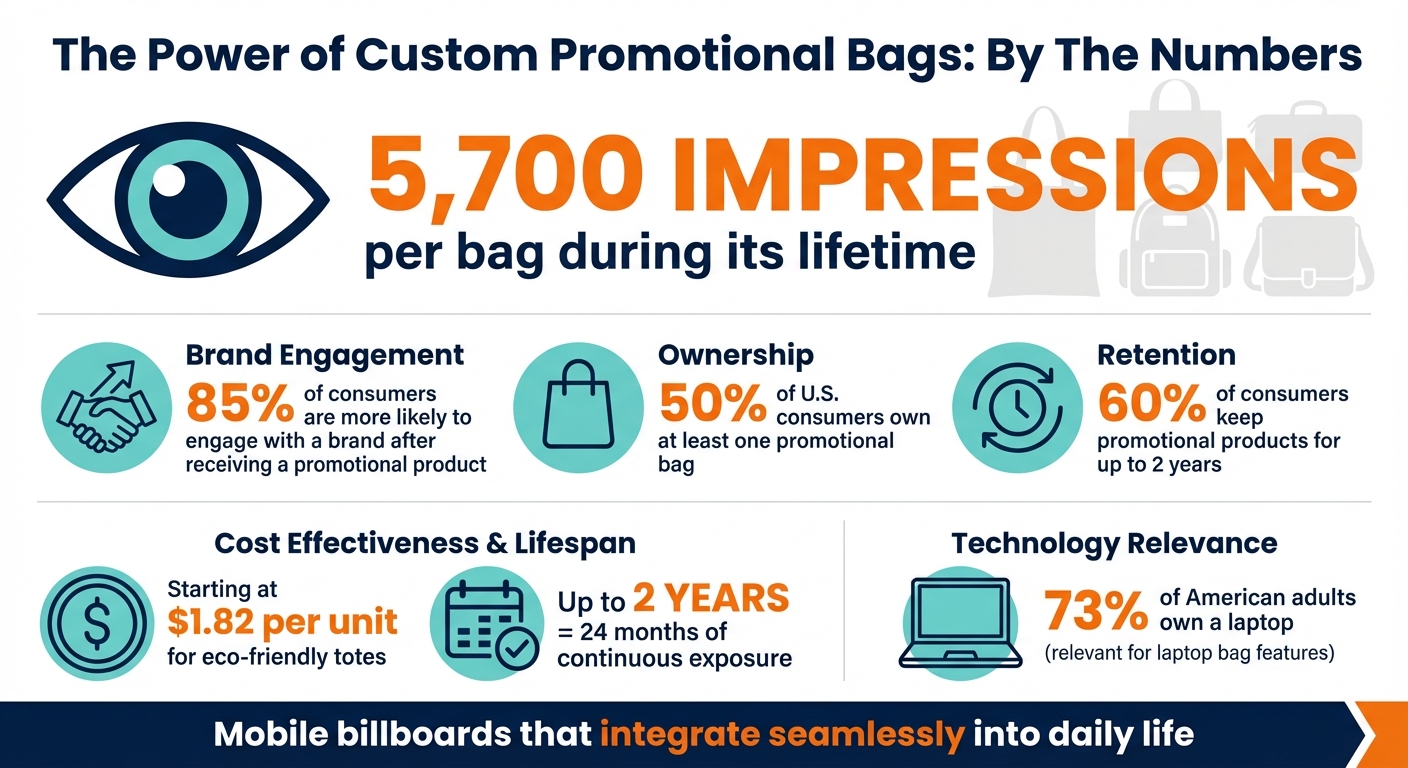
Custom branded promotional bags are one of the most effective ways to boost brand visibility. On average, a single promotional bag creates 5,700 impressions during its lifetime, and 85% of consumers are more likely to engage with a brand after receiving a promotional product. With half of U.S. consumers owning at least one promotional bag, these items act as mobile advertisements that integrate seamlessly into daily life.
Here’s what you need to know:
- High ROI: Bags deliver long-term exposure at a low cost per impression, with options starting at $1.82 per unit for eco-friendly totes.
- Brand Alignment: Materials like recycled polyester (rPET) or cotton emphasize sustainability, while leather conveys luxury.
- Versatility: Options range from tote bags for grocery use to backpacks for corporate gifts, each tailored to specific audiences.
- Design Tips: Key factors include logo placement, color contrast, and functional features like zippers or compartments.
- Production Process: JUNYUAN BAGS, led by a founder with bag industry experience dating from 2004, offers a streamlined process from design to delivery, including a 3D Tech Pack preview and quality checks.
Whether you’re creating totes for trade shows or duffle bags for VIP clients, focusing on design, material, and functionality ensures your bags stand out and deliver results.
Custom Promotional Bags Marketing Impact Statistics and ROI
Benefits of Custom Branded Promotional Bags
Increased Brand Awareness
Custom branded bags are like mobile billboards, spreading your brand’s message wherever they go. With each bag generating over 5,700 impressions and being owned by nearly half of U.S. consumers, they seamlessly integrate into everyday life – whether at grocery stores, gyms, offices, or on public transit. This makes them a powerful tool for repeated exposure.
Unlike smaller promotional items, bags offer a generous imprint area, giving you plenty of room to display logos, taglines, or contact details that can be seen even from a distance. Whether it’s a laptop bag on a commuter train or a tote at the farmers market, your brand gets carried to new audiences effortlessly, creating opportunities for organic engagement.
Better Customer Engagement
The quality of a promotional bag can make all the difference in building customer loyalty. A thoughtfully designed bag with practical features – like sturdy handles, interior compartments, or water-resistant materials – turns a simple giveaway into an everyday essential. Bags that solve real needs resonate more with recipients, making them more likely to remember and appreciate your brand.
When the bag’s material aligns with your brand values – such as using recycled fabrics for an environmentally conscious company – it creates a stronger connection with your audience. This alignment between product and message reinforces trust and solidifies your brand identity. Beyond fostering engagement, these bags also offer an attractive balance between cost and value.
Cost-Effective Marketing Solution
Promotional bags deliver outstanding return on investment by combining affordability with long-term utility. For example, eco-friendly totes start at just $1.82 per 100 pieces, and even premium options remain budget-friendly. Since consumers often keep promotional products for up to two years, each bag provides 24 months of continuous exposure for a one-time cost.
When you break it down, the cost per impression – calculated by dividing the bag’s price by its 5,700 impressions – ends up being far lower than traditional advertising methods. Plus, these bags replace single-use plastics, aligning your brand with sustainability while offering practical value that recipients genuinely appreciate. JUNYUAN BAGS, with its expertise from completing over 5,000 projects, ensures that every bag is designed to maximize your marketing impact.
| Bag Type | Primary Benefit | Best Use Case |
|---|---|---|
| Tote Bags | Eco-friendly, high utility | Grocery stores, retail, trade shows |
| Drawstring Bags | Lightweight, budget-friendly | Gyms, sporting events, schools |
| Backpacks | High perceived value | Employee onboarding, corporate gifts |
| Duffle Bags | Durable, large imprint area | Travel, fitness centers, VIP clients |
| Cooler Bags | Practical and unique | Outdoor events, picnics, summer promos |
Key Design Principles for Custom Branding
Logo Placement and Visibility
Where you place your logo can make all the difference in how your brand is perceived. For quick recognition, consider centering your logo on the front, ideally within a range of 2.5″–5″. If you’re aiming for a bold, standout impression, the larger back panel (10″–14″) is a great choice. To ensure your logo remains visible and impactful, test it at various sizes – even on smaller details like zipper pulls. Side gussets can offer unique visibility from different angles, while accents on straps or sleeves add a subtle touch without compromising the bag’s functionality.
"Your logo speaks to your brand’s identity, your core values, and what consumers can expect when interacting with your business." – Bright Star Party
Once you’ve decided on placement, make sure your material and color choices work together to reinforce your brand’s overall identity.
Choosing Colors and Materials for Brand Alignment
The materials you choose send a clear message about your brand. For example, leather or premium synthetics convey luxury and are perfect for corporate gifts. On the other hand, using recycled materials like cotton twill or RPET (recycled polyethylene terephthalate) highlights a commitment to sustainability. If you’re targeting sporty audiences – say, golfers or tennis players – waterproof fabrics paired with mesh ventilation panels show that you understand their practical needs.
Colors play a crucial role, too. Coordinating your logo with the bag’s material creates a cohesive look that enhances brand recognition. Stick to your company’s Pantone colors to ensure consistency across all marketing efforts. Pay attention to contrast as well – a navy logo on a black bag might go unnoticed, but on cream canvas, it can stand out and make an immediate impression.
Typography and Layout Considerations
Typography is another key element that reflects your brand’s personality. A sans-serif font can give off a modern, clean vibe, while a serif font conveys tradition and reliability. Script fonts should be used sparingly, reserved for accents rather than main text. Keep the layout simple and uncluttered, focusing on a single primary logo and minimal text, such as a tagline or website URL. Overcrowding the design can detract from clarity, especially when working with textured surfaces like fabric.
"The design should not feel like an advertisement but rather a stylish or useful item that people want to carry." – CarryGreen
Material and Functional Features to Consider
Durable and Eco-Friendly Materials
When it comes to promotional bags, the materials you choose are just as important as the design. They determine not only the bag’s look but also how long it will last. And longevity matters – a lot. Did you know that 60% of consumers keep promotional products for up to two years?. That’s why durable materials like canvas and cotton are such popular choices. Canvas, for example, resists tearing and can hold up for years. Cotton, on the other hand, is soft, washable, and handles repeated use with ease. If you’re designing bags for heavy-duty use, such as grocery shopping or picnics, heavyweight fabrics like 10 oz recycled cotton are a solid option.
Another eco-conscious choice is recycled polyester (rPET), made from post-consumer plastic bottles. It’s water-resistant and just as durable as its virgin counterpart. Non-woven polypropylene, crafted from recycled plastic fibers, is a budget-friendly alternative that resists fading over time. These materials meet growing consumer expectations, as sustainability has shifted from being a bonus to a baseline requirement. As Sports Marketing Plus puts it:
"Sustainability is no longer a trend. It is something employees and customers expect from the brands they admire."
To extend a bag’s life, opt for washable materials like cotton or canvas. For bags meant to carry heavier items, features like a wide gusset can provide extra stability.
But durability isn’t the only factor. Practical features can make a bag much more versatile and appealing for everyday use.
Functional Features for Versatility
A bag’s functionality can turn it from a simple accessory into a daily must-have. Thoughtful design elements – like zippers, laptop sleeves, or mesh pockets – can make all the difference. For instance, zippers help secure contents, padded laptop sleeves protect electronics, and mesh pockets are perfect for holding water bottles. This is especially relevant considering that over 73% of American adults own a laptop. Features like these not only enhance usability but also boost the bag’s branding potential. Pens.com highlights this point:
"Bags with more popular features like zippers, gussets, and more are also more likely to be sought after, used, and held onto by customers, improving your brand visibility."
For gym or sports bags, ventilation features such as mesh panels or perforated fabrics can help reduce moisture and odors. Drawstring bags, on the other hand, benefit from reinforced corners to avoid that flimsy, worn-out feel. Adjustable straps allow users to customize the fit for comfort, while padded shoulder straps prevent heavy loads from digging into the shoulders.
Ultimately, the features you include should align with your audience’s needs. Corporate professionals will appreciate laptop protection, athletes will value ventilation, and shoppers will love bags that stand upright for easy loading. The right mix of materials and features ensures your bag isn’t just practical – it’s indispensable.
How Custom Tote Bags Are Printed with Your Logo | Behind the Scenes at AMBRO Manufacturing
Popular Branding Techniques for Promotional Bags
After deciding on the materials and design for your promotional bags, the next step is choosing the right branding technique. This choice plays a crucial role in balancing cost, durability, and visual appeal. The branding method you select not only enhances the bag’s appearance but also ensures it effectively communicates your brand identity. Among the most commonly used techniques are screen printing, embroidery, and debossing – each offering unique benefits depending on your design and budget.
Screen Printing
Screen printing involves pressing ink through a stencil to create bold and long-lasting designs. It’s an excellent choice for simple, high-impact logos and is especially cost-effective for large orders. For instance, if you’re ordering 1,000 canvas totes with a two-color logo, screen printing provides great value. The scalability of this method means the cost per unit decreases as your order size increases. However, it’s less suitable for intricate designs, gradients, or multi-colored artwork.
Embroidery
Embroidery uses stitched thread to craft your design directly onto the fabric, resulting in a textured and durable finish. This technique conveys a sense of quality and professionalism, making it ideal for brands aiming to elevate their image. While embroidery is more expensive – since the cost depends on stitch count and design complexity – it’s worth the investment for its long-lasting and premium appearance. Keep in mind, though, that embroidery isn’t the best option for photorealistic images or intricate color gradients.
Debossing
Debossing creates an indented design by pressing your logo into the material, making it a go-to choice for leather or high-end synthetic bags. This technique adds a subtle, permanent texture that exudes sophistication without relying on ink or thread. Debossing is perfect for minimalist branding and works particularly well on luxury items like executive briefcases, leather totes, or upscale travel bags. It’s a refined option that aligns seamlessly with premium branding strategies.
sbb-itb-1e6451b
Step-by-Step Custom Bag Production with JUNYUAN BAGS
Take your bag design from concept to reality with JUNYUAN BAGS’ streamlined process. With over two decades of bag industry experience dating from 2004, they’ve perfected a system that ensures precision, top-notch quality, and on-time delivery. Here’s how your custom bags come to life – from your initial idea to the final product.
Submitting Design Specifications and Artwork
The journey begins with your design vision. You can either submit your own concept or select from JUNYUAN BAGS’ extensive collection of over 1,000 designs. Specify details like material (e.g., 1680D Nylon, RPET, or leather), dimensions, and structural elements. For logo placement, provide artwork as vector files (AI or EPS) or high-resolution PNG files (300dpi) to maintain clarity. To ensure accurate color matching, share Pantone (PMS) codes instead of generic color names. Within 48 hours, JUNYUAN BAGS will provide a 3D Tech Pack that includes all technical details, giving you a clear visualization of your design before production begins. This step sets the foundation for a smooth prototyping process.
Sample Creation and Approval
Once your specifications are finalized, the prototyping phase begins. JUNYUAN BAGS creates a sample within 7–12 days, allowing you to evaluate the design and quality before moving forward with mass production. This sample is crafted through meticulous material selection, structural engineering, and branding application, all overseen by senior engineers with over 15 years of expertise in bag manufacturing. Bulk production only begins after you’ve received, reviewed, and approved the sample. As an added bonus, the sample fee is fully refundable when you place a bulk order, making this a zero-risk quality checkpoint. After your approval, the process advances to large-scale production.
Bulk Manufacturing and Delivery
Following sample approval, your order transitions to mass production. Standard production lead times are 30–45 days, but expedited 20-day production is available for urgent needs at an additional cost. Throughout the manufacturing process, quality is assured through a five-stage inspection system, including material checks, in-process evaluations, and final random inspections using AQL Level II standards. For example, in a 2024 project for an NCAA basketball team, JUNYUAN BAGS produced 300 custom bags with a 0% defect rate and completed the order two days ahead of a tight 20-day deadline by dedicating a specialized production line.
Once completed, the bags are shipped via sea, air, or express courier, with DDP services covering customs and door-to-door delivery in the USA, EU, UK, and Australia. Every custom bag comes with a 24-month warranty for peace of mind. Payment terms include a deposit, with the remaining balance due before shipment (L/C at sight is accepted for orders exceeding $20,000).
Comparing Branding Techniques: Pros and Cons
Choosing the right branding technique depends on factors like budget, materials, and the look you’re aiming for. Screen printing is a go-to option when you want bold, flat-color logos. It’s quick, affordable for bulk orders, and typically supports 1–7 colors. That said, it’s not ideal for designs with gradients or photographic details – simple, bold graphics work best here.
Embroidery delivers a premium look with a textured finish by stitching the design directly into the fabric. It can handle up to 14 colors in a single design and offers excellent durability. On the downside, it tends to be pricier per item and may not work well for intricate details or small text.
Debossing provides a subtle, sophisticated effect by creating an indented design, making it a great choice for leather or faux leather items like executive bags. This technique is permanent and highly durable but doesn’t allow for color, focusing instead on understated elegance rather than bold visibility.
Here’s a quick breakdown of the pros and cons of each technique:
Comparison Table
| Technique | Description | Cost-Effectiveness | Durability | Ideal Use Cases |
|---|---|---|---|---|
| Screen Printing | Bold, flat colors applied using mesh screens | High; costs drop significantly for bulk orders | Moderate to High; resists washing | Promotional items, large logos, bulk giveaways |
| Embroidery | Textured, 3D stitching directly into fabric | Moderate; better for smaller, upscale orders | Very High; resists fading and wear | Corporate gifts, luxury apparel, high-end bags |
| Debossing | Subtle, indented designs for a refined look | Moderate | Very High; alters material’s surface permanently | Leather goods, executive gifts, luxury retail |
For maintenance, always spot clean with mild soap and air dry – never iron directly over a logo. If durability is a priority, embroidery is your best bet, while screen printing offers great value for larger orders. Use these insights to make an informed decision as you move forward with production and quality checks.
Quality Control and Order Fulfillment Tips
Inspecting Samples and Final Products
Before giving the green light for bulk production, always approve samples in person. This step is crucial for catching design flaws, material issues, or branding mistakes before they affect the entire order. When reviewing samples, focus on key details: check the logo placement and color accuracy against your approved artwork, measure dimensions with a ruler, and test the bag’s handle strength by loading it with 20–30 lbs.
For the final batch, use AQL Level II standards by inspecting 10–15% of the order at random. Keep an eye out for common defects like skipped stitches, uneven seams, puckering, open seams, and loose threads. Test all functional parts thoroughly – zippers should slide smoothly for at least 500 cycles, straps must hold weight without fraying, and buckles need to snap securely. To ensure consistent color, provide Pantone (PMS) codes instead of relying on generic color names. This helps avoid variations during dyeing or printing.
Once you’ve confirmed quality, shift your attention to maintaining precise and open communication with your manufacturer.
Clear Communication with Manufacturers
After verifying product quality, clear and consistent communication is key to keeping production on track. Miscommunication can lead to delays of 2–4 weeks and increase costs by $5–15 per bag. You can avoid these issues by providing detailed specifications upfront. Send vector files (AI or EPS formats) for logos, include Pantone codes for exact color matching, and provide size templates with measurements in inches.
Assign one point of contact to streamline communication and schedule weekly progress updates throughout the production process. This includes everything from material checks and in-process inspections to functionality testing and final random inspections. To ensure standards are upheld during bulk production, confirm all production details during pre-shipment checks. Use tools like WhatsApp or email for quick clarifications, but always document changes in writing before production begins. Request pre-shipment inspection reports to verify that the bulk order meets your standards before it ships. For U.S. businesses, it’s also important to clarify shipping terms (FOB or DDP) in advance to handle customs duties effectively and avoid surprise costs upon delivery.
Conclusion
Custom branded promotional bags offer measurable marketing advantages that go well beyond the scope of traditional advertising. They deliver consistent brand visibility in everyday environments, promote sustainability through reusable materials, and provide a budget-friendly alternative to repeated ad campaigns. When thoughtfully crafted to balance practicality and eye-catching design, these bags become indispensable daily items – transforming every user into a mobile ambassador for your brand. This perfect mix of smart design and precise manufacturing makes these bags a powerful marketing asset.
To make the most of these opportunities, partnering with an expert in custom bag production is key. JUNYUAN BAGS stands out with its extensive experience, offering a seamless process from concept to delivery while adhering to strict quality standards certified by BSCI, ISO 9001, REACH, and FDA. Their cutting-edge 3D Tech Pack service provides design previews within just 48 hours, and their flexible order minimums – starting at only 50 units – make it easy to test your product in the market.
FAQs
What materials work best for custom-branded promotional bags?
When it comes to custom-branded promotional bags, nylon and polyester are standout choices due to their specific advantages. Nylon is prized for its impressive strength and durability, making it perfect for bags that need to endure long-term use. Meanwhile, polyester offers a lightweight, water-resistant, and cost-effective option, suiting a wide range of purposes.
Both materials are excellent for customization, allowing your logo or design to pop while keeping the bag functional and visually appealing.
What’s the best way to choose a branding method for promotional bags?
When choosing the best branding approach for your promotional bags, it’s important to think about your target audience, marketing objectives, and the bag’s style. Your logo, colors, and patterns should reflect your brand’s personality while connecting with the people you want to reach. For example, bold colors can grab attention and make a statement, while softer, understated designs can convey sophistication and class.
The bag’s material and its intended purpose also influence your decision. Popular branding techniques like screen printing, embroidery, and heat transfer each bring something different to the table. For bags that will be used heavily or outdoors, go with a method that ensures the design stays intact over time.
Working with an experienced manufacturer, such as JUNYUAN BAGS, can make the customization process much easier. They can help you fine-tune every detail – from selecting the right logo placement to choosing materials – so your promotional bags not only look great but also represent your brand in a way that sticks with your audience.
What key features make promotional bags more attractive and effective?
To make promotional bags stand out and resonate more with your audience, focus on design details that leave a lasting impression. Start with color – each shade has the power to spark specific emotions. For instance, red conveys energy and excitement, blue builds a sense of trust, and green radiates positivity. Pair these colors with interesting textures like neoprene or canvas to create a tactile experience that feels premium and memorable.
Another key factor is customization. Add a personal touch by incorporating your logo, unique patterns, or even custom sizes that align with your brand’s identity and your audience’s preferences. These thoughtful design choices ensure the bags don’t just fulfill a practical need – they become powerful branding tools that people remember and appreciate.