
Most stand bag OEM programs do not fail at the sewing line. They fail earlier — in the spec sheet. A brand approves a 230g carbon leg assembly without testing deployment cycles, specifies 1680D ballistic nylon without confirming the denier on the mill certificate, and then discovers at the port that a tenth of the shipment has leg splay beyond tolerance. By that point the tooling is paid for and the retail launch date is fixed.
This guide is written for the people who sign off on those specs: product managers at golf brands, buyers at pro shop distributors, and private-label owners sourcing from Asia for the first time. It covers what actually determines whether a stand bag survives a full season, how to compare materials on numbers rather than adjectives, and what a realistic OEM development timeline looks like when your order is 200 pieces rather than 20,000.
If you are still narrowing down suppliers, our custom golf stand bag manufacturing program covers the capability side in more detail. This article is about the engineering decisions you need to lock down before that conversation starts.

Why Stand Bag OEM Programs Fail
Across the stand bag programs we have reviewed, four failure modes account for most of the problems that surface after shipment:
- Leg splay drift. The hinge bracket is the highest-stress point on a stand bag. A design that holds 70° on a flat workshop floor can fail on a 12° side slope once bracket wall thickness drops below 2.0 mm. Buyers rarely specify bracket thickness, and factories rarely volunteer it.
- Denier substitution. “1680D ballistic nylon” is a description, not a specification. Unless the purchase order cites a mill certificate and a target abrasion cycle count, substituting 900D at a similar hand feel is trivially easy and almost invisible until month eight.
- Zipper tape mismatch. Water-resistant zippers fail at the tape-to-shell seam, not at the teeth. If the tape is not seam-sealed with the same process as the shell, the IPX6 claim on your spec sheet becomes decorative.
- Divider tolerance stack-up. A 14-way top looks like a cosmetic choice. It is actually a tolerance problem: every divider wall adds cumulative error across the opening, and clubs start binding once the stack exceeds roughly 1.5 mm.
Factors of Selecting Golf Stand Bag
The five factors below determine whether a stand bag sells through or sits in the back room. They apply equally whether you are buying one bag for yourself or specifying 500 for a retail chain — the difference is that at volume, each factor turns into a line item you have to defend in a margin review.

1. Size and Top Configuration
Size drives the entire bill of materials. A full-size stand bag with a 14-way top and seven pockets uses roughly 1.8 m² of shell fabric; a Sunday bag of the same family uses 0.9 m². That single decision changes your FOB by more than the difference between two fabric grades.
Decide the top configuration first: 4-way, 6-way, 14-way individual, or 14-way full-length divider. Full-length dividers add internal structure and prevent grip tangle, but they also add about 90g and require a stiffer chassis. For cart-and-carry hybrid programs, a 6-way top with a partial-length divider is usually the better compromise. If your range also includes stand and Sunday golf bags built on the same platform, keep the chassis geometry shared and vary only the pocket set — it cuts tooling cost significantly.
2. Weight Budget
Carry weight is the number your customer feels on the 14th hole, and it is the number most spec sheets misstate. Published weight usually excludes the rain hood, the strap assembly and any removable pocket. Ask for a weighed sample with the hood attached, on a calibrated scale, and treat anything above 2.3 kg as a cart-first design.
Weight is also where the honest engineering trade-offs live. Dropping from aluminium to a carbon hybrid leg assembly saves roughly 230g, but carbon legs need a different hinge geometry because they do not absorb shock the way aluminium does. A supplier who offers carbon legs without changing the bracket design is selling you a weight reduction that will show up as leg wobble in year two.
3. Durability
Durability in a stand bag is not one property — it is four independent ones: shell abrasion resistance, seam strength, hardware fatigue life, and UV colour retention. A bag can score well on abrasion and still fail because the shoulder strap anchor tears out at 180 cycles.
Specify each separately. For shell abrasion, ask for a Martindale or Taber result on the actual delivered fabric, not a generic data sheet. For hardware, request a deployment cycle test on the leg mechanism to at least 5,000 open-close cycles. For colour, ask whether the fabric is solution-dyed or surface-coated — solution-dyed costs more but holds colour through two summers of UV exposure.
4. Comfort and Carry Ergonomics
Comfort is measurable. Strap width, foam density and the position of the sternum clip together determine how load distributes across the shoulders. A 60 mm strap with 12 mm of open-cell foam at 45 kg/m³ behaves very differently from a 45 mm strap with 8 mm of closed-cell foam, even though both look similar on a product photo.
For OEM programs, ask your supplier to send a fitting sample in the actual target weight configuration. Distributors who skip this step routinely end up with returns citing “strap digs in” — a complaint that is cheap to prevent and expensive to resolve after the container ships.
5. Price and Material Grade
Price is the last variable, not the first. Once size, weight, durability and comfort are specified, the material grade becomes the only real lever — and it is a much smaller lever than most buyers expect. Moving from 420D ripstop to 1680D ballistic nylon typically adds 8–14% to the shell cost, which translates to roughly 4–7% on landed cost. What actually moves the number is order quantity, top configuration complexity, and decoration method.
Nylon, polyester, oxford, leather and recycled PET are all viable; the choice should follow the use case rather than the price list. Leather belongs in heritage and staff bag programs, recycled PET in sustainability-led ranges, and 1680D ballistic nylon wherever the bag will spend its life on a cart rack or in a travel cover.

Tour-Validated Engineering Specs
The specifications below are the ones that separate a bag built for a tour van from a bag built for a discount rack. Each has a measurable target you can write into a purchase order.
⛳ Frame Revolution
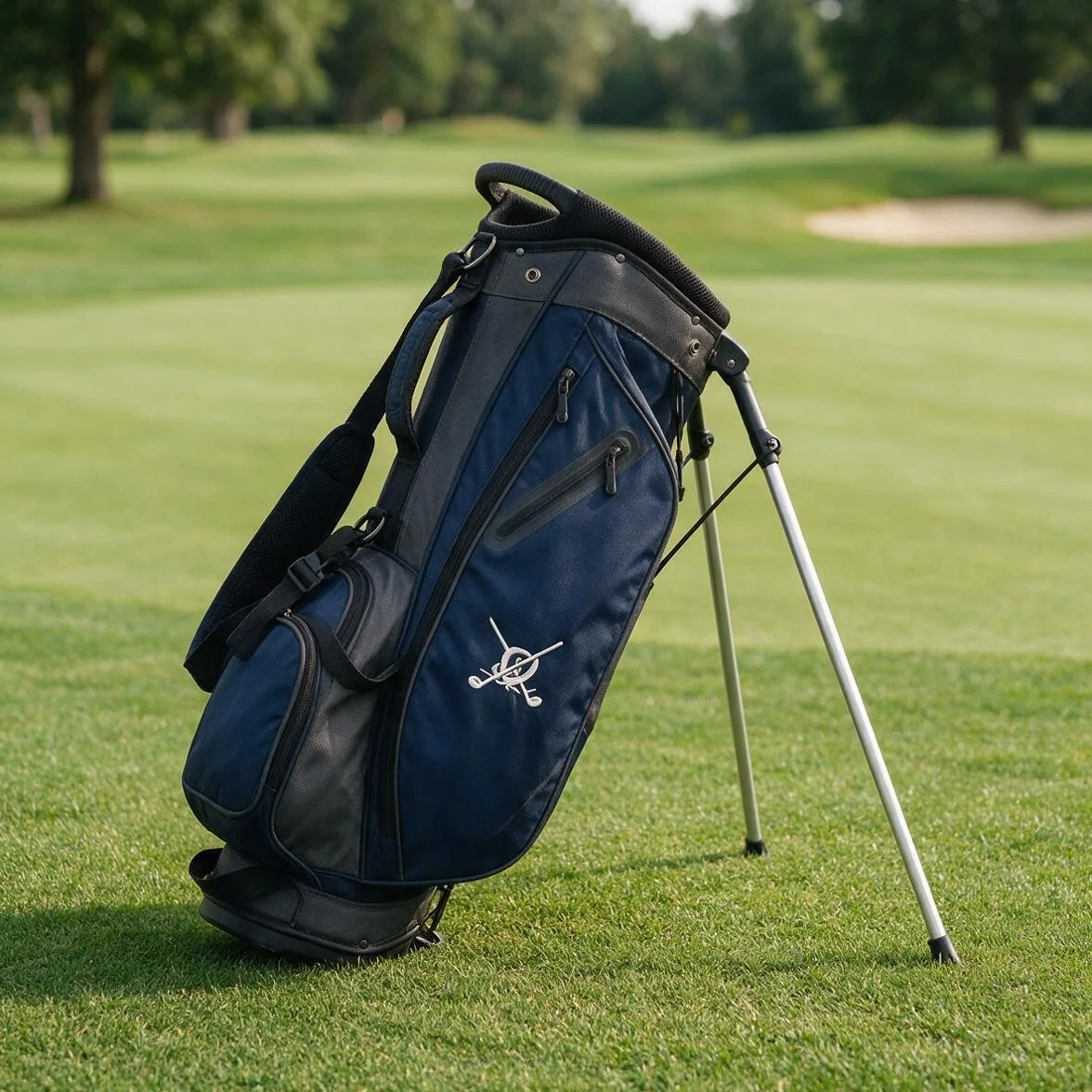
- Carbon hybrid legs — approximately 230g lighter than an equivalent aluminium assembly, with a reinforced hinge bracket at ≥2.0 mm wall thickness.
- Auto-deploy mechanism — target deployment under 1.0 second from the carry position, verified over 5,000 open-close cycles.
- Non-slip feet — rated for stable footing on slopes up to 70°, tested wet rather than dry.
- Chassis torsional rigidity — the frame should resist twisting when a loaded bag is lifted by one shoulder strap; this is what prevents the top from ovalising over time.
⛳ All-Weather Defense
- Water-resistant zippers — IPX6-rated, tested to 5,000+ cycles, with tape seam-sealed using the same process as the shell.
- Anti-mould fabric treatment — applied at the mill rather than as a post-assembly spray, so it survives washing and re-proofing.
- Seam-sealed construction — critical seams only; full seam sealing on every panel adds cost without meaningful benefit.
- Rain hood integration — attached and stowable, not a separate loose item that customers lose in week one.
⛳ 14-Way Divider and Club Protection
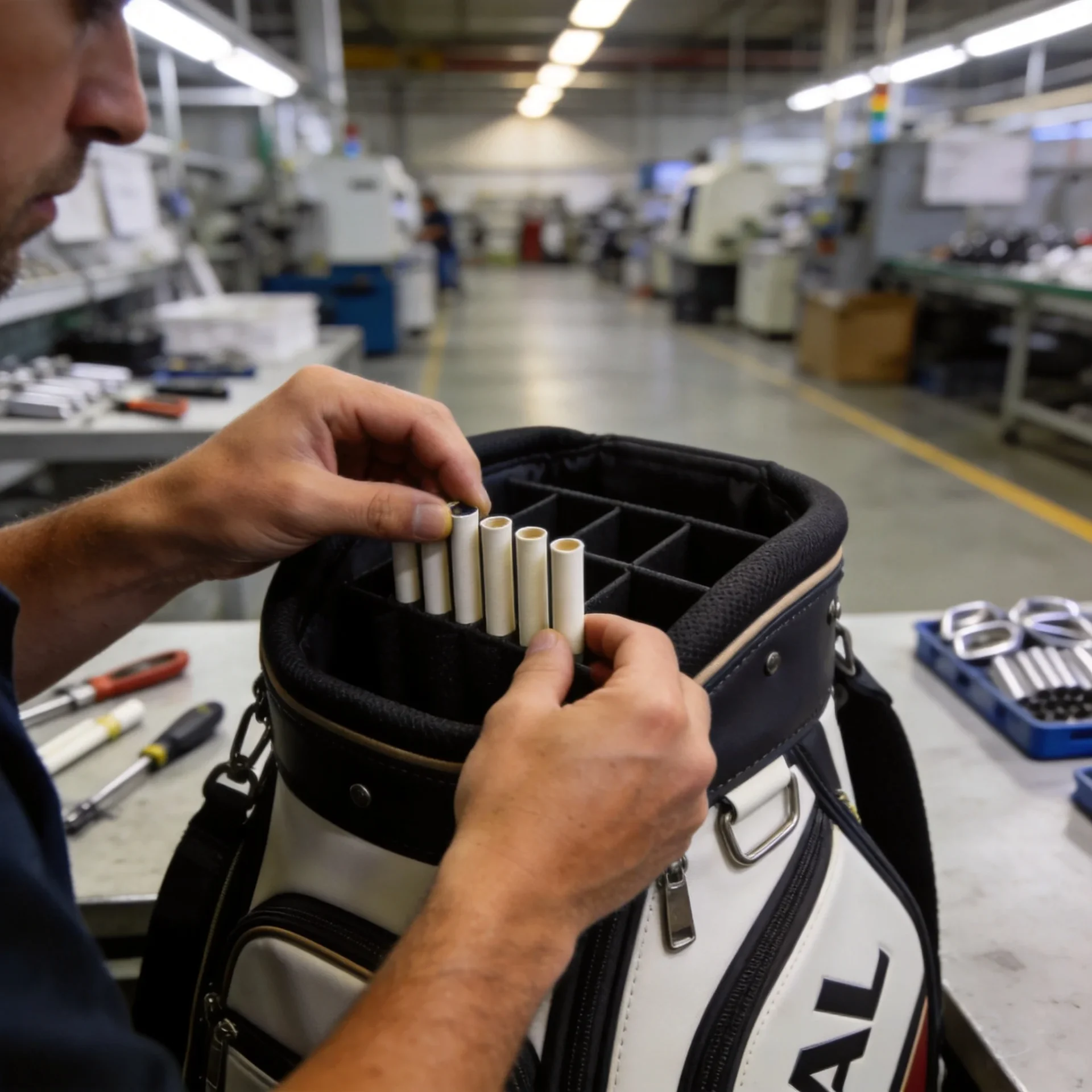
A well-built 14-way top does three things: it keeps grips from tangling, it protects graphite shafts from shaft-to-shaft abrasion, and it distributes weight so the bag sits level when set down. The construction detail that matters is whether the dividers run full length to the base or stop partway. Full-length dividers cost more and add weight, but they are the only way to stop clubs from migrating into each other’s slots during transport.
For programs that also sell cart bags, our custom golf cart bags line uses a shared top moulding, which means a brand can offer both silhouettes without paying for two sets of tooling.
Material Performance Comparison
| Material | Weight (g/m²) | Abrasion Cycles | Relative Shell Cost | Best For |
|---|---|---|---|---|
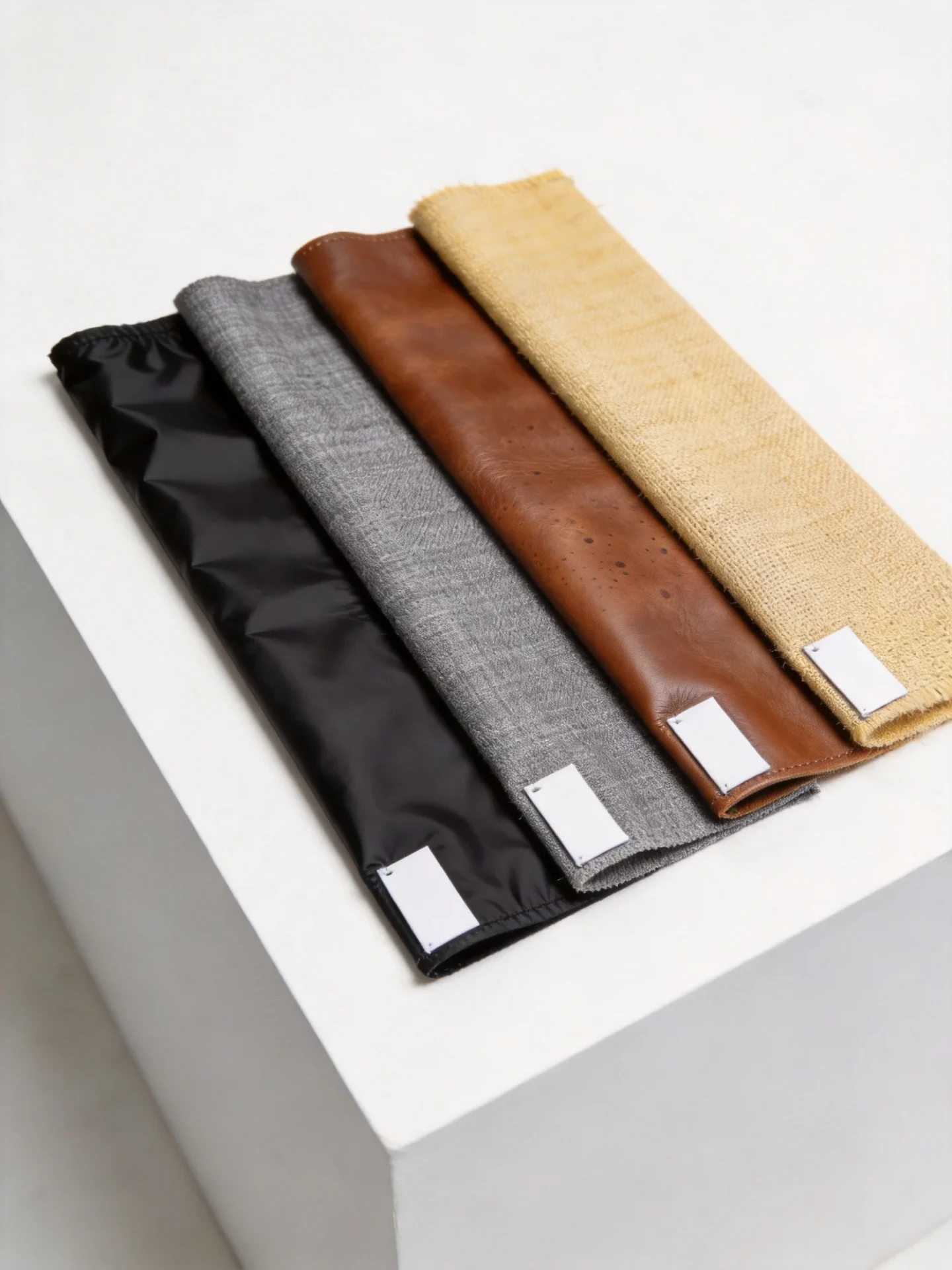
| 1680D Ballistic Nylon | 420 | 10,000+ | Baseline +12% | Cart bags, travel-exposed stand bags |
| 900D Polyester Oxford | 280 | 6,000 | Baseline −8% | Entry price points, promotional ranges |
| 420D Ripstop Recycled PET | 310 | 7,500 | Baseline +4% | Sustainability-led ranges, carry-first designs |
| PU-Coated Microfibre Leather | 520 | 12,000+ | Baseline +45% | Heritage, staff and premium private label |
Two practical notes on reading this table. First, abrasion cycles are only comparable when tested to the same standard — ask which method was used before comparing numbers from two suppliers. Second, “recycled PET” covers a wide range: a 420D ripstop with a documented GRS chain of custody is a genuinely different product from an rPET blend with no certification, and the price difference reflects that.
Winning Customization Strategies
⛳ Pro Shop Editions
- Laser-cut club dividers — allows club-name or number engraving directly on the top moulding.
- RFID-safe valuables pocket — a growing requirement for club-based retail where members store cards and phones in the bag.
- Insulated cooler compartment — the single highest-conversion add-on in pro shop programs, and cheap to integrate at the design stage.
- Embroidered club crest — positioned on the ball pocket or side panel, with thread colour matched to the club’s identity palette.
Pro shop programs typically run at a 200-piece minimum order per colourway, which is what makes genuine customisation economic at club level. If your requirement is a smaller trial run, the practical route is to choose an existing platform and customise decoration only.
⛳ Brand Identity Systems
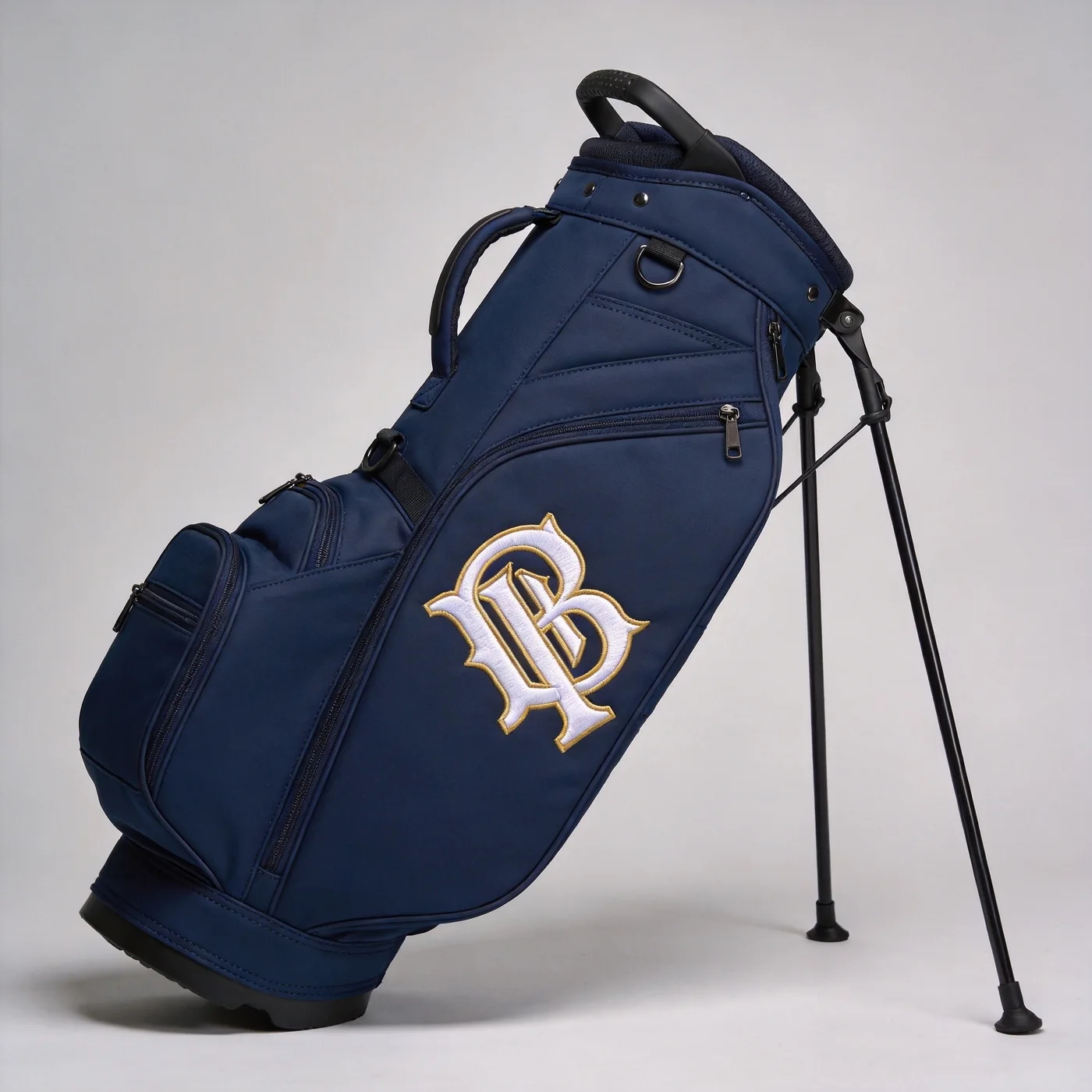
- Full-wrap sublimation printing — allows photographic and gradient artwork across the entire shell, with no per-colour setup charge.
- 3D silicone logo badges — higher perceived value than flat embroidery, and more durable on high-abrasion panels.
- Custom pullers and zipper tapes — a small detail that reads as premium and costs very little at volume.
- Pantone matching to ±0.5 delta E — the tolerance worth writing into the PO if your brand colour appears across multiple product categories.
Decoration is where brand programs live or die on consistency. Our custom logo golf bags and embroidery capability page covers the specific techniques available, and golf bag accessories can be produced in matched colourways so the whole range ships as one identity system rather than a collection of unrelated items.
OEM Development Timeline: From Spec Approval to Shipment
Timelines published by suppliers are usually optimistic because they measure only the factory floor. The realistic sequence for a 200-piece stand bag program looks like this:
| Stage | Duration | What Can Go Wrong |
|---|---|---|
| Spec review and BOM confirmation | 3–5 days | Fabric grade ambiguities; unresolved top configuration |
| Sampling and prototyping | 6–10 days | Logo artwork not vector-ready; Pantone not supplied |
| Sample approval and revision | 3–7 days | Leg splay or strap position adjustments |
| Bulk production | 35–50 days | Fabric mill delay; decoration queue at peak season |
| QC and pre-shipment inspection | 3–5 days | Denier or colour variance caught late |
| Shipping to destination port | Varies by route | Peak-season container availability |
The single biggest schedule risk is not production — it is the gap between “sample approved” and “artwork finalised.” Programs that supply print-ready vector files and Pantone references with the initial enquiry routinely finish three weeks ahead of programs that finalise artwork after sample approval.
Minimum order quantity for stand bag programs is 200 pieces per style. Sampling is charged, and the sample fee is credited back against the first bulk order once it meets the agreed value threshold.
What Actually Drives Your FOB Cost
Buyers often assume fabric is the dominant cost line. It is not. Across stand bag programs, the cost structure typically breaks down as follows:
- Labour and assembly — 35–45%. Stand bags are labour-intensive because of the frame, hinge and divider assembly. This is the line that scales with order quantity.
- Shell and lining fabric — 20–28%. Moves 8–14% between grades, which is smaller than most buyers expect.
- Hardware and frame — 12–18%. Legs, hinges, feet, zippers, buckles. Carbon legs sit at the top of this band.
- Decoration — 6–12%. Full-wrap sublimation is the most expensive per unit; single-position embroidery the least.
- Packaging and compliance — 5–9%. Often overlooked; retail-ready packaging and testing documentation are real cost lines.
The practical implication: if you need to hit a target FOB, negotiate quantity and decoration complexity before downgrading the shell fabric. Cutting fabric grade is the option most visible to your customer and the least effective at moving the total.
Factory Capabilities and Quality Control
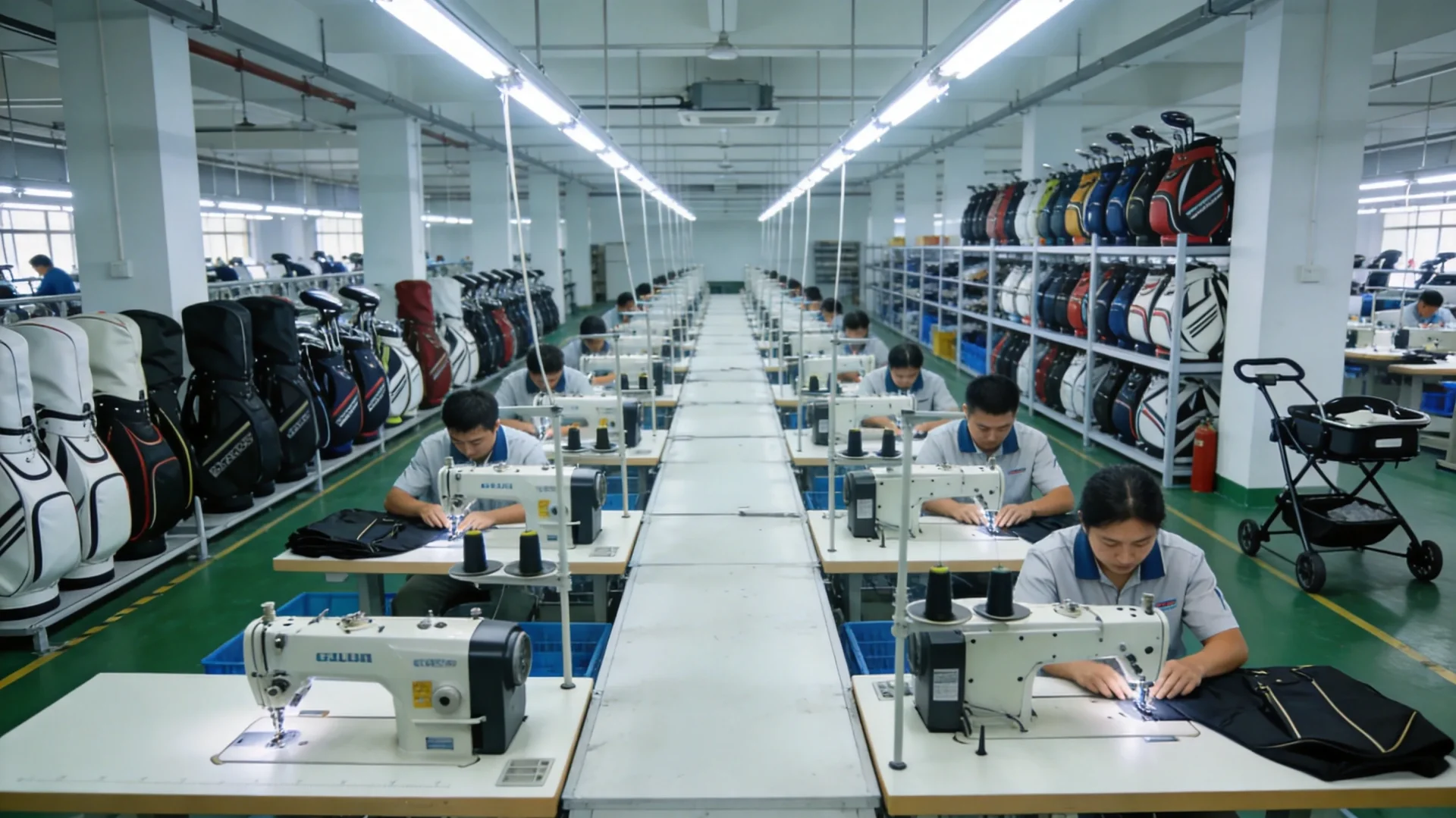
Junyuan was established in 2014, with a founding team whose bag-manufacturing experience goes back to 2004. Production runs through affiliated and partner factories in Fujian, which gives programs access to specialised lines — frame assembly, sublimation, embroidery — without every capability having to sit under one roof.
- R&D and prototyping — 3D prototype within 72 hours of receiving a complete spec; physical sample in 6–10 days.
- Material compliance — REACH and LFGB documentation available for specified fabrics on request.
- Small batch production — 200-piece minimum per style, which is what makes genuine customisation viable for mid-size brands and pro shop groups.
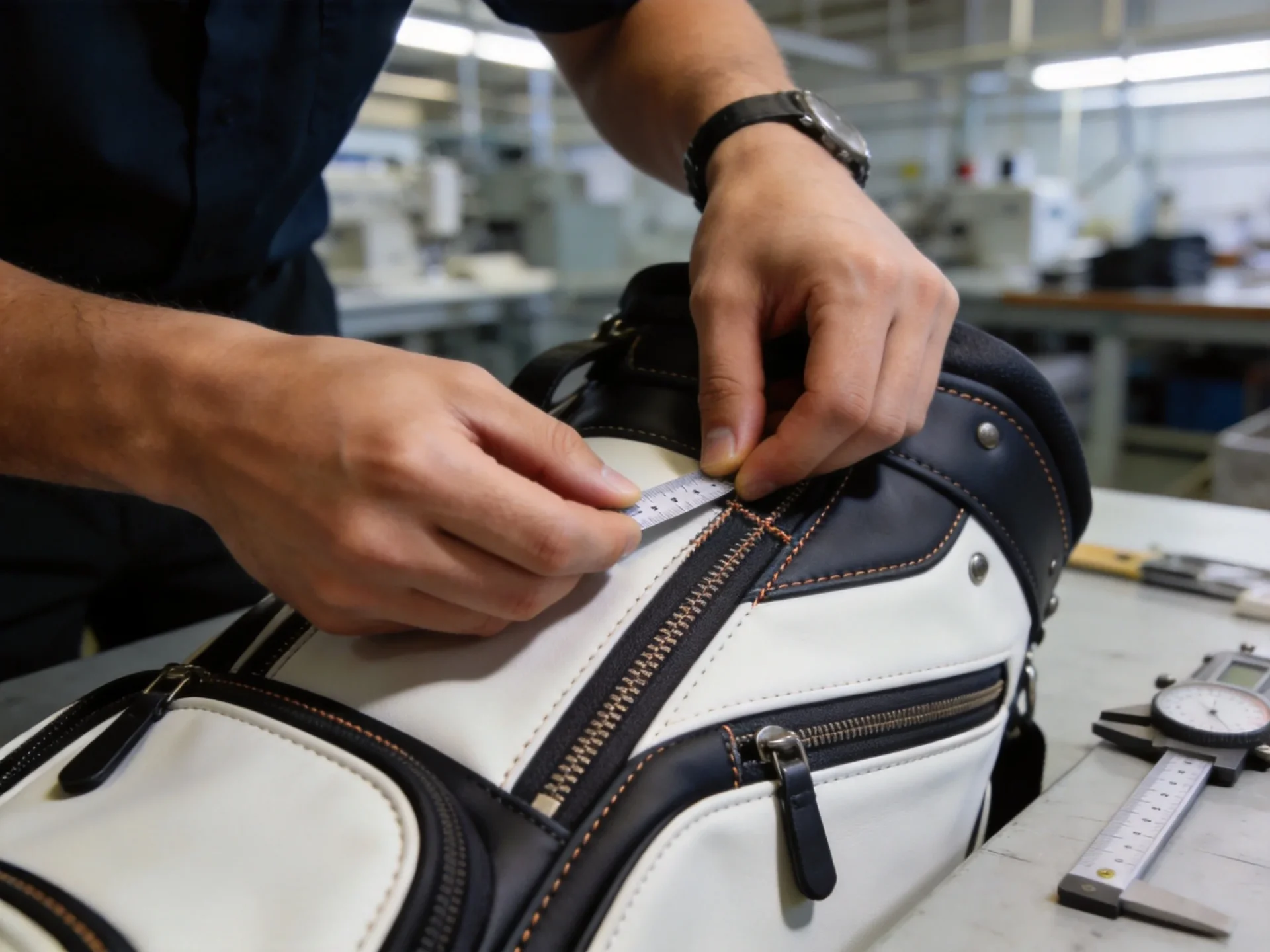
- Inspection — AQL-based pre-shipment inspection with photographic reporting, plus in-line checks at frame assembly and final packing.
If you are benchmarking suppliers across the region, our overview of golf bag manufacturers in China sets out how the main production clusters differ, and the custom golf staff bags line shows the same capability applied to a heavier, more structured silhouette.
Frequently Asked Questions
What is the minimum order quantity for custom golf stand bags?
200 pieces per style and colourway. This applies to full customisation including shell fabric, top configuration, colourway and decoration. Smaller trial quantities are possible only where an existing platform is used with decoration changes alone.
How long does sampling take?
6–10 days from confirmation of a complete specification, including fabric selection, top configuration and artwork. A 3D prototype can be produced within 72 hours if you need to validate proportions before committing to a physical sample.
How long is bulk production?
35–50 days after sample approval and receipt of deposit. Peak season (February to May) typically sits at the upper end of that range because sublimation and embroidery queues lengthen.
Can you match a specific Pantone colour?
Yes, to ±0.5 delta E for sublimation and embroidery. Fabric-dyed colourways have a wider tolerance because the dye lot depends on the mill run; we will confirm the achievable range before you approve the sample.
Do you manufacture in your own factory?
Production runs through affiliated and partner factories in Fujian that we have worked with for years. This structure lets a program access specialised lines — frame assembly, sublimation, embroidery — without every process sitting in a single facility, and we manage QC and delivery across the whole chain.
What are the payment terms?
Standard terms are a deposit on order confirmation with the balance due before shipment. Terms can be discussed for established repeat programs.
Which certifications can you supply?
REACH and LFGB documentation for specified materials, plus GRS chain-of-custody for recycled PET fabrics where the mill provides it. Tell us at enquiry stage which certificates your market requires — retrofitting compliance after production is significantly more expensive.
Can you ship a stand bag that is safe for air travel?
Yes. Stand bags designed for air travel need a removable or stowable rain hood, protected leg mechanisms and reinforced handles. Our guide to taking a golf bag on a plane covers the airline rules, and we can build the design requirements into the spec from the start.
Next Step
If you have a spec sheet, send it over and we will tell you where the tolerances are too loose to hold at production. If you do not have one yet, send the target retail price, the silhouette you want and your launch date — we will come back with a proposed BOM and a realistic timeline rather than a generic catalogue.
Email [email protected] with your requirements, or review the full custom golf stand bag manufacturing capability set first.