Yes — you can fly carry-on without fees and without cramming, as long as you understand two numbers: the airline’s linear-inch/centimetre carry-on limit and the weight cap, then size and pack your luggage to both. The most common oversize and overpacking mistakes come from ignoring that wheels and handles count toward the size limit, and from overloading a bag that just does not hold what you tried to force in. In this guide our OEM/ODM luggage team breaks down standard airline bag sizes and restrictions, shows you how to size a bag that boards free, and shares the packing method that ends overpacking for good. If you want custom, airline-ready luggage for your brand, our standard order begins at a MOQ of 500 pieces per style, with sampling in 6–10 days and bulk production in 35–50 days.
The Two Rules That Decide Your Luggage Size
When you ask “what size luggage can I take?” you are really asking two separate questions, and both matter:
- The size limit — how big the bag may be, measured in linear inches or in width×depth×height, and always including wheels and handles.
- The weight limit — how much the bag may weigh, typically 15–23 kg for carry-on and 23–32 kg for checked bags depending on the airline and fare class.
Most global carriers use a carry-on size close to 56×36×23 cm (about 22×14×9 in) with a 7–10 kg weight cap. If your bag fits that envelope at that weight, it boards free; if it exceeds either limit, you pay. That is why a suitcase with chunky spinner wheels or an extended handle can push a “22-inch” bag over the limit — the measurement is the whole bag, not the shell.
Standard Airline Bag Sizes & Restrictions at a Glance
| Bag type | Typical max size | Typical max weight |
|---|---|---|
| Carry-on (standard) | 56×36×23 cm / 115 cm linear | 7–10 kg |
| Personal item | ~40×30×20 cm | Depends on airline |
| Checked bag (standard) | 158 cm total linear (L+W+H) | 23–32 kg |
| Checked bag (heavy) | Often 203 cm linear max | Subject to surcharge |
Always confirm with the airline you fly, because low-cost carriers (Spirit, Ryanair, Allegiant and similar) often apply stricter limits and charge for any oversize carry-on. Measure your bag with handles and wheels extended, and weigh it before you go — a luggage scale costs far less than an at-the-gate fee.
How Overpacking Ruins Your Trip
Overpacking is the single biggest reason travellers get charged at the gate. When you stuff a bag past its intended capacity you do three things wrong at once:
- You push past the weight limit. Even if the size is fine, an overloaded bag can exceed the 7–10 kg carry-on cap on a budget airline.
- You burst the size envelope. Overstuffed fabric bags and expansion zippers can swell past the width limit, turning a free carry-on into a checked bag.
- You stress the bag and your back. Overloading strains zippers, handles and wheels, and means carrying more than you need on your shoulders.
The solution is not a bigger bag — airlines tend to charge more for bigger checked bags. The solution is packing to the bag’s real size. Choose a bag sized to your trip, not your entire wardrobe.
Best Luggage Sizing by Trip Type
Match your luggage size to how long and how heavy the trip is, and you avoid both overpacking and oversized-bag fees:
- Best for a quick weekend (top pick): a 35–45 L carry-on or duffel that fits the 56×36×23 cm envelope — light and free to board.
- Best for a week away: a 45–55 L checked standard suitcase within 158 cm linear.
- Best for family & bulk: a 60–70 L suitcase or large duffel, checked, packed under the line ’s weight cap.
- Best for business & laptops: a cabin carry-on with a padded tech compartment that stays under the personal-item or carry-on size.
When you buy in OEM, you can also spec a knock-down or compression design so the bag packs flat and boards within limits — the size is decided at sampling, not at the airport.
How to Stop Overpacking (The 3-Step Method)
- Set a limit by list, not by spare space. Write your packing list first, then choose the smallest bag that fits it; never buy a bigger bag “just in case” you add more.
- Compress instead of cram. Roll clothes and use packing cubes or compression to reduce volume, so a correctly sized bag holds the same things with room to spare.
- Weigh before you leave. Keep a small luggage scale or a home scale handy, and check total loaded weight against your airline’s limit before heading to the airport.
Follow these three steps and the overpacking problem mostly disappears — you carry less, you move faster and you rarely pay a single fee.
Size & Packing as an OEM Decision
For brands, luggage size is a specification decision, not just a travel convenience. Getting the size, weight and material right for your target user means a product that boards free, packs well and survives the airport. As an OEM/ODM luggage partner, we design panel patterns to standard carry-on and checked envelopes, grade wheels, handles and zippers to the expected load, and confirm every dimension and the loaded weight at sampling before bulk runs. Our standard MOQ is 500 pieces per style.
How Our Physical Size Standards Are Set
Why 500-piece MOQ? A dedicated luggage line, cutting fixtures and QC inspection become cost-efficient at a minimum batch, which is how we keep per-unit cost down while holding quality. What it is based on is more than a decade of running affiliated and partner luggage production lines for global brands, during which material yield, labour and inspection costs stabilise at this small-batch-to-scale order size. What it means for you: predictable cost, real sampling before commitment, and consistent, inspection-ready output at scale — inspected under AQL 2.5.
Designing Luggage That Respects Airline Rules
When we build custom luggage, we optimise for airline compliance first: external dimensions that hit the carry-on envelope, wheel housings and handles that do not add excess size, lightweight materials that keep loaded weight down, and trolley sleeves that secure the bag to carry-on wheels. The result is luggage that is easier for your customers to fly with — a real selling point for any travel brand.
Choose a Manufacturer Who Builds To Fly
for many years and working with long-time affiliated and partner factories, JUNYUAN Bags engineers custom luggage, carry-on spinners, trolley cases and travel duffels to real airline size and weight standards. We support custom dimensions, custom capacity, custom logo work (embroidery, heat transfer or woven labels), Pantone colour matching and TSA-compatible locks, all starting from a 500-piece-per-style MOQ with 6–10 day sampling and 35–50 day bulk lead times under AQL 2.5. Our workmanship is held to recognised standards including BSCI, ISO 9001, SGS and SEDEX, and orders ship protected by a 12-month warranty.
Designing custom luggage for your brand? Tell us your target route and user profile, and we will spec a size and pack style that boards free and packs well. Reach our team at [email protected] or on WhatsApp at +86 177 5002 0688.
FAQ: Luggage Size and Bag Restrictions
What is the standard luggage size for a carry-on?
Most global carriers allow a carry-on of about 56×36×23 cm (about 22×14×9 in), or up to 115 cm total linear size, with a 7–10 kg weight cap — always measured including wheels and handles.
Do wheels count in luggage size for airlines?
Yes. Airline size limits are measured on the full outer dimensions including wheels, handles and straps, so a bag with large spinner wheels can exceed the limit even if the shell is small.
What is the maximum weight for checked luggage?
Most full-service airlines allow 23–32 kg per checked bag, with heavier bags subject to surcharges; low-cost carriers often set lower caps of 15–20 kg.
How many linear inches is allowed for carry-on?
Standard carry-on size is about 45 linear inches (about 115 cm), worked out as length plus width plus depth, with wheels and handles included.
What happens if my luggage is slightly oversized?
The airline can charge an oversized-bag fee or require you to check the bag; at the gate this often costs more than checking it in advance.
Is 22 inches considered a carry-on?
Usually yes — a 22-inch-tall bag is the classic carry-on size — but confirm the full dimensions including wheels stay within your airline’s linear limit.
What size suitcase is best for a weekend trip?
A 35–45 L carry-on suitcase or duffel fits 2–3 days of clothes and boards free within standard carry-on limits.
What size suitcase do I need for a week away?
A 45–55 L checked suitcase within 158 cm linear size suits most one-week trips, leaving room to stay under the weight cap.
How do I avoid overpacking?
Write your list first, choose the smallest bag that fits it, roll clothes and use packing cubes for compression, and weigh your bag before leaving for the airport.
Do airlines charge for oversized carry-on on budget flights?
Yes — low-cost carriers often use stricter limits and charge overweight or oversize carry-on fees at the gate, so measuring and weighing first pays off.
Can I customise the size of my luggage in OEM?
Yes. As an OEM/ODM partner we cut panel patterns to your exact dimensions and confirm size and loaded weight at sampling, so you can order airline-ready luggage at the 500-piece MOQ.
What is the MOQ for custom luggage?
Our standard MOQ is 500 pieces per style. Order a sample first — the sample fee is refunded in full when you confirm the first bulk order.
What is the lead time for custom luggage?
Sampling takes 6–10 days and bulk production runs 35–50 days after sample approval, under AQL 2.5 inspection.
What is the warranty on custom luggage?
Our production partners cover manufacturing defects for 12 months from shipment, subject to the terms agreed on your OEM order.
What is the best size suitcase for airline travel?
A 56×36×23 cm carry-on for short trips and a 158 cm-linear checked bag for longer ones — the best size is the smallest one that fits your route and load.
Related guides: Custom Luggage & Travel Bags · Everything About Airline Carry-on Size · Best Travel Duffels for Airlines · Custom Bag Dimension Planner

— Sizing your luggage to board free —

— Knowing airline bag fees —
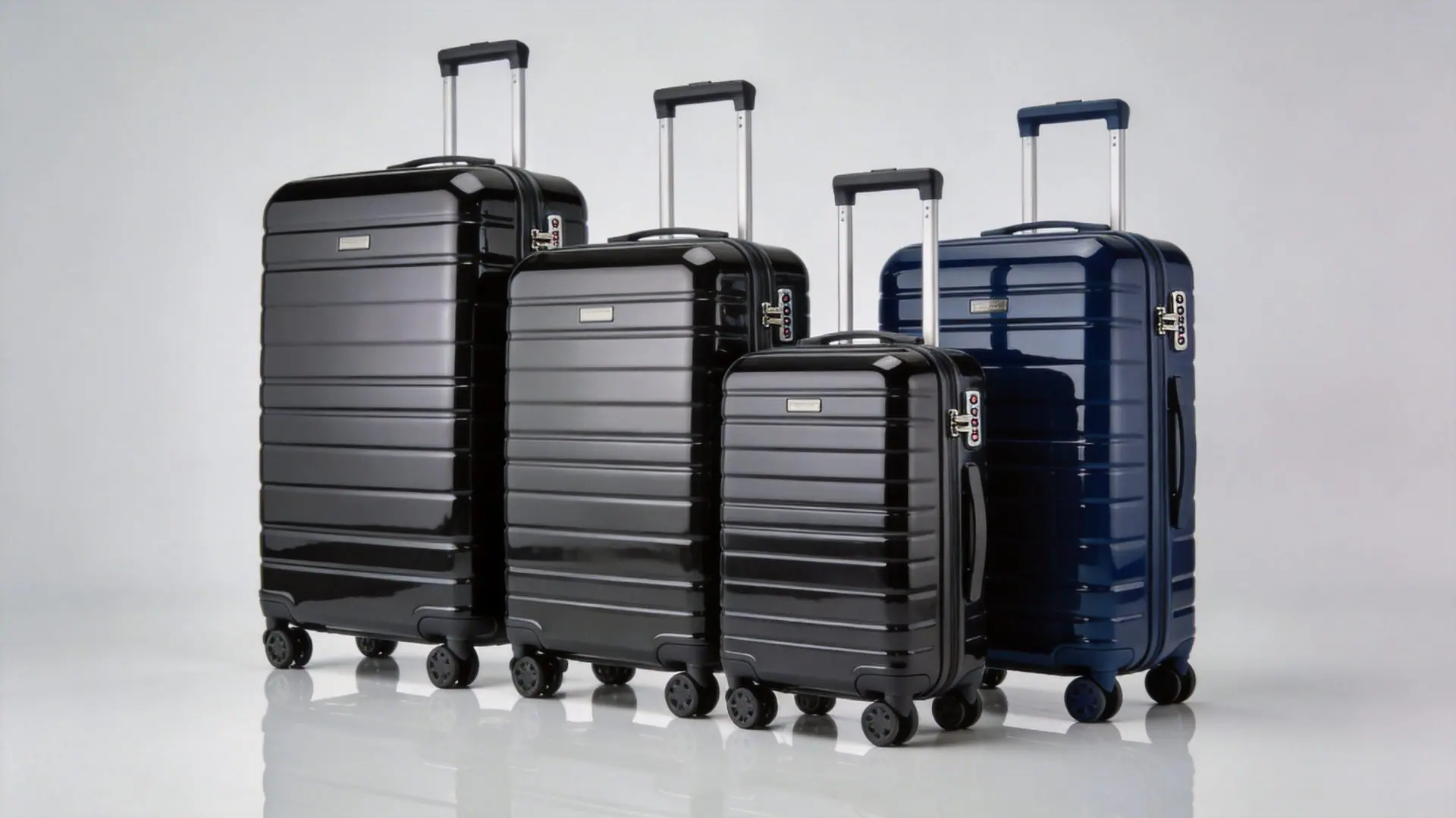
— Our hard-shell luggage collection by JUNYUAN Bags —