
The best way to choose a leather bag for your brand is to fix three decisions before you compare any supplier: the leather grade, the bag type, and the quality threshold you will inspect against. Set those first and you can shortlist a custom leather bag manufacturer in a single sourcing round. At JUNYUAN Bags (established 2014), a custom leather bag program typically starts at a MOQ of 500 pcs, sampling takes 6–10 days, bulk production runs 35–50 days, every shipment is inspected to an AQL 2.5 level, and finished bags carry a 12-month warranty.
Leather Grades: What Determines How Long a Bag Lasts
Leather is graded by which layer of the hide it comes from and how much the surface is sanded or refinished. This single decision drives roughly half the price and nearly all of the durability, so it is the first spec your buying guide should lock down. The standard industry ladder runs from full-grain (best) down to bonded and PU (synthetic).
| Grade | Surface | Durability | Aging / Patina | Typical position |
|---|---|---|---|---|
| Full-grain | Original grain, untouched | Highest | Darkens & burnishes through the grain | Premium |
| Top-grain | Top 0.1–0.3 mm sanded, refinished | High | Mostly sealed; wears, less colour change | Mid–high |
| Genuine (split) | Lower layer, often finished | Medium | Limited, prone to peeling | Budget |
| Bonded | Reconstituted scraps glued | Low | Short lifespan | Lowest-cost |
| PU / vegan leather | Polyurethane coated fabric | Varies | No natural patina; coating can crack | Affordable |
Full-grain leather keeps the strongest, tightest fibre layer, which is why it outlasts the alternatives and develops a patina. Top-grain is the smoother, more uniform everyday choice for professional bags. Independent tanner-grade references describe the same ladder — for example, tanner-supplier guides on how leather is graded group full-grain and top-grain at the top of the hide, and note that the difference in retail is usually a finishing step, not the layer itself (Leather grades explained — Galen Leather). For B2B buyers, put the grade in writing on the spec sheet; never rely on the label “genuine leather” alone.


Which Leather Bag Types to Source (and Sizing)
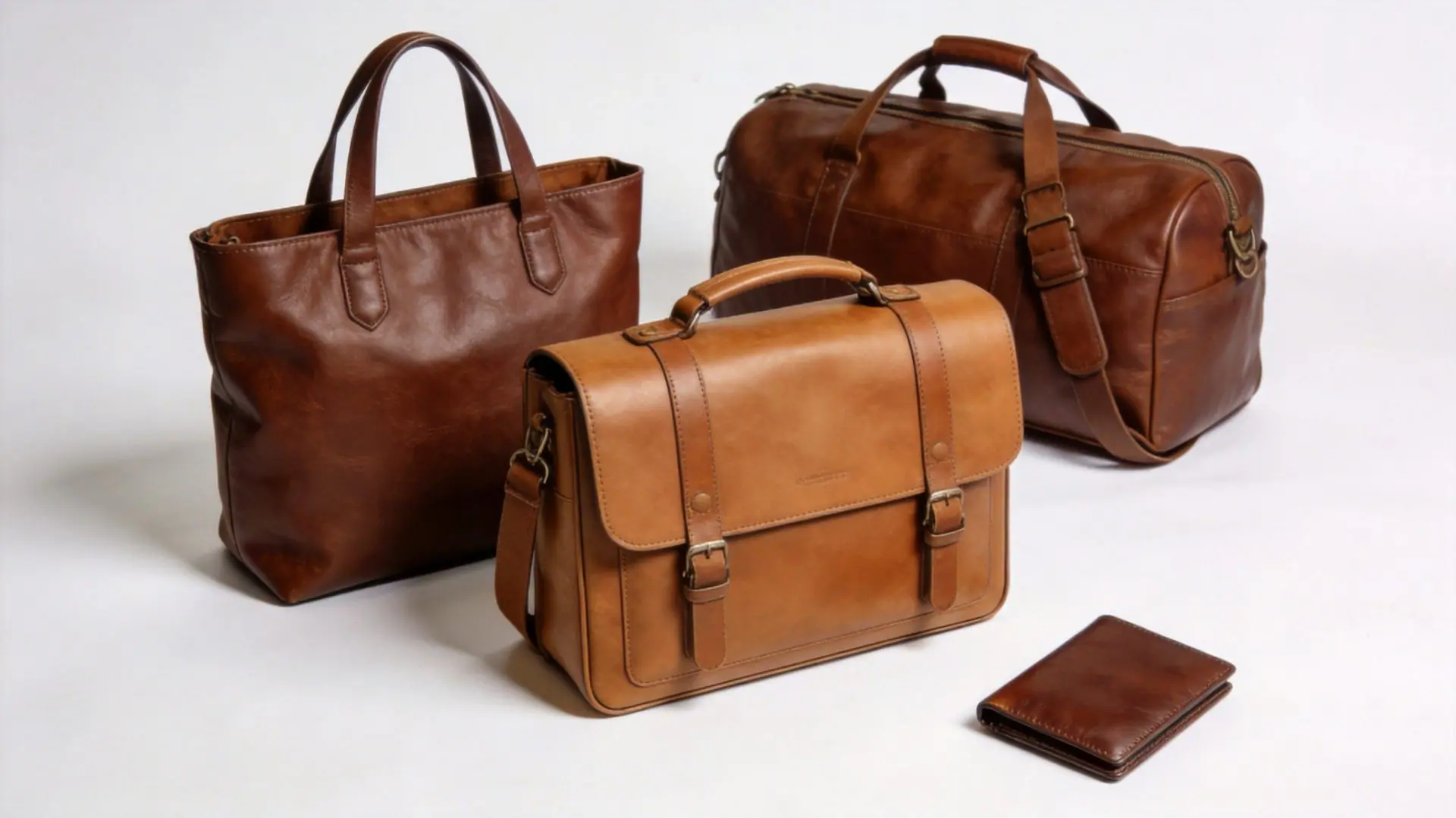
Match the bag type to your market and the daily carry load. Leave the load-out weight and dimension to the buyer, but confirm the outer dimensions and the type before quoting. The five most common OEM leather programs are:
- Tote bag — open-top, office and shopping; typical 36–42 cm width.
- Backpack — padded laptop sleeve, 28–42 L class.
- Duffle / weekender — travel, 35–60 L.
- Briefcase / laptop folio — padded 13–16 in compartment.
- Crossbody / shoulder — compact, one-hand access.
Specify the leather grade, lining, hardware finish, and carry handle type on the same sheet so the sample lab and the QC line read from one source of truth.
A Practical Leather Bag Inspection Checklist
Use the same checklist a QC inspector would, so you and the factory agree on pass/fail before production. Run it on the sample and again at bulk inspection.
- Stitching: even, consistent 8–12 stitches per inch; double stitching at handles and corners; no loose threads or glue-only seams.
- Hardware: solid metal zipper teeth and clasps (not plastic-coated); zippers glide without catching; D-rings hold firm.
- Lining & edge finishing: durable lining, smooth or painted edges — raw edges fray quickly.
- Structure: set the bag on a flat surface; it should hold its shape empty and full.
- Strap & weight: straps distribute weight, don’t slip; a quality leather bag feels substantial but not over-heavy.

Leather vs. PU: What to Tell Your Customer
Your customer cares about price and durability, so prepare one plain comparison. Real full-grain leather can last decades with care but carries a premium; PU is affordable and water-resistant but has no natural patina and the coating can crack over years of flexing. Industry B2B material comparisons put top-grain as the balanced pick for professional bags and full-grain for premium lines (Leather vs. nylon vs. canvas for B2B buyers — Alibaba Seller). Offer both lines so buyers self-select by budget.
Leather Finishes, Care, and Packaging
Understand the surface finish before you order, because it changes how the bag looks and how your buyer should care for it. Aniline leather is dyed through with no coating, so it shows the natural grain and ages into a rich patina, but it absorbs stains more easily. Semi-aniline adds a thin protective layer while keeping most of the natural feel. Pigmented leather carries an opaque coating, so it is the most uniform and easiest to clean, but it hides natural markings and develops wear rather than patina. Tell your buyer three simple care points: keep the bag out of prolonged direct sun, condition it every few months, and test any cleaner on an inside seam first. For private-label programs, a branded dust bag and silica sachet in each shipping carton protect the finish in transit and lift the unboxing experience — a small detail that improves perceived value far more than its cost.
What to Send in Your First Leather Bag RFQ
To get an accurate quote in one round instead of two, send five numbers on the first request: (1) the leather grade — full-grain, top-grain, or PU; (2) the bag type and outer dimensions; (3) the quantity and your MOQ intention; (4) the hardware finish you want, such as zinc-alloy, antique brass, or gunmetal; and (5) your target price and the market you sell into. Factories price full-grain hand-stitched work very differently from machine-sewn top-grain, and 500 pcs very differently from 2,000 pcs, so the gap between asking for “custom leather bags” and sending a precise spec can be 30–50% on unit cost.
Lead Time and Pricing Levers for Custom Leather Bags
Three factors move leather bag cost and lead time more than anything else. The leather grade is the largest cost driver — full-grain commands a clear premium over top-grain, while PU sits far lower — followed by hardware and construction complexity. Quantity drives unit price through the MOQ band. Lead time stretches when you combine a new grade, a new pattern, and a new hardware finish, because the factory must set up a fresh cutting, stitching, and finishing line. Season and tanning also matter: vegetable-tanned (veg-tan) leather is more eco-positioned and ages with a warm patina, but it takes longer to source and cures than chrome-tanned leather, which is faster and more colour-stable. Plan a 6–10 day sampling window and 35–50 days of bulk production, and keep your spec frozen through the sampling round so the line is not reset.
The JUNYUAN Custom Leather Bag Program (MOQ, Timeline, QC)
Our OEM/ODM workflow is designed to take you from spec sheet to bulk shipment in one controlled loop. Every custom leather bag project follows the same milestones, with the same factory-owned data points.
| Milestone | JUNYUAN standard |
|---|---|
| MOQ | 500 pcs (per style) |
| Sampling | 6–10 days, sample fee refunded on first bulk order |
| Bulk production | 35–50 days |
| Inspection level | AQL 2.5 |
| Warranty | 12 months on workmanship |
| Factory | Affiliated production partners, since 2014 |
We also support factory audit visits before order confirmation so you can see the sewing line and QC checks in person. From briefing and sampling through bulk production, the whole program runs through our custom leather bag manufacturing guide and can be quoted through our OEM/ODM service. If you are still comparing a partner, see our factory audit checklist and the custom bag manufacturer overview. For other styles in the same leather program, browse custom duffle bags and start a project on our custom leather bags page.
The Bottom Line for B2B Leather Bag Buyers
Before you sign the purchase order, read the spec back as three lines: the leather grade, the bag type and size, and the inspection level. If they match the sample you approved, freeze the spec and keep it unchanged through sampling and bulk runs. One clear spec, one sample round, and one AQL 2.5 inspection is the lowest-risk path to a repeatable leather bag program — and it is exactly how JUNYUAN Bags has shipped OEM/ODM bags since 2014. Start with a 500 pcs pilot order to qualify your supplier before scaling to a larger private-label run, and keep the same grade and QC threshold in the scale-up.
Leather Bag Buying FAQ
Q1: Which leather grade is best for a bag?
Full-grain is the most durable and develops the best patina; top-grain is the smoother, more uniform everyday pick. For most professional bags, top-grain is the balanced default; choose full-grain for premium positioning and long service life.
Q2: What is the difference between full-grain and top-grain leather?
Both come from the top layer of the hide. Full-grain keeps the original surface untouched, so it is stronger and ages with a patina; top-grain has the top 0.1–0.3 mm sanded and refinished for a uniform look, trading a little durability for consistency.
Q3: What is the MOQ for custom leather bags?
At JUNYUAN Bags a standard custom leather bag order starts at 500 pcs per style. Lower quantities are possible for sampling, but 500 pcs is the repeatable bulk threshold that keeps unit cost and lead time stable.
Q4: How long does leather bag sampling take?
Standard sampling takes 6–10 days. The sample fee is refunded when the sample leads to a first bulk order.
Q5: How long does bulk production take?
Bulk production typically runs 35–50 days depending on style, leather type, and quantity. The exact slot is confirmed in your production plan after sampling.
Q6: What quality standard do you inspect against?
Every bulk shipment is checked to an AQL 2.5 inspection level, with random sampling and pass/fail recorded per defect class.
Q7: How do I verify a leather bag supplier?
Ask for a written grade spec, request a sample, and run a factory audit or video audit. At JUNYUAN we support on-site audits before order confirmation so you can see the sewing line and QC process.
Q8: Which leather bag types can be OEM/ODM customised?
Totes, backpacks, duffle/weekenders, briefcases and laptop folios, and crossbody or shoulder bags — all can be built with your branding and custom dimensions, materials, and hardware.
Q9: How do I estimate the cost of a custom leather bag?
Cost is driven by leather grade, bag type and size, hardware quality, and order quantity. Lock the grade and type first, then the factory quotes per MOQ band; higher grades and full-grain push price up, larger order sizes bring unit cost down.
Q10: What hardware should a durable leather bag use?
Solid metal zippers, clasps, and D-rings — not plastic-coated parts. Test that zippers glide without catching and clasps close with positive resistance.
Q11: Is PU / vegan leather a good replacement for genuine leather?
As a budget option, yes: PU is affordable, water-resistant, and consistent in colour. But it has no natural patina and its coating can crack with age. Offer both lines so buyers choose by price point.
Q12: How do I protect my design when sourcing?
Keep the ask surgical: request an NDA, share technical specs rather than full artwork, and confirm the factory will not re-list your design without permission. Put grade, hardware, and QC in the written spec so the sample line builds to your intent.
Q13: What stitching should I check on a leather bag?
Look for even, consistent stitching at 8–12 stitches per inch, double stitching at handles and corners, and no loose threads or glue-only seams. Pull gently at the corners — quality stitching should not loosen.
Q14: Do you provide samples and a warranty?
Yes. We provide samples (6–10 days) with the fee refunded on first bulk order, and finished bags carry a 12-month warranty on workmanship. Since 2014 we have shipped OEM/ODM bags under the KEEP PERFECT brand standard.