Here is the short answer for buyers sourcing for the 2026 back-to-school season: bulk school backpacks for K-12 and college typically run 20–35 liters in capacity, use 600D polyester or recycled rPET fabric, and land at roughly FOB US $3.50–$9.00 per unit at a 200-piece minimum order quantity (MOQ) from a Chinese OEM factory. Private-label and district programs that need custom colors, woven labels, embroidered logos and retail packaging should place a confirmed purchase order 3–4 months before August delivery — late March to early April for FCL ocean freight — because pre-production samples take 6–10 working days and mass production runs 35–50 working days. Stock wholesale orders placed with an existing factory program can ship in 2–4 weeks.
This guide is written from the factory floor, not the retail shelf. It is for school districts and charter networks buying uniform or spirit packs, wholesalers and importers stocking back-to-school programs, Amazon and retail sellers building their own brands, and corporate or institutional buyers ordering logo backpacks as giveaways. We explain grade-by-grade specifications, compliance documentation, logo decoration options, the wholesale-versus-private-label decision, and the exact ordering timeline. To put the market size in perspective: the National Retail Federation projects record 2026 K-12 back-to-school spending of $43.3 billion, with another $103.5 billion for college students, and NCES counts roughly 49.6 million students in U.S. public elementary and secondary schools — a large, recurring annual order base.
Which School Backpack Types Sell, by Grade Level?
A “school backpack” is not one product. A second-grader and a college freshman carry completely different loads, and the spec sheet should reflect that. Most of the popular campus silhouettes on retail shelves — the classic 28L everyday daypack, the padded laptop commuter pack, the wheeled rolling bag for heavy textbooks — are all routinely produced at OEM scale; buyers looking at reference styles can compare specs against common campus models such as this campus daypack spec benchmark or this value-tier school pack comparison, then brief the factory on capacity, fabric and features rather than branding.
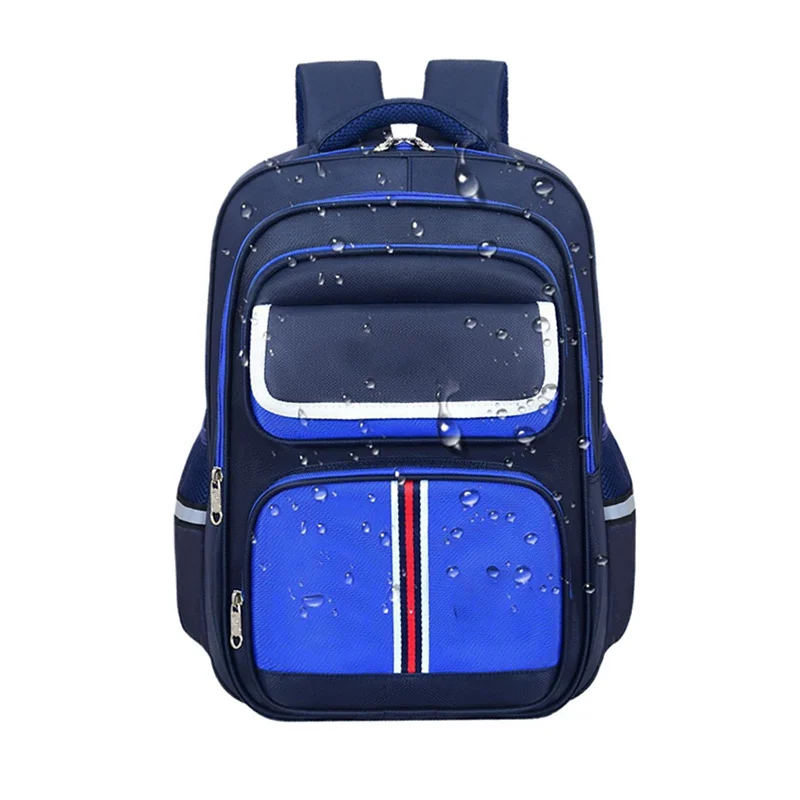
- Elementary (K–5): 15–22L, lighter and shorter torso fit (bag height around 38–42 cm), bright colors or character-friendly panels, two-way reflective trim for walkers, chest strap, easy-pull zipper pulls sized for small hands, and name-tag or ID-window pockets.
- Middle school (6–8): 22–28L, water-bottle side pockets, organizer panel for pens and passes, headphones port or cable routing on some programs, and tougher 600D construction.
- High school (9–12): 28–35L with a padded 15.6-inch laptop or Chromebook sleeve, padded back panel, sternum strap, and enough structure for a full day of binders, a device and sports kit.
- College / university: 30–40L commuter or laptop-first designs, 15.6–17 inch padded compartments with Velcro or elastic device strap, USB charging port options, trolley (luggage) strap for travel, and more mature color stories.
- Promotional / institutional giveaways: 15–25L basic 600D daypacks optimized for logo visibility and unit cost — orientation kits, corporate back-to-school events, non-profit distribution.
Three specialty programs are worth including in any range plan. Rolling backpacks with inline-skate wheels and a telescopic handle sell well to elementary and middle grades with heavy textbook loads — though note they are not ideal on stairs, a point many districts flag. Clear or transparent backpacks remain a repeat order for security-conscious school policies. Backpack-plus-lunch-bag combos (matching insulated lunch tote, sometimes a pencil case) lift average order value in retail bundles and are straightforward to produce in one fabric program.
The table below summarizes the typical grade-level programs our lines quote every season. FOB figures are indicative ex-factory prices before freight, duty and decoration; your final quote depends on fabric grade, hardware, logo method, packaging and order volume. Request an itemized quote for your exact spec.
| Grade / Program | Capacity | Typical Fabric | Key Features | FOB Price Range | Typical MOQ | Common Use |
|---|---|---|---|---|---|---|
| Elementary K–5 | 15–22L | 600D polyester / 300D with PU coating | Reflective trim, chest strap, ID window | $3.50–$5.50 | 200 pcs | District packs, elementary programs |
| Middle school | 22–28L | 600D polyester or rPET | Organizer panel, bottle pockets | $4.20–$6.50 | 200–300 pcs | Wholesale, retail basics |
| High school | 28–35L | 600D/900D polyester, rPET options | 15.6″ laptop sleeve, padded back | $5.50–$8.00 | 200 pcs | Private label, retail mid-tier |
| College / commuter | 30–40L | 900D/heathered polyester, rPET | USB port, trolley strap, 17″ sleeve | $6.50–$9.00 | 200–500 pcs | Bookstore, e-commerce brands |
| Promotional giveaway | 15–25L | 600D polyester | Large logo area, simple construction | $3.50–$5.00 | 200 pcs | Corporate, events, donations |
What actually moves the unit price? From our quoting desk, the five biggest levers are: (1) fabric grade and backing — 900D and rPET cost more per yard than standard 600D; (2) logo decoration — embroidery and rubber patches cost more per unit than screen print, with setup amortized over quantity; (3) hardware — branded zippers, magnetic buckles and metal hooks versus standard plastic; (4) construction complexity — every extra pocket, sleeve or USB port adds sewing minutes; and (5) packaging and labeling — retail boxes and individual poly bags add cost but are required for shelf-ready programs. Order volume then scales everything: a 3,000-piece program commonly lands 10–20% below a 200-piece trial of the same design.
What Specs Matter Most on a Bulk School Backpack Order?
When you buy for hundreds or thousands of students, per-unit failures multiply. These are the construction points our merchandisers lock into every spec sheet before sampling.
- Capacity and dimensions: Always specify liter volume and dimensions in centimeters. For K-5 packs, torso length matters more than volume; a bag that hangs more than about 10 cm below the waist pulls on the shoulders.
- Ergonomic carry system: Padded, contoured shoulder straps at least 6–7 cm wide, breathable padded back panel, adjustable sternum strap (standard on youth programs), and optional waist belt on larger sizes. Pediatric guidance widely cited by the American Academy of Pediatrics advises that a child’s loaded backpack should not exceed roughly 10–15% of body weight — a lightweight empty bag (under ~0.6 kg for youth sizes) leaves more safe load margin for books.
- Laptop/device protection: High school and college programs should specify a padded sleeve with size callout (14″, 15.6″ or 17″), an elastic or Velcro device strap, and a bottom that keeps the device off the floor.
- Reflective safety: Reflective piping or printed reflective strips on the front and both sides are a frequent district requirement for students walking or biking in low light.
- Zippers and hardware: Branded or graded nylon coil zippers (e.g., YKK or approved equivalent), zipper pulls that survive 5,000+ cycles in pull testing, and reinforced stress points at strap anchors and handle.
- Durability testing: Ask for results or witness testing for strap pull strength, zipper cycle life, drop testing, colorfastness (rubbing/washing), and a loaded shake test. Factories with structured OEM/ODM processes run these in-line rather than at final inspection only.

Materials and Safety Compliance: What Districts and Importers Should Verify
Fabric. The workhorse of school bags is 600D polyester with PU or PVC backing for water resistance and shape. Premium and college programs step up to 900D polyester, heathered poly, or coated nylon for a softer hand and better durability. Sustainability-minded programs increasingly specify recycled polyester (rPET) spun from post-consumer plastic bottles; it is one of the fastest-growing material stories in the industry — Grand View Research projects the recycled polyester market to reach US$26.18 billion by 2030, growing at a 9.25% CAGR. rPET school bags perform comparably to virgin polyester and let districts and brands publish a recycled-content claim; ask for GRS (Global Recycled Standard) certification for the fabric if you intend to market recycled content.
Chemical and children’s-product compliance. Backpacks marketed for children 12 or younger fall under U.S. children’s product rules. Under CPSIA, accessible component parts must meet total lead limits (100 ppm), surface coating lead limits (90 ppm), and regulated phthalates must not exceed 0.1% (1,000 ppm) in accessible plasticized parts; children’s products also require third-party testing and a Children’s Product Certificate. The CPSC publishes the phthalates limits and CPSIA section 108 reference here. For EU programs, request REACH SVHC and RoHS declarations; California buyers may additionally need Prop 65 language.
Audits and certifications. For district and large-retail vendor onboarding, expect to provide factory social-compliance and quality-system documentation. JUNYUAN BAGS holds BSCI, ISO 9001 and SGS audit/testing credentials, and can arrange SGS or Intertek third-party inspection on your PO if required.

Customization Options for Branded and Private-Label School Bags
Decoration and trim are where a wholesale pack becomes your product. Choose logo method by order size, fabric and budget:
- Screen printing — lowest cost for large, simple 1–3 color logos; ideal for promotional giveaways and district wordmarks.
- Embroidery — premium, durable look for high school/college bookstore and retail packs; priced per stitch count.
- Rubber/PVC patches and woven labels — raised 3D logos, leather-look or TPU patches; popular on private-label mid-tier lines.
- Heat transfer / sublimation — full-color photographic and all-over prints on light fabrics; good for youth character themes and fashion programs.
Beyond the logo, factories can customize fabric color by Pantone code, lining color and print, zipper tape and pull color, webbing and stitching, plus hang tags, woven neck labels, printed poly bags, insert cards, and retail-ready packaging including FNSKU/FBA labeling for Amazon sellers. Small details — zipper garages, padded top handles, key clips, dedicated water-bottle pockets — are the differentiators buyers test on samples. Browse the full decoration toolkit on our custom backpack manufacturer page.

Wholesale Stock vs Private Label: Which Model Fits Your Business?
Wholesale / stock programs
Buy existing factory designs with a logo print only. Lower cost, faster lead time (2–4 weeks when stock fabric is available), lower risk. Best for event giveaways, donation drives, first-time importers and price-sensitive retail. Your margin per unit is smaller because the design is not exclusive.
Private label / OEM & ODM
Customize design, fabrics, colors, hardware, labels and packaging under your own trademark. Higher margin and brand equity, repeat ordering, and protection from direct price comparison. Requires design approval, pre-production samples and the 35–50 working day production window — so it must be planned months ahead. Start with our OEM/ODM service overview.
Many buyers run a hybrid: a private-label hero SKU in two colors for margin, plus a stocked basic daypack for value traffic. If you are benchmarking against mainstream retail lines, spec comparisons for premium commuter packs and the wider China factory landscape can help you position price and features.
How to Order School Backpacks from a China Factory: Step by Step
- Brief and RFQ: Send target grade, capacity, fabric, logo artwork (AI/vector files), quantity, destination port and compliance needs. We quote within 1–2 business days.
- Sampling: Pre-production or custom samples are ready in 6–10 working days; sample fees are refunded against your first bulk order once it meets the agreed threshold. Approve fit, colors, stitching and logo in hand.
- Order confirmation: Sign PI, pay deposit (typically 30% T/T), and lock the production schedule — critical for back-to-school windows.
- Mass production: 35–50 working days, covering material cutting, printing/embroidery, sewing, assembly and packing. In-line QC checks run at cutting, printing and assembly stations.
- Quality control: Final AQL inspection (commonly AQL 2.5) plus optional third-party SGS/BV inspection; fabric test reports and CPC documentation issued as required.
- Shipment: Balance payment, then FCL/LCL ocean freight (FOB Xiamen) or air/express for small urgent orders. We support door-to-door freight forwarding quotes and Amazon FBA delivery.
Two practical notes on logistics. Carton packing for school bags is typically 30–50 pieces per export carton depending on size and whether bags ship with stuffing; ask your merchandiser for the per-carton measurements and gross weight early, since that drives CBM and freight cost — a 20GP container holds roughly 8,000–12,000 standard daypacks. Inspection standards should be agreed on the PI: most retail and district programs use AQL 2.5 for major defects, with random carton pulls at final packing. If you book a third-party inspector, schedule them while goods are still 80% packed so any issues can be corrected before container loading.

Back-to-School Sourcing Timeline: When Must You Order?
Retail shelves and district distribution centers need product on hand from late June through August. Working backward from an August delivery with ~30–45 days of ocean freight plus customs:
- January–February: Finalize designs, collect quotes, order samples for private-label lines.
- March: Approve samples and place the deposit for full custom programs (latest safe date for FCL).
- April: Mass production in progress; confirm packaging, labeling and freight bookings.
- May–June: QC, balance payment, container loading, ocean transit.
- July: Goods arrive at destination warehouses; restocking and promotional wholesale orders can still ship via LCL or air for urgent demand.
NRF data shows shoppers themselves now start early — 62% of back-to-school shoppers had begun by early July in 2026. Retail programs that miss the June warehousing window lose the highest-traffic selling weeks.
RFQ Checklist: Send This to Your Supplier
- Target user: grade level / age range / promotional vs retail
- Capacity (liters) and dimensions (cm), weight target
- Fabric: 600D/900D/rPET, backing type, Pantone colors
- Features: laptop sleeve size, USB port, reflective trim, chest/waist straps, bottle pockets
- Logo: method (print/embroidery/patch), size, positions, vector artwork
- Labels and packaging: hang tags, woven labels, poly bags, carton marks, FNSKU
- Compliance: CPSIA/CPC, CPSIA lead & phthalate test reports, REACH/RoHS, Prop 65, GRS for rPET
- Order quantity and target FOB price, destination port, incoterm, required delivery date
- Inspection: AQL standard, third-party inspection requirement
Ready-made wholesale programs can skip the design phases, but every one of these points still belongs in writing on the PI.

Why Source School Backpacks from JUNYUAN BAGS?
JUNYUAN BAGS (registered trademark KEEP PERFECT) is a Quanzhou, Fujian-based bag manufacturer established in 2014 — 12+ years of manufacturing experience focused on backpacks, golf bags and travel bags. Our scale and credentials for bulk and private-label programs:
- 4,950 sqm factory campus with cutting, printing/embroidery, sewing and packing lines under one roof
- 200,000 pieces monthly production capacity — comfortable for district-wide and retail-chain volumes with on-time delivery
- Trusted by 200+ brands, exporting to 100+ countries
- BSCI, ISO 9001 and SGS certified; CPSIA/REACH test documentation and third-party inspection available
- MOQ from 200 pieces for custom orders; samples in 6–10 working days with sample fee refunded on the first bulk order; mass production 35–50 working days
- One-stop OEM/ODM: design, sampling, decoration, packaging, freight — see our full backpack product range, and for sports-adjacent programs our custom golf bag line shows the same engineering depth
Whether you are outfitting a school district, stocking a wholesale channel, or launching your own backpack brand, the first step is the same: send your spec list and get itemized FOB pricing. Request a quote or reach us directly at [email protected] / WhatsApp +86 17750020688. Prefer to talk it through? Use the contact page and our merchandising team will respond within one business day.
Frequently Asked Questions
What is the typical price for bulk school backpacks?
At factory-direct FOB terms, bulk school backpacks generally run US $3.50–$9.00 per unit for orders of 200+ pieces. Simple 600D promotional daypacks for younger students sit at $3.50–$5.50, mid-tier high school packs with laptop sleeves land around $5.50–$8.00, and feature-rich college commuter packs with USB ports and premium fabric reach $6.50–$9.00. Prices move with fabric choice, logo method, hardware, packaging and order volume, and exclude ocean freight and import duty. Always request an itemized quote rather than comparing unit prices across different specs.
What is the minimum order quantity for custom school backpacks?
At JUNYUAN BAGS, the MOQ for custom school backpacks is 200 pieces per style, which is accessible for district pilot programs, independent retail brands and first-time importers alike. Stock wholesale designs with logo printing only can sometimes ship in smaller batches when fabric is on hand. Larger orders unlock tiered pricing on fabric, decoration and freight, so buyers planning a full back-to-school program typically order 500–2,000+ pieces across two or three colors. Tell us your quantity target and we will indicate the volume break points up front.
How long does production and delivery take?
Pre-production or custom samples take 6–10 working days, and mass production runs 35–50 working days after the deposit and sample approval. Ocean freight from China adds roughly 30–45 days plus customs clearance, while LCL or air express is faster for urgent top-ups. For August back-to-school delivery, private-label buyers should confirm orders by late March to early April. Stock wholesale orders placed against existing factory programs can ship within 2–4 weeks. Booking freight early in the May–July peak window avoids container-space delays.
Can I order school backpacks with my own brand label and logo?
Yes — private label and OEM are our core service. You can supply your own design or work from our ODM templates, then customize fabric colors by Pantone, lining, zippers, webbing and hardware. Logo decoration options include screen printing, embroidery, rubber/PVC patches, woven labels and heat-transfer or sublimation prints. We also produce woven neck labels, hang tags, custom packaging and FNSKU labels for Amazon FBA. Your trademarks and designs are treated as confidential, and we do not reuse customer-exclusive patterns for other buyers.
What safety certifications do school backpacks need for the U.S. and EU?
For the U.S., backpacks intended for children 12 or younger are children’s products under CPSIA: accessible parts must meet the 100 ppm total lead limit, 90 ppm lead-in-surface-coatings limit, and 0.1% limits on regulated phthalates, with third-party testing and a Children’s Product Certificate. For the EU, request REACH SVHC declarations and RoHS compliance; California buyers may need Prop 65 wording. JUNYUAN BAGS holds BSCI, ISO 9001 and SGS credentials and can supply test reports or arrange SGS/Intertek inspection on your PO. rPET lines can additionally be supplied with GRS certification for recycled-content claims.
Are recycled rPET school backpacks more expensive than regular polyester?
rPET fabric typically costs slightly more per yard than virgin polyester, but the gap has narrowed as recycled polyester spinning capacity has scaled, and on a finished bag the premium is often only a few percent of FOB price — frequently absorbed at higher order volumes. rPET packs meet the same durability standards as 600D/900D polyester and give districts and brands a genuine sustainability story for parents and students. If you plan to market recycled content, ask for GRS-certified fabric so the claim is auditable. Grand View Research projects the recycled polyester market will reach US$26.18 billion by 2030, reflecting how mainstream the material has become.
Do you provide samples before bulk ordering, and is the sample fee refundable?
Yes. We produce pre-production or custom samples in 6–10 working days so you can approve fabric hand, construction, dimensions, colors and logo decoration in person before committing to mass production. The sample fee is refunded against your first bulk order once it reaches the agreed order threshold, which effectively makes sampling free for buyers who proceed. We recommend ordering samples of any top-two candidate styles, since fit and stitch quality are hard to judge from photos and protect against costly bulk mistakes.