
Camera Bag OEM/ODM: Protective Systems, Weatherproofing & Configurations (2026)
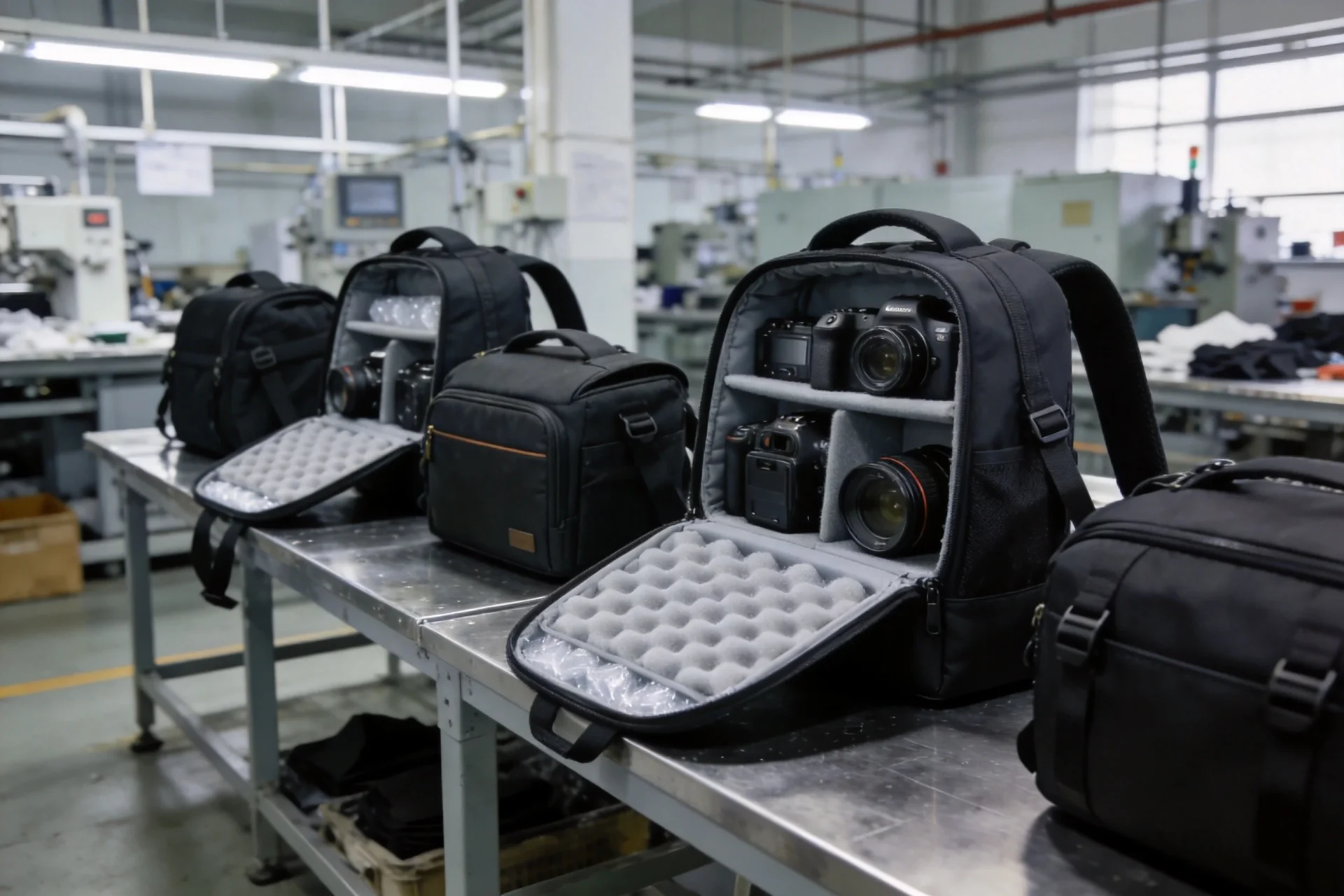
JUNYUAN BAGS camera bag production facility in Quanzhou, Fujian — OEM/ODM solutions for leading camera brands worldwide
The camera bag market has undergone a dramatic transformation as mirrorless systems, drone technology, and computational photography reshape what photographers carry in the field. For brands targeting this evolving landscape, partnering with an experienced OEM/ODM bag manufacturer who understands the unique engineering requirements of camera equipment protection is essential.
As a professional bag manufacturer based in Quanzhou, Fujian, China, JUNYUAN BAGS has been at the forefront of camera bag manufacturing led by a founder with bag industry experience dating from 2004. Our factory produces camera backpacks, messenger-style camera bags, sling camera bags, and hard-shell camera cases for brands across 100+ countries. With FOB Xiamen shipping, MOQ starting at 300 pieces, and full customization capabilities, we serve as the manufacturing backbone for camera bag brands ranging from boutique photography labels to major electronics retailers.
This comprehensive technical guide covers every critical engineering aspect of camera bag OEM manufacturing — from multi-layer protective systems and IPX-rated waterproofing to quick-access mechanism design, drone-specific storage, anti-theft features, and complete brand customization solutions.
1. Protective Systems Engineering: Multi-Layer Defense Architecture
Camera equipment represents some of the most fragile and expensive gear that photographers carry. A professional DSLR body alone can exceed $3,000, while lenses like the Canon RF 28-70mm f/2 or Sony FE 70-200mm f/2.8 can cost $2,500-$3,000 each. Camera bag protective systems must be engineered to absorb impact, resist compression, and prevent internal movement that causes equipment damage.
1.1 EPE Foam: The First Line of Defense
Expanded Polyethylene (EPE) foam is the most widely used cushioning material in camera bag manufacturing due to its excellent shock absorption properties and lightweight characteristics. Our factory utilizes EPE foam in the following configurations:
- Low-density EPE (25-30 kg/m³): Used as outer wrap layers for lightweight cushioning (5-10mm thickness)
- Medium-density EPE (33-45 kg/m³): Primary divider material for compartment separation (10-15mm thickness)
- High-density EPE (60-80 kg/m³): Impact zone reinforcement at bag corners, bottom panels, and stress points
EPE foam is closed-cell, meaning it does not absorb moisture — a critical property for camera bags exposed to rain, humidity, and temperature changes. All EPE foam used in our manufacturing facility is certified free of CFC and HCFC blowing agents, meeting international environmental standards.
1.2 EVA Molded Inserts: Precision Protection
Ethylene-Vinyl Acetate (EVA) molded inserts represent the premium tier of camera bag protection. Unlike cut-and-glue foam assemblies, EVA inserts are compression-molded to exact equipment dimensions, creating form-fitting cradles that eliminate internal movement entirely.
EVA Insert Manufacturing Process
- 3D scanning: Camera bodies and lenses are 3D-scanned to create precise digital models
- CAD design: Insert geometry is designed with 3-5mm clearance around each equipment piece
- Mold fabrication: Aluminum molds are CNC-machined from the CAD data (2-3 week lead time for new molds)
- Compression molding: EVA sheets are heat-pressed into the mold cavity at 150-180°C
- Trimming and QC: Finished inserts are trimmed, inspected for dimensional accuracy, and test-fitted
EVA molded inserts command a 20-35% cost premium over foam divider systems but deliver significantly superior protection and brand perception. Our factory maintains molds for 50+ popular camera models, enabling rapid deployment for OEM partners without custom tooling costs. For brands exploring crossover camera-carry solutions, our custom backpack manufacturing division offers complementary product lines.
1.3 Adjustable Velcro Divider Systems
For maximum versatility, adjustable divider systems allow photographers to reconfigure their bag layout as their equipment collection evolves. Our divider designs include:
- Standard padded dividers: 12mm EPE core with nylon facing, hook-and-loop attachment to loop-lined interior walls
- Bendable dividers: Segmented design allowing L-shaped or U-shaped configurations around equipment
- Stackable shelf dividers: Horizontal platforms that create two-tier storage within a single compartment
- Zippered mesh dividers: Transparent separators for organizing accessories, batteries, and memory cards
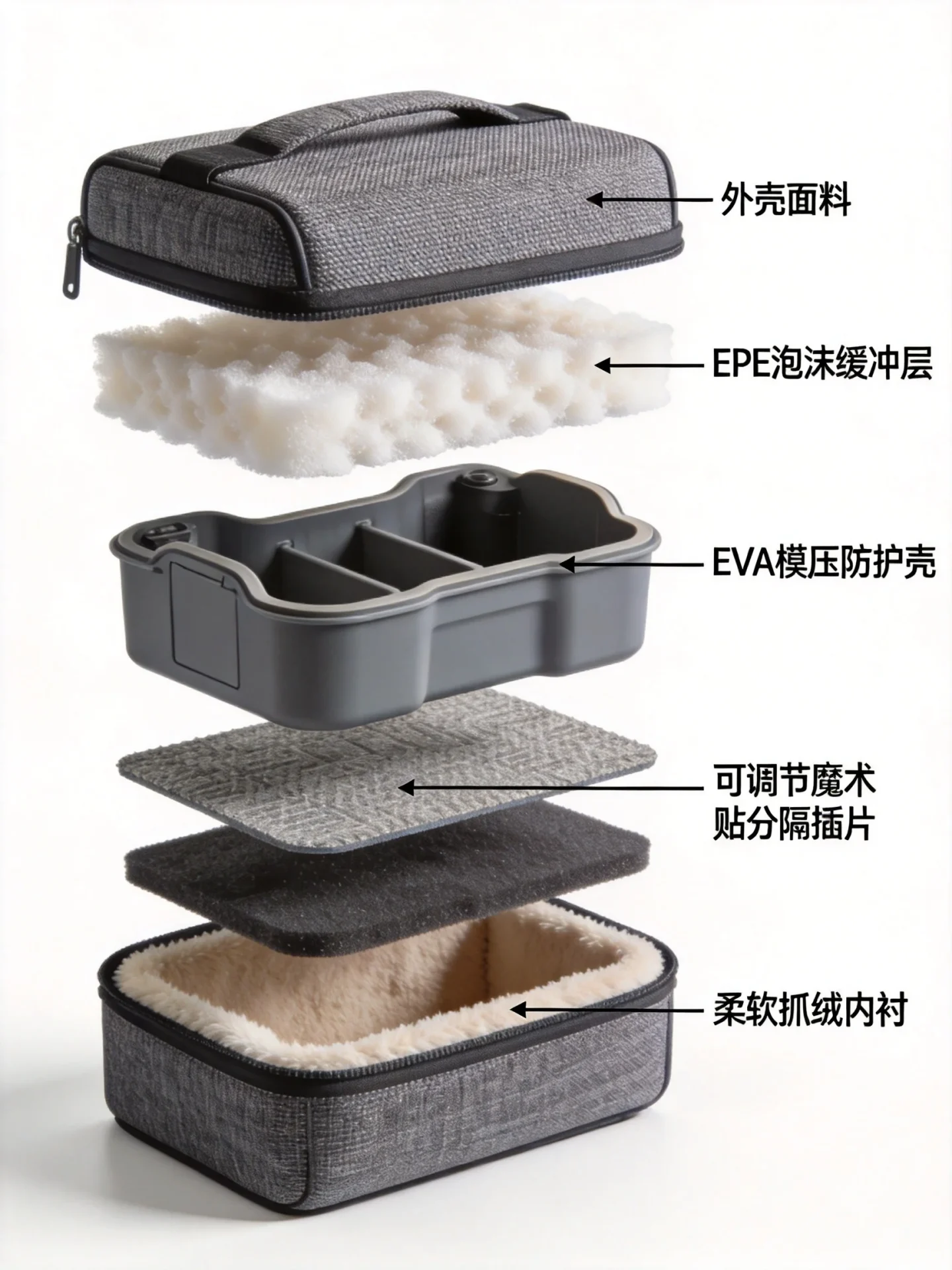
Multi-layer protective system architecture used in OEM camera bag manufacturing at JUNYUAN BAGS
1.4 Suspension and Anti-Shock Systems
Premium camera bags incorporate suspension systems that isolate equipment from direct impact. These include:
- Floating bottom panels: Equipment compartments suspended 15-25mm above the bag floor using elastic attachment points
- Corner air cushions: Inflatable or spring-loaded corner bumpers that absorb angled impacts
- Spine protectors: Rigid HDPE sheets laminated with foam, positioned against the back panel to resist puncture from pointed objects
These advanced protection features are particularly important for camera bags designed for adventure photography, photojournalism, and extreme sports documentation. Our tactical bag division applies similar protection principles to create camera bags rated for military and law enforcement field use.
2. Waterproofing Engineering: IPX4 to IPX7 Protection Levels
Water damage is the most common cause of camera equipment failure in the field. Camera bag OEM manufacturers must understand both material-level water resistance and system-level waterproofing to deliver reliable protection across diverse environmental conditions.
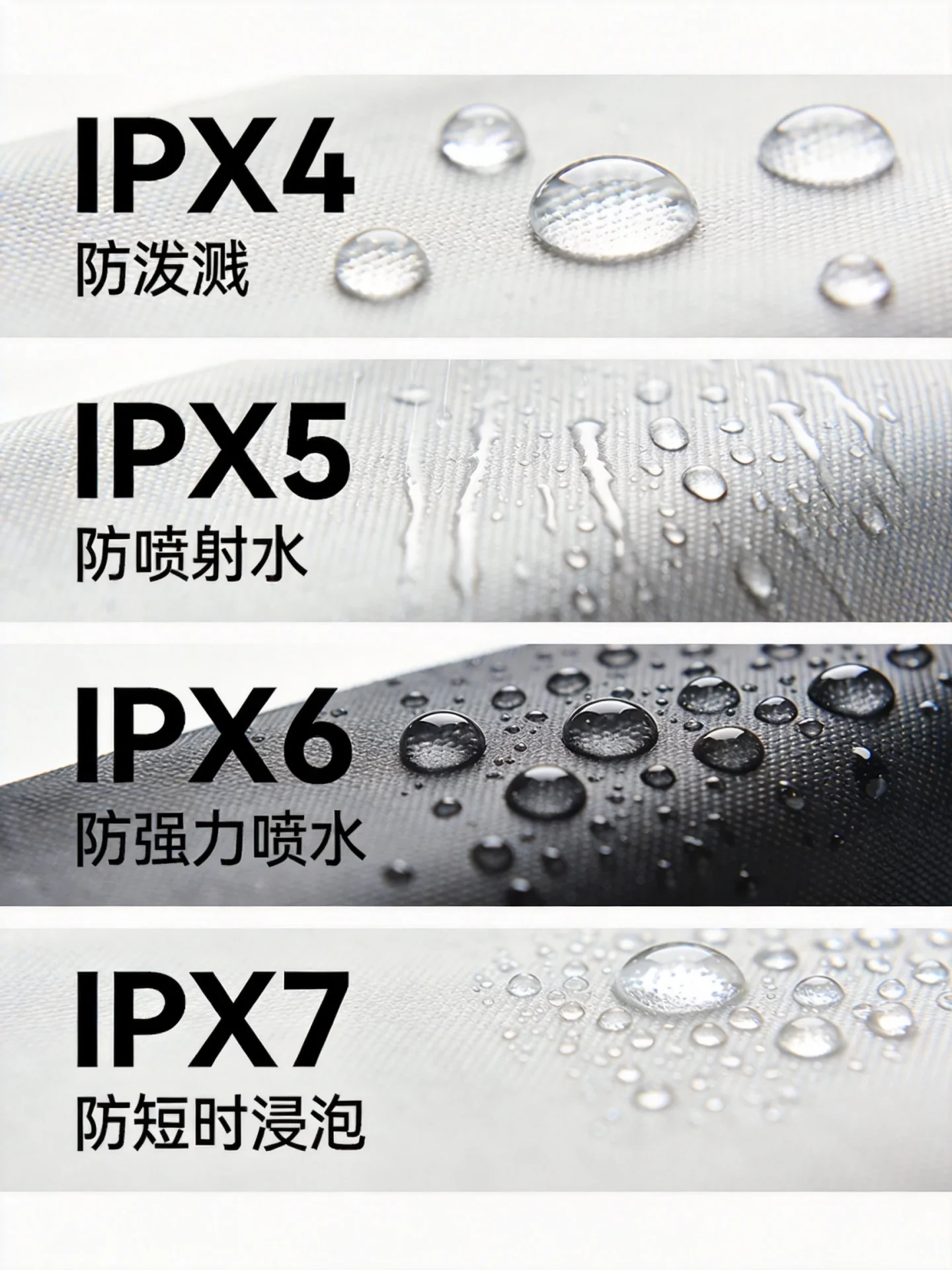
Waterproofing technology comparison across IPX4 through IPX7 protection levels for camera bag manufacturing
2.1 Understanding IPX Ratings for Camera Bags
The IPX (Ingress Protection) rating system defines the level of water resistance a camera bag provides. Understanding these ratings is essential for positioning products in the market:
Splash-proof
Light rain resistant
Entry-level protection
Water jet resistant
Heavy rain capable
Mid-range protection
Powerful jet resistant
Storm conditions
High-end protection
Temporary submersion
30 min at 1m depth
Maximum protection
2.2 Material Selection for Water Resistance
Outer shell fabric selection directly determines the base water resistance level of a camera bag:
| Material | Base Rating | With Coating | With Seam Seal | Best Application |
|---|---|---|---|---|
| 420D Nylon + PU | IPX3 | IPX4 | IPX5 | Urban camera bags, everyday use |
| 840D Nylon + PVC | IPX4 | IPX5 | IPX6 | Professional field bags, travel |
| TPU Laminated Fabric | IPX5 | IPX6 | IPX7 | Expedition bags, extreme conditions |
| Hypalon/DCF Hybrid | IPX6 | IPX7 | IPX7+ | Ultra-premium expedition camera bags |
| PVC Tarpaulin (Welded) | IPX6 | IPX7 | IPX7+ | Fully waterproof roll-top designs |
2.3 Construction Techniques for System-Level Waterproofing
Achieving IPX6+ protection requires attention to every penetration point in the bag construction:
- Waterproof zippers: YKK AQUAGUARD or SBS waterproof zipper series with laminated coil construction
- Seam sealing: Hot-melt PU tape applied to all internal seam lines (13mm or 20mm width depending on seam type)
- Welded construction: High-frequency welding for panel joins, eliminating stitch holes entirely
- Waterproof valve ports: One-way air valves for pressure equalization without water ingress
- Roll-top closures: For maximum waterproofing, roll-top designs create a water-tight seal through multiple fabric folds
Our OEM/ODM production lines are equipped with both traditional sewing and high-frequency welding capabilities, enabling us to produce camera bags across the full IPX4-IPX7 spectrum based on client requirements and market positioning.
2.4 Rain Cover Integration
For camera bags designed for hiking, outdoor photography, and travel, integrated rain covers provide an additional layer of protection. Our rain cover designs include:
- Built-in compartment: Elasticized pocket at bag bottom containing a 190T polyester rain cover with PU coating
- Quick-deploy design: Single-pull deployment system for emergency coverage in under 3 seconds
- Reflective elements: Reflective piping on rain cover edges for visibility in low-light conditions
- Lens hood access: Drawstring opening that cinches around lens barrels for shooting in rain
3. Quick-Access Opening Design: Capturing the Moment
For photographers, equipment access speed can mean the difference between capturing a fleeting moment and missing it forever. Camera bag access design is one of the most important functional considerations in OEM manufacturing, directly influencing user satisfaction and brand loyalty.
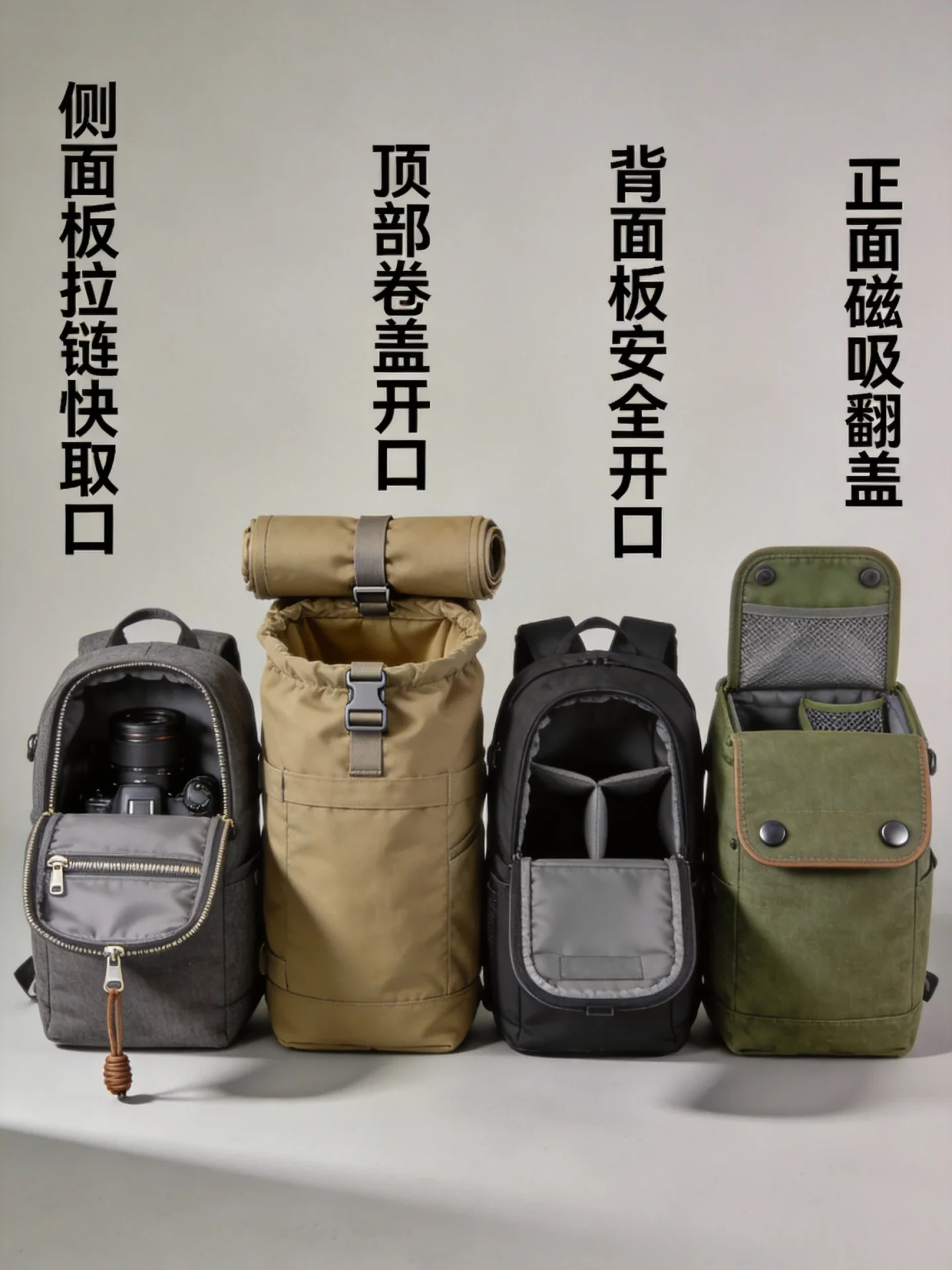
Four primary quick-access opening configurations engineered for camera bag OEM production
3.1 Side-Panel Access
Side-panel access is the most popular configuration for camera sling bags and camera backpacks. The bag rotates from the back to the front, allowing the photographer to access equipment without removing the bag entirely.
Design Specifications
- Zipper arc: 270-degree wrap-around zipper opening for maximum panel exposure
- Self-supporting shell: Semi-rigid back panel that maintains shape when the access panel is open
- One-hand operation: Magnetic or mechanical latch for single-handed panel release
- Silent entry: Magnetic closure system eliminates zipper noise for wildlife and event photography
3.2 Top-Loading / Roll-Top Access
Top-loading camera bags offer a classic access pattern with the added benefit of roll-top expandability for variable load volumes. This design is particularly effective for:
- Drone photography: Vertical space accommodates drone bodies with propellers attached
- Travel photography: Roll-top expansion allows 10-20% volume increase for additional gear
- Street photography: Wide opening provides full visibility of all equipment at a glance
3.3 Back-Panel Security Access
Anti-theft access design positions the main equipment compartment against the wearer’s back, making unauthorized access virtually impossible while wearing the bag. Key design elements include:
- Hidden zipper pulls: Zipper sliders concealed behind fabric flaps or magnetic covers
- Locking loops: Integrated loops accepting small padlocks or cable locks
- RFID-blocking panel: Metallized fabric layer protecting contactless cards and devices
- Slash-resistant materials: Wire-mesh reinforcement within fabric layers to resist blade attacks
These anti-theft features are increasingly demanded by urban photographers and travelers in high-pickpocket environments. Our comprehensive OEM/ODM service covers all anti-theft customization requirements. Our tactical bag expertise directly informs the anti-theft design language of our camera bag line.
3.4 Front-Panel Magnetic Flap Access
Popular in messenger-style camera bags, the front-panel magnetic flap combines quick access with weather protection. The flap design uses:
- Fidlock magnetic buckles: One-handed release with automatic re-engagement
- Internal divider curtain: Secondary protection layer preventing equipment from falling when the flap is open
- Silenced closure: Neodyrene-dampened magnetic catch for whisper-quiet operation
4. Specialized Storage: Drone, Lens, and Accessory Configurations
Modern photography systems extend far beyond camera bodies and lenses. Drones, gimbals, portable lighting, and mobile editing stations all need secure, organized transport. Camera bag OEM manufacturing must accommodate this expanding equipment ecosystem.
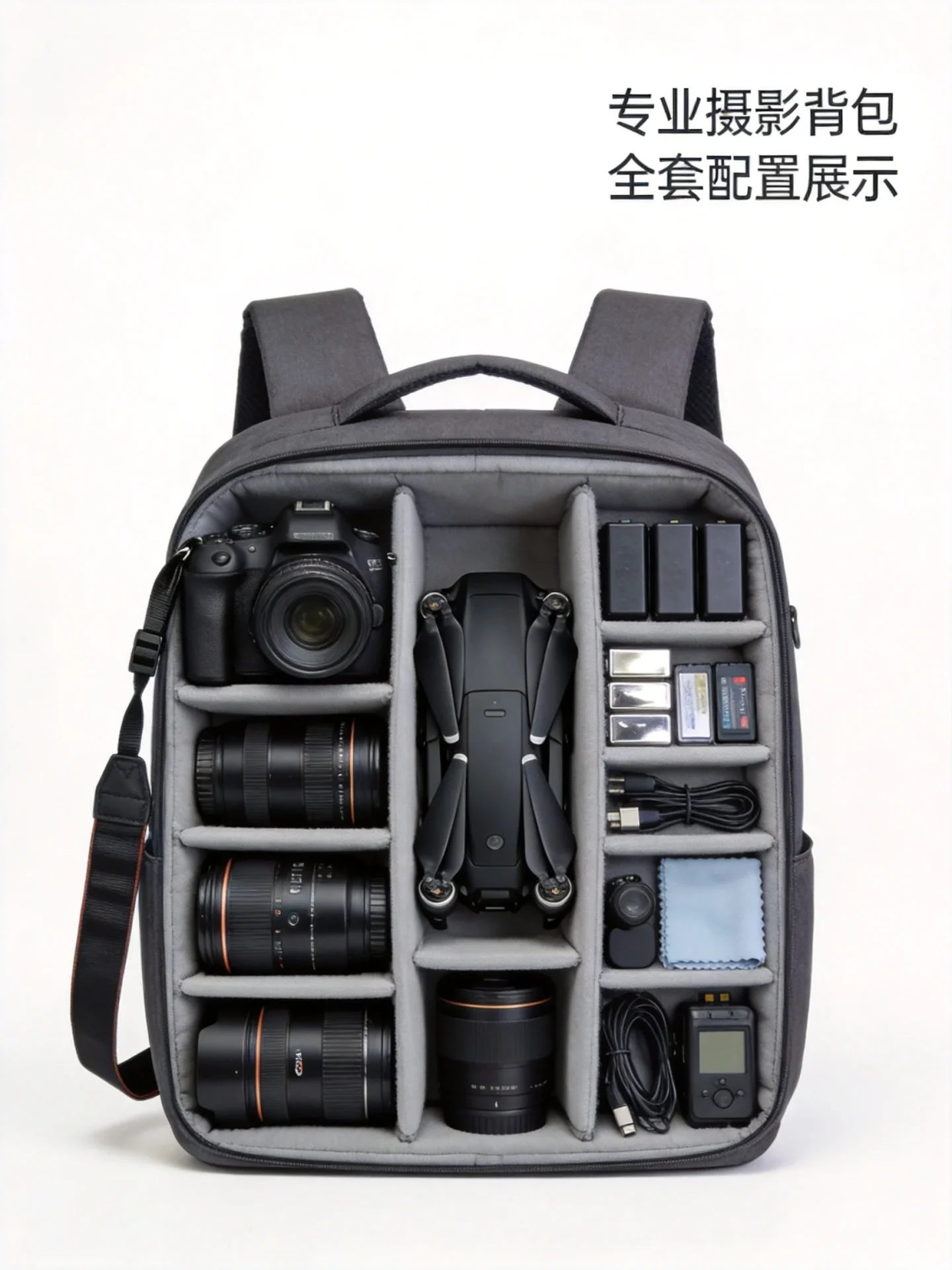
Comprehensive camera bag configuration system designed for OEM/ODM customization
4.1 Drone-Specific Storage Solutions
Drone photography has experienced exponential growth, and camera bags must accommodate increasingly sophisticated UAV systems. Our drone storage designs address:
- Propeller protection: Dedicated propeller cases or guards preventing bend damage during transport
- Battery isolation: Fire-resistant LiPo battery pouches meeting airline transport regulations
- Controller compartment: Padded slot sized for DJI RC-N1, Smart Controller, or similar transmitters
- ND filter organizer: Small-format slots for lens filter systems (67mm-82mm range)
- Quick-deploy design: Drone can be removed and flight-ready in under 60 seconds
4.2 Lens Storage Engineering
Lens storage must balance protection with accessibility. Our lens compartment systems include:
- Padded lens holsters: Individual cylindrical pockets with 15mm foam wall thickness
- Diameter-graded dividers: Adjustable compartments accommodating 60mm to 200mm lens diameters
- Mounted lens protection: Sleeves designed for camera bodies with attached 70-200mm f/2.8 class lenses
- Front/rear cap retention: Elastic loops securing lens caps to prevent loss during access
4.3 Power Management Storage
Modern photographers carry significant power requirements. Dedicated power storage includes:
- Battery chambers: Padded, separated compartments preventing terminal short-circuits
- Charger pockets: Sized for dual-charger units with ventilation mesh for heat dissipation
- Power bank sleeve: Dedicated pocket with cable routing port for on-the-go device charging
- Solar panel attachment: MOLLE-compatible lash points for portable solar panel integration
4.4 Memory Card and Data Management
- Card vault: Water-resistant zippered pocket with foam insert for SD/CFexpress cards
- Portable drive sleeve: Anti-static lined pocket for SSD or portable RAID units
- Color-coded system: Labeled slots distinguishing empty vs. full cards for workflow efficiency
For brands building comprehensive camera bag lines, our design team can create modular systems compatible with our messenger bag range and backpack collection, enabling cross-category product consistency.
5. Anti-Theft Features and Security Engineering
Camera equipment is a high-value target for theft, particularly in tourist destinations and urban environments. Anti-theft engineering has become a critical product differentiator in the camera bag market.
5.1 Physical Security Features
- Slash-resistant strap: Wire-core shoulder straps that resist cutting with blades
- Lockable zippers: Zipper pulls with integrated hasps accepting small combination locks
- Anchor cable system: Internal steel cable that can be looped around fixed objects to secure the bag
- RFID-blocking lining: Full-panel metallized fabric protecting contactless credit cards and passports
- Hidden pockets: Body-facing pockets concealed behind the back panel for valuables
5.2 Smart Security Integration
Emerging camera bag designs incorporate technology-enabled security features:
- AirTag/GPS tracker pocket: Dedicated compartment sized for Apple AirTag or Tile trackers
- Alarm-ready loops: Attachment points for Bluetooth-enabled bag alarms
- NFC authentication: Embedded NFC chips for product verification and anti-counterfeiting
5.3 Material-Level Theft Deterrence
- Diamond-cut resistant fabric: UHMWPE (Ultra-High Molecular Weight Polyethylene) reinforcement layer
- Cut-proof mesh: Stainless steel wire mesh laminated between outer fabric and lining
- Tamper-evident zippers: Color-changing zipper pulls that indicate unauthorized access attempts
6. OEM Customization Solutions: Building Your Camera Bag Brand
Successful camera bag brands require more than functional excellence — they need distinctive design language, compelling brand storytelling, and manufacturing consistency. JUNYUAN BAGS offers end-to-end OEM/ODM services tailored to the photography equipment market.
6.1 OEM Manufacturing
Provide your complete technical package — patterns, Bill of Materials, tech packs, and branding artwork — and our factory executes production to your exact specifications. We support:
- Technical drawing interpretation and pattern development
- Material sourcing with Pantone color matching
- Pre-production sample creation with full branding
- Production with AQL 2.5 quality standards
- Custom packaging and labeling
6.2 ODM Development
For brands seeking design partnership, our in-house team creates camera bag concepts based on your market research, target user profiles, and price positioning. We offer:
- Market trend analysis and product positioning recommendations
- 3D concept renderings with material boards
- Functional prototyping with your equipment for fit testing
- Cost engineering to target retail price points
- Production optimization for scalable manufacturing
Learn more about our OEM vs. ODM manufacturing models and which approach best suits your business needs.
6.3 Brand Customization Options
Complete brand expression across every touchpoint:
- Exterior branding: Embroidered logos, silk-screened graphics, rubber patches, leather patches, woven labels
- Interior branding: Custom lining prints, woven labels, care instruction tags, QR-coded authenticity markers
- Hardware branding: Logo-engraved buckles, branded zipper pulls, custom color metal finishes
- Packaging: Custom dust bags, branded hangtags, retail-ready packaging, e-commerce optimized shipping boxes
6.4 Compliance and Certification
Our factory supports brands in meeting international compliance requirements:
- BSCI / SEDEX: Social compliance certifications for ethical manufacturing verification
- ISO 9001: Quality management system certification
- REACH / CPSIA: Chemical safety compliance for EU and US markets
- GRS: Global Recycled Standard for sustainable material claims
- TSA/airline compliance: Battery storage designs meeting IATA lithium battery transport regulations
- Athletic bag crossover: Our custom athletic backpacks division can develop sport-photography crossover products
7. Production Capabilities and Lead Times
Our camera bag manufacturing operation delivers industry-leading turnaround times without compromising quality:
| Phase | Duration | Details |
|---|---|---|
| Design Consultation | 3-5 days | Requirements analysis, material selection, cost estimation |
| 3D Design & Sampling | 7-15 days | 3D renderings, material sourcing, prototype creation |
| Sample Approval | 3-5 days | Client review, fit testing, modification (if needed) |
| Mass Production | 25-45 days | Full production run with in-process quality checks |
| Quality Inspection | 2-3 days | Final inspection, load testing, packaging |
| Shipping (FOB Xiamen) | 3-5 days | Quanzhou to Xiamen port, container loading |
Monthly production capacity exceeds 200,000 pieces across all bag categories. Our Quanzhou factory operates 6 production lines with 160+ skilled workers, supported by a dedicated camera bag design and engineering team.
8. Pricing Framework and MOQ
Camera bag OEM pricing varies based on protection level, material quality, and customization complexity:
| Product Type | Protection Level | MOQ | FOB Price Range (USD) |
|---|---|---|---|
| Basic camera insert | EPE foam dividers | 500 pcs | $5.00 – $8.50 |
| Camera sling bag | EPE + EVA padding | 300 pcs | $12.00 – $22.00 |
| Professional camera backpack | Multi-layer + rain cover | 300 pcs | $25.00 – $45.00 |
| Drone camera bag | EVA molded + IPX5+ | 300 pcs | $30.00 – $55.00 |
| Hard-shell camera case | Full EVA shell + IPX7 | 200 pcs | $45.00 – $95.00 |
All prices quoted FOB Xiamen port. Contact our sales team for detailed quotations based on your specific requirements.
Frequently Asked Questions
Our standard MOQ is 300 pieces per design per color for camera bags. For camera inserts and simpler configurations, MOQ starts at 500 pieces. Hard-shell cases with custom EVA molds require a minimum of 200 pieces plus mold costs. Contact our OEM/ODM team for project-specific MOQ discussions.
Yes. We offer both custom-molded EVA inserts (requiring new tooling, 2-3 week mold lead time) and semi-custom solutions using our existing mold library covering 50+ popular camera and lens models. Custom EVA molds are a one-time investment that can be amortized across multiple production runs.
Depending on material and construction selection, we produce camera bags ranging from IPX4 (splash-proof) to IPX7 (temporary submersion). For IPX6+ protection, we recommend TPU-laminated fabrics with heat-welded seams and waterproof zipper systems. Our manufacturing facility supports both sewn-and-sealed and fully welded construction methods.
Absolutely. We engineer dedicated drone storage compartments with propeller guards, fire-resistant LiPo battery pouches meeting airline regulations, controller slots, and quick-deploy designs. Our drone bag designs are compatible with DJI Mini, Air, Mavic, and Inspire series, as well as most competing drone platforms.
Our anti-theft camera bag options include slash-resistant straps with wire cores, lockable zippers, anchor cable systems, RFID-blocking lining, hidden body-facing pockets, and optional smart tracker compartments for AirTag or GPS devices. These features draw on our tactical bag manufacturing expertise.
Standard sampling takes 7-15 business days after design confirmation. Samples with custom EVA inserts or specialized hardware may require 15-20 business days. Rush sampling (5-7 days) is available for an additional fee. Visit our contact page to initiate your sample request.
Yes. We design camera bags to comply with major airline carry-on dimension requirements (typically 55cm × 40cm × 20cm or equivalent). We also ensure LiPo battery storage compartments comply with IATA Dangerous Goods Regulations for carry-on transport.
For extreme weather applications, we recommend 1000D Cordura nylon with DWR finish, TPU-laminated construction with heat-welded seams, YKK AQUAGUARD waterproof zippers, and sealed seam tape. For cold environments, we specify cold-crack resistant materials rated to -30°C. As a full-service bag manufacturer, we provide comprehensive material recommendations based on your target use environment.
Yes. Our sustainable camera bag options include GRS-certified RPET recycled polyester, organic cotton canvas liners, recycled EVA foam, and recycled metal hardware. Our factory holds GRS certification, enabling brands to make verified sustainability claims. Explore our main product page for eco-friendly bag options.
Mass production takes 25-45 days depending on order complexity and quantity. Orders under 1,000 pieces typically complete in 25-30 days. Larger orders (5,000+ pieces) require 35-45 days. All shipments depart FOB Xiamen from our Quanzhou, Fujian factory.
Launch Your Custom Camera Bag Line with JUNYUAN BAGS
Partner with a trusted camera bag OEM/ODM manufacturer in Quanzhou, Fujian, China. two decades of protective equipment manufacturing expertise dating from 2004. From IPX4 splash-proof to IPX7 submersion-rated designs — we engineer solutions that protect your clients’ most valuable equipment.
Free 3D Design Mockup | 48-Hour Quote | Sample in 7-15 Days | FOB Xiamen