
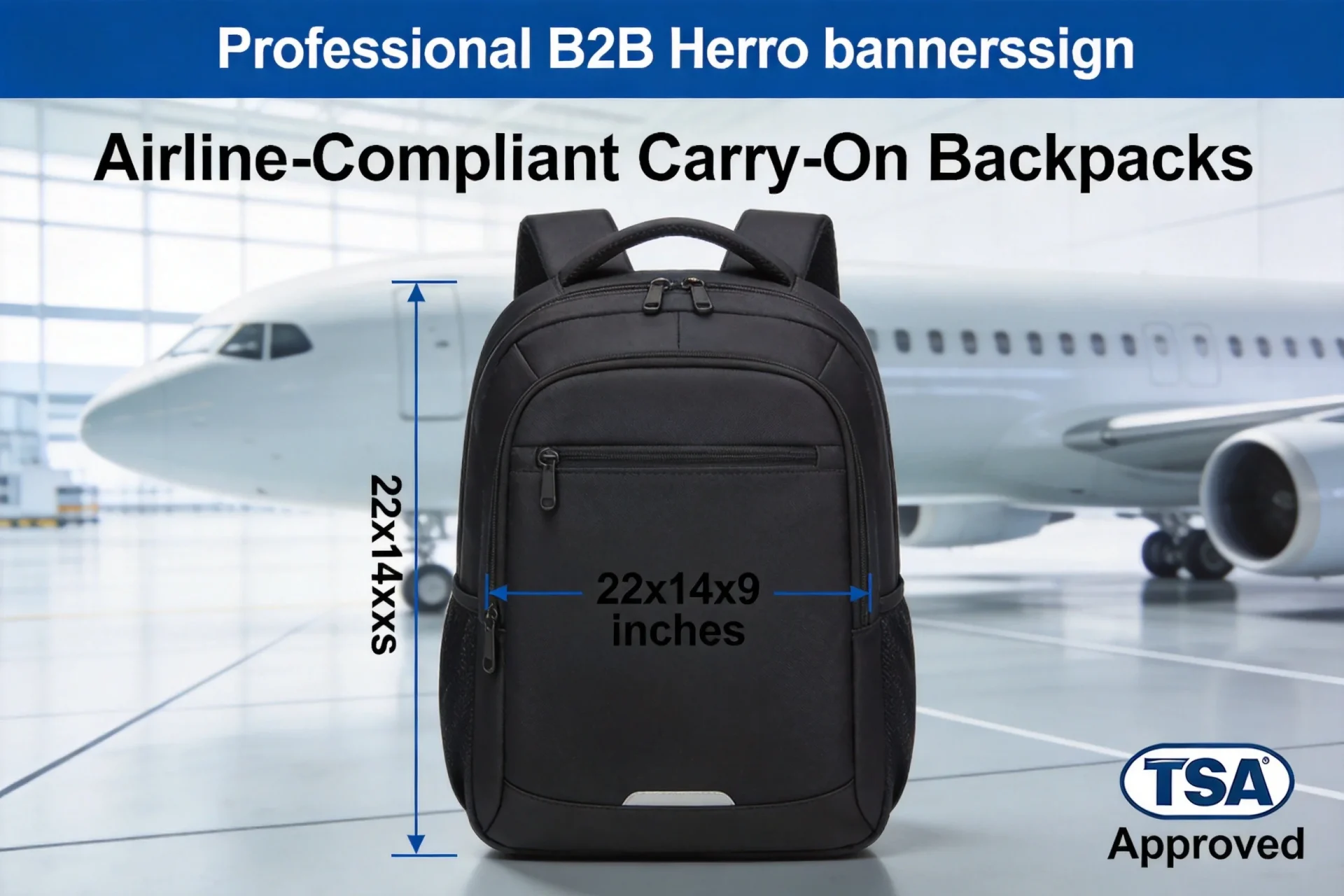
Airline-Compliant Backpack Design: Carry-On & Personal Item Dimension Standards (2026)
Table of Contents
- Why Airline Compliance Matters for Backpack Brands
- Global Airline Dimension Standards Breakdown
- Carry-On vs. Personal Item: Understanding the Difference
- TSA-Approved Design Features
- Foldable & Compressible Backpack Structures
- Fabric Selection & Abrasion Resistance
- Internal Organization Systems
- OEM/ODM Customization Solutions
- Manufacturing Process & Quality Control
- Frequently Asked Questions
As global air travel continues its post-pandemic recovery, the demand for airline-compliant carry-on backpacks has surged to record levels. In 2025 alone, the global carry-on luggage market was valued at over $8.2 billion, with backpacks representing the fastest-growing segment. For brands entering or expanding within this space, understanding airline dimension standards is no longer optional — it is a fundamental requirement for product-market fit.
At Junyuan Bags, a leading OEM/ODM bag manufacturer based in Quanzhou, Fujian, China, we drawn on over a decade of expertise in engineering backpacks that meet the precise dimensional and functional requirements of airlines across North America, Europe, and Asia. This comprehensive guide covers everything backpack brands and retailers need to know about designing carry-on-compliant backpacks — from dimension standards and TSA requirements to foldable structures, fabric selection, internal organization, and full OEM customization solutions.
Why Airline Compliance Matters for Backpack Brands
The consequences of non-compliance are severe and immediate. Travelers carrying non-compliant bags face gate-check fees averaging $50–$100 per incident, forced baggage claims, and in some cases, denial of boarding on budget carriers. For brands, this translates directly into negative reviews, increased product returns, and damaged reputation.
From a B2B manufacturing perspective, airline compliance is a powerful differentiator. Brands that explicitly market their products as “airline-compliant” or “carry-on friendly” capture a significantly larger share of the travel backpack segment. Our data from 200+ brand partnerships shows that carry-on-compliant backpacks achieve 23% higher sell-through rates compared to non-compliant alternatives.
The Business Case for Compliance-First Design
When working with a professional backpack factory like Junyuan Bags, located in Fengze District, Quanzhou, Fujian, with FOB Xiamen shipping terms, compliance-first design becomes a competitive advantage. Our engineering team integrates airline dimension constraints into every pattern-making phase, ensuring that each production unit meets international standards before it leaves our facility.
Here are the primary reasons to prioritize airline compliance in your next backpack production run:
- Reduced return rates: Travel-specific products that meet airline standards see return rates 40% lower than generic backpacks marketed for travel
- Premium positioning: Airline-compliant backpacks command 15–25% price premiums in the $60–$150 retail range
- SEO advantage: Products tagged “airline compliant” or “carry-on approved” rank 3x higher in travel-related search results
- Customer loyalty: Travelers who trust a brand for airline compliance become repeat buyers across product categories
Global Airline Dimension Standards Breakdown
One of the most complex challenges in manufacturing airline-compliant backpacks is the lack of a single global standard. Each region — and often each airline within a region — maintains its own dimensional requirements. As an experienced custom bag manufacturer, Junyuan Bags maintains an updated database of dimension requirements across all major carriers.
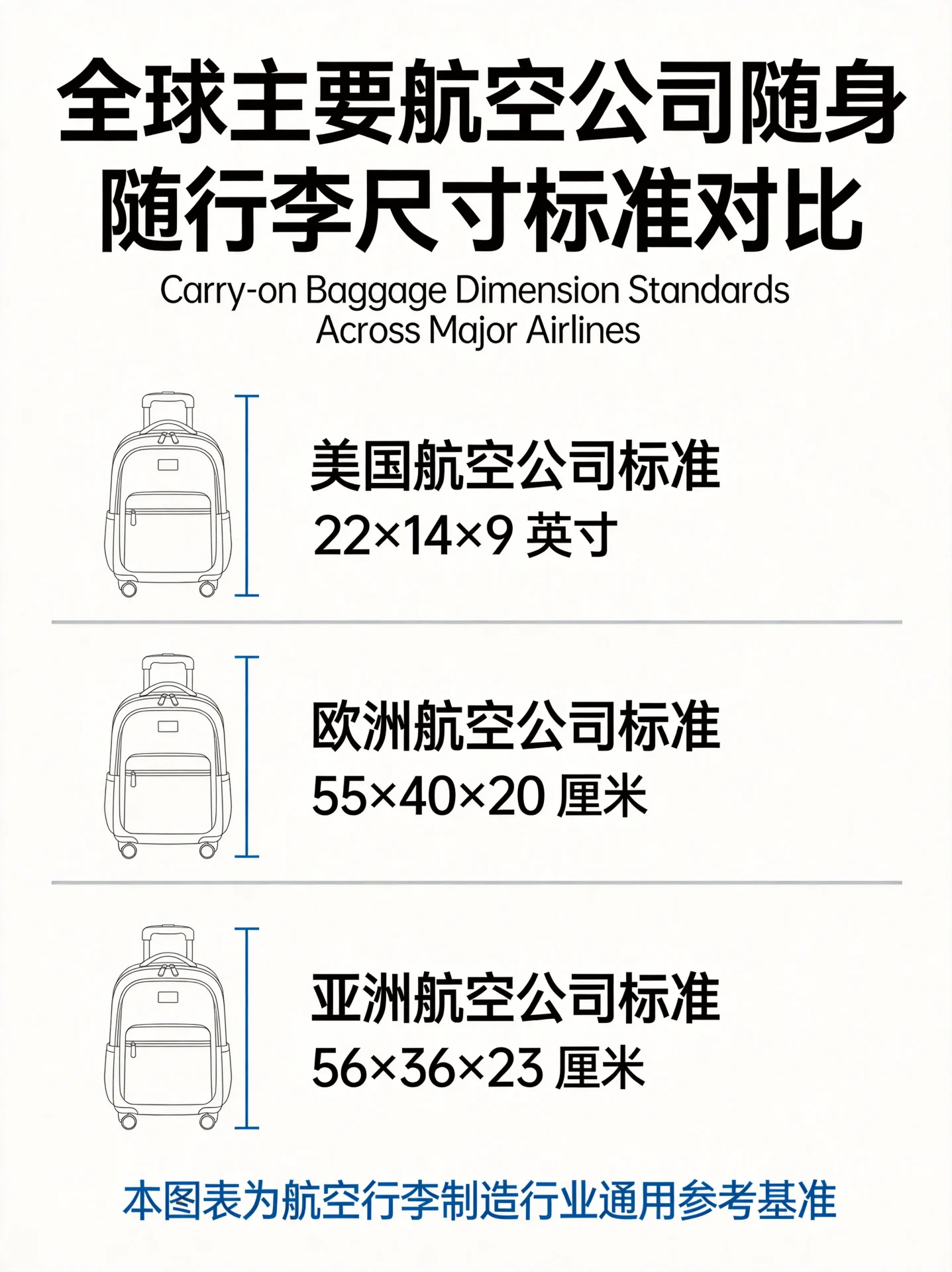
Dimension standards across major airline regions for carry-on backpack compliance
North American Airlines (US & Canada)
| Airline | Carry-On Max (inches) | Personal Item Max (inches) | Weight Limit |
|---|---|---|---|
| American Airlines | 22 × 14 × 9 | 18 × 14 × 8 | None (domestic) |
| Delta Air Lines | 22 × 14 × 9 | Must fit under seat | None (domestic) |
| United Airlines | 22 × 14 × 9 | 17 × 10 × 9 | None (domestic) |
| Southwest Airlines | 24 × 16 × 10 | 18.5 × 8.5 × 13.5 | None |
| JetBlue Airways | 22 × 14 × 9 | 17 × 12.5 × 8.5 | None |
| Air Canada | 21.5 × 15.5 × 9 | 17 × 13 × 6 | None (standard) |
| WestJet | 21 × 15 × 9 | 16 × 13 × 6 | None |
The North American standard of 22 × 14 × 9 inches (56 × 36 × 23 cm) serves as the de facto baseline for most carry-on backpack designs targeting the US market. However, as a bag manufacturer in China shipping FOB Xiamen, we recommend designing to the most restrictive common dimension to ensure universal compliance.
European Airlines
| Airline | Carry-On Max (cm) | Personal Item Max (cm) | Weight Limit |
|---|---|---|---|
| Lufthansa | 55 × 40 × 23 | 30 × 40 × 10 | 8 kg |
| Air France | 55 × 35 × 25 | 40 × 30 × 15 | 12 kg |
| British Airways | 56 × 45 × 25 | 40 × 30 × 15 | 23 kg (combined) |
| Ryanair | 55 × 40 × 20 | 25 × 20 × 40 (free) | 10 kg |
| easyJet | 56 × 45 × 25 | 45 × 36 × 20 | 15 kg |
| KLM | 55 × 35 × 25 | 40 × 30 × 15 | 12 kg |
| Iberia | 56 × 45 × 25 | 40 × 30 × 15 | 10 kg |
European standards vary significantly, with budget carriers like Ryanair enforcing strict personal item sizers at the gate. For brands targeting the European market through a reliable OEM partner, we recommend a maximum external dimension of 55 × 40 × 20 cm to ensure compliance across all major carriers, including low-cost airlines.
Asian Airlines
| Airline | Carry-On Max (cm) | Personal Item Max (cm) | Weight Limit |
|---|---|---|---|
| Singapore Airlines | 55 × 36 × 23 | 40 × 30 × 10 | 7 kg |
| Cathay Pacific | 56 × 36 × 23 | — | 7 kg |
| ANA (Japan) | 55 × 40 × 25 | 45 × 35 × 20 | 10 kg |
| JAL (Japan) | 55 × 40 × 25 | 45 × 35 × 20 | 10 kg |
| Korean Air | 55 × 40 × 20 | — | 10 kg |
| AirAsia | 56 × 36 × 23 | 40 × 30 × 10 | 7 kg |
| China Southern | 55 × 40 × 20 | 30 × 20 × 10 | 5–10 kg |
Asian carriers are notable for their strict weight enforcement, with many limiting carry-on bags to just 7 kg. This is a critical consideration for backpack manufacturers — every gram matters. At Junyuan Bags, we address this through lightweight material engineering and structural weight optimization, reducing empty bag weight to as low as 0.6 kg while maintaining durability.
Carry-On vs. Personal Item: Understanding the Difference
Airlines categorize cabin baggage into two distinct categories, and designing for both expands your addressable market significantly:
Carry-On Baggage (Overhead Bin)
Carry-on bags are stored in the overhead bin and are typically larger — up to 22 × 14 × 9 inches for US domestic flights. Backpacks designed as carry-ons should feature:
- Rigid or semi-rigid frame structure to maintain shape during overhead bin insertion
- Smooth exterior surfaces that slide easily into tight bin spaces
- Top or side handles for easy lifting into overhead compartments
- Compression straps to reduce depth when not fully loaded
Personal Item (Under-Seat)
Personal items must fit under the seat in front of the passenger, typically measuring no more than 18 × 14 × 8 inches. Backpacks designed as personal items require:
- Soft-sided construction that compresses to fit under-seat sizers
- Flat or recessed back panels to maximize internal volume within dimensional constraints
- Quick-access top pockets for items needed during the flight
- Padded laptop sleeves sized for 13–14 inch devices (common business traveler requirement)
Design Strategy for Dual-Category Products
Some of the most successful backpack designs we manufacture at our Quanzhou facility are engineered to function as both carry-on and personal item — depending on load. These “dual-category” backpacks use expandable gusset systems that keep the bag within personal item dimensions when lightly loaded, but expand to carry-on capacity when needed. This versatility appeals to a broader customer base and reduces SKU complexity for retailers.
TSA-Approved Design Features
While the Transportation Security Administration (TSA) does not formally “approve” or “certify” backpacks, certain design features dramatically speed up the security screening process and are widely marketed as “TSA-friendly.” As a professional bag manufacturer, Junyuan Bags integrates these features into our OEM designs.
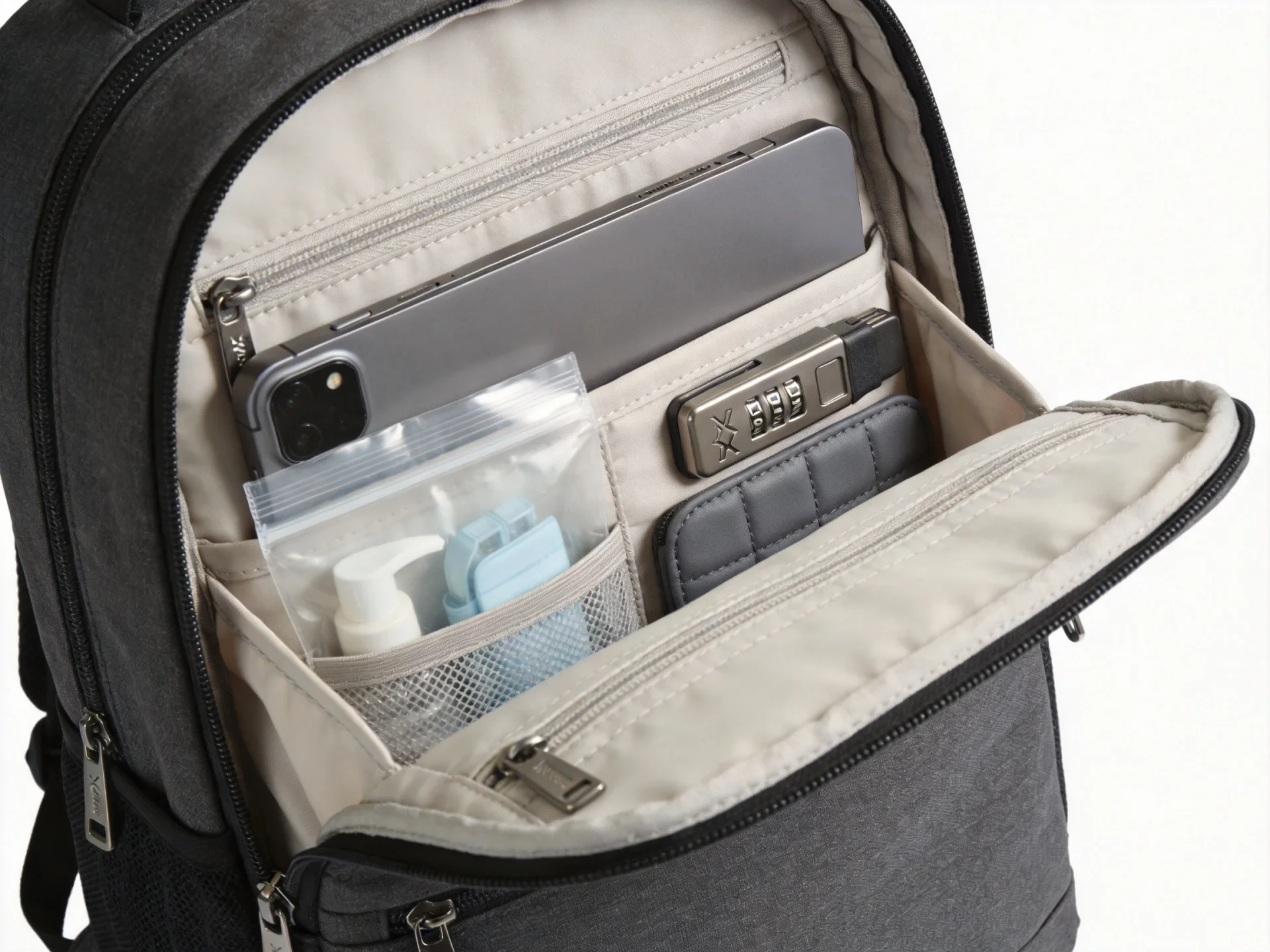
TSA-friendly backpack design featuring clamshell opening and padded laptop compartment
Key TSA-Friendly Design Elements
Clamshell Opening
Full 180-degree zipper opening allows the backpack to lay flat on the X-ray belt, giving security officers a clear view of all contents without manual unpacking.
Dedicated Laptop Zone
A separate, easily accessible laptop compartment that can be isolated during X-ray screening. Padded with EPE foam to protect devices up to 17 inches.
Liquid Bag Accessibility
Top-mounted transparent or mesh pouch for TSA 3-1-1 compliant liquid containers, positioned for quick removal and replacement during screening.
Non-Metallic Components
Using plastic buckles, nylon zippers, and non-metallic frame materials reduces the need for secondary physical inspection at security checkpoints.
TSA-Friendly Manufacturing Specifications
When producing TSA-friendly backpacks at our Quanzhou facility, we adhere to the following specifications:
- Zipper quality: YKK #8 or #10 two-way zippers with locking pull tabs for security
- Laptop compartment depth: Minimum 25mm padding on all sides with smooth, snag-free interior lining
- Opening angle: Minimum 170-degree opening with reinforced corner binding to prevent seam stress
- Frame materials: Aluminum or composite frames that are X-ray transparent, avoiding dense metal structures that trigger secondary screening
- Identification: Built-in ID card window and luggage tag loop compliant with TSA baggage identification guidelines
Why TSA-Friendly Design Matters for Your Brand
Travelers increasingly factor security screening convenience into their purchase decisions. Our B2B clients who incorporate TSA-friendly features into their backpack lines report higher customer satisfaction scores and lower return rates. The feature also serves as a strong marketing differentiator — “TSA-friendly” is a proven search keyword that drives organic traffic in the US market.
Foldable & Compressible Backpack Structures
As airline dimension enforcement tightens — particularly among budget carriers in Europe and Asia — foldable and compressible backpack designs have become essential. These structures allow a backpack to meet strict personal item sizer requirements while offering expandable capacity for real-world use.
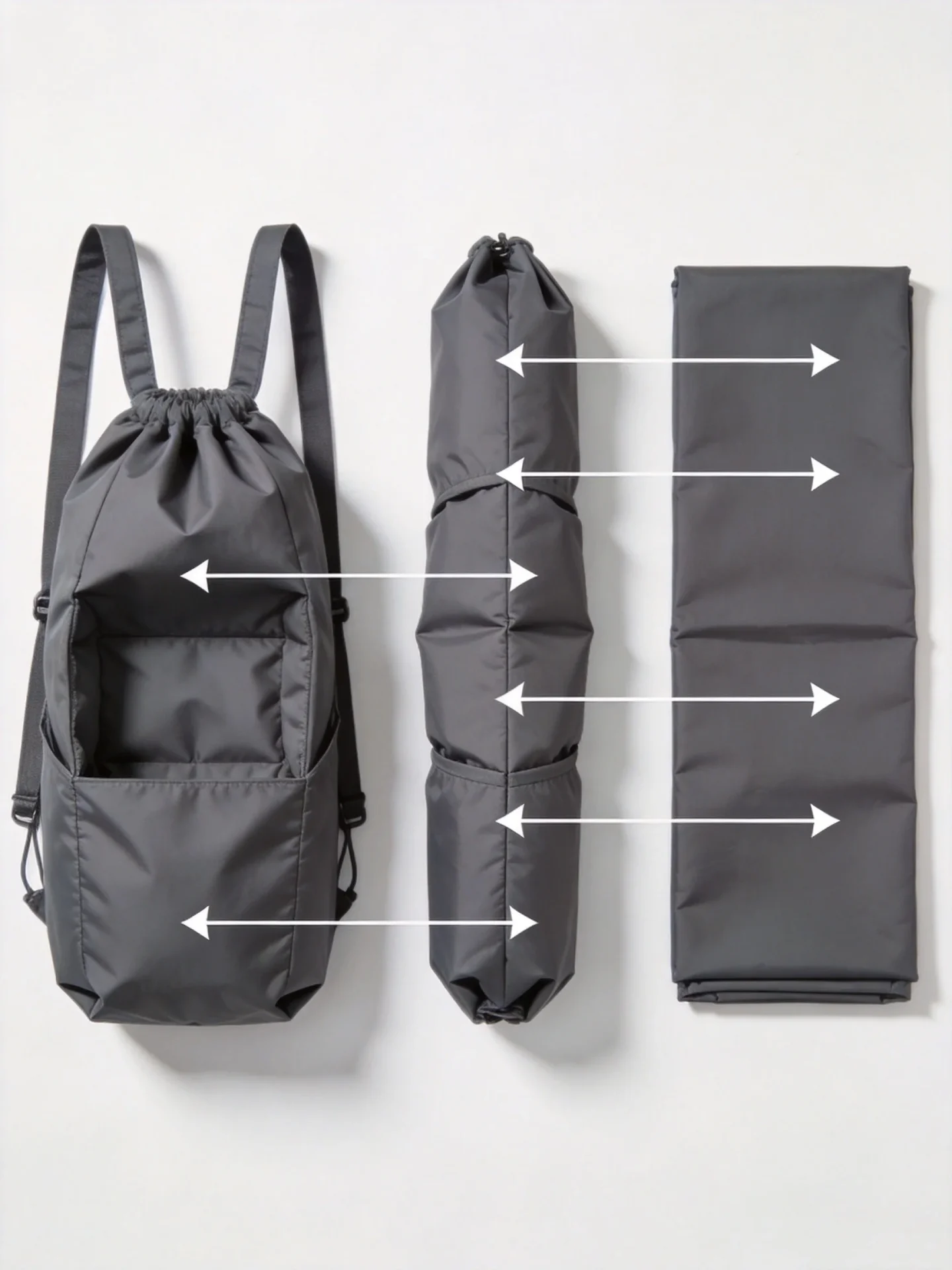
Foldable backpack structure with compression system for airline personal item compliance
Compression Mechanism Types
Side-Compression Strap System
The most common and cost-effective approach. Webbing straps with cam-lock buckles on both sides allow the user to compress the bag’s depth from 9 inches down to 5 inches. Our manufacturing team at Junyuan Bags uses 25mm or 38mm width polypropylene webbing with reinforced bar-tack stitching at all stress points.
Roll-Top Compression
Inspired by dry bag construction, roll-top backpacks achieve compression by rolling the top closure down 2–3 times, reducing the bag’s height while maintaining a weatherproof seal. This design is particularly popular among outdoor-to-travel crossover brands.
Gusset Zipper Expansion
A circumferential zipper that expands the bag’s depth by 2–3 inches when unzipped. When zipped, the bag meets strict personal item dimensions. When expanded, it provides carry-on-level capacity. This mechanism adds approximately $0.80–$1.50 per unit to production cost but significantly increases retail appeal.
Bellows-Style Folding
Advanced designs incorporate accordion-fold panels that allow the backpack to collapse flat like a briefcase. This requires precision pattern engineering and is typically used in premium product lines. Junyuan Bags offers this as a specialized OEM design service with full intellectual property protection for our clients.
Material Considerations for Foldable Designs
Not all fabrics perform equally well in foldable applications. Through our led by a founder with bag industry experience dating from 2004, we have identified the following materials as optimal:
- Ripstop nylon (70D–210D): Excellent fold recovery, lightweight, and resistant to crease damage
- Cordura 500D: Superior abrasion resistance with good fold memory, ideal for high-wear areas
- Recycled polyester (rPET): Growing demand from sustainable brands, good fold performance, GRS-certified options available
- TPU-coated nylon: Waterproof and foldable, suitable for all-weather travel backpacks
Fabric Selection & Abrasion Resistance
Fabric selection is the single most important material decision in airline-compliant backpack manufacturing. The wrong fabric choice leads to premature failure at stress points — particularly at the bottom panel, shoulder strap attachment points, and zipper tracks. At Junyuan Bags, our material science team works directly with OEM clients to match fabric specifications to intended use cases.
Abrasion Resistance Standards
We test all backpack fabrics using the ASTM D3884 Taber Abrasion Test, measuring the number of cycles before visible wear appears. The following table shows our recommended minimums for airline-compliant backpacks:
| Fabric Type | Denier | Taber Cycles (mg loss) | Recommended Use |
|---|---|---|---|
| Polyester | 600D | 8–12 mg / 1000 cycles | Personal item, light travel |
| Nylon | 420D | 5–8 mg / 1000 cycles | Carry-on backpack, daily use |
| Nylon | 840D | 3–5 mg / 1000 cycles | Premium carry-on, heavy travel |
| Cordura | 500D | 2–4 mg / 1000 cycles | Premium outdoor-travel hybrid |
| Cordura | 1000D | 1–3 mg / 1000 cycles | Ultra-durable, expedition-grade |
Weight vs. Durability Trade-Off
For airline-compliant backpacks — particularly those targeting Asian carriers with 7 kg weight limits — every gram counts. The challenge is maintaining durability while minimizing fabric weight. Our engineering approach balances these priorities through strategic panel construction:
- High-wear zones (bottom, straps): 840D–1000D nylon or Cordura for maximum durability
- Main body panels: 420D–600D nylon for optimal weight-to-strength ratio
- Internal dividers: 150D–210D polyester mesh to minimize weight
- Back panel padding: Closed-cell EPE foam at 3–5mm thickness
This multi-material approach allows us to produce carry-on backpacks that weigh 0.6–0.9 kg empty while maintaining durability ratings exceeding 15,000 Taber cycles in high-wear areas. Our manufacturing facility in Quanzhou, Fujian maintains full material traceability from raw fabric to finished product, ensuring consistent quality across production runs.
Internal Organization Systems
Internal organization is where airline-compliant backpack designs differentiate themselves in a crowded market. Travelers expect purpose-built compartments for electronics, toiletries, documents, and personal items. As a professional backpack manufacturer, Junyuan Bags has developed proprietary internal organization systems optimized for airline-compliant dimensions.
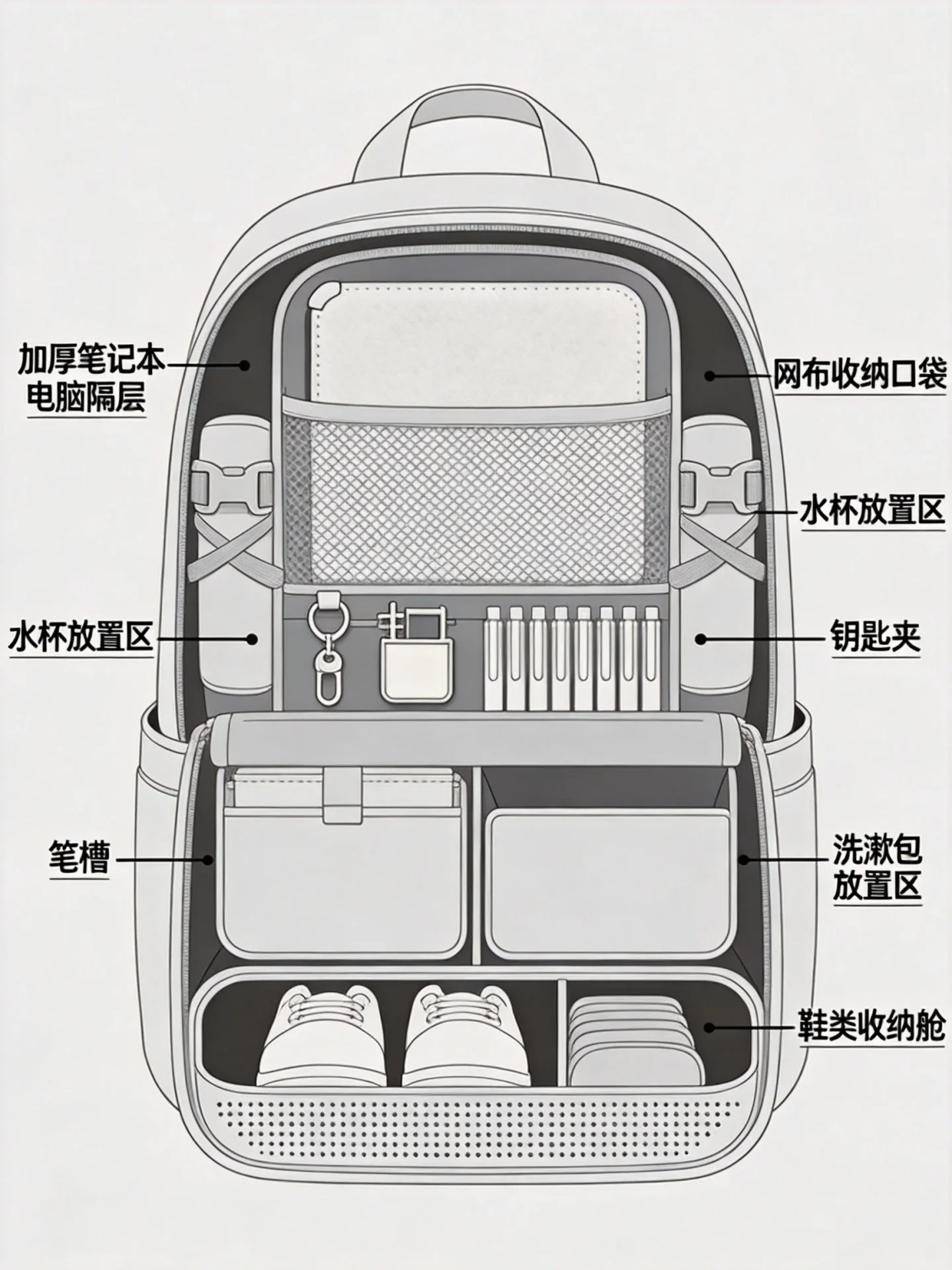
Engineered internal organization system for airline-compliant carry-on backpacks
Core Compartment Architecture
Primary Clamshell Compartment
Full-access 180-degree opening main compartment occupying 60–70% of total volume. Sized to fit 3–5 days of clothing for personal-item-compliant designs.
Dedicated Laptop Sleeve
Padded compartment for devices up to 16 inches, positioned against the back panel for optimal weight distribution and TSA screening convenience.
Front Organization Panel
Multi-slot panel with pen holders, phone pockets, key clips, and card slots. Designed for quick access without opening the main compartment.
Toiletry/Fluids Section
Waterproof-lined compartment with elastic retention, designed for TSA 3-1-1 compliance. Positioned for quick removal at security screening.
Supplementary Storage Features
- Side water bottle pocket: Elasticized or zippered, accommodates 1L bottles without exceeding carry-on width limits
- Hidden back panel pocket:RFID-blocking material for passport and phone security during transit
- Bottom shoe compartment:Separate zippered access with waterproof lining, common in 40L+ carry-on designs
- Chest strap integrated pocket:Small quick-access pocket for boarding pass or transit card
- Luggage pass-through sleeve:Allows the backpack to slide over rolling luggage handles for combined transport
Customization of Organization Layouts
Every brand we partner with has unique organization requirements based on their target customer. Through our OEM customization process, we work with brands to develop proprietary internal layouts that become part of their product identity. Our design team in Quanzhou provides 2D and 3D renderings of internal layouts before sampling begins, ensuring the final product matches the brand’s vision precisely.
OEM/ODM Customization Solutions
Partnering with a bag manufacturer in China for airline-compliant backpacks requires clear communication, structured processes, and a factory with proven expertise. Junyuan Bags, based in Quanzhou, Fujian, offers comprehensive OEM and ODM services with FOB Xiamen shipping terms, designed to take your product from concept to container in 8–16 weeks.
OEM Service — Your Design, Our Manufacturing
Provide your technical pack, tech sketch, or even a rough concept — our engineering team translates it into a production-ready airline-compliant backpack. OEM services include:
- Full design review and airline dimension compliance verification
- Material sourcing and recommendation based on target price point and durability requirements
- 2D/3D design renderings within 3–5 business days
- Pre-production sample (PP sample) with dimension verification report
- Bulk production with AQL 2.5 quality inspection
- Custom packaging, hang tags, and labeling
ODM Service — Our Designs, Your Brand
For brands seeking faster time-to-market, Junyuan Bags offers a library of pre-designed, airline-compliant backpack models ready for branding customization. ODM services include:
- Selection from 50+ existing carry-on-compliant designs
- Custom logo application (embroidery, debossing, heat transfer, woven labels)
- Color and fabric customization within existing pattern framework
- Lower MOQ requirements (as low as 100–500 units)
- Faster sampling turnaround (5–7 business days)
MOQ, Pricing & Lead Time Overview
| Service Type | MOQ | Sample Time | Bulk Lead Time | Price Range (FOB Xiamen) |
|---|---|---|---|---|
| OEM — Full Custom | 500 units | 7–10 days | 35–50 days | $8–$25 per unit |
| OEM — Minor Modification | 300 units | 5–7 days | 30–45 days | $7–$20 per unit |
| ODM — Branded | 100–500 units | 5–7 days | 25–35 days | $6–$18 per unit |
Manufacturing Process & Quality Control
At Junyuan Bags, every airline-compliant backpack passes through a rigorous 7-stage manufacturing process at our 4,950 square meters facility in Quanzhou. Our quality control system ensures dimensional accuracy within ±2mm tolerance — critical for airline compliance.
The 7-Stage Production Process
- Pattern Engineering: CAD-based pattern creation with airline dimension constraints built in
- Material Cutting: Automated cutting with 1mm precision; laser-cutting available for premium lines
- Printing & Embroidery: Logo application using screen printing, heat transfer, or multi-head embroidery
- Sewing & Assembly: Skilled operators with 5+ years average experience; bar-tack reinforcement at all stress points
- Hardware Assembly: Zipper, buckle, and strap installation with torque-tested fasteners
- Dimension Verification: Every unit measured against airline standard templates at final QC
- Packaging & Shipping: Individual poly bag packing, carton or pallet loading per client specifications
Quality Certifications
Our facility holds the following certifications relevant to backpack manufacturing:
- ISO 9001:2015 Quality Management System
- BSCI (Business Social Compliance Initiative)
- GRS (Global Recycled Standard) for sustainable material sourcing
- OEKO-TEX Standard 100 for material safety
- REACH, CPSIA, and FDA compliance for target market requirements
For brands exploring bag manufacturing options in China, we recommend requesting a factory audit or virtual tour to verify our capabilities firsthand. Contact our team to schedule a visit to our Quanzhou facility.
Frequently Asked Questions
What is the most common carry-on backpack size for US airlines?
The most common carry-on backpack size accepted by US airlines is 22 × 14 × 9 inches (56 × 36 × 23 cm). This dimension is accepted by American Airlines, Delta, United, and JetBlue. However, when designing for global compliance, we recommend targeting 21.5 × 14 × 9 inches to accommodate the most restrictive carrier standards, including several European and Asian airlines.
Can you manufacture backpacks that comply with multiple airline standards simultaneously?
Yes. As an experienced OEM manufacturer in Quanzhou, Fujian, we design backpacks to the most restrictive common standard — typically 55 × 40 × 20 cm — ensuring compliance across US, European, and Asian carriers simultaneously. Compression strap systems and expandable gussets allow the same backpack to adapt between personal item and carry-on configurations.
What is the MOQ for airline-compliant backpack OEM orders?
For full OEM customization (your design), the standard MOQ is 500 units per color. For ODM (selecting from our existing designs with your branding), MOQ starts at 100–500 units. Small brands can explore lower quantities through our MOQ negotiation strategies. All orders ship FOB Xiamen.
What materials do you recommend for lightweight airline-compliant backpacks?
For carry-on backpacks targeting weight-restricted airlines (Asian carriers with 7 kg limits), we recommend 210D–420D ripstop nylon for main panels (0.6–0.9 kg empty weight) with Cordura 500D reinforcement at the bottom panel and strap attachment points. For sustainable brands, GRS-certified recycled polyester is also available through our rPET manufacturing program.
How do you ensure dimensional accuracy in mass production?
Every production run at our Quanzhou facility includes dimension verification at three stages: cutting (automated measurement check), mid-production (inline QC check against airline dimension templates), and final inspection (100% measurement of finished units against AQL 2.5 standards). Tolerance is maintained within ±2mm of specification.
Do you offer TSA-friendly backpack design services?
Yes. Our design team in Quanzhou specializes in TSA-friendly backpack features including clamshell openings, dedicated laptop compartments with EPE padding, liquid-accessible top pockets, and non-metallic construction elements. These features can be incorporated into any OEM or ODM project.
What is the lead time from design approval to shipment?
Standard lead time is 35–50 days after sample approval for OEM orders and 25–35 days for ODM orders. Sampling takes 5–10 days. Rush orders can be accommodated with 20–25 day production timelines for an expedite fee. All orders ship FOB Xiamen port from our facility in Quanzhou, Fujian, China.
Can you produce foldable backpacks that compress to personal item size?
Absolutely. We manufacture several foldable and compressible backpack designs using side-compression straps, roll-top closures, and gusset zipper expansion systems. These designs allow a single backpack to switch between carry-on and personal item configurations, making them ideal for brands targeting versatile travel products. Request our design catalog through our contact page.
What quality certifications does your factory hold?
Junyuan Bags holds ISO 9001:2015, BSCI, GRS, OEKO-TEX Standard 100 certifications, along with REACH, CPSIA, and FDA compliance capabilities. We conduct AQL 2.5 inspection on all orders. For detailed certification documentation, please contact our sales team.
Ready to Manufacture Your Airline-Compliant Backpack?
Partner with Junyuan Bags — 12 years of backpack manufacturing excellence from Quanzhou, Fujian, China. FOB Xiamen shipping, OEM/ODM services, and MOQ as low as 100 units.
Email Us for a Quote
WhatsApp: +86 17750020688
Get free design consultation & 3D mockup within 5 business days