Short answer: the five backpack manufacturers and suppliers Canadian brands use most in 2026 are Parkland (Vancouver, recycled-material lifestyle bags), PKG Carry Goods (Toronto, family-run everyday carry), Holiday Group (Montreal, licensed luggage and soft bags), Landau Sacamoto (Montreal, private-label leather and sport bags) and JUNYUAN BAGS (Quanzhou, OEM/ODM from 500 pcs for Canadian brands that need proprietary patterns). Choose a Canadian supplier for small branded runs and an offshore OEM once you need 500+ units with full design control.
This guide is written for Canadian brand owners, importers and retail buyers specifying backpacks for retail, corporate, school or promotional programs. The five suppliers below are the same names Canadian buyers have used for years; each entry has been rebuilt around the four dimensions that actually decide an order — customisation depth, minimum order quantity, lead time and compliance documentation — so you can shortlist without a round of exploratory emails.
Quick Comparison: Canadian Backpack Manufacturers at a Glance
| Supplier | Base | Best fit | Custom MOQ | Lead time |
|---|---|---|---|---|
| Parkland | Vancouver, BC | Recycled-material lifestyle and everyday bags | Wholesale program | Quoted per project |
| PKG Carry Goods | Toronto, ON | Everyday carry, commuter and messenger bags | Wholesale program | Quoted per project |
| Holiday Group | Montreal, QC | Licensed luggage, soft bags and travel ranges | Licence-based | Quoted per project |
| Landau Sacamoto | Montreal, QC | Private-label handbags, wallets and sport bags | Quoted per project | Quoted per project |
| JUNYUAN BAGS | Quanzhou, Fujian, China — FOB Xiamen | Custom OEM/ODM backpack programs at volume | 500 pcs | Sample 6–10 days; bulk 35–50 days |
How We Assessed These Suppliers
Four criteria separate a supplier you can build a program around from one that looks good on a website.
Customisation depth. Printing a logo on a stock bag is decoration, not manufacturing. A genuine custom program starts from a technical drawing and covers pattern, fabric, lining, hardware, zip specification, internal organisation, labelling and packaging. Ask any supplier for the last three custom patterns they developed and request one tech pack as evidence.
Minimum order quantity and sampling speed. MOQ decides how much capital is tied up before the product is proven. Sampling speed decides how many design iterations fit inside a launch window. A supplier at 6–10 days per sample gives you four iterations in a season; a supplier at eight weeks gives you one.
Compliance documentation. Canadian retail listings increasingly require restricted-substance declarations, bilingual labelling artwork and accurate country-of-origin statements. A supplier who cannot produce these on request delays your listing, not just your production.
Landed cost and logistics. FOB terms, port of loading, carton cube and gross weight determine landed cost as much as unit price. A quote that is 5% cheaper with 20% worse carton cube loses money on a 500-piece sea shipment to Vancouver or Montreal.
1. Parkland
Established: 2015
Location: Vancouver, British Columbia
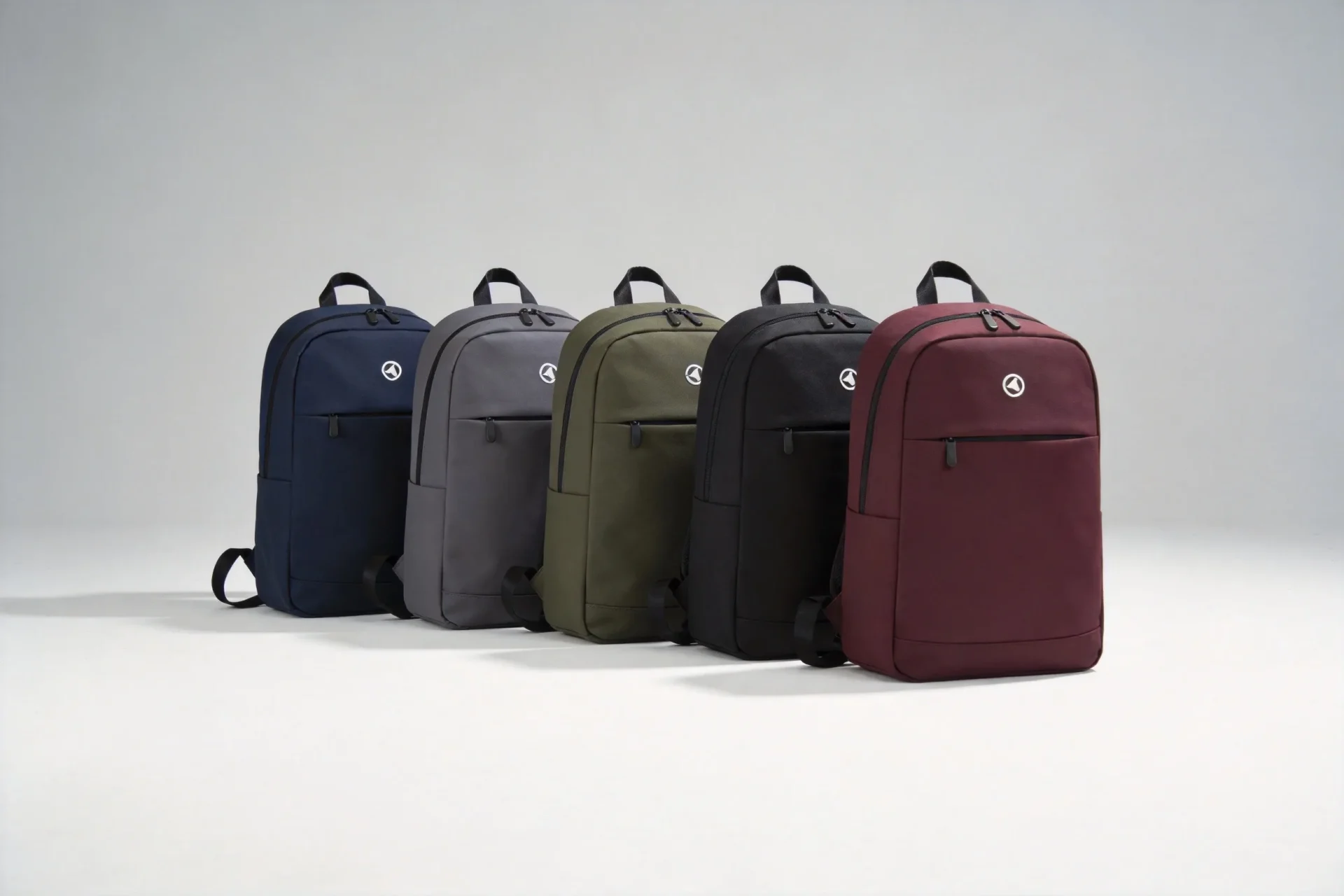
Parkland Design & Manufacturing builds bags and accessories for everyday use, and its defining specification is material: the exterior fabric of Parkland products is made from 100% recycled water bottles. That single decision positions the brand in the sustainability segment, where Canadian retail buyers — particularly outdoor, campus and grocery-channel accounts — now ask sustainability questions before they ask price questions.
For a buyer, Parkland’s relevance is as a benchmark rather than a factory. It shows what a recycled-content program has to look like to be credible: consistent recycled feedstock, a traceable supply chain statement, and a price point that still works at retail. If you are building a recycled RPET backpack line, the practical lesson is that the shell fabric decision drives both your sustainability claim and your cost — specify the recycled content percentage and the certification route before you approve any sample. Parkland products are sold through select retailers only, so it operates as a wholesale brand rather than a contract manufacturer.
2. PKG Carry Goods
Founded: 2009
Location: Toronto, Ontario
PKG Carry Goods is a Canadian, family-run business producing men’s backpacks, women’s backpacks and messenger bags. Its design focus is versatility and durability for urban everyday carry — laptop protection, organised front compartments, weather-resistant shells — and it is well established in the Canadian local market.
As a supplier profile, PKG represents the mid-market Canadian brand model: design and brand owned domestically, production sourced abroad, distribution through Canadian retail. That is precisely the structure most Canadian labels end up with, and it is worth understanding why. Domestic cut-and-sew capacity in Canada is limited and priced for small runs; a brand that wants 3,000 units a year across four styles almost always sources offshore and keeps design, marketing and fulfilment in Canada.
3. Holiday Group
Founded: 1952 (Holiday Group); Travelpro founded 1984
Location: Montreal, Quebec
Holiday Group has led the Canadian luggage and soft-goods industry primarily through licensing since 1952. The group’s product range has expanded from luggage into business cases, camera and media bags, backpacks, sports bags, hockey bags, ski and board bags, handbags, lunch bags, cosmetic bags, children’s bags, small leather goods, travel accessories and umbrellas. Travelpro, founded in 1984 by an airline pilot, holds eleven patents with six pending and invented the first rolling vertical carry-on, the Rollaboard.
The licensing model is the key detail for anyone approaching Holiday Group. Licensing means the brand name is granted to a manufacturer or distributor for a territory or category, with the licensee carrying production and inventory risk. For a Canadian brand owner, this is a route to scale through an established name rather than a route to manufacturing your own design. If your goal is a proprietary backpack pattern, licensing does not solve it — an OEM program does.
4. Landau Sacamoto
Location: Montreal, Quebec
Landau Sacamoto Inc. is a Canadian-owned private corporation engaged in the design, manufacturing and distribution of handbags, wallets, sport bags and travel accessories. It is the closest thing on this list to a Canadian contract manufacturer with genuine private-label capability across leather goods and soft bags.
That makes it the right first call for a Canadian brand building a leather or leather-trim line — a product where material hand-feel, edge finishing and hardware quality carry the price point, and where a local sample room shortens the review cycle. For a polyester school, commuter or promotional backpack at 500+ units per colourway, local labour cost pushes the unit price well above an offshore FOB quote, and that is the point at which buyers move production offshore while keeping design in Canada.
5. JUNYUAN BAGS
Established: 22 August 2014 (founding team in bag manufacturing since 2004)
Location: Quanzhou, Fujian, China — FOB Xiamen
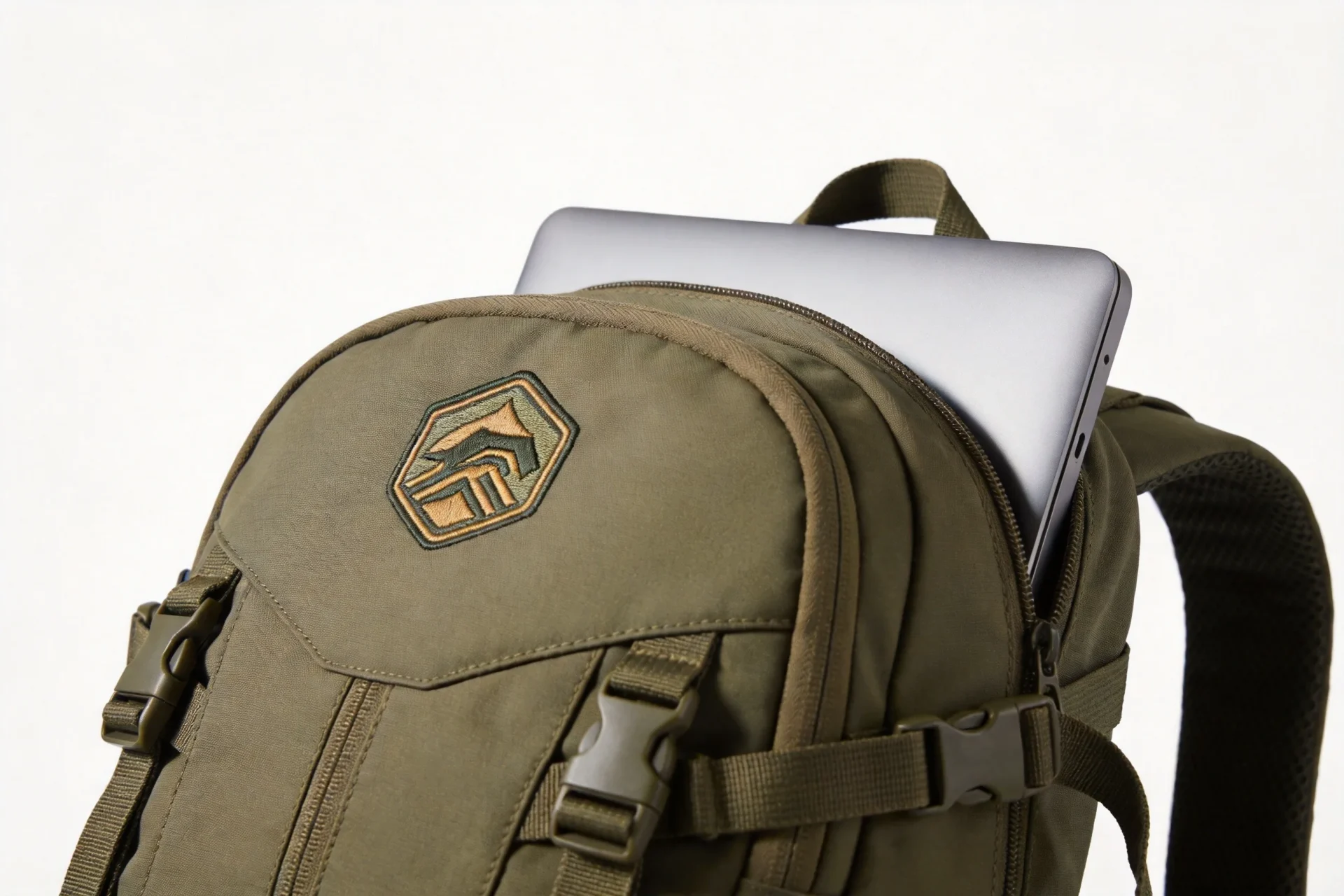
JUNYUAN BAGS is the offshore OEM/ODM option on this list, and for Canadian brands specifying 500 units or more it is the lowest landed-cost route to a genuinely proprietary backpack. We work from your tech pack or a reference sample and return a quotation, a pattern review and a pre-production sample; nothing enters bulk production until that sample is approved in writing.
Commercial terms are fixed rather than negotiated case by case: MOQ 500 pcs for custom backpack programs, sampling in 6–10 days, bulk production 35–50 days after deposit and sample approval, inspection to AQL 2.5 before shipment, and goods shipped FOB Xiamen. FOB terms matter for Canadian importers because you keep control of the freight forwarder, the consolidation and the marine insurance, which means you can compare two factory quotes with the freight variable held constant.
Customisation covers the whole bag: 600D/900D polyester, recycled RPET, nylon, canvas and coated shells; zip specifications matched to your target price point; padded or suspended laptop sleeves; EVA back panels and load-bearing harness; custom webbing, buckles, pulls and metal hardware; sublimation, screen print, embroidery, heat transfer and silicone badges; and retail-ready polybag, hangtag or gift-box packaging. Barcodes, carton marks and mixed-carton assortments are handled at packing, which matters for Canadian retailers receiving direct to store.
Documentation ships with the order: restricted-substance and AZO test reports from accredited third-party laboratories, fibre-composition data per component for bilingual labelling, and a country-of-origin statement. If you are new to offshore sourcing, our complete guide to custom backpack manufacturing covers the sequence from drawing to shipment, and OEM vs ODM vs private label explains which model fits which stage of brand growth.
Canadian Manufacturer or Offshore OEM? The Cost Math
Canadian buyers comparing a domestic quote with an offshore quote usually compare two different things. The domestic figure is delivered, duty-paid and tax-inclusive. The offshore figure is FOB — goods loaded at Xiamen, with freight, insurance, duty and taxes still to be added.
Build a landed-cost sheet with five lines before you decide: FOB unit cost; freight per unit (total freight divided by units, using actual carton cube); marine insurance; Canada Border Services Agency duty at the applicable tariff classification; and GST/HST. Only then is the offshore quote comparable to a Canadian delivered price. At 500+ units the offshore route is normally substantially cheaper even after all five lines; below roughly 200 units, freight per unit can exceed the manufacturing cost and domestic supply wins on total cost and speed.
Carton engineering is where programs quietly lose money. A style that packs 20 units per carton at 0.09 cbm costs less per unit to ship than one packing 15 units at 0.10 cbm, at identical FOB prices. Ask for carton dimensions and gross weight inside the quotation, not after production.
Compliance and Labelling for the Canadian Market
Three requirements apply to backpacks sold in Canada, and each one needs a document rather than an assurance.
Bilingual labelling. Consumer packaging and labelling in Canada requires English and French for prescribed information. For a backpack this covers product identification, fibre content, care instructions, importer identity and country of origin. Build the bilingual artwork into the sampling stage — retrofitting French onto packaging after print approval is the most common avoidable delay in Canadian programs.
Product safety. Under the Canada Consumer Product Safety Act, suppliers must not manufacture, import or sell consumer products that pose a danger to health or safety, and must report incidents. For children’s backpacks, pay particular attention to small parts, cord and loop strangulation hazards, and any button cell battery in an attached light or tracker, which is regulated separately.
Textile labelling and origin. Fibre content must be accurate by percentage, and care instructions must be truthful for the material used. Country-of-origin marking must be accurate; “Made in Canada” has a defined threshold under the Consumer Packaging and Labelling Act, and a bag assembled abroad from imported components cannot claim it. If your brand leans on Canadian identity, review the wording before packaging print.
On restricted substances, Canadian retailers increasingly reference European and US lists. Specify up front that you need test reports covering AZO dyes, phthalates, formaldehyde, lead and cadmium from an accredited third-party laboratory, and confirm who pays for the test and in whose name the report is issued.
MOQ, Sampling and Lead Times: What to Expect in 2026
The three numbers that decide whether a program is feasible are MOQ, sample time and bulk lead time. For a custom backpack at JUNYUAN BAGS they are 500 pcs, 6–10 days for a pre-production sample, and 35–50 days for bulk after deposit and sample approval. Add 3–5 weeks of ocean freight to Vancouver or Montreal, plus clearance.
Work backwards from your retail window rather than forwards from today. A back-to-school program that must land in Canadian stores by mid-July needs goods leaving Xiamen by early June, which means bulk starting in late April, which means an approved sample by mid-April, which means a tech pack in the factory by late March. Brands that start in May ask for air freight and pay three to five times more per unit for the same product.
If your volume does not reach 500 pcs, the practical answer is usually to launch one style across two or three colourways instead of three styles at low volume. Our guide to MOQ strategies for small brands covers the alternatives, and our article on supplier payment terms explains how deposit and balance structures allocate risk.
Conclusion
Finding a good backpack manufacturer is a documentation exercise, not a search exercise. The five suppliers above cover the realistic Canadian options: Parkland for a recycled-material benchmark, PKG for the domestic-brand-offshore-production model, Holiday Group for licensing at scale, Landau Sacamoto for Canadian private-label leather goods, and JUNYUAN BAGS for proprietary OEM/ODM programs at 500 pcs and above.
Shortlist by asking each supplier for four things in the first reply: a sample lead time, a carton cube, the documentation package, and a quote against your actual tech pack rather than a catalogue page. The supplier who answers all four precisely is the one worth a deposit. For a wider comparison, see our guides to top custom backpack manufacturers in China, high-volume bag manufacturing hubs in Asia and waterproof backpack manufacturers for outdoor brands.
Frequently Asked Questions
What is the minimum order quantity for custom backpacks in Canada?
At JUNYUAN BAGS a custom backpack program starts at 500 pcs per style. That covers your own pattern, fabric and colour selection, custom labelling and retail packaging, with mixed colourways accepted inside the 500 pcs. Canadian suppliers on this list quote MOQ per project, and their minimums are typically lower but priced at domestic labour rates.
How long does it take to get a backpack sample from a Chinese manufacturer?
Pre-production sampling takes 6–10 days after we receive your tech pack, artwork and any reference sample. That window includes pattern making, material sourcing and one physical sample. If the design uses a fabric or hardware item we do not hold, sourcing time is added and confirmed in the quotation rather than discovered mid-project.
What is the production lead time for a 500-piece backpack order?
Bulk production runs 35–50 days after deposit receipt and written sample approval. Single-colour programs on stocked materials sit at the low end; multi-colour, multi-style orders with custom hardware or sublimation sit at the high end. Add 3–5 weeks of ocean freight to Vancouver or Montreal plus customs clearance.
Is it cheaper to manufacture backpacks in Canada or import them?
Importing is cheaper at volume, with the crossover usually around a few hundred units. Canadian cut-and-sew capacity is limited and priced for small runs, so at 500 pcs an offshore FOB price is typically a fraction of a domestic quote. Below roughly 200 units, freight and clearance per unit erode that advantage and domestic supply often wins on total cost and speed.
What duties and taxes apply to backpacks imported into Canada?
Backpacks are dutiable under Canada’s customs tariff, and GST/HST applies on the duty-paid value. The exact rate depends on the bag’s outer material and construction, so confirm classification with a licensed customs broker before you set a retail price. Also confirm whether CARM registration and importer-of-record obligations apply to your business.
Do backpacks sold in Canada need bilingual English and French labels?
Prescribed information on consumer packaging must appear in both English and French. For a backpack that covers product identification, fibre content, care instructions, importer identity and country of origin. Build the bilingual artwork into sampling, because retrofitting French after print approval is the most common avoidable delay in Canadian backpack programs.
Which fabrics work best for Canadian winters?
For winter and commuter programs, specify a water-repellent 600D polyester or recycled RPET shell, because road salt and slush degrade surface-dyed fabric quickly. Avoid PVC-coated shells that stiffen below -10°C. For hardware, specify metal or cold-resistant acetal buckles; cheap brittle plastic is the first component to fail in a Canadian winter.
How is quality inspected before shipment?
Every order is inspected to AQL 2.5, covering critical, major and minor defects on a defined sample size drawn from finished cartons. Inspection covers stitch density, seam strength, zip function, hardware attachment, measurement against specification, label placement and packaging. You receive the report with photographs before goods leave, so any claim is settled against documented evidence.
Can you match Pantone colours and apply my logo?
Yes. Fabric and webbing are matched to Pantone TCX references, and logo application covers embroidery, screen print, heat transfer, silicone badge, rubber patch, woven label and metal plate. A physical proof is produced for logo and colour approval before bulk. Small dye-lot variation is normal in fabric; the approved standard is documented and held as the reference for repeat orders.
What compliance documents can you supply for Canadian retail?
We supply restricted-substance test reports from accredited third-party laboratories covering AZO dyes, phthalates, formaldehyde, lead and cadmium; fibre composition per component for bilingual labelling; care-instruction artwork; and a country-of-origin statement. Reports are issued against the specific materials and colourways ordered, so they are valid for that program rather than as a generic certificate.
What payment terms are normal for a first order from Canada?
A standard first order uses a deposit and balance structure: a percentage with the order to fund materials, and the balance against the bill of lading or before shipment. Terms become more flexible as the relationship matures. Our article on supplier payment terms sets out the structures and the risk each one places on buyer and factory.
How do you ship 500 backpacks from Xiamen to Vancouver or Montreal?
At 500 units, sea LCL is usually the cheapest option and air freight the fastest. A commuter backpack typically packs 15–25 units per carton, so 500 units occupies roughly 1.5–3 cbm and consolidates well. We ship FOB Xiamen, so you nominate the forwarder and we deliver to the nominated warehouse with carton marks and packing list ready.
What is AQL 2.5 and why does it matter?
AQL 2.5 is the acceptance quality limit applied at final inspection: it defines how many defects are tolerated in a sample before the whole lot is rejected. It matters because it turns “we check quality” into a measurable contract term. Without a stated AQL, a buyer has no objective basis to reject a shipment and a factory has no objective target.
How do you protect my design from being copied?
We manufacture to your pattern and do not resell your design, and we will sign a non-disclosure and non-reproduction agreement before receiving a tech pack. Practical protection also comes from your side: register the design where registrable, keep technical drawings off shared drives, and avoid publishing unlaunched product photography before the first shipment clears.
Which supplier should a Canadian startup contact first?
If the goal is a proprietary design at retail-ready quality, contact JUNYUAN BAGS first and request a quote against your tech pack, because you learn the real cost and lead time of your design in one step. If the goal is a small branded run for a local client, contact Landau Sacamoto or PKG’s wholesale channel. Both answers are legitimate; they serve different business models.
Next Steps
The fastest way to settle the local-versus-offshore question is to test it with real numbers. Send the same specification to one Canadian supplier and one offshore OEM, then compare four lines: sample lead time, carton cube, documentation package and landed cost per unit. That comparison resolves the decision for your specific program in about two weeks.
JUNYUAN BAGS manufactures custom backpacks and bags for Canadian brands from Quanzhou, Fujian — incorporated 22 August 2014, with a founding team in the trade since 2004. Custom backpack programs start at 500 pcs, sampling takes 6–10 days, bulk production 35–50 days, inspection is to AQL 2.5, and goods ship FOB Xiamen. To start, send your tech pack or a reference sample and we will return a quotation, a pattern review and a sampling schedule.