
If you’re in the custom bag manufacturing business, certifications can make or break your market access and reputation. Here’s why: Buyers and regulators demand proof of compliance with quality, ethical labor, and safety standards. Certifications like ISO 9001, ISO 14001, BSCI, GRS, and others validate your processes and materials, ensuring you meet global expectations for quality, social responsibility, and environmental safety.
Key Takeaways:
- ISO 9001: Ensures product quality and process consistency.
- ISO 14001: Focuses on reducing environmental impact across the product lifecycle.
- BSCI: Verifies ethical labor practices and safe working conditions.
- GRS: Confirms the use of recycled materials and responsible production methods.
- SA8000: Promotes ethical treatment of workers and fair labor standards.
- SMETA: Simplifies social and ethical auditing for global supply chains.
- GOTS: Certifies organic textile production.
- FSC: Tracks responsibly sourced forest-based materials like paper or wood.
- REACH: Ensures chemical safety for products sold in the EU.
Why It Matters:
These certifications not only meet regulatory requirements but also boost buyer trust. For instance, 73% of consumers prefer sustainable brands, and certifications like GRS or BSCI can directly influence purchasing decisions.
Cost & Timeline:
- Certification costs range from $3,000 to $15,000, depending on the standard and factory size.
- Processes typically take 3–8 months, with annual renewals or audits required.
Pro Tip: Collaborate with suppliers to share certification costs and streamline compliance. Tools like Trello or Notion can help track deadlines and audits efficiently.
Investing in these certifications is a smart move for long-term growth, especially with evolving regulations like the EU’s Corporate Sustainability Reporting Directive. Factories like JUNYUAN BAGS are already leveraging these credentials to meet buyer expectations and stay competitive globally.
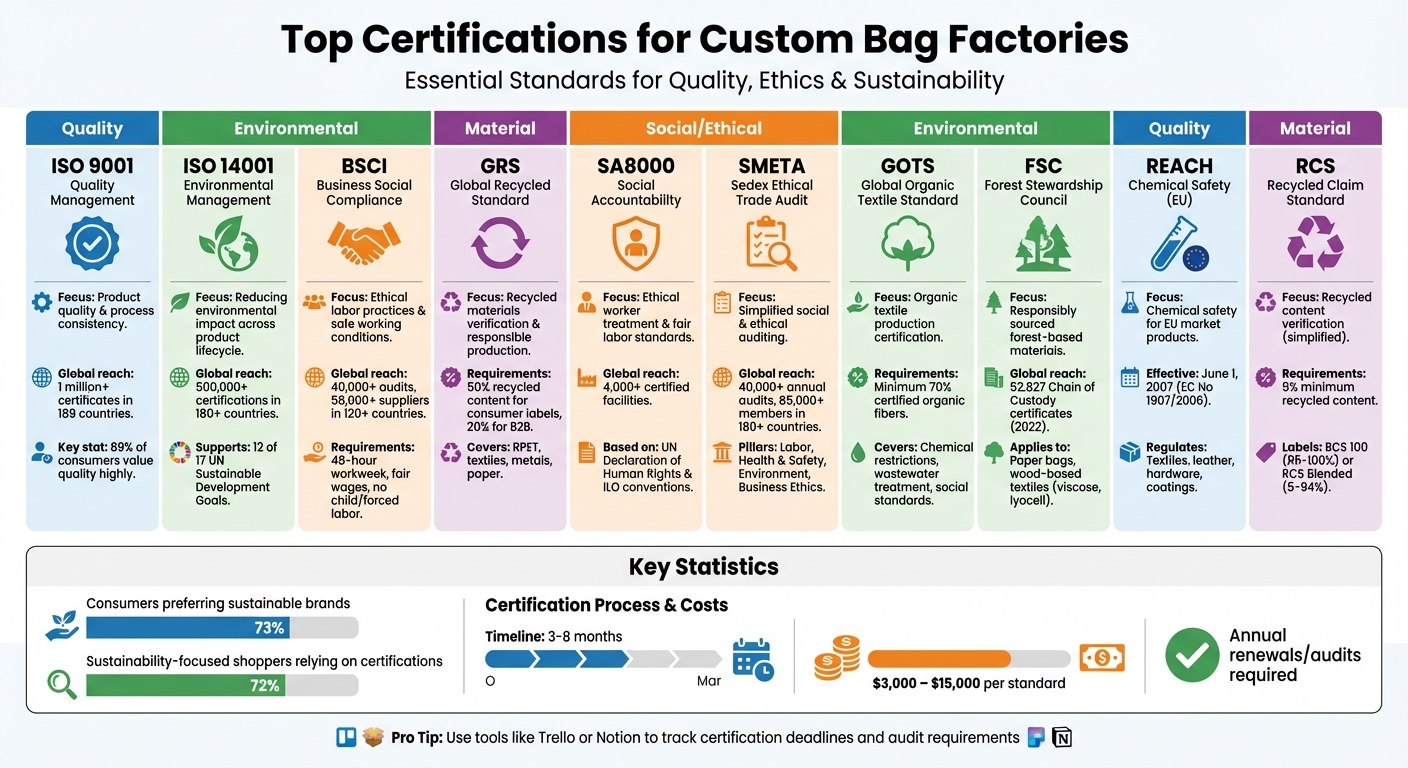
Top 10 Certifications for Custom Bag Factories: Requirements, Costs & Benefits Comparison
1. ISO 9001 Quality Management Systems
ISO 9001:2015 is recognized worldwide as the standard for Quality Management Systems (QMS), with over 1 million certificates issued in 189 countries. For custom bag factories, this certification provides a structured approach to ensure consistent quality throughout the entire production process – from sourcing raw materials to final inspections and delivery.
To achieve certification, factories must document their quality policies, outline production workflows, and conduct internal audits over a three-month period. This is followed by a two-stage independent assessment. Additionally, factories are required to keep detailed records of employee training, production processes, and corrective actions. Starting in 2024, organizations must also assess how climate change could impact their ability to meet quality management objectives. The table below highlights how ISO 9001 applies specifically to bag manufacturing.
| ISO 9001 Section | Application to Bag Factories |
|---|---|
| Section 5: Leadership | Management must demonstrate commitment to quality and customer focus. |
| Section 7: Support | Ensuring staff are properly trained and maintaining accurate documentation. |
| Section 8: Operation | Overseeing the entire product lifecycle, including design, sourcing, and production. |
| Section 9: Performance | Tracking customer satisfaction and performing regular internal audits. |
| Section 10: Improvement | Addressing and resolving issues with nonconforming products. |
Quality is a top priority for consumers – 89% value it highly, and 72% of sustainability-focused shoppers rely on certifications like ISO 9001 when making purchasing decisions. High-volume manufacturers, in particular, reap the benefits of this system. GreenWing Packaging emphasizes its importance:
"ISO 9001 is the gold standard for consistent product quality and process control. For a factory like ours producing 5 million bags daily, ISO 9001 keeps the engine running smoothly".
Ishtiak Parag, Managing Director of Victor Bags Factory Ltd., also shares practical advice:
"Use simple AI tools to track your manufacturing certifications deadlines and audit requirements – free apps like Trello or Notion can automate 80% of the paperwork, letting you focus on actual compliance instead of admin chaos".
At JUNYUAN BAGS, ISO 9001 is central to maintaining quality standards, ensuring compliance throughout the production lifecycle, and meeting industry expectations.
2. ISO 14001 Environmental Management Systems
ISO 14001:2015 provides a structured framework for managing environmental impacts, with over 500,000 certifications issued across more than 180 countries. For custom bag factories, this certification ensures a systematic approach to addressing environmental concerns throughout the product lifecycle – from sourcing raw materials to production and final disposal.
The standard requires factories to pinpoint key "environmental aspects" such as fabric waste, chemical usage, water consumption, and energy emissions, aiming to minimize their impact. Its focus is squarely on improving environmental performance and optimizing resource use. As SGS explains:
"ISO 14001 applies to all organizations and the environmental aspects of their activities, products and services that can control or influence, from a life-cycle perspective".
To achieve certification, factories must operate their Environmental Management System (EMS) for at least three months, conduct internal audits, and pass a two-stage external assessment. This process typically costs between $3,000 and $15,000 and takes 3 to 8 months to complete. After certification, factories must undergo annual surveillance audits and renew their certification every three years. The standard supports 12 out of the 17 United Nations Sustainable Development Goals, including Goal 12 (Responsible Consumption and Production) and Goal 13 (Climate Action).
ISO 14001 integrates smoothly with other standards, creating a cohesive sustainability strategy. For example, JUNYUAN BAGS uses ISO 14001 alongside BSCI to meet both environmental and social compliance requirements. Its "High Level Structure" (Annex SL) enables seamless alignment with ISO 9001, cutting down on duplicate documentation and audit costs. With stricter ESG reporting regulations, such as the EU’s Corporate Sustainability Reporting Directive, ISO 14001 is increasingly vital for factories catering to global markets, ensuring compliance from material sourcing to the product’s end-of-life stage.
3. BSCI Business Social Compliance Initiative
The Business Social Compliance Initiative (BSCI), launched by Amfori in 2003, is a standardized system designed to improve working conditions and promote ethical labor practices across global supply chains. By following International Labor Organization (ILO) standards, it helps factories gradually adopt social responsibility measures. In 2024 alone, the BSCI framework facilitated over 40,000 social audits, covering more than 58,000 registered suppliers in 120+ sourcing countries. This system serves as a foundational tool for aligning with broader compliance standards throughout a product’s lifecycle.
For custom bag manufacturers, BSCI focuses on key aspects of ethical production, such as fair wages, safe working environments, a 48-hour workweek, and the elimination of child and forced labor. It also addresses environmental concerns through Performance Area 12, which requires factories to manage waste responsibly, reduce emissions, and handle chemicals used in dyes and treatments safely. As Amfori explains:
"The ultimate goal of BSCI is protecting the workers’ rights and benefits in compliance of local and international requirements".
The BSCI audit process is thorough, involving on-site inspections, employee interviews, and reviews of critical documents like payroll, working hours, occupational health and safety (OHS) training records, and waste disposal logs. Factories receive grades ranging from A (Outstanding) to E (Unacceptable). Grades A and B are valid for two years, while lower scores require a follow-up audit within 2 to 12 months. To prepare, factories are encouraged to conduct a self-assessment 1 to 3 months before the official audit, addressing issues such as fire safety or wage documentation.
One advantage of BSCI is its ability to reduce "audit fatigue" by providing a single, unified report accepted by numerous international retailers and brands. It complements certifications like ISO 14001 by combining social and environmental compliance, which is especially important for sustainable custom bag production. For instance, JUNYUAN BAGS leverages both BSCI and ISO 14001 to meet these dual compliance goals. With over 2,400 active members in its network, BSCI is particularly relevant for bag manufacturers targeting European markets or adhering to strong Corporate Social Responsibility (CSR) policies. This integration strengthens the overall compliance framework, making it a valuable tool for ethical and sustainable manufacturing.
4. SA8000 Social Accountability
SA8000 is a globally recognized social certification standard rooted in the principles of the Universal Declaration of Human Rights and the conventions of the International Labour Organization (ILO). It provides a structured framework for custom bag factories to incorporate ethical practices into their daily operations and supply chain management. This certification emphasizes a commitment to ethical and sustainable production, impacting millions of workers across more than 4,000 facilities worldwide.
The standard addresses nine key areas, including child labor, forced labor, health and safety, and fair compensation. Unlike traditional checklist-style audits, SA8000 employs a management-systems approach, encouraging ongoing improvement. Factories are required to establish internal processes to monitor their social performance, manage supplier relationships, and maintain accountability at every level of their operations.
Achieving SA8000 certification involves a two-phase audit process. The first phase assesses readiness, while the second phase includes a thorough 10-day review featuring inspections, document evaluations, and employee interviews. Any identified non-compliances must be addressed immediately. Factories are also required to maintain detailed records on worker hours, wages, and supplier oversight. Once certified, the SA8000 certificate remains valid for three years, with follow-up surveillance audits conducted every six months to ensure ongoing compliance.
For bag manufacturers, SA8000 offers more than just ethical validation. Partha Sengupta, Vice President of Corporate Services at Tata Steel, highlights its broader impact:
"SA8000 concepts are incorporated in our everyday decisions from supply chain management to workplace issues".
Industry experts agree that SA8000 certification can enhance quality, boost productivity, and build employee loyalty.
A vital component of SA8000 is supplier control, which ensures that all material providers adhere to the same social accountability standards. This aligns seamlessly with certifications like GRS or GOTS, creating a fully ethical production chain. Additionally, the Social Accountability International (SAI) organization is currently revising the standard for SA8000:2026 to address emerging human rights challenges and integrate modern best practices into global supply chains.
5. Sedex/SMETA Audits
SMETA (Sedex Members Ethical Trade Audit) is one of the most widely used social audit methodologies globally. It evaluates key areas like working conditions, health and safety, environmental practices, and business ethics. For custom bag factories, this framework offers a practical way to align with international labor standards while reducing the need for multiple audits from different buyers. It not only meets buyer expectations but also simplifies the audit process for factories operating in global markets.
Unlike traditional certifications that rely on a pass/fail system, SMETA provides a detailed overview of a factory’s compliance. The audit can focus on two pillars – Labor Standards and Health & Safety – or expand to four pillars by including Environment and Business Ethics. Each year, over 40,000 SMETA audits are conducted and uploaded to the Sedex platform, which connects more than 85,000 members across 180+ countries. This shared platform allows manufacturers to conduct a single audit and share the results with multiple global buyers, cutting down on repetitive assessments.
SMETA audits also complement other certifications by focusing on continuous improvement. Independent third-party Affiliate Audit Companies (AACs) carry out on-site evaluations that include reviewing documentation, touring facilities, and interviewing workers. Compliance is assessed against the Ethical Trade Initiative (ETI) Base Code, International Labour Organization (ILO) Conventions, and local regulations. Instead of a simple pass or fail, factories receive a Corrective Action Plan (CAP) that outlines specific areas for improvement. As Sedex explains:
"Instead of focusing on passing or failing, SMETA audits provide Corrective Action Plans to help improve supplier performance and resolve issues found in the audit".
To prepare for a SMETA audit, factories must register as Sedex members and maintain an active account on the platform. The latest version, SMETA 7, includes a Management Systems Assessment to identify risks and evaluate factory systems. Bag manufacturers can use the SMETA toolkit and e-learning modules to better understand documentation requirements. On-site audits usually take between one and four days to complete. For JUNYUAN BAGS, this integrated audit process aligns with their broader commitment to verified sustainability.
6. GRS Global Recycled Standard
The Global Recycled Standard (GRS) is a third-party certification designed to verify the use of recycled content in products while promoting responsible social, environmental, and chemical practices throughout the production process. For custom bag manufacturers, this certification applies to recycled materials like plastics (RPET), textiles, metals, and paper. What sets GRS apart is its ability to track recycled materials from start to finish through a Chain of Custody model based on the CCS framework. It works hand-in-hand with other sustainability standards to ensure recycled materials are authentic and traceable.
The certification focuses on four key areas:
- Recycled content verification: Ensures materials align with ISO 14021 definitions.
- Social responsibility: Enforces compliance with International Labour Organization labor standards.
- Environmental management: Monitors energy use and wastewater treatment.
- Chemical restrictions: Prohibits the use of harmful substances.
Products must meet specific thresholds for recycled content – 20% for B2B applications and 50% for consumer-facing labels. As Textile Exchange highlights:
"The GRS includes a higher (50%) minimum recycled content percentage and additional social and environmental requirements related to processing and chemical use".
To achieve certification, factories need two documents:
- Scope Certificate (SC): Confirms the facility is authorized to handle GRS materials.
- Transaction Certificate (TC): Verifies that individual shipments contain authentic recycled content.
Without a valid TC for each batch, recycled content claims cannot be substantiated. Certification costs generally range from $3,000 to $8,000 per facility annually, with certificates valid for one year and requiring yearly audits for renewal.
Factories aiming for GRS certification must adopt rigorous material segregation practices to ensure recycled materials remain separate from conventional ones during storage and production. Additionally, they need to prepare documentation like material purchase records, production flow charts, chemical inventories, and environmental permits – usually 2–6 months before their audit. Before using the GRS logo, manufacturers must submit their artwork and a Labelling Release form for approval by the certification body.
Looking ahead, Textile Exchange plans to replace GRS with the Materials Matter Standard starting December 12, 2025, with full implementation required by December 31, 2027. For companies like JUNYUAN BAGS, GRS certification not only ensures the integration of recycled materials into their custom bag designs but also promotes transparency and compliance throughout the production process.
sbb-itb-1e6451b
7. RCS Recycled Claim Standard
The Recycled Claim Standard (RCS) is an international, voluntary chain-of-custody standard that helps custom bag manufacturers verify the recycled content in their products. Unlike the Global Recycled Standard (GRS), which requires at least 50% recycled material for consumer labeling, RCS certification is available for products containing as little as 5% recycled content. This lower threshold makes it especially useful for factories working with blended materials or those just beginning their efforts to incorporate recycled content. The standard uses the Content Claim Standard (CCS) framework to track recycled materials – such as recycled polyester and PET fabrics – from the recycling stage to the final business-to-business transaction. This focused tracking simplifies the audit process, making verification more straightforward.
RCS focuses exclusively on material integrity and traceability, without addressing chemical usage or broader social and environmental factors. Textile Exchange clarifies this approach:
"The Recycled Claim Standard (RCS) is a chain of custody standard to verify and track recycled raw materials through the supply chain. It does not address the use of chemicals or any social or environmental aspects of production beyond the integrity of the recycled material."
This narrower focus means factories face fewer compliance layers, concentrating solely on the tracking and verification of recycled materials, unlike the more extensive requirements of GRS.
RCS certification offers two label categories based on the percentage of recycled content: RCS 100 applies to products made with 95% to 100% recycled material, while RCS Blended applies to products containing between 5% and 94% recycled material. Both categories require Scope Certificates (SC) and Transaction Certificates (TC), along with documentation verifying that all recycled inputs meet ISO’s definition of "recycled", which includes both pre-consumer and post-consumer materials.
Textile Exchange has introduced the Materials Matter Standard to replace individual standards like RCS, with a mandatory transition deadline set for the end of 2027. Manufacturers currently holding or seeking RCS certification will need to review and adapt to the new criteria to ensure compliance. These changes highlight the importance of staying flexible and proactive with certification strategies.
For manufacturers like JUNYUAN BAGS, which incorporate recycled materials into their custom bag designs, RCS offers a straightforward way to validate recycled content claims. By using RCS certification, JUNYUAN BAGS not only ensures material authenticity but also takes a step toward achieving broader sustainability goals in alignment with evolving industry standards.
8. GOTS Global Organic Textile Standard
The Global Organic Textile Standard (GOTS) sets the benchmark for organic fiber processing throughout the entire production chain. For a custom bag factory to achieve this certification, it must meet strict requirements, from sourcing materials to the final stages of trading. To carry the GOTS label, a bag must contain at least 70% certified organic fibers.
GOTS certification ensures adherence to key production criteria that promote compliance with sustainable practices. The certification process is divided into three scopes:
- Scope 1 covers mechanical processing activities like cutting and sewing.
- Scope 2 applies to in-house wet processing, including dyeing and finishing.
- Scope 3 focuses on trading or exporting finished products.
Each scope requires annual on-site inspections, which involve reviewing records, wastewater treatment processes, and worker compliance.
Two essential documents form the backbone of the certification process. The Scope Certificate (SC) confirms that a factory is equipped to produce GOTS-compliant goods. Meanwhile, Transaction Certificates (TCs) ensure that specific shipments meet organic standards. Every supplier in the chain, from fabric mills to component providers, must submit TCs to guarantee traceability.
As GOTS outlines:
"The GOTS quality assurance system requires that beyond the entire processing and manufacturing chain… also B2B traders… must participate in the inspection and certification programme before the final products can be labelled as GOTS certified."
The certification also imposes strict rules on chemical inputs, permitting only low-impact dyes and auxiliaries that meet approved standards. Accessories are tested against a Restricted Substances List to ensure safety. Additionally, GOTS mandates wastewater treatment systems, monitors energy and water usage, and enforces social standards. These include prohibitions on child and forced labor, requirements for fair wages, and ensuring safe working conditions.
Companies like JUNYUAN BAGS, known for their custom bag designs, depend on GOTS certification to produce organic bags that align with rigorous environmental and ethical criteria. The certification fee starts at €150 (approximately $165) per facility, with additional costs based on the factory’s location and size. Before using the GOTS logo, factories must submit a "Labelling Release" form.
9. FSC Forest Stewardship Council Chain of Custody
The FSC Chain of Custody (CoC) certification is essential for custom bag factories that use forest-based materials like paper for shopping bags or wood-based textiles such as viscose or lyocell for linings and straps. Factories working with these materials must obtain FSC certification to label their products accordingly.
This certification ensures that forest-based materials are responsibly sourced and tracked throughout the entire production process – from procurement and storage to manufacturing and final sale. Factories must either keep FSC-certified materials separate from non-certified ones or mix them only under strict, approved guidelines. Four key FSC standards guide this process:
- FSC-STD-40-004: Chain of Custody management
- FSC-STD-50-001: Trademark use
- FSC-STD-40-007: Recycled fibers
- FSC-STD-40-005: Controlled wood sourcing
Here’s how FSC labels break down by material composition and typical applications:
| FSC Label Type | Material Composition | Common Bag Applications |
|---|---|---|
| FSC 100% | Materials entirely from FSC-certified forests | High-end paper shopping bags, gift bags |
| FSC Mix | A blend of certified, recycled, and/or controlled wood | Standard paper bags with partial certification |
| FSC Recycled | Exclusively reclaimed materials | Eco-conscious bags made from post-consumer waste |
Factories seeking certification must also meet documentation requirements. This includes a self-assessment to confirm compliance with four core labor standards: banning child labor, eliminating forced labor, promoting non-discrimination, and respecting freedom of association. Additionally, factories must maintain detailed records of FSC-certified material purchases and sales, and undergo third-party audits to verify material separation, management systems, and invoice accuracy.
When ordering FSC-certified bags, it’s important to specify this requirement during the initial quotation process. Allow an extra 2–5 days for artwork approval. The factory’s unique FSC license code and claim type (FSC 100%, FSC Mix, or FSC Recycled) must be included on both the order confirmation and final invoice to uphold the chain of custody.
As of 2022, Chain of Custody certification remains the most widely adopted FSC category, with 52,827 certificates issued globally.
Custom bag manufacturers like JUNYUAN BAGS (https://junyuanbags.com) prioritize FSC certification to ensure transparency and responsible practices across their supply chains.
10. REACH Compliance
REACH, short for Registration, Evaluation, Authorization, and Restriction of Chemicals, is a regulation introduced by the European Union (EC No 1907/2006) that went into effect on June 1, 2007. This regulation governs the use of chemicals across a wide range of industries, from textiles and leather to hardware components like zippers and coatings. If you’re a manufacturer or importer selling products in the EU, Iceland, Liechtenstein, or Norway, REACH requires you to prove that the chemicals in your products are safe for both human health and the environment.
Here’s a breakdown of REACH’s key components and their implications:
| REACH Component | Impact on Bag Factories | Key Action Required |
|---|---|---|
| Registration | Monitor chemical volumes in raw materials | Submit a technical dossier to ECHA for substances exceeding 1 metric ton per year |
| Evaluation | Ensure accuracy of safety data | Maintain compliance with ECHA’s quality checks |
| Authorization | Eliminate hazardous substances | Obtain permits for SVHCs (Substances of Very High Concern) or replace them with safer alternatives |
| Restriction | Keep banned chemicals out of products | Test hardware and coatings for harmful substances like lead, cadmium, and azo dyes |
Manufacturers are required to meticulously document and communicate chemical usage throughout their supply chains. For example, if a bag contains substances listed on the Candidate List in concentrations above 0.1% w/w, the manufacturer must notify the European Chemicals Agency (ECHA) and provide safe-use instructions. Additionally, non-EU manufacturers must appoint an EU-based "Only Representative" to handle registration responsibilities. This setup allows companies to retain control over their proprietary formulations while staying compliant.
As ECHA puts it:
"In the long run, the most hazardous substances should be substituted with less dangerous ones".
This regulation aligns with the increasing consumer demand for products made from safer, vegan, and recycled materials in the bag industry. Companies like JUNYUAN BAGS (https://junyuanbags.com) emphasize REACH compliance to ensure their products meet stringent European safety standards. At the same time, they support environmentally conscious manufacturing practices, reinforcing sustainability in custom bag production.
Conclusion
Custom bag factories that invest in multiple certifications go beyond just meeting basic requirements – they establish a comprehensive compliance framework that covers every stage of the product lifecycle. Certifications like ISO 9001 for quality management, BSCI and SA8000 for social accountability, and GRS and ISO 14001 for environmentally responsible practices work together to address the growing expectations of global buyers. These buyers are increasingly looking for supply chains that are traceable, labor practices that are ethical, and commitments to sustainability that are backed by evidence.
This multi-certification approach does more than ensure compliance – it boosts a factory’s ability to compete in the global market. By integrating quality, social, and environmental standards, factories can better navigate changing regulations, such as the EU’s Corporate Sustainability Reporting Directive (CSRD) and updated U.S. CPSC safety requirements. These steps are no longer optional but critical for staying relevant and competitive internationally. Taken together, these measures strengthen a factory’s position in a world where regulatory demands are becoming more stringent.
The certification landscape itself is evolving, with the Materials Matter Standard, introduced on December 12, 2025, aiming to unify various textile standards by December 31, 2027. Factories that build robust compliance systems today will be better equipped to adapt to these changes. Companies like JUNYUAN BAGS (https://junyuanbags.com) demonstrate how integrated certifications can enhance global competitiveness. By meeting strict European safety requirements and prioritizing eco-friendly manufacturing, they align with the values of environmentally conscious buyers. The ultimate objective is to create a compliance system that grows alongside your factory’s capabilities and keeps pace with industry advancements.
FAQs
Why should custom bag factories invest in multiple certifications?
Certifications play a crucial role for custom bag factories, helping them meet customer expectations, comply with regulations, and showcase their dedication to quality and eco-friendly practices. For instance, certifications like ISO 9001 (quality management) and ISO 14001 (environmental management) confirm that a factory adheres to globally recognized standards. This not only ensures consistent product quality and environmentally conscious operations but also simplifies access to major markets like the U.S. and EU, where such certifications are often a legal or contractual necessity.
Beyond compliance, certifications such as SA8000 (ethical labor practices), GOTS (organic materials), and GRS (recycled materials) help build credibility with buyers who value sustainability and ethical sourcing. Factories with these credentials often gain a competitive edge and can charge premium prices for their products. Take JUNYUAN BAGS, for example – this certified factory confidently ships custom sports, travel, and diaper bags worldwide, meeting stringent safety and environmental standards while enhancing its reputation and standing out in the market.
How can custom bag factories manage certification costs and timelines efficiently?
Custom bag factories can cut down on certification costs and shorten timelines by weaving compliance into the product development process right from the beginning. By focusing on widely recognized standards – like ISO 9001 for quality management, GOTS for sustainability, and WRAP for social responsibility – factories can simplify their approach. These certifications often have overlapping requirements, so creating a single, well-structured quality management system can help minimize redundant work and audit fees, saving both time and money.
To stay on track, factories should develop a clear certification plan. This plan should outline documentation deadlines and identify the best times for audits, ideally during slower production periods. Setting aside a budget for fees, third-party testing, and consulting services can also prevent surprise costs. Regular internal audits are another smart move – they can catch potential problems early, giving factories time to fix them before external reviews. Additionally, bundling certifications with similar processes can further reduce expenses and streamline operations, making compliance easier without disrupting production.
Why do custom bag factories need to follow environmental and social standards?
Adhering to environmental and social standards is essential for custom bag factories striving for sustainable and ethical production. Certifications like ISO 14001 play a key role in helping factories manage waste, reduce emissions, and use resources more efficiently, all while keeping their environmental footprint in check. On the social front, programs such as WRAP and the Global Recycled Standard (GRS) ensure that workers are treated fairly, with safe working conditions, fair wages, and strict prohibitions against forced or child labor. These measures not only protect workers’ rights but also safeguard the reputation of the factories.
Aligning with these standards can open doors to lucrative markets, especially as U.S. buyers increasingly prioritize products that meet ethical and sustainable criteria. Certifications like GOTS and SA8000 help build trust with both consumers and retailers, allowing factories to differentiate themselves and even command premium pricing. Take JUNYUAN BAGS, for example – they incorporate certifications such as ISO 9001, ISO 14001, and WRAP to ensure their custom sports, travel, and specialty bags meet the expectations of U.S. consumers while contributing to global sustainability objectives.