
A bag manufacturer established in 2014, with our founder working in the industry since 2004. We build private-label first aid kit bags, medical pouches, IFAK packs, trauma bags, vehicle emergency cases and wall-mount kits for pharmacy chains, safety distributors, outdoor brands, fleet operators and promotional programs — in Oxford polyester, ripstop nylon, PVC tarpaulin, TPU laminate and moulded EVA.
Short answer for buyers: a first aid kit bag is not a normal bag with a cross printed on it. It has to open one-handed in a gloved hand, keep contents visible and fixed in a known position, survive being cleaned with a disinfectant wipe, carry lot and expiry labelling without cracking, and be mountable where the emergency actually happens. We build these bags at 500 pieces per style, sample them in 6–10 working days, and ship mass production 35–50 days after sample approval, inspected to AQL 2.5 major / 4.0 minor.
What a First Aid Kit Bag Has to Do That an Ordinary Bag Does Not
Most bags are designed around carrying capacity. A first aid bag is designed around retrieval under stress. The person opening it is usually not the person who packed it, is often wearing gloves, is frequently in poor light, and has a limited window in which the contents must be in the right hand. Every design decision on this product flows from that single constraint, and it is the reason a first aid bag cannot simply be a re-labelled cosmetic pouch or tool bag.
We write the design brief for every first aid program around six functional requirements, and we ask the buyer to sign off on them before the pattern is cut:
- Open in one movement. A single zip pull or a single buckle, with the opening running around at least three sides of the bag so the lid folds fully clear of the contents. A bag that requires the user to hold the lid open with one hand has already failed the test.
- See what is inside before touching it. Either a clear window panel, a mesh lid pocket, or a printed pictogram layout card. Untrained users — which is most of the market for home, vehicle and workplace kits — find items by shape and colour, not by reading labels.
- Hold contents in a fixed position. Elastic loops, webbing slots and elasticated pockets sized to the actual contents, so that the tourniquet is in the same place on day 400 as it was on day one, and so that nothing migrates to the bottom of the bag in transit.
- Survive cleaning. Wipeable liner, sealed or bound internal seams, no exposed open-cell foam, no untreated cardboard stiffener that turns to pulp after a disinfectant wipe.
- Be carried and mounted. A handle that takes the full loaded weight, plus a way to hang or attach the bag: D-ring, MOLLE webbing, belt loop, hook-and-loop panel, or a wall bracket for fixed installations.
- Be identifiable and traceable. Space reserved for the brand mark, the kit class or contents list, the lot number, the assembly or expiry date, and — where the buyer is a medical device manufacturer — a UDI carrier.
These requirements are cheap to design in at the pattern stage and expensive to retrofit. The single most common mistake we see in imported first aid bags is a bag designed as a generic pouch and then fitted with a printed card listing contents that do not match the pockets, which produces a kit that looks organised and is unusable in practice.
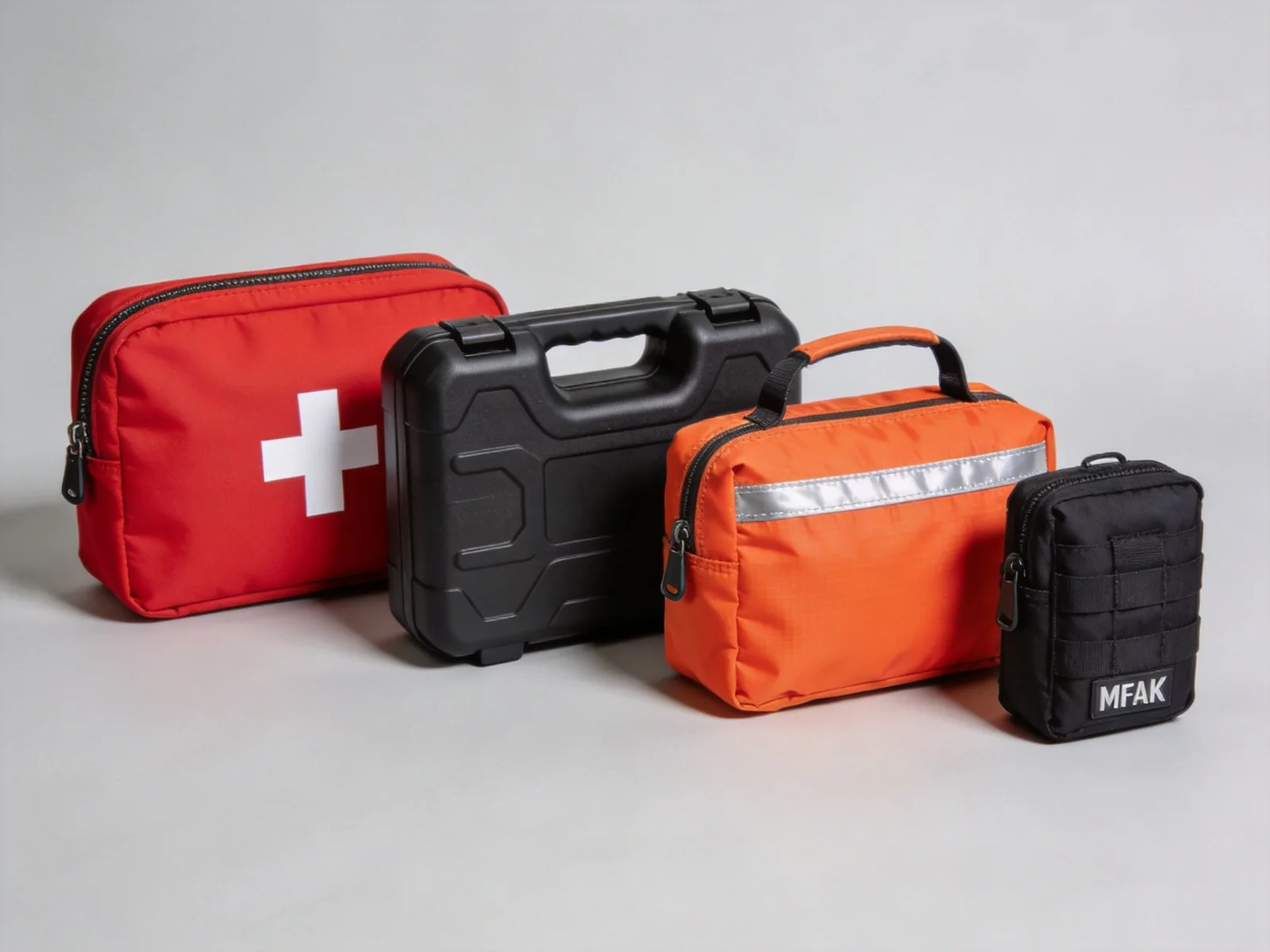
The Buying Landscape: Who Orders First Aid Bags and What Each Channel Needs
First aid bags look like one product category from the outside and behave like six from the inside. A pharmacy chain buying display-ready kits, a safety distributor supplying construction sites, and an outdoor brand selling an IFAK to hikers have almost nothing in common except the word “first aid”. We plan the sample room around the channel, because the channel decides the construction, the labelling and the packaging long before it decides the price.
| Channel | Typical order | Construction that wins | Non-negotiable requirement |
|---|---|---|---|
| Pharmacy and retail chains | 3,000–20,000 pcs per SKU, seasonal resets | Moulded EVA or semi-rigid case, printed contents card, retail colour box | Shelf presence and a legible contents list on the front; barcode and carton marks ready for DC intake |
| Workplace safety distributors | 1,000–10,000 pcs, repeat annually | 600D Oxford soft case with wall bracket or hanging D-ring | Compliance with the workplace kit class the distributor sells; refill-friendly opening |
| Outdoor, hiking and EDC brands | 500–5,000 pcs per colourway | Ripstop nylon IFAK pouch, MOLLE back panel, 100–200 g target weight | Weight and packed size; weather resistance; attachment to a belt or pack strap |
| Fleet, logistics and rental operators | 500–3,000 pcs, often tendered | Fold-out vehicle kit, high-visibility orange or yellow, reflective trim | Fits a specified stowage compartment; contents visible at a roadside check |
| Schools, sports clubs, public facilities | 300–2,000 pcs | Soft case with carry handle, child-safe closure, wall-mount option | Durability under shared use; simple restocking by non-specialist staff |
| Promotional and corporate gifting | 1,000–50,000 pcs | Compact zip pouch, 210D–420D polyester, single-colour print | Unit cost at volume, print area, delivery in a fixed campaign window |
| Kit assemblers and medical device brands | 2,000–20,000 pcs, multi-year | Custom liner layout, UDI and lot fields, ISO 13485-aligned documentation | Traceability, change control, consistent pocket geometry batch to batch |
The order size ranges above are what we see in practice, not a policy. The commercial threshold is 500 pieces per style, and within that 500 a buyer can mix up to three colourways and two print layouts, which is usually enough for a distributor to test a new SKU without committing to a full container of a single variant.
Regulation: What Applies to the Bag, and What Applies to the Kit
This is the section most buyers get wrong, and it is worth being precise because it changes the labelling, the documentation and sometimes the material.
The bag on its own is a bag. A soft pouch, a case or a trauma bag sold empty is a textile or plastic accessory. It is not a medical device, and no notified body is involved. What applies to it is general product and material law: REACH in the EU (SVHC disclosure and Annex XVII restrictions), California Proposition 65 in the US, CPSIA if the bag is marketed to or could be used by children, plus the buyer’s own restricted substances list.
A filled kit may be a regulated product. The moment the bag is sold as a first aid kit with contents, the assembled product can fall inside medical device or workplace safety regulation, and the obligation sits with the brand placing it on the market, not with the bag factory. In the EU, first aid kits are generally Class I under the Medical Device Regulation (EU) 2017/745, which means self-declaration, a technical file, CE marking and a responsible person — no notified body for most Class I kits, but the paperwork is real. In the US, a first aid kit is generally a Class I, exempt device under 21 CFR 878.4018, which brings establishment registration and listing obligations for the assembler. In workplaces, the reference standards are ANSI/ISEA Z308.1 in the US, which defines kit classes A, B and C plus Types I to IV for portability and mounting, and DIN 13164 in Germany, which prescribes exact contents for workplace kits.
We do not act as the regulatory manufacturer of a filled kit and we do not issue a CE certificate for one. What we do is build the bag to the layout the buyer’s technical file requires, supply the material declarations and test reports that go into that file, and reserve and print the label fields — lot, assembly date, expiry, UDI — that the buyer’s quality system needs. Buyers assembling kits under their own CE mark or FDA listing routinely audit us against their supplier requirements, and we support that with batch records and a signed change-control commitment: once a layout is approved, pocket geometry and material specifications do not change without written notice.
| Requirement | Applies to | What it means for the bag |
|---|---|---|
| REACH SVHC / Annex XVII | All bags sold in the EU | Material declarations from fabric, zipper and trim suppliers; no restricted azo dyes or phthalates above threshold |
| California Prop 65 | All bags sold in California | Low-lead hardware and inks; warning label only if a listed substance is present above the safe-harbour level |
| CPSIA | Bags for children or family use | Total lead and phthalate testing on accessible components; tracking label |
| ANSI/ISEA Z308.1 | Workplace kits in the US | Class A, B or C contents list drives pocket count and pocket size; Type I–IV drives portability and mounting features |
| DIN 13164 | Workplace kits in Germany | Fixed contents list drives a fixed liner layout; deviation is not acceptable to the buyer’s auditor |
| EU MDR 2017/745 | Filled kits sold as devices in the EU | Label fields, UDI space, technical file drawings, change control |
| ISO 13485 | Buyers who are device manufacturers | Batch traceability, documented inspection, supplier control; we align our records to the buyer’s audit format |
One practical note on antimicrobial and “sterile” claims: a fabric bag is not sterile and cannot be sold as sterile packaging. If a buyer wants an antimicrobial finish on the liner, we can source a treated fabric with the supplier’s test report, but the claim wording has to be agreed with the buyer’s regulatory advisor before it goes on the label. We will not print a claim we cannot document.
Construction Types: Ten Ways to Build a First Aid Bag
The ten constructions below cover the overwhelming majority of what we ship. Sizes are internal dimensions, and any of them can be adjusted within the existing pattern without new tooling. What changes between them is the opening geometry, the stiffening method and the carry system — not the basic sewing operations.
| Model | Construction | Internal size (cm) | Typical build | Usual buyer |
|---|---|---|---|---|
| FA-01 | Mini IFAK pouch | 15 × 10 × 6 | 420D ripstop nylon, #5 zip, MOLLE back panel, elastic loops inside | Outdoor, EDC, tactical retail |
| FA-02 | Flat zip pouch | 20 × 12 × 3 | 210D–420D polyester, bound zip, clear window front, no gusset | Promotional, corporate gifting, travel |
| FA-03 | Clamshell soft kit bag | 25 × 18 × 10 | 600D Oxford with PU backing, three-side zip, lid mesh pocket, carry handle | Pharmacy retail, home and office kits |
| FA-04 | Trauma bag | 45 × 25 × 25 | 600D Oxford or PVC tarpaulin, #8 or #10 zip, reflective trim, rigid base board, shoulder strap | EMS suppliers, industrial safety distributors |
| FA-05 | Responder sling pack | 30 × 20 × 12 | Ripstop nylon, single-shoulder sling, front admin pocket, hook-and-loop ID panel | Event medical, ski patrol, rescue teams |
| FA-06 | Moulded EVA hard case | 30 × 22 × 9 | EVA shell with 1680D face fabric, die-cut EVA insert, mesh lid, zip-around | Retail kits, diagnostic devices, dental |
| FA-07 | Wall-mount kit case | 40 × 35 × 12 | Semi-rigid case with steel hanging bracket, front clear panel, single latch | Factories, schools, hospitality, fleet depots |
| FA-08 | Fold-out vehicle kit | 50 × 30 × 8 (open) | 600D Oxford, zip-around fold-out panels, high-visibility shell, elastic tool loops | Fleet, rental, roadside assistance |
| FA-09 | Responder backpack | 45 L | 1000D nylon, padded harness, clamshell opening, modular internal dividers | Ambulance services, mine rescue, NGO programs |
| FA-10 | Belt or leg rig pouch | 18 × 12 × 7 | 1000D nylon, snap-buckle belt loops, quick-pull tab, single-hand opening | Tactical, range, wilderness first aid |
Two adjacent products we deliberately keep separate: disposable or single-use kit bags, which are a non-woven converting job rather than a sewing job, and medical instrument bags for clinics, which are usually specified around cleanability and device fit rather than around retrieval speed. Mixing a disposable bag into a durable-goods line is how brands end up with a kit that fails a workplace inspection.
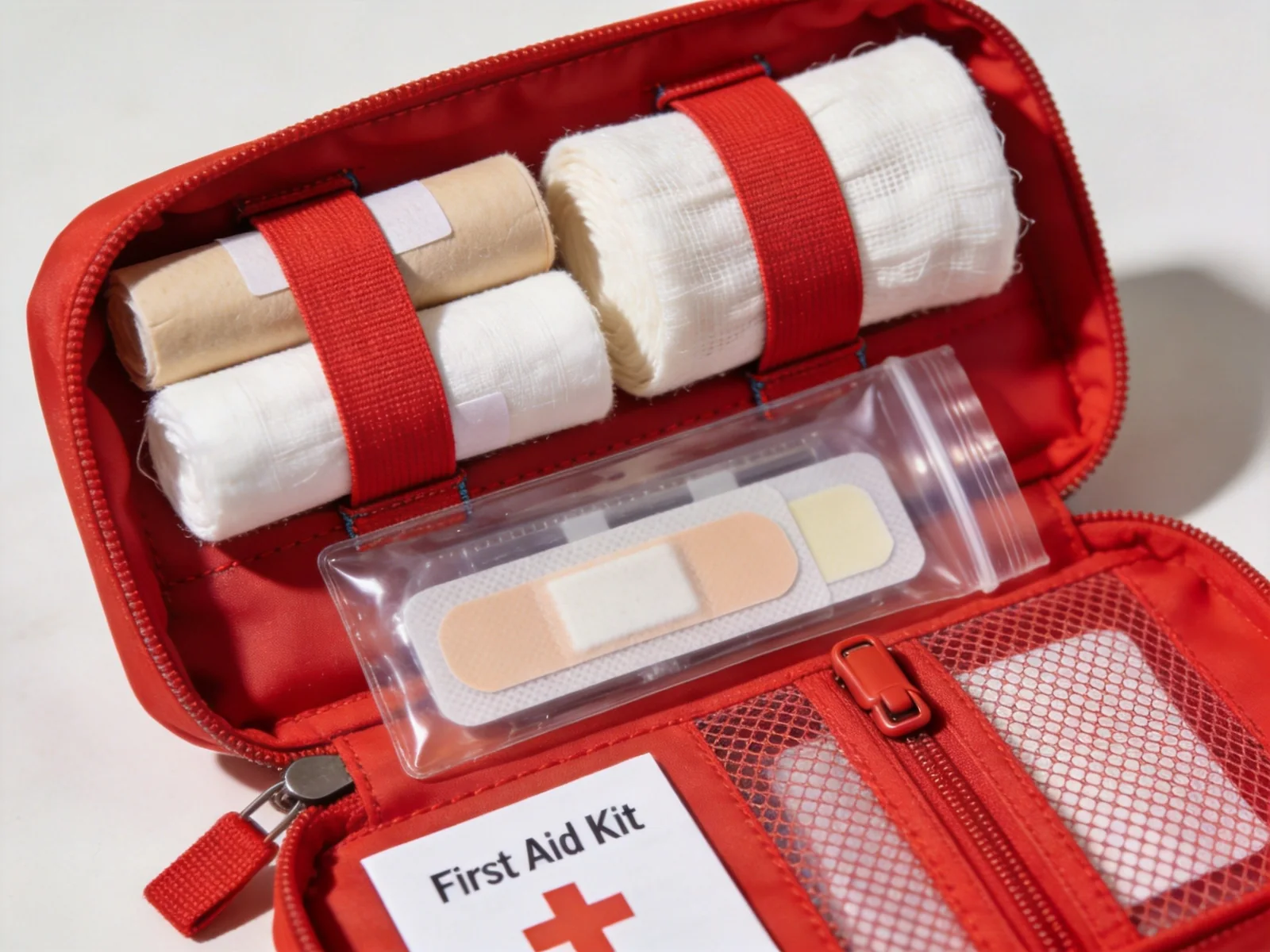
Material Selection: Six Fabrics and What Each One Is Actually For
Material choice on a first aid bag is driven by four things in this order: the cleaning regime, the weight the user will accept, the environment, and the print method the brand wants. Price comes fifth, because the fabric is a small share of a bag that carries contents worth many times the bag cost.
| Material | Weight / spec | Best for | Watch-outs |
|---|---|---|---|
| 210D polyester, PU coated | ≈ 120 g/m² | Promotional pouches, light travel kits, single-season programs | Thin hand feel; low abrasion resistance; print needs a coated-surface ink |
| 420D ripstop nylon, PU coated | ≈ 180 g/m² | IFAK pouches, hiking and EDC kits where weight matters | Ripstop grid shows through light print colours; seam slippage on unsupported edges |
| 600D Oxford polyester, PVC or PU backing | ≈ 260–300 g/m² | Workhorse soft cases, trauma bags, wall-mount kits | PVC backing limits recycling claims; PU backing costs more but is the better default for EU buyers |
| 1000D nylon | ≈ 400 g/m² | Responder packs, belt rigs, high-abrasion programs | Heavy and stiff; needs a heavier needle and a longer stitch length or the seam puckers |
| PVC tarpaulin | ≈ 500 g/m² | Vehicle kits, wet environments, wipe-down industrial use | Not breathable; phthalate restrictions apply; print must be high-frequency welded or UV cured |
| TPU laminated fabric | ≈ 300–350 g/m² | Waterproof kits, marine and dive-adjacent programs, phthalate-free requirements | Higher material cost; welding rather than stitching at the seams |
| Moulded EVA with face fabric | 5–8 mm shell | Hard cases, retail kits, device kits needing shape retention | Tooling cost per shape; not repairable, so the zip and latch quality must be right first time |
| RPET 600D | ≈ 280 g/m² | Brands with recycled-content targets | Colour consistency batch to batch; GRS certification only if the supply chain is certified, so the claim must be verified |
For most first aid programs the right answer is 600D Oxford with a PU backing and a wipeable liner. It is heavy enough to hold shape, light enough to carry, prints cleanly with a solvent or UV screen print, and it tolerates the disinfectant wipes that a workplace kit actually receives. Where a buyer needs waterproofing, we move the shell to PVC tarpaulin or TPU laminate and weld the seams; where the buyer needs a retail look, we move to a moulded EVA case.
Eight Failure Points We Design Out
Returns and complaints on first aid bags cluster around a small number of components. These are the eight we test for on every program, and the design rules we apply to each.
1. The zipper is the bag
A first aid bag’s zip is opened far more often than a travel bag’s, and it is opened by a user in a hurry. We default to a #5 nylon coil zip on pouches and a #8 or #10 coil on trauma bags, with two sliders on any bag wider than 40 cm so it can be opened from either end. Metal sliders look better and corrode faster; on a workplace kit that lives in a damp depot we specify plastic sliders and a nylon coil. Zip pulls get a webbing extension so a gloved hand can find them.
2. Seams fail at the opening, not in the middle
The three-side opening concentrates load at the two zip-end corners. We bar-tack both corners, bind the seam allowance rather than overlocking it into a lump, and on Oxford bags add a small triangular reinforcement at each corner. An unbound seam at the zip end is the first thing to fray on a cheap kit bag.
3. Handle attachment decides the service life
A loaded trauma bag can weigh 6–8 kg. We attach handles with a box-X stitch through webbing that continues down the bag body, not with a short tab stitched onto the top edge. Handle pull is one of the tests in our inspection plan, and it is the test that most often rejects an incoming sample from a new supplier.
4. Attachment systems that are not really attached
MOLLE webbing, belt loops and D-rings are only as strong as their stitching. On IFAK pouches we stitch MOLLE rows with a double row at each end and specify 25 mm webbing rather than 20 mm, because 25 mm is what the market’s pouches and clips are actually sized for. A D-ring should be anchored to a webbing strap that runs into the seam, never to the lining alone.
5. Interior organisation that does not match the contents
Elastic loops are usually specified too loose and too tall, so contents slide out. We ask for the actual contents list, including item diameters, and cut loops to 85–90% of the item circumference. For flat items — dressings, plasters, gloves — a clear vinyl pocket beats a loop every time, because it holds the item flat and visible.
6. Surfaces that cannot be cleaned
Blood-borne pathogen protocols assume the outside of the bag will be wiped. Open-cell foam, untreated cardboard stiffeners, raw seam allowances and unsealed embroidery all trap material and degrade with cleaning. We specify closed-cell EVA or PE board for stiffening, bound internal seams, and we flag embroidery on the exterior as a cleanability compromise the buyer should accept knowingly.
7. Print that peels off coated fabric
Oxford and tarpaulin are low-surface-energy substrates. A standard plastisol print will pass a fingernail test in the sample room and fail after ten wipes in the field. We use solvent-based screen print with a proper cure, UV digital print with a primer, or a heat-transfer label, and we test adhesion after abrasion and after a wipe cycle rather than only on a fresh sample.
8. Labelling that has nowhere to go
Lot number, assembly date, expiry, contents list, brand, and for device kits a UDI carrier. On a small pouch that is a real estate problem, and it is usually solved badly with a sticker on the back that peels. We build a dedicated label panel into the pattern — a flat, unstitched area with a matt surface — and print the fields in the production run rather than applying them afterwards.
Interior Layout: Engineering the First Five Minutes
Layout is where a first aid bag earns its price. The principle we work to is layering by urgency, not by category: what the user needs in the first thirty seconds goes on the top layer or the lid, what is needed in the next five minutes goes in the main compartment, and what is needed rarely — scissors, thermometer, spare refills — goes in a secondary pocket that does not have to be opened under pressure.
| Layer | Typical contents | Layout device | Why |
|---|---|---|---|
| Immediate access (lid or front panel) | Gloves, CPR face shield, trauma shears, tourniquet | Lid mesh pocket plus two wide elastic loops, high-contrast colour tab | These are the items needed before any assessment; they must not require unpacking |
| Wound care (main compartment, upper) | Dressings, gauze, bandages, tape, antiseptic wipes | Clear vinyl pocket for flat items, elastic loops for rolls | Visible and dry; flat items stay flat and labelled |
| Medication and small items (main, lower) | Plasters, blister plasters, pain relief, saline pods | Zipped mesh pouch, colour-coded | Small items otherwise migrate to the bottom corner |
| Tools and assessment (secondary pocket) | Scissors, tweezers, thermometer, torch, pen and report form | Webbing slots, pen loop, flat document pocket | Accessed once, deliberately, and should not clutter the urgent layer |
| Refill and bulk (rear or base) | Spare gloves, spare dressings, burn gel sachets | Zip compartment with a gusset | Keeps restocking out of the working area |
Two layout details that pay for themselves. First, a printed layout card sewn into the lid: a simple pictogram of the bag showing where each item lives, which lets a non-specialist restock the kit correctly. Second, colour coding — a red tab on the immediate-access layer, blue on wound care, green on medication — which is understood instantly and costs one extra binding operation. On kits sold into multilingual markets, colour coding also removes the need for translated labels inside the bag.
Customization: What We Change on a 500-Piece Order
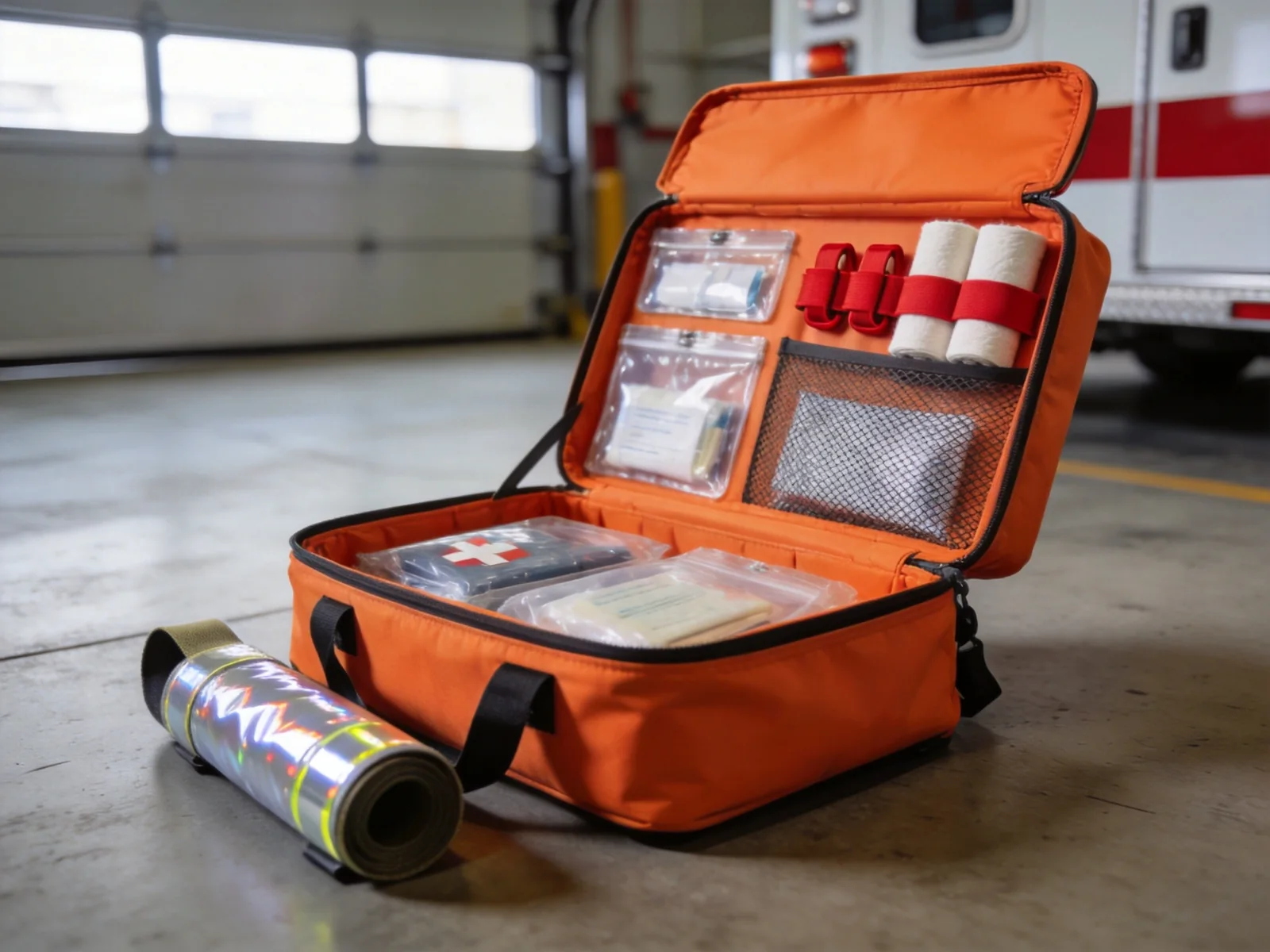
A first aid bag is a fast product to customise, because the tooling is the pattern and the print screen — there is no injection mould to amortise on a soft bag, and colour changes are a fabric and trim decision rather than a dye lot commitment. What we can change inside a 500-piece run:
- Size and pocket geometry — pattern adjustments within the existing construction, or a new pattern with a 6–10 day sample
- Shell fabric — 210D, 420D ripstop, 600D Oxford, 1000D nylon, PVC tarpaulin, TPU laminate, RPET, or a buyer-nominated fabric
- Colour — stock colours plus Pantone matching on the shell, binding, zip tape, webbing and thread; high-visibility orange, yellow and red are stock
- Branding — solvent screen print, UV digital print, heat-transfer label, woven label in the seam, rubber or TPU patch, debossed EVA panel, embroidery (with the cleanability caveat noted above)
- Interior — elastic loop layout, clear vinyl or mesh pockets, dividers, removable insert tray, printed layout card, colour-coded tabs
- Closure — single or double zip, zip-around clamshell, buckle and flap, latch on hard cases, tamper-evident seal loop
- Carry and mounting — grab handle, shoulder strap, sling, backpack harness, belt loops, MOLLE panel, D-ring, wall bracket, hook-and-loop ID patch
- Safety features — reflective trim in glass-bead or microprism grade, glow-in-the-dark zip pulls, external contents label window
- Packaging — polybag with header card, printed belly band, retail colour box, display-ready carton, barcode and carton marking to the buyer’s DC specification
The one constraint worth restating: put the brand mark where the bag is empty and legible. A logo across the centre of a soft case disappears behind the bulge of the contents and cracks first at the fold. A mark on the lid, a patch on the front panel, or a print on the binding reads clearly, survives cleaning better and photographs better in a retail fixture.
Quality Control: The Inspection Plan and the Tests Behind It
Every order is inspected to AQL 2.5 for major defects and AQL 4.0 for minor defects, using a sampling plan agreed with the buyer before production. Major defects are those that make the bag unusable or unsafe — a broken zip, a handle that pulls out, a lining that is not attached, a label that is wrong. Minor defects are cosmetic and non-functional — a skipped stitch, a thread end, a print registration shift under 1 mm.
| Test | Method | Acceptance |
|---|---|---|
| Zip function | Open and close the full length, both sliders, 50 cycles by hand | No skip, no separation, no slider binding |
| Handle static load | Loaded bag suspended from the handle for 30 seconds | No stitch failure, no webbing pull-out, no more than 3 mm seam extension |
| Seam strength at stress points | Pull test at zip-end corners and handle anchors | No rupture of the seam or the fabric before the stitch line |
| Print adhesion | Cross-hatch tape test plus 20 wipe cycles with a 70% alcohol wipe | No lifting or flaking at the edges |
| Colourfastness to crocking | Dry and wet rub | Grade 4 minimum on the shell; grade 3–4 acceptable on dark binding |
| Water resistance of the shell | Spray test on the finished bag, seams included | No wet-out on the interior within the test duration; seams dry |
| Cold crack | Shell flexed at −20 °C | No cracking of coating or print |
| Hardware corrosion | Salt spray on metal components where specified | No red rust within 24 hours on decorative hardware; no corrosion on functional hardware |
| Label and lot marking | Visual and rub check against the approved artwork | Legible, correct field content, no smearing, correct position |
| Measurement | Internal dimensions against the approved spec sheet | Within ±5 mm on soft goods; ±2 mm on hard cases |
Inspection happens twice: during production at the sewing line, and at final random inspection before packing. The buyer receives a written report with defect classification and photographs, and where a buyer’s own quality team wants to attend the final inspection, we schedule production so that the inspection date falls inside the shipping window rather than after it.
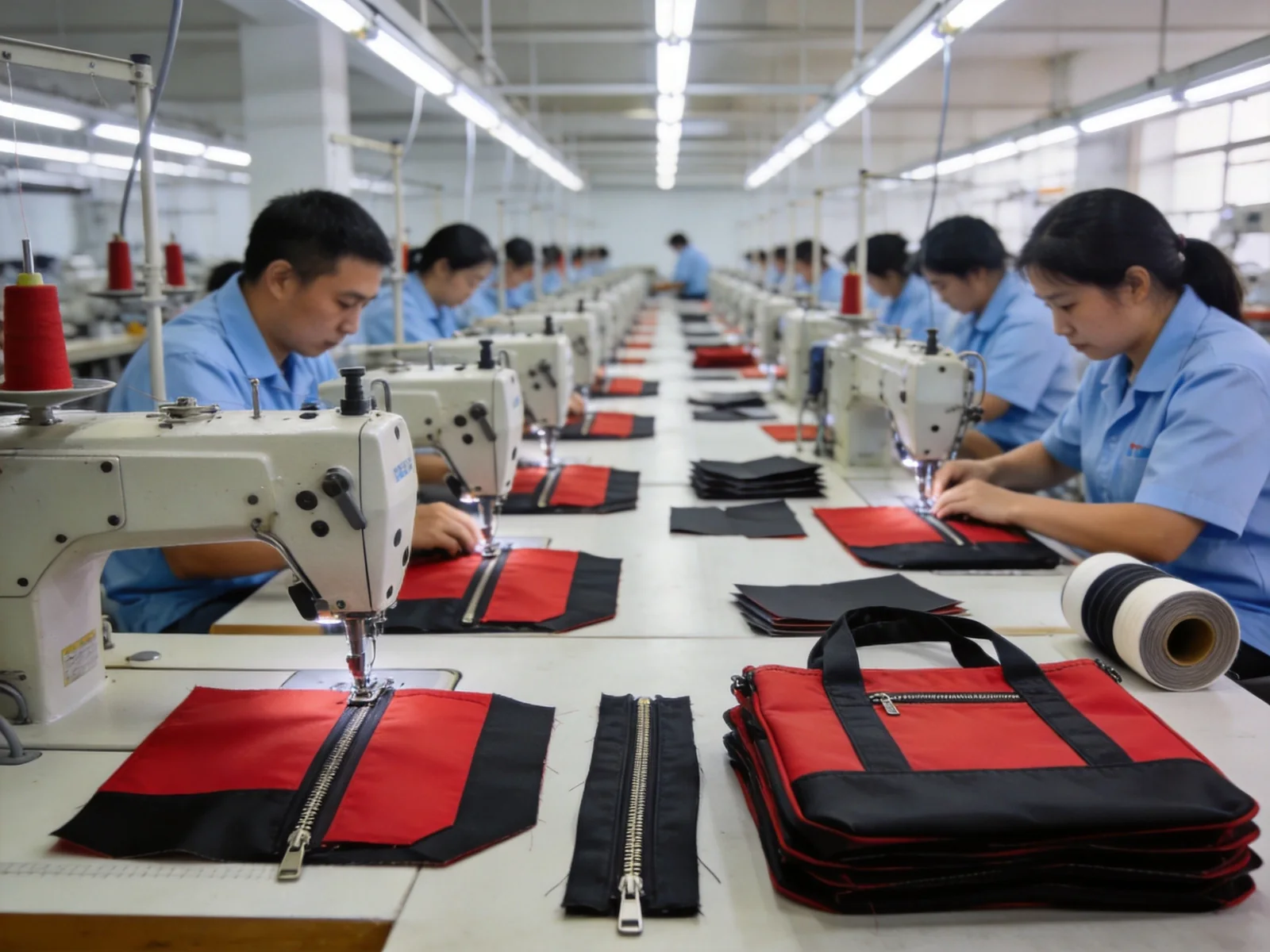
MOQ, Sampling and Production Timeline
The commercial terms are deliberately simple, because most first aid buyers are working to a reset date, a tender delivery date or a campaign gate, and they need the timeline to be predictable more than they need it to be short.
- MOQ: 500 pieces per style. Up to three colourways can be mixed inside that 500, with print applied per colourway. Below 500 we will quote, but the unit cost reflects the setup rather than the material.
- Sampling: 6–10 working days from a confirmed spec sheet and print-ready artwork. Pre-production samples are charged, and the sample fee is credited back against the first mass-production order at full quantity.
- Mass production: 35–50 days after sample approval and receipt of the deposit, depending on fabric lead time, print method and packaging. Programs booked with a Q3 gate for a Q4 reset are comfortably achievable; a program that needs a new moulded EVA shape needs the tooling lead time added.
- Payment: 30% deposit with the order, balance against the pre-shipment inspection report and a copy of the shipping document. Longer-standing accounts are discussed case by case.
- Shipping: FOB Xiamen or Shenzhen by default; EXW, CIF and DDP on request. First aid bags are light relative to their volume, so carton optimisation matters more than weight — a 500-piece order of flat pouches typically loads into 3–5 master cartons, while the same quantity of trauma bags can need 15 or more.
For a first order we recommend a two-step approach: a paid sample in the final construction and the final liner layout, then a 500-piece run in one colourway with the print and the contents layout the brand is most confident about. Once the pattern and the liner are proven, colour extensions and size extensions are fast and cheap, because only the cut file, the trim order and the print screen change.
Sourcing Practicalities: Documentation, Packaging and Carton Marking
The bag is the visible part of the purchase; the paperwork is what decides whether the goods clear and whether the buyer’s quality team can sign off. We supply as standard: a material declaration covering shell fabric, lining, webbing, zip and hardware; REACH SVHC and Proposition 65 statements based on supplier declarations; test reports where the buyer’s specification requires them; the final inspection report with photographs; and a packing list with carton dimensions, net and gross weight and SKU breakdown.
Packaging is where retail and industrial programs diverge. Retail kits need a shelf-ready presentation — printed colour box, hangtag, barcode on the base, contents list on the back panel, and a carton that can go straight to a distribution centre without rework. Industrial and fleet kits need the opposite: a plain polybag, a carton mark with the kit class and contents version, and a label field for the buyer’s asset number. We build both, and we will print the carton marks to the buyer’s specification rather than to our own template.
One documentation habit worth adopting: version the contents layout. A first aid kit changes contents more often than it changes bag, and if the layout card and the carton mark are not versioned, a restock order will eventually ship a bag whose pockets do not match the card. We hold the approved layout drawing against the SKU and print the version code inside the lid.
Why Brands Consolidate First Aid Bags With Us
Most first aid programs sit inside a wider bag range, and the practical advantage of consolidating is that a brand places one purchase order instead of four. The first aid pouch ships alongside the EVA case, the makeup bag, the tool bag and the tactical bag in the same container, on the same inspection plan, at the same AQL standard, with the same labelling format and the same carton marking. Trim and colour consolidation across SKUs also reduces the material minimums a brand has to carry, which matters most on coated fabrics bought by the roll.
On the technical side, the shared capability that matters for first aid bags is our liner work. Die-cut EVA inserts, elastic loop layouts, clear vinyl windows, mesh pockets and colour-coded tabs are the same operations we run for camera bags and laptop bags, where internal organisation is the product. A first aid layout is a simpler version of the same engineering, which is why we can usually go from a contents list to a working sample in one round.
Where a buyer’s range extends into wet or outdoor use, the same factory builds waterproof bags, dry bags and cooler bags; where it extends into travel and storage, it builds packing cubes, travel bags and shoe bags. Document protection is covered by our fireproof bag line, which several first aid buyers add for insurance documents and medication records. Buyers who want to benchmark the wider market before committing can read our review of the medical bag manufacturers serving healthcare and first aid brands.
Frequently Asked Questions
Start a First Aid Bag Program
Send us the contents list, the market the kit will be sold in, the target packed size and the print-ready artwork, and we will come back with a construction recommendation, a liner layout drawing and a quotation inside two working days. If the layout is not settled, we can start from one of the ten constructions above and adapt it — most first aid programs begin with an existing pattern and one meaningful change, not with a new design from zero.
What we need to quote accurately: contents list with dimensions, target market and the standard the kit will be sold against, shell material preference or a reference sample, branding method and artwork, packaging format, order quantity and required delivery window. What we will tell you honestly: where a requested construction will fail in use, where a compliance claim cannot be documented, and where a cheaper material will cost more over the life of the kit.
Request a First Aid Bag Quote
500 pcs MOQ · 6–10 day sampling · 35–50 day production · AQL 2.5 major / 4.0 minor · OEM/ODM since 2014
Related Manufacturing Pages
- Custom Bag Manufacturer — OEM/ODM Hub
- Custom EVA Case Manufacturer
- Custom Tool Bag Manufacturer
- Custom Tactical Bag Manufacturer
- Custom Camera Bag Manufacturer
- Custom Laptop Bag Manufacturer
- Custom Makeup Bag Manufacturer
- Custom Packing Cubes Manufacturer
- Custom Waterproof Bag Manufacturer
- Custom Dry Bag Manufacturer
- Custom Fireproof Bag Manufacturer
- Medical Bag Manufacturers — Market Review