A bag manufacturer established in 2014, with our founder in the industry since 2004. We build private-label clear PVC and TPU stadium totes, clear backpacks, crossbody bags, fanny packs, zip pouches and see-through work pouches on 0.3–0.5 mm transparent vinyl, with heat-welded seams, colour-matched binding and print that survives a full season of gate checks — for sports and event merchandisers, promotional distributors, retail chains, security and inspection channels, and Amazon private-label sellers.
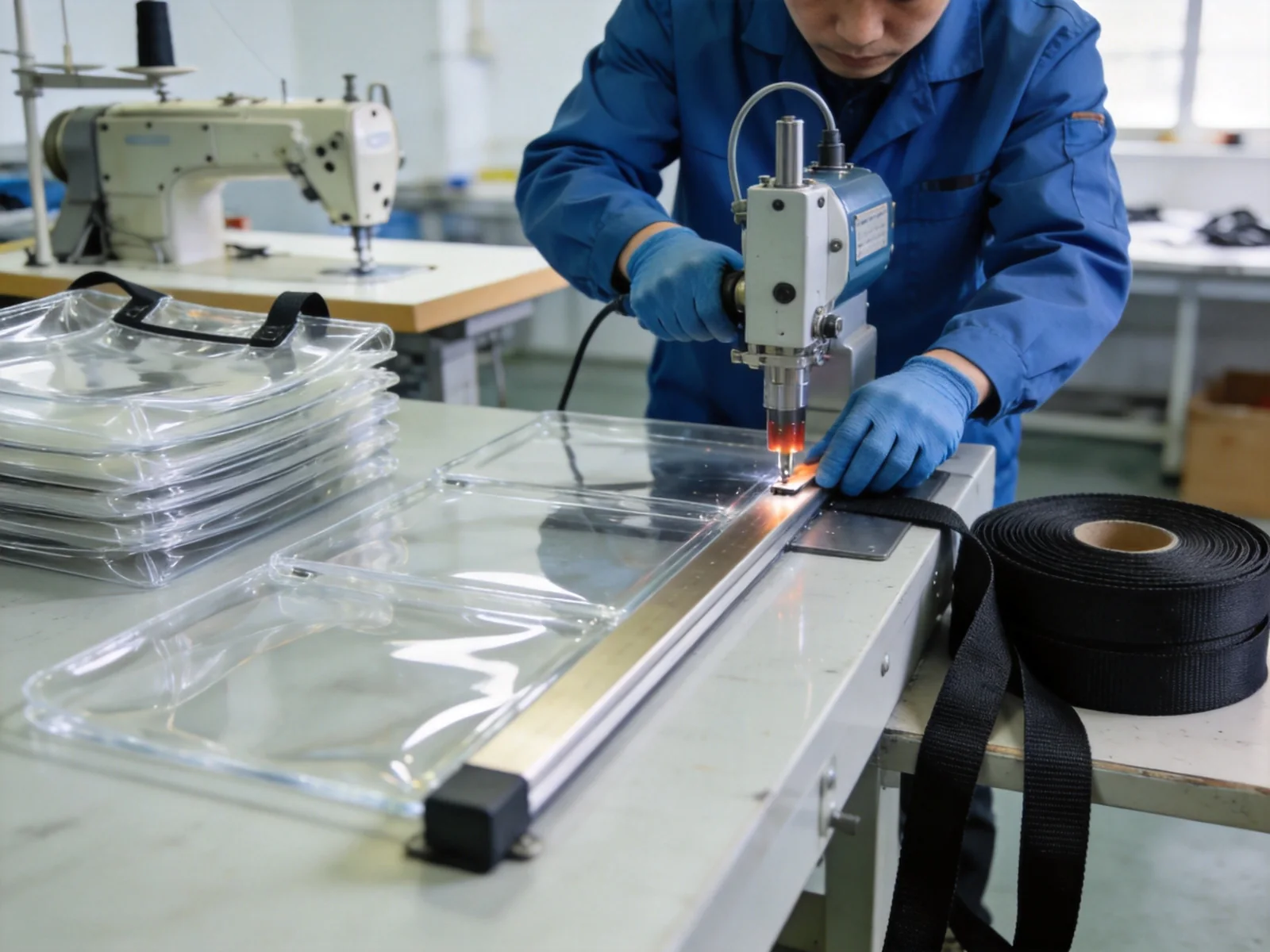
Looking for a custom clear bag manufacturer? Junyuan Bags has been making bags since 2014 — our founder has worked in the bag industry since 2004 — and today we produce private-label clear stadium bags, clear totes, clear backpacks, clear crossbody bags, clear fanny packs, transparent zip pouches and see-through inspection pouches for sports and event merchandisers, promotional distributors, retail and grocery chains, security and venue channels, and Amazon private-label sellers across North America, Europe, the UK and Australia. Every bulk order is inspected to AQL 2.5 major / 4.0 minor, with MOQ 500 pieces per style, sampling in 6–10 business days, and mass production in 35–50 days. A standard stadium tote measures 30.5 × 15 × 30.5 cm (12 × 6 × 12 in), is built from 0.3–0.5 mm (12–20 mil) clear PVC or TPU, uses high-frequency welded seams rather than stitching, and carries 25 mm black webbing handles bar-tacked at four points — the four variables that decide whether a clear bag passes a gate check and survives a season, or splits at the seam in week three. Combined capacity across our affiliated and partner factories covers programs from 500 to 50,000 pieces per style, quoted within 24–48 hours of a complete specification.
- Material: clear PVC film at 0.3 mm / 0.4 mm / 0.5 mm (12 / 16 / 20 mil), or phthalate-free TPU at 0.35–0.5 mm for brands that need a plasticiser-free claim
- Stadium spec: 30.5 × 15 × 30.5 cm (12 × 6 × 12 in) tote, the envelope most venue clear-bag policies are written around
- Seams: high-frequency (RF) or hot-bar welded, 6–8 mm weld width, 100% peel-tested at the handle and gusset corners
- Handles: 25 mm PP or polyester webbing, bar-tacked at four points, 12–15 kg static load on a 0.4 mm tote
- Zippers: #5 nylon coil with a plastic slider, or a vinyl-bound open top for venues that require zero closure
- Print: solvent screen print, UV digital or heat-transfer on clear film, with a white underlay where the artwork needs opacity
- Inspection: AQL 2.5 major / 4.0 minor on weld strength, film clarity, print registration, dimensions and labelling
Clear Bag Policies: What Actually Drives Demand for This Product
The clear bag category does not exist because shoppers like transparent bags. It exists because venues, stadiums, arenas, festivals, schools and secure workplaces decided that the fastest way to screen 60,000 people in ninety minutes is to make the bag itself the inspection. Once a policy is published, a supply chain appears within one season — and it is a supply chain with unusually hard specifications, because a bag that is 2 cm too large is simply turned away at the gate.
The reference point for most of the market is the NFL clear bag policy, introduced in 2013 and copied in various forms by college conferences, arenas, concert promoters and stadium operators worldwide. The core envelope is 12 × 6 × 12 inches (about 30.5 × 15 × 30.5 cm) for a tote or a one-gallon resealable freezer bag, with smaller limits for clutch-style bags and a separate exemption route for medically necessary items. Venue rules differ on the details — whether a clear backpack is allowed, whether the bag must be fully unzipped at inspection, whether logos are permitted and how large they may be, whether hard-sided clear cases are banned — but they converge on the same three requirements: transparent material, a maximum envelope, and no concealed compartment.
| Buyer / channel | What the policy usually specifies | Product we build for it | Typical order |
|---|---|---|---|
| NFL-style venue policy | Clear tote 12 × 6 × 12 in, or a one-gallon clear bag; small clutch permitted; logo limits often apply | CB-01 stadium tote, 0.4 mm clear PVC, webbing handles | 5,000–50,000 pcs per season |
| College / university athletics | Similar envelope, plus clear backpack and clear fanny pack allowed at many campuses | CB-02 clear backpack, CB-04 clear fanny pack | 2,000–15,000 pcs |
| Concert and festival promoters | Clear bag plus clear pouch; often a smaller clutch limit and a ban on hard cases | CB-05 clear crossbody, CB-06 clear zip pouch | 1,000–10,000 pcs |
| Retail and grocery chains | Reusable clear tote for store entry and self-checkout loss prevention | CB-07 clear shopping tote, reinforced base | 5,000–30,000 pcs |
| Schools and exam centres | Clear pencil case or clear document pouch, no print or restricted print | CB-08 clear exam pouch, CB-09 clear document envelope | 1,000–20,000 pcs |
| Industrial and security sites | Clear tool and parts pouch for bag-free entry, often with a hang loop | CB-10 clear inspection pouch, grommet or loop | 500–5,000 pcs |
Two practical lessons come out of this table. First, the envelope is the product: we keep tooling for the 12 × 6 × 12 tote permanently, so a brand can launch in a new colourway without a new pattern. Second, the same construction serves several channels, which is why a sports merchandiser and a grocery chain can often share a base pattern and differ only in binding colour, print and handle length. When a policy changes — and they do change — the pattern usually survives and only the print and the label change.
Clear Bag vs Opaque Bag: The Trade-Off a Brand Has to Sell
Every clear bag program runs into the same objection from a merchandising team: “our customers don’t want everyone to see what’s in their bag.” The answer is that a clear bag is not a fashion purchase, it is an access purchase — it is the object that gets a person through a gate. Once a brand frames it that way, the design brief changes completely, and the comparison below is the one we walk buyers through before a quote is written.
| Factor | Clear PVC / TPU bag | Opaque fabric bag |
|---|---|---|
| Primary purchase driver | Venue or site access compliance | Fashion, utility, brand affinity |
| Typical retail price band | USD 8–29 | USD 12–60 |
| Unit weight (12 × 6 × 12 tote) | 280–420 g | 350–700 g |
| Construction method | Heat welding, RF sealing, bound edges; minimal stitching | Cut-and-sew, multi-panel, lining, interlining |
| Branding surface | Print on clear film (needs white underlay for opacity), coloured binding, coloured webbing, woven label | Embroidery, woven label, rubber patch, sublimation, debossed leather |
| Design differentiation | Limited — trim colour, handle type, print, silhouette | Wide — material, hardware, structure, lining |
| Wear-out mode | Weld failure, film cracking at folds, print abrasion, zipper pull loss | Seam failure, lining tear, hardware loss, fabric fade |
| Repairability | Low — welding is factory equipment | Moderate — a local tailor can restitch |
| Recyclability message | PVC code 3 is difficult; TPU is the cleaner story | RPET and recycled canvas are the cleaner story |
| Best use case | Game day, festivals, secure sites, exam halls, store entry | Daily carry, travel, work, school |
The commercially useful insight: clear bags sell in volume and repeat, not in margin per unit. A team store that sells 20,000 clear totes a season at USD 12–18 retail is running a promotional business with a hard compliance requirement attached, and the winning supplier is the one whose weld does not split when a fan stuffs a jacket into a bag built for a phone and a wallet. That is a manufacturing problem, not a design problem, and it is where most of our development time goes.
Choosing the Film: PVC, TPU, EVA or Clear Mesh
Almost every clear bag on the market is one of four materials, and the choice is driven by the buyer’s compliance position and price target far more than by appearance. All four are transparent; they behave very differently in production, in cold weather and in a compliance file.
| Material | Typical thickness | Strengths | Watch-outs | Best for |
|---|---|---|---|---|
| Clear PVC (vinyl) | 0.3–0.5 mm (12–20 mil) | Lowest cost per unit, welds cleanly at high frequency, excellent clarity, prints well, wide colour and finish range | Requires plasticiser; phthalate restrictions apply in the EU, US children’s products and California; stiffens in cold; code 3 recycling is limited | High-volume stadium and promotional programs |
| Clear TPU | 0.35–0.5 mm | Phthalate-free and plasticiser-free, flexible at low temperature, strong cold-crack performance, better abrasion resistance, sewable | Higher film cost, needs careful welding parameters, slightly lower optical clarity than PVC | Brands with a sustainability or child-safety claim; cold-climate markets |
| Clear EVA | 0.6–1.5 mm sheet | Stiffer, self-supporting, soft-touch surface, good for structured cases and pencil boxes | Less transparent than film, limited foldability, higher unit weight | Exam cases, tool pouches, structured cosmetic and tech pouches |
| Clear vinyl mesh | 0.5–0.8 mm coated mesh | Ventilated, lightweight, cheaper, folds flat | Not fully transparent — some venues reject mesh; contents visible but not readable | Beach and dive gear bags, laundry and storage, non-secure venues |
Three notes we give buyers before they commit to a film. One: if the product is marketed to children, or sold in the EU, plan for a phthalate-free film from the start — retrofitting a compliant material into a welded pattern is a re-development, not a substitution. Two: PVC clarity is not free — a 0.3 mm film is noticeably softer and creases more than a 0.4 mm film, and creases are where cracks begin. Three: if a venue policy says “clear”, it usually means you must be able to read a phone screen through the panel; mesh does not qualify, and a tinted or frosted film is a compliance risk rather than a design choice.
Construction Details That Decide Whether a Clear Bag Survives a Season
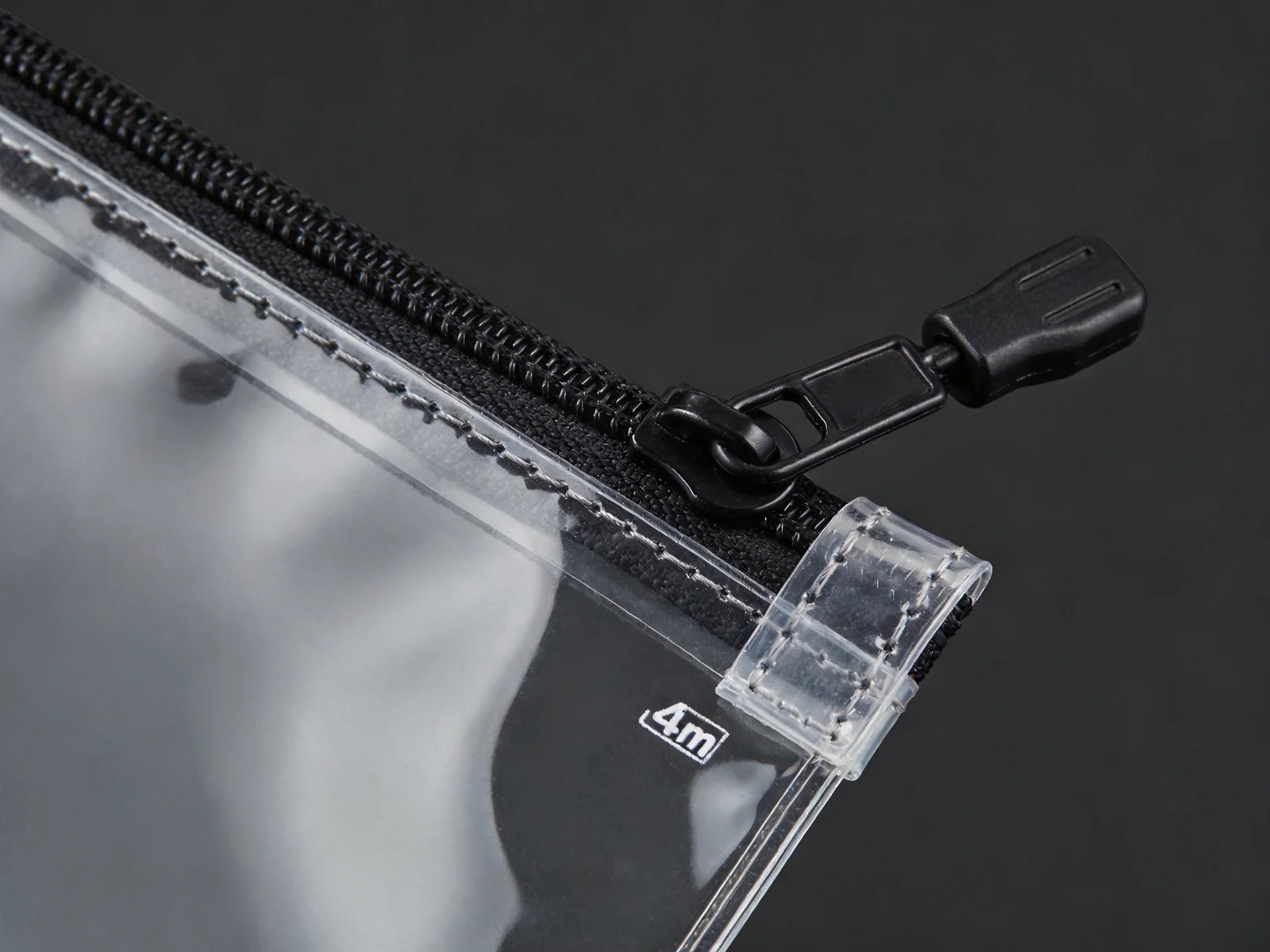
When a clear bag comes back as a complaint, it is almost never the middle of a panel. It fails at a weld, a handle anchor, a zipper end or a fold line. These are the seven decisions we review with every buyer, because they separate a bag that lasts a season from a bag that photographs well and splits in week three.
1. Film thickness is a durability decision, not a cost decision
A 0.3 mm film is fine for a light promotional tote that carries a phone and a programme. It is not fine for a 12 × 6 × 12 stadium bag that will be stuffed with a hoodie and carried by one handle for four hours. Our default for stadium totes is 0.4 mm (16 mil), with 0.5 mm on the base panel and handle anchor zone where the load concentrates. The cost difference between 0.3 mm and 0.4 mm at 500 pieces is a few cents per unit; the return-rate difference is not.
2. Weld, do not stitch, through the film
Every stitch through clear film is a row of perforations that becomes a tear line the moment the bag is loaded. Clear bags are assembled with high-frequency (RF) welding or hot-bar sealing at 6–8 mm weld width, with the film clean and dry before welding and a controlled dwell time so the material fuses rather than thinning. Where a seam must be sewn — handle webbing to binding tape, for example — the stitching goes through webbing and binding only, never through the clear panel, and the panel is protected behind a reinforced tab.
3. Bind every edge, and bind it wide
An unbound clear edge is a razor. It cuts hands, it catches on clothing, and it propagates a tear from the smallest nick. We bind the mouth, the gusset ends and the zip ends with 20–25 mm PP or cotton binding tape, folded and welded or double-stitched to the panel. Binding also gives the bag its shape memory, which is why a bound tote stands open on a table while an unbound one collapses.
4. Handles fail before panels do
The single most common failure in a clear tote is a handle pulling out of the panel. We bar-tack or box-X every handle anchor, place a 0.5 mm reinforcement patch behind each anchor point, and specify 25 mm woven PP or polyester webbing rather than a folded vinyl strip. A correctly anchored 0.4 mm tote carries 12–15 kg statically; a heat-sealed vinyl strip handle carries about a third of that before it peels.
5. Hardware: plastic, or nothing
Metal hardware on a clear bag is a scratch generator and, at security gates, an invitation to a second inspection. We use plastic side-release buckles, plastic D-rings and nylon coil zippers with plastic sliders. Where a venue requires an open top with no closure at all, we build a vinyl-bound open mouth and put the zip on an internal pocket instead — the bag stays compliant and the customer still gets a secure compartment.
6. Print adhesion on a non-porous surface
Ink does not soak into vinyl; it sits on top and abrades off. Clear bags need either a solvent-based screen print with a proper adhesion promoter, a UV digital print with a white underlay, or a heat-transfer label — and then a rub test to prove it. Our standard is a 500-cycle Taber abrasion check and a 24-hour tape-pull test on the first article of every print run. Where a brand wants a logo on a curved gusset, we will say no and move it to the flat front panel, because a print that cracks along a fold is worse than no print.
7. Cold, heat and the fold line
PVC stiffens as temperature drops and can cold-crack below about −10 °C, which matters for anyone selling into northern US states, Canada or Scandinavia from a summer-season program. We test film samples at −20 °C for 4 hours then flex, and recommend TPU where the product will genuinely be used in winter. At the other end, a clear bag left in a car in an Australian or Texan summer will soften and take a permanent set — so we specify the fold lines in the pattern, and pack flat with a paper interleaf so the bag arrives without a memory crease.
Compliance: Phthalates, Prop 65, REACH and the PVC Conversation
Clear bags sit in an unusually dense regulatory field for such a simple product, because the material is a plasticised film and the end user is often a child or a general consumer. This is the part of the conversation where a supplier’s honesty matters, and where a cheap film becomes an expensive problem two years later.
| Requirement | What it covers | What we do |
|---|---|---|
| US CPSIA | Total lead ≤100 ppm in substrate and ≤90 ppm in surface coatings; eight restricted phthalates ≤0.1% in children’s toys and child care articles | Phthalate-free film and compliant print for any children’s SKU; test reports from the film supplier on file per lot |
| California Prop 65 | DEHP, DINP, DBP, BBP, DIDP and DnHP warnings or reformulation for plasticised PVC in consumer products | Phthalate-free film as the default for US retail; Prop 65 assessment supplied with the documentation pack |
| EU REACH Annex XVII | DEHP, DBP, BBP and DIBP ≤0.1% in plasticised material; SVHC notification above 0.1% w/w | Phthalate-free plasticiser declaration per film lot; SVHC statement issued with each shipment |
| EU food-contact (where relevant) | Overall and specific migration limits for articles contacting food | We do not position clear bags as food-contact products; where a buyer needs it, the film is specified to a food-grade grade and tested separately |
| Packaging and EPR rules | Extended producer responsibility fees and recyclability labelling in the EU, UK and several US states | Material and weight data supplied per SKU so the brand can file correctly; TPU or mono-material options quoted where the fee exposure is significant |
| Venue policy compliance | Maximum envelope, transparency, no concealed compartments, logo size limits | We build to the published envelope and supply a dimension drawing the brand can hand to a venue or a marketplace |
The strategic recommendation we make most often: if the brand sells into the EU, the UK, California or any children’s channel, specify phthalate-free TPU or a compliant PVC from the first order. The unit cost difference at 500 pieces is typically 15–25%, and it is far cheaper than reformulating a welded pattern, re-testing and re-shooting a listing after a compliance flag. For a pure US stadium program sold to adults through a team store, a standard clear PVC with a phthalate declaration is usually sufficient — and we will tell you which of those two situations you are in before you place a purchase order.
The Product Line We Manufacture
Ten shapes cover most of the clear bag market. All of them can be built on the same film and the same welding process; what changes is the pattern, the closure and the trim. Sizes below are the internal dimensions we tool for most often, and any of them can be adjusted within the pattern without new tooling.
| Model | Product | Internal size (cm) | Typical build | Usual buyer |
|---|---|---|---|---|
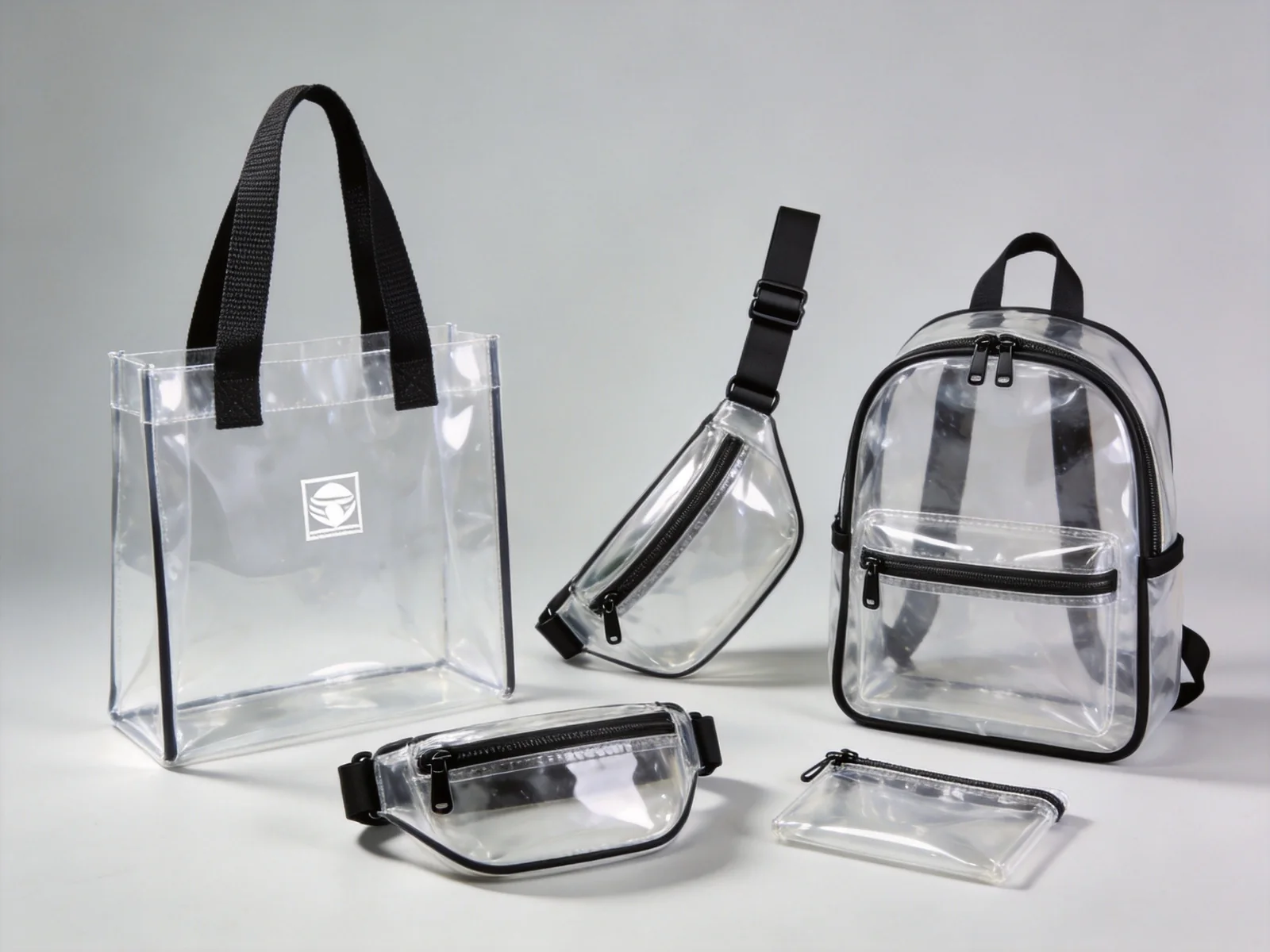
| CB-01 | Stadium clear tote, 12 × 6 × 12 in | 30.5 × 15 × 30.5 | 0.4 mm clear PVC, welded gusset, 25 mm webbing handles, bound mouth | Team stores, venue merchandisers, promo distributors |
| CB-02 | Clear backpack, stadium size | 30.5 × 15 × 30.5 | 0.4 mm film, padded-look webbing straps, front zip pocket, bound edges | College athletics, festival retail |
| CB-03 | Clear mini backpack | 22 × 12 × 26 | 0.35 mm film, single front pocket, adjustable PP straps | Youth and campus channels |
| CB-04 | Clear fanny pack / waist bag | 26 × 6 × 14 | 0.35 mm film, #5 nylon zip, 25 mm adjustable waist strap | Venue and festival retail |
| CB-05 | Clear crossbody bag | 24 × 7 × 18 | 0.35–0.4 mm film, adjustable shoulder strap, zip top | Concert and event channels |
| CB-06 | Clear zip pouch, flat | 22 × 14 | 0.3 mm film, bound zip, no gusset | Promotional, cosmetics, travel |
| CB-07 | Clear shopping tote, reinforced base | 38 × 15 × 35 | 0.4 mm film with 0.5 mm base panel, box-X handles, bound mouth | Retail and grocery chains |
| CB-08 | Clear exam / pencil pouch | 22 × 10 × 7 | 0.5 mm film or clear EVA, wide zip opening, no print option | Schools, exam boards, stationery |
| CB-09 | Clear document envelope with zip | 33 × 24 | 0.3 mm film, colour zip, hanging hole optional | Office, events, conferences |
| CB-10 | Clear inspection pouch with hang loop | 30 × 20 × 8 | 0.5 mm film, grommet or welded loop, tool pockets | Industrial, security, maintenance |
Two adjacent products we build on request and deliberately keep separate: clear vinyl mesh gear bags, where ventilation matters more than transparency and no venue policy applies, and frosted or tinted TPU pouches, which are a retail fashion product and must not be sold as policy-compliant. Mixing a compliance claim with a fashion finish is how brands end up with returns at the gate.
Customization: Branding on a Transparent Surface
Clear bags are a fast, low-tooling product to customise — there is no pattern tooling beyond the cut file, no print screens to amortise on digital, and colour changes are a binding and webbing decision rather than a dye lot. What is genuinely constrained is where you can put a logo, because a clear panel is a window and a print on it competes with the contents behind it. What we can change on a 500-piece order:
- Size and proportion — pattern adjustments within the existing construction; new pattern and sample in 6–10 days
- Film and finish — 0.3 / 0.4 / 0.5 mm clear PVC, clear TPU, clear EVA, or a specified tint; anti-fog and anti-scratch coatings on request
- Trim colour — binding tape and webbing in black, white, navy, red or Pantone-matched on volume runs; contrasting binding is the cheapest way to make a clear bag look designed
- Branding — solvent screen print with white underlay, UV digital print, heat-transfer label, woven label sewn into the binding, printed header card, embossed or debossed patch on the binding
- Closure — open bound mouth for venue compliance, #5 nylon coil zip with plastic slider, double zip, or zip on an internal pocket only
- Carry — 25 mm webbing handles, shoulder strap, adjustable crossbody strap, backpack straps, wrist strap, welded hang loop
- Interior — internal zip pocket, card slot, key leash, divider, removable clear insert pouch
- Retail packaging — printed belly band, hangtag with the venue-policy dimensions, polybag with a barcode label, colour box, mailer-ready carton
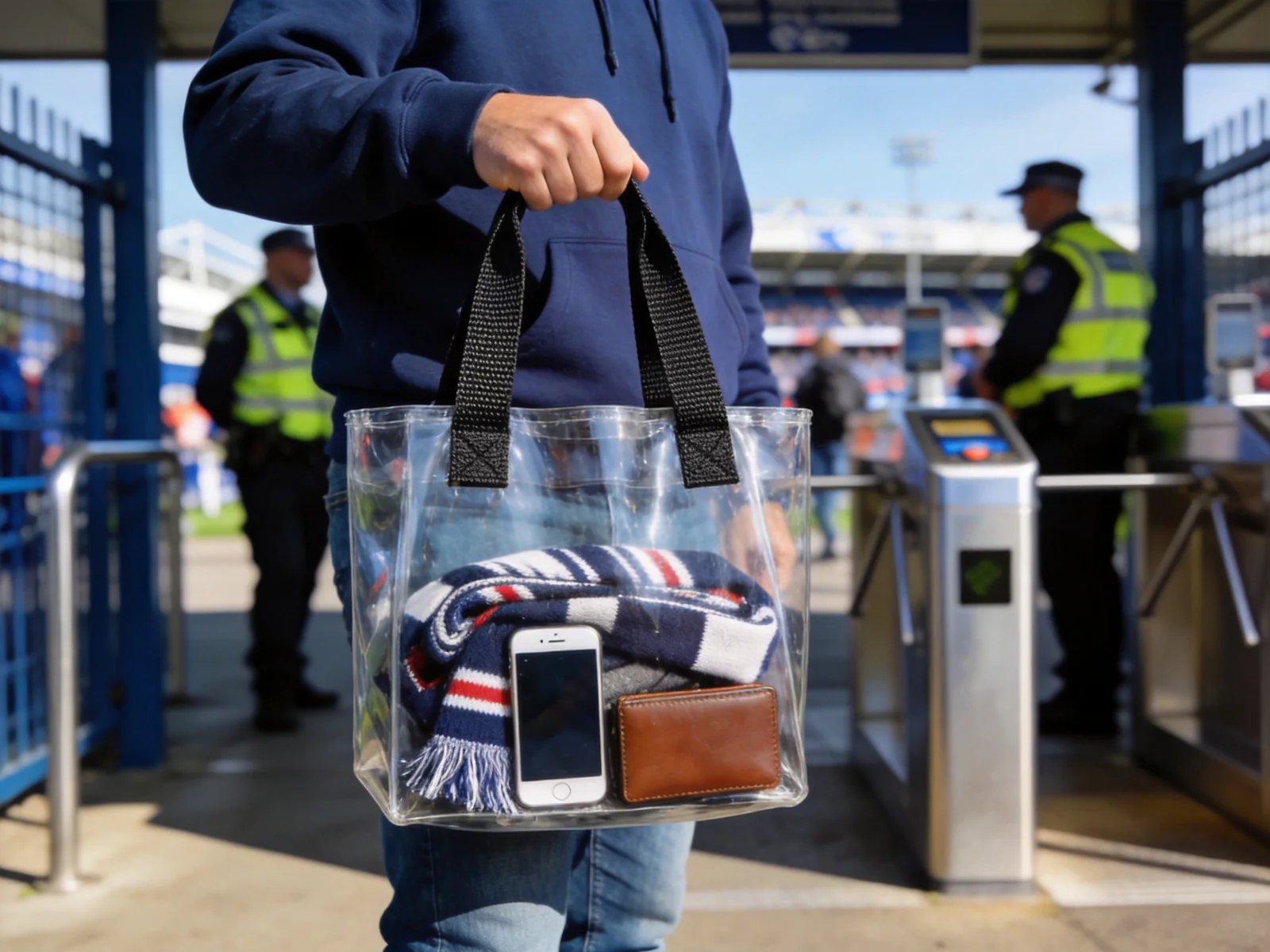
One rule we repeat to every buyer: put the logo where the bag is empty, not where it is full. A print on the lower front panel reads clearly when the bag holds a phone and a wallet; the same print across the centre disappears behind a jacket. For team and event programs, the highest-converting layout is a small mark on the front panel plus a coloured binding and a printed hangtag — it costs less than a full-coverage print and it photographs better in a store fixture.
Quality Control: What We Inspect and How
Inspection on a clear bag is different from inspection on a fabric bag, because the product is transparent: every internal defect is visible to the customer, and every external defect is visible to a security guard. Our inspection plan runs at four points — incoming film, in-line welding, end-of-line and pre-shipment.
| Checkpoint | What is measured | Method / frequency | AQL or control |
|---|---|---|---|
| Incoming film | Thickness, clarity, gel count, width, plasticiser declaration | Micrometer, 3 readings per roll; visual against a light table | Reject roll outside ±5% thickness or with visible gels |
| Cut panels | Dimensions, squareness, edge quality | Template check, first 5 and every 50 | ±2 mm; AQL 2.5 |
| Weld strength | Peel strength on gusset and mouth welds | Destructive pull test, 3 pcs per batch per weld type | Record and retain; no peel below spec |
| Handle anchors | Bar-tack presence, reinforcement patch, static load | 100% visual; load test 3 pcs per batch | 12–15 kg static, 60 seconds, no tear |
| Zipper function | Slider smoothness, end stops, pull attachment | 100% open/close cycle at end-of-line | AQL 2.5 major |
| Registration, opacity, adhesion | Tape-pull and rub test on first article; visual 100% | No lift after 24-hour tape pull; AQL 2.5 | |
| Clarity | Scratches, scuffs, fingerprints, creases | 100% visual under 800 lux | Zero tolerance on scratches and creases |
| Dimensions and weight | Finished size, unit weight | Pre-shipment sampling | AQL 4.0 minor |
| Labelling | Material code, care line, SKU, barcode, country of origin | 100% visual | AQL 2.5 major |
| Packaging | Carton count, interleaf, drop test on a master carton | Per shipment | 1.2 m drop, 6 faces |
Every batch ships with an inspection report, a photo set of the sealed golden sample against the production piece, and a weld-strength record. If a brand uses a third-party inspection company, we book the slot and prepare the AQL plan with them rather than around them. Acceptance is AQL 2.5 major / 4.0 minor on all criteria, and critical defects — a failed weld, a torn handle anchor, a print that lifts, a wrong film thickness — are zero-tolerance regardless of the sampling plan.
MOQ, Sampling and Production Timeline
The commercial terms are deliberately simple, because most of our clear bag buyers are running a seasonal program with a fixed gate date and need predictability more than flexibility.
- MOQ: 500 pieces per style. Colourways can be mixed inside that 500 — typically up to three binding and webbing colours in one order, with print applied per colourway.
- Sampling: 6–10 business days from a confirmed spec and artwork. Pre-production samples are charged and the sample fee is credited back against the first mass-production order at full quantity.
- Mass production: 35–50 days after sample approval and receipt of the deposit, depending on film thickness, print method and packaging. Seasonal programs booked in Q2 are comfortably delivered before a Q4 gate date.
- Payment: 30% deposit with the order, balance against the pre-shipment inspection report and copy of the shipping document. Terms for long-standing accounts are discussed case by case.
- Shipping: FOB Xiamen or Shenzhen by default; EXW, CIF and DDP quotes on request. Clear totes pack flat and light — a 500-piece order typically loads into 4–6 master cartons.
For a first order we recommend a two-step approach: a paid sample in the final construction, then a 500-piece run in one colourway with the print the brand is most confident about. Once the weld and the film are proven, colour extensions and size extensions are cheap and fast — the pattern already exists, so only the cut file, the binding order and the print screen change.
Why Brands Consolidate Clear Bags With Us
Most of our clear bag programs sit inside a wider bag range, and the practical advantage is that a brand can place one purchase order instead of four. The stadium tote ships alongside the custom tote bag, the beach bag and the waterproof bag in the same container, on the same inspection plan, with the same AQL standard and the same labelling format. Colour and trim consolidation across SKUs also reduces the material minimums a brand has to carry, which matters more on clear bags than on fabric bags because film is ordered by roll.
On the technical side, the four things that make the difference are unglamorous: a film thickness that matches the load, welds instead of stitches, handle anchors that are reinforced rather than assumed, and a compliance file that matches the claim on the hangtag. We have been building bags since 2014, our founder has been in the industry since 2004, and the clear bag line exists because event and retail buyers kept asking for a transparent product built with the same discipline as their technical bags. If you also sell EVA cases, cosmetic bags or packing organizers, those can run on the same purchase order and the same inspection plan.
Frequently Asked Questions
Start a Clear Bag Program
Send us your target dimensions, venue or channel policy, film preference, branding and quantity. You will get a specification recommendation, an FOB quotation and a sampling date within 24–48 hours.
Related Manufacturing Pages
- Custom Bag Manufacturer — OEM/ODM Hub
- Custom Tote Bag Manufacturer
- Custom Beach Bag Manufacturer
- Custom Waterproof Bag Manufacturer
- Custom EVA Case Manufacturer
- Custom Makeup Bag Manufacturer
- Custom Packing Cubes Manufacturer
- Custom Lunch Bag Manufacturer
- Custom Fireproof Bag Manufacturer
- Custom Camera Bag Manufacturer
- Custom Shoe Bag Manufacturer
- Custom Travel Bag Manufacturer