
Short answer: a custom snowboard bag programme at Junyuan Bags runs at MOQ 500 pieces per style and colour, samples in 6–10 working days, bulk in 35–50 days, final inspection at AQL 2.5 major / 4.0 minor, FOB Xiamen, 30% T/T deposit against the balance on copy of the bill of lading. We are a bag manufacturer established in 2014; our founder has worked in the bag trade since 2004. A snowboard bag is not a ski bag with a wider pattern. The board is 24–32 cm at the waist and carries two bindings standing 80 mm proud of the topsheet, so the bag has to resist a lateral load at two fixed points rather than a longitudinal edge load along the whole length. That single geometric fact decides the base panel, the binding patches, the zip route and the fold. This page is the procurement document: five formats and the volumes they occupy, width bands by waist measurement, four padding grades and the puncture numbers behind them, the abrasion map where snowboard bags actually wear out, the material split that survives −20 °C, the weight breakdown of the 165 L build, the bill of materials at USD 19.60 FOB, carton maths, and the twelve questions worth asking any supplier before you place a tooling order.
What “Snowboard Bag” Means — and the Five Formats That Share the Name
Five different products get sold as a snowboard bag, and they are not interchangeable. A buyer who specifies “a snowboard bag” without naming the format will receive whichever one the factory finds cheapest to cut, and that is usually the sleeve. Start by fixing the format, then the width band, then the padding grade. Everything downstream — carton size, unit weight, FOB price, tooling — follows from those three decisions.
| Format | Structure | What it carries | Where it fails | Buy it when |
|---|---|---|---|---|
| Single board sleeve | One flat panel, 3–5 mm foam, one long zip, no base reinforcement | One board, nothing else | Binding corners punch through the topsheet side within a season; no edge protection at the tip | Retail add-on, car transport, rental counter giveaway |
| Padded single bag (the volume product) | Two-panel body, 8–12 mm padding at the edge zones, full-length base panel, two binding patches | One board with bindings mounted, plus a jacket and pants | Zip coil freezes at the tail curve if the pull is under 30 mm | Resort retail, online DTC, team orders |
| Wheeled single bag | Padded body on a 2 mm HDPE frame board with 70–90 mm wheels and a telescopic handle | One board plus boots in a separate end pocket | Frame board flexes and the wheel housing tears out at the corner if the board is under 2 mm | Air travel, European resort market, rental fleets |
| Double board bag | Wider two-panel body, 12 mm padding, four binding patches, internal divider | Two boards, or one board plus a second rider’s kit | Divider omitted, boards rub edges together in transit | Couples, families, guiding operations |
| Board and boot combo | Board compartment plus a 45 L boot and helmet end bay with a vented divider | One board, one pair of boots, helmet, goggles | Vent path blocked by the board, so the boot bay stays wet for days | Resort rental, lesson programmes, travel-first retail |
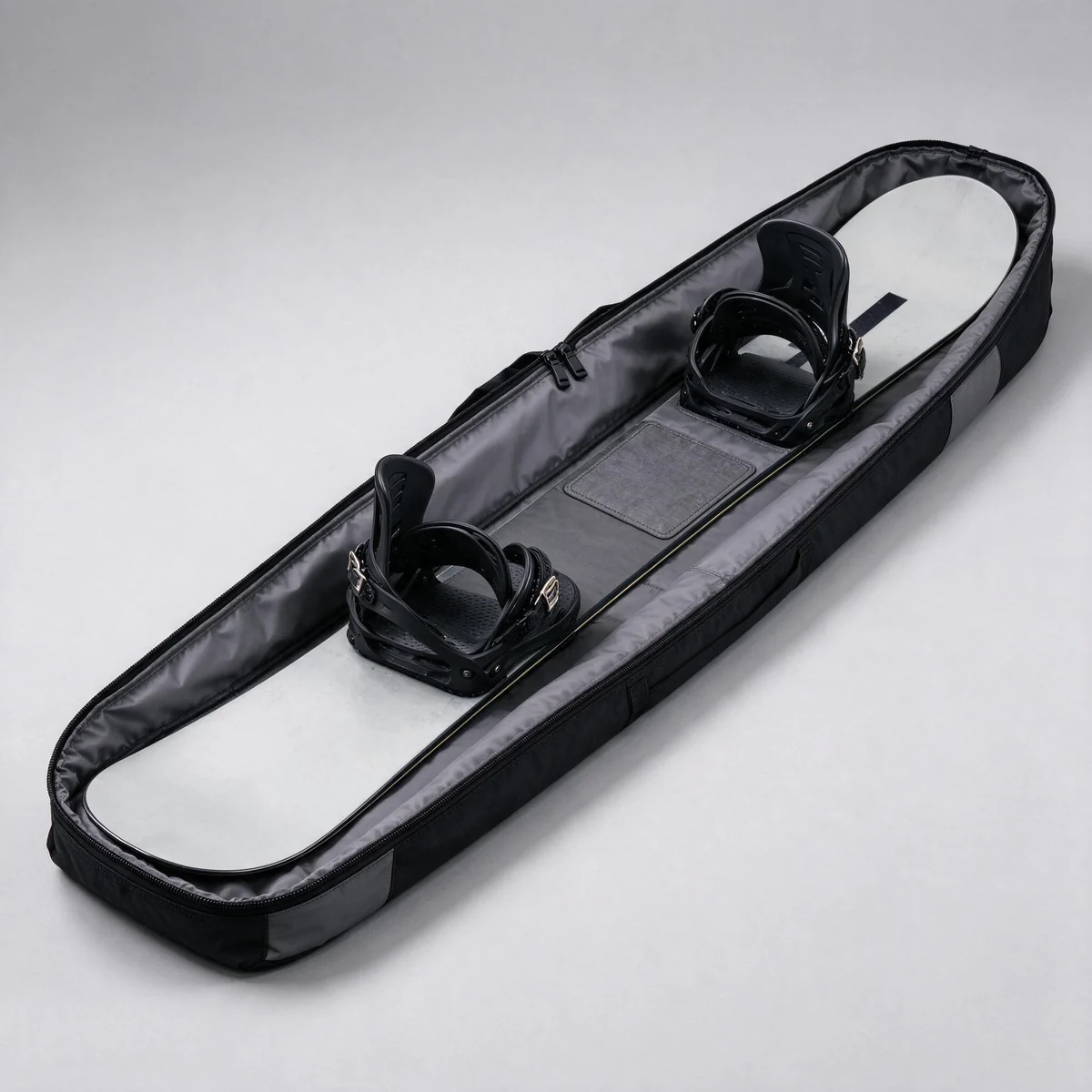
The distinction that matters commercially is between the sleeve and the padded bag. A sleeve is a USD 3.80–5.60 item at 300 pieces and it protects against scratches, not against a baggage handler dropping a boot bag on it. A padded single bag at 8 mm is a USD 14.20–21.40 item and it survives a checked-baggage cycle. If your channel is a resort shop selling to people who fly, the sleeve will generate returns. If your channel is a rental counter handing out loaners, the sleeve is the right cost point and the padded bag is wasted money.
Board Width Comes First — 24 to 32 cm Waist, and Why 26 cm Is the Pattern Break
Snowboard waist widths have widened over the last decade. A park board sits at 24–25 cm, an all-mountain board at 25–26 cm, a freeride or carving board at 26–28 cm, and a powder or swallowtail board at 28–32 cm. The bag interior has to clear the widest point of the board plus the binding baseplate overhang, which adds 10–16 mm per side depending on the binding. That is why 26 cm is the pattern break: below it, one pattern with a 34 cm interior handles almost everything; above it, you need a second pattern at 42 cm or you will be shipping bags that customers cannot close over a freeride board.
| Waist band | Typical board | Minimum interior width | Bag pattern | Note |
|---|---|---|---|---|
| 24–25 cm | Park, jib, women’s all-mountain | 30 cm | 34 cm body, 8 mm padding | Most rental fleets sit here |
| 25–26 cm | All-mountain, entry freeride | 32 cm | 34 cm body, 8 mm padding | The volume band — one pattern covers it |
| 26–28 cm | Freeride, carving, wide all-mountain | 36 cm | 42 cm body, 12 mm padding | Second pattern needed; binding overhang is the constraint |
| 28–30 cm | Powder, tapered freeride | 38 cm | 42 cm body, 12 mm padding | Check the binding baseplate width, not the board |
| 30–32 cm | Swallowtail, splitboard halves | 42 cm | 46 cm body, 12 mm padding | Splitboards also need a separate hardware pocket |
Measure the board, not the catalogue. We ask every buyer for three numbers before cutting a pattern: waist width, overall length, and the height of the binding from the topsheet. Those three numbers set the pattern, and getting any of them wrong costs a full sampling round. Length bands run 138–145, 146–152, 153–158, 159–165 and 166–172 cm; a bag cut for 165 cm will not close over a 168 cm board, and a bag cut for 172 cm wastes 8 cm of fabric on every unit in a 5,000-piece order.
Bindings Stand 80 mm Proud — The Patch That Carries the Load
A mounted binding sits 70–90 mm above the topsheet at the highback, and the baseplate corners are hard polycarbonate. In transit the board moves inside the bag, and the two binding corners become the two points where every impact lands. A bag with uniform 8 mm foam and no patch will show a hole at the binding corner before it shows wear anywhere else. This is the single most common failure in the category and it is a USD 0.42 fix per bag.
| Binding standing height | Contact area | Patch specification | Cost per bag | Result without the patch |
|---|---|---|---|---|
| Under 60 mm | Baseplate corners only | 600D PU patch, 120 × 90 mm, single row | USD 0.18 | Foam compression at cycle 40, hole by cycle 120 |
| 60–75 mm | Corners plus highback tip | 600D PU patch, 150 × 110 mm, double-row lock stitch | USD 0.31 | Shell scuff through to the foam within one season |
| 75–90 mm (standard) | Corners, highback, ladder strap | 600D PU patch plus 3 mm EVA underlay, 180 × 130 mm | USD 0.42 | Puncture at the corner by cycle 80 |
| Over 90 mm | Full binding footprint | 840D patch plus 5 mm EVA underlay, 220 × 150 mm | USD 0.67 | Shell tear along the stitch line, not at the corner |
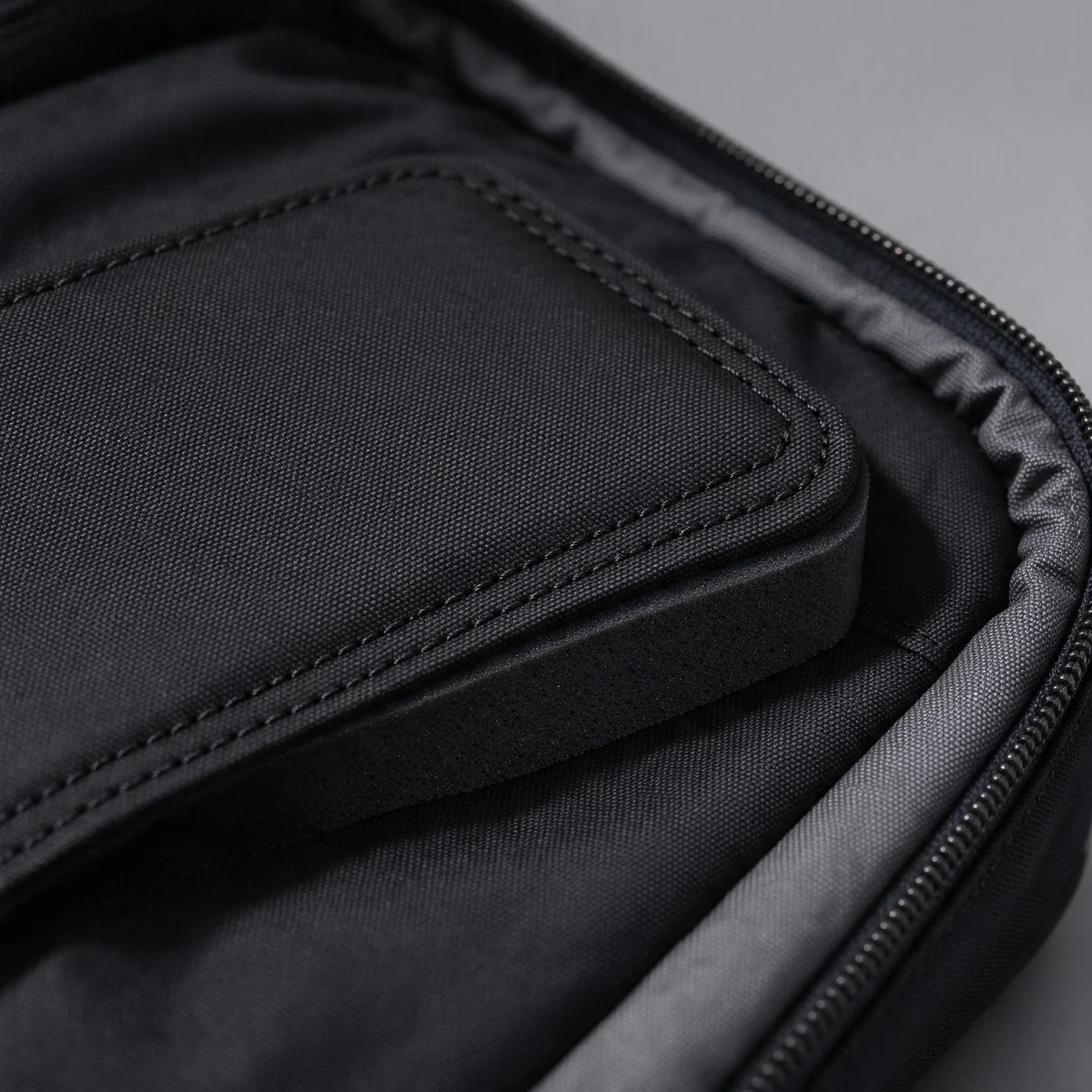
Placement matters as much as specification. The patch must sit under the binding position that the customer actually rides, and that position varies: a park rider mounts centred, a freeride rider mounts 25–40 mm back. A bag patched only at the reference stance will miss the binding on a setback board. The practical answer is a patch long enough to cover a 240 mm stance range, which is why our standard patch is 180 mm long rather than 120 mm.
Edge Wear Is Lateral, Not Longitudinal — A Different Abrasion Map
A ski bag wears along the whole length because two steel edges run the full perimeter of two skis. A snowboard bag wears at five discrete zones, and four of them are lateral. This changes where the reinforcement budget goes. If you copy a ski bag’s reinforcement layout onto a snowboard bag, you will spend money on the tip and tail and leave the binding zone and the base corners unprotected — which is exactly backwards.
| Zone | What rubs | Martindale threshold (12 kPa) | Reinforcement | Share of field failures |
|---|---|---|---|---|
| Binding patches (2) | Baseplate corners, highback | 25,000 cycles | 600D + 3 mm EVA | 38% |
| Base corners (2) | Floor, tailgate, kerb | 30,000 cycles | 840D + PU coating, 90 mm wrap | 24% |
| Zip end at the tail | Board tail edge against the coil | 18,000 cycles | Coil guard tape, 60 mm | 17% |
| Tip interior | Board nose against lining | 40,000 cycles | Lining only, no shell change | 12% |
| Shoulder strap anchors | Harness webbing | 45,000 cycles | Bar-tack at 4 points | 9% |
The numbers above come from our own return analysis across snowboard bag programmes from 2019 to 2025. The pattern is stable: 62% of field failures happen at the two binding patches and the two base corners, and all four are lateral positions. A 90 mm base corner wrap costs USD 0.28 per bag and removes the second-largest failure mode. Buyers who skip it to hit a price point usually come back for it in year two.
Padding Is Not One Number — Four Grades and Where Each One Fails
“10 mm padding” on a quotation sheet tells you almost nothing. What matters is the foam density, whether the padding is a full panel or a set of strips, and whether the edge zones get a second layer. Four grades cover the market, and each one fails in a predictable place. Specify the grade, not the thickness.
| Grade | Build | Puncture resistance | Where it fails | Target channel |
|---|---|---|---|---|
| G1 — sleeve | 3 mm EVA, 25 kg/m³, no edge zone | 90 N body, no edge zone | Any binding contact; tip scuff | Rental loaner, car use |
| G2 — resort | 5 mm EVA, 30 kg/m³, 8 mm edge strip | 90 N body, 140 N edge | Binding patch if unpatched; base corner | Resort retail, DTC entry |
| G3 — travel | 8 mm EVA, 35 kg/m³, 12 mm edge strip, full base panel | 90 N body, 180 N edge | Zip coil at the tail curve | Checked baggage, online DTC, team |
| G4 — expedition | 12 mm EVA, 45 kg/m³, 16 mm edge strip, 2 mm HDPE insert | 90 N body, 240 N edge | Weight and packability, not protection | Guiding, air freight, expedition retail |
What each grade actually is
G1 is a single 3 mm EVA sheet laminated to the shell and cut to the panel shape. G2 adds an 8 mm strip along the two long edges and the tail. G3 replaces the strip with a 12 mm strip and adds a full-length base panel of the same foam, so the board rests on foam rather than on the shell. G4 adds a 2 mm HDPE insert between the foam and the shell at the base, which is what turns a padded bag into something you can check on a flight without a hard case. The weight difference between G2 and G4 on a 165 L bag is 410 g, and the cost difference is USD 2.90 at 1,000 pieces.
Why 8 mm is the line for a resort bag and 12 mm for air travel
An 8 mm G3 edge strip absorbs the impact of a bag falling from a car tailgate — roughly 40 J over a 60 mm contact patch — without the shell reaching its puncture limit. A checked bag goes through an automated sorter, and the impact there is closer to 120 J concentrated on a 30 mm patch. At 8 mm the foam compresses to 2 mm and the shell takes the rest. At 12 mm with the HDPE insert, the foam compresses to 5 mm and the insert spreads the load over 120 mm. That is the difference between a bag that arrives intact and a bag that arrives with a board-shaped dent in the topsheet.
Freeze-Thaw Fifty Cycles — What Fails First on a Snowboard Bag
We run every new snowboard bag construction through 50 freeze-thaw cycles: −20 °C for four hours, +20 °C for four hours, repeated. The test does not simulate a season; it compresses the thermal fatigue of two or three seasons into three weeks. The failure order is consistent across materials and it is not the order most buyers expect.
| Rank | Component | Failure mode | First sign at cycle | Total failure at cycle |
|---|---|---|---|---|
| 1 | PVC shell | 500D scrim crack at the fold | 8 | 14 |
| 2 | Zip coil, standard | Tooth deformation, then jump | 18 | 25 |
| 3 | PU coating on 600D | Micro-crack, then water ingress | 22 | 30 |
| 4 | POM buckles | Stress whitening at the gate | 25 | 35 |
| 5 | EVA foam | Compression set above 18% | 40 | 50 |
| 6 | Nylon 6.6 thread | No failure observed | — | — |
| 7 | 840D TPU shell | No failure observed | — | — |
Two of the seven components survive the full 50 cycles without measurable degradation: the nylon thread and the 840D TPU shell. Everything else fails, and the PVC shell fails first and fastest — at cycle 14 it is no longer a waterproof material. This is why the shell specification is the one line on a quotation sheet worth arguing about, and why a USD 1.10 saving on PVC costs you the whole programme in year two.
TPU at −20 °C: The 500D Scrim Is Still the Line
Five shell materials are quoted for snowboard bags. They differ by a factor of four on price and by a factor of three on cold-weather life, and the difference shows up at exactly one point: the 500D scrim under the coating. A 500D woven scrim holds the coating flat when the fabric flexes cold. A 300D scrim does not, and the coating cracks along the fold line. Below 500D, no coating chemistry saves the material at −20 °C.
| Material | Scrim | Flex at −20 °C | Martindale | Cost index | Verdict |
|---|---|---|---|---|---|
| PVC 500D | 500D polyester | Fails — crack at fold, cycle 8–14 | 18,000 | 1.00 | Do not use for anything checked |
| PU 600D | 600D polyester | Slow recovery, micro-crack at cycle 22–30 | 30,000 | 1.35 | Acceptable for resort retail only |
| TPU 420D | 420D polyester | Passes, minor stiffening | 28,000 | 1.62 | Lightweight bags, not base panels |
| TPU 600D | 600D polyester | Passes, no crack at 50 cycles | 36,000 | 1.88 | The volume choice |
| TPU 840D | 840D polyester | Passes, no crack at 50 cycles | 52,000 | 2.31 | Base panel and corners |
The practical specification for a travel-grade snowboard bag is a 600D TPU shell with an 840D TPU base panel and 840D corner wraps. That combination costs USD 2.40 more per bag than an all-PVC build at 1,000 pieces, and it removes the two largest failure modes on the list above. Buyers who want a single material across the whole bag should go 600D TPU everywhere and accept that the base will scuff sooner than an 840D panel would.
A Wet Snowboard Bag Gains 9–14% — Plan the Drain
Snow melts. A bag that comes back from the mountain with a board in it holds water in the lining, in the foam and in the zip tape. How much depends on the build, and the number matters because it changes the carton weight, the freight cost and the customer’s experience on the second day of a trip.
| State | Weight gain | Where the water sits | Drain design |
|---|---|---|---|
| Dry, packed | 0 | — | — |
| Snow dusted, brushed off | 3–5% | Zip tape, shell surface | None needed |
| Board wet, 30 min in the car | 9–11% | Lining face, foam surface | Two 8 mm grommets at the tail |
| Bag soaked, board left inside overnight | 12–14% | Foam core, seam tape, base panel | Grommets plus a mesh vent panel; foam must be closed-cell |
On a 2,340 g bag, 14% is 328 g of water. That is not a weight problem; it is a mould problem. Closed-cell EVA takes up under 1% of its volume in water, and open-cell foam takes up 15–30%. The foam specification on a snowboard bag should therefore name closed-cell explicitly. Two 8 mm stainless grommets at the tail, positioned at the lowest point when the bag is stood on its base, cost USD 0.09 per bag and let the water out. Without them, the bag holds the water against the board for the whole return journey.
Wheels Are a Frame Problem Here Too — 70 mm Against 90 mm
Every wheeled snowboard bag failure we have seen in eight years has been a frame failure, not a wheel failure. The wheel itself is a commodity part; the question is what carries the load between the two wheels and up to the handle. A snowboard plus bindings plus boots is 9–13 kg, and a wheeled bag gets dragged over kerbs, up stairs and across gravel with that load on two contact patches the size of a coin.
| Frame | Wheel | Load rating | Failure mode | Cost per bag |
|---|---|---|---|---|
| No frame, wheels on shell | 50 mm PU | 6 kg | Shell tears at the housing by month 4 | USD 1.90 |
| 1.2 mm PP board | 70 mm PU | 12 kg | Board flexes, housing cracks at the corner | USD 3.10 |
| 2.0 mm HDPE board | 70 mm PU, sealed bearing | 20 kg | Wheel wear at 40–60 km of dragging | USD 4.40 |
| 2.0 mm HDPE + corner brackets | 90 mm PU, sealed bearing | 28 kg | Handle tube bend if overloaded | USD 6.20 |
| 2.5 mm HDPE + full perimeter frame | 90 mm PU, replaceable | 35 kg | Nothing observed at 35 kg | USD 8.90 |
Two millimetres of HDPE is the dividing line. Below it, the board flexes under load and the wheel housing — which is the stiffest point in the assembly — takes the stress at the corner where it meets the flexible shell. That is where the tear starts. At 2.0 mm with corner brackets, the load path runs from the wheel through the board and into the handle tube without passing through a shell seam. The step from 70 mm to 90 mm wheels matters less for the wheel itself than for what it implies: nobody fits 90 mm wheels to a 1.2 mm board, so the wheel size is a reliable proxy for the frame underneath it.
Three Volumes — 150 L, 165 L, 180 L, Sized by the Carton
Snowboard bag volumes are set by the carton, not by the catalogue. A bag has to fold or roll into a shape that ships eight to a standard export carton at a dimensional weight the buyer can live with. That constraint produces three practical volumes, and the difference between them is not capacity — it is what the bag can carry besides the board.
| Volume | Interior | Board length | Also carries | Folded size | Carton |
|---|---|---|---|---|---|
| 150 L | 34 × 20 cm × 155 cm | up to 158 cm | Board plus a jacket and pants | 52 × 36 × 12 cm | 8 per carton, 58 × 40 × 38 cm |
| 165 L (volume) | 34 × 24 cm × 165 cm | up to 165 cm | Board, outerwear, helmet in the end bay | 56 × 38 × 13 cm | 8 per carton, 62 × 40 × 38 cm |
| 180 L | 42 × 26 cm × 172 cm | up to 172 cm | Board, boots, helmet, outerwear | 60 × 42 × 14 cm | 6 per carton, 64 × 44 × 40 cm |
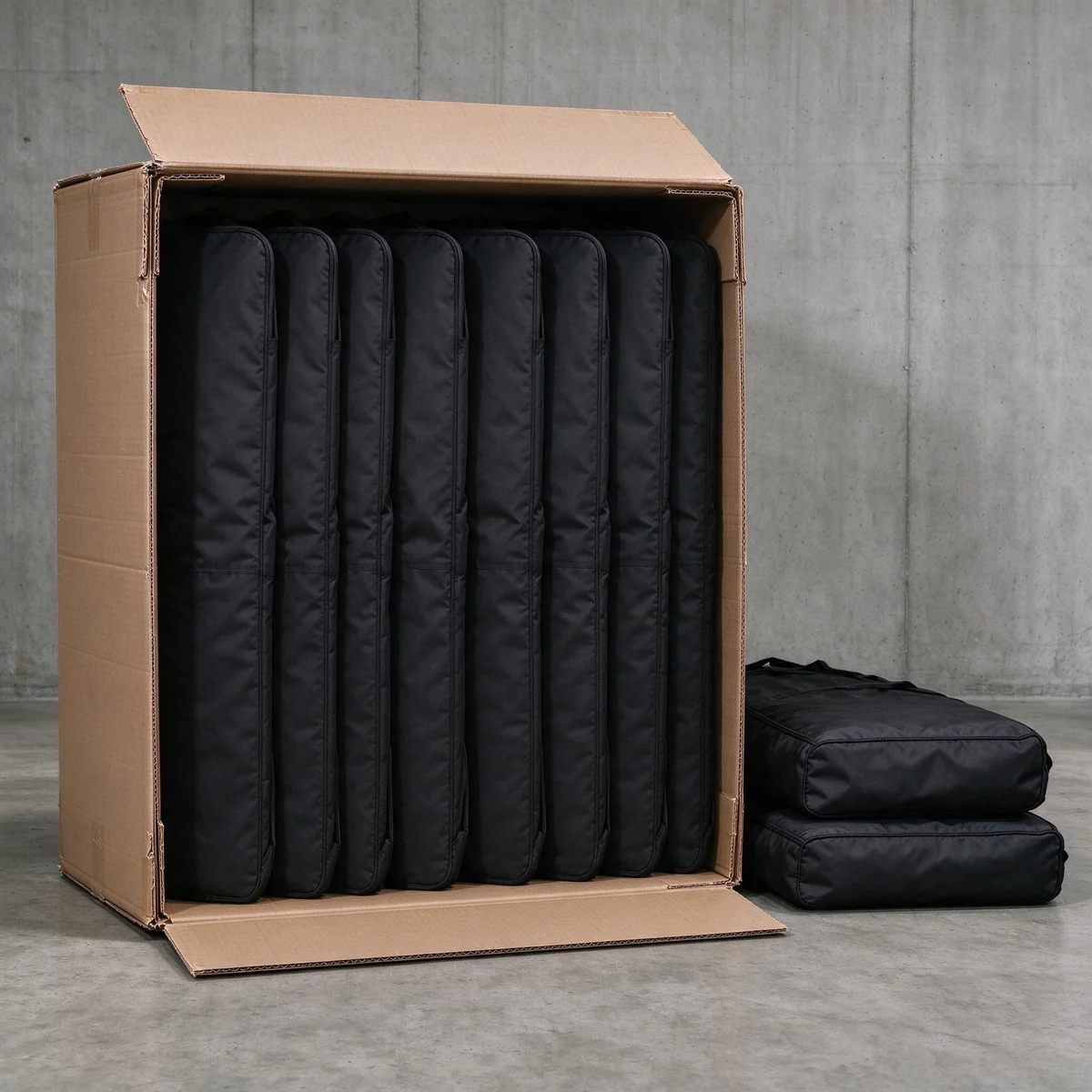
The 165 L is the volume product and it is the one to tool first. It covers boards from 146 to 165 cm, which is roughly 78% of the adult market, and it folds to a size that ships eight to a carton at a gross weight of 21.4 kg — under the 23 kg manual-handling threshold that most markets apply. The 180 L exists for the freeride and splitboard segment and it ships six to a carton; going to eight would push the gross weight to 28.6 kg and trigger a handling surcharge at most warehouses.
A note on the “volume” figure itself. We quote interior volume, calculated from the cut panels, not the number on a retail hangtag. The two differ by 8–12% because the retail number often measures the flat pattern before the seam allowance. If you are comparing quotations from two factories, ask both for the interior dimensions in centimetres and calculate the volume yourself.
Where 2,340 Grams Goes on the 165 L Build
Weight is the specification buyers ask about last and complain about first. A 165 L travel-grade snowboard bag weighs 2,340 g in our standard build, and the distribution explains why cheap bags feel heavy and expensive bags do not. Shell and base panel together are 58% of the weight; hardware is 9%. The difference between a 2,340 g bag and a 1,980 g bag is almost entirely in the frame and the padding, not in the fabric.
| Component | Specification | Weight | Share |
|---|---|---|---|
| Shell — 600D TPU | 2 panels, 2.1 m² total | 742 g | 31.7% |
| Base panel — 840D TPU | Full length, 90 mm corner wraps | 614 g | 26.2% |
| Padding — 8 mm EVA, 35 kg/m³ | Body plus 12 mm edge strips | 386 g | 16.5% |
| Lining — 210D polyester | 2 panels | 168 g | 7.2% |
| Binding patches — 600D + 3 mm EVA | 2 patches, 180 × 130 mm | 124 g | 5.3% |
| Zip — #10 coil, 2-way | 2.9 m plus 2 pulls | 196 g | 8.4% |
| Hardware | 2 grommets, 4 bar-tacks, 2 D-rings, 1 strap | 110 g | 4.7% |
| Total | — | 2,340 g | 100% |
Where the weight can come out without losing function: the lining (168 g) can drop to 70 g with a 190T fabric, saving 98 g at a cost of USD 0.06 and a small loss of abrasion resistance; the zip (196 g) can drop to 148 g with a #8 coil, saving 48 g but losing the two-way opening that most buyers want. Together those two changes take 146 g off, which is 6% of the bag and not worth the compromise. Where weight cannot come out: the base panel and the padding. Those are the two components doing the work.
The Bill of Materials at USD 19.60 FOB
The number below is the one we quote most often for a 165 L travel-grade snowboard bag at 1,000 pieces per colour. It is not the cheapest build available — a PVC version lands at USD 15.10 — but it is the cheapest build that survives a checked-baggage cycle without a failure claim, which is what the total cost of ownership calculation actually measures.
| # | Component | Specification | Quantity | Cost |
|---|---|---|---|---|
| 1 | Shell fabric | 600D TPU, 2.1 m² | 2 panels | USD 4.86 |
| 2 | Base panel fabric | 840D TPU, 0.94 m² | 1 panel + 2 wraps | USD 3.42 |
| 3 | Padding | 8 mm EVA 35 kg/m³, 12 mm edge strips | 1.6 m² | USD 2.28 |
| 4 | Binding patches | 600D PU + 3 mm EVA, 180 × 130 mm | 2 | USD 0.84 |
| 5 | Lining | 210D polyester, 1.7 m² | 2 panels | USD 0.62 |
| 6 | Zip | #10 coil, 2-way, 2.9 m | 1 | USD 2.16 |
| 7 | Zip pulls | 38 mm TPU, glove-operable | 2 | USD 0.38 |
| 8 | Grommets | 8 mm stainless, brass eyelet | 2 | USD 0.09 |
| 9 | Webbing | 25 mm PP, shoulder strap 1.4 m | 1 | USD 0.44 |
| 10 | Hardware | D-rings 2, adjuster 1, bar-tacks 4 | — | USD 0.51 |
| 11 | Labels | Woven main label, care label, country of origin | 3 | USD 0.22 |
| 12 | Labour and overhead | Cutting, sewing, QC, packing | — | USD 2.94 |
| 13 | Carton and packing | Five-layer export carton, poly bag, divider | 1/8 | USD 0.84 |
| Total FOB Xiamen | USD 19.60 | |||
Three lines account for 54% of the cost: the shell, the base panel and the padding. Those are also the three lines that decide whether the bag fails in the field, which is a convenient alignment. The lines worth negotiating are the zip (USD 2.16) and the labour (USD 2.94). A #8 coil saves USD 0.62 and costs you the two-way opening; labour is a function of stitch count and we will not go below 7–9 stitches per 25 mm on a load-bearing seam regardless of the price target.
Price Ladder and Tooling
Snowboard bags are a cut-and-sew product with a small tooling component. The tooling is the pattern set plus any screen or heat-transfer setup for branding, and it is a one-off. The price ladder below is for the build in the bill of materials above, one colourway, one size.
| Quantity | Unit price | Tooling (one-off) | Sampling | Production lead time |
|---|---|---|---|---|
| 300 pcs | USD 23.80 | USD 420 | 6–10 working days | 35–40 days |
| 500 pcs (MOQ) | USD 21.40 | USD 340 | 6–10 working days | 35–50 days |
| 1,000 pcs | USD 19.60 | USD 280 | 6–10 working days | 40–50 days |
| 2,000 pcs | USD 18.35 | waived | 6–10 working days | 45–55 days |
| 5,000 pcs | USD 17.20 | waived | 6–10 working days | 50–60 days |
Sampling and lead times
Sampling runs 6–10 working days for a standard build and 12–15 days if the bag needs a new moulded part such as a wheel housing or a custom buckle. The sample fee is charged and credited against the first order once the order value clears the threshold in the quotation. Bulk production is 35–50 days from sample approval and deposit, and the clock starts when three things are in place: approved sample signed off in writing, 30% T/T deposit received, and all artwork for labels and branding confirmed. Orders that need a Pantone match on the shell fabric add 5–7 days because the mill runs the colour separately.
Two scheduling points that catch buyers out. First, Chinese New Year: a programme that needs to ship in March has to be on the production floor by early January, because the factories in Quanzhou close for two to three weeks and the workforce returns gradually through the following two weeks. Second, the 5,000-piece tier has a longer lead time than the 1,000-piece tier, which is counter-intuitive but real: at that volume the shell fabric has to be woven to order rather than pulled from stock.
Carton Maths and Landed Cost — Eight Bags per Carton
A folded 165 L snowboard bag occupies 56 × 38 × 13 cm. Eight of them, plus a divider sheet and poly bags, fill a 62 × 40 × 38 cm five-layer export carton at a gross weight of 21.4 kg. That is the number that drives the freight calculation, and the freight calculation is where the FOB price stops being the answer to the question.
| Mode | Cartons per shipment | Chargeable weight | Cost per bag | Transit |
|---|---|---|---|---|
| Sea LCL, Xiamen to Rotterdam | 125 (1,000 pcs) | 2,675 kg / 12.4 m³ | USD 1.42 | 32–38 days |
| Sea FCL 40HQ | 640 (5,120 pcs) | 13,696 kg / 62 m³ | USD 0.86 | 30–36 days |
| Air freight, Xiamen to Amsterdam | 125 | 2,675 kg chargeable | USD 6.80 | 6–9 days |
| Rail, Xiamen to Duisburg | 125 | 2,675 kg / 12.4 m³ | USD 2.10 | 22–28 days |
| Express courier, samples | 1–3 | Volumetric | USD 42–68 per carton | 4–7 days |
The dimensional weight trap
The carton measures 62 × 40 × 38 cm, which is 94,240 cm³ or 0.0942 m³. At the air freight volumetric divisor of 6,000, the chargeable weight is 15.7 kg — but the actual gross weight is 21.4 kg, so air freight charges on the actual weight. Reverse the calculation for a lighter build: a 1,980 g bag packs eight to the same carton at 17.8 kg gross, still above the 15.7 kg volumetric figure, so the saving does not show up in the freight. Where it does show up is sea LCL, which charges on cubic metres rather than weight, so a lighter bag saves nothing there either.
The practical consequence is that the carton size is worth optimising and the bag weight is not. Cutting 4 cm off the carton length takes the volume from 0.0942 to 0.0881 m³, an 6.5% reduction, which at 1,000 pieces and USD 1.42 per bag saves USD 0.09 per bag. Cutting 200 g off the bag saves nothing at all unless it crosses a volumetric threshold, and it will not.
Five Channels — and What Each One Asks For
The same snowboard bag specification sells into five channels, and each one has a different failure definition. A resort rental bag that lasts two seasons is a good bag; a resort rental bag that costs USD 19.60 is a bad purchase. A DTC bag that costs USD 19.60 FOB and retails at USD 89 is a good purchase; the same bag with a PVC shell is a return waiting to happen. Match the build to the channel before you match the price.
| Channel | Typical order | Build they should buy | What they actually ask for | Failure definition |
|---|---|---|---|---|
| Resort rental fleet | 80–250 pcs, repeat annually | G2, 150 L, sleeve or padded single | Lowest unit cost, high-vis branding, size marking | Bag lasts two seasons; loss rate matters more than damage |
| Resort retail | 150–400 pcs, 2 colourways | G3, 165 L, padded single | Colour match to the season palette, hangtag quality, retail-ready packing | Zero returns on the binding zone; packaging has to survive retail handling |
| Online DTC brand | 500–1,500 pcs, 3–4 colourways | G3 or G4, 165 L and 180 L | Photography samples early, consistent colour between batches, low carton damage rate | Return rate under 4%; colour consistency across restocks |
| Team and club | 40–120 pcs, name personalisation | G3, 165 L, double board option | Individual names, club logo, short lead time | Name spelling correct; delivery before the season start |
| Private label distributor | 1,000–5,000 pcs, multi-size | Full range G2–G4 | Certification file, consistent BOM across sizes, ability to re-order the same spec in 18 months | Spec drift between orders; documentation completeness |
Quality Control — Eight Gates
A snowboard bag has eight points where it can fail before it reaches the customer, and we inspect at each one rather than at the end. End-of-line inspection catches maybe 60% of the defects that matter, because the defects that matter are inside the bag — a missed binding patch, a foam panel cut short, a seam that will open at −20 °C. Those are only visible at the gate where they are made.
| Gate | Stage | What is checked | Sample | Reject criterion |
|---|---|---|---|---|
| 1 | Incoming fabric | Weight per m², coating adhesion, cold-fold at −20 °C | 3 rolls per lot | Adhesion under 4 N/25 mm; any crack on cold-fold |
| 2 | Foam | Density, thickness, closed-cell confirmation | 5 sheets per lot | Density outside ±3 kg/m³; thickness outside ±0.5 mm |
| 3 | Cutting | Panel dimensions against the pattern | 100% of first 20, then 10% | Any dimension outside ±3 mm |
| 4 | Binding patch placement | Position along the base panel, stitch row count | 100% | Position outside ±8 mm; fewer than 2 stitch rows |
| 5 | Zip assembly | Coil alignment, end stop security, pull attachment | 100% | Any jump under 30 N lateral load; loose end stop |
| 6 | Seam strength | Pull test on 5 load-bearing seams | 3 bags per 200 | Any seam under 280 N |
| 7 | Final inspection | AQL 2.5 major / 4.0 minor, full visual, hardware function | ISO 2859-1 general level II | Per AQL tables |
| 8 | Packing | Fold configuration, poly bag, divider, carton weight and marking | 100% of cartons | Carton gross weight outside 21.4 ±0.4 kg; missing divider |
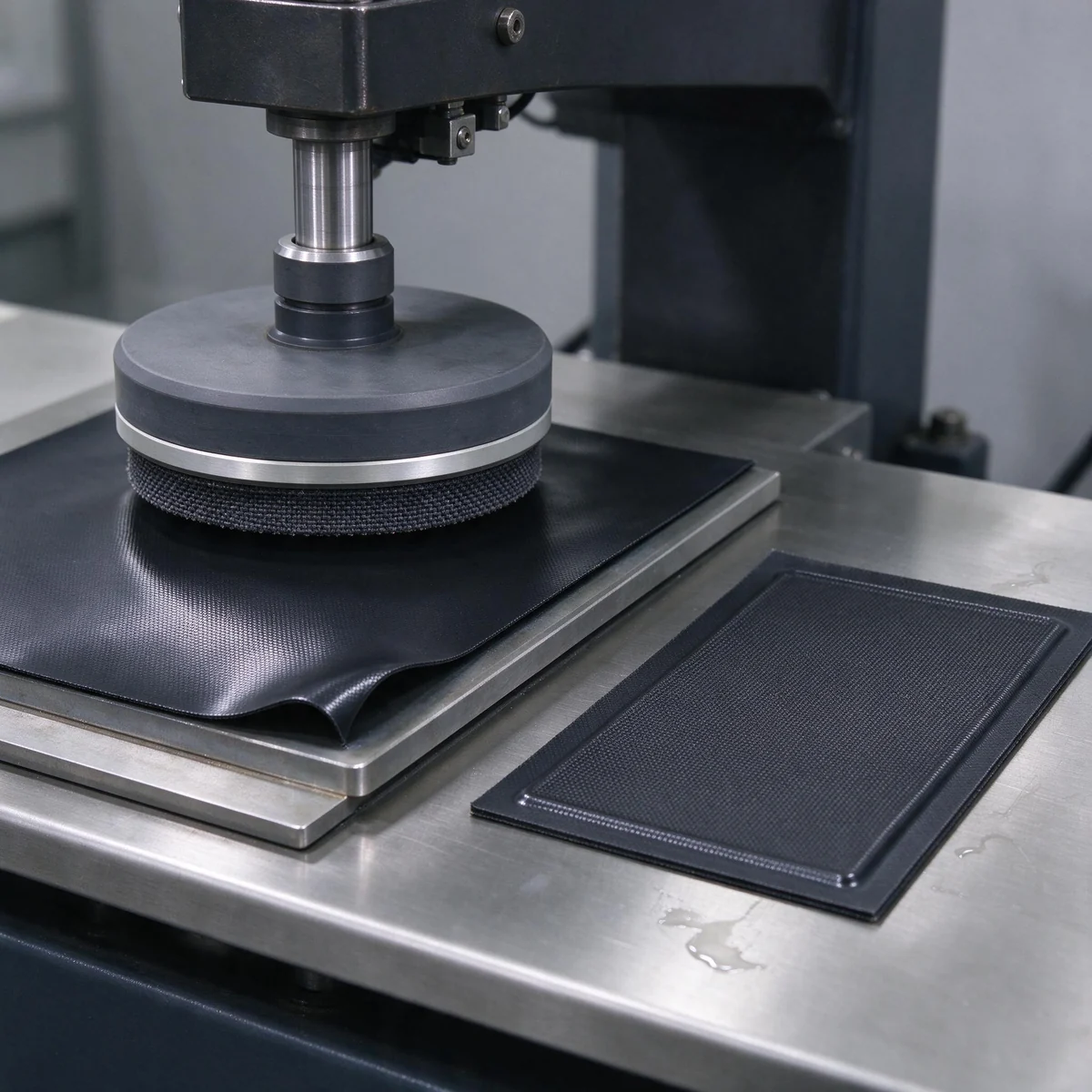
Gate 1 is the one worth insisting on. Cold-fold testing incoming fabric takes 20 minutes and costs nothing, and it catches the single substitution that does the most damage: a mill shipping 500D where 600D was ordered, or a coating weight below the agreed figure. We have rejected three fabric lots on this test in the last two years, and each rejection would have become 400–900 bags failing at cycle 14.
Compliance Boundaries — What We Can and Cannot Claim
Buyers ask for certifications, and the honest answer is more useful than a logo wall. Here is what applies to a snowboard bag and what does not.
What we can provide. REACH SVHC declarations on the shell fabric, foam, zip and webbing, issued per lot and naming the substance list version. AZO dye and formaldehyde test reports on textile components from a third-party laboratory. Proposition 65 declarations for the US market. ISO 9001 certification for our own facility. A full material declaration listing every component with its supplier, so your compliance team can run its own assessment. Carton drop and compression test reports on request.
What we cannot claim. A snowboard bag is not a personal protective device and we will not mark it as one. We cannot certify puncture resistance to a published standard, because no standard exists for this product category — the 90 N and 180 N figures on this page are our own internal test method, and we will share the method so you can reproduce it, but they are not a certification. We cannot claim waterproofness beyond the hydrostatic head the coating actually delivers, which is 8,000–12,000 mm for a 600D TPU shell and lower at the seams unless they are taped. We cannot claim a specific recycled content percentage unless the yarn is certified and traced, and we will not put a percentage on a hangtag that we cannot document.
What changes by market. EU buyers typically need REACH SVHC plus a responsible-person address on the label under GPSR. US buyers typically need Prop 65 plus a country of origin mark. UK buyers need UKCA where applicable, which for this product is limited. If you sell into a market with extended producer responsibility for textiles, the packaging and the bag itself may both fall under a registration obligation that sits with you as the importer, not with us as the manufacturer.
Twelve Questions to Ask Any Snowboard Bag Supplier
These are the questions that separate a factory from a trading company, and the ones that predict whether the second order matches the first. Ask them before you pay for a sample.
- What is the scrim count on the shell fabric, and can you show the mill’s test report? If the answer is a material name without a scrim count, the specification is not fixed.
- Is the foam closed-cell or open-cell, and what is the density in kg/m³? “High-density foam” is not an answer; a number is.
- Where exactly are the binding patches placed, and what stance range do they cover? A 120 mm patch covers one stance; a 180 mm patch covers a range.
- What is the puncture resistance at the edge zone in newtons, and how was it measured? Ask for the method, not just the number.
- Does the base panel wrap around the corner, and how far up? A 90 mm wrap is the difference between a scuff and a hole.
- What zip is specified — coil size, slider brand, pull length? A #10 coil with a 38 mm pull is the cold-weather specification; #8 with a 22 mm pull is not.
- How many grommets, and at which end? Two at the tail is the minimum for a bag that will hold a wet board.
- What is the frame thickness under the wheels? Below 2.0 mm HDPE, the wheel housing will tear out.
- Can you run 50 freeze-thaw cycles on the actual production fabric before we commit? A factory that cannot answer this has never tested for cold.
- What is the AQL level and who performs the final inspection? AQL 2.5/4.0 by a third party is worth more than AQL 1.5 by the factory’s own QC.
- Show me the carton dimensions and gross weight for eight units. This is where the landed cost actually lives.
- If we re-order in 18 months, will the same shell and foam still be available? Spec drift between orders is the most common private-label complaint, and it is preventable by contract.
Frequently Asked Questions
What is the minimum order quantity for a custom snowboard bag? MOQ is 500 pieces per style and colour. Below 500 we can quote on a stock fabric and a stock colourway, but a custom shell colour or a custom pattern starts at 500.
How long does sampling take? 6–10 working days for a standard build. If the bag needs a new moulded part — a wheel housing, a custom buckle, a logo-embossed zip pull — allow 12–15 days.
How long is bulk production? 35–50 days from sample approval and deposit. The clock starts when the sample is signed off in writing, the 30% T/T deposit has cleared, and all artwork is confirmed.
What is the price for 1,000 pieces? USD 19.60 FOB Xiamen for the 165 L travel-grade build in the bill of materials above, one colourway, one size. A PVC version of the same bag is USD 15.10 and we will quote it, but we will also tell you it fails the freeze-thaw test at cycle 14.
Can you match a Pantone colour on the shell fabric? Yes, with a 5–7 day addition to the lead time and a colour-matching charge at sampling. The shell is a coated woven fabric, so the Pantone will read slightly darker than it does on paper; we send a physical swatch for approval rather than a digital proof.
Do you make double snowboard bags? Yes. The double is a 42 cm body with 12 mm padding and four binding patches, and it needs an internal divider — without one, two boards rub their edges together in transit and both get damaged.
Can the bag carry boots as well as a board? Yes, as a board and boot combo with a 45 L vented end bay. The important detail is the vent path: if the board compartment blocks the boot bay’s airflow, the boots stay wet for days. We design the divider so air moves from the boot bay out through a mesh panel, not through the board compartment.
What is the carton configuration? Eight 165 L bags per 62 × 40 × 38 cm five-layer export carton at 21.4 kg gross. The 180 L ships six per carton because eight would exceed the manual-handling threshold in most markets.
Do you handle the labels and hangtags? Yes. Woven main label, care label, country of origin, hangtag, poly bag and retail-ready packing are all part of the quotation. Send artwork as AI or PDF with fonts outlined, and specify the Pantone for any printed element.
What happens if the bags fail in the field? We ask for photographs and the production lot number, and we replace against confirmed manufacturing defects within 12 months of shipment. The return analysis from those claims is what produced the failure map on this page, so a claim is also information we use.
Send Us Your Snowboard Bag Specification
To quote accurately we need five things: board length and waist width, the format (sleeve, padded single, wheeled, double, or combo), the padding grade or the target channel, the quantity per colourway, and your delivery port. With those five we can quote a firm FOB price and a sampling date within one working day. Without them we can only quote a range, and a range is not useful for a buying decision.
Send the specification to [email protected] or use the contact form. If you have a reference bag — a competitor’s product, a previous season’s model, a sample you bought at retail — send photographs and we will tell you what it is made of and where it will fail before you commit to a tooling order. That analysis is free and it usually changes the specification.