
Short answer: a custom ski boot bag programme at Junyuan Bags runs at MOQ 500 pieces per style and colour, samples in 6–10 working days, bulk in 35–50 days, final inspection at AQL 2.5 major / 4.0 minor, FOB Xiamen, 30% T/T deposit against the balance on copy of the bill of lading. We are a bag manufacturer established in 2014; our founder has worked in the bag trade since 2004. A ski boot bag is not a small duffel with two compartments. The product exists to dry a pair of boots that comes off the mountain holding 180 ml of meltwater in the liner, and every design decision follows from that: the vent path, the base drainage, the position of the divider between the two boots, and the material of the panel that touches the sole. A bag that carries boots is easy. A bag that dries them is the product. This page is the procurement document: six configurations and the volumes they occupy, boot last geometry by Mondopoint, three ventilation architectures with their airflow numbers, the sole abrasion test, helmet bay clearance, the weight breakdown of the 45 L build, the bill of materials at USD 11.80 FOB, carton maths, and the twelve questions worth asking any supplier before you place a tooling order.
What “Ski Boot Bag” Means — and the Six Configurations Sold Under That Name
Six different products get sold as a ski boot bag, and they differ by what the buyer is trying to solve: carrying boots from the car to the lift, carrying boots plus a helmet on a flight, or drying boots overnight in a rental room. A buyer who specifies “a boot bag” without naming the configuration will get the cheapest one to cut, and that is usually the cube — which carries boots and does not dry them.
| Configuration | Structure | What it carries | Where it fails | Buy it when |
|---|---|---|---|---|
| Boot cube | Single compartment, 6 mm padding, one top zip, no vent | One pair of boots | No airflow; boots stay wet and the lining goes mouldy by day three | Rental counter giveaway, car use |
| Vented boot bag (the volume product) | Two boot bays, mesh vent panel between them, 2 grommets at the base, 6 mm shell padding | One pair of boots, gloves, goggles | Vent blocked if the boot bays are packed tight against the mesh | Resort retail, DTC, team orders |
| Boot and helmet backpack | Vented boot bay plus a 22 mm-clearance helmet dome, padded harness | Boots, helmet, goggles, gloves | Helmet dome collapses if the shell is under 600D | Air travel, European resort market |
| Boot and gear duffel | Vented boot bay plus a 25 L dry compartment for outerwear | Boots plus a full change of clothes | Dry compartment shares the vent path and gets damp | Weekend travel, guiding |
| Wheeled boot bag | Vented boot bay on a 2 mm HDPE frame with 70 mm wheels | Boots, helmet, one change of clothes | Frame flexes; the wheel housing tears at the corner | Air travel with a checked ski bag |
| Boot bag with drying port | Vented boot bay plus a 40 mm port for a portable boot dryer | Boots on a dryer, overnight | Port seal fails and the bag leaks onto the boots | Rental fleets, chalet operators, high-volume drying |
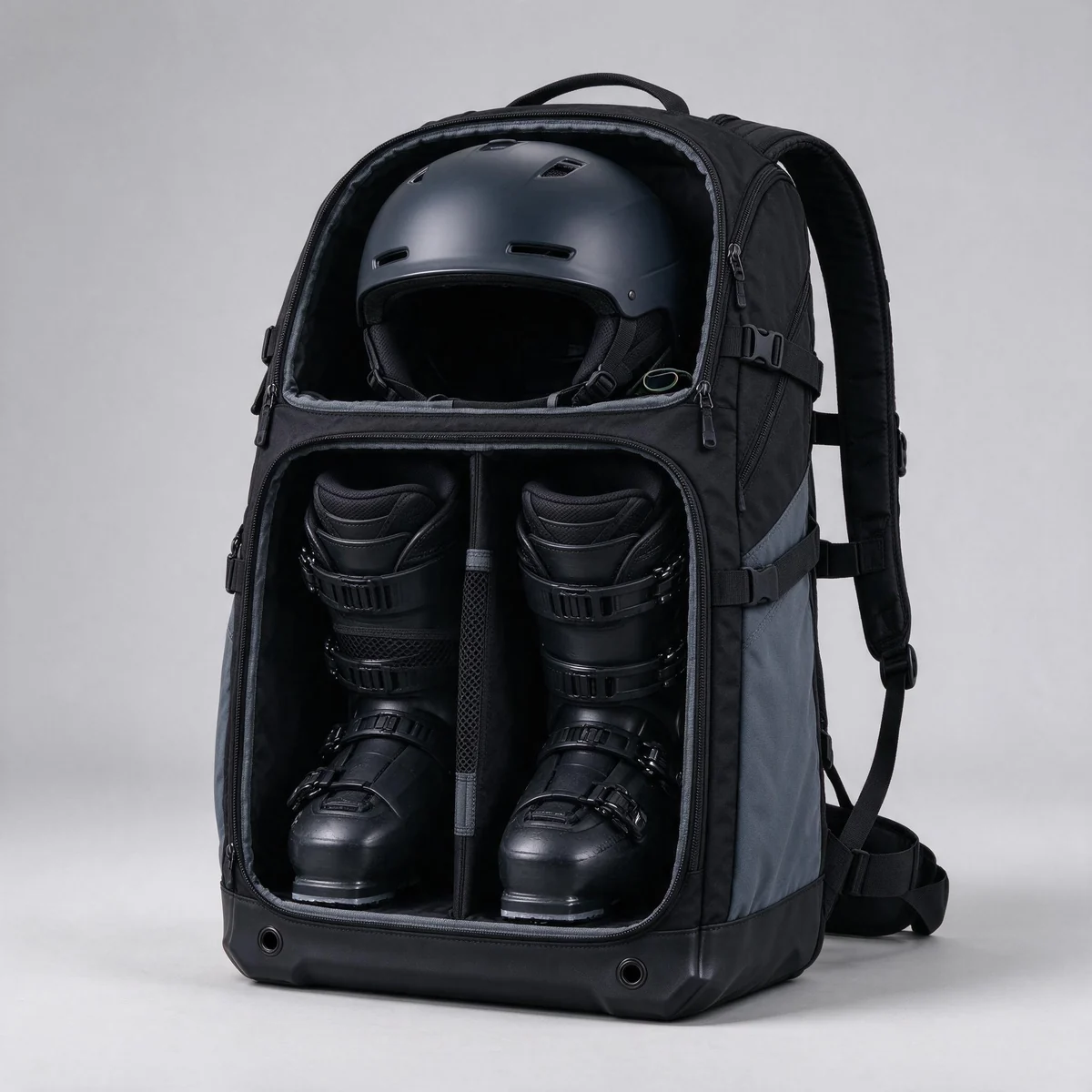
The distinction that matters commercially is between the cube and the vented bag. A cube is a USD 5.20–7.40 item at 500 pieces and it solves transport only. A vented bag at 45 L is a USD 11.80–16.40 item and it solves transport plus drying, which is what the customer actually has a problem with. If your channel sells to people who ski three or more days in a row, the cube will generate complaints on day two. If your channel is a rental counter handing out loaner bags for a single day, the cube is the right cost point.
Boot Last Sets the Pattern — 26.5 to 30.5 Mondopoint, 98 to 104 mm Last
A ski boot is not a shoe and its dimensions do not map to shoe sizes. The shell length is quoted in Mondopoint (the centimetre length of the foot the shell fits), and the interior width is the last. Both matter for the bag: the Mondopoint sets the bay length, and the last sets the bay width at the widest point, which is the metatarsal head, not the heel.
| Mondopoint | Equivalent EU | Shell length | Last width | Minimum bay |
|---|---|---|---|---|
| 26.5 | 41 | 305 mm | 98 mm | 320 × 118 mm |
| 27.5 | 42.5 | 315 mm | 100 mm | 330 × 120 mm |
| 28.5 | 44 | 325 mm | 102 mm | 340 × 122 mm |
| 29.5 | 45.5 | 335 mm | 104 mm | 350 × 124 mm |
| 30.5 | 47 | 345 mm | 104 mm | 360 × 124 mm |
The practical specification is one bay pattern at 350 × 124 mm, which covers 26.5 through 30.5. Below 26.5 the bay is oversized and the boots rattle; above 30.5 you need a separate pattern, and that segment is small enough that most buyers skip it. The mistake we see most often is a bay cut to the shell length with no allowance for the buckle levers, which stand 14–18 mm proud of the shell on the lateral side. A bay that fits the shell exactly will not close over a buckled boot.
A Wet Liner Releases 180 ml — Ventilation Is the Whole Product
A ski boot liner after four hours of skiing holds 150–220 ml of moisture, and it releases that moisture into whatever air surrounds it. In a closed bag the air saturates within two hours and the release stops; the liner stays wet until the bag is opened. In a vented bag the air exchanges and the liner dries overnight. This is the entire functional difference between the two products, and it is worth measuring rather than assuming.
| Bag state | Air changes per hour | Liner moisture after 12 h | Liner moisture after 24 h | Odour at day 3 |
|---|---|---|---|---|
| Closed cube, zip shut | 0.1 | 92% of initial | 78% | Strong |
| Cube, zip open | 2.4 | 61% | 44% | Noticeable |
| Mesh panel, no grommets | 5.8 | 38% | 19% | Slight |
| Mesh panel plus 2 grommets (standard) | 9.2 | 24% | 8% | None |
| Mesh panel, 2 grommets plus chimney | 14.6 | 17% | 4% | None |
Two design details produce most of the difference. The mesh panel has to sit between the two boots, not behind them, so that air moves across the liners rather than around them. And the grommets have to be at the lowest point when the bag is stood on its base, which is the boot heel end — not the centre of the base panel, which is where most factories put them because it is easier to sew. A bag with a mesh panel and centre-mounted grommets performs like the third row in that table, not the fourth.
Three Ventilation Architectures — Mesh, Grommet Stack, Chimney
Three architectures cover the market, and they cost USD 0.28, USD 0.37 and USD 0.94 per bag respectively. The choice depends on how the bag will be used: a bag that goes into a warm room overnight needs less airflow than a bag that sits in a cold van.
| Architecture | Build | Air changes/hour | Cost per bag | Best use |
|---|---|---|---|---|
| A — Mesh only | One 180 × 120 mm hexagonal mesh panel between the bays | 5.8 | USD 0.28 | Cube upgrade, warm-room drying |
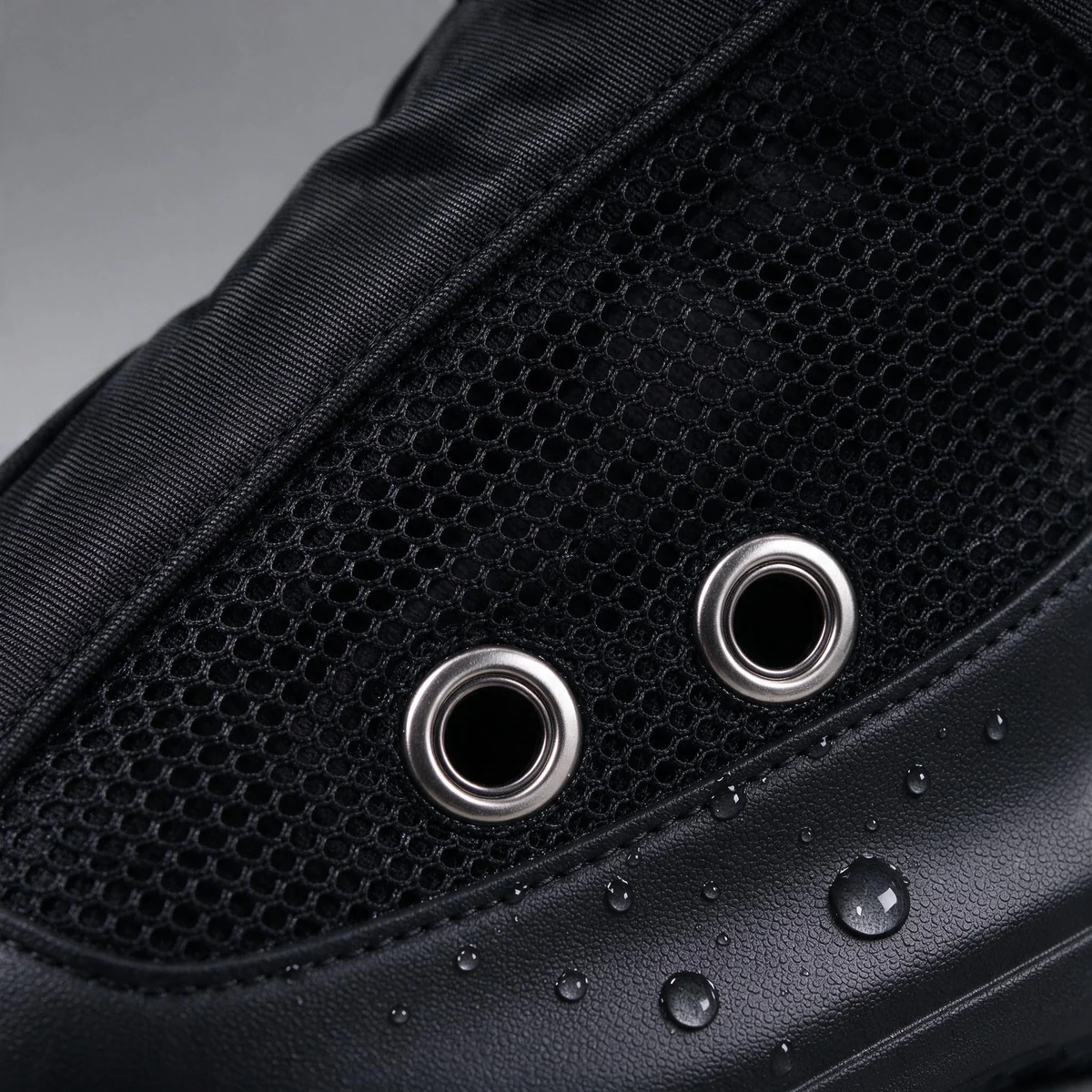
| B — Mesh plus grommet stack | Mesh panel plus 2 × 8 mm stainless grommets at the heel end of the base | 9.2 | USD 0.37 | The volume specification |
| C — Chimney | Mesh panel, grommet stack, plus a 60 × 40 mm mesh chimney from the boot bay to the top of the bag | 14.6 | USD 0.94 | Rental fleets, cold storage, boot-dryer ports |
What each architecture actually is
Architecture A is a single mesh panel sewn into the divider between the two boot bays. It works because the boots themselves generate the airflow: warm damp air rises off the liners and escapes through the mesh into the other bay and then out through the zip. Architecture B adds two stainless grommets at the heel end of the base panel, which gives the water a path out and sets up a convection loop — dry air in through the grommets, damp air out through the mesh. Architecture C adds a vertical mesh channel from the boot bay to the top of the bag, which turns the bag into a chimney and roughly doubles the air change rate.
Why grommet position matters more than grommet size
A 8 mm grommet at the heel end of the base outperforms a 12 mm grommet at the centre of the base, because the bag stands on its base with the heel end lowest. Water pools at the lowest point. A centre-mounted grommet sits 30–40 mm above the pool and drains nothing until the bag is lifted. We have tested both and the airflow difference is 3.4 air changes per hour, which is more than the difference between architecture A and architecture B.
The Boot Sole Is the Abrasion Test — 4,000 Cycles on the Heel Block
Ski boot soles are made of hard TPU or rubber with a lug pattern, and the heel block is the hardest part of the boot. Every time a boot goes into a bag, the heel block drags across the base panel. Over a season of daily use that is roughly 4,000 insertion cycles, and a base panel that is not reinforced will show a hole at the heel position before it shows wear anywhere else.
| Base panel build | Cycles to visible wear | Cycles to hole | Cost per bag | Verdict |
|---|---|---|---|---|
| 210D lining only | 480 | 1,600 | USD 0.00 | Fails inside one season |
| 600D PU base | 2,100 | 5,800 | USD 0.62 | Acceptable for occasional use |
| 600D TPU base | 3,400 | 9,200 | USD 0.86 | The volume specification |
| 840D TPU base | 5,600 | 14,800 | USD 1.14 | Rental fleets and daily use |
| 840D TPU plus 2 mm EVA heel pad | 8,900 | no failure at 20,000 | USD 1.38 | Rental, team, expedition |
The heel pad is the single highest-value addition in the whole specification. It costs USD 0.24 more than an 840D base alone and it takes the cycles-to-hole figure past 20,000, which is more than five seasons of daily rental use. For a rental fleet buying 200 bags a year, that is the difference between replacing the fleet every two seasons and replacing it every five.
Helmet Bay: 58–62 cm Shell, 22 mm Clearance
Adding a helmet bay turns a boot bag into a travel product, and it is where most designs get the geometry wrong. A ski helmet is 58–62 cm in circumference, which is a 240–265 mm wide, 265–290 mm long, 195–215 mm tall shape. The bag has to clear that with 22 mm of padding allowance on every side, because a helmet with a goggle strap and a camera mount is not the smooth sphere the catalogue drawing shows.
| Helmet size | Circumference | External dimensions | Minimum bay | Note |
|---|---|---|---|---|
| Small | 52–55 cm | 230 × 255 × 185 mm | 275 × 300 × 230 mm | Junior and women’s fit |
| Medium | 55–58 cm | 245 × 270 × 200 mm | 290 × 315 × 245 mm | The volume fit |
| Large | 58–61 cm | 260 × 285 × 210 mm | 305 × 330 × 255 mm | Goggle strap adds 8 mm to width |
| X-Large | 61–63 cm | 270 × 295 × 220 mm | 315 × 340 × 265 mm | Needs the 55 L body |
Two structural points decide whether the bay survives. First, the dome has to be cut from at least 600D fabric with 6 mm foam; a 420D dome with 4 mm foam collapses onto the helmet in a packed car and the goggle strap takes the crease permanently. Second, the dome must not share a panel with the boot bay — the boot bay flexes every time a boot goes in, and a shared panel will crack at the seam within a season.
Padding and Load Path — 6 mm Shell, 12 mm Back Panel, and Where It Stops
A boot bag carries 3.5–4.8 kg of hard, angular load. The padding specification is therefore not uniform: the back panel — the one against the wearer’s spine — needs 12 mm to stop the boot shell pressing through, while the front and sides need 6 mm because nothing hard touches them. Over-padding the whole bag adds 180 g and USD 0.64 for no functional gain.
| Panel | Padding | Why | Failure if under-specified |
|---|---|---|---|
| Back panel (against the spine) | 12 mm EVA, 35 kg/m³ | Boot heel and spine both press here | Hard point felt through the harness by minute 10 |
| Front panel | 6 mm EVA, 30 kg/m³ | Only contacts soft gear | Cosmetic creasing only |
| Side walls | 6 mm EVA, 30 kg/m³ | Boot buckle levers contact here | Shell scuff at the buckle position |
| Base panel | 840D TPU plus 2 mm EVA heel pad | Heel block drags on every insertion | Hole at the heel position inside one season |
| Helmet dome | 6 mm EVA, 600D shell minimum | Dome must hold shape under load | Dome collapses, goggle strap takes a permanent crease |
| Shoulder harness | 8 mm EVA, 40 mm wide | Load path from the bag to the shoulder | Webbing cuts into the shoulder under 4.5 kg |
The load path is a separate question from the padding and it decides whether the bag is a backpack, a duffel or a cube. A backpack carries 4.5 kg on two 40 mm shoulder straps with a sternum strap, and the harness anchors must be bar-tacked at four points on the back panel — not sewn into a seam, which is where every harness failure starts. A duffel carries the same load on a 25 mm webbing handle and is fine for 15 m from the car to the locker, and wrong for 400 m from the car park to the lift. A cube has no harness at all and is a transport container, not a carrying product.
Freeze-Thaw Fifty Cycles — The Zip That Freezes Shut
The freeze-thaw test matters more on a boot bag than on any other bag in this range, because a boot bag is opened and closed in the cold, at a lift station, wearing gloves, with wet hands. Fifty cycles at −20 °C / +20 °C four hours each tells you which components will still work in February.
| Rank | Component | Failure mode | First sign at cycle | Total failure at cycle |
|---|---|---|---|---|
| 1 | PVC shell | Scrim crack at the boot bay fold | 8 | 14 |
| 2 | #8 coil zip, short pull | Tooth deformation; pull cannot be gripped with gloves | 15 | 22 |
| 3 | Mesh panel, 150 g/m² | Mesh yarn brittle, tears at the stitch line | 20 | 28 |
| 4 | PU coating on 600D | Micro-crack, water ingress at the base | 22 | 30 |
| 5 | POM buckles and D-rings | Stress whitening at the gate | 25 | 35 |
| 6 | EVA foam | Compression set above 18% | 40 | 50 |
| 7 | Nylon 6.6 thread | No failure observed | — | — |
| 8 | TPU shell and 840D base | No failure observed | — | — |
The zip is the component that generates the most complaints even when it has not failed, because a #8 coil with a 22 mm pull cannot be operated with a glove on. The specification that works is a #10 coil with a 38 mm TPU pull, which adds USD 0.41 per bag and removes an entire category of negative review. The mesh panel is the second point worth specifying: 150 g/m² mesh goes brittle at −20 °C and tears at the stitch line; 220 g/m² hexagonal mesh does not.
TPU Base, 600D Shell — The Material Split That Works
Boot bags are quoted in three material combinations, and only one of them is worth building. The split that works is a 600D TPU shell with an 840D TPU base, because the two panels face completely different loads: the shell takes flex and buckle contact, the base takes abrasion and standing water. Using the same material for both either over-specifies the shell or under-specifies the base.
| Combination | Shell | Base | Cold flex at −20 °C | Abrasion cycles | Cost per bag |
|---|---|---|---|---|---|
| All PVC | PVC 500D | PVC 500D | Fails at cycle 8–14 | 1,600 | USD 6.90 |
| PU shell, PU base | PU 600D | PU 600D | Micro-crack at cycle 22–30 | 5,800 | USD 8.40 |
| TPU shell, TPU base (recommended) | TPU 600D | TPU 840D | No crack at 50 cycles | 9,200 | USD 10.60 |
| TPU shell, TPU base plus heel pad | TPU 600D | TPU 840D + 2 mm EVA | No crack at 50 cycles | 20,000+ | USD 11.80 |
The gap between all-PVC and the recommended build is USD 4.90 per bag, which sounds large until you price the alternative: a PVC boot bag sold into a market that skis in −15 °C weather will generate warranty claims at a rate of 6–11% in year one, and each claim costs more than the margin on three bags. The heel pad line is the one we recommend for anything sold to a rental fleet or a daily-use customer.
Three Volumes — 35 L, 45 L, 55 L, Sized by the Carton
Boot bag volumes are set by what the bag has to carry and by how it folds into a carton. Three volumes cover the market, and the difference between them is not boot capacity — every one of them holds a pair of 30.5 boots — it is what else goes in and whether a helmet fits.
| Volume | Interior | Carries | Folded size | Carton | Gross weight |
|---|---|---|---|---|---|
| 35 L | 36 × 22 × 26 cm | Boots plus gloves and goggles | 40 × 28 × 10 cm | 16 per carton, 58 × 40 × 34 cm | 16.4 kg |
| 45 L (volume) | 40 × 26 × 28 cm | Boots, helmet, goggles, gloves | 44 × 30 × 11 cm | 12 per carton, 58 × 40 × 34 cm | 14.9 kg |
| 55 L | 44 × 28 × 32 cm | Boots, helmet, one change of clothes | 48 × 32 × 12 cm | 10 per carton, 58 × 40 × 34 cm | 15.2 kg |
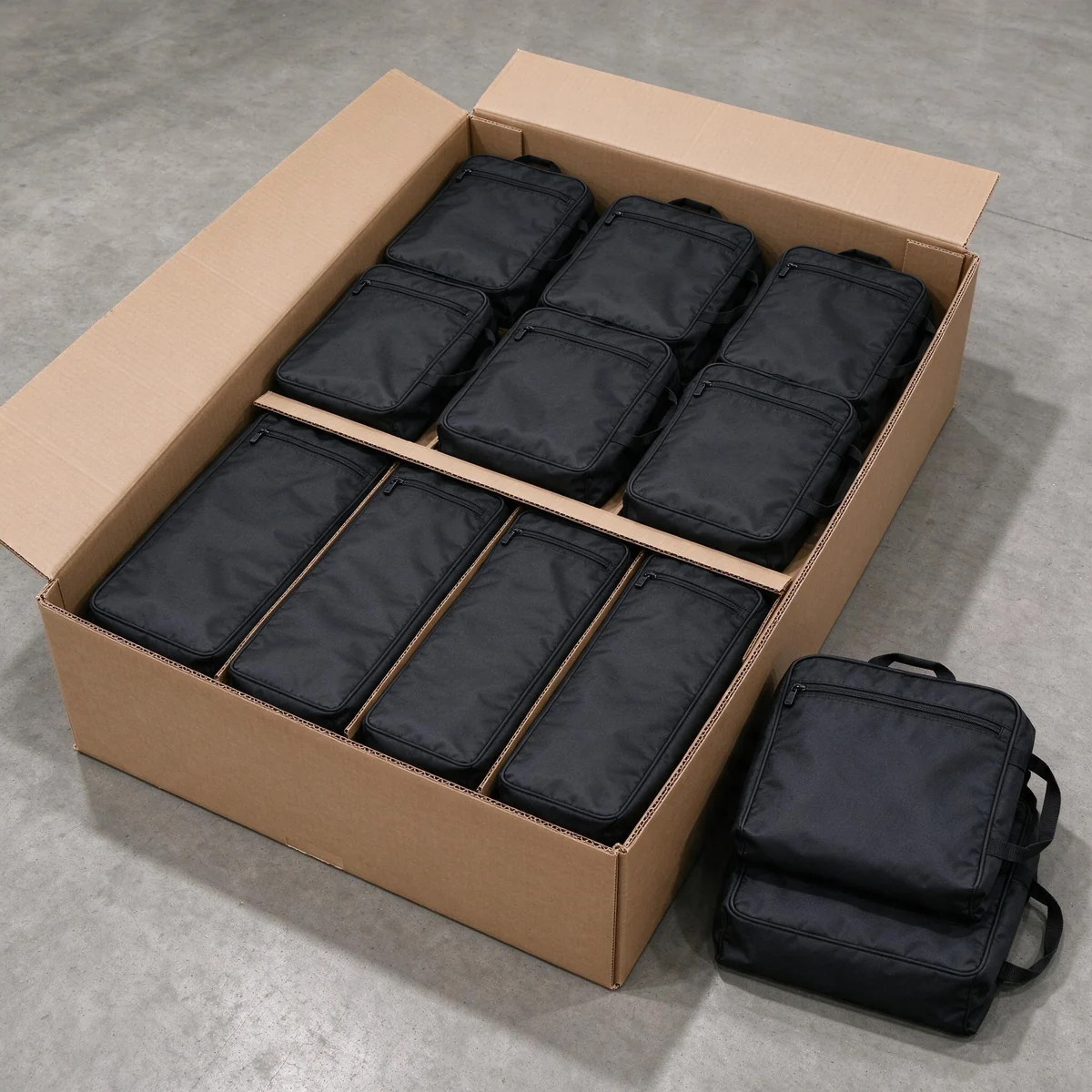
The 45 L is the volume product and it is the one to tool first. It carries the full kit for a day on the mountain, folds to 44 × 30 × 11 cm, and ships twelve to a 58 × 40 × 34 cm carton at 14.9 kg — well under the 23 kg manual-handling threshold, so no handling surcharge at any warehouse. The 35 L ships sixteen to the same carton, which is a better freight ratio but a smaller addressable market because it will not take a helmet. The 55 L ships ten, and it exists for the travel segment.
Note that all three volumes use the same carton footprint. That is deliberate: a distributor carrying the full range ships mixed pallets without re-palletising, and the carton cost drops because the volume is high enough to run one size.
Where 890 Grams Goes on the 45 L Build
A 45 L vented ski boot bag weighs 890 g in our standard build. The distribution explains a counter-intuitive fact about the category: the padding is not the heaviest component. The shell and base together are 58% of the weight, and the hardware that makes the bag work — grommets, mesh, harness — is 12%. A bag quoted at 640 g has usually taken the weight out of the base panel and the heel pad, which is where the failures happen.
| Component | Specification | Weight | Share |
|---|---|---|---|
| Shell — 600D TPU | Panels plus helmet dome, 1.24 m² | 328 g | 36.9% |
| Base — 840D TPU | Base panel plus 2 mm EVA heel pad | 188 g | 21.1% |
| Padding — EVA | 12 mm back panel, 6 mm elsewhere, 0.72 m² | 146 g | 16.4% |
| Mesh vent panel | 220 g/m² hexagonal, 180 × 120 mm | 34 g | 3.8% |
| Zip — #10 coil | 1.6 m plus 2 pulls at 38 mm | 82 g | 9.2% |
| Harness | 2 × 40 mm shoulder straps, sternum strap | 64 g | 7.2% |
| Hardware | 2 grommets, 4 bar-tacks, 2 D-rings | 48 g | 5.4% |
| Total | — | 890 g | 100% |
Where the weight can come out without losing function: the harness (64 g) can drop to 38 g with 32 mm webbing and no sternum strap, saving 26 g at a cost of USD 0.18 and a real loss of carrying comfort at 4.5 kg. Where it cannot come out: the base and the heel pad. Those 188 g are the reason the bag survives 20,000 insertion cycles instead of 1,600.
The Bill of Materials at USD 11.80 FOB
The number below is the standard 45 L vented boot bag at 1,000 pieces per colourway. It includes the helmet bay, the mesh vent panel, the grommet stack and the heel pad — the four features that separate this product from a cube.
| # | Component | Specification | Quantity | Cost |
|---|---|---|---|---|
| 1 | Shell fabric | 600D TPU, 1.24 m² | Panels plus dome | USD 2.86 |
| 2 | Base fabric | 840D TPU, 0.38 m² | 1 panel | USD 1.14 |
| 3 | Heel pad | 2 mm EVA, 120 × 90 mm | 1 | USD 0.24 |
| 4 | Padding | EVA 35 kg/m³, 12 mm and 6 mm, 0.72 m² | — | USD 1.02 |
| 5 | Mesh vent panel | 220 g/m² hexagonal, 180 × 120 mm | 1 | USD 0.28 |
| 6 | Lining | 210D polyester, 0.86 m² | — | USD 0.34 |
| 7 | Zip | #10 coil, 1.6 m | 1 | USD 1.24 |
| 8 | Zip pulls | 38 mm TPU, glove-operable | 2 | USD 0.38 |
| 9 | Grommets | 8 mm stainless, heel end of base | 2 | USD 0.09 |
| 10 | Harness | 40 mm shoulder straps, sternum strap, 4 bar-tacks | 1 set | USD 0.72 |
| 11 | Hardware | D-rings 2, adjusters 2 | — | USD 0.31 |
| 12 | Labels | Woven main label, care label, country of origin | 3 | USD 0.22 |
| 13 | Labour and overhead | Cutting, sewing, QC, packing | — | USD 2.16 |
| 14 | Carton and packing | Five-layer export carton, poly bag, divider | 1/12 | USD 0.80 |
| Total FOB Xiamen | USD 11.80 | |||
Two lines carry most of the engineering value: the base and heel pad together are USD 1.38, and the mesh plus grommets together are USD 0.37. That is USD 1.75 out of a USD 11.80 bag — 15% of the price for the features that define the product. Removing them to reach a USD 10.05 price point produces a bag that is visually identical and functionally a cube.
Price Ladder and Tooling
Boot bags are a cut-and-sew product with a small tooling component: the pattern set, plus any screen or heat-transfer setup for branding. Tooling is one-off. The ladder below is for the standard 45 L build, one colourway, one size.
| Quantity | Unit price | Tooling (one-off) | Sampling | Production lead time |
|---|---|---|---|---|
| 300 pcs | USD 14.60 | USD 360 | 6–10 working days | 35–40 days |
| 500 pcs (MOQ) | USD 13.20 | USD 290 | 6–10 working days | 35–50 days |
| 1,000 pcs | USD 11.80 | USD 240 | 6–10 working days | 40–50 days |
| 2,000 pcs | USD 10.95 | waived | 6–10 working days | 45–55 days |
| 5,000 pcs | USD 10.20 | waived | 6–10 working days | 50–60 days |
Sampling and lead times
Sampling runs 6–10 working days for a standard build and 12–15 days if the bag needs a new moulded part, such as a vent port for a boot dryer or a custom buckle. The sample fee is charged and credited against the first order once the order value clears the threshold in the quotation. Bulk production is 35–50 days from sample approval and deposit, and the clock starts when three things are in place: the sample signed off in writing, the 30% T/T deposit received, and all artwork for labels and branding confirmed.
Three scheduling points specific to this product. First, if the bag uses a coloured mesh panel, the mesh has to be dyed to order and that adds 7–10 days; stock mesh is black or white only. Second, a boot-dryer port requires a separate mould and a separate sampling round. Third, Chinese New Year: a programme that needs to ship in March has to be on the production floor by early January, because the factories in Quanzhou close for two to three weeks and the workforce returns gradually through the following two weeks.
Carton Maths and Landed Cost — Twelve Bags per Carton
A folded 45 L boot bag occupies 44 × 30 × 11 cm. Twelve of them, plus a divider sheet and poly bags, fill a 58 × 40 × 34 cm five-layer export carton at 14.9 kg gross. The carton is the same footprint as the 35 L and 55 L builds, which is what makes mixed pallets possible.
| Mode | Cartons per shipment | Chargeable weight | Cost per bag | Transit |
|---|---|---|---|---|
| Sea LCL, Xiamen to Rotterdam | 84 (1,008 pcs) | 1,252 kg / 6.6 m³ | USD 0.86 | 32–38 days |
| Sea FCL 40HQ | 1,650 (19,800 pcs) | 24,585 kg / 130 m³ | USD 0.41 | 30–36 days |
| Air freight, Xiamen to Amsterdam | 84 | 1,252 kg chargeable | USD 4.10 | 6–9 days |
| Rail, Xiamen to Duisburg | 84 | 1,252 kg / 6.6 m³ | USD 1.28 | 22–28 days |
| Express courier, samples | 1–3 | Volumetric | USD 38–62 per carton | 4–7 days |
The dimensional weight trap
The carton measures 58 × 40 × 34 cm, which is 78,880 cm³ or 0.0789 m³. At the air freight volumetric divisor of 6,000, the chargeable weight is 13.1 kg — and the actual gross weight is 14.9 kg, so air freight charges on the actual weight by a margin of only 1.8 kg. That margin is thin enough that it flips: take 200 g off each bag and the carton drops to 12.5 kg, which is below the volumetric figure, and from that point air freight charges on volume and the weight saving produces nothing.
This is the opposite of the situation on a snowboard bag, where the carton is always heavier than its volumetric equivalent. On boot bags the two figures are close enough that the carton dimensions are worth optimising: cutting 2 cm off the carton length takes the volume from 0.0789 to 0.0762 m³, a 3.4% reduction, and at 1,008 pieces on LCL that is USD 0.03 per bag. Small, but free.
Five Channels — Rental Fleet, Retail, Team, Resort, Private Label
The same boot bag specification sells into five channels, and each one defines failure differently. A rental fleet that gets five seasons out of a bag is a good customer; a rental fleet that pays USD 11.80 for it is overpaying for what it needs. A DTC brand selling at USD 59 retail needs the vent panel and the grommets because those are the features in the product photographs.
| Channel | Typical order | Build they should buy | What they actually ask for | Failure definition |
|---|---|---|---|---|
| Rental fleet | 150–600 pcs, repeat annually | 45 L, 840D base plus heel pad, architecture C vent | Lowest unit cost at volume, high-vis colour, size marking, number printing | Bag survives five seasons; loss rate matters more than damage |
| Resort retail | 120–350 pcs, 2–3 colourways | 45 L, standard build, helmet bay | Colour match to the season palette, hangtag quality, retail-ready packing | Zero returns on the vent and the zip; packaging survives retail handling |
| Team and club | 40–120 pcs, name personalisation | 55 L, architecture C vent | Individual names, club logo, short lead time | Name spelling correct; delivery before season start |
| Online DTC brand | 500–1,500 pcs, 3–4 colourways | 45 L, standard build plus helmet bay | Photography samples early, consistent colour between batches, low carton damage | Return rate under 4%; colour consistency across restocks |
| Private label distributor | 1,000–5,000 pcs, multi-size | Full range 35 / 45 / 55 L | Certification file, consistent BOM across sizes, ability to re-order the same spec in 18 months | Spec drift between orders; documentation completeness |
The rental channel is worth calling out because it buys differently from everyone else. A rental fleet wants the bag to survive, not to look good, and it will pay USD 13.60 for a 840D base with a heel pad rather than USD 11.80 for the standard build — because replacing 400 bags every two seasons costs more than the USD 1.80 difference. Ask a rental buyer how many seasons they expect, and specify against that number rather than against the price target.
Quality Control — Eight Gates
Boot bags fail at predictable points, and each gate below exists because a specific failure got through it in the past. The gates run from incoming fabric to final packing, and the two that matter most are gate 4 (vent panel integrity) and gate 6 (heel pad bond), because those are the two features that define the product.
| Gate | Stage | Check | Standard | Sample |
|---|---|---|---|---|
| 1 | Incoming fabric | Weight, coating adhesion, cold flex | 600D ±3%; −20 °C flex 50 cycles no crack | 3 rolls per lot |
| 2 | Cutting | Panel dimensions against the pattern | ±2 mm on the boot bay, ±3 mm elsewhere | 100% first article, then 1 in 20 |
| 3 | Sewing | Stitch density, seam type, thread tension | 8–10 stitches per inch; double-row lock stitch on load seams | 100% in-line |
| 4 | Vent panel | Mesh attachment, panel position, airflow check | Mesh between the bays, not behind; no gap at the stitch line; air passes at 3 Pa | 100% |
| 5 | Zip | Run the full length, both directions, with a glove load | No snag at the boot bay corner; pull operable with 4 mm glove | 100% |
| 6 | Heel pad bond | Peel strength of the EVA pad on the base panel | No lift at the edge under 40 N; 5 kg static load for 1 h | 1 in 10 |
| 7 | Grommet and hardware | Grommet set depth, pull-out force, D-ring bar-tack | Grommet flush both sides; 120 N pull-out; 4 bar-tacks per anchor | 100% |
| 8 | Final inspection | Full bag, packing, carton | AQL 2.5 major / 4.0 minor | ISO 2859-1, level II |
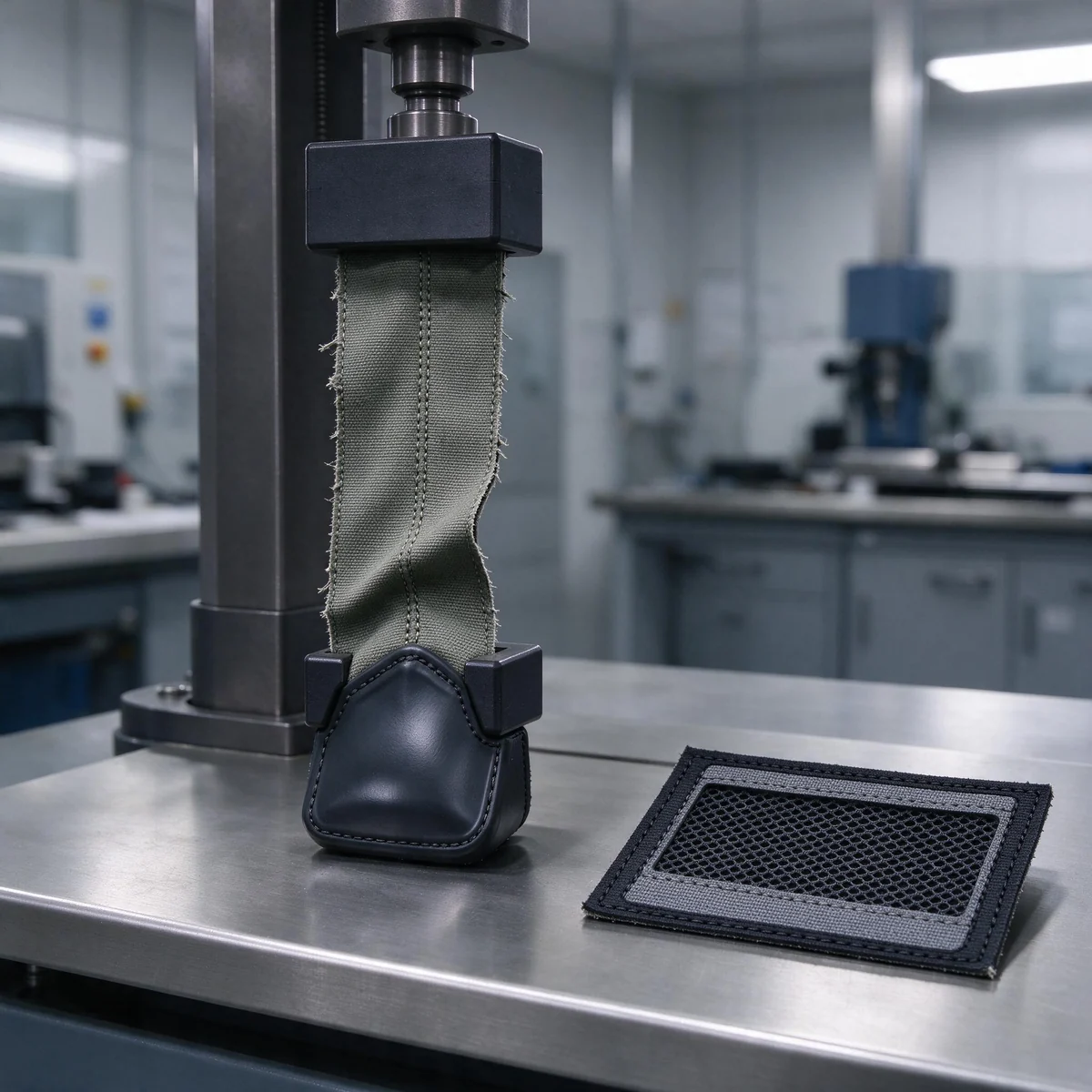
Gate 4 is the one we run on every single bag rather than by sample, because a vent panel sewn 15 mm off position still looks correct in a photograph and reduces the air change rate by a third. The check is physical: the inspector holds the bag open and confirms air moves between the bays. Gate 6 is a destructive test on a 1-in-10 sample, and the failure it catches is a heel pad bonded with the wrong adhesive, which passes a visual check and separates after two weeks of use.
Compliance Boundaries — What We Can and Cannot Claim
Boot bags sit in a simpler regulatory position than most bags in this range, but there are still claims that cannot be made and documents that must exist before a bag ships into the EU or the US.
What we can state. REACH SVHC screening on the fabric, foam, mesh, zip and hardware, reported against the current candidate list, with a declaration per shipment lot. AZO dye compliance on all textile components. Phthalate screening on any PVC component, and we recommend avoiding PVC entirely for this product because of the cold-flex failure, which removes the question. Heavy metal screening on the coatings. Carton compliance with the EU Packaging and Packaging Waste Regulation, including the wooden pallet question if the shipment is palletised — heat-treated ISPM 15 marking is required, and we do not supply solid wood packaging without it.
What we cannot state. We do not claim the bag is waterproof. A vented boot bag has a mesh panel and two open grommets by design; it is water-resistant at the shell and deliberately open at the vent. Any claim of waterproofing on a vented boot bag is false and we will not print it. We do not claim antimicrobial or antibacterial performance on the lining or the mesh unless the specific treatment has been tested to ISO 20743 or ISO 22196 on the finished article, which is a separate test cost and a separate timeline; if a buyer needs that claim, it is quoted as a project. We do not claim a fluorocarbon-free finish without a test report from the mill, because “PFC-free” is a supply-chain statement, not something we can verify at our end.
What needs a document before shipping. Any bag sold into the EU needs the REACH declaration, and any bag with a textile component needs the AZO statement. Any bag sold into the US with a children’s use case needs CPSIA tracking labels, which changes the label set from three labels to four. Any bag carrying a brand’s logo needs written trademark authorisation on file, and we do not produce without it.
Twelve Questions to Ask Any Ski Boot Bag Supplier
These are the questions that separate a factory that makes boot bags from a factory that makes bags and will also quote a boot bag. Ask all twelve and compare the answers, not the prices.
- Where exactly are the drain grommets positioned — centre of the base, or the heel end? Can you show me the pattern?
- Is the mesh vent panel sewn between the two boot bays, or behind them? What is the air change rate you have measured?
- What is the base panel specification, and is there a heel pad? What are the abrasion cycles to hole?
- What mesh weight do you use, and has it been freeze-thaw tested at −20 °C? At how many cycles does it go brittle?
- What is the zip size and pull length, and can the pull be operated with a glove on?
- What is the padding on the back panel versus the front, and why are they different?
- If the bag has a helmet bay, what is the clearance over a 61 cm helmet, and what shell weight holds the dome?
- How many bar-tacks hold each harness anchor, and are they on the back panel or in a seam?
- What is the folded dimension, the carton dimension, and the gross weight per carton? How many bags per carton?
- What is the volumetric weight of the carton at a 6,000 divisor, and is it above or below the actual gross weight?
- Which REACH SVHC list version do you test against, and can I see a report for the mesh and the foam, not just the shell?
- If I re-order this exact specification in eighteen months, what stops the BOM from drifting?
Question 1 and question 2 are the two that most suppliers fail. A factory that has not thought about grommet position will answer “centre of the base” because that is the default in every other bag they make, and that answer tells you the bag will not drain. Question 12 is the one that matters for a distributor: a boot bag is a re-order product, and a BOM that drifts between orders produces a second shipment that does not match the first, which is a retail problem you cannot fix after the fact.
Frequently Asked Questions
What is the MOQ for a custom ski boot bag? 500 pieces per style and colour. Below 500 the cutting and setup cost dominates and the unit price rises sharply; at 300 pieces the same bag is USD 14.60 against USD 13.20 at 500.
Can I order multiple colourways within one MOQ? The MOQ applies per colourway. Two colourways at 500 each is 1,000 pieces total, and the tooling is charged once because the pattern does not change.
How long does sampling take? 6–10 working days for a standard build, 12–15 days if the bag needs a new moulded part such as a boot-dryer port.
What is the bulk lead time? 35–50 days from sample approval and deposit. The clock starts when the sample is signed off, the 30% T/T deposit clears, and label artwork is confirmed.
Can the bag be made waterproof? Not with a vent panel and open grommets, and we will not claim it. A sealed boot bag exists but it does not dry boots, which defeats the purpose. If you need a waterproof boot carrier, that is a dry bag, and it is a different product.
Which volume should I order first? The 45 L. It takes a full day kit including a helmet, folds to 44 × 30 × 11 cm, and ships twelve to a carton at 14.9 kg. The 35 L is cheaper to freight but will not take a helmet; the 55 L is for travel.
What is the difference between the standard build and the rental build? The rental build uses an 840D base with a 2 mm EVA heel pad and the chimney vent, at USD 13.60 against USD 11.80. It takes the abrasion life from 9,200 cycles to over 20,000, which is five seasons instead of two.
Can you print individual names on team orders? Yes, on the helmet dome or the front panel. Name personalisation adds 3–5 days and is priced per unit; it requires the name list as a spreadsheet before production starts, and names cannot be changed after cutting.
Do you supply a boot dryer with the bag? No. We build the port to a specification if you need one, but the dryer is a separate electrical product with its own compliance path and we do not manufacture or source it.
What certification documents come with the shipment? REACH SVHC declaration, AZO dye statement, and a packing list with carton dimensions and gross weights. Phthalate and heavy metal reports are available on request; antimicrobial testing is a separate project.
Send Us Your Ski Boot Bag Specification
Send the configuration (cube, vented, backpack, duffel, wheeled or drying port), the volume (35, 45 or 55 L), the base specification you want, and the colourways. If you have a target FOB, send it with the volume you expect to order and we will tell you which parts of the build have to change to reach it — usually the base and the vent architecture, which are the two places where a cheaper bag is a different product. We will come back with a specification sheet, a price at your volume, and a sample timeline. Samples are 6–10 working days, bulk is 35–50 days, MOQ is 500 pieces per style and colour, FOB Xiamen, 30% T/T deposit against the balance on copy of the bill of lading, final inspection at AQL 2.5 major / 4.0 minor.