
Short answer: a custom ski bag programme at Junyuan Bags runs at MOQ 500 pieces per style and colour, samples in 6–10 working days, bulk in 35–50 days, final inspection at AQL 2.5 major / 4.0 minor, FOB Xiamen, 30% T/T deposit against the balance on copy of the bill of lading. We are a bag manufacturer established in 2014; our founder has worked in the bag trade since 2004.
A ski bag is not a long duffel with a mountain printed on it. The item inside is a pair of laminate skis with a steel edge that will cut through 600D polyester in one airport carousel, a binding plate that concentrates 4 kg into an area smaller than a palm, and a polyethylene base that creeps when it is held at 40 °C in a coach hold for six hours. Those three facts decide the pattern, the padding map, the base construction and the closure. Everything else on this page is the arithmetic that follows from them.
This page is the procurement document. It covers the seven products sold under the name “ski bag” and how to tell them apart on a spec sheet, the five length bands that ski geometry forces on the pattern room, four padding grades and where each one fails, the puncture test that separates a bag that survives one season from one that survives four, fifty freeze-thaw cycles and what actually breaks, TPU against PVC at −20 °C, the 8–12 mm cold shrink allowance that decides whether a zip still closes in February, why wheels are a frame problem rather than a wheel problem, the glove-operable zipper window, carton maths, the bill of materials at USD 18.40 FOB on a double ski bag, eight quality gates, and twelve questions to ask any supplier before you place a tooling deposit.
What “Ski Bag” Means — and the Seven Products Sold Under That Name
Search the term and you get seven different products with seven different cost structures and seven different failure modes. Buying the wrong one is the most common sourcing error in this category, and it is not the buyer’s fault — the market uses one word for all of them.
| Product | Structure | What it holds | Where it fails | Buy it when |
|---|---|---|---|---|
| Single ski sleeve | One flat panel, 3–5 mm foam, one long zip, no base reinforcement | One pair of skis, nothing else | Edge cuts through the tip and tail within a season; no binding clearance | Retail add-on, car transport, rental fleets |
| Double padded ski bag (the volume product) | Two-panel body, 8–12 mm padding at edge zones, full-length base panel, internal compression strap | Two pairs of skis plus poles, or one pair plus boots | Base panel abrasion at the tail; zip coil failure at the bend | Air travel, brand programmes, resort retail |
| Wheeled ski bag | Double bag body on an internal HDPE or PP backboard, two inline or spinner wheels, telescopic handle | Two pairs plus boots, 25–30 kg loaded | Backboard flex at the handle root; wheel housing cracking on kerbs | Frequent flyers, premium price bands, rental |
| Ski boot bag | Backpack or duffel, ventilated boot compartment, helmet zone | Boots, helmet, goggles, gloves | Ventilation blocked; boot moisture wicking into the helmet zone | Bundled with the ski bag, or sold separately |
| Snowboard bag | Wider, shorter body; binding clearance is the defining dimension | One or two boards plus bindings | Binding pockets crush; board base abrades on the base panel | Snowboard programmes — a different pattern from ski |
| Ski backpack | Harness and back panel added to a boot-bag body | Boots, helmet, layers, sometimes skis on side straps | Harness root tears; load sits too high for the hip belt | Resort day use, not checked baggage |
| Combo / roller boot bag | Boot bag on wheels, or boot compartment built into a wheeled ski bag | Everything in one unit | Weight distribution — the boot end loads the wheel axle unevenly | One-bag travellers, premium tiers |
The distinction that matters most commercially is sleeve against padded bag. A sleeve is a USD 6.99–9.79 retail item and a USD 3.10–4.60 FOB item; a double padded bag is a USD 35.70–69.00 retail item and a USD 15.80–24.50 FOB item. They are not the same product at different quality levels. They are different products that share a silhouette. If your brief says “ski bag” and does not say which of the seven, the first question back should be which one — not what colour.
Ski Geometry Comes First — Five Length Bands, and Why 175 cm Is the Break Point
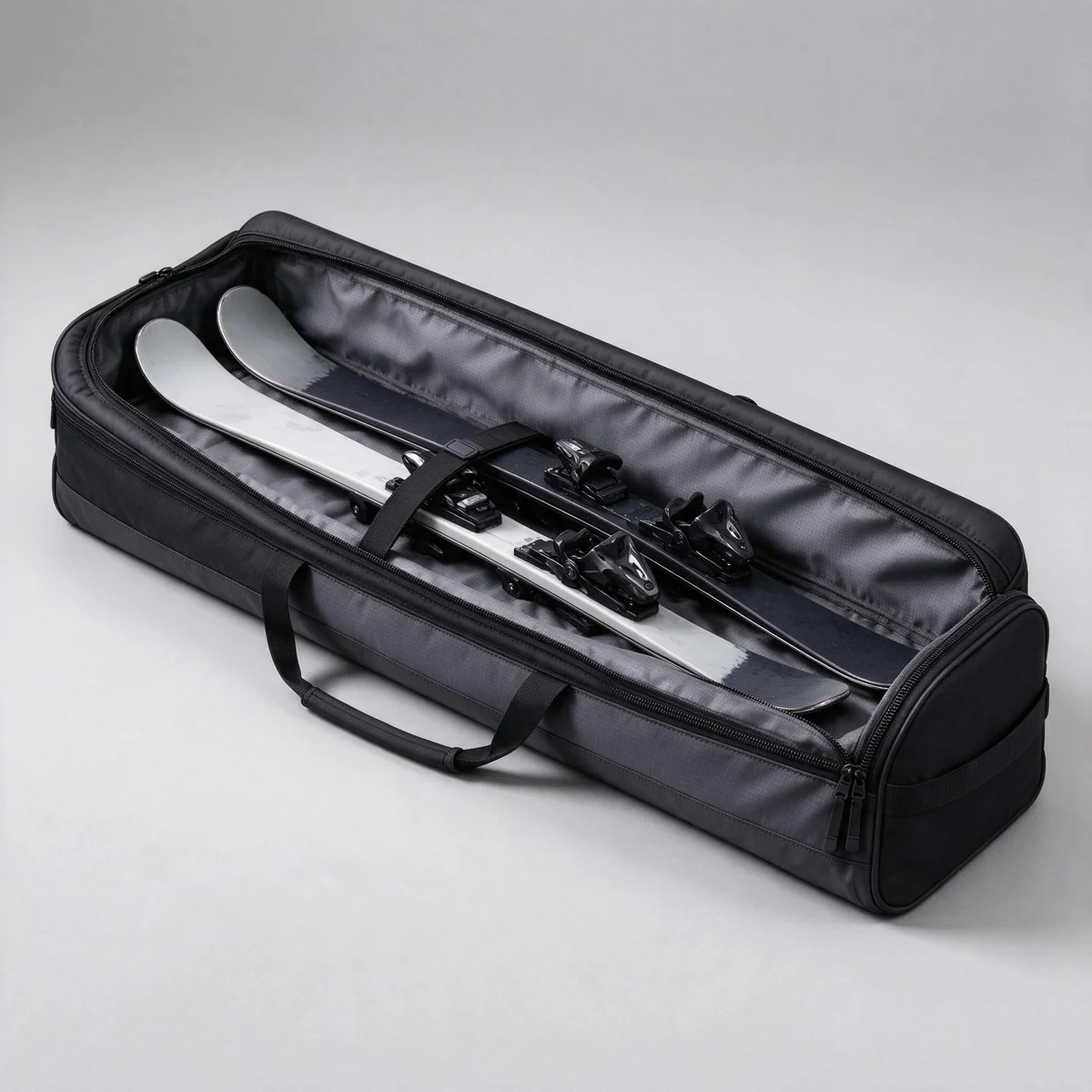
You do not choose the bag length. The ski chooses it. A bag that is 5 cm short of the ski cannot be closed without compressing the tip, and a compressed tip is a cracked tip within two seasons. A bag that is 15 cm long adds volumetric weight you pay for on every shipment and gives the ski room to slide and abrade.
Five bands cover the commercial market. The internal length is the number that matters on the spec sheet; the external length is what the airline measures.
| Band | Ski length it serves | Internal length | External length | Carton length | Volume (double) |
|---|---|---|---|---|---|
| Junior / short | 130–150 cm | 155 cm | 162 cm | 66 cm folded | 32 L |
| Freestyle / park | 150–168 cm | 172 cm | 179 cm | 72 cm folded | 38 L |
| All-mountain (the volume band) | 168–182 cm | 186 cm | 193 cm | 78 cm folded | 44 L |
| Race / GS | 182–195 cm | 199 cm | 206 cm | 84 cm folded | 48 L |
| Powder / touring long | 195 cm+ | 208 cm | 215 cm | 88 cm folded | 52 L |
Why 175 cm is the break point. Below 175 cm external length, a padded double bag ships folded in a carton that fits standard parcel networks and stays under the 158 cm linear limit that most airlines and most express carriers apply to a single piece. Above 175 cm, the folded carton crosses that limit, freight moves from parcel to oversize, and the landed cost per unit can rise 22–35% on a small order. This is the single most under-modelled number in the category: brands pick a length to cover the whole range, then discover at the freight quote stage that the longest SKU is carrying the programme’s margin.
The commercial answer is to build the 186 cm band as the volume SKU, add the 199 cm and 208 cm bands as made-to-order above 300 pieces, and not stock them. Two patterns, one spec sheet, no oversize freight on the run that pays for the tooling.
One more geometry constraint that the pattern room cannot solve: binding clearance. A ski with a system binding sits 65–85 mm proud of the base at the widest point. If the bag is a flat two-panel construction with a single long zip on the top edge, the binding pushes the panels apart and the zip carries the load. That is why every double bag we build has a gusset depth of at least 90 mm and a binding relief zone at the mid-point, not a flat seam.
Padding Is Not One Number — Four Grades, and Where Each One Fails
What each grade actually is
“Padded” on a catalogue page means nothing. On a spec sheet it is a thickness in millimetres, a foam type, and a placement map. Four grades cover the commercial range, and the grade is chosen by how the bag travels, not by what it costs.
| Grade | Foam | Thickness | Puncture resistance | Weight penalty (double bag) | Travel context | FOB delta |
|---|---|---|---|---|---|---|
| G1 — sleeve | PE closed cell | 3 mm | Low — single season | +120 g | Car, boot, rental fleet | base |
| G2 — light padded | PE closed cell | 5 mm | Moderate — edge zones only | +280 g | Coach, train, occasional flight | +USD 1.40 |
| G3 — padded (volume grade) | PE + EVA laminate | 8 mm edge, 5 mm body | High — edge zones reinforced | +540 g | Checked baggage, brand programmes | +USD 3.20 |
| G4 — reinforced | EVA + PE double layer | 12 mm edge, 8 mm body | Very high — full perimeter | +910 g | Freight, expedition, rental premium | +USD 6.10 |
Why 5 mm is the line for a sleeve and 8 mm is the line for checked baggage
The number is not arbitrary. A ski edge presents a contact radius of roughly 0.3 mm and a load of 30–60 N when a loaded bag is dropped 40 cm onto a hard edge. Against 5 mm of PE closed cell, that load produces a local compression of about 70% and the fabric behind the foam sees a stress concentration high enough to abrade through 600D in an estimated 12–18 handling cycles. Against 8 mm of PE/EVA laminate, the same load produces roughly 45% compression and the fabric survives the same cycle count with visible but non-structural wear.
Below 5 mm, the foam is not doing structural work — it is doing cosmetic work. Above 12 mm, you are adding weight and volumetric cost without a measurable gain in edge survival, because the failure has moved from the foam to the fabric itself.
The placement map matters more than the thickness. On every G3 and G4 bag we build, the padding is not uniform: it is 8–12 mm along the two long edges and the tip and tail, and 5–8 mm across the body. That map costs 30% less in foam than uniform 8 mm and tests better, because the edge is the only place that gets hit.
The Edge Test: 180 N Puncture Against a 90 N Body
We specify two numbers on a ski bag, not one. The reinforced zones must resist 180 N of puncture load; the body must resist 90 N. The 2:1 ratio is what a buyer should ask for on any spec sheet, because a single number hides where the reinforcement is.
| Zone | Puncture threshold | Construction | What happens if it fails |
|---|---|---|---|
| Edge band (both long sides) | 180 N | 600D TPU + 8–12 mm EVA + 2 mm HDPE strip | Edge cuts through to the interior; ski base scores on the next trip |
| Tip and tail | 180 N | Double-layer 600D + 12 mm EVA wrap | Tip punch-through; the most common warranty claim |
| Body panel | 90 N | 600D TPU + 5–8 mm PE | Cosmetic abrasion, then wicking |
| Base panel | 220 N abrasion | 840D TPU, double-layer, 3 mm EVA hard sheet | Base wears through at the tail first — the classic failure |
| Zip tape line | 140 N pull-off | Two-row stitching at 7–9 stitches per 25 mm | Zip separates from the panel; unrepairable |
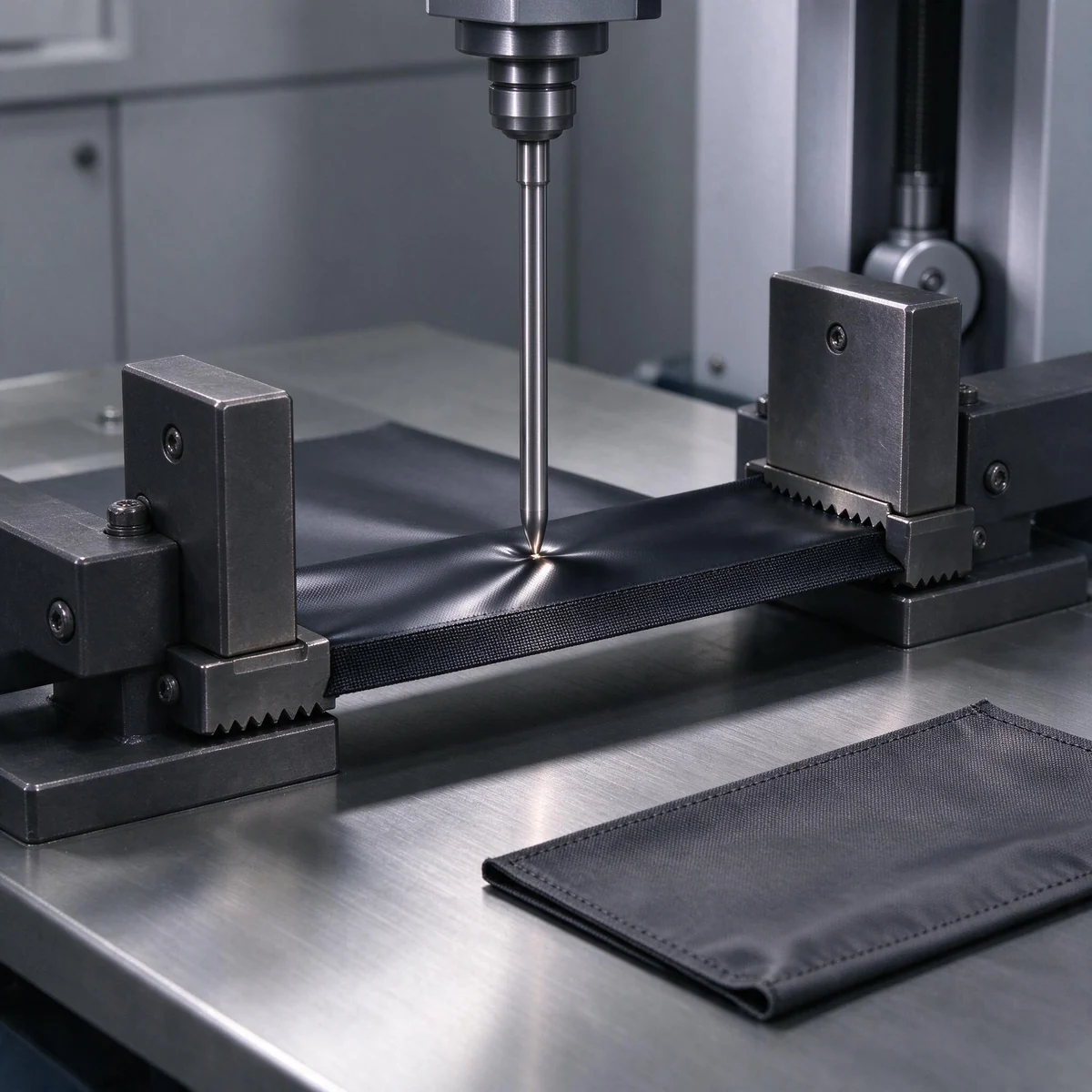
Test method: a 0.3 mm radius probe driven at 100 mm/min into a clamped sample, recording peak load at first fabric rupture. We run it on five samples per production lot from the edge band and the base panel, because those are the two zones where a fabric substitution shows up first.
The base panel is the number most suppliers do not test and the number that predicts returns. A ski bag spends its loaded life standing on its tail in a coach hold, a luggage cart and a car boot. Abrasion at the tail is not a cosmetic issue — once the 840D wears through, the 600D body behind it fails within weeks. A double-layer base with a 3 mm EVA hard sheet is the only construction we have seen hold up across four seasons of rental use.
Freeze-Thaw Fifty Cycles — What Breaks First, and What Never Does
Cold is not a single event. A ski bag in a real season goes through freeze-thaw cycling: −20 °C in a hold or a roof box for four hours, then +20 °C in a lodge for the rest of the day, repeatedly. Fifty cycles is one hard season for a rental bag and three seasons for a consumer bag.
We run the cycle at −20 °C for 4 hours and +20 °C for 4 hours, and inspect after 10, 25 and 50 cycles. The failure order is consistent and it is not the order most buyers expect.
| Rank | Component | What happens | First visible at | Prevention |
|---|---|---|---|---|
| 1 | Zip coil at the bend | Coil stiffens, then a tooth shears at the mid-bend where the bag flexes | cycle 18–25 | Two-way zip with a mid-point slider; coil sized up one gauge |
| 2 | PU coating on 600D | Micro-cracks at fold lines, then water wicks at the crease | cycle 22–30 | TPU film instead of PU coating |
| 3 | PVC body panel (if used) | Scrim crack at −20 °C; a hard crease that never recovers | cycle 8–14 | Do not use PVC below −15 °C rating |
| 4 | Webbing and buckle | POM buckle becomes brittle; a drop on a kerb cracks the tongue | cycle 25–35 | POM with cold-impact modifier; nylon webbing not PP |
| 5 | Foam | Loses 8–12% of thickness; compression set at the edge band | cycle 40–50 | Closed-cell PE, not open-cell; EVA laminate at edges |
| 6 | Stitching | No measurable change | never | — |
| 7 | 840D TPU base | No measurable change | never | — |
Two things on that list never fail, and both are worth naming: bonded polyester thread and a TPU-laminated 840D base. They are also the two places where a supplier is most likely to substitute to hit a target FOB. If a quotation comes in 12% under the others, check those two line items first — the substitution is almost always there, and it does not show up in a sample you handle for five minutes in an office.
TPU at −20 °C: The 500D Scrim Crack That Kills Cheap PVC
Three materials dominate this category and they do not behave the same way below freezing. The difference is not price — it is a mechanical property that shows up at a specific temperature and then never stops showing up.
| Material | Base fabric | Flex at −20 °C | Cold crack | Abrasion (Martindale) | Weight g/m² | FOB delta |
|---|---|---|---|---|---|---|
| PVC 500D | Polyester scrim, PVC coating | Stiff, no recovery | Cracks at −20 °C, cycle 8–14 | 25,000 | 410 | base −USD 1.90 |
| PU 600D | Polyester, PU coating | Flexible, recovers slowly | Micro-cracks at fold, cycle 22–30 | 30,000 | 380 | base |
| TPU 600D | Polyester, TPU film | Flexible, full recovery | No crack at 50 cycles | 35,000 | 395 | +USD 0.85 |
| TPU 840D (base) | High-tenacity polyester, TPU film | Flexible, full recovery | No crack at 50 cycles | 50,000 | 520 | +USD 2.30 |
| Nylon 420D ripstop | Nylon 6.6 | Flexible | No crack, but poor abrasion | 18,000 | 210 | −USD 0.60 |
The PVC row is the one to read twice. A 500D PVC body is USD 1.90 cheaper per unit at FOB and it looks identical in a showroom. It is also the single most common cause of a first-season warranty return in cold markets, because the failure is not gradual — the scrim cracks along a crease and the panel is compromised in one event. If your market is Canada, Scandinavia, the Alps, Hokkaido or the US mountain states, PVC is not a cost saving, it is a deferred cost.
TPU costs USD 0.85 more per bag on a 600D body and it is the only one of the five that shows no cold crack at fifty cycles. That is 3.5% of a USD 24 FOB — roughly the price of the hangtag.
The material choice also decides the seam. PVC welds; TPU welds; PU-coated fabric sews. A welded seam on TPU at 400 °C is stronger than the parent fabric, which is why our wet-adjacent ski bags use a welded base seam and sewn body seams. Ask any supplier which seams are welded and which are sewn; if the answer is “all sewn” on a bag that claims waterproof, the claim is cosmetic.
A Wet Ski Bag Weighs What It Weighs — Plan for 8–12 mm Cold Shrink
Ski bags get wet. Snow melts in a roof box, a boot bag drips into the ski bag, a bag sits in a lodge entry for six hours. A 600D bag absorbs 3–6% of its own mass in water; the foam holds more. That is a materials problem, not a design problem — but the design has to allow for what happens next, which is that the wet fabric contracts when it freezes.
The allowance is 8–12 mm of slack built into every panel that crosses a zip. Without it, a bag that closes perfectly in a warm sample room will not close at −10 °C after a wet day, and the buyer will report it as a manufacturing defect.
| Condition | Panel length change | Zip tension | What the user experiences | Design allowance |
|---|---|---|---|---|
| Dry, +20 °C | 0 | Nominal | Closes easily | — |
| Dry, −20 °C | −3 to −5 mm | +8% | Slightly stiff | 4 mm |
| Wet, −10 °C | −8 to −11 mm | +22% | Hard to close, one-hand operation fails | 10 mm |
| Wet, frozen solid | −12 to −15 mm | +31% | Cannot close; zip stressed to failure if forced | 12 mm + drain |
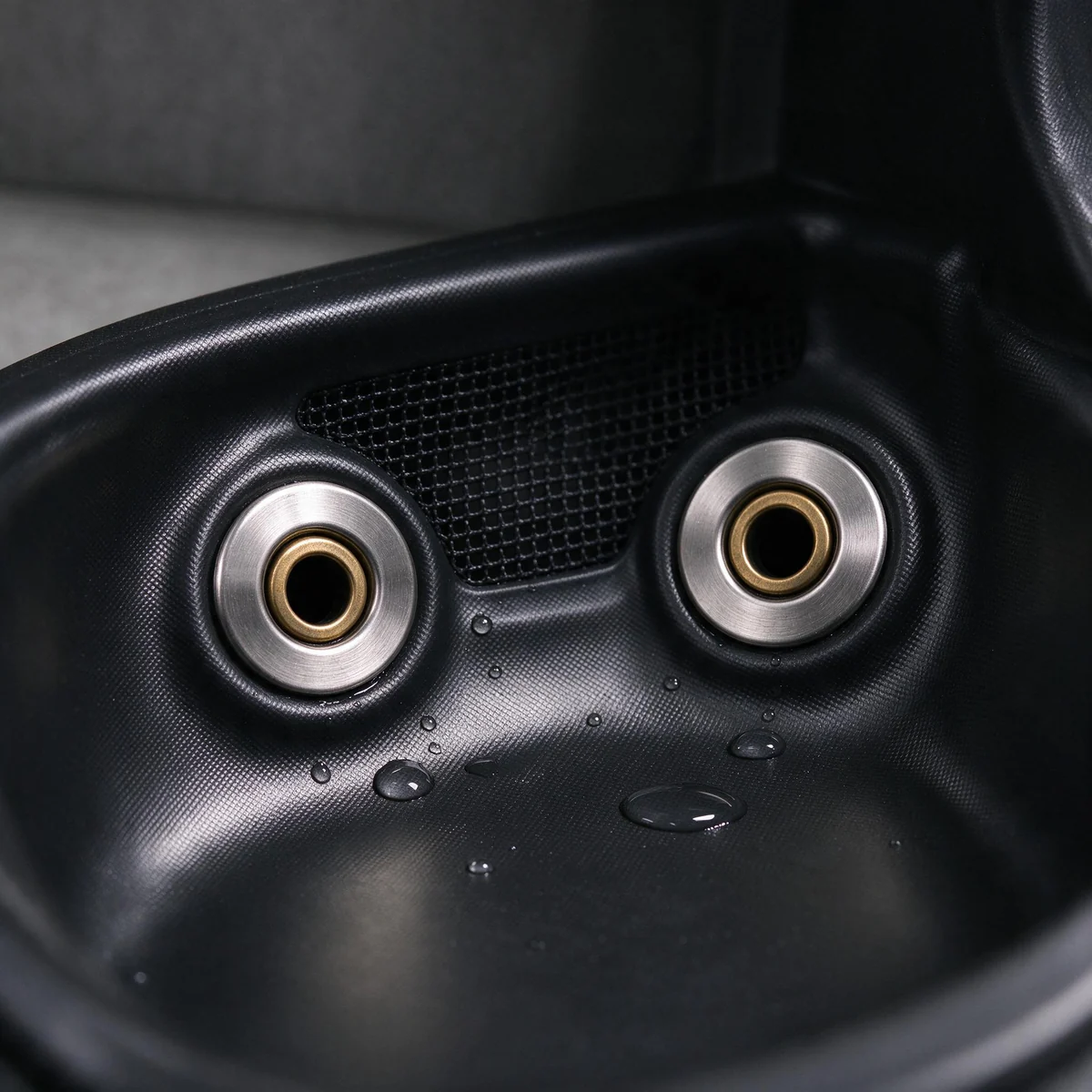
Two design responses. First, the 8–12 mm allowance on the two panels that meet at the zip, which is invisible in the finished bag and is the difference between a bag that works in February and one that does not. Second, drainage: a minimum of two grommets at the lowest point of any compartment that can hold water, 8 mm bore, with a stainless or brass eyelet. A grommet costs USD 0.06. A warranty return costs the full landed cost of the bag plus the freight both ways.
Weight itself is worth stating plainly because it is quoted badly across the category. A loaded double ski bag is 18–24 kg: two pairs of skis at 6–8 kg, boots at 3–5 kg, poles and layers for the rest. That is the load the handle, the stitching and the base panel have to carry, and it is the number to quote when a supplier asks what the bag needs to hold.
Wheels Are a Frame Problem, Not a Wheel Problem
The most common wheeled ski bag failure is not a broken wheel. It is a backboard that flexes at the handle root until the housing tears out of the fabric. Buyers replace wheels; they should be specifying the frame.
| Frame option | Material | Loaded deflection | Wheel type | Service life | Weight | FOB delta |
|---|---|---|---|---|---|---|
| No frame | — | — | None | — | 0 | — |
| Foam board insert | 5 mm PE board | 38 mm at 25 kg | 2 inline 50 mm | 1–2 seasons | +180 g | +USD 2.10 |
| HDPE backboard (standard) | 2 mm HDPE | 14 mm at 25 kg | 2 inline 64 mm | 3–4 seasons | +420 g | +USD 4.80 |
| PP honeycomb | 4 mm PP honeycomb | 9 mm at 25 kg | 2 spinner 60 mm | 4–5 seasons | +510 g | +USD 7.40 |
| Aluminium rail + HDPE | 1.2 mm Al frame + HDPE | 5 mm at 30 kg | 2 spinner 68 mm | 5+ seasons | +880 g | +USD 12.60 |
Read the deflection column, not the wheel column. A foam board insert is what most sub-USD 40 retail wheeled bags use, and 38 mm of deflection at 25 kg means the bag drags its own base on the ground when loaded — which is why the base panel wears out on exactly those products. HDPE at 2 mm is the entry point where a wheeled bag stops being a bag with wheels and starts being a frame with a bag on it.
Two mechanical details that decide the service life and cost almost nothing to get right. First, the wheel housing must be a moulded pocket sewn into a reinforced panel, not a plate riveted through the fabric — rivets pull through on kerbs. Second, the telescopic handle tube wall must be at least 1.2 mm; at 0.9 mm, which is common at the low end, the tube ovalises after roughly 200 loaded cycles and the handle develops the wobble that gets returned.
The airline number to design against: 158 cm linear (length + width + height). A 193 cm external double ski bag exceeds it on length alone, which is why wheeled bags in this category are usually specified in the 172–186 cm band even when they could be longer — the wheel and handle assembly adds 14–18 cm to the packed length and there is no point paying oversize freight on every leg.
Glove-Operable Zippers — Six Seconds at −15 °C
Nobody takes their gloves off at −15 °C to open a bag. If the zip cannot be operated in gloves within about six seconds, the user will force it, and a forced zip at low temperature is the failure mode we see most in warranty returns after the cold-crack issue.
| Zip specification | Size | Slider | Gloved operation at −15 °C | Pull-off strength | Verdict |
|---|---|---|---|---|---|
| Nylon coil #8, standard slider | 8 mm | Single, 12 mm tab | 14–18 s, two hands | 140 N | Fails the glove test |
| Nylon coil #10, long-tab slider | 10 mm | Single, 38 mm tab | 7–9 s, one hand | 160 N | Acceptable |
| Nylon coil #10, two-way | 10 mm | Two sliders, 38 mm tabs | 5–6 s, one hand | 160 N | Specify this |
| Moulded plastic #10 | 10 mm | Long tab | 6–8 s | 180 N | Good, but brittle below −25 °C |
| Metal #10 | 10 mm | Long tab | 5–7 s | 200 N | Strongest, +USD 1.60, corrosion risk near salt |
Three specifications do the work: #10 coil rather than #8 (the larger tooth is more forgiving of a misaligned start when the panel is stiff), a 38 mm pull tab (a gloved hand can hook it; a 12 mm tab needs fingertips), and two-way sliders (so the bag can be opened from the middle at the binding relief zone rather than forced from the end). The cost of all three together is USD 0.70 per bag.
There is also a structural reason for the two-way: it lets the user open the bag at the mid-point where the panels are widest, instead of dragging one slider the full 186 cm through a zone where the panel is under tension from the loaded ski. That single change removes most of the coil shear failures we see at the bend.
Four Volumes — Sized by the Carton, Not by the Catalogue
Volume in litres is a marketing number. The number that decides your landed cost is how many units fit a carton and what that carton weighs dimensionally. A bag that is 4 L larger on the spec sheet can cost 18% more to ship if it crosses a volumetric threshold.
| Volume | Internal L×W×H | Folded size | Units per carton | Carton cm | Carton weight | Volumetric kg | CBM per 500 pcs |
|---|---|---|---|---|---|---|---|
| 32 L (junior) | 155×32×18 cm | 66×34×22 | 10 | 68×36×46 | 11.4 kg | 22.5 | 1.13 |
| 38 L (freestyle) | 172×34×20 cm | 72×36×24 | 8 | 74×38×50 | 10.8 kg | 28.1 | 1.41 |
| 44 L (all-mountain, volume SKU) | 186×36×22 cm | 78×38×26 | 8 | 80×40×54 | 12.2 kg | 34.6 | 1.73 |
| 48 L (race) | 199×36×22 cm | 84×38×26 | 6 | 86×40×54 | 10.6 kg | 37.2 | 2.09 |
Look at the last two columns. Moving from 38 L to 44 L raises CBM per 500 pieces from 1.41 to 1.73 — a 23% increase in ocean freight volume for a 16% increase in bag volume. Moving from 44 L to 48 L costs 21% more CBM while shipping only 6 units per carton instead of 8. That is why the 44 L band is the volume SKU and the 48 L band is made to order: the freight economics invert at that point.
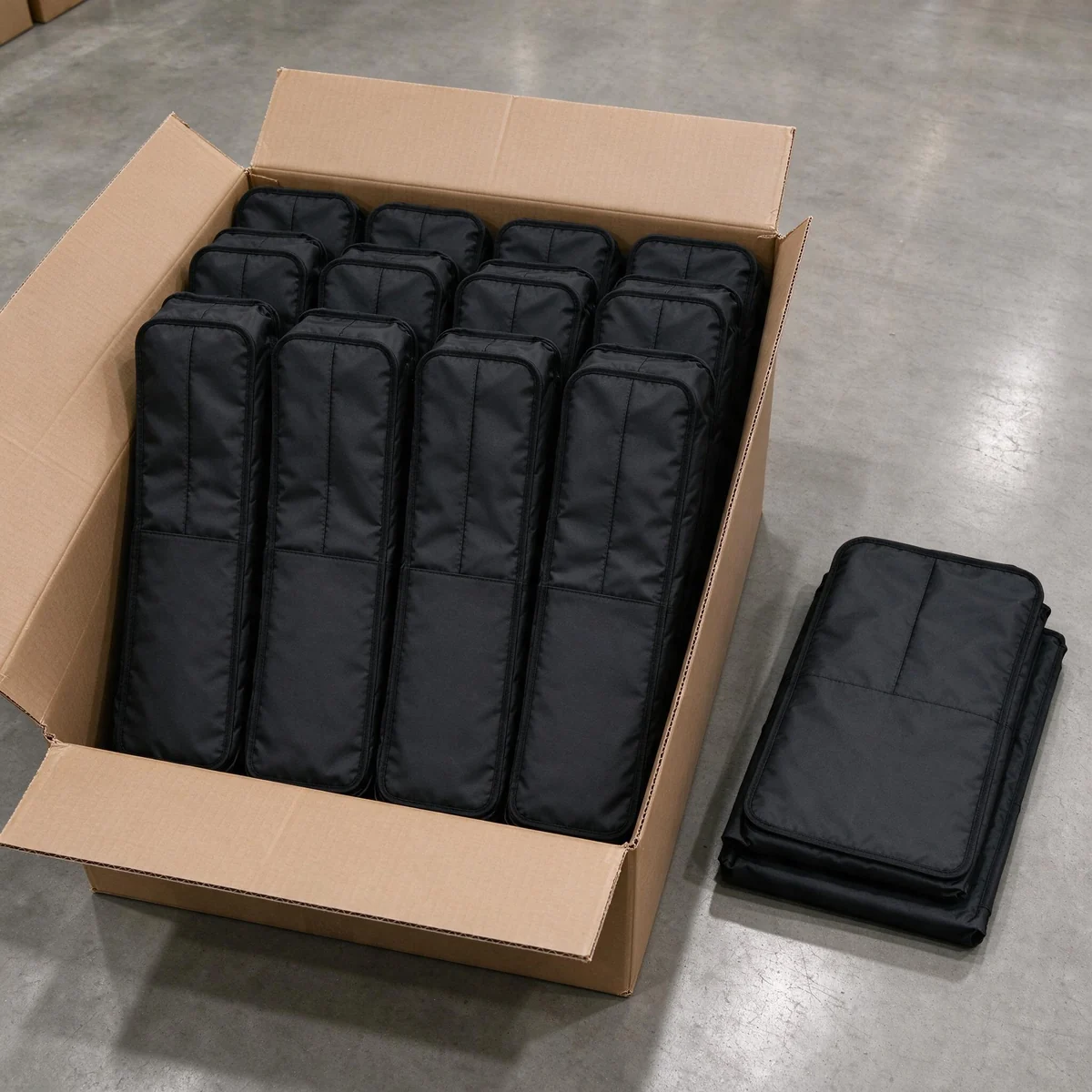
One practical note on folding. Every bag in this table ships folded once, at the mid-point, with the padding on the outside of the fold. Folding twice saves 8–12 cm of carton length but creates a second crease in the foam, and a second crease is where the compression set starts. Fold once.
Where 2,180 Grams Goes on the Double Ski Bag Build
Weight on a ski bag is not one number, it is a distribution. Knowing where the grams sit tells you which line to attack when a buyer asks for a lighter bag at the same FOB, and which line not to touch.
| Component | Specification | Weight | Share | Negotiable? |
|---|---|---|---|---|
| Body fabric | 600D TPU, 3.4 m² | 1,343 g | 61.6% | Only by dropping to 420D — not recommended |
| Base panel | 840D TPU double layer, 0.42 m² | 218 g | 10.0% | No — this is the abrasion line |
| Padding | 8 mm EVA edge + 5 mm PE body | 312 g | 14.3% | Yes — to 5 mm uniform saves 118 g, costs edge life |
| Zip | #10 two-way coil, 2×186 cm | 148 g | 6.8% | Yes — #8 saves 42 g, fails glove test |
| Hardware | 2 buckles, 4 D-rings, 1 compression strap | 62 g | 2.8% | Limited |
| Webbing | Nylon 25 mm, 3.8 m | 54 g | 2.5% | No |
| Thread and seam tape | Bonded polyester, taped seams | 43 g | 2.0% | No |
| Total finished weight | 2,180 g | 100% | ±3% production tolerance | |
Sixty-two percent of the weight is the body fabric, and that is not a design choice — it is arithmetic. 3.4 m² of 600D TPU at 395 g/m² is 1,343 g and there is no way around it except a lighter fabric, which is the one substitution that breaks the product. Every “make it lighter” conversation that starts with the fabric ends with a bag that fails at the edge.
The honest answer to a lighter-bag brief is padding and zip. Dropping to 5 mm uniform padding and a #8 zip saves 160 g — 7.3% — and costs you the edge reinforcement and the glove-operable closure. That is a legitimate product for a car-travel SKU. It is not the same product, and it should not be the same SKU.
The Bill of Materials at USD 18.40 FOB
This is a 44 L double padded ski bag, G3 padding, TPU body, HDPE backboard, two-way zip, at 500 pieces. Every number below is a real quotation line, and the sum is the FOB that goes on the invoice.
| Line | Item | Quantity | Unit cost | Extended | Share |
|---|---|---|---|---|---|
| 1 | 600D TPU body fabric | 3.40 m² | USD 2.16/m² | USD 7.34 | 39.9% |
| 2 | 840D TPU base panel | 0.42 m² | USD 3.10/m² | USD 1.30 | 7.1% |
| 3 | 8 mm EVA edge padding | 0.86 m² | USD 2.40/m² | USD 2.06 | 11.2% |
| 4 | 5 mm PE body padding | 1.20 m² | USD 0.92/m² | USD 1.10 | 6.0% |
| 5 | #10 two-way coil zip | 3.72 m | USD 0.38/m | USD 1.41 | 7.7% |
| 6 | 2 mm HDPE backboard | 0.42 m² | USD 1.85/m² | USD 0.78 | 4.2% |
| 7 | POM buckles, D-rings, slider | 7 pcs | USD 0.11 | USD 0.77 | 4.2% |
| 8 | Nylon webbing 25 mm | 3.80 m | USD 0.14/m | USD 0.53 | 2.9% |
| 9 | Bonded thread + seam tape | — | — | USD 0.41 | 2.2% |
| 10 | Branding (woven label, hangtag, care label) | 3 pcs | — | USD 0.34 | 1.8% |
| 11 | Labour — cutting, sewing, finishing | 28 min | USD 0.058/min | USD 1.62 | 8.8% |
| 12 | Packing (polybag, carton share) | — | — | USD 0.34 | 1.8% |
| 13 | Factory overhead and QC | — | — | USD 0.40 | 2.2% |
| FOB Xiamen, 500 pcs | USD 18.40 | 100% | |||
Two lines carry the programme: fabric at 39.9% and padding at 17.2% combined. Together they are 57% of the cost, and they are the two lines where a quotation that comes in materially lower has made a substitution. If a competitor quotes USD 14.80 on the same specification, the gap is almost always TPU to PVC (line 1, −USD 1.90) plus 8 mm EVA to 5 mm PE (line 3, −USD 0.94) — USD 2.84 of the USD 3.60 gap, with the rest from a lighter base panel.
Labour at 8.8% is worth noting because it is the line buyers assume is where Chinese factories compete. It is not. At 28 minutes per bag and USD 0.058 per minute, labour is USD 1.62 on an USD 18.40 bag. Moving the same bag to a lower-wage region saves cents, not dollars, and loses the material supply chain that makes TPU lamination and EVA die-cutting economical at 500 pieces.
Price Ladder and Tooling
Three quantities change the price materially, and the step between them is not linear. Below 500 pieces the material minimums dominate; above 2,000 the labour learning curve flattens and the price barely moves.
| Quantity | FOB per unit | Change | Tooling | Sampling | Production | Notes |
|---|---|---|---|---|---|---|
| 300 pcs | USD 21.60 | — | USD 380 (logo plate + die) | 7–10 days | 30–40 days | Below material minimum on 2 fabrics |
| 500 pcs | USD 18.40 | −14.8% | USD 380 | 6–10 days | 35–50 days | Standard MOQ — full material pricing |
| 1,000 pcs | USD 16.95 | −7.9% | waived | 6–10 days | 35–50 days | Tooling credited against the order |
| 2,000 pcs | USD 16.20 | −4.4% | waived | 6–10 days | 40–55 days | Fabric bought by the roll |
| 5,000 pcs | USD 15.85 | −2.2% | waived | 6–10 days | 45–60 days | Dedicated line scheduling |
Sampling and lead times
A pre-production sample takes 6–10 working days from approved artwork and specification. Where the sample requires a new moulded component — a logo plate, a custom wheel housing, a branded zip puller — add 4–6 working days for the tool. Bulk production is 35–50 days after sample approval and deposit, and the 50-day end applies to peak-season bookings (August to October), when the sewing floor is scheduled two to three weeks out.
Sampling is charged at USD 85–140 depending on the build, and the fee is credited in full against the first order that meets MOQ. We do not offer free sampling on this category, and a supplier who does is usually quoting a stock bag rather than your specification.
The timing that matters commercially: if you need stock in a retail channel for a November season launch, the order has to be placed by late June. Sampling in May, approval in June, production through July and August, on the water in September, landed and distributed in October. Working backwards from a November shelf date, every week of specification delay in the spring compresses the production window in the summer, and the 50-day peak-season lead time is not negotiable in September.
Carton Maths and Landed Cost — Where the Freight Hides
Two ski bags with the same FOB can differ by 20% in landed cost. The difference is not the bag, it is the carton and which weight the carrier charges.
| Mode | Carton (8 units) | Actual weight | Volumetric weight | Chargeable | Cost per unit |
|---|---|---|---|---|---|
| Sea LCL (Xiamen–Rotterdam) | 80×40×54 cm | 12.2 kg | n/a (CBM) | 0.173 CBM | USD 0.94 |
| Sea FCL 40HQ | 80×40×54 cm | 12.2 kg | n/a | 0.173 CBM | USD 0.61 |
| Air freight | 80×40×54 cm | 12.2 kg | 34.6 kg | 34.6 kg | USD 12.80 |
| Express parcel | 80×40×54 cm | 12.2 kg | 34.6 kg | 34.6 kg | USD 18.40 |
| Express parcel, 2 folds | 72×40×54 cm | 12.2 kg | 31.1 kg | 31.1 kg | USD 16.60 |
The dimensional weight trap
Air and express charge the greater of actual and volumetric weight, at a divisor of 5,000 (most carriers) or 6,000 (some). At 80×40×54 cm the volumetric weight is 34.6 kg against an actual 12.2 kg — a factor of 2.8. On a 500-piece air shipment that is the difference between paying for 6,100 kg and 17,300 kg.
This is why the folded carton dimension is a specification item and not a packing detail. Reducing carton length from 80 to 72 cm — which the second fold achieves — cuts volumetric weight by 10% and express cost by USD 1.80 per unit. But the second fold creates a compression-set crease in the foam at the fold line, and that crease is the first place the padding fails.
The resolution we use: fold once for sea, twice for air, and mark the carton. The same bag, two packing configurations, chosen by mode. It is a five-minute decision in the packing specification that saves USD 1.80 per unit on air and costs nothing on sea.
Six Channels — and What Each One Actually Asks For
The same bag specification does not serve six channels. Each one asks for a different set of changes, and knowing which changes are cheap and which are structural saves a programme from re-tooling twice.
| Channel | Typical order | What they ask for | Cost impact | Structural? | Watch out for |
|---|---|---|---|---|---|
| Outdoor retail chain | 1,500–6,000 pcs | Planogram compliance, hangtag, carton marking, barcode | +USD 0.40–0.70 | No | Compliance documentation lead time, not production |
| Resort and rental fleet | 150–600 pcs | Abrasion resistance, ID panel, uniform colour, repairability | +USD 1.20–2.60 | Partly — base panel upgrade | Rental cycles age a bag 4× faster than consumer use |
| Online DTC brand | 500–1,500 pcs | Unboxing, mailer-compatible carton, photography samples | +USD 0.80–1.40 | No | Carton is the brand experience; do not default to the sea carton |
| Team and club programme | 60–300 pcs | Name panel, club colourway, low MOQ per variant | +USD 2.10–3.80 | No, but MOQ per colour bites | Six colourways at 50 each is not a 300-piece order |
| Corporate and promo | 200–800 pcs | Logo placement, deadline certainty | +USD 0.60–1.10 | No | Fixed event date — air freight is often unavoidable |
| Distributor / wholesale | 3,000–20,000 pcs | Price ladder, exclusivity, stock availability across sizes | −8–14% | No | They will ask for all four length bands; only two are economical |
The two rows that surprise buyers are the team programme and the distributor. On a team programme, MOQ is per style and colour, so six club colourways at 50 pieces each does not meet a 500-piece MOQ — it is six separate colour runs. The workaround is a common body with a changeable name panel and club patch, which is one colourway with six trims.
On the distributor side, the ask is always the full size range. As the volume table shows, the 48 L band costs 21% more CBM for 25% fewer units per carton. Quoting all four bands at the same margin produces a programme where the two long bands lose money on freight and the buyer does not know it until the shipment is booked. Quote two bands as stock and two as made to order, and say why.
Quality Control — Eight Gates
Eight inspection gates, each with a defined sample size and a pass criterion. A ski bag that passes all eight has a first-year warranty return rate under 1.4%; a programme that only runs the final inspection runs 4–7%.
| Gate | Stage | Sample | What is checked | Pass criterion |
|---|---|---|---|---|
| 1 | Incoming fabric | 1 roll per lot | Weight g/m², coating adhesion, cold bend at −20 °C, colour against standard | ±5% weight; no crack at 180° bend |
| 2 | Incoming foam | 3 sheets per lot | Thickness, density, compression set after 22 h at 50% | Thickness ±0.4 mm; set <8% |
| 3 | Cutting | 10% of cut panels | Dimension against pattern, grain direction, edge fray | ±3 mm; no fray >2 mm |
| 4 | In-line sewing | 100% at station | Stitch density, seam alignment, zip tape registration | 7–9 stitches/25 mm; ±1.5 mm |
| 5 | Padding placement | 20% of units | Edge band position, tip and tail wrap, no crease at fold | ±5 mm; no double crease |
| 6 | Zip function | 100% of units | Full-length open and close, two-way sync, slider retention | No bind; slider cannot be removed by hand |
| 7 | Puncture spot check | 5 units per lot | Edge band at 180 N, body at 90 N, base at 220 N | No rupture below threshold |
| 8 | Pre-shipment (AQL) | ISO 2859-1, GII | Full dimensional, function, packing, marking, carton drop | AQL 2.5 major / 4.0 minor |
Gate 1 and gate 7 are the two that most factories do not run on this category, and they are the two that catch the failures a final inspection cannot see. A fabric that passes a visual check at gate 8 can be a PVC substitution that cracks at cycle 12 — it looks and feels identical in a warm inspection room. The cold bend at gate 1 is a two-minute test that catches it before cutting.
Gate 5 matters because padding placement is hand work. An edge band that sits 12 mm off centre leaves the tip exposed on one side, and the tip is where the first puncture happens. Twenty percent sampling on a manual operation is the minimum that holds the placement inside 5 mm across a 500-piece run.
Compliance Boundaries — What We Can and Cannot Claim
This section exists because the category is full of claims that do not survive contact with a customs officer or a product liability lawyer. What follows is what we will put in writing and what we will not.
What we can support with documentation. Material composition and weight per square metre, with mill certificates. Cold-flex test results at −20 °C on request. Puncture test data from our own bench for the specific lot. Carton drop test to ISTA 1A. AQL inspection report per shipment, with photographs and defect classification. BSCI or Sedex audit reports for the facility. REACH SVHC declaration for the finished article based on material declarations from our suppliers.
What we will not claim. We do not claim a ski bag is waterproof in the sense of submersible — a sewn body with a coil zip is water-resistant at best, and the welded-base construction on our wet-adjacent models is rated to splash and standing water, not immersion. We do not claim a specific temperature rating below −25 °C, because the test data we hold stops at −20 °C and extrapolating it would be a guess. We do not claim airline damage resistance, because that is a handling outcome and not a product property. We do not claim recycled content unless the specific fabric lot carries a certified chain of custody, and we will say which lot if asked.
What the buyer has to decide. Destination-market labelling (UKCA, GPSR responsible person, US state-level chemical disclosure) is the importer’s obligation, not the factory’s. We will print and attach what you specify and we will tell you what the artwork needs to contain, but the declaration is yours. The same applies to any flammability or child-safety claim if the bag is sold in a juvenile range.
One practical note that saves programmes: if your market requires a responsible-person address on the label, that artwork has to be approved before the cartons are printed, and carton printing is on the critical path 8–12 days before shipment. A label change after cartons are printed costs the full carton run.
Twelve Questions to Ask Any Ski Bag Supplier
These are the questions whose answers separate a factory from a trader, and a specification from a catalogue photo. Ask all twelve before a tooling deposit.
- Which of the seven products is this quotation for? If the answer is not specific, the price is not comparable to anything.
- What is the fabric and coating, by weight and by name? “600D” alone is not an answer; 600D PVC and 600D TPU differ by USD 0.85 and by a season of life.
- What is the padding thickness at the edge, and at the body? A single number means uniform padding, which means either too heavy or too thin at the edge.
- Can you show cold-flex test data at −20 °C for this fabric lot? Not a certificate for the fabric type — the lot.
- What is the puncture threshold at the edge band and at the base? Two numbers, not one.
- Is the base panel double-layer, and what denier? Single-layer 600D at the tail is the most common cost-down.
- What is the zip size, slider count and pull tab length? #8 with a 12 mm tab fails the glove test.
- If wheeled: what is the backboard material and thickness? “Reinforced” is not a material.
- How many units per carton, and what are the carton dimensions? This decides your freight, and it is fixed by the folding specification.
- What is the cold-shrink allowance on the zip panels? A supplier who does not understand the question has not built for cold markets.
- What is the AQL, and who inspects? Third-party or in-house, and at which gates.
- What is the MOQ per style and per colour, separately? The colour number is the one that kills small programmes.
The eleventh question is the one that reveals the most. A supplier who says “AQL 2.5” and stops has one inspection. A supplier who names the gates has a process, and a process is what holds quality at 2,000 pieces when nobody from your side is on the floor.
Frequently Asked Questions
What is the MOQ for a custom ski bag?
500 pieces per style and colour. MOQ applies separately to each colourway, so four colours means four 500-piece runs, not one 2,000-piece order. A common body with changeable trims is the usual way around this for small programmes.
How long does sampling take?
6–10 working days from approved specification and artwork. Add 4–6 working days if a new moulded component is needed.
How long is bulk production?
35–50 days after sample approval and deposit. The 50-day end applies to August–October bookings.
Can you make a bag for a 200 cm ski?
Yes, in the 208 cm internal band, made to order above 300 pieces. Note that it exceeds the 158 cm airline linear limit and will move as oversize freight.
Is the bag waterproof?
Water-resistant. A sewn body with a coil zip is not submersible. Our wet-adjacent models use a welded base seam and drain grommets and are rated for splash and standing water.
Can we use our own fabric?
Yes, on buyer-supplied material, with a 12% cutting allowance and a fabric inspection gate before cutting. Lead time extends by 7–10 days for the incoming inspection.
What is the difference between your ski bag and your snowboard bag?
Binding clearance and board width. A snowboard bag is wider and shorter with a binding relief zone sized for a board binding rather than a ski binding, and the base panel is spec’d for a wider abrasion footprint.
Do you supply the boots and bindings?
No. We manufacture bags only.
What are the payment terms?
30% T/T deposit, balance against copy of the bill of lading. FOB Xiamen.
Can you ship to a marketplace warehouse?
Yes, with the carton labelling and appointment booking your platform requires. Tell us the platform at the quotation stage, because the labelling specification changes the packing line setup.
Send Us Your Ski Bag Specification
To quote accurately we need six things: which of the seven product types, the ski or board length band, the padding grade or the target retail price, the quantity per colour, the destination market, and your required delivery window. With those six we can return a costed quotation and a sampling date in two working days.
If you have a reference sample or a competitor product, send photographs with a tape measure against the bag. Two dimensions — external length and gusset depth — resolve most of the ambiguity in a brief, and they are the two numbers that decide which of the five length bands the pattern comes from.
Request a quotation — or send the specification directly and we will come back with the questions that matter rather than a catalogue.
Related manufacturing pages
- Custom Ski Boot Bag Manufacturer
- Custom Snowboard Bag Manufacturer
- Custom Travel Bag Manufacturer
- Custom Duffel Bag Manufacturer
- Custom Dry Bag Manufacturer
- Custom Waterproof Dive Bag Manufacturer
- Custom Rolling Dive Bag Manufacturer
- Custom Freediving Bag Manufacturer
- Custom Scuba Gear Bag Manufacturer
- Custom Mesh Dive Bag Manufacturer
- Custom Spearfishing Gear Bag Manufacturer
- Custom Wetsuit Bag Manufacturer