
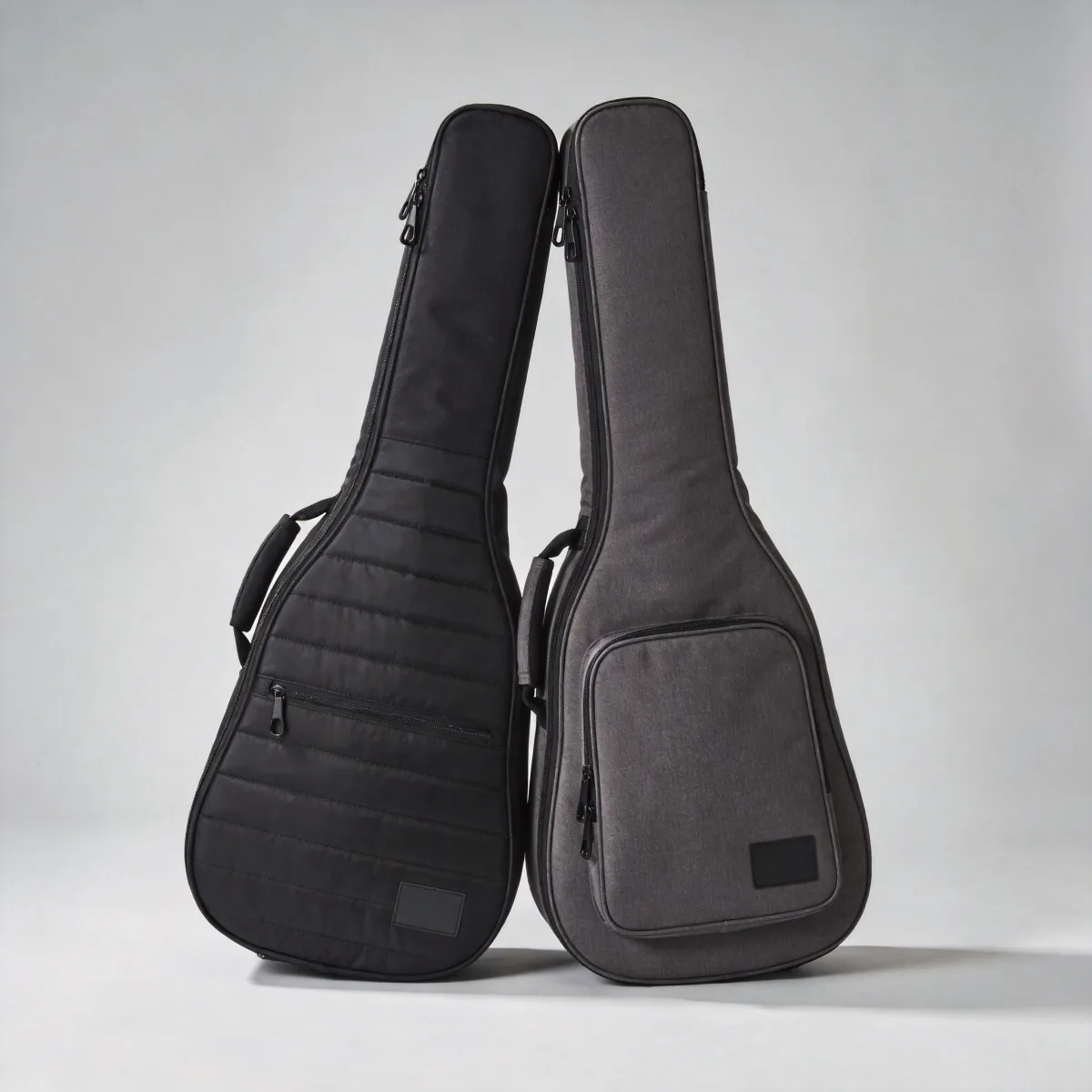
The General Product Safety Regulation has applied since 13 December 2024, and it changed what has to be printed on a bag before that bag can be sold in the EU: an EU responsible person named on the product or its packaging, a batch or lot number on the unit itself, manufacturer contact details including an email address, and instructions in the language of the member state the bag sells in. None of it can be added after the carton is sealed. This page sets out what the regulation requires of a custom bag programme, what the label has to carry, what we supply as your manufacturer, and what stays with you as the importer or the brand. It describes the rules — it is not legal advice, and where a clause depends on your structure we say so.
GPSR at a Glance: What Applies to Bags Since 13 December 2024
GPSR is Regulation (EU) 2023/988 on general product safety. It was adopted on 10 May 2023, published in the Official Journal on 23 May 2023, and has applied since 13 December 2024, repealing the General Product Safety Directive 2001/95/EC and Directive 87/357/EEC. It is a regulation rather than a directive, and that difference is practical rather than academic: it applies directly in every member state without being transposed into national law, so there is no country-by-country text to track and no national grace period to rely on.
A padded guitar gig bag sits inside it. The bag is a consumer product, and it is not covered by a sector-specific CE directive such as toys, electrical equipment, PPE or radio equipment — so GPSR is not a gap-filler for a gig bag, it is the safety framework that governs the product in full. Three consequences follow. The product has to meet the general safety requirement, which expressly includes the presentation of the product, its labelling, warnings and instructions. A technical file has to exist before the product is placed on the market and has to be kept for ten years. And every unit has to be identifiable by type, batch or serial number.
Two clarifications are worth making early, because both are widely repeated and both are wrong. GPSR does not introduce a CE mark for bags: CE marking comes from the harmonised directives, and a soft instrument bag is not in scope of any of them, so a CE mark printed on a gig bag “for GPSR” is at best meaningless and at worst a misrepresentation. And GPSR is not a chemical restriction: substance limits are REACH, which applies in parallel and is compared in section seven below.
| Item | What It Says | What It Means for a Bag Order |
|---|---|---|
| Instrument | Regulation (EU) 2023/988 on general product safety, adopted 10 May 2023, OJ L 135 of 23 May 2023 | The safety rule that governs a soft instrument bag sold in the EU |
| Applies from | 13 December 2024 | Any bag placed on the EU market after that date is in scope, including stock bought under an older purchase order |
| Replaces | Directive 2001/95/EC (GPSD) and Directive 87/357/EEC | GPSD-era label wording is not sufficient on its own; the responsible-person block did not exist under GPSD |
| Products covered | New, used, repaired and reconditioned consumer products, paid or free of charge, in shops or online (Art. 2) | A gig bag, a bag sold with a strap and pick pouch, a bag sold as a school or rental instrument kit — all in scope |
| Products excluded | Medicinal products, food, feed, living plants and animals, certain aircraft, antiques (Art. 2) | Not relevant to bags, but check any accessory in the set that is a toy or a food-contact item |
| CE marking | Not created by GPSR | Do not print a CE mark on a bag to satisfy GPSR |
| Operators bound | Manufacturer, authorised representative, importer, distributor, fulfilment service provider, online marketplace (Arts. 9–18, 22) | If you sell under your own brand you are deemed the manufacturer (Art. 13), whoever sews the bag |
| Record keeping | Technical documentation 10 years; supplier and customer traceability 6 years (Arts. 9(3), 15) | A filing habit rather than a one-off folder, and it outlives most supplier relationships |
For a buyer, the practical version is shorter than the regulation. Before the first purchase order, decide who your EU responsible person is and put their name and address on the label artwork. Before sampling, freeze the label copy. Before shipment, check that the batch number printed inside the bag matches the one on the master carton and the packing list. Almost everything else in GPSR is downstream of those three decisions, and all three are cheap at the start and expensive later.
Who the EU Responsible Person Is — and Why the Label Cannot Be Printed Without One
Article 16 is the clause that stops shipments. It provides that a product covered by the regulation may not be placed on the EU market unless there is an economic operator established in the Union who is responsible for it. Not a Chinese manufacturer with an EU phone number, not a sales agent, not a marketplace acting as intermediary: an operator established in the Union, carrying the tasks listed in Article 4(3) of Regulation (EU) 2019/1020.
Article 4(2) of that regulation sets an order of preference, and the order settles the question in most supply chains. An EU-established manufacturer is the responsible operator for its own products. Where the manufacturer is outside the Union, the importer takes the role. Where there is no EU importer — a brand shipping from China direct to EU consumers, or holding stock in an EU fulfilment centre — an authorised representative appointed by written mandate takes it, and where none of those exists the fulfilment service provider becomes the backstop. Where nothing is in place, the product may not be offered at all.
| Who Holds the Role | When It Applies | What the Role Actually Carries |
|---|---|---|
| Manufacturer established in the EU | The bag is made inside the Union | Owns the technical file and answers market surveillance authorities directly |
| Importer established in the EU | Manufacturer outside the EU and an EU business places the goods on the market | Verifies the technical documentation exists, keeps a copy for 10 years, name and address on the product or packaging (Art. 11) |
| Authorised representative under written mandate | No EU importer; brand sells direct to consumers or through an EU 3PL | Written mandate required; answers authorities on request, checks the product against its documentation (Art. 16(2)), informs authorities of a risk, cooperates on corrective action |
| Fulfilment service provider | Fallback where no manufacturer, importer or representative is established in the Union | Becomes the responsible operator for the units it handles |
| Nobody | No EU importer, no mandate, no EU fulfilment | The product may not be placed on the market (Art. 16(1)) |
The role is not a mailbox. Under Article 16(2) the responsible operator has to check, at least where the risks justify it, that the product corresponds to its technical documentation and to the labelling and information requirements, and to give a market surveillance authority documented evidence of those checks on request. Under Article 16(3) its name or registered trade name or trade mark, together with its postal address and electronic address, must appear on the product, on the packaging, on the parcel or on an accompanying document. For distance sales, Article 19 adds a separate duty: the online offer itself has to show the manufacturer’s identity, the responsible person’s name and postal and electronic address where the manufacturer is outside the Union, a product identification with a picture, and any warnings or safety information.
For a bag programme this produces one hard deadline that is easy to miss. The responsible person’s details go on a printed label, and printed labels are ordered before production, not after. If the appointment is still being negotiated when the fabric is being cut, the order either prints the wrong block or waits in the packing area for a reprint. We ask buyers to confirm the responsible-person block in writing at the sample stage even when the block is provisional, and to confirm it again before the label run is released. Which structure suits your channel — importer, written mandate or fulfilment provider — is a question for your importer or compliance adviser. The regulation sets the preference order; the answer differs between an own webshop, a marketplace listing and an EU warehouse, and it can differ per product family.
The Seven Information Elements on a GPSR-Compliant Bag Label
GPSR does not prescribe one label design, and it does not use the phrase “seven elements”. What it does is spread mandatory information across Articles 9, 11, 15, 16 and 19. Collected into one place for a bag, those obligations come to seven blocks of information that have to be findable by a consumer and by an inspector. This is the list we work from when we build a compliance label, and it is the list to send with your artwork.
| # | Element | Where It Typically Goes | Legal Anchor |
|---|---|---|---|
| 1 | Manufacturer name, registered trade name or trade mark, postal address and electronic address | Woven or printed label, or an accompanying document if the bag is too small to carry it legibly | Art. 9(5), 9(6) |
| 2 | EU responsible person: name or trade mark, postal address and electronic address | Same label block, or the parcel, or an accompanying document — and separately in the online listing | Art. 16(3), Art. 19 |
| 3 | Product identification: the model or type designation a buyer or authority can quote | Label and hangtag; model name repeated on the master carton | Art. 9(5) |
| 4 | Batch, lot or serial number linking the unit to a production run | Printed label or stamp inside the bag; the same code repeated on the master carton | Art. 9(5) |
| 5 | Warnings and safety information specific to the product | Label, hangtag, inner card and the online listing | Art. 9(7), Art. 19 |
| 6 | Traceability records: which supplier, which lot, which customer received which units | Not printed — held in your file and ours, produced on request | Art. 15 |
| 7 | Instructions and safety information in the language required by the member state of sale | Insert card, hangtag or listing text; not always the sewn label | Art. 9(7), Art. 11(4) |
Elements one and two are what an inspector looks for first, and they are the two a factory cannot invent. We print what you approve, in the position you approve; we cannot supply an EU address, and we cannot appoint a representative for you. Element three is usually the easiest to get wrong in a quiet way: a model name that exists only on the purchase order and nowhere on the product is not an identification element, because the consumer holding the bag has nothing to quote when they complain.
Element four is where a bag programme either has traceability or does not. Our convention is one lot code per style, colour and production run, printed inside the bag on the compliance label and repeated on the master carton marking and the packing list, so a complaint about a single unit can be traced back to a dye lot, a cutting lay and a sewing line without re-opening the whole shipment. If you need the batch number to carry a date or a factory code in a format your own system recognises, tell us at the spec stage — changing the batch format after the labels are printed is a reprint.
Element five, the warning content, is your decision as the brand and we will not draft it for you. What we can supply is the product-side fact the warning has to be consistent with: the tested load on the handle and strap anchors, the materials and finishes, whether the bag is intended to carry an instrument only, and the temperature range the foam and coating tolerate. A warning that contradicts the product — a 15 kg load claim on a handle tested to 6 kg, for example — is worse than no warning, because it is documented and wrong at the same time.
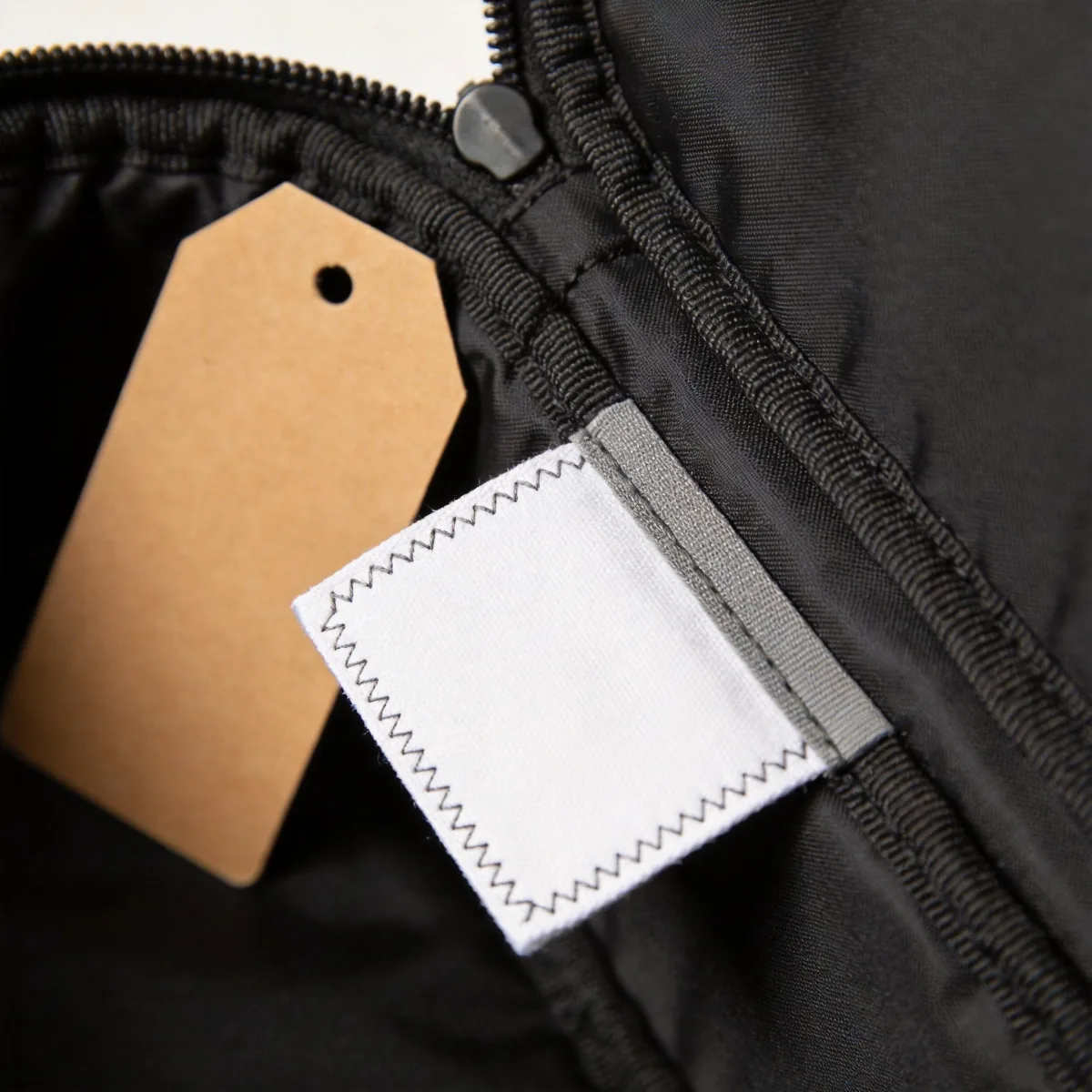
What a GPSR Label Actually Looks Like on a Guitar Bag
A gig bag has less printable area than a carton and more abrasion than a garment, so the label plan is a construction decision as much as a compliance one. In practice a compliant programme uses four placements, and the cheapest time to decide all four is the specification sheet, not the week before shipment. Label copy is frozen at the same point in our guitar bag OEM process as the dimensions and the hardware, for the same reason.
- ✓ A sewn-in compliance label inside the bag. Usually 40 × 60 mm, black print on white woven or coated polyester, set into the interior side seam or the inner lid seam so it is visible when the bag is open but does not rub against the instrument. This carries elements one to four.
- ✓ A second printed label on the underside or back panel. Used when the responsible-person block is long, or when the retailer wants the manufacturer and importer details visible without opening the bag.
- ✓ A hangtag. The natural home for element five and the multi-language version of element seven, because a hangtag can be printed in several languages on two sides without shrinking the type. A hangtag is also removable, which is why it should never be the only place a mandatory element appears.
- ✓ The master carton marking. Not a legal label requirement in itself, but the practical link between the batch code inside the bag and the shipment documents, and the first thing an inspector or a 3PL will read.
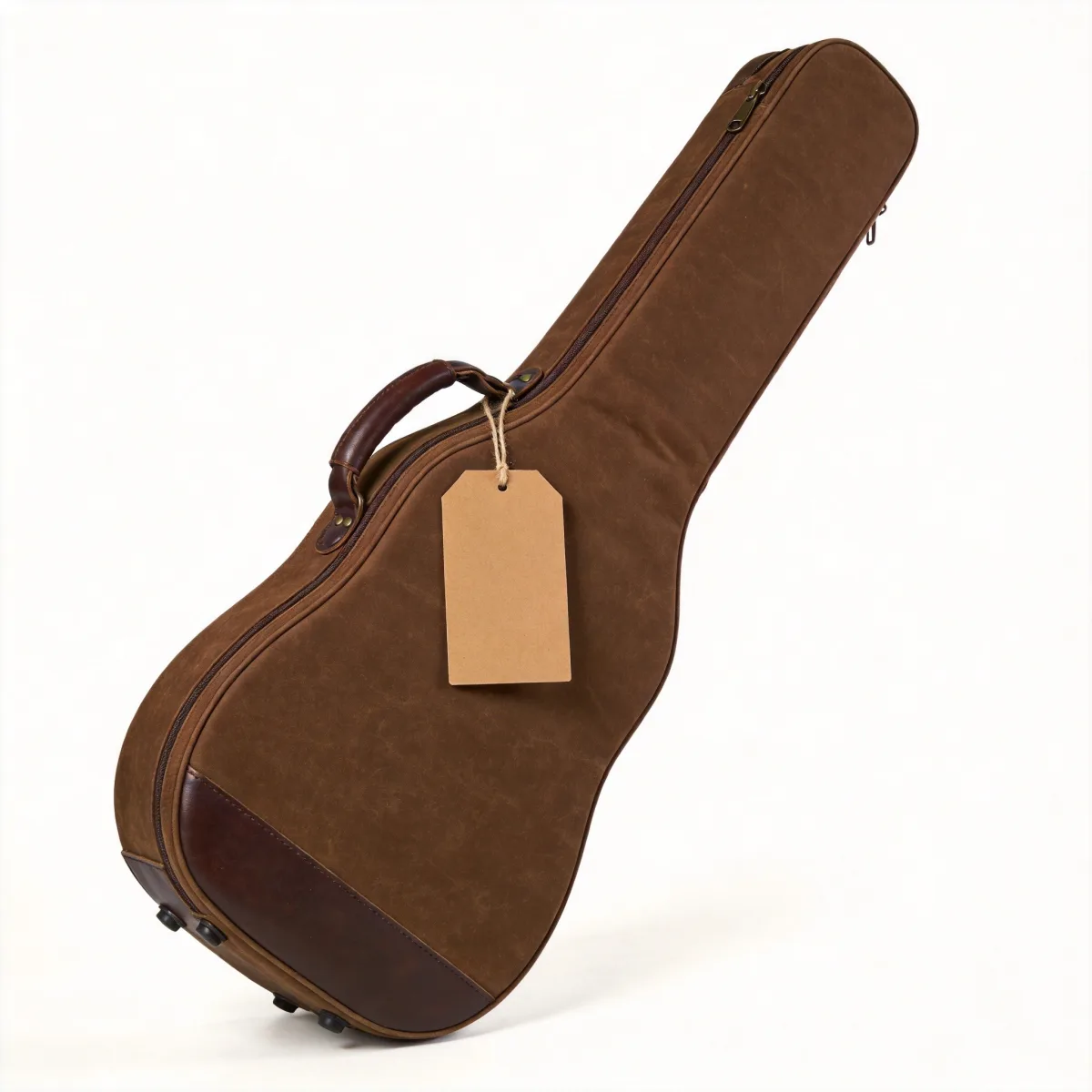
Three construction details are worth writing into the spec. First, legibility over the life of the product: a label printed in 6 pt on a dark lining, or covered by the accessory pocket flap, satisfies nobody, and market surveillance checks products in use rather than products in a showroom. Second, durability: the label has to survive the wash-and-wear of a gig bag — abrasion from the instrument, humidity, and the strap rubbing the back panel — so we specify a coated label or a woven label with a heat-sealed edge, and we test it by rubbing the printed surface 50 times with a dry cloth before approving the placement. Third, avoid the obvious bad positions: over the zipper tape, under the handle anchor where the bar-tack sits, on the foam edge where the binding is thinnest, and anywhere the instrument’s bridge or tuners press when the bag is loaded.
Where the block is long — a manufacturer address, an importer address and a responsible person in three lines — the layout usually needs to move to a two-panel label or a folded label with a second leaf. That is a label cost, not a bag cost, and it is quoted with the order. Sending us the final copy in a text file at the sampling stage is enough; we will return a print proof with the exact type size and position for your approval before the run.
What We Provide as Your Manufacturer — and What We Cannot Sign For
One structural point first, because it decides which name goes in the manufacturer block. Junyuan Bags is a bag manufacturing and export company: production runs through affiliated and partner factories in Quanzhou that we have worked with for years, and we control the specification, the sampling, the quality standard and the shipment. Our legal name on the quotation, the invoice and the packing list is QUANZHOU JUNYUAN COMMERCIAL AND TRADING CO., LTD., and that is the name and address we print in the manufacturer block when a buyer asks us to supply it. Where your importer prefers the workshop’s own name and address on the label, tell us at the sampling stage and we will confirm which entity is running the order before the label artwork is released.
The most common misunderstanding in GPSR conversations is the assumption that a Chinese supplier either “handles GPSR” or does not. Neither is true. GPSR splits obligations by economic operator, and a factory’s part is the product-level evidence: what the bag is made of, how it was built, which lot it came from, and what the construction can be expected to withstand. The market-level decisions — who represents the product in the Union, what the warnings say, which languages are printed, what the listing displays — belong to the brand and the importer.
| Item | What Junyuan Supplies | What Stays With You |
|---|---|---|
| Product description and construction record | Dated specification sheet with revision number, dimensions, materials, foam grade, hardware and construction notes | Confirming that the specification matches what you intend to sell |
| Material declarations and test reports | Fabric, lining, foam and hardware test reports from accredited labs, per material and per lot where available, with the lab name and report date | Deciding which reports your market requires, and paying for any additional testing |
| Risk analysis input | The product-side facts: tested handle and anchor load, edge and point assessment, small-part and cord findings, coating and foam data | Carrying out the internal risk analysis and drawing up the technical documentation (Art. 9(2)) |
| Label artwork and print | Label layout, print proof, placement, and the printed run to your approved copy | Writing the copy, including the responsible-person block, warnings and language selection |
| Batch and lot coding | Lot code per style, colour and run; the same code on the inner label, carton and packing list | Keeping the traceability record of which customer received which lot (Art. 15) |
| EU responsible person | Nothing — we are not established in the Union | Appointing an importer, an authorised representative by written mandate, or relying on your fulfilment provider |
| Declaration of conformity | Supporting documents and answers to technical questions | Signing it, where a harmonised CE directive applies to the product. A soft bag under GPSR alone has no DoC obligation; the equivalent evidence is the technical file |
| Market surveillance correspondence | Cooperation and records on request, in English | Being the contact point, and responding within the authority’s deadline |
| Recall execution | Production records, affected-lot identification and rework capability | Deciding on and running the recall, including the notice content (Arts. 36–37) |
Two boundaries are worth stating plainly, because a supplier who blurs them is not helping you. We cannot act as your EU responsible person: we are not established in the Union, and a Chinese address does not satisfy Article 16. And we cannot guarantee that a product complies with GPSR, because compliance is a property of the product as placed on the market with its documentation, labelling, listing and representative — four of which are outside a factory’s control. What we can do is make our part of the file complete, dated and consistent, so that the part you own is not held up by missing paperwork.
One further point that matters for private label. Under Article 13, anyone who places a product on the market under their own name or trade mark is treated as the manufacturer, and the same applies to a substantial modification that affects safety. A brand buying 500 gig bags with its own logo on them is therefore the manufacturer for GPSR purposes, not the workshop that sewed them — and that is the reason the label block is a brand decision rather than a supplier default. We have seen buyers discover this only when a marketplace asked for the technical file, six weeks after launch. If your programme is private label, plan the file from the first order. Our page on bag manufacturer vs supplier covers the commercial side of that distinction; the compliance side is here.
Four Reasons Bags Get Held, Delisted or Sent Back
In practice the failures are repetitive. They are not exotic regulatory arguments; they are four omissions that a marketplace reviewer, a customs broker or a market surveillance officer can see in under a minute. Each one is cheap to prevent at the sampling stage and expensive to fix once 500 bags are packed.
One: no responsible person anywhere on the product. The label carries the brand and the factory, and nothing else. Under Article 16 the bag cannot be placed on the market at all in that state, so the fix is not a reprint — it is a reprint plus an appointment, and the appointment takes longer than the reprint. This is the single most common reason a first EU shipment is stopped, and it is entirely avoidable because it is decided months earlier.
Two: the wrong language. Instructions and safety information must be in the language required by the member state where the product is sold. English only is not sufficient for a product sold in Germany, France, Italy, Spain, Poland or the Netherlands, and a hangtag printed in English and German does not cover a shipment that also goes to France. Multi-language hangtags and insert cards are the usual solution; the number of languages is a decision for you and your importer, and we will quote the print accordingly. What we will not do is guess which languages you need.
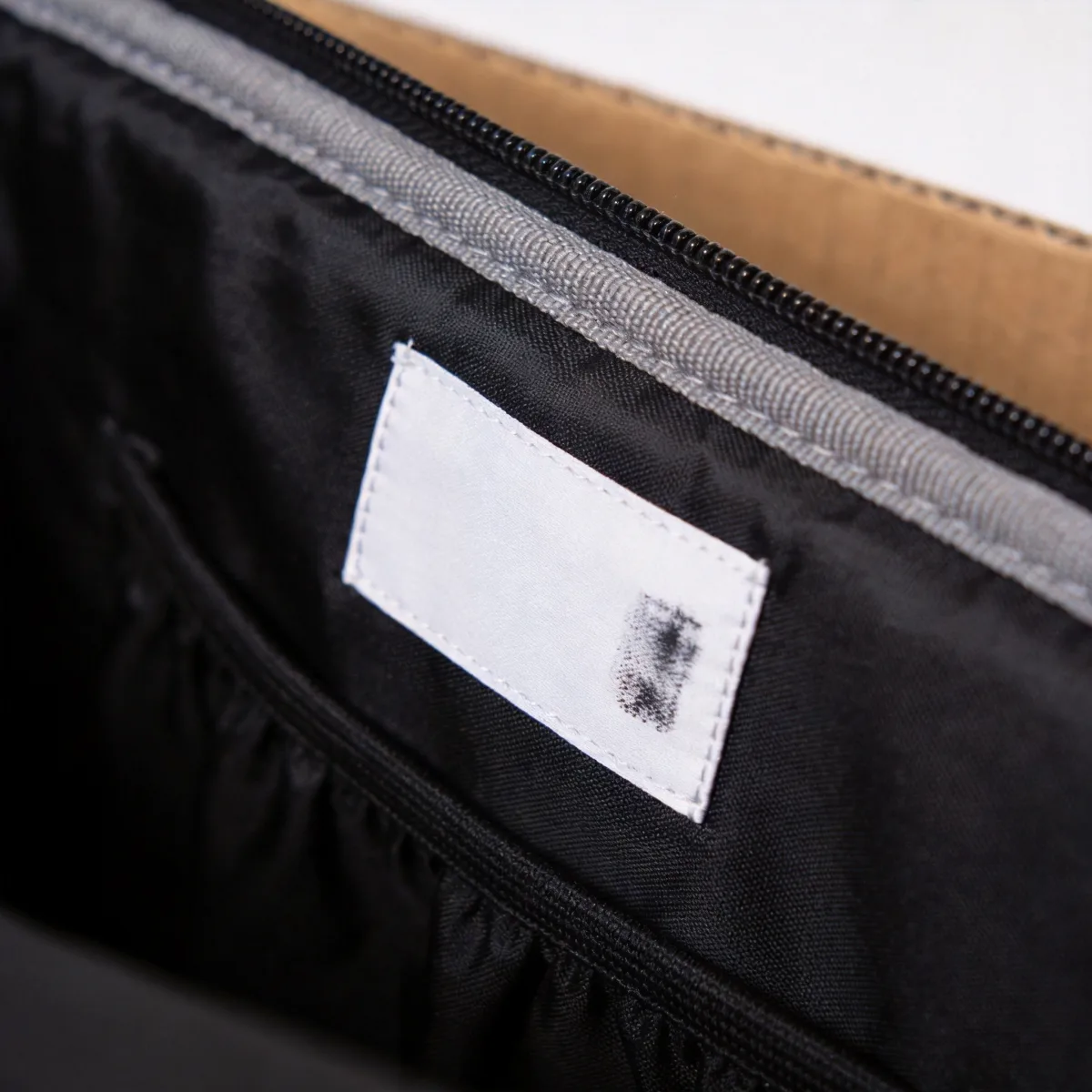
Three: no batch, lot or serial number on the unit. The carton has a code, the packing list has a code, and the bag has nothing. That breaks traceability at exactly the moment it is needed: when one customer reports a defect and the question is whether it affects 20 units or 2,000. Our standard is a lot code printed on the inner compliance label and repeated on the carton, but it only works if the code is specified before the label run.
Four: the listing was never updated. Article 19 puts obligations on the offer itself, not only on the physical product: manufacturer identity, the responsible person’s name and postal and electronic address where the manufacturer is outside the Union, a product identification with a picture, and the warnings. Marketplaces have tightened their listing checks since 2024 and routinely unpublish offers that lack the block. This one is not a factory issue at all, and it is the failure most often blamed on the supplier.
There is a fifth, quieter failure worth mentioning because it costs the most time: a label added late, by the importer, on top of the manufacturer’s label, in a way that obscures the manufacturer details or the batch code. Article 11 requires the importer to add its details without making the existing mandatory information illegible. If your importer intends to over-label, tell us at the sampling stage and we will leave a clear panel and a gap in the print block for it. That single instruction has saved more shipments in our experience than any other line in a spec sheet.
GPSR and REACH: Two Different Questions, Asked at the Same Time
European buyers usually ask about REACH and GPSR in the same email, and suppliers usually answer them as if they were one subject. They are separate legal instruments with separate evidence, and a programme needs both. REACH is Regulation (EC) 1907/2006 and it governs chemical substances: restricted substances, substances of very high concern above 0.1% by weight in an article, and the notification and communication duties that follow. GPSR is Regulation (EU) 2023/988 and it governs the safety of the product as a whole, including mechanical hazards, the labelling, the warnings, the traceability and the representative in the Union.
- ✓ REACH asks: what is in the material? Azo dyes, formaldehyde, heavy metals in hardware and coatings, phthalates in PVC trim, and whether any SVHC above 0.1% w/w requires a declaration and a SCIP notification.
- ✓ GPSR asks: is the product safe in normal and reasonably foreseeable use, and can it be traced? Handle and anchor strength, sharp points and edges, cord and strap length, small detachable parts, coating adhesion, and the information that travels with the product.
- ✓ They share evidence. A material test report serves REACH directly and feeds the GPSR technical file as part of the product description. One set of reports, two purposes — which is why testing is quoted per material and per lot rather than as a single line.
- ✓ They fail differently. A REACH problem is a substance finding, usually resolved by changing a material or a supplier. A GPSR problem is often a documentation or labelling omission, resolved by reprinting and re-filing — cheaper, but it stops the shipment just as effectively.
For US-bound programmes the same logic applies with different instruments: CPSIA for children’s products, including lead and phthalate limits and tracking labels, and California Proposition 65 for chemical exposure warnings. A bag sold as a general instrument bag is not a children’s product, but a small gig bag marketed for young students can be argued into that category, and the tracking-label requirement under CPSIA looks very much like the GPSR traceability requirement from a different direction. Our export compliance guide covering REACH, CPSIA and Prop 65 sets out the US side, and the EU substance detail is on our REACH compliance for custom bags page.
The practical conclusion is that compliance should be specified once, at the brief, for all destination markets at the same time. Buyers who plan the EU label and the US tracking label in the same artwork review pay one label setup; buyers who add the second market after the first shipment pay for a second run, a second proof and, usually, a re-labelling operation in the packing area.
A Practical Pre-Order GPSR Checklist for Buyers
This is the list we run through with a buyer before a first EU order is confirmed. It is written to be forwarded to whoever owns compliance on your side, and it is deliberately short enough to be answered in one email. If you have not placed a bag order in the EU before, read it alongside our custom guitar bag manufacturer overview, which covers specification, sampling and inspection.
- ✓ Name the EU responsible person. Importer, authorised representative under written mandate, or fulfilment provider — and get the exact legal name, postal address and email in writing, not a trading name.
- ✓ Confirm your own role. If the bags carry your brand, Article 13 makes you the manufacturer for GPSR purposes. Plan the technical file accordingly.
- ✓ Choose the destination member states. That single answer sets the language list for the insert card and hangtag, and it is the most common cause of a late reprint.
- ✓ Freeze the seven label elements. Manufacturer block, responsible-person block, model identification, batch format, warning text, traceability fields and language set, all approved as a print proof.
- ✓ Decide the batch format before labels are ordered. Style, colour and run code, in a format your own records can search.
- ✓ Ask which reports exist and which are missing. Per material, per lot, with the lab name and date visible. Missing reports are a lead-time item, not a paperwork item.
- ✓ Leave a panel for importer over-labelling if your importer adds its own label, so the manufacturer details and batch code stay legible.
- ✓ Update the listing before the stock lands. Article 19 data, product picture, warnings and the responsible-person block, in every marketplace and your own shop.
- ✓ Agree who holds the file and for how long. Technical documentation for ten years, supplier and customer traceability for six.

None of this changes the commercial terms of a bag order. Minimum order quantity stays at 500 pieces per style and colour, sampling at 6–10 business days, bulk production at 35–50 days after written sample approval, and inspection at AQL 2.5 for major and 4.0 for minor defects. What it changes is the order of work: the label copy and the responsible-person block become inputs to sampling rather than afterthoughts before shipment. Programme that sequence properly and the compliance file is a by-product of a normal order. Leave it until the packing stage and it becomes the reason a container misses its vessel.
Send your destination markets, your label copy and your responsible-person details. We will return a print proof with the seven elements laid out, a list of the material reports we hold for your chosen construction, and a written quotation — with a physical sample in 6–10 business days.
Email: [email protected] | WhatsApp / Tel: +86 17750020688
Frequently Asked Questions About GPSR Compliance for Custom Bags
Q1: When did GPSR take effect, and does it apply to guitar bags?
Q2: Who can act as our EU responsible person?
Q3: Where exactly must the responsible person’s details appear?
Q4: What are the seven information elements a compliant label needs?
Q5: Can you print the responsible person block on our label?
Q6: What documentation can you provide as the manufacturer?
Q7: What language must the instructions and warnings be in?
Q8: How long must the technical file and traceability records be kept?
Q9: Does GPSR replace REACH, or do we need both?
Q10: Does GPSR labelling change MOQ, sampling time or bulk lead time?
Related Compliance and Guitar Bag Pages
- REACH Compliance for Custom Bags — the substance side of EU compliance
- Export Compliance Guide: REACH, CPSIA, Prop 65 — the US and multi-market view
- Custom Guitar Bag Manufacturer — the category hub: styles, materials, MOQ and quality standard
- Guitar Bag OEM Process — where the label copy and batch code fit into the six steps
- Custom Gig Bag Manufacturer — gig bags across bass, keyboard, ukulele and effects boards
- Custom Electric Guitar Bag Manufacturer — Stratocaster, Telecaster and Les Paul patterns
- Custom Acoustic Guitar Bag Manufacturer — dreadnought, jumbo, OM and 000 shapes
- Custom Bass Guitar Bag Manufacturer — 4-, 5- and 6-string bass programmes
- Bag Manufacturer vs Supplier — what changes when you buy direct
- Custom Equipment Bag Manufacturer — protective bags for gear and instruments
- Custom Backpack Manufacturer — daypacks, commuter and laptop bags
- Sports Bags Manufacturer — gym, duffel and training bags
- Private Label Guitar Bag Manufacturer — branding methods, mould costs and retail packaging
- Custom Ukulele Bag Manufacturer — soprano to baritone sizing and mixed-size MOQ
- OEM & ODM Service — full programme scope, sampling workflow and MOQ terms
- Custom Golf Bag Manufacturer — stand bags, cart bags and tour staff bags