
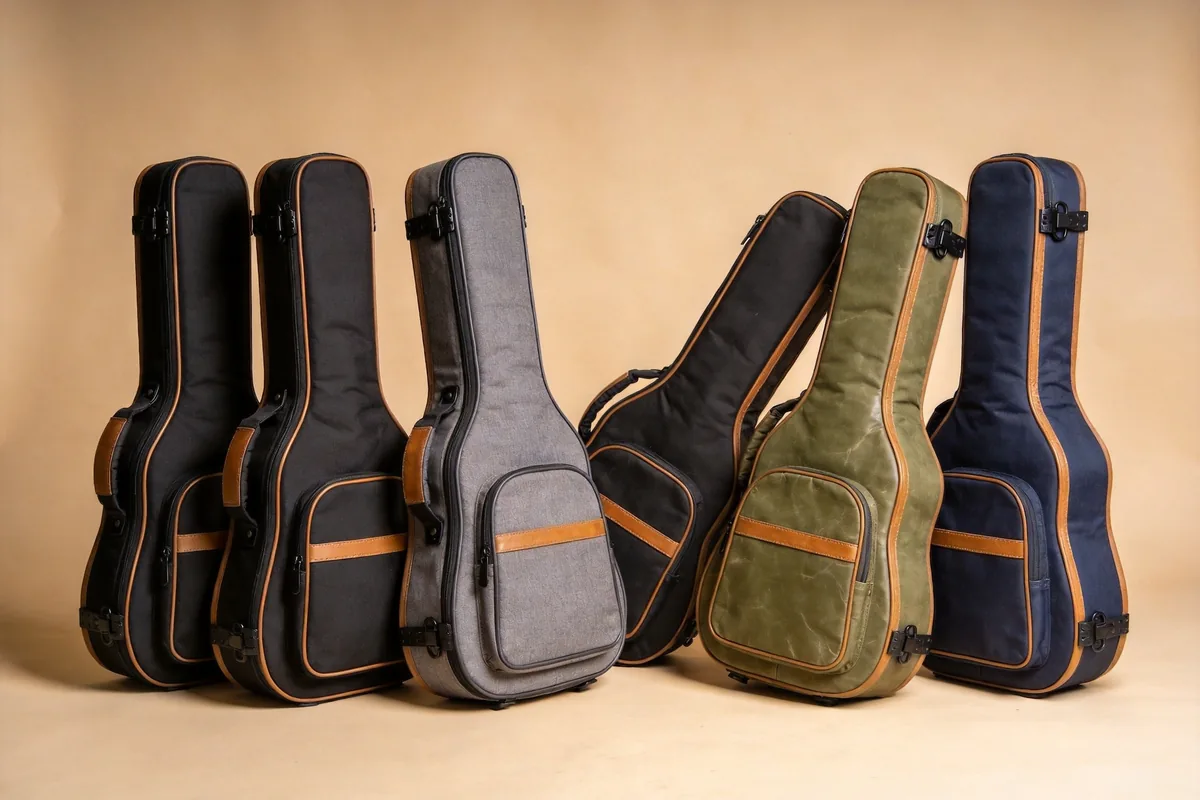
A ukulele bag looks like a small guitar bag until you try to make one. The instrument is short but the body is deep, the neck is thin, and the four sizes — soprano, concert, tenor and baritone — do not scale from a single pattern. Get the interior length right and the bag sells; get it 15mm short and the whole lot comes back. This page sets out the interior dimensions for all four sizes, what 10–20mm EPE actually does at each zone, the student specification with a reflective strip and a name window, how mixed sizes combine to reach a 500-piece minimum, and why ukulele bags ship in the same container as your guitar bags at no extra freight booking. Same line, same materials, same inspection standard — a smaller format.
What a Custom Ukulele Bag Programme Covers — and Who Buys It
A custom ukulele bag is a padded soft case built to your interior dimensions, padding specification, lining, hardware and branding, at a minimum of 500 pieces per style and colour. The construction logic is the guitar gig bag’s, compressed: an outer shell in 600D or 1680D polyester, an EPE foam body, a soft lining, a bound edge, a coil zip and a carry handle, with a front pocket sized for a tuner, a strap and a spare set of strings. What changes is the geometry. A soprano bag is roughly 53–56cm inside; a baritone is 76–79cm. That is a 25cm spread across four sizes that all get called “ukulele bag” in a catalogue, and it is the reason a single generic pattern does not work.
The buyers are more varied than the product suggests. Music education distributors order by the hundred for classroom sets and care about a name window and a reflective strip more than they care about lining colour. Marketplace sellers order a tight colour range in the two sizes that sell, and care about carton marks, barcodes and a polybag that satisfies the marketplace. Instrument brands add a ukulele bag to a guitar bag range because their dealers want one supplier, one delivery and one invoice. And gift and lifestyle brands order a smaller volume of a more designed bag, usually in a heavier canvas with a leather-look trim.
| Buyer Type | What They Usually Order | Specification Focus | Packaging |
|---|---|---|---|
| Music education distributor | Concert and soprano, one or two colours, 500–2,000 pcs per intake | Name tag window, reflective strip, reinforced handle, colour-coded by size | Polybag with size sticker, carton marked by size, sometimes a classroom set of 30 |
| Marketplace seller | Concert and tenor, three to five colourways, reorders every 8–12 weeks | Photogenic lining, tight tolerance on interior length, consistent colour between lots | Polybag with suffocation warning, barcode label, FNSKU applied at packing |
| Instrument brand or distributor | All four sizes, matched trim to their guitar bag range | Same shell and trim as the guitar bags, own branding, exclusivity on the colourway | Hangtag, dust bag, printed carton mark matching the packing list |
| Gift, lifestyle and souvenir brand | Concert and soprano, heavier canvas, 500–1,000 pcs | Trim, lining and print rather than protection; smaller logo, tonal branding | Printed colour box or a printed belly band, tissue, retail-ready |
One thing worth stating early, because it changes the quotation: a ukulele bag is not a low-value item simply because the instrument is small. The material consumption is lower, but the labour content is close to a guitar bag’s — the same number of panels, the same binding, the same zip installation, the same handle reinforcement. What the smaller format buys you is carton efficiency and a lower unit freight cost, not a proportionally lower unit price. Buyers who expect a soprano bag to cost a third of an acoustic bag are usually surprised; buyers who plan the range around carton density and mixed-size orders get the economics they were looking for.
The Four Sizes: Soprano, Concert, Tenor and Baritone Interior Dimensions
Interior length is the governing dimension, and it is measured inside the bag from the base seam to the tip of the headstock cavity, not from the outside of the bag. The distinction matters because a bag quoted at “58cm” on a supplier’s spec sheet is often 58cm outside, which gives 55cm inside once the shell, the foam and the base reinforcement are accounted for. On a guitar that 3cm is absorbed by the body cavity. On a ukulele it is the difference between a bag that closes and a bag that does not.
| Size | Interior Length | Interior Width (body) | Interior Depth | Fits | Notes |
|---|---|---|---|---|---|
| Soprano | 53–56 cm / 21–22 in | 20–21 cm | 6–7 cm | Standard 21 in soprano, pineapple body needs +1 cm width | The volume size. 10mm EPE is normally enough because the instrument is light and the body is shallow. |
| Concert | 58–61 cm / 23–24 in | 21–23 cm | 7–8 cm | Standard 23 in concert, long-neck concert needs the tenor length | The best-selling size in most Western markets. Specify 60cm if you want one bag to cover both concert and long-neck. |
| Tenor | 66–69 cm / 26–27 in | 23–25 cm | 8–9 cm | Standard 26 in tenor, 8-string tenor needs +2 cm width | Widest body of the four after baritone. Where buyers most often under-specify width rather than length. |
| Baritone | 76–79 cm / 30–31 in | 26–28 cm | 9–10 cm | Standard 30 in baritone | The only size where 20mm EPE at the headstock end is standard rather than optional, because the neck is long and unsupported. |
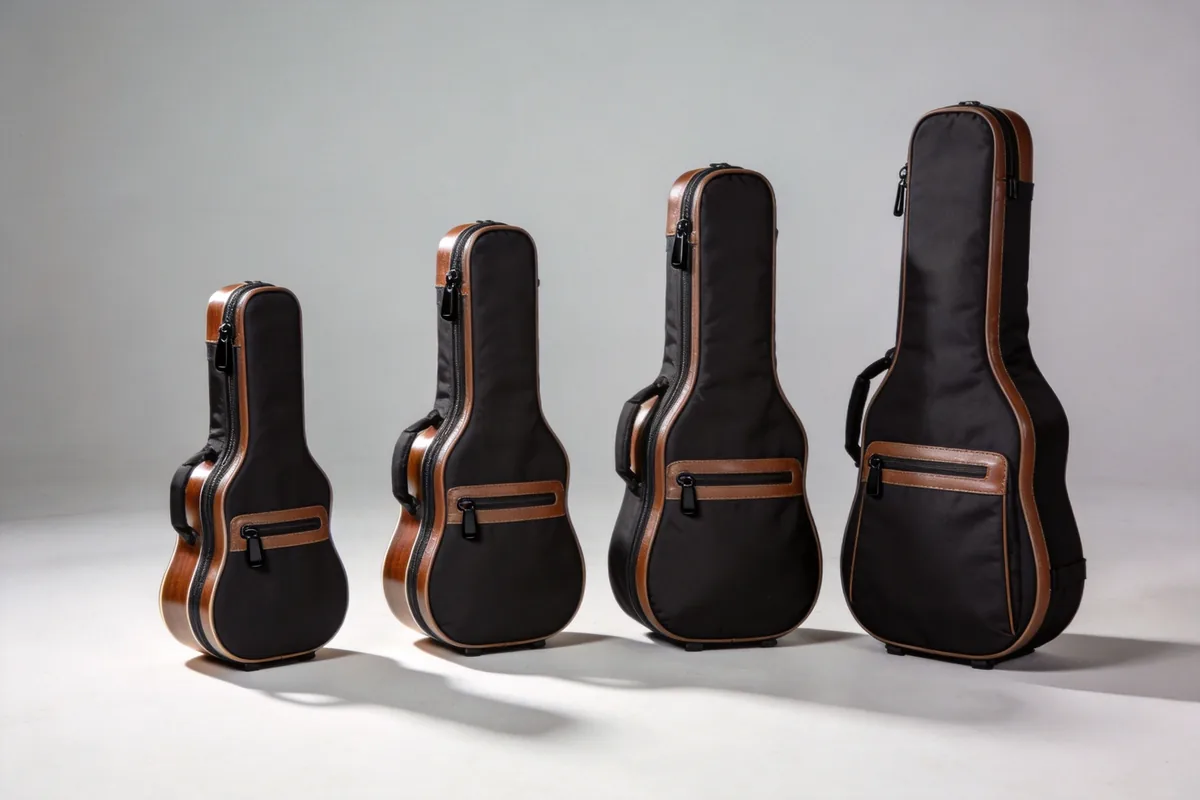
Two tolerances are worth fixing at the brief rather than discovering at inspection. The first is length tolerance: we hold ±5mm on interior length, which absorbs the normal variation between instruments of the same nominal size. The second is body width at the lower bout, where pineapple and pineapple-concert bodies run wider than the standard figure-eight shape and a bag cut to the figure-eight width will not take them. If your range includes both shapes, either specify the wider width for the whole size run or split the size into two styles — the second option costs a second pattern but avoids the returns.
If you are unsure which size your instrument actually needs, the reliable method is to measure the instrument rather than the catalogue: total length from base to the top of the headstock, the widest point of the body, and the body depth including the bridge. Send those three numbers and we will confirm the size and the clearance we recommend — typically 2–3cm on length and 1–2cm on width, which is enough for the instrument to drop in without being loose enough to move in transit.
Padding, Lining and Construction: What 10–20mm EPE Does at Each Zone
EPE — expanded polyethylene, the closed-cell foam sold as pearl foam — is the standard padding on a soft instrument bag, and the number that matters is not the headline thickness but where that thickness sits. A bag described as “20mm padding” usually means 20mm at the body panels, 10mm at the neck and 5mm at the pocket. That is a sensible build, but it is worth writing into the specification zone by zone, because a bag padded evenly at 10mm everywhere protects the body and leaves the headstock exposed, which is the failure that actually breaks instruments.
| Zone | Standard EPE | Upgrade Available | What It Protects Against |
|---|---|---|---|
| Body panels, front and back | 10mm (soprano, concert), 15mm (tenor), 20mm (baritone) | 20–25mm, or a PE board insert behind the front panel | Knocks against a table edge, stacking pressure in a carton, the bag next to it in a vehicle |
| Base and lower bout | 20mm, plus a 2mm PE sheet or an abrasion patch | Double-layer EPE plus a 600D abrasion panel | The most common drop point. Nearly every bag failure we see in returns is base or lower bout. |
| Headstock end | 10mm (soprano, concert), 20mm (tenor, baritone) | 20mm plus a shaped foam block | Neck breakage on a fall, and pressure from the bag above in a carton |
| Neck channel | 5–10mm, plus a neck rest or a strap | A padded neck cradle or a hook-and-loop neck strap | The instrument sliding forward and the headstock hitting the end of the bag |
| Front pocket | 5mm, or none on economy builds | 5mm plus a divider | Accessory hardware pressing into the body panel from the outside |
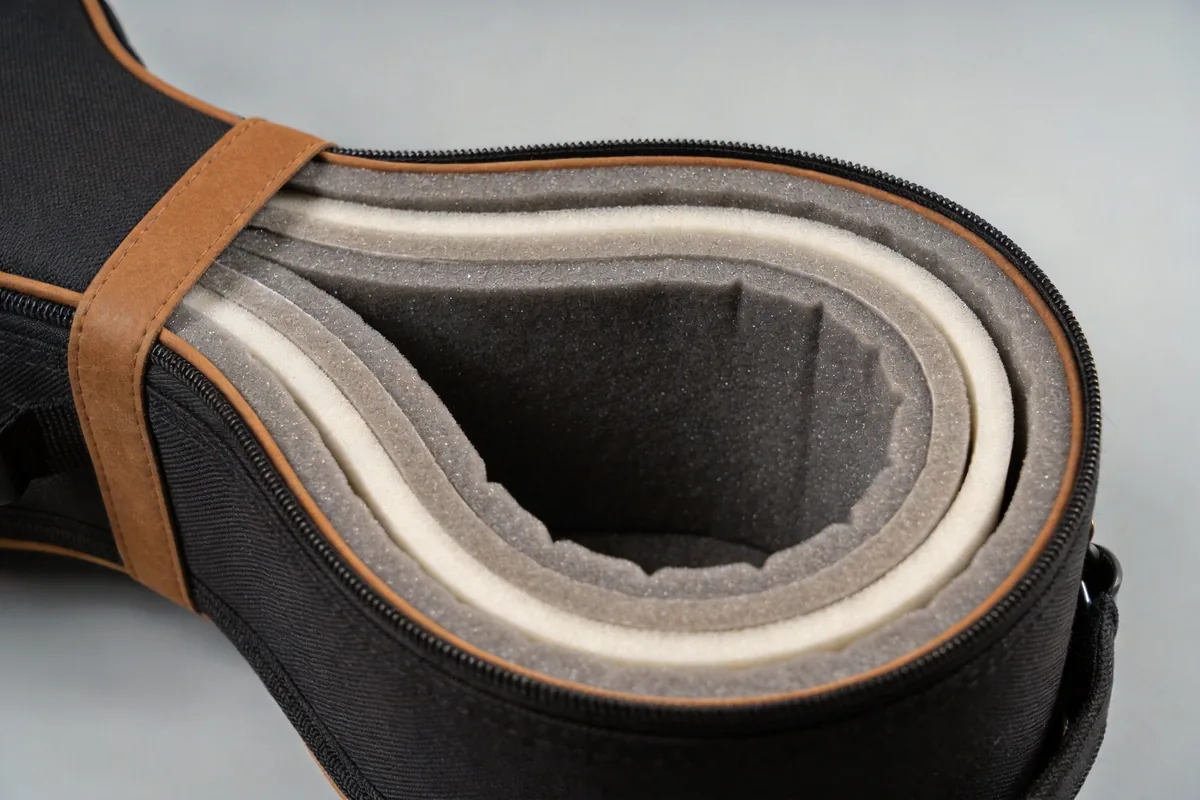
Lining is the second decision and the one buyers underestimate on a small bag, because a ukulele bag is open more often than a guitar bag is — players take the instrument out at home, at a lesson and at a session, several times a day. A 190T taffeta lining is the economy standard and is perfectly serviceable; a 210D polyester is more abrasion-resistant where the tuning pegs rub; a brushed tricot is the softest and is what a brand reaches for when the interior is part of the sales story. On the soprano and concert sizes the cost difference between taffeta and tricot is small enough that most brands take the tricot and use the interior in their product photography.
The zip deserves a sentence of its own. A #5 nylon coil is adequate on soprano and concert, and it is what most economy bags use. A #8 coil is worth the increment on tenor and baritone because the zip run is longer, the load on the curve at the lower bout is higher, and a #5 coil on a 79cm bag is where the returns come from. Reverse-coil, where the teeth face inward, is the version to specify if the bag is likely to be used outdoors in rain, because it sheds water at the seam rather than wicking it. We quote the zip by size and by type, so the difference is visible in the quotation rather than buried in the unit price.
Student and Education Programmes: Reflective Strip, Name Window and Size Runs
Education is the channel where a ukulele bag is bought as equipment rather than as a product, and the specification changes accordingly. A classroom set of thirty instruments is issued to thirty children, goes home on a bus, comes back the following week, and is expected to survive two or three academic years. The two features that schools ask for on every enquiry are a name tag window and a reflective strip, and both are cheap to add if they are designed in at the pattern stage and expensive to add afterwards.
The name window is a clear PVC panel, usually 60×35mm, stitched into the front panel or the upper back panel, sized to take a standard card or a strip of tape. The design detail that matters is that it is stitched on all four sides with the opening at the top and a bound edge, because a window stitched on three sides with a raw opening frays at the first wash and collects chalk dust. The second detail is placement: high on the front panel is visible when the bag is standing in a rack, low on the back panel is visible when it is hanging on a hook. Ask which one your schools use before the pattern is cut.
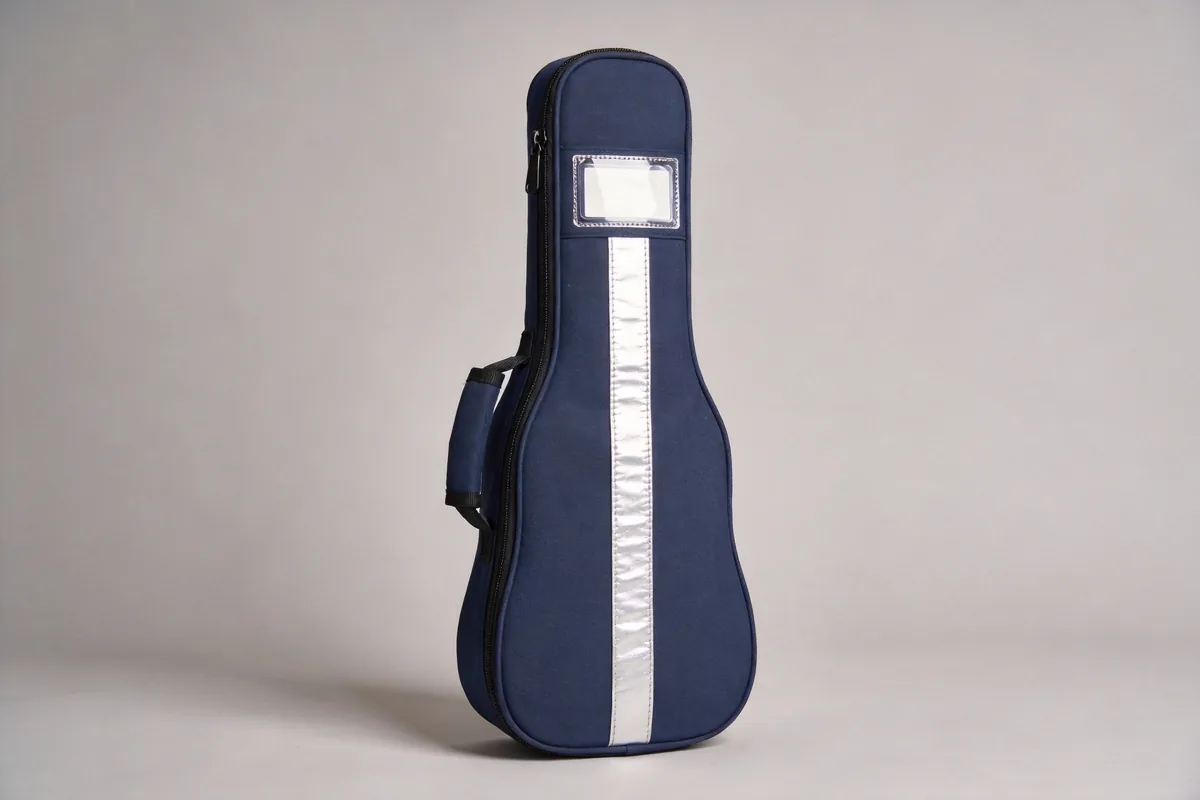
The reflective strip is normally a 20–25mm silver-grey retro-reflective tape, stitched along the front panel vertically or across the lower body, and occasionally around the base. We source it to the specification you name rather than to a certification we claim: if your market requires a particular retro-reflective performance class for a school product, give us the standard and we will quote tape that is documented to it, and if your market has no such requirement we will supply a commercial-grade tape and say so. What we will not do is describe a bag as “certified reflective” when the tape has not been tested to a named standard.
Size runs are the third education-specific requirement, and they are a packing problem more than a production one. A school set is usually one size — concert is the most common classroom instrument — but a district order often mixes concert and soprano, and the bags then have to be separable in the storeroom. The practical solution is a colour-coded size system: one colour per size, with the size printed on the polybag label and on the carton mark, and the cartons packed one size per carton where the quantity allows. A storeroom that receives a mixed carton of 60 bags in two sizes with no marking will spend an afternoon sorting them, and will blame the supplier for it.
Where the bag is intended for children, we ask buyers to confirm the product classification for their own market rather than assume it. A padded bag is not a toy, but a bag marketed to children can attract additional labelling and substance requirements in some jurisdictions, and the responsibility for that classification sits with the brand that puts it on the market. We will supply the material declarations you need to support your assessment, and our page on GPSR compliance for custom bags sets out the EU side of that file in detail.
How Mixed Sizes Reach the 500-Piece Minimum
The minimum is 500 pieces per style and colour, and within one style the four sizes combine. That is the rule that makes a ukulele programme workable, because almost no buyer wants 500 pieces of a single size. The combination is by style and colour, not by size: a run of 150 soprano, 200 concert, 100 tenor and 50 baritone in the same shell, the same trim and the same lining colour is a single 500-piece order, quoted at the 500-piece price, sampled once and inspected as one lot.
| Combination | Counts Toward the 500? | Why |
|---|---|---|
| Different sizes, same style, same colour | Yes — combines | One pattern set, one fabric colour, one cutting setup. The size is a grading decision, not a new material purchase. |
| Different colours, same style | No — each colour is its own 500 | Fabric is bought per colour, and the cutting table is reset per colour. Two colours means two dye lots and two setups. |
| Different shell fabric, same style | No — each shell is its own 500 | 600D and 1680D are different materials with different cutting behaviour and different lining pairings. |
| Student build vs standard build, same style | No — separate styles | The reflective strip and the name window change the panel pattern, so it is a second style rather than an option. |
| Same style, mixed sizes, plus a branded puller | Yes — tooling is a one-off on top | The puller mould is charged once per design and does not change the bag MOQ. |
| Below 500 in total | Quoted case by case | We will quote a pilot order where the pattern already exists, rather than advertise a number we cannot hold at a competitive unit price. |
A worked example, because the arithmetic is where buyers get stuck. Suppose you want four sizes at a 40/35/20/5 split. That is 200 concert, 175 soprano, 100 tenor and 25 baritone for a total of 500 — one order, one colour, one sample, one inspection. If you also want a second colour, the split repeats at 500 for that colour, which is why most first programmes launch one colour across four sizes and add the second colour on the reorder once the size mix is proven. If the 25 baritone pieces feel too few to be worth the pattern, the usual answer is to drop baritone from the first order and add it later: the pattern cost is the same whenever you pay it, and a size that sells 25 pieces in a season is a size you should test before you commit a full run to it.
Tooling and artwork sit outside the MOQ and are quoted separately. A woven label, an embroidered logo, a silicone patch or a moulded puller is charged once per design and belongs to the buyer, so the tooling paid on the first order carries across every reorder and every size. If your branding is a printed logo rather than a moulded one, there is no tooling at all beyond a screen charge per colour, and the mixed-size order becomes very straightforward.
Shipping Ukulele Bags Together with Guitar Bags: The Logistics Advantage
This is the commercial reason to buy ukulele bags from a guitar bag supplier rather than from a specialist. Ukulele bags are built on the same line, in the same factory group, with the same shell fabrics, the same foam and the same trim as your guitar bags — so they can be produced in the same production window and shipped in the same container, on one booking, with one set of export documents. That is not a small saving. A second supplier means a second deposit, a second sample round, a second inspection, a second booking and a second set of documents, and the freight on a part-container of small bags is disproportionately expensive.
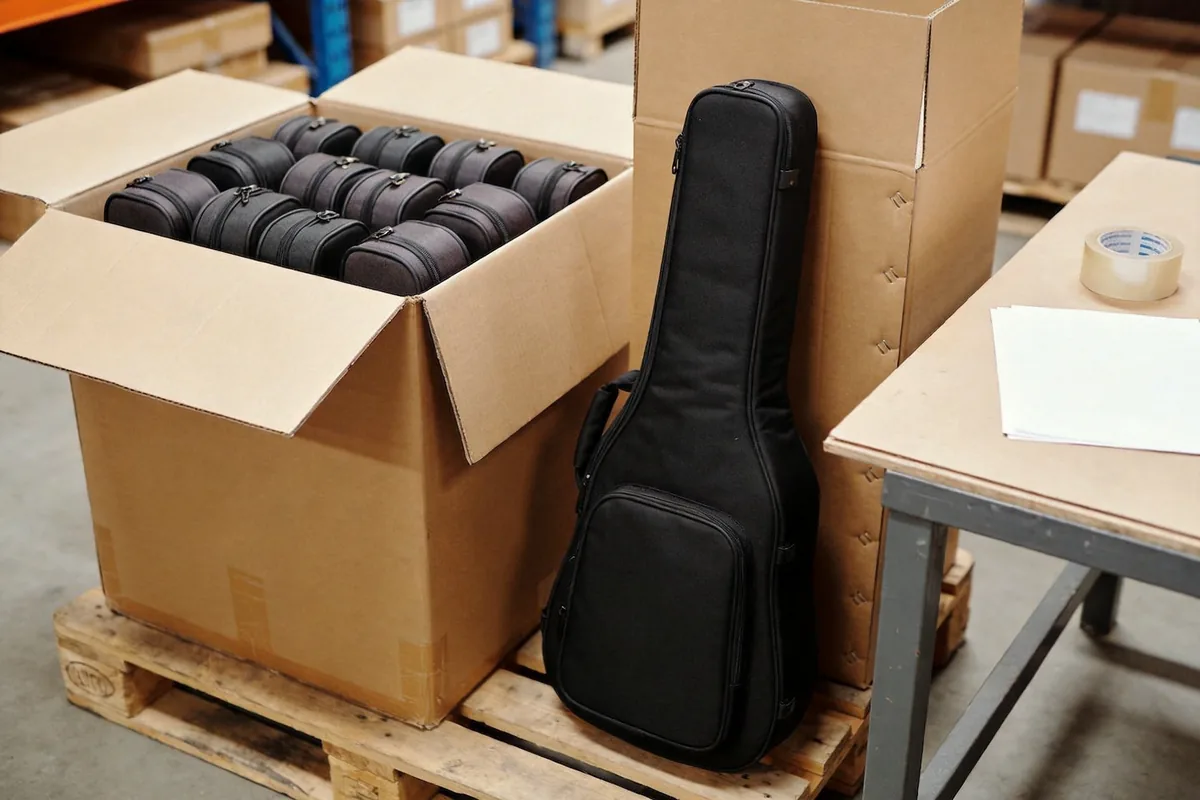
The carton economics are the part buyers find surprising. A soprano or concert bag folds or lays flat at roughly a third of the volume of an acoustic guitar bag, so a 60×40×40cm carton takes 40–60 ukulele bags where the same carton takes 10–12 guitar bags. The result is that a 500-piece ukulele order is a small number of cartons and a very small freight cost per unit, and the order slots into a container that is already going out rather than requiring one of its own. On an LCL shipment the effect is larger still, because the minimum chargeable volume is what it is whether you fill it or not.
Two things have to be planned for consolidation to work. The first is the production calendar: the ukulele run has to be scheduled inside the guitar run’s window, which means the sample has to be approved before the guitar bulk order is cut, not after. The second is the carton mark, which must separate the sizes line by line and match the packing list exactly, because a consolidated shipment is where a customs query is most likely and a carton mark that says “bags” rather than “ukulele bag, concert, 60 pcs” is the kind of detail that stops a container. We mark by size and colour as standard, and we send the packing list for approval before the cartons are sealed.
If you are buying both categories for the first time, the sequence that works is to sample the guitar bag and the ukulele bag together — two samples, one approval round, one set of comments — and then place the bulk orders so that both are ready in the same fortnight. Sampling runs 6–10 business days from written approval of specification and artwork, bulk production runs 35–50 days after sample sign-off, and inspection is to AQL 2.5 major and 4.0 minor before the container is booked. The guitar bag OEM process page walks the same sequence from the buyer’s side if you want the detail before you start.
Customisation, Branding and Compliance on a Small Format
The branding options on a ukulele bag are the guitar bag’s, but the panel area is smaller and that changes which method works. A woven label needs a seam or a flat panel at least 40mm wide to sit without distorting, and on a soprano front panel the usable flat area is limited, so the label usually goes into the pocket seam or onto the upper back panel. Embroidery reads well on the pocket because the stitch follows the outline and does not need a minimum flat area. A heat transfer is the cheapest way to get a multi-colour logo onto a small panel, and a moulded silicone patch is the most durable where the bag will be handled daily. Most programmes use two methods: a woven label in the seam for identification and an embroidered or moulded mark on the pocket for presence.
Colour and trim are where a ukulele range is easiest to make look proprietary. Because the bag is small, a contrast lining is visible the moment it is opened, and a coloured zip tape or a leather-look pull tab reads clearly at this scale in a way it does not on a large guitar bag. The usual build we quote for a brand launching a range is a 600D shell in one of four stock colours, a contrast brushed-tricot lining, a bound edge in a matched tape, matte black hardware and one branding method — which is enough to look designed and simple enough to hold a 6–10 day sampling schedule. If you want the full set of branding methods with their mould costs and MOQ implications, the private label guitar bag manufacturer page sets them out side by side and the logic carries straight across to the smaller bag.
Compliance is the one area where a small bag is not automatically simpler than a large one. The substances are the same — azo dyes, phthalates in any PVC window, heavy metals in coatings and hardware — and a clear PVC name window is exactly the kind of component that attracts a phthalate question in the EU. We ask for the destination market at quotation, supply the material declarations you need, and print the compliance label from copy you approve. What we do not do is declare a product compliant on your behalf: the legal manufacturer name on the label is QUANZHOU JUNYUAN COMMERCIAL AND TRADING CO., LTD., and the responsible-person block your market requires is printed from your approved copy.
Junyuan Bags is the trading name of QUANZHOU JUNYUAN COMMERCIAL AND TRADING CO., LTD., established in 2014, and its founder entered the bag trade in 2004. Production runs through affiliated and partner factories that specialise in the construction each programme needs, which is why a ukulele pattern can be graded into four sizes and sampled in 6–10 business days rather than waiting for a single line to clear capacity. Your purchase order, invoice and shipping documents are issued in the legal entity name above.
Send the instrument sizes you need to cover, the quantity per size and colour, the padding level you want and any branding or artwork you already hold. You will have a written quotation with the size breakdown and tooling shown separately within 2–3 working days, and a sample in 6–10 business days once artwork is approved.
Email: [email protected] | WhatsApp / Tel: +86 17750020688
Frequently Asked Questions About Custom Ukulele Bags
Q1: What is the MOQ for custom ukulele bags?
Q2: What are the interior dimensions for soprano, concert, tenor and baritone bags?
Q3: How much padding should a ukulele bag have?
Q4: Can you add a reflective strip and a name tag window for school orders?
Q5: Do you make ukulele bags on the same line as guitar bags?
Q6: How long does sampling and bulk production take?
Q7: Can I ship ukulele bags in the same container as my guitar bags?
Q8: What branding works best on a small bag?
Explore the Rest of the Guitar and Ukulele Bag Range
- Custom Guitar Bag Manufacturer
- Custom Gig Bag Manufacturer
- Electric Guitar Bag Manufacturer
- Acoustic Guitar Bag Manufacturer
- Bass Guitar Bag Manufacturer
- Guitar Bag OEM Process
- GPSR Compliance for Custom Bags
- Private Label Guitar Bag Manufacturer
- Bag Manufacturer vs Supplier
- Sports Bags Manufacturer
- OEM & ODM Service — full programme scope, sampling workflow and MOQ terms
- Custom Golf Bag Manufacturer — stand bags, cart bags and tour staff bags