A bag manufacturer established in 2014, with our founder in the industry since 2004. We build private-label tactical packs, range bags, admin pouches, utility pouches and duty organizers on a PALS/MOLLE platform — Cordura-style 500D and 1000D shells, bar-tacked webbing, YKK-grade zippers and laser-cut laminate — for tactical retailers, range and outdoor brands, duty-equipment distributors, and promotional programs.
Looking for a custom tactical bag manufacturer? Junyuan Bags has been producing bags since 2014 — our founder has worked in the industry since 2004 — and today we manufacture private-label tactical backpacks, range bags, admin and utility pouches, EDC organizers and duty bags for tactical retailers, range and shooting-sports accessory brands, outdoor and hiking labels, and promotional distributors in North America, Europe, and Australia. Every bulk order is inspected to AQL 2.5 major / 4.0 minor, with MOQ 500 pieces per style, sampling in 6–10 business days, and mass production in 35–50 days. Combined capacity across our affiliated and partner factories covers programs from 500 to 50,000 pieces per style, quoted within 24–48 hours of a complete specification.
- ✓ PALS geometry built to print, not to eye — 25 mm (1 in) webbing on 38 mm (1.5 in) vertical row spacing, so third-party MOLLE pouches actually lock in
- ✓ Load paths designed first — bar-tacks at every strap junction, box-X stitches at handle and shoulder anchors, reinforced base panels
- ✓ Both panel routes — stitched webbing rows for repairable, heavy-use builds, or laser-cut laminated panels for a flatter, lighter, snag-free face
- ✓ Hardware that survives the field — Duraflex-style and ITW-style side-release buckles, metal D-rings, lockable sliders, and YKK-grade #8 and #10 zippers
- ✓ AQL 2.5 major / 4.0 minor inspection — stitch density, bar-tack pull, webbing spacing, zipper cycling and buckle retention checked on every batch
- ✓ Low entry point — 500 pieces per style, up to three colorways mixed in one order
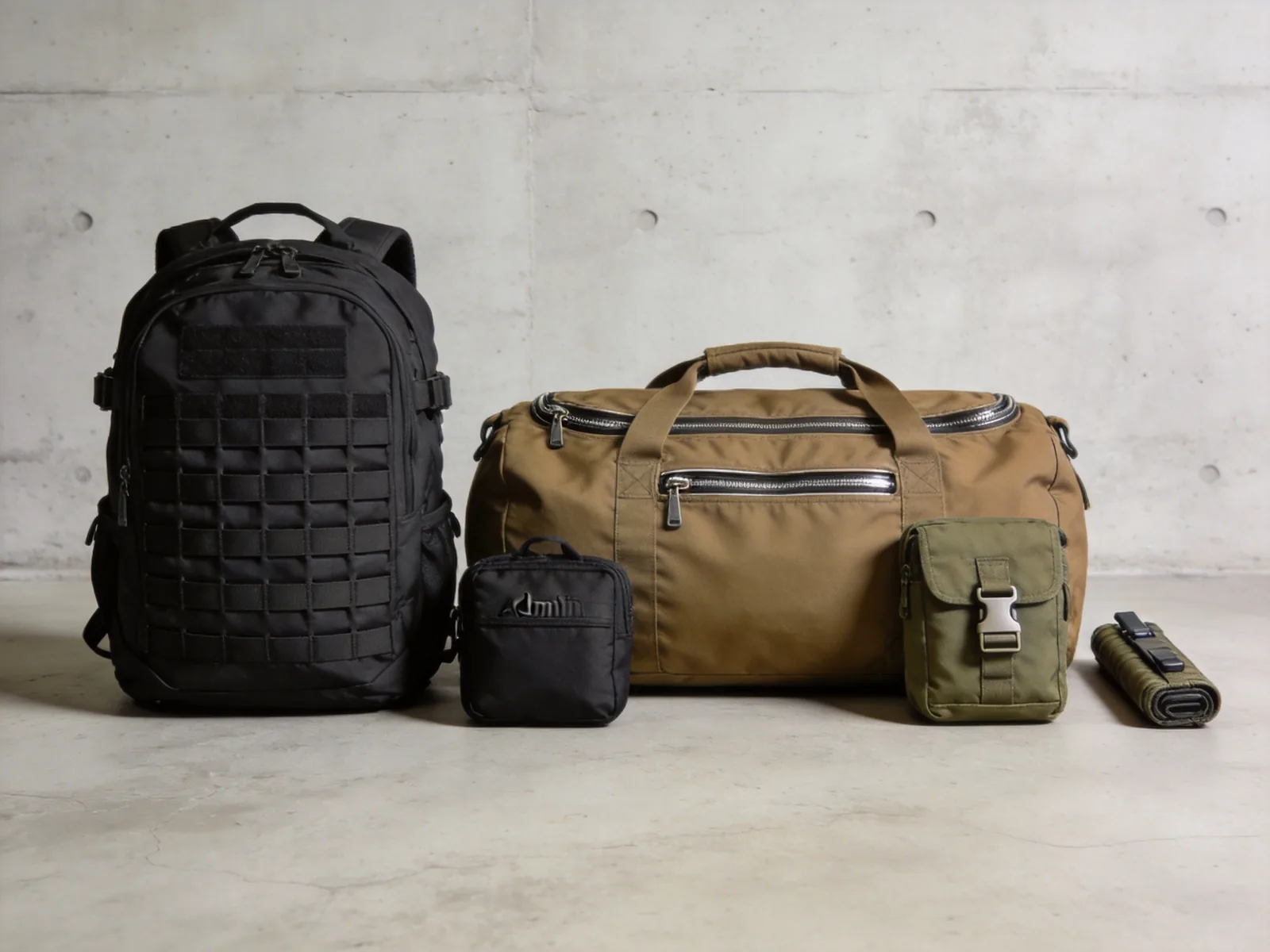
Custom tactical bags — MOLLE backpack, range duffel, admin pouch, and utility pouch, built to your specification
What Is a Custom Tactical Bag and Who Buys Them?
A custom tactical bag is a load-bearing bag or pouch built on a modular attachment platform, where the outside face carries a webbing or laser-cut grid (PALS) that accepts interchangeable pouches, and the inside is organized for equipment that has to be found by touch. It is not a hiking pack in olive drab: the platform, the hardware rating, the stitch pattern at every stress point, and the way the bag hangs off a belt, a chest rig, or a vehicle seat are all part of the design brief. “Custom” means the panel layout, fabric, webbing, buckle set, loop field, and branding are set per order at 500 pieces per style.
Five buyer groups order these bags. Tactical and shooting-sports retailers order range bags and MOLLE backpacks where the internal dividers must hold ear protection, eye protection, magazines, tools, and a cleaning kit in fixed positions. Duty and security equipment distributors order duty bags, patrol packs, and utility pouches where buckle retention and silent opening matter more than cosmetics. Outdoor and hiking brands order tactical-styled packs because the MOLLE face is a selling feature for attachment-hungry customers. EDC and travel brands order admin pouches, organizer inserts, and sling packs that fit inside a larger bag. Promotional and corporate buyers order utility pouches and tool rolls as staff or gift items, usually with a large logo panel.
Because the buyer is attaching things to the bag, the specification conversation is dimensional from the first email: what has to attach to the outside, what has to sit in a fixed pocket inside, how much weight the shoulder harness carries, and whether the bag is worn, carried by handle, or strapped down. Those four answers decide the panel type, the fabric weight, and the hardware — which is why we quote the platform and the interior together.
Tactical Bag Types We Manufacture
The table below shows the formats we produce most often, with the construction each one normally carries. Every column is adjustable: panel type, fabric weight, capacity, hardware, and interior layout are set by your line and your channel.
| Style | Best for | Typical construction | Carry | MOQ |
|---|---|---|---|---|
| MOLLE assault backpack, 35–45 L | Range days, duty, outdoor day packs | 500D shell, stitched PALS rows, padded laptop or bladder sleeve | Padded harness + sternum strap | 500 pcs |
| Range bag / gear duffel | Range sessions, kit transport | 600D–1000D shell, wrap-around #10 zip, removable internal dividers | Webbing handles + shoulder strap | 500 pcs |
| Admin pouch | Documents, tools, EDC, maps | 500D shell, elastic loop grid, zip mesh pocket, loop field on front | MOLLE straps or belt loops | 500 pcs |
| Utility / general-purpose pouch | Attachments, first-line gear, radios | 500D shell, gusseted zip, drainage grommet, PALS back panel | Malice-style clips or straps | 500 pcs |
| EDC sling pack | Concealed-carry-style sling, daily carry | 500D or laser-cut laminate, loop-lined rear panel, quick-pull tab | Single sling strap, reversible | 500 pcs |
| Tool roll / organizer roll | Tools, cleaning kits, small parts | 600D shell, elastic or webbing slots, roll-up with buckle closure | Webbing tie or handle | 500 pcs |
| Duty / patrol bag | Shift kit, vehicle kit, evidence transport | 1000D base panel, lockable double sliders, hi-vis ID window | Handle + detachable shoulder strap | 500 pcs |
| Modular insert / panel only | Adding organization inside a bag you already sell | Padded panel with PALS face or loop field, hook backing | None (drop-in) | 500 pcs |
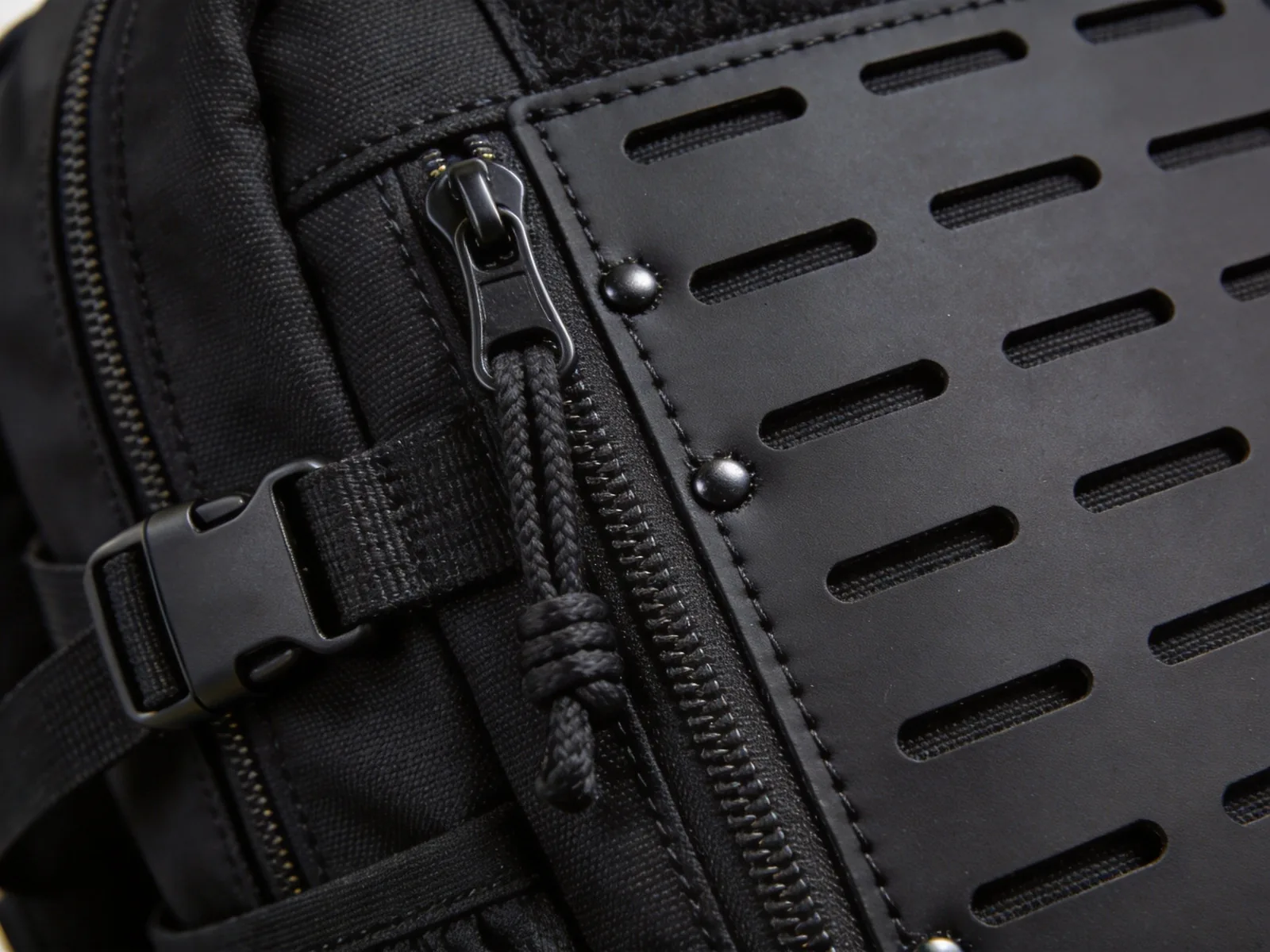
Laser-cut laminate grid, bar-tack stitching, cord-pull zipper, and side-release buckle — the four details that decide field life
The MOLLE / PALS Platform: How the Grid Is Built
Most quality complaints on tactical bags are platform complaints, not fabric complaints: a pouch that will not seat, a webbing row that sags after a month, a strap that pulls through the panel. We set the platform first, then build the fabric and hardware around it.
PALS spacing and webbing choice
- Stitched PALS rows — 25 mm (1 in) webbing stitched at 38 mm (1.5 in) vertical intervals onto the bag face, with stitch lines at the row ends. This is the repairable, heavy-use route: a damaged row can be re-stitched, and the face keeps its shape under load.
- Laser-cut laminate panel — a laminated 500D face with slots cut by laser to the same 25 × 38 mm rhythm. Flatter, lighter, no loose webbing to snag, and it holds a pouch tightly; the trade-off is that the panel itself carries the load, so the laminate grade has to be specified for it.
- Hybrid face — laser-cut panel on the flat areas, stitched webbing where the bag flexes or where heavy items hang. Used on sling packs and EDC bags where both looks and durability matter.
Attachment hardware
Pouches are held by straps with side-release buckles, Malice-style clips, or hook-and-loop. We specify the attachment type with the pouch weight: side-release buckles for anything removed often, clips for semi-permanent attachments, and hook-and-loop for panels that must be silent to open. Every attachment point is bar-tacked at both ends of the webbing, not just at the seam.
Load-bearing stress points
Handles, shoulder-strap anchors, D-rings, and compression-strap junctions are the four places tactical bags fail. We box-X stitch every handle and harness anchor into a reinforced panel, add a 1.5–2 mm PE board behind the harness when the bag carries over 10 kg, and bar-tack compression-strap junctions with 42-stitch tacks in bonded nylon thread. Base panels get a double layer or a 1000D wear patch where the bag contacts the ground.
Fabric, Webbing & Hardware Specification
Fabric weight is chosen against the load and the channel, not by habit. The table below is the working range we quote most often.
| Shell / face material | Weight | Abrasion & tear | Hand & finish | Typical use |
|---|---|---|---|---|
| 500D polyester (PU-backed) | 500D | Good; the default for most pouches | Matte, soft hand, takes print well | Admin pouches, EDC bags, mid-size packs |
| 500D nylon (Cordura-style) | 500D | High; better tear strength than polyester | Dry matte texture, slight sheen | Range bags, MOLLE backpacks |
| 1000D nylon | 1000D | Very high; heavy abrasion resistance | Coarse, stiff, rugged | Base panels, duty bags, heavy range bags |
| Laser-cut laminated 500D | 500D laminate | High; slots are the weak line | Flat, modern, low-profile | Sling packs, lightweight plate-style panels |
| Ripstop nylon 210D–420D | 210–420D | Moderate; grid holds small tears | Light, packable, technical look | Packable organizers, liners, stuff bags |
| Waxed canvas 16–20 oz | 16–20 oz | Moderate; water-repellent surface | Heritage look, softens with use | Heritage-style field bags and rolls |
| RPET recycled polyester | 500–600D | Comparable to virgin polyester | Matte, recycled-content story | Brands with sustainability targets |
| Neoprene or EVA-faced panel | 3–5 mm | Impact and shape retention | Smooth, semi-rigid | Protective inserts, structured panels |
Webbing is 25 mm and 38 mm woven nylon or polyester in matching or contrast color, with a minimum 1,200 lb break strength on load-bearing runs. Zippers are YKK-grade #8 and #10 reverse-coil on main compartments, #5 on pouches, with cord pulls or molded pulls specified per channel. Buckles are Duraflex-style and ITW-style side-release and ladder-lock, with metal D-rings, locking sliders, and grommets where drainage is needed. Stitch density runs 8–10 stitches per inch with bonded nylon thread; binding tape covers every internal seam so no raw edge touches the contents.
Interior Organization: Loop Fields, Elastic Grids & Dividers
The inside of a tactical bag is a retrieval system. We build it from your equipment list — dimensions and quantities — rather than from a generic layout, and we specify three variables together: retention method, panel position, and access direction.
Retention systems
- Elastic loop grid — the default for admin pouches and range bags; sized in 15 mm, 20 mm, and 25 mm loops for pens, drivers, batteries, and cylindrical items
- Hook-and-loop (Velcro-style) loop field — a full loop-lined panel for hook-backed organizers, so the layout can be re-arranged by the end user
- Removable padded dividers — hook-and-loop attached dividers in a range bag so the internal volume re-configures for different kit
- Zip mesh pockets — visible, ventilated storage on the lid or the rear panel
- Slip pockets and sleeve panels — flat storage for documents, targets, or a bladder sleeve with a hanger and drinking-tube port
Access direction
Range bags open flat and stay open: we specify a wrap-around #10 zip with dual sliders and a wire-reinforced opening so the lid holds position while both hands are busy. Backpacks open from the top for speed, or clamshell-style when the user needs to see everything at once. Pouches open on three sides when the contents are long, and on two sides when the pouch is worn on a belt and only the front face is reachable. Getting this wrong is the single most common reason a bag is returned — the capacity is right but the access is wrong.
Insert-only development
If you already sell a bag, the fastest route to a modular SKU is a standalone panel: we build a padded insert with a PALS face or a loop field, add hook backing to match your lining, and deliver it flat-packed at 500 pieces. No tooling on your side, and it turns an existing product into a modular platform without a new pattern.
Customization, Branding & Private Label
Every element below is set per order, and none of them changes the MOQ structure: one style, 500 pieces, up to three colorways mixed.
- Panel and pattern — stitched PALS, laser-cut laminate, hybrid, or plain face; new patterns are drawn to your dimensions and confirmed before sampling
- Colors — black, coyote brown, ranger green, olive drab, tan, grey, navy, and multi-tone panel splits matched to Pantone or approved lab dips
- Logo methods — embroidered patch, PVC or rubber patch, laser-engraved loop patch, silkscreen, heat transfer, woven label, and debossed leather or Hypalon patch
- Loop fields — front, lid, or shoulder-strap loop panels for patches, sized to standard 50 × 75 mm or custom
- Hardware — matte black, coyote, or silver finishes; side-release, ladder-lock, G-hook, and lockable sliders
- Interior — elastic grid layout, loop panel position, divider count, mesh pocket, ID window, and printed lining
- Carry — padded harness with sternum strap, detachable shoulder strap, belt loops, MOLLE back straps, drag handle, and trolley sleeve
- Packaging — branded poly bag, printed retail box, hangtag, and set boxes for multi-piece kits
For private label, we produce under your brand only: no third-party markings on the product, the packaging, or the carton. Artwork proofs are issued before sampling, and a physical pre-production sample is approved in writing before bulk starts.
Tactical Bag Size & Capacity Reference
The dimensions below are reference points from our most-ordered formats, not a fixed catalogue. Any of them can be re-drawn for a specific equipment list.
| Reference | Format | External (cm) | Capacity | Holds |
|---|---|---|---|---|
| TB-01 | Admin pouch | 22 × 15 × 6 | 1.8 L | Documents, pens, tools, phone |
| TB-02 | Utility pouch, medium | 20 × 12 × 8 | 1.9 L | Radio, first-line gear, batteries |
| TB-03 | EDC sling pack | 32 × 20 × 10 | 6 L | Daily carry, tablet, EDC tray |
| TB-04 | Tool roll, 12 slots | 48 × 30 (open) | — | Drivers, wrenches, cleaning rods |
| TB-05 | Range bag, compact | 38 × 24 × 24 | 22 L | Ear and eye protection, 2 pistols or tools, ammo boxes |
| TB-06 | Range bag, full size | 50 × 30 × 30 | 45 L | Full range kit, dividers, cleaning mat |
| TB-07 | MOLLE backpack, 35 L | 48 × 30 × 22 | 35 L | Day kit, 2 L bladder, jacket, admin panel |
| TB-08 | MOLLE backpack, 45 L | 54 × 34 × 26 | 45 L | Overnight kit, helmet or boots externally |
How to Order Custom Tactical Bags
The process runs in five steps and typically completes in 41–60 days from a confirmed specification.
- Specification — send the equipment list with dimensions, the attachment requirement, the load the bag must carry, the format, quantity, logo method, and target retail price. We return a quotation within 24–48 hours with a proposed panel type, fabric weight, and interior layout.
- Pattern and artwork — we issue a dimensioned drawing, a PALS layout drawing, and an artwork proof for approval, including logo placement, loop field position, and hardware finish.
- Sampling — a physical pre-production sample is built in 6–10 business days. Sample cost is charged at material and labor value and is offset against the bulk order once the 500-piece MOQ is confirmed.
- Bulk production — 35–50 days after written sample approval, depending on quantity, panel type, and the number of logo and lining steps.
- Inspection and shipping — AQL 2.5 major / 4.0 minor inspection with a photo and measurement report, then carton marking and shipment by sea, air, or express, or FBA-ready prep.
Compliance & Documentation
Tactical bags ship into retail, duty, and outdoor channels, so documentation is prepared alongside the goods rather than after the fact. We work with REACH-compliant, AZO-free, and phthalate-free materials, and can supply material declarations, heavy-metal and phthalate screening statements for California Proposition 65 programs, color fastness reports, and hardware salt-spray results. Where a program requires it, we also provide a signed compliance declaration per shipment and lot-level traceability for shell fabric, webbing, and hardware. We manufacture bags and pouches only — we do not produce weapons, ammunition, or regulated firearm components, and we do not take on programs that require us to do so.
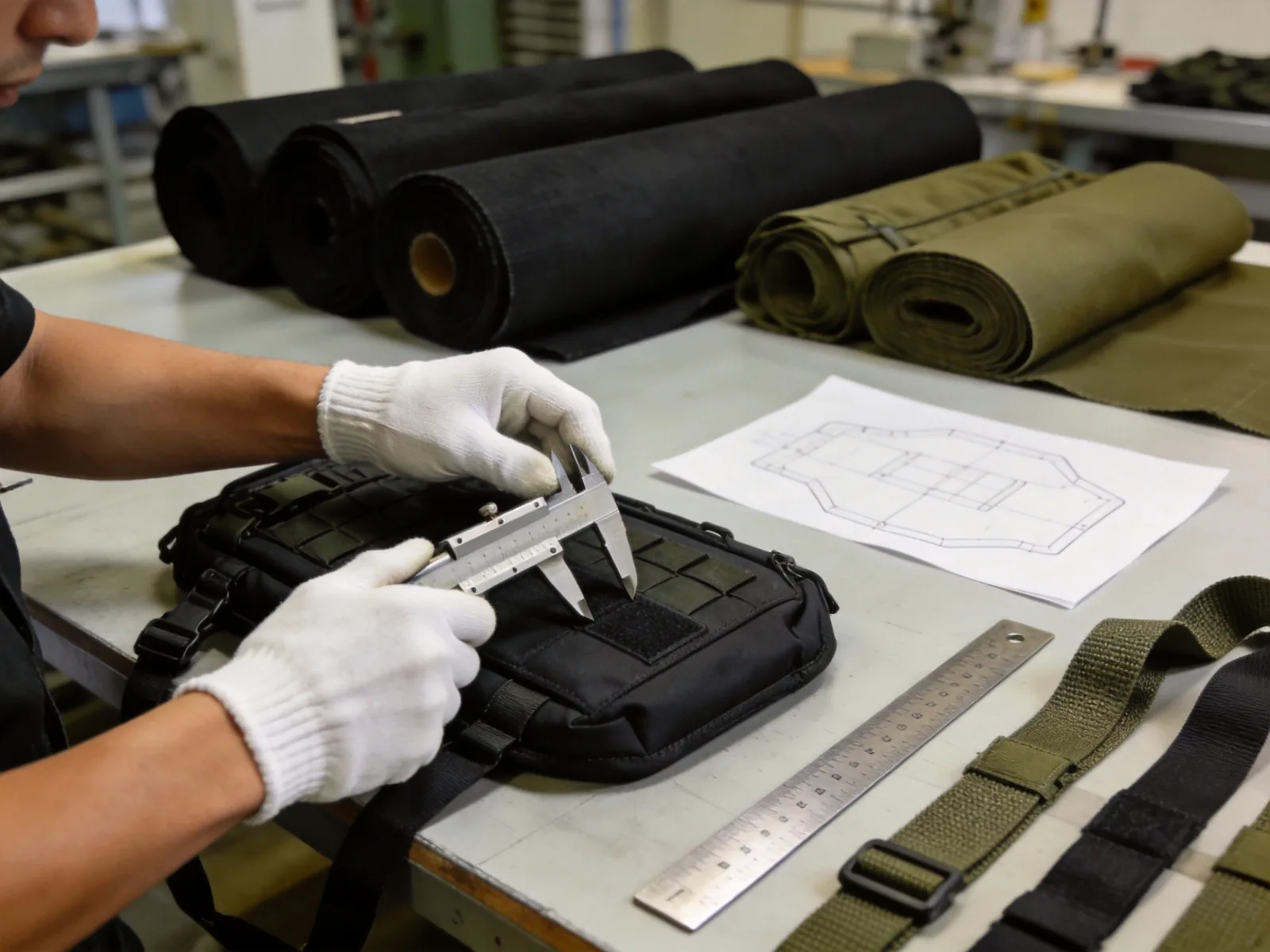
Dimensional and stitch inspection on a tactical panel across our affiliated and partner factories
Quality Control & AQL 2.5 Inspection
Inspection is built into the schedule, not added at the end. Inline checks run at cutting, after panel assembly, and at final packing; the pre-shipment inspection applies AQL 2.5 for major defects and 4.0 for minor defects. The checklist covers:
- External dimensions and capacity against the approved drawing, including pocket and divider positions
- PALS row spacing at 38 mm and webbing width at 25 mm, measured at three points per row
- Bar-tack count, tack length, and pull strength at handles, D-rings, and compression-strap junctions
- Box-X stitch integrity at harness and shoulder-strap anchors, plus PE board position on load-bearing bags
- Zipper cycling — 500 open-and-close cycles on a sampled bag, with slider smoothness and no skipped teeth
- Buckle retention and release force on side-release, ladder-lock, and clip attachments
- Stitch density at 8–10 stitches per inch, thread trimming, and binding tape coverage on every seam
- Laser-cut slot accuracy and edge quality on laminate panels, with no fraying or delamination
- Loop field pile height and hook engagement, plus patch retention after a 100-cycle pull test
- Hardware plating appearance, salt-spray performance, and grommet seating
- Logo registration, placement tolerance, and adhesion or stitch security
- Color match against the approved lab dip under standard light, plus carton drop and packing accuracy
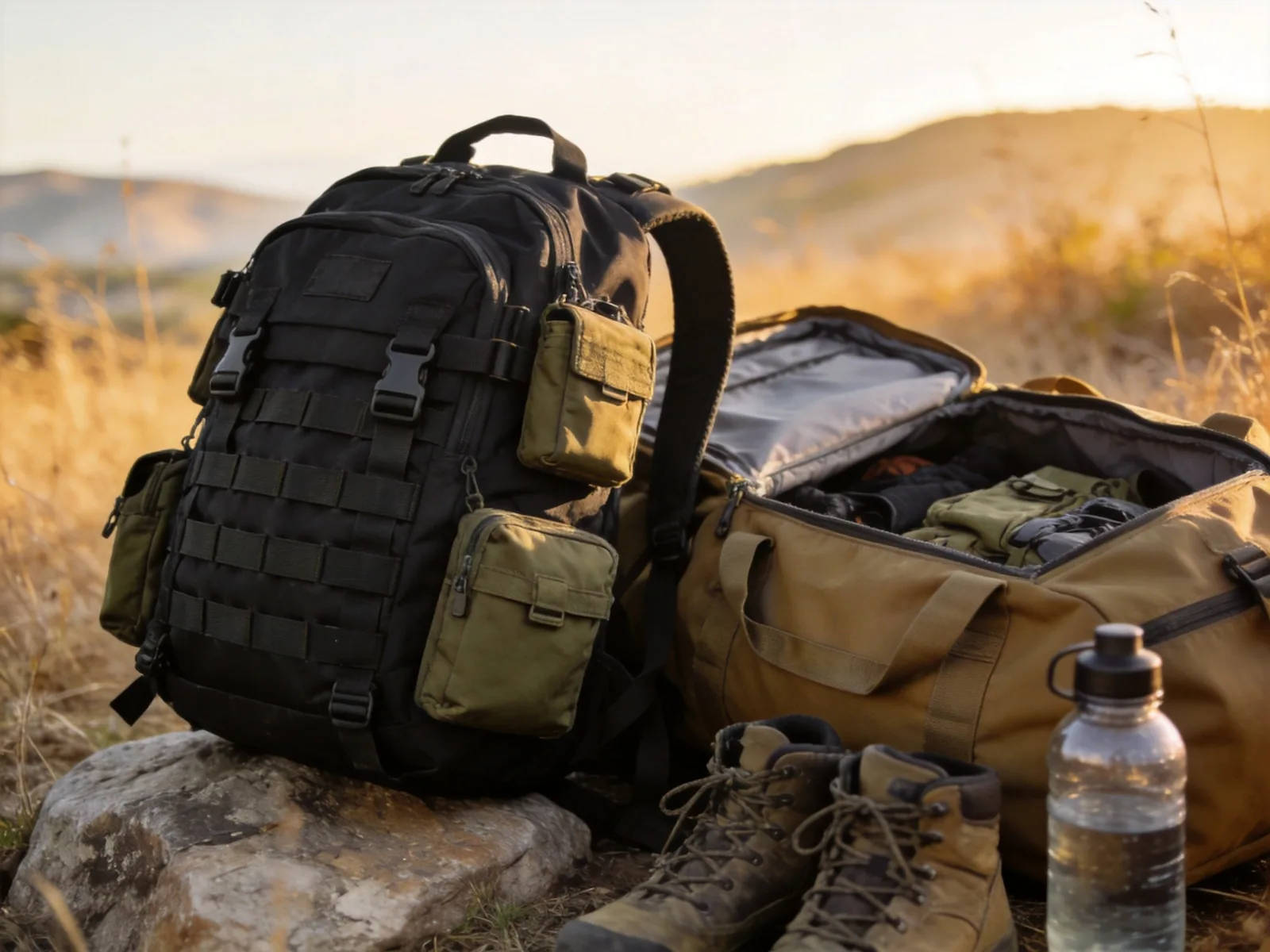
Field use decides the design: panel position, attachment hardware, and access direction are specified for real working conditions
Tactical Bags for Retail, Duty, Range & Outdoor Programs
Different channels need different bags, and the specification shifts accordingly. Tactical retailers need shelf presence, a patch-ready loop field, and packaging that survives a retail box, with the panel finished so it photographs well under store lighting. Duty and security distributors need silent opening, buckle retention under load, a lockable main compartment, and an ID window — the bag is handled by many users and often lives in a vehicle. Range and shooting-sports brands need a bag that opens flat and stays open, with dividers that hold shape after a hundred sessions. Outdoor and hiking labels need a harness that carries weight over distance, a bladder sleeve, and a lighter panel so the pack does not read as military surplus. Promotional programs need a low unit cost, a large logo area, and a shorter lead time, and often accept a 500D pouch with a simple elastic interior.
For e-commerce sellers, the admin pouch and the 35 L MOLLE backpack are usually the better first SKUs: lighter shipping weight, lower carton cube, and a size that ships in a standard box without oversize fees. Many of our clients launch one pouch first, then add a range bag or a 45 L pack once the first container sells through.
Why Work With Junyuan Bags?
We are a bag manufacturer established in 2014, with our founder in the industry since 2004, and our production is concentrated in the categories we know best: golf bags, backpacks, travel bags, and technical carriers. That focus is why a tactical brief does not get translated into a hiking pack with webbing sewn on top — the platform, the load path, and the interior are drawn by the same team that builds the bag.
- Platform engineering included — PALS layout, panel type, fabric weight, and hardware set proposed with the quotation, not sold as an upgrade
- One accountable team — sampling, bulk, inspection, and documentation handled by the same production group
- 500-piece entry — a first order that fits a launch plan without heavy inventory risk
- Consistent specification — approved sample, approved lab dip, and approved PALS drawing are the reference for every reorder
- Realistic lead times — 6–10 days sampling and 35–50 days bulk, quoted against the actual material, panel, and logo steps
Ready to Start Your Custom Tactical Bag Order?
Send Your Equipment List, Get a Quotation in 24–48 Hours
Tell us what has to attach to the outside, what has to sit in a fixed pocket inside, how much weight the harness carries, the format you have in mind, your quantity, and your logo method. We will propose the panel type, fabric weight, PALS layout, drawing, and price — MOQ 500 pieces per style, sampling in 6–10 days.
Request a Tactical Bag Quotation
[email protected] | WhatsApp +86 17750020688
Explore Our Other Custom Bag Lines
Related manufacturing pages
- Custom Bag Manufacturer — OEM/ODM Overview
- Custom Tool Bag Manufacturer
- Custom Camera Bag Manufacturer
- Custom Waterproof Bag Manufacturer
- Custom Dry Bag Manufacturer
- Custom Hiking Backpack Manufacturer
- Custom Cycling Bag Manufacturer
- Custom Packing Cubes Manufacturer
- Custom Laptop Bag Manufacturer
- Custom Briefcase Manufacturer
- Custom Cooler Bag Manufacturer
- Custom Backpack Manufacturer