
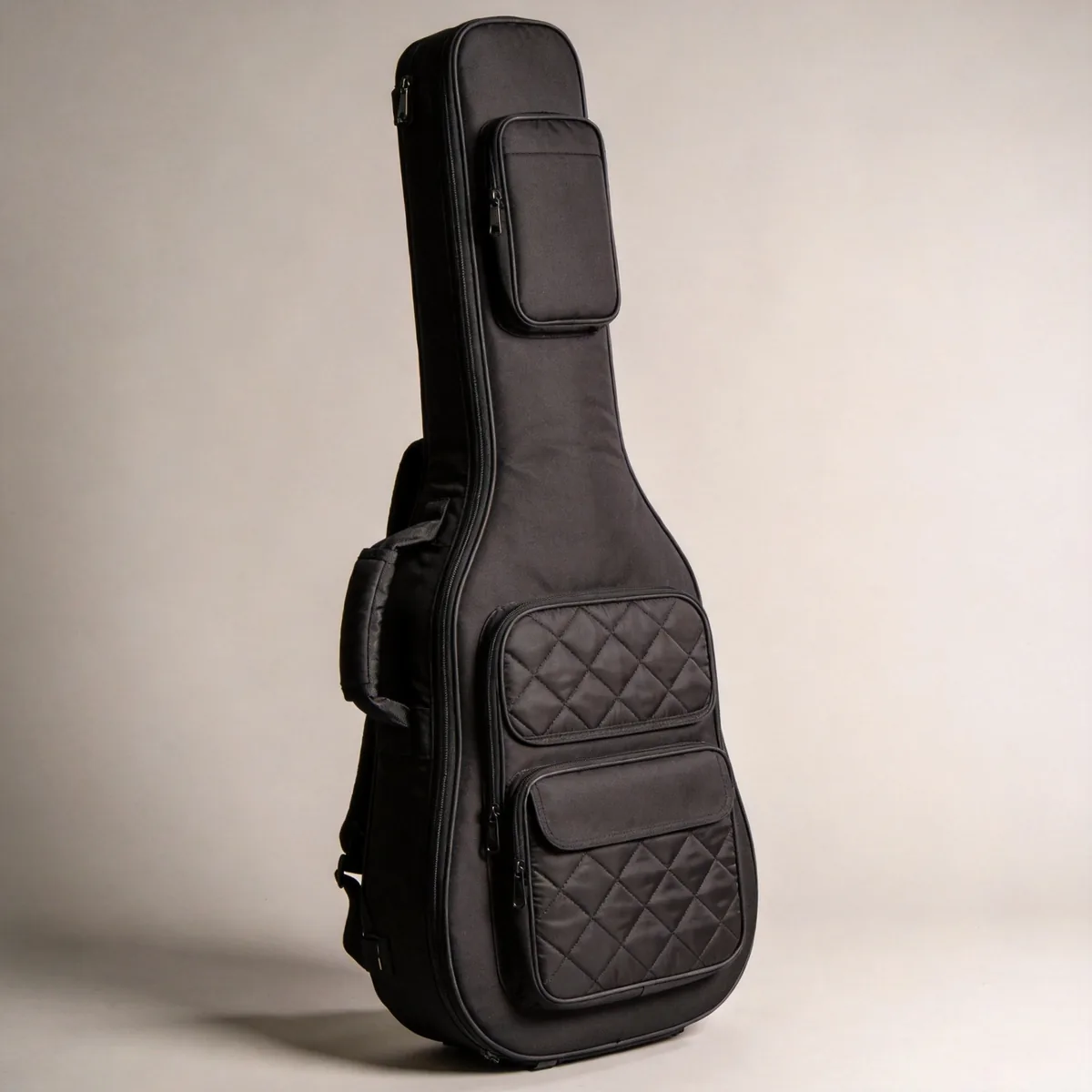
The full guitar bag OEM process, written out step by step so you can hold a supplier to it: the brief and tech pack, quotation and specification lock, a physical sample in 6–10 business days, the sign-off standard a sample has to meet, 35–50 days of bulk production with an in-line check, and an AQL 2.5 final inspection before the carton is sealed. Junyuan Bags runs this sequence for OEM and private label guitar bag programmes from our affiliated and partner factories in Quanzhou, Fujian.
Guitar Bag OEM Process at a Glance
The guitar bag OEM process runs in six stages: brief and tech pack, quotation and specification lock, sampling, sample approval, bulk production, and final inspection with shipment. A straightforward custom guitar bag order takes 8–11 weeks from first enquiry to container, of which roughly 6–8 weeks is production and inspection and the remainder is your own review time. The single most common cause of a late order is not factory capacity; it is a specification that keeps changing after the sample was approved.
| Step | What Happens | What You Receive | Typical Duration |
|---|---|---|---|
| 1. Brief & tech pack | Instrument measurements, style reference, materials, branding, packing and target market requirements reviewed and turned into a draft specification | Specification draft with open questions listed | 1–2 working days |
| 2. Quotation & spec lock | Material breakdown, MOQ per style and colour, unit price bands, packing and lead time priced | Written quotation plus a dated, revision-numbered spec sheet | 2–3 working days |
| 3. Sampling | Pattern cut to your instrument, shell and foam cut, sewn, trimmed, logo applied | One physical pre-production sample with your branding | 6–10 business days |
| 4. Sample approval | You test-fit the instrument, check the interior, hardware and logo, then approve or mark up changes | Signed sample approval, sealed golden sample | Buyer-controlled, usually 3–7 days |
| 5. Bulk production | Materials procured to lot, cutting, sewing, assembly, trimming, in-line check at 20–30% of output, packing | In-line inspection photos and measurements | 35–50 days |
| 6. Inspection & shipment | AQL 2.5 major / 4.0 minor pre-shipment inspection, photo report, carton marks, booking and documents | Inspection report with defect log, shipping documents | 3–5 days |
Two things are worth saying at the start, because they decide how smooth the rest of the process is. First, the process is a specification process, not a production process — 90% of the disputes we are asked to arbitrate as a second supplier come from a sample that was approved verbally against a spec sheet nobody signed. Second, every stage has a written output. If a supplier cannot show you a dated spec sheet, a sample approval record and an inspection report, the process is being run from memory, and memory is not repeatable across 500 pieces.
This page is the expanded version of the six-step table on our custom guitar bag manufacturer hub. It is written to be forwarded to a colleague or used as a checklist against any supplier, not only against us. For the commercial comparison behind step 2 — what actually changes when you buy from a manufacturer rather than a trading company — see bag manufacturer vs supplier.
Before Step 1: The Factory Audit and What to Prepare
A factory audit usually happens before the brief, and it is the cheapest risk control in the whole programme. It answers three questions: can this workshop physically make your bag, does it control materials and quality with records rather than habit, and will the people who answer your emails be the same people who run your order. Buyers who skip the audit and go straight to sampling often discover a capacity or documentation problem at the worst possible moment — three weeks before a retail launch.
One point of honesty about how we are structured, because it affects how you should audit us. Junyuan Bags is a bag manufacturing and export company, not a single-walled factory: production runs through affiliated and partner factories in Quanzhou that we have worked with for years, and we control the specification, sampling, quality standard and shipment. That means an audit should be booked against the specific workshop scheduled to run your order, not against an office address. Ask which workshop is planned for your style, and audit that one. Any supplier that cannot answer that question precisely is either guessing or routing your order after the fact.
- ✓ Legal entity and licence. Business licence matching the company name on the quotation and the invoice, with the legal name spelled out in full: QUANZHOU JUNYUAN COMMERCIAL AND TRADING CO., LTD.
- ✓ Process coverage. Cutting, sewing, foam lamination, hardware setting, trimming and packing all present, or an explanation of which step is subcontracted and to whom.
- ✓ Machine list. Number of single-needle and walking-foot machines, bar-tacking machines, long-arm machines for bag bodies, die-cutting or hot-knife foam cutting.
- ✓ Sample room. A pattern table, a pattern library and a person who can cut a new pattern from measurements rather than copy an existing bag.
- ✓ Material control. Fabric and foam stored off the floor, dye lots kept separate and labelled, a record of which lot went into which order.
- ✓ Quality records. Previous AQL reports, in-line check sheets, defect logs and the corrective actions taken. Ask to see a report that failed and what happened next.
- ✓ Test documentation. REACH or equivalent material test reports per fabric and per lot, with the lab name and the report date visible. Our compliance position is set out on REACH compliance for custom bags.
- ✓ Social and safety basics. Fire extinguishers, exits, lighting over the sewing lines, and any third-party social audit report the workshop holds.
What you should bring: a one-page audit agenda with times, your own QA checklist so the answers are comparable across suppliers, a reference bag you like so you can ask how they would build it, an NDA if your artwork is sensitive, and a list of four or five questions about capacity and scheduling. If travel is not possible, a scheduled video walk-through of the line works well, provided it is live and unedited and you ask to see the packing area as well as the sewing floor — the packing area is where most measurement failures are caught or missed.
The audit output should be a short written summary with photographs, not a verbal impression. Ask for it in writing. A supplier who will not put audit findings in writing will not put a corrective action in writing either.
Step 1 — Brief and Tech Pack: What to Send, and the Three Gaps That Cause Rework
You do not need a formal tech pack to start a conversation, and insisting on one before the first quote wastes a week. What you do need is enough information for a supplier to price the bag without guessing. The four items that make a first quotation meaningful are the instrument the bag must fit, the quantity per style and colour, the target FOB band, and the destination market. Everything else can be developed together.
A proper tech pack is worth building before sampling, though, because it is the document the whole order is measured against. For a guitar bag it contains twelve elements. Each one moves the price, which is why an incomplete brief produces a quotation that later “changes for no reason”.
| Tech Pack Element | What to Send | Why It Changes the Price |
|---|---|---|
| 1. Instrument dimensions | Overall length, lower-bout width, upper-bout width, body depth, headstock width including tuners | Sets the pattern, the foam cutting size and the carton size; a 10 cm length change alters fabric consumption per bag by 8–12% |
| 2. Style and reference | Your own drawing, or photos of a bag you like with the interior shown | Determines panel count, pocket layout and how many operations per bag |
| 3. Shell fabric | 600D polyester, 1680D, ripstop nylon, waxed canvas or RPET, with colour reference | Fabric is the largest single material cost and sets the MOQ per colour |
| 4. Padding and structure | 10 mm, 15 mm, 20 mm or 25 mm EPE; optional 5 mm PE board behind the body | Foam grade and lamination steps are priced per square metre and per operation |
| 5. Lining | 210D PU-backed taffeta, brushed tricot or plush velvet, with colour | Plush lining adds cost and sewing time but is the main perceived-quality signal inside the bag |
| 6. Zipper and hardware | Reverse-coil nylon or moulded-tooth, slider type, pullers, D-rings, buckles, feet | Hardware brand and metal vs plastic content changes cost and test requirements |
| 7. Branding method | Embroidery, woven label, rubber or PVC patch, metal plate, heat transfer, with artwork in vector | Each method has its own setup cost, minimum and placement constraint |
| 8. Label and hangtag copy | Final text for care label, fibre content, country of origin, importer details, barcode | Printed labels are ordered per copy; changing copy after cutting means a new label run |
| 9. Packaging | Polybag or non-woven bag, hangtag attachment, master carton quantity and marking | Packing drives carton dimensions, CBM and therefore freight per unit |
| 10. Compliance documents | Destination market, labelling rules, any substance restriction or test report the retailer demands | Testing and documentation are quoted as line items, not absorbed silently |
| 11. Quantity per colour | Units per style and per colourway, with a split if you need one | Sets fabric dye-lot buying and whether the colour surcharge applies |
| 12. Target price and ship date | Target FOB band and the date the goods must leave | Lets us propose a grade that meets the price instead of quoting a bag you will not buy |
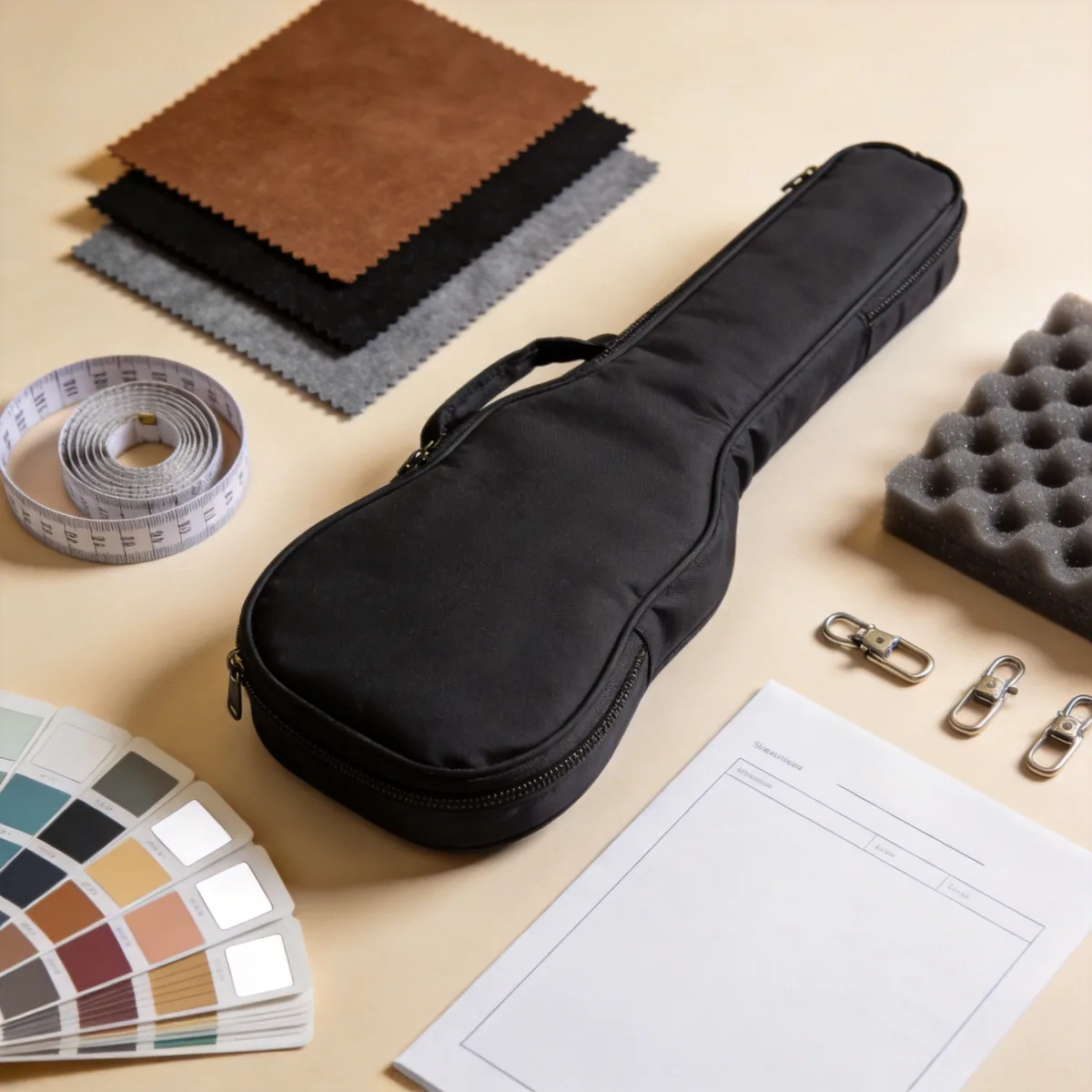
Pitfall 1: Dimensions Sent Incomplete
“It needs to fit a dreadnought” is not a specification, and neither is “standard electric”. Two guitars with the same nominal body style can differ by 15 mm in lower-bout width and 30 mm in overall length once the headstock and strap button are included. When only a model name arrives, we pattern from our own library and the sample arrives either loose or tight, and the buyer reads that as a quality problem when it is a data problem.
Send five numbers and the pattern is unambiguous: overall length from tail to headstock tip, lower-bout width, upper-bout width at the waist, maximum body depth including any arched top, and headstock width measured across the tuner buttons rather than the wood. Add the neck width at the nut if the bag has a contoured neck channel. If the instrument is one you manufacture, send a physical unit — we pattern directly from it, and that removes the largest single source of retail returns in this category at zero cost.
Pitfall 2: A Pantone Number Instead of a Physical Swatch
A Pantone reference is a starting point, not a colour match. The same Pantone TCX number reads differently on 600D polyester, on 1680D nylon and on PU-coated fabric, because the base fibre, the dye uptake and the surface texture all shift the result. In practice a Pantone-only brief produces a first sample that is 1–2 ΔE away from the buyer’s expectation, which is inside nobody’s tolerance and outside everybody’s patience.
The workable sequence is a lab dip: we dye a small piece of your specified fabric to the Pantone reference, send it to you by courier, and you approve it under the light you actually sell under — daylight, retail spotlight and phone screen all disagree. Once the dip is approved, that dip becomes the standard, and the bulk fabric is matched to the dip rather than to the number. It costs a few days at the front of the project and it prevents the one argument that cannot be settled after the goods are on the water.
Pitfall 3: Label Copy Not Finalised
Labels are printed, not embroidered on demand, and a printed label run has its own lead time and minimum. If the care label, fibre content, country of origin, importer address or barcode is still being edited when the fabric is being cut, the labels arrive after the bags and the order sits in the packing area waiting for a sticker. We have seen a 900-piece order held for eleven days by a care label that changed one word.
Finalise four pieces of copy before sampling, not before packing: the care and fibre content wording, the country of origin line, the importer or responsible-person block if the destination is the EU, and the barcode or retailer label data. Then freeze it. If copy must change afterwards, expect a new label run and a re-labelling operation, both of which are chargeable and neither of which is fast.
Two More That Cost a Week Each
Hardware changed after sampling. Swapping a reverse-coil zipper for a moulded-tooth zipper, or changing a plastic slider for a metal one, changes the needle, the foot, the stitch length and sometimes the panel dimension at the opening. It is not a like-for-like substitution even when the two parts look similar. Decide hardware at the spec sheet stage and treat a later change as a new sample.
Packing specification left until after production. Master carton quantity, carton dimensions, polybag vs non-woven bag, hangtag attachment method and carton marking all affect CBM and therefore freight per unit. A carton that is 4 cm too tall across 300 cartons is a measurable freight cost, and re-packing after the fact costs more than the carton itself. Settle packing when you settle the price.
Step 2 — Quotation and the Specification Lock
A guitar bag quotation is only useful if it can be compared with another quotation line by line. Ours is issued with a material breakdown so the number can be checked rather than trusted: shell fabric and consumption per bag, foam grade and thickness, lining, zipper and hardware, branding method and setup, label and hangtag, polybag and carton, testing and documentation where required, and the unit price at each quantity band.
Five numbers on any quotation deserve a second look, whichever supplier issues it. The MOQ per style and colour, because a low headline MOQ often turns into a per-colour minimum at order confirmation. The sampling fee and whether it is credited against the bulk order. The lead time start point — counted from spec approval, from sample approval, or from deposit, which can differ by three weeks. The packing quantity and carton CBM, which decide your freight. And the validity period, because fabric prices move and a quote with no validity date is not a commitment.
The specification lock is the part buyers underrate. When the quotation is accepted, we issue a dated spec sheet with a revision number covering fabric, colour reference, foam, lining, hardware, dimensions with tolerances, branding placement, label copy, packing and inspection standard. Both sides confirm it. From that point every change is logged as a revision with a date, and every later question — a colour argument, a size argument, a “this is not what we agreed” — is answered by pointing at a revision rather than at a memory. On a 500-piece order this document is worth more than any discount.
- ✓ Internal length: ±10 mm on the stated figure.
- ✓ Internal width at the lower bout: ±8 mm.
- ✓ Foam thickness: ±1 mm on 10–25 mm EPE.
- ✓ Logo placement: ±3 mm from the stated centre point.
- ✓ Colour against the approved lab dip: ΔE ≤ 1.5 under D65.
- ✓ Finished bag weight: ±5% of the approved sample.
Minimum order quantity is 500 pieces per style and colour. Two to four colourways of one style can be combined to reach that quantity at no extra charge, and sizes within one pattern can usually be combined as well; a different body pattern or a different instrument type is a different style and counts separately. Sampling is charged and the fee is credited against the first bulk order. Bulk production is 35–50 days after written sample approval.
Step 3 — Sampling: 6–10 Business Days from Spec Approval
Sampling starts when the spec sheet is confirmed and your artwork is in hand, and it takes 6–10 business days. The clock does not start at the first email; it starts when we have the measurements, the materials and the logo file, which is why an incomplete brief is expensive in calendar terms even when it is free in money terms.
Inside those days the work runs in a fixed order. The pattern is cut from your measurements on the pattern table, not copied from an existing bag, and the foam is cut to the same pattern so the shell and the padding match. The shell panels are cut, the zipper is set into the gusset, the lining is assembled separately and bagged out, the foam is inserted, and the body is closed. Then the hardware is bar-tacked, the branding is applied, and the bag is trimmed, measured and photographed against the spec sheet before it is packed.
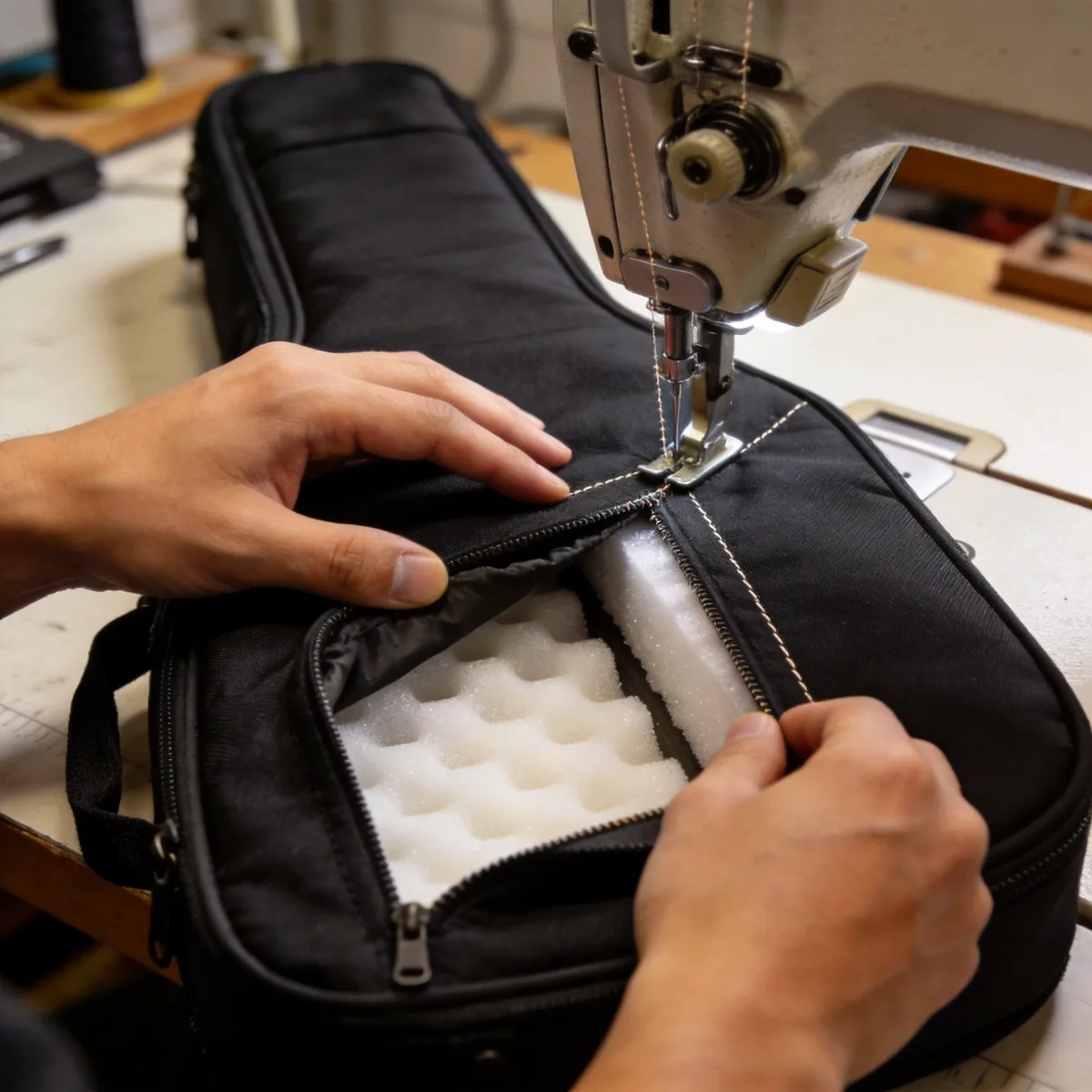
A sample has to prove six things, and it is worth checking all six rather than only the one you care about most. Fit: the instrument goes in and comes out without forcing the zipper, with 2–4 cm of clearance in length. Geometry: the neck rest lands under the neck, not under the body or the headstock. Protection: foam covers the body outline and the headstock end has structure behind it. Hardware: the zipper runs the full length without catching at the curve, and the handle carries the loaded weight. Branding: the logo is where the artwork said, at the size the artwork said. Finish: no skipped stitches, no oil marks, no loose thread, lining bonded flat with no bubbles.
Two revision rounds are normally included in the sampling fee. Each additional round adds 5–7 days. A revision is a change to an approved specification — a different foam thickness, a moved pocket, a different zipper. A new pattern, a different instrument or a different construction is a new development and is quoted as one. Being clear about which of the two you are asking for prevents the most common sampling dispute, which is a buyer expecting a free third round on what is in fact a new style.
Step 4 — Sample Approval: The Sign-Off Standard
Sample approval is the hinge of the whole order. Everything before it is reversible; everything after it is a production commitment. We ask buyers to approve in writing against the checklist below rather than by message, because a written approval is what the in-line check and the final inspection are measured against, and a verbal approval leaves both sides guessing three weeks later.
| Check | Pass Standard | If It Fails |
|---|---|---|
| Instrument fit | Instrument enters and exits without forcing the zipper; 2–4 cm length clearance | Re-cut pattern; new sample round |
| Internal length and width | Within ±10 mm length and ±8 mm width of the spec sheet | Pattern correction before bulk cutting |
| Body depth clearance | Bag closes over the deepest point of the body with foam compressed, not stretched | Increase gusset depth or reduce foam grade |
| Headstock pocket | Pocket 10–20 mm wider than the headstock across the tuner buttons; no contact with a hard surface | Re-size pocket template and end protection |
| Neck rest position | Centre within 5 mm of the measured position, rest supports the neck without lifting the body | Re-position and re-stitch the rest |
| Zipper function | 50 open/close cycles by hand with no catching, no separation and no pulled teeth at the curve | Change zipper type or re-set the curve |
| Handle and anchors | Loaded hang test at 6 kg for 30 minutes: no stitch pull, no rotation beyond 15° | Add bar-tack and PE backing at anchors |
| Logo and label placement | Within ±3 mm of the artwork position; label copy matches the approved text exactly | Re-apply branding on the sample, re-check |
| Colour match | ΔE ≤ 1.5 against the approved lab dip under D65 | New lab dip or dye-lot correction |
| Lining bond | Flat, no bubbles, no lifting at the corners after 24 hours at room temperature | Change adhesive or lamination method |
| Weight | Within ±5% of the approved sample weight | Review foam and hardware grade |
| Packing fit | Bag folds into the stated master carton at the stated quantity without compressing the foam permanently | Adjust carton dimensions before printing marks |
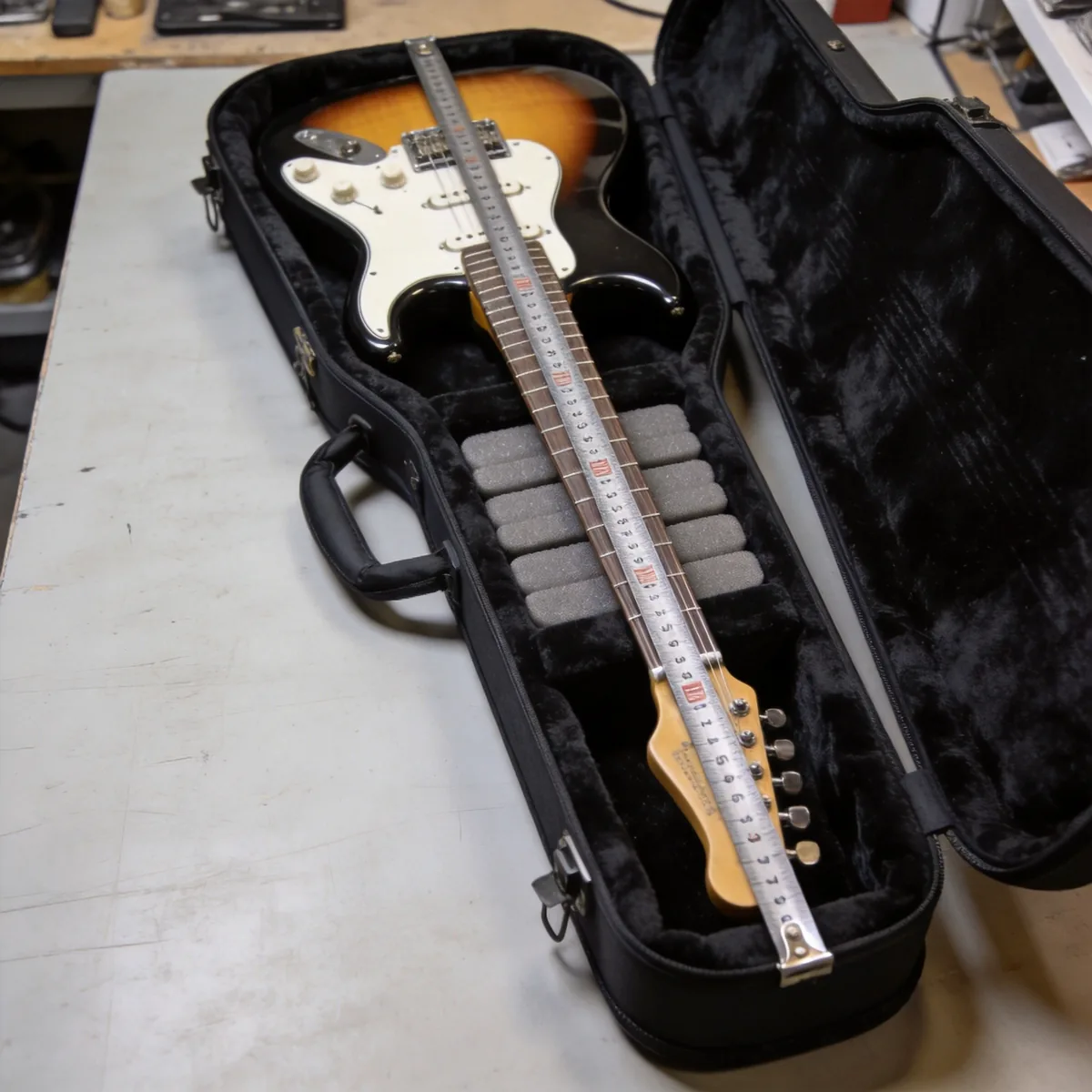
When the sample passes, it becomes the golden sample. We keep one sealed sample at the workshop and you keep one; both are labelled with the spec sheet revision number and the approval date. Production is then checked against that physical object, not against a description of it. If you later need a change, the change is approved in writing, the golden sample is re-sealed with a new revision number, and the in-line check sheet is updated. That discipline is unglamorous and it is the reason a 500-piece order can be repeated a year later without re-developing it.
“Approved with comments” is a legitimate outcome, but only if the comments are sorted into two lists: things that must be fixed before bulk, and things to improve on the next development. A sample approved with an unprioritised list of eleven comments becomes a bulk order with eleven arguments. Sort them, sign the revised spec, and start production.
Step 5 — Bulk Production: 35–50 Days and the In-Line Check
Bulk production runs 35–50 days from written sample approval. The range is real rather than a buffer: a single-colour 600D bag with a woven label sits near 35 days, while a multi-panel bag with plush lining, embroidered logo, rubber patch and individual polybagging runs toward 50. Where the days go matters, because it tells you which delays you can influence.
Material procurement takes 7–12 days: fabric dyed to the approved dip, foam laminated to grade, zippers and hardware pulled against the order, printed labels and hangtags produced. Cutting takes 3–5 days and is done in lays, which is why a colour change after cutting is expensive and a quantity change is not. Sewing takes 12–18 days depending on panel count and pocket layout. Assembly and trimming — hardware setting, bar-tacking, thread cleaning, measurement — takes 5–8 days. Packing takes 3–5 days, and we hold a small buffer rather than promising a date that assumes nothing goes wrong.
The in-line check happens when roughly 20–30% of the order is complete, and it is the most useful inspection of the three. At that point the line is running, the operators are settled into the style, and a systematic error — a pattern piece cut 8 mm short, a logo stamp 5 mm off, a stitch density set too loose — can still be corrected across the remaining 70% without scrapping finished goods. We check internal length and width on the first units off the line, stitch density at 7–9 stitches per inch on load-bearing seams, bar-tack presence at every anchor, zipper function on a running sample, and logo position against the golden sample. Photographs go to the buyer with the measurements.
- ✓ A specification change after cutting. The most expensive delay there is, because cut panels cannot be un-cut. Changes are cheapest before step 3 and ruinous after step 5 starts.
- ✓ A fabric dye lot that does not match the dip. Better to wait 5–7 days for a re-dye than to ship a visible colour break across 500 pieces.
- ✓ The Chinese New Year window. Production stops for two to four weeks around the holiday and the weeks either side are congested. Orders that must land in Q1 are scheduled before December.
- ✓ Labels or hangtags arriving late. Goods finished but unpackable still occupy the floor and still miss the vessel.
- ✓ Deposit arriving after the slot was reserved. A reserved slot is held for a limited period; material buying starts on deposit, not on good intentions.
Material traceability is part of this stage and worth asking about. The whole order should be cut from one dye lot per colour wherever the quantity allows, and the lot reference recorded against the order so a later re-order can be matched. If the fabric falls short, we ask before substituting; a silent substitution is the kind of thing that surfaces as a customer complaint six months later, when the retailer puts two deliveries side by side.
Step 6 — Final Inspection and Shipment: How to Read an AQL 2.5 Report
Final inspection happens when 100% of the order is packed and available for sampling, and it follows AQL 2.5 for major defects and AQL 4.0 for minor defects on ISO 2859-1 single sampling tables at general inspection level II. Critical defects carry zero tolerance. The report is issued with photographs before the carton is sealed, and shipment is booked only after the lot is accepted.
| Lot Size (pcs) | Code Letter | Sample Size | Critical (0 allowed) | Major AQL 2.5 Ac / Re | Minor AQL 4.0 Ac / Re |
|---|---|---|---|---|---|
| 151–280 | G | 32 | 0 / 1 | 2 / 3 | 3 / 4 |
| 281–500 | H | 50 | 0 / 1 | 3 / 4 | 5 / 6 |
| 501–1,200 | J | 80 | 0 / 1 | 5 / 6 | 7 / 8 |
| 1,201–3,200 | K | 125 | 0 / 1 | 7 / 8 | 10 / 11 |
| 3,201–10,000 | L | 200 | 0 / 1 | 10 / 11 | 14 / 15 |
| 10,001–35,000 | M | 315 | 0 / 1 | 14 / 15 | 21 / 22 |
Read the table left to right. Your lot size sets the code letter, the code letter sets the sample size, and the sample size sets the acceptance and rejection numbers. For a 500-piece guitar bag order that means 50 bags inspected: up to 3 major defects is an accept, 4 or more rejects the lot; up to 5 minor defects is an accept, 6 or more rejects. Any single critical defect rejects the lot regardless of the numbers, because Ac 0 means there is no acceptable count.
What counts as what in a guitar bag matters as much as the numbers, so the definitions are written into the spec sheet rather than left to the inspector’s mood. Critical: any exposed sharp hardware inside the cavity, a zipper that separates under load, a strap anchor pulling out of the shell, mould or odour, a bag that will not accept its stated instrument. Major: internal length out by more than 10 mm, a skipped stitch run longer than 25 mm, a logo misplaced by more than 5 mm, a torn lining, a handle attached off-centre, a wrong label or wrong colour against the dip. Minor: loose thread under 25 mm, an oil mark under 5 mm on an inconspicuous panel, a skewed label, a colour deviation inside ΔE 1.5–2.5 on a secondary panel.
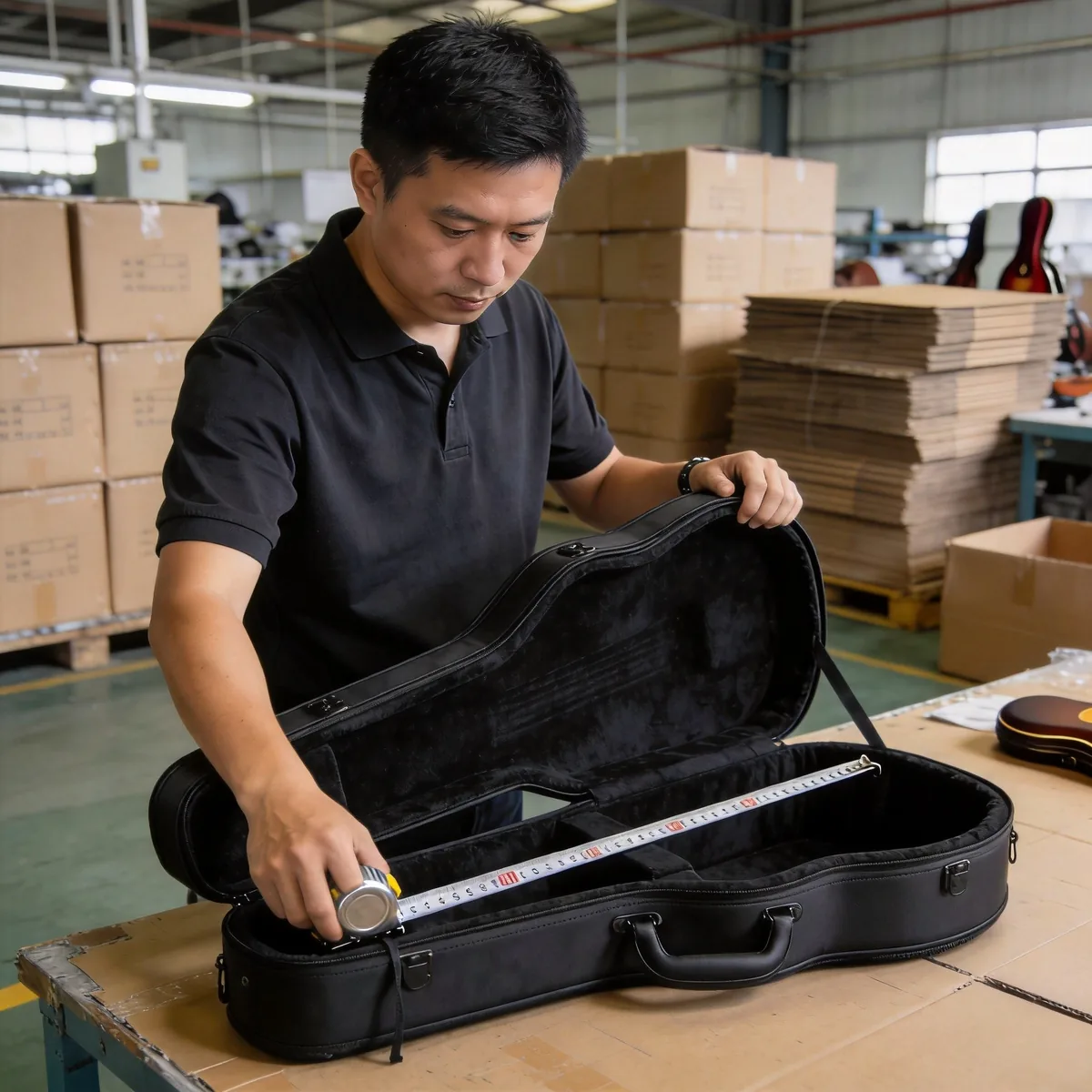
A rejected lot has four possible dispositions, and the report should say which one applies: 100% sorting with defects removed and the lot re-offered, rework and re-inspection, accept with a concession agreed in writing, or rejection and remaking. Anything other than a clean accept should come with a corrective action note naming the cause, not just the symptom. If you use a third-party inspection company, we welcome it — book it at 100% packed and send us the booking date so the goods are staged and accessible, and note that a third-party inspection typically adds 2–3 days to the schedule.
Shipment closes the loop. We quote FOB Fujian ports as standard and can quote CIF or DDP where you need a landed cost. Carton marks, packing list and commercial invoice are prepared to your instruction, the bill of lading and certificate of origin are issued as standard, and the container is loaded with photographs of the loading. Documents are sent as copies on shipment and originals or telex release per the agreed terms. Compliance files for the destination market — substance test reports, and the labelling elements a European importer needs — travel with the shipment rather than being assembled afterwards; the detail is on our REACH compliance page.
Send your instrument measurements, quantity per colour and target market. You will get a specification draft and a written quotation in 2–3 working days, and a physical sample with your branding in 6–10 business days.
Email: [email protected] | WhatsApp / Tel: +86 17750020688
Frequently Asked Questions About the Guitar Bag OEM Process
Q1: How long does the whole guitar bag OEM process take from brief to container?
Q2: What is the minimum order quantity for a custom guitar bag?
Q3: What does a sample cost and is the fee refundable?
Q4: How many revision rounds are included in sampling?
Q5: What exactly should I send in the first email?
Q6: What is AQL 2.5 and do I need a third-party inspection?
Q7: Can I audit the factory before placing an order?
Q8: What causes rework most often?
Q9: Can you hold a production slot, and what delays bulk production?
Q10: Do you handle shipping and documentation?
Related Guitar Bag Pages and Programmes
- Custom Guitar Bag Manufacturer — the category hub: styles, materials, MOQ and quality standard
- Custom Gig Bag Manufacturer — gig bags across bass, keyboard, ukulele and effects boards
- Custom Electric Guitar Bag Manufacturer — Stratocaster, Telecaster and Les Paul patterns
- Custom Acoustic Guitar Bag Manufacturer — dreadnought, jumbo, OM and 000 shapes
- Custom Bass Guitar Bag Manufacturer — 4-, 5- and 6-string bass programmes
- Bag Manufacturer vs Supplier — what changes when you buy direct
- REACH Compliance for Custom Bags — EU documentation explained
- Custom Equipment Bag Manufacturer — protective bags for gear and instruments
- Custom Backpack Manufacturer — daypacks, commuter and laptop bags
- Sports Bags Manufacturer — gym, duffel and training bags
- GPSR Compliance for Custom Bags — EU labelling, responsible person and the technical file
- Private Label Guitar Bag Manufacturer — branding methods, mould costs and retail packaging
- Custom Ukulele Bag Manufacturer — soprano to baritone sizing and mixed-size MOQ
- OEM & ODM Service — full programme scope, sampling workflow and MOQ terms
- Custom Golf Bag Manufacturer — stand bags, cart bags and tour staff bags