
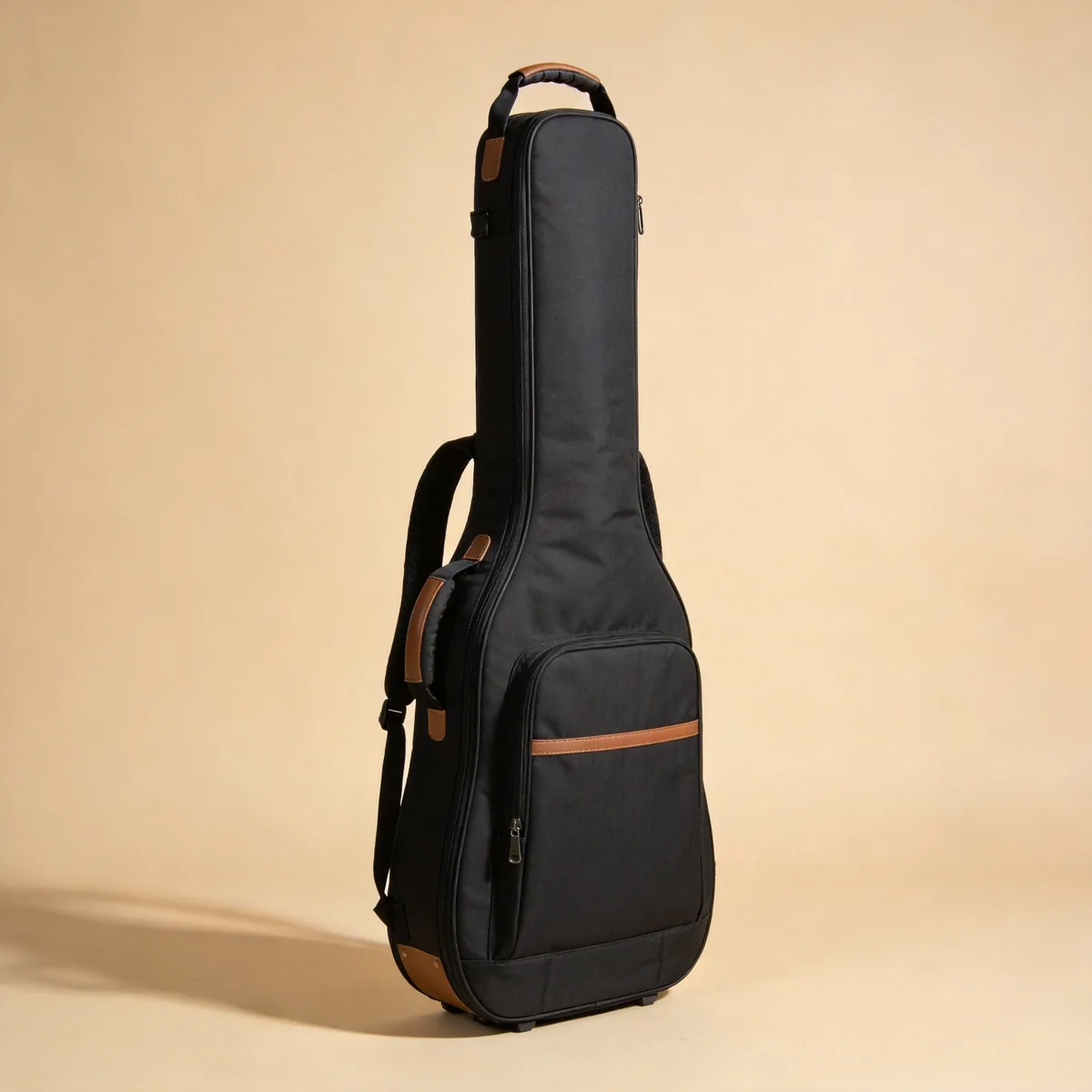
Junyuan Bags is a custom bass guitar bag manufacturer producing OEM and ODM gig bags for 4-, 5- and 6-string electric basses. 118–122 cm internal length for a standard 34-inch scale, a rigid moulded end cap or a double-layer EPE block at the headstock, a long neck rest positioned to the effective scale length, and a widened headstock pocket quoted separately for extended-range instruments. Sampling in 6–10 business days from our affiliated and partner factories in Quanzhou, China.
What Is a Custom Bass Guitar Bag?
A custom bass guitar bag is a padded soft case patterned around one bass instrument family — its real length, its real headstock width and its real balance point — rather than a guitar bag stretched longer. A 34-inch bass measures 116–118 cm from tail to headstock tip against 98–100 cm for a Stratocaster. The extra 18 cm sits entirely in front of the neck, so every load path in the bag changes: the shell sags further from the carry handle, the headstock sits further from the body mass, and a pattern that was adequate at electric-guitar length starts to fold at bass length.
Four groups of buyers come to us for this programme. Bass and extended-range instrument brands that need their own logo, colourway and interior on an accessory currently sourced through a trading company. Distributors who want one 5-string bass guitar bag supplier covering 4-, 5- and 6-string models on a single purchase order. Music shops and education distributors buying in bulk, where identical sizing across a rental fleet matters more than fashion. And OEM buyers who ship the bag in the same carton as the instrument they build, where the bag must fit one exact model with no tolerance for error.
- ✓ Length ahead of the neck. 116–118 cm overall against 98–100 cm. The bag needs 118–122 cm internal length, and the unsupported span between handle and headstock is what decides whether the shell keeps its shape.
- ✓ Headstock mass and tuner count. A 4-in-line bass headstock carries four tuners; a 5-string carries five and is 10–20 mm wider; a 6-string can carry six in a 3+3 layout at 100–110 mm. Tuner buttons protrude beyond the headstock outline and are the first thing to hit the bag end.
- ✓ Wider neck. 38–42 mm at the nut on a 4-string, 45–48 mm on a 5-string, 52–56 mm on a 6-string. The neck relief channel and the neck rest have to match that width, not a guitar’s 42 mm.
- ✓ Weight and balance. A 4-string bass runs 3.8–4.5 kg, a 5-string 4.5–5.2 kg, a 6-string 5.2–6.0 kg, with most of the mass in a body at one end. On one shoulder that produces rotation, not just weight.
- ✓ Headstock-end failure. The single most common claim on a bass bag is a torn or crushed headstock end, because that end carries the lever arm of the longest instrument in the guitar family.
This page covers the bass programme only. For the full range across electric, acoustic, classical, bass, double and ukulele formats, see our custom guitar bag manufacturer hub page. Electric solid-body patterns are on the custom electric guitar bag manufacturer page, and acoustic shapes on the custom acoustic guitar bag manufacturer page.
4-String, 5-String and 6-String Bass: Where the Dimensions Actually Differ
Three bass configurations look similar in a photograph and behave very differently in a bag. The body cavity barely changes — a Jazz Bass body and a 5-string modern bass body are both roughly 33–36 cm across. What changes is the neck width, the headstock width and, on some models, the scale length. Those three numbers drive the pattern, the neck rest and the end protection.
| Configuration | Scale Length | Nut Width | Headstock Width | Typical Instrument Length | Bag Internal Length | Bag Internal Width |
|---|---|---|---|---|---|---|
| 4-string, short scale | 762 mm / 30″ | 38–40 mm | 70–80 mm | 106–110 cm | 108–112 cm | 32–35 cm |
| 4-string, medium scale | 813 mm / 32″ | 38–41 mm | 72–82 mm | 111–115 cm | 113–117 cm | 33–36 cm |
| 4-string, long scale | 864 mm / 34″ | 38–42 mm | 75–85 mm | 116–118 cm | 118–122 cm | 34–36 cm |
| 5-string, 34″ | 864 mm / 34″ | 45–48 mm | 88–96 mm | 116–119 cm | 119–123 cm | 35–37 cm |
| 5-string, 35″ | 889 mm / 35″ | 45–48 mm | 88–98 mm | 120–123 cm | 121–125 cm | 35–37 cm |
| 6-string, 34–35″ | 864–889 mm | 52–56 mm | 100–110 mm | 120–124 cm | 123–127 cm | 36–39 cm |
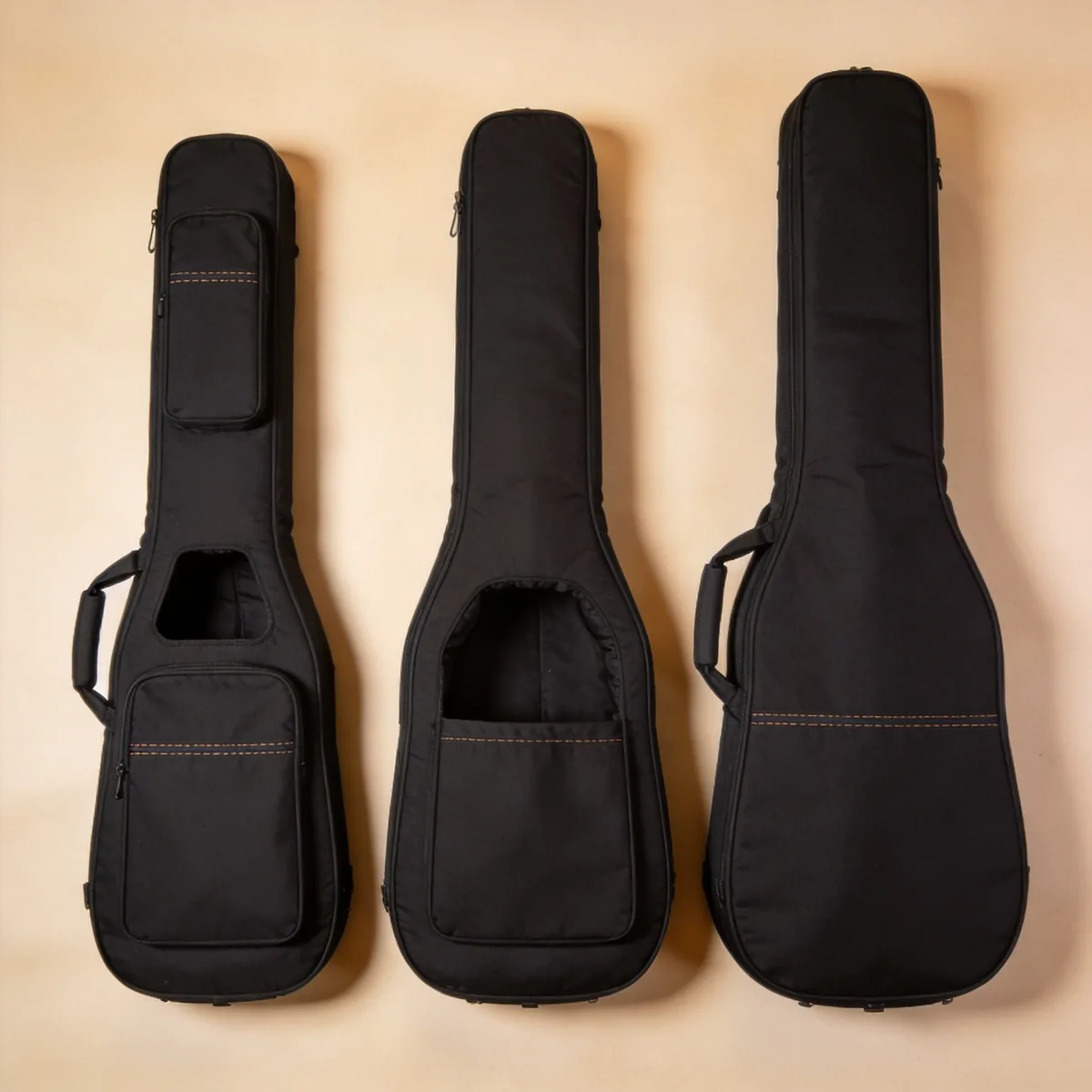
The number buyers most often get wrong is headstock width. A 4-in-line 4-string headstock measures 75–85 mm across including the tuner buttons. A 5-string inline headstock measures 88–96 mm. A 6-string in a 3+3 layout can reach 110 mm, and because the buttons protrude on both sides the pocket has to be wider than the headstock itself. If a buyer orders “the 5-string version of our 4-string bag” without re-measuring, the sample arrives with tuners pressed into the end wall and the bag reads as a quality failure when it is a specification failure.
Internal Length 118–122 cm: Why Bass Bags Fail at the Headstock End
Internal length is measured from the inside of the tail panel to the inside of the headstock-end wall, along the centre line, with the bag lying flat and unloaded. For a standard 34-inch bass we build to 118–122 cm. The instrument itself is 116–118 cm, which leaves 2–4 cm of clearance — enough to get the instrument in and out without forcing the zipper, and not so much that it slides 6 cm fore and aft in transit. Clearance below 2 cm means the buyer fights the bag on every use; clearance above 5 cm means the instrument shifts and the headstock takes impacts it should never see.
| Scale Length | Instrument Length (tail to headstock tip) | Bag Internal Length | Neck Rest Centre, from Bag Tail | Typical Models |
|---|---|---|---|---|
| 30″ short scale | 106–110 cm | 108–112 cm | 62–68 cm | Short-scale and student basses, Mustang-style |
| 32″ medium scale | 111–115 cm | 113–117 cm | 66–72 cm | Medium-scale vintage reissues |
| 34″ long scale | 116–118 cm | 118–122 cm | 69–76 cm | Jazz Bass, Precision Bass, most modern 4-string |
| 35″ long scale | 120–123 cm | 121–125 cm | 72–79 cm | 35-inch 5-string, low-B extended models |
| 36″ long scale | 124–127 cm | 125–129 cm | 75–82 cm | 36-inch 6-string and fanned-fret multi-scale |
Two structural consequences follow from that length. First, the shell has a longer unsupported span between the carry handle and the headstock end, so the fabric and the foam both have to be specified for a longer lever. A 600D shell with 15 mm foam that works at 100 cm will show a fold at 120 cm after a few months of van use. Second, the headstock end wall takes the load of the whole instrument whenever the bag is stood on its base or leaned against a wall. That is why the end of a bass bag is built as a structural element, not a seam.
Headstock Protection: Rigid End Cap or Double-Layer EPE Block
We build two headstock-end constructions, and the choice is a real trade-off rather than an upsell.
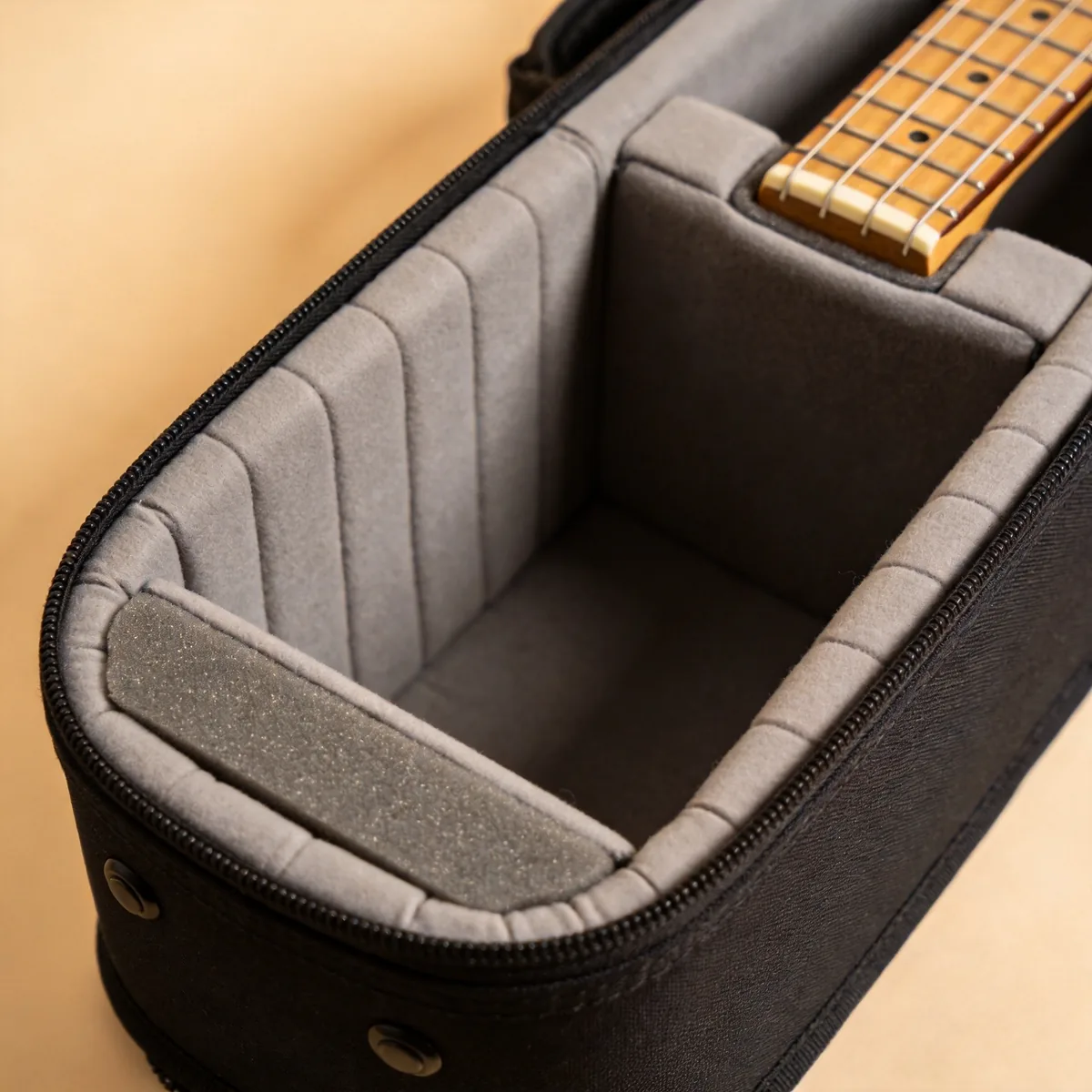
Rigid end cap. A moulded PE or PP cap, 2.0–2.5 mm wall, sewn into the end of the bag and wrapped in lining so no hard edge touches the instrument. It holds the bag’s shape when the bag is stood upright, spreads a knock across the full end wall, and stops the shell folding forward onto the tuners. It adds 60–90 g and a small unit cost. This is the right choice for retail programmes, rental fleets, airline-adjacent travel and any bag that will spend its life being stood on the floor.
Double-layer EPE block. Two 20 mm EPE sheets laminated at 90 degrees to each other, cut to the headstock pocket outline, with a recess for the tuner buttons. It absorbs impact better than a rigid cap and costs less, but it does not hold the shell’s shape — the end still folds under sustained load. This is the right choice for entry price points, for carton-packed OEM bundles where the instrument carton provides the outer protection, and for buyers who need weight down.
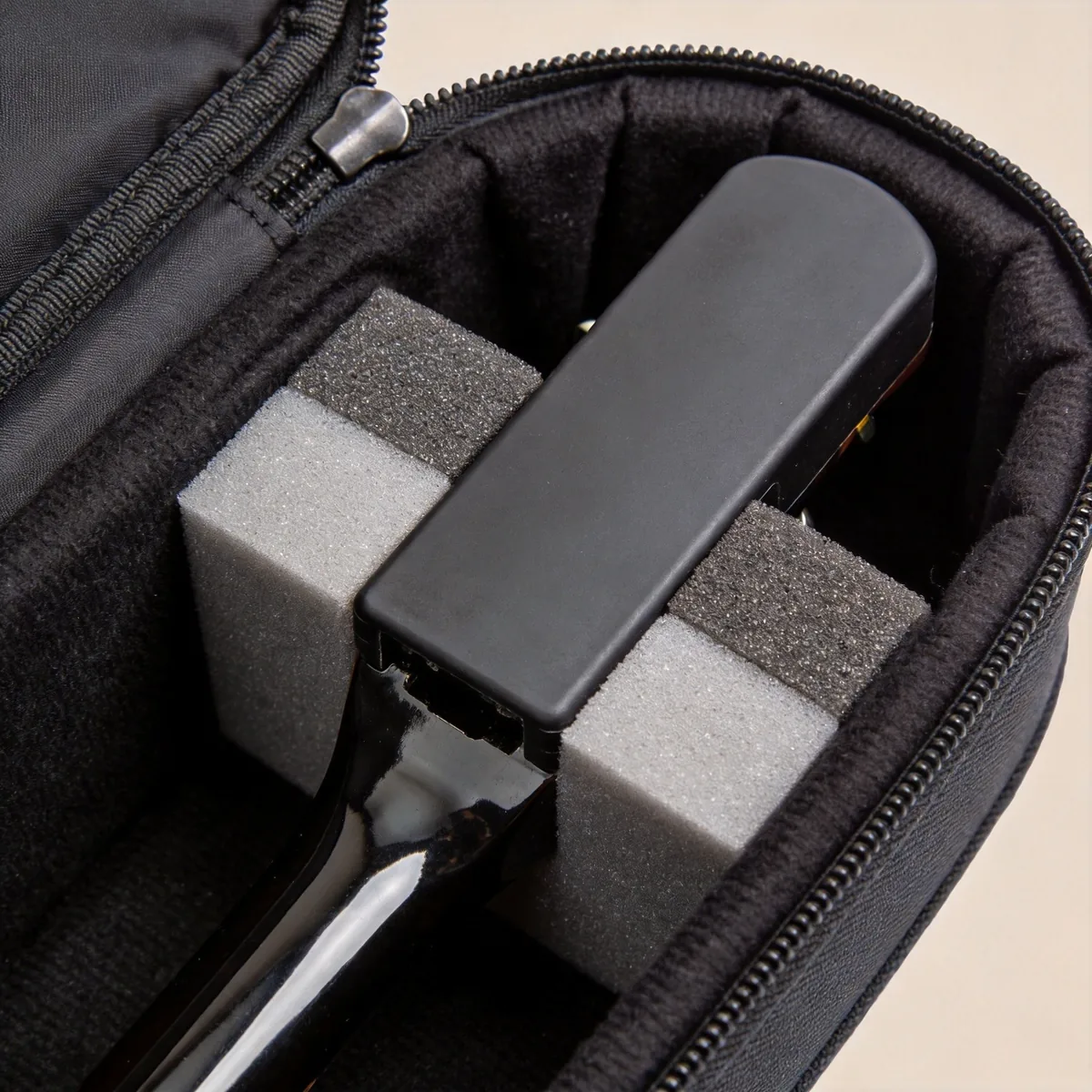
Whichever construction is chosen, three details are non-negotiable in our spec. The tuner recess must be cut to the buyer’s actual headstock, not a generic 80 mm slot. The end wall is bar-tacked at the four corners of the cap, not only stitched around the perimeter, because perimeter stitching alone pulls out under a 6 kg lever. And the lining is wrapped over the cap edge so nothing hard is exposed inside the cavity — an exposed cap edge is a critical defect in our inspection standard, not a minor one.
Neck Rest Positioned to the Effective Scale Length
The neck rest is the raised block under the neck that stops the instrument rocking and takes the neck’s weight off the headstock. On a guitar it is a small component. On a bass it is a long one, and its position is a measurement, not a guess.
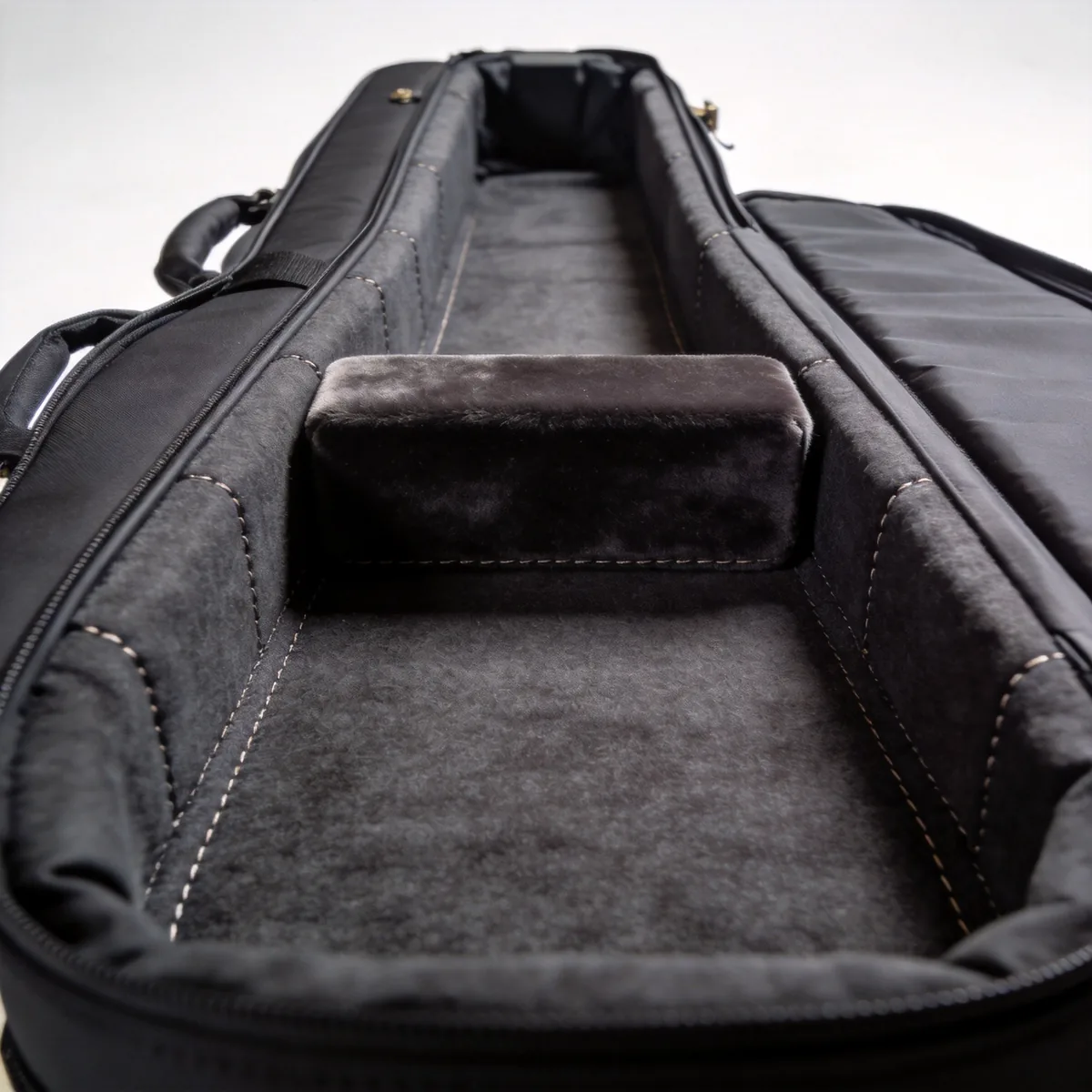
We position the rest centre at 69–76 cm from the bag tail on a standard 34-inch bass, which lands it under the neck at roughly the second to fourth fret — the point where the neck is stiffest and where supporting it does not lift the body off the base. Place it 8 cm further forward and the body becomes a lever; place it 8 cm further back and the neck is unsupported over the longest span in the bag. The rest itself is a velvet-wrapped 25–35 mm foam block, stitched through the lining to the shell rather than glued, because glued rests detach in heat and then migrate inside the cavity.
Effective scale length matters more than the nominal number on the spec sheet. A 35-inch 5-string and a 34-inch 4-string can share a body outline while their necks end in different places, and a 24-fret bass moves the neck pocket toward the bridge, which shifts the neck 10–15 mm relative to a 21-fret instrument of the same scale. Multi-scale and fanned-fret basses add a slanted nut, so the rest has to be positioned for the bass side of the neck, not the centre line. Send us the instrument’s tail-to-nut measurement and we set the rest from that figure; we do not set it from the model name.
Widened Headstock Compartment for 5- and 6-String Basses
A widened headstock compartment is a separate pattern, not a wider seam allowance. The pocket is cut from its own template, the divider wall is repositioned, the end protection is re-sized, and the tuner recess is re-drawn. That is why we quote 5- and 6-string headstock pockets separately from the 4-string base price, and why they count as separate styles against MOQ.
| String Count | Headstock Width (with tuners) | Pocket Internal Width | Pocket Depth | End Construction |
|---|---|---|---|---|
| 4-string, inline | 75–85 mm | 95–105 mm | 55–65 mm | Rigid cap or double EPE, 4-string template |
| 5-string, inline | 88–96 mm | 110–120 mm | 60–70 mm | Rigid cap re-sized, wider tuner recess |
| 5-string, 2+3 layout | 95–105 mm | 118–128 mm | 60–70 mm | Deeper recess on both sides of the headstock |
| 6-string, 3+3 layout | 100–110 mm | 125–138 mm | 65–75 mm | Widest cap, twin recesses, reinforced divider |
The 2+3 and 3+3 layouts are the ones that catch buyers out. An inline 5-string headstock is longer and narrower, so the pocket grows in one direction. A 2+3 headstock is shorter and wider, so the pocket grows sideways and the tuner recess has to be cut on both faces. If your range covers both layouts, treat them as two patterns; a single “5-string pocket” will fit one and crush the other.
Centre of Gravity, Balance and Single-Shoulder Load
A bass is the heaviest instrument in the guitar family and its mass is concentrated at one end. A 5-string at 4.8 kg with the body at the bottom of the bag produces a rotating load on a single shoulder: the strap point sits above the body, the bag pivots around it, and the headstock end swings outward with every step. That is a design problem, not a carrying-technique problem, and it is solved with four decisions.
Strap anchor position. The upper strap anchors are set 8–12 cm below the top of the bag, at the point where the loaded bag balances. Anchors placed at the very top make the bag hang like a sack; anchors placed at the balance point let it hang close to the spine.
Anchor reinforcement. Every anchor is a box-X stitch through a 40 mm webbing tab backed by a PE board, because a single-line stitch through 600D fails at 5 kg dynamic load. A strap anchor pulling out is a critical defect in our standard.
Load distribution. A sternum strap and a removable 38 mm waist belt transfer part of the load to the hips. On 6-string and 35-inch programmes we recommend both as standard, not optional. Shoulder straps are 25–38 mm webbing with 8–12 mm foam, and the adjustment range has to be long enough for a 120 cm bag to sit at hip height on a 170 cm carrier.
Handle and base. The top handle carries the full 5–6 kg whenever the bag is lifted, so it is bar-tacked at both ends and backed with a PE stiffener. The base panel is a wear part: 1680D, or a TPU abrasion patch, because bass bags are stood on the floor far more often than guitar bags. Our own hang test loads a finished bag with a 6 kg dummy and checks rotation, anchor stitch integrity and base-panel distortion before a pattern is approved.
OEM Options, MOQ, Sampling and Production Timeline
The bass programme uses the same material library as our other bag lines, so a buyer can align a bass bag with an existing guitar bag range without a new development cycle. Shell fabrics are 600D polyester as standard, with 1680D, ripstop nylon, waxed canvas and TPU-coated options. Padding is 15 mm, 20 mm or 25 mm EPE, with a 5 mm PE board behind the body area on premium builds. Linings are PU-backed 210D taffeta, brushed tricot or short-pile plush. Zippers are reverse-coil nylon or moulded-tooth, with locking sliders on request. Branding is embroidery, woven label, rubber or PVC patch, metal plate or heat transfer, positioned to your artwork.
Minimum order quantity is 500 pieces per style and colour. Sizes within one pattern can usually be combined, and two to four colourways of one style can be combined at no extra charge; a different string count is a different pattern and counts as a separate style. Sampling takes 6–10 business days from approval of the spec sheet and receipt of artwork, and the sample is charged with the cost credited against the first bulk order. Bulk production takes 35–50 days after written sample approval.
| Stage | What Happens | Lead Time |
|---|---|---|
| Brief and spec sheet | Instrument measurements, string count, materials, branding, target price | 1–2 working days to confirm |
| Quotation | Written quote with material breakdown and MOQ per style | 2–3 working days |
| Sampling | Pattern built, physical sample with your logo | 6–10 business days |
| Sample approval | Fit check with the instrument, comments consolidated | Buyer-controlled |
| Bulk production | Cutting, sewing, assembly, packing | 35–50 days |
| Inspection | AQL 2.5 major / 4.0 minor, photo report issued | 2–3 days |
| Booking and shipping | Carton marks, documents, forwarder handover | 3–5 days |
Inspection follows AQL 2.5 for major defects and AQL 4.0 for minor defects on ISO 2859-1 sampling tables. Critical defects carry zero tolerance and reject the lot: exposed hardware inside the cavity, a zipper that separates under load, a strap anchor pulling out, a headstock cap edge left uncovered, a neck rest detached from the shell. Every inspection is documented with a photo report covering sampled units, measurements and defects, issued before shipment.
Send us your instrument’s tail-to-headstock length, headstock width with tuners, string count and target price. Written quotation within 2–3 working days, physical sample with your logo in 6–10 business days.
Email: [email protected] | WhatsApp / Tel: +86 17750020688
Frequently Asked Questions About Custom Bass Guitar Bags
Q1: What is the MOQ for a custom bass guitar bag?
Q2: What internal length does a bass guitar bag need?
Q3: Can one bag fit both 4-string and 5-string basses?
Q4: Rigid end cap or double-layer EPE at the headstock?
Q5: Where exactly is the neck rest positioned?
Q6: Do you charge extra for 5-string and 6-string headstock pockets?
Q7: How do you stop a heavy bass from rotating on one shoulder?
Q8: What padding and shell do you recommend for a bass bag?
Q9: How long do sampling and bulk production take?
Q10: What quality standard do you inspect to?
Related Bag Programs From Junyuan Bags
- Custom Guitar Bag Manufacturer — full range: electric, acoustic, bass, classical, double
- Custom Electric Guitar Bag Manufacturer — Stratocaster, Telecaster, Les Paul patterns
- Custom Acoustic Guitar Bag Manufacturer — dreadnought, jumbo, OM and 000 shapes
- Custom Gig Bag Manufacturer — padded gig bags for all instrument types
- Guitar Bag Collection — browse our guitar bag range
- Custom Equipment Bag Manufacturer — protective bags for gear and instruments
- Custom Waterproof Bag Manufacturer — waterproof bags and packs
- Sports Bags Manufacturer — gym, duffel and training bags
- Custom Backpack Manufacturer — daypacks, commuter and laptop bags
- Bag Manufacturer vs Supplier — what actually changes when you buy direct
- REACH Compliance for Custom Bags — EU documentation explained
- Guitar Bag OEM Process — artwork to delivery in six steps, with the real lead times
- GPSR Compliance for Custom Bags — EU labelling, responsible person and the technical file
- Private Label Guitar Bag Manufacturer — branding methods, mould costs and retail packaging
- Custom Ukulele Bag Manufacturer — soprano to baritone sizing and mixed-size MOQ
- OEM & ODM Service — how a development programme runs from brief to shipment
- Custom Golf Bag Manufacturer — golf bag programmes with logo and private label