
If you are sourcing sports backpacks for your brand, you already know this is no ordinary product category. A sports backpack must survive being slammed into locker rooms, dragged across gym floors, hauled through rain on morning runs, and stuffed with sweaty gear day after day. At the same time, it needs to look sharp enough for your customers to carry to the coffee shop afterward.
That dual demand—rugged function plus lifestyle aesthetics—is exactly what makes sports backpack manufacturing one of the most technically challenging and commercially rewarding segments in the bag industry. In this complete B2B guide, we break down every element that goes into producing a high-performance custom sports backpack: market segmentation, product categories, harness engineering, compartment design, material science, manufacturing workflows, quality control, branding, cost structures, and lead times.
Whether you are launching a basketball bag line, expanding your fitness accessories catalog, or building an entire athletic brand from scratch, this guide gives you the technical depth and sourcing intelligence you need—backed by 22 years of factory expertise at JUNYUAN, a Quanzhou-based manufacturer producing 1.5 million+ pieces annually across 30,000 sqm of production space.
1. The Sports Backpack Market: Segments & Opportunities
The global sports bag market was valued at over USD 12 billion in 2025 and is projected to grow at a CAGR of 5.8% through 2030. Within this market, the sports backpack segment is the fastest-growing sub-category, driven by the convergence of athleisure fashion, fitness culture, and the practical need for purpose-built carry solutions. But “sports backpack” is not a single product—it is a family of products, each with distinct design requirements, target users, and price points.
Market Segmentation by Sport
Understanding the segmentation is the first step in building a profitable product line. Here is how the major sports backpack categories break down:
| Segment | Key Users | Avg. Retail Price (USD) | Typical MOQ | Growth Trend |
|---|---|---|---|---|
| Basketball Backpack | Student athletes, AAU teams, recreational players | $35–$80 | 500 pcs | ★★★★☆ |
| Gym/Fitness Backpack | Gym-goers, CrossFit enthusiasts, personal trainers | $40–$120 | 500 pcs | ★★★★★ |
| Running/Hiking Daypack | Trail runners, hikers, outdoor fitness enthusiasts | $50–$150 | 500 pcs | ★★★★★ |
| Tennis/Racquet Sport Bag | Tennis players, badminton clubs, squash players | $45–$100 | 500 pcs | ★★★☆☆ |
| Swimming/Water Sports Bag | Swimmers, surfers, triathletes | $30–$70 | 500 pcs | ★★★☆☆ |
| Multi-Sport Training Bag | General athletes, PE students, weekend warriors | $25–$60 | 500 pcs | ★★★★☆ |
Brand Landscape and OEM Opportunity
The sports backpack market features a tiered brand structure. At the top, Nike, Adidas, Under Armour, and The North Face dominate with massive marketing budgets. In the mid-tier, brands like Hayfield, Bange, and CATERWT carve out niches through specialized designs. At the entry tier, white-label and Amazon-native brands compete on price.
For B2B buyers, the real opportunity lies in the mid-to-premium tier. Here is why:
- Higher margins: A well-designed gym backpack with premium materials can retail at 5–8x the FOB cost
- Lower competition: Unlike basic drawstring bags, technical sports backpacks require genuine manufacturing expertise
- Brand loyalty: Athletes who find a bag that works stick with it—and recommend it to teammates
- Customization demand: Teams, clubs, and fitness chains want branded gear, creating natural OEM/ODM demand
If you are exploring the broader custom bag landscape, our custom bag manufacturer OEM/ODM guide covers how to evaluate factory capabilities across multiple product categories.
2. Sports Backpack Categories: Choosing Your Product Line
Every successful sports backpack line starts with choosing the right product categories. Each category has unique design DNA, functional requirements, and target price points. Let us walk through the six core categories you should consider.
Basketball Backpack
The basketball backpack is defined by one non-negotiable feature: a large external or dedicated ball compartment. This is typically a mesh or zippered pocket sized to hold a regulation-size basketball (29.5″ circumference / 75 cm). Beyond the ball compartment, key design elements include:
- Capacity: 30–45 liters to accommodate shoes, uniform, towel, water bottle, and the ball
- Reinforced base: The bag must support 10–15 kg of gear without sagging
- Ventilated shoe compartment: Separate bottom compartment with mesh panels for airflow
- Padded laptop sleeve: Increasingly expected for student-athletes (fits 15.6″ laptop)
Typical dimensions: 50 × 32 × 20 cm. Material: 600D polyester or 420D nylon with PU coating.

Gym/Fitness Backpack
The gym backpack has evolved from a simple gear carrier into a lifestyle product. Modern gym-goers want a bag that transitions seamlessly from the weight room to the office. Key design features include:
- Separate shoe compartment: Ventilated, typically at the base, fits size 12+ athletic shoes
- Wet/dry separation: Waterproof-lined pocket for sweaty clothes, towels, or swimwear
- Laptop/tablet compartment: Padded sleeve for 13″–15.6″ devices (the “gym-to-office” crowd demands this)
- Quick-access top pocket: For phone, keys, wallet, gym membership card
- Odor-resistant lining: Silver-ion or antimicrobial treatment is a strong selling point
Typical dimensions: 48 × 30 × 18 cm. Capacity: 25–35 liters. This is where partnering with an experienced backpack manufacturer pays dividends—the compartment engineering requires precision pattern-making.

Running/Hiking Daypack
Running and hiking daypacks prioritize weight reduction and ergonomic fit above all else. These bags must stay stable during dynamic movement—bouncing is unacceptable. Critical design elements include:
- Hydration bladder compartment: Dedicated sleeve with hose port, compatible with 1.5L–3L bladders
- Chest strap with sternum buckle: Essential for load stability during running
- Bounce-free harness system: Contoured shoulder straps with load-lifter adjustments
- Reflective elements: 3M reflective strips or piping for low-light visibility
- Lightweight shell fabric: 210D ripstop nylon or ultra-light 70D fabric
Typical dimensions: 45 × 25 × 15 cm. Capacity: 10–20 liters. Weight target: under 600g empty.

Tennis/Racquet Sport Bag
Tennis and racquet sport backpacks center around the thermal-molded racquet compartment. This insulated pocket protects frames from temperature damage and prevents string tension loss. Design specifics include:
- Thermal racquet pocket: Holds 2–4 racquets, lined with PE foam or thermal foil
- Accessory organization: Mesh pockets for balls, grip tape, wristbands, sunscreen
- Convertible carry: Padded handles plus backpack straps for dual carry modes
- Structured base: Molded EVA bottom panel to prevent tipping when set down
Typical dimensions: 52 × 32 × 22 cm. Capacity: 25–35 liters. For brands exploring racquet bags alongside backpacks, our ultimate guide to custom sports bag manufacturing covers the full spectrum of sports bag types.
Swimming/Water Sports Bag
Swimming bags live in a wet environment by design. The core engineering challenge is waterproof compartmentalization—keeping wet items contained without letting moisture damage electronics or dry clothes. Key features:
- TPU-welded waterproof pocket: For wet swimwear, goggles, and caps
- Drainage grommets: Small holes at the base of wet compartments for ventilation
- Fleece-lined top pocket: For phone and valuables—must stay completely dry
- Chlorine-resistant materials: Fabric and webbing must resist degradation from pool chemicals
Typical dimensions: 45 × 28 × 20 cm. Capacity: 20–30 liters.
Multi-Sport Training Bag
The multi-sport training bag is the versatile workhorse of the category. It serves PE students, general fitness enthusiasts, weekend athletes, and anyone who needs a solid all-purpose sports carry solution. Design priorities include:
- Simple, clean construction: Fewer specialized compartments, more open space
- Durable materials: 600D polyester is the standard for cost-effective durability
- Comfortable carry: Padded straps, breathable back panel, optional chest strap
- Price accessibility: Target FOB $5–$12 to enable competitive retail pricing
For brands considering duffel-style alternatives alongside backpacks, our custom duffel bag manufacturing guide provides detailed comparisons and production guidelines.

3. Harness & Back Panel Systems: The Comfort Engineering
The harness and back panel system is the single most important comfort determinant in any sports backpack—and it is where amateur manufacturers cut corners and where premium brands invest engineering resources. A poorly designed harness system will generate complaints and returns regardless of how good the rest of the bag looks.
Shoulder Strap Design
There are three primary shoulder strap configurations in sports backpack manufacturing:
| Strap Type | Description | Best For | Cost Impact |
|---|---|---|---|
| S-Curve Contoured | Ergonomic S-shape that follows the natural curve of the shoulder | Running, hiking, premium gym bags | +15–25% vs. straight strap |
| Straight Padded | Rectangular strap with uniform padding, simplest construction | Entry-level, multi-sport, basketball bags | Baseline cost |
| Wide Air-Mesh | Extra-wide strap (7–8 cm) with air-mesh face and EVA core | Heavy-load carry, hiking daypacks | +20–35% vs. straight strap |
At JUNYUAN, our standard strap construction uses die-cut EVA foam (density 40–60 kg/m³) wrapped in breathable air mesh fabric. For premium lines, we offer memory foam straps with temperature-adaptive comfort—ideal for running and fitness backpacks where strap pressure points are a common complaint.
Back Panel Systems
The back panel is where engineering meets user experience. Sports backpacks generate significant sweat during use, making ventilation a critical design factor. Here are the three back panel technologies we deploy:
- Air Channel Foam: CNC-grooved EVA foam creates channels for air circulation between the back panel and the user’s back. Cost-effective and widely used in gym and basketball backpacks. Typical groove depth: 5–8 mm, groove spacing: 15–20 mm.
- Suspended Mesh Panel: A tensioned mesh screen stretched over a frame, creating a physical air gap between the pack and the back. This is the gold standard for ventilation, used in premium running and hiking daypacks. The mesh is typically 3D spacer fabric with 2–3 mm airflow gap.
- 3D Honeycomb Foam: A molded foam panel with a honeycomb surface pattern that provides both cushioning and airflow. More cost-effective than suspended mesh while offering good ventilation. Commonly used in mid-range fitness and training backpacks.

Chest Strap & Waist Belt Configuration
Not every sports backpack needs a chest strap or waist belt, but knowing when to include them is important:
- Chest strap: Essential for running daypacks and any bag intended for dynamic movement. A simple elastic sternum strap with adjustable sliding buckle adds $0.30–$0.60 to FOB cost and dramatically improves load stability.
- Waist belt: Used in hiking daypacks (15L+) and heavy-load carry bags. Can be removable (zip-off) for versatile use. Adds $0.80–$1.50 to cost.
- Whistle buckle: A small but popular detail—integrating a survival whistle into the sternum strap buckle. Costs $0.10 extra but adds perceived value, especially for outdoor sports and youth markets.
Sport-Specific Harness Requirements
| Sport Type | Strap Style | Back Panel | Chest Strap | Priority |
|---|---|---|---|---|
| Basketball | Straight padded | Air channel foam | Optional | Durability + Load capacity |
| Gym/Fitness | Wide air-mesh | 3D honeycomb | Optional | Comfort + Ventilation |
| Running | S-curve contoured | Suspended mesh | Required | Stability + Weight reduction |
| Tennis | Wide padded | Air channel foam | Optional | Structured support |
| Swimming | Straight padded | Quick-dry mesh | Not needed | Water resistance |
| Multi-Sport | Wide air-mesh | 3D honeycomb | Optional | Versatility + Cost |
Understanding these harness differences is key to positioning your product line correctly. For brands also exploring specialized bags like tool backpacks, our tool backpack OEM manufacturing guide covers how harness requirements differ across professional use cases.
4. Compartment Design & Functional Layout
Compartment design is where a sports backpack earns its value proposition. Unlike a basic school backpack, a sports backpack must organize a complex set of gear—shoes, wet clothes, electronics, water bottles, sport-specific equipment—while keeping everything accessible. Getting the layout right is a competitive advantage.
Main Compartment Opening Styles
There are three dominant opening styles for the main compartment, each with trade-offs:
| Opening Style | Construction | Advantages | Disadvantages | Best For |
|---|---|---|---|---|
| Top Loading | Single zipper at the top, drawcord optional | Simplest construction, lowest cost, best water resistance | Hard to access items at the bottom | Running daypacks, hiking bags |
| Front Panel | Zippered panel on the front face, opens flat | Full visibility of contents, easy packing | More seams = more potential leak points | Gym bags, basketball bags |
| Clamshell / U-Zip | U-shaped zipper opening 180° or 3/4 | Maximum access, luggage-style packing | Highest zipper cost, structural weakness if overpacked | Premium gym/travel sport bags |
Specialized Compartments
Beyond the main compartment, sports backpacks require purpose-built pockets for specific gear:
- Shoe compartment: Typically a separate bottom compartment with its own zipper entry. Interior lined with TPU or PEVA for easy cleaning. Ventilation grommets or mesh panels prevent odor buildup. Standard size: 35 × 15 × 12 cm (fits up to men’s size 13).
- Wet/dry separation bag: An internal waterproof pouch, usually TPU-welded seams, sized for a full set of wet workout clothes. Often positioned against the back panel to keep moisture away from the laptop sleeve. Common size: 30 × 25 cm.
- Laptop/tablet sleeve: Padded with 5–8 mm EPE foam, suspended above the base to protect against drops. Fits 13″–15.6″ devices. Increasingly standard even in sports-specific bags.
- Water bottle side pockets: Stretch mesh or elasticated nylon pockets on both sides. Must accommodate 750 ml–1L bottles. For running bags, these are often hip-belt pockets instead.
- Valuables pocket: Small fleece-lined or soft-touch pocket at the top of the bag for phone, sunglasses, keys. Often lined with microfiber to prevent scratches.
External Attachment Systems
For outdoor and adventure-oriented sports backpacks, external attachment capability adds significant utility:
- MOLLE webbing: Modular attachment grid for clip-on accessories. Popular in tactical-style sports bags and hiking daypacks. Adds $0.50–$1.20 to cost depending on coverage area.
- Elastic bungee cord: Surface bungee with cord locks for stuffing a jacket, yoga mat, or foam roller. Cost: $0.20–$0.50.
- Compression straps: Side compression straps stabilize load and reduce bounce. Essential for running daypacks. Cost: $0.30–$0.80 per pair.
- Ice axe / trekking pole loops: Reinforced attachment points at the base and upper shoulder area. Used in hiking-oriented daypacks.
Size Specifications by Sport Type
| Category | Height (cm) | Width (cm) | Depth (cm) | Volume (L) | Weight Target (g) |
|---|---|---|---|---|---|
| Basketball Backpack | 50–55 | 30–34 | 18–22 | 30–45 | 800–1,100 |
| Gym/Fitness Backpack | 45–50 | 28–32 | 16–20 | 25–35 | 600–900 |
| Running Daypack | 42–48 | 22–26 | 12–16 | 10–20 | 350–600 |
| Tennis Backpack | 50–55 | 30–34 | 20–24 | 25–35 | 700–1,000 |
| Swimming Bag | 42–48 | 26–30 | 18–22 | 20–30 | 500–750 |
| Multi-Sport | 45–50 | 28–32 | 16–20 | 25–35 | 500–800 |
These dimensions are guidelines—custom sizing is one of the core advantages of OEM manufacturing. At JUNYUAN, every pattern is custom-drafted to your specifications, and our in-house design team can optimize compartment layouts based on your target user profile.
5. Materials Selection for Sports Backpacks
Material selection directly impacts durability, weight, water resistance, cost, and sustainability credentials. For sports backpacks, the stakes are higher than average because the bags face extreme conditions—sweat, chlorine, mud, UV exposure, and heavy loads.
Nylon vs. Polyester: The Core Shell Fabric Decision
| Property | Nylon (210D) | Nylon (420D) | Nylon (600D) | Nylon (1000D) | Polyester (600D) |
|---|---|---|---|---|---|
| Tensile Strength | Good | Very Good | Excellent | Exceptional | Good |
| Abrasion Resistance | Moderate | Good | Very Good | Excellent | Good |
| Weight (per sqm) | ~70g | ~130g | ~180g | ~280g | ~200g |
| Water Absorption | Higher (~4%) | Higher | Higher | Higher | Lower (~0.4%) |
| UV Resistance | Moderate | Moderate | Good | Good | Excellent |
| FOB Cost Impact | Baseline | +20–30% | +40–60% | +80–120% | -10–15% vs Nylon 600D |
| Best Application | Running daypacks | Gym bags, mid-range | Basketball, multi-sport | Hiking, tactical | Entry-level all-purpose |
Key insight: Polyester 600D is the workhorse of the sports backpack industry—it offers good durability at a competitive price, with superior UV resistance and lower water absorption than nylon. Nylon is preferred for premium lines where hand-feel and drape matter, but it degrades faster under UV exposure.
Waterproofing Technologies
Sports backpacks face moisture from multiple directions—rain, sweat, wet gear, pool splash. Your waterproofing strategy should match the use case:
- DWR (Durable Water Repellent) Coating: A surface treatment that causes water to bead and roll off. Applied to the outer fabric. Effective for light rain and splash protection. Adds $0.15–$0.30 per bag. Re-treatment needed after 20–30 washes.
- TPU (Thermoplastic Polyurethane) Lamination: A membrane bonded to the inner face of the shell fabric. Provides true waterproof barrier (tested to 5,000–10,000 mm hydrostatic head). Essential for swimming bags and premium outdoor daypacks. Adds $0.80–$1.50 per bag.
- Waterproof Zippers (YKK Aquaguard or equivalent): Sealed zippers with waterproof tape. Critical for main compartment protection in rain. Adds $0.50–$2.00 per zipper depending on length and brand. YKK Aquaguard is the industry benchmark.
- Taped Seams: Heat-sealed tape applied to internal stitching lines. Required for fully waterproof bags (swimming bags, hiking rain packs). Adds $1.00–$3.00 per bag in labor and materials.
RPET Recycled Fabric in Sports Backpacks
Sustainability is no longer optional for sports brands. Major retailers now require ESG compliance documentation, and consumers—especially Gen Z athletes—actively seek recycled materials. RPET (Recycled Polyethylene Terephthalate) fabric, made from post-consumer plastic bottles, has become the go-to sustainable option for sports backpack shells.
Key advantages of RPET in sports backpack manufacturing:
- Equivalent durability and hand-feel to virgin polyester 600D
- Each bag can use 15–30 recycled bottles (depending on size), a powerful marketing message
- GRS (Global Recycled Standard) certification available for supply chain verification
- Cost premium: only 10–20% above virgin polyester, shrinking annually as recycling infrastructure scales
At JUNYUAN, we hold GRS certification and produce RPET sports backpacks for multiple European and North American brands. Our RPET recycled backpack manufacturing guide provides a deep dive into certified sustainable production.

Recommended Materials by Sport
| Sport | Shell Fabric | Lining | Waterproofing | Special Requirements |
|---|---|---|---|---|
| Basketball | 600D Polyester | 210T Polyester | DWR coating | Reinforced base panel |
| Gym/Fitness | 420D Nylon or RPET | Antimicrobial treated | TPU wet pocket | Odor-resistant lining |
| Running | 210D Ripstop Nylon | Lightweight mesh | DWR + water-resistant zippers | High-tenacity yarn for low weight |
| Tennis | 600D Polyester | 210T with thermal foil | DWR coating | Thermal racquet pocket lining |
| Swimming | 420D Nylon + TPU laminate | TPU welded | Full waterproof + taped seams | Chlorine-resistant webbing |
| Multi-Sport | 600D Polyester | 210T Polyester | DWR coating | Cost-effective construction |
6. Manufacturing Process & Quality Control
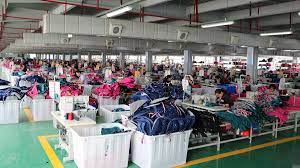
Understanding the manufacturing process helps you communicate effectively with your factory, set realistic timelines, and identify where quality issues can emerge. Here is the complete workflow for sports backpack production at a professional facility like JUNYUAN.
The Complete Manufacturing Workflow
- Step 1 — Design & Pattern Making: Your design brief (sketches, reference samples, or tech pack) is translated into CAD patterns by our design team. For sports backpacks, pattern accuracy is critical because compartment layouts involve complex multi-piece assemblies. Typical pattern set: 15–35 pieces per bag.
- Step 2 — Fabric Cutting: Fabric is laid in stacks (up to 100 layers) and cut using CNC-controlled cutting machines or die-cut presses. For printed fabrics, pattern matching is verified at this stage. Precision: ±1 mm tolerance.
- Step 3 — Printing / Embroidery: Logo application happens before assembly. Options include screen printing, heat transfer, sublimation, embroidery, and rubber/silicone labels. For sports bags, we recommend sublimation printing for all-over patterns (unlimited colors, no hand-feel) and embroidery for premium brand logos.
- Step 4 — Sewing & Assembly: This is the most labor-intensive stage. A typical sports backpack requires 45–90 minutes of sewing time depending on complexity. Our production lines use a cell-based system where each operator specializes in specific operations (e.g., zipper installation, strap attachment, compartment assembly).
- Step 5 — Quality Control: In-line QC at each major assembly stage plus final random inspection (AQL 2.5 standard). Sports backpacks have specific QC checkpoints detailed below.
- Step 6 — Packing & Shipping: Each bag is stuffed with paper for shape retention, poly-bagged, and carton-packed. Standard packing: 1 pc/poly bag, 10–20 pcs/carton. Custom packaging (branded hang tags, UPC labels, retail-ready boxes) is fully supported.
Sports Backpack–Specific QC Checkpoints
Sports backpacks face harsher use conditions than most bag categories, so QC protocols are correspondingly rigorous:
| Test Item | Method | Standard | Frequency |
|---|---|---|---|
| Zipper Durability | Cycle test (open/close) under 5 kg load | 3,000+ cycles for main zipper | Every production run |
| Strap Pull Strength | Static load test on shoulder strap attachment | 30+ kg for 30 seconds, no seam failure | 5 pcs per 500 pcs |
| Bearing Capacity | Load bag to 150% of intended capacity, drop test from 60 cm | No structural failure, no zipper burst | 3 pcs per 500 pcs |
| Waterproof Test | Spray test or hydrostatic head test | No leakage at DWR bags; 5,000+ mm for TPU bags | 5 pcs per 500 pcs |
| Back Panel Comfort | Wear test by QC staff (30 min loaded carry) | No pressure points, adequate ventilation | 2 pcs per 500 pcs |
| Color Fastness | Crocking test (dry and wet) | Grade 4+ (dry), Grade 3+ (wet) | Per color per production |
| Print/Logo Adhesion | Cross-cut tape test | No peeling or flaking | Per design per production |
The JUNYUAN Advantage
With 22 years of backpack and bag manufacturing experience, JUNYUAN operates a 30,000 sqm facility in Quanzhou City, Fujian Province, China, producing over 1.5 million pieces annually. We currently serve 200+ brands across 100+ countries, and our sports backpack lines include some of our highest-volume programs.
Our competitive advantages in sports backpack manufacturing include:
- In-house design team: 15+ designers who can develop concepts from rough sketches to production-ready tech packs
- Dedicated sports bag production lines: Separate lines for technical bags vs. simple constructions, ensuring specialist operators
- Vertically integrated sourcing: Direct relationships with fabric mills, zipper suppliers (YKK, SBS, HHH), and hardware manufacturers
- Compliance certifications: BSCI, ISO 9001, GRS, OEKO-TEX, and customer-specific audit readiness
For brands exploring additional bag categories beyond sports backpacks, our custom tote bag manufacturing guide and custom golf bag manufacturing guide cover adjacent product lines.
7. Branding, Customization & OEM Workflow
Branding transforms a generic sports backpack into your brand’s physical ambassador. The customization options available in modern backpack manufacturing are extensive, and choosing the right combination of branding techniques is essential for brand recognition and perceived value.
Logo Application Methods
| Method | Best For | Cost Range | MOQ Impact | Durability | Visual Quality |
|---|---|---|---|---|---|
| Screen Printing | Large area graphics, simple logos | $0.10–$0.50 | No impact | Good (50+ washes) | ★★★☆☆ |
| Embroidery | Premium brand logos, text | $0.30–$1.50 | +50 pcs | Excellent (permanent) | ★★★★☆ |
| Heat Transfer | Multi-color logos, photographic images | $0.20–$0.80 | No impact | Good (30+ washes) | ★★★★★ |
| Rubber/Silicone Label | Premium 3D logos, outdoor brands | $0.30–$1.00 | +500 pcs (custom mold) | Excellent | ★★★★★ |
| Metal Nameplate | Luxury positioning, limited editions | $0.50–$2.00 | +500 pcs | Permanent | ★★★★★ |
| Woven Label | Interior brand labels, care labels | $0.05–$0.20 | No impact | Permanent | ★★★★☆ |
Full Customization Options
Beyond logo application, virtually every element of a sports backpack can be customized:
- Fabric: Custom color (Pantone matching), custom denier, custom texture, RPET options
- Zippers: Color-matched pulls, branded pull tabs (custom metal or rubber pulls), YKK vs. SBS selection
- Webbing & Straps: Custom woven webbing with brand pattern or text, custom width and padding
- Interior: Custom lining color, branded care labels, custom hang tags, UPC stickers
- Packaging: Custom poly bags with brand printing, retail-ready packaging, foam inserts for premium unboxing
OEM Workflow: From Concept to Delivery
A typical OEM sports backpack project at JUNYUAN follows this timeline:
- Concept Discussion (Day 1–3): Share your ideas, target market, price point, and reference samples. We provide initial feedback on feasibility, material recommendations, and cost estimates.
- 3D Design & Rendering (Day 4–10): Our design team creates detailed 3D renderings showing all angles, colors, and branding placement. Unlimited revisions until you approve the design.
- Pre-Production Sample (Day 11–20): A physical sample is produced for your evaluation. This is made with actual production materials and construction methods. Shipping sample to your location: 5–7 days by express.
- Sample Revision (if needed, Day 21–28): Adjustments based on your feedback. A second sample is produced if changes are significant.
- Production Order (Day 29–73): Upon sample approval, mass production begins. Standard lead time is 30–45 days depending on order quantity and complexity.
- QC & Shipping (Day 74–80): Final inspection, packing, and shipment arrangement. We support FOB, CIF, and DDP terms.

8. Cost Structure, MOQ & Lead Time
Understanding the cost structure of sports backpack manufacturing helps you set realistic retail pricing, identify cost-saving opportunities, and negotiate effectively with your factory.
Cost Breakdown by Component
For a typical mid-range gym backpack (600D polyester, 25L capacity, standard construction), the FOB cost structure breaks down as follows:
| Component | Percentage of FOB | Typical Cost (USD) | Key Variables |
|---|---|---|---|
| Shell Fabric & Lining | 25–30% | $1.50–$3.00 | Fabric type, denier, RPET premium |
| Hardware & Trims | 15–20% | $1.00–$2.00 | Zipper brand, buckle quality, custom pulls |
| Labor (Cutting + Sewing) | 20–25% | $1.50–$2.50 | Complexity, compartment count |
| Padding & Foam | 8–12% | $0.50–$1.20 | Strap type, back panel system |
| Printing / Branding | 5–10% | $0.30–$1.00 | Method, colors, coverage area |
| Packing & Labels | 3–5% | $0.20–$0.50 | Poly bag, hang tags, carton |
| Overhead & Margin | 10–15% | $0.80–$1.50 | Factory efficiency, order volume |
Consolidated view:
| Category | Share |
|---|---|
| Materials (fabric + hardware + foam) | ~40–50% |
| Labor | ~20–25% |
| Branding & Accessories | ~10–15% |
| Packing | ~3–5% |
| Factory Overhead & Margin | ~10–15% |
MOQ Guidelines
| Product Tier | MOQ (per color) | Price Range (FOB) | Typical Lead Time |
|---|---|---|---|
| Entry-Level / Multi-Sport | 500 pcs per color | $4.00–$8.00 | 30 days |
| Mid-Range / Gym & Basketball | 500 pcs per color | $8.00–$15.00 | 35–40 days |
| Premium / Technical Running | 500 pcs per color | $15.00–$25.00+ | 40–45 days |
For first orders, we offer trial order flexibility—reduced MOQs of 500 pcs to help brands test the market before committing to full production runs. Repeat orders of 500+ pcs per color unlock volume pricing with 5–15% cost reductions.
Lead Time Reference
| Stage | Duration | Notes |
|---|---|---|
| Design & 3D Rendering | 7–10 days | Included in development cost |
| Pre-Production Sample | 10–15 days | Sample cost: $50–$150 (refunded on bulk order) |
| Sample Shipping | 5–7 days (express) | DHL/FedEx/UPS |
| Mass Production | 30–45 days | Depends on quantity and complexity |
| QC & Packing | 3–5 days | Included in production timeline |
| Total (from order to ready-to-ship) | ~55–80 days | Includes sampling + production |
Peak season (July–October) can add 7–10 days to production timelines due to higher factory utilization. We recommend placing orders at least 90 days before your target retail launch date to account for sampling, production, and ocean freight.
Frequently Asked Questions
What is the minimum order quantity for custom sports backpacks?
MOQ varies by product tier: 500 pcs per color for entry-level multi-sport bags, 500 pcs for mid-range gym and basketball backpacks, and 500 pcs for premium technical bags. First orders can start at 500 pcs.
How long does it take to manufacture custom sports backpacks?
From design approval to shipment readiness, the total timeline is typically 55–80 days. This includes 10–15 days for sampling, 30–45 days for mass production, and 3–5 days for final QC and packing. Ocean freight adds 15–35 days depending on destination.
What materials are best for sports backpacks?
600D polyester is the most popular choice for its balance of durability, cost, and UV resistance. For premium lines, 420D nylon offers superior hand-feel and strength. For outdoor/running bags, 210D ripstop nylon minimizes weight. For brands focused on sustainability, RPET recycled polyester is an excellent option with minimal cost premium.
Can you make waterproof sports backpacks?
Yes. We offer multiple waterproofing levels: DWR coating for splash resistance (light rain), TPU lamination with waterproof zippers for heavy rain protection, and fully taped-seam construction with welded TPU pockets for swimming and water sports bags. The appropriate solution depends on your target use case and price point.
What branding options are available for sports backpacks?
We offer screen printing, embroidery, heat transfer, custom rubber/silicone labels, metal nameplates, woven labels, and custom zipper pulls. Multiple branding methods can be combined on a single bag for a layered brand identity—e.g., embroidered logo on the front pocket plus a rubber label on the strap.
Do you provide design support for new sports backpack lines?
Absolutely. Our in-house design team of 15+ specialists can develop complete product lines from initial concept. We provide 3D renderings for approval before sampling, and our team has deep experience across basketball, gym, running, tennis, swimming, and multi-sport backpack categories. Design consultation is complimentary for confirmed orders.
What certifications does JUNYUAN hold?
JUNYUAN holds BSCI, ISO 9001, GRS (Global Recycled Standard), and OEKO-TEX Standard 100 certifications. We also pass customer-specific social compliance audits (Sedex, SMETA, Walmart FCCA). All certifications are maintained through regular third-party audits.
What is the cost difference between standard and RPET recycled materials?
The RPET premium is currently 10–20% above virgin polyester, and this gap is narrowing as recycling infrastructure scales globally. For a typical gym backpack, the RPET upgrade adds approximately $0.50–$1.00 to the FOB cost—often a worthwhile investment for the marketing advantage of “made from recycled bottles” positioning.
Start Your Custom Sports Backpack Project
Whether you are launching your first sports backpack line or scaling an existing catalog, JUNYUAN’s 22 years of manufacturing expertise, 1.5 million+ piece annual capacity, and dedicated sports bag production lines make us the ideal manufacturing partner. From design development through mass production, we handle every detail so you can focus on building your brand.
Ready to get started?
- 📧 Email: [email protected]
- 📱 WhatsApp: +86 17750020688
- 🏭 Factory: Quanzhou City, Fujian Province, China
- 📐 Facility: 30,000 sqm | 1,500,000+ pieces/year | 200+ brands served | 100+ export countries
Send us your design concept or reference samples, and receive a detailed quote within 48 hours. We look forward to partnering with you.
Related Guides: Custom Backpack Manufacturer | Custom Bag OEM/ODM | Sports Bag Manufacturing | Duffel Bag Manufacturing | Golf Bag Manufacturing